On January 20, the Trump administration issued an executive order (EO) titled, “Defending Women from Gender Ideology Extremism and Restoring Biological Truth to the Federal Government.” The EO was one of several executive orders and actions published by the Trump administration on its first day in office.
The EO states that the United States government will recognize only two sexes — male and female — and defines sex as “an individual’s immutable biological classification as either male or female.” The definition continues to say that sex is “not a synonym for and does not include the concept of ‘gender identity.’” The executive order also defines “woman” and “girl” and “man” and “boy” to be adult and juvenile human females and males, respectively.
The EO orders the secretary of health and human services to provide guidance expanding on the definitions established in the EO. It also directs all federal agencies to use the definitions set forth in the order “when interpreting or applying statutes, regulations, or guidance and in all other official agency business, documents, and communications.” All federal agencies will also be directed to use the term “sex” and not “gender” when administering or enforcing sex-based distinctions in applicable federal policies and documents.
It also appears that the Trump administration hopes to codify these definitions into law through Congressional action. Specifically, the EO directs the assistant to the president for legislative affairs to provide the president proposed bill text to codify the definitions set in the order within 30 days.
The EO also discusses the Supreme Court’s decision in Bostock v. Clayton County, which held that Title VII of the Civil Rights Act of 1964 protects employees from discrimination on the basis of sexual orientation or gender identity. The EO states that the Biden administration argued that the Bostock decision “requires gender identity-based access to single-sex spaces under, for example, Title IX of the Educational Amendments Act,” which the Trump administration states is “legally untenable.” As such, the EO directs the U.S. attorney general to issue guidance to federal agencies to “correct the misapplication” of Bostock to “sex-based distinctions in agency activities.” The EO also directs the attorney general to issue guidance and assist federal agencies in protecting sex-based distinctions.
The EO directs all federal agencies to submit an update to the Trump administration on implementation of this order within 120 days. The update is required to include information on changes to agency documents and agency-imposed requirements on federally funded entities, including federal contractors, that were implemented to comply with the order. The head of each federal agency is also directed to rescind all guidance documents inconsistent with the requirements of the order, and the EO includes a partial list of documents that the administration deems as inconsistent, including several Department of Education guidance documents on Title IX and the Equal Employment Opportunity Commission’s 2024 Enforcement Guidance on Harassment in the Workplace.
Finally, the EO directs agencies to take “all necessary steps, as permitted by law, to end the federal funding of gender ideology” and to “assess grant conditions and grantee preferences” to “ensure grant funds do not promote gender ideology.”
Federal agencies will soon begin to take action and announce guidance to comply with the EO requirements. Institutions should therefore be aware of forthcoming guidance from the Department of Education on Title IX as a result of this EO. There could also be future ramifications for institutions that receive federal funds, including grants and contracts. CUPA-HR will continue to monitor for agency actions as well as any additional updates from the Trump administration as it relates to sex and gender-related policy.
On January 9, a federal judge in the Eastern District of Kentucky Court vacated the Biden administration’s Title IX regulations. The order strikes down the regulations nationwide, reverting enforcement back to the 2019 Title IX regulations set by the Trump administration.
Background
The Biden administration’s Title IX final rule was released in April 2024 and was set to take effect on August 1, 2024. Soon after the rule was published, several states filed legal challenges against it, resulting in preliminary injunctions that blocked the rule from taking effect in 26 states and hundreds of schools in other states that did not challenge the regulations.
The Biden administration appealed the preliminary injunctions to the Supreme Court, requesting that the court limit the scope of the preliminary injunctions placed by the lower courts to block only those provisions that related to gender identity. They argued that the lower courts’ decisions to grant the preliminary injunctions were based on concerns with the expanded protections for transgender students and that other provisions like the new grievance procedures and training requirements set forth by the final rule should be able to take effect. The Supreme Court ultimately rejected the Biden administration’s request, arguing that the gender identity provisions were “intertwined with and affect other provisions of the rule.”
District Court Judge’s Ruling
In the ruling that vacates the rule nationwide, the federal judge stated that the Biden administration’s Title IX rule is unlawful because Title IX’s prohibition on sex discrimination does not include the scope laid out in the regulations, which include expanded protections for pregnancy or related conditions, gender identity and sexual orientation. The order also states that the rule violates the First Amendment and that it is “arbitrary and capricious.”
Looking Ahead
The judge’s order almost certainly ends any hopes for the Biden administration’s Title IX regulations to take effect nationwide. The Biden administration may decide to appeal the decision to a higher court, but efforts to reinstate the rule will likely be unsuccessful given the few days they have left in office and the incoming Trump administration’s unwillingness to defend the rule in court. Alternatively, the Trump administration may seek to update their 2019 Title IX regulations, though any urgency to do so may be diminished now that the 2019 regulations are back in place.
CUPA-HR will continue to monitor for Title IX updates and keep members apprised via Washington Insider Alert emails and the blog.
A years-long effort to change how colleges respond to reports of sexual harassment and discrimination and to expand protections for transgender students is dead after a federal judge ruled Thursday that the Biden administration’s overhaul of Title IX of the Education Amendments of 1972 was unlawful.
The court order vacates the rule nationwide and could create more confusion for colleges as they seek to move forward without running afoul of the federal gender equity law. The Title IX changes were already on hold in 26 states and at hundreds of colleges, thanks to a series of lawsuits from 26 Republican attorneys general. Thursday’s order is the first final ruling in those cases and was part of a lawsuit brought by Indiana, Kentucky, Ohio, Tennessee, Virginia and West Virginia.
Republican lawmakers and state officials celebrated the ruling as a victory for women and girls while advocates for LGBTQ+ students criticized the decision as an attack on transgender students. The Biden rule allowed students to use the bathrooms and locker rooms that align with their gender identity.
Chief Judge Danny Reeves of the U.S. District Court for the Eastern District of Kentucky, who previously criticized the rule, wrote in a 15-page opinion that the regulations suffer “significant constitutional infirmities.” For instance, using the wrong pronouns for a student could be considered harassment under the rule. That provision “offends the First Amendment,” wrote Reeves, a George W. Bush appointee.
“As expected, courts have continued to find it impossible to justify the Biden administration’s changes to Title IX rules eviscerating students’ speech and due process rights,” said Tyler Coward, lead counsel for government affairs at the Foundation for Individual Rights and Expression, a free speech and civil liberties advocacy organization.
The ruling is the latest legal setback for Biden’s higher ed agenda, which hasn’t fared well in federal court.
‘Back in Time’
Colleges and universities will now revert to the previous Title IX rule, which took effect in summer 2020 during the first Trump administration. Those regulations required colleges to hold live hearings with an opportunity for cross-examination to allow those accused of sexual misconduct to confront their accusers—a provision the Biden rules nixed. Additionally, the 2020 regulations defined sexual harassment more narrowly than the Biden Title IX rule.
“Fitting, I guess—everything’s going back in time four years,” said Brigid Harrington, a higher education attorney at Bowditch & Dewey who focuses on compliance with civil rights laws. “Schools that had been enjoined were already there, so it doesn’t change things for many.”
Colleges don’t have to throw out all their new policies related to harassment and discrimination; they can keep the parts that don’t conflict with the 2020 rule. For example, under the 2024 regulations, colleges must give pregnant students notice of their rights, and the 2020 rule doesn’t prevent a college from doing so. (Reeves didn’t take issue with the pregnancy provisions but said, “It simply is not proper for the court to rewrite the regulations by excising the offending material.”)
Thursday’s ruling wasn’t a complete surprise for colleges and universities, considering the injunction and upcoming change in administrations. Andrea Stagg, director of consulting services at Grand River Solutions, a company that works with colleges on Title IX and other issues, said that colleges already have started talking about what to change in their policies and what to keep.
Still, reimplementing the 2020 regulations will mean retraining and re-educating students, staff and faculty about the changes.
“It’s very complicated, expensive and exhausting … and folks don’t have the resources,” she said. “For a field that already experiences a ton of burnout … it’s demoralizing to work so hard and then have the rules change on you.”
Several other lawsuits challenging the rule are still pending, and the Biden administration could appeal the decision to the U.S. Court of Appeals for the Sixth Circuit, so Thursday’s decision may not be the end of the legal battle over Title IX. The Education Department could not be reached for comment Thursday because the offices were closed in commemoration of former president Jimmy Carter’s passing.
“I don’t think this is the last that we’re going to hear of this,” said Harrington. “I think that civil rights are going to be a big topic for the next four years.”
“The court’s ruling is yet another repudiation of the Biden administration’s relentless push to impose a radical gender ideology through unconstitutional and illegal rulemaking,” Tennessee attorney general Jonathan Skrmetti said in a statement. “Because the Biden rule is vacated altogether, President Trump will be free to take a fresh look at our Title IX regulations when he returns to office [Jan. 20].”
President-elect Donald Trump has criticized Biden’s Title IX changes, and many experts expect him to issue new regulations that are more conservative than his 2020 rule, especially concerning LGBTQ+ students.
Congressional Republicans, who sought to overturn the Title IX rule, also praised the ruling and pledged to protect educational opportunities for women and girls. Passing legislation that would prevent transgender students from participating on the sports team consistent with their gender identity is a top priority for the House.
“It is clear the Biden-Harris administration completely lost its way on Title IX,” said Louisiana senator Dr. Bill Cassidy, the chair of the HELP committee, in a news release. “They betrayed the original intent of Title IX by removing longstanding protections that ensured fairness for women and girls.”
Representative Tim Walberg, the Michigan Republican who chairs the House Committee on Education and the Workforce, said that Biden’s proposed rewrite “would have undermined safety, freedom and fairness for women.”
Meanwhile, advocates for LGBTQ+ students and those who experience harassment or sexual violence described the ruling as an attack on trans students and others that would impact their educations.
“With these protections already removed in some states, students who experience sexual assault have had their complaints dismissed, or worse, been punished by their schools after reporting; pregnant students have been unfairly penalized for taking time off to give birth to a child; and LGBTQI+ students have faced vicious bullying and harassment just for being who they are,” said Fatima Goss Graves, president and CEO of the National Women’s Law Center.
Tracey Vitchers, executive director of It’s On Us, a national organization working to combat campus sexual assault, took issue with claims that overturning the Biden rule would protect women and girls.
“The 2020 regulations did well-documented harm to the safety of women and girls by making it more difficult to report and obtain justice if they experience sexual violence in school,” she said. “If preserving the rights and safety of women and girls was the actual litmus test for today’s decision, the judge would have chosen to uphold Biden’s rule. Instead, the safety of women and girls is being weaponized to discriminate” against trans people.
Vitchers added that while Title IX is important, colleges are required under state and federal laws to respond to reports of harassment and address student safety.
“Institutions are going to have to find ways to be creative to uphold the rights and safety of students on their campus under this new environment,” she said. “If Title IX is going to continue to be this horrible political football it has turned into, we need to see schools invest in evidence-based approaches to sexual violence prevention, because the ultimate goal is to ensure students have an education free of sexual violence.”
From time to time, we here at FAN post op-eds on various timely issues. One such issue is who decides what is taught in public schools and what are the applicable constitutional restraints placed on attempts to restrict teachers’ educational objectives. A recent court ruling in Concerned Jewish Parents & Teachers of Los Angeles v. Liberated Ethnic Studies Model Curriculum Consortium, et al. (Cen. Dist., Nov. 30, 2024) places this issue in bold relief.
In the piece below,Stephen Rohde, a First Amendment authority, analyzes the case and the First Amendment issues raised in it.
News items and the Supreme Court’s docket follow the op-ed. – rklc
Stephen Rohde
An important recent court ruling rejected attempts by Jewish parents and teachers in the Los Angeles Unified School District to remove an ethnic studies curriculum they labelled “anti-Semitic” and “anti-Zionist.” On Nov. 30, 2024, a federal judge reaffirmed that a system of education “which discovers truth out of a multitude of tongues” must allow teachers and their students “to explore difficult and conflicting ideas.”
In his 49-page ruling, U.S. District Judge Fernando M. Olguin wrote: “[W]e must be careful not to curb intellectual freedom by imposing dogmatic restrictions that chill teachers from adopting the pedagogical methods they believe are most effective.” Moreover, he stressed that “teachers must be sensitive to students’ personal beliefs and take care not to abuse their positions of authority,” but they “must also be given leeway to challenge students to foster critical thinking skills and develop their analytical abilities” (citing C.F. ex rel. Farnan v. Capistrano Unified Sch. Dist. (9th. Cir., 2019)).
An international controversy
The lawsuit (filed by Lori Lowenthal Marcus and Robert Patrick Sticht) came in the midst of a national — and indeed international — debate surrounding who controls the telling of the complicated history of Israel and the Palestinians and how criticism of Israel and its policies is being attacked with epithets such as “anti-Semitism” and “anti-Zionism.” It was an unprecedented attempt to convince a federal court to force the second largest public school system in the United States to adopt a single, one-sided interpretation of the hotly-contested political, religious, legal, military, and cultural histories of Judaism (spanning thousands of years), Zionism (which emerged in the late nineteenth century), and the State of Israel (founded in 1948). And all of this has been marked throughout the years by an endless variety of shifting perspectives by Jews and non-Jews alike.
Lori Lowenthal Marcus (Plaintiff’s counsel)
Not incidentally, the ruling also represents a welcome rebuke to the efforts of Republican state legislators and conservative parent groups to restrict the teaching of comprehensive American and world history in public schools. This campaign includes attempts to ban books that examine racism, sexism, and LGBTQ issues as well as their efforts to eliminate programs that seek to ensure diversity, equity, and inclusion in American education.
The LAUSD lawsuit is part of a well-financed, well-resourced campaign in the United States and around the world to impose an official, dogmatic pro-Israel narrative not only on Israel’s current war in Gaza and the West Bank, but on its entire 76-year history, and to silence any contrary or pro-Palestinian perspectives in the name of fighting “anti-Semitism.”
Ominous nature of lawsuit
The ominous nature of the lawsuit can be seen in the breathtakingly overbroad injunction the plaintiffs had requested. Had it been granted, the injunction, as described in the plaintiffs’ own words, would have enlisted the powerful authority of a federal court to require the indoctrination of an entire school district, and all of its teachers and students, with false, misleading, highly-contested, and controversial claims, by prohibiting the following:
[A]ny language, in any teaching materials, asserting that Zionism is not a Jewish belief; denouncing the Jewish belief in the land of Israel as the land promised by God to the Jewish people, or the Jewish belief in Zionism, or asserting that the State of Israel, as the Nation-State of the Jewish people, is illegitimate, or asserting as a fact that the Jewish State is guilty of committing such horrific crimes against others as ethnic cleansing, land theft, apartheid or genocide, or that the Jewish people are not indigenous to the land of Israel or to the Middle East, or denying the State of Israel the right to self-defense; and/or denying the historical or religious connection between the Jewish people and the land of Israel.
Had this handful of parents and teachers succeeded, more than 24,000 LAUSD teachers would have been forced by court order to teach more than 565,000 students the single dogma that Zionism, a movement that emerged a little over a hundred years ago, is “a Jewish belief,” when in fact there is a wide diversity of views among Jews on the issue of Zionism.
In addition, if the injunction had been granted, all LAUSD teachers would have been banned by law from teaching or debating, for example, the fact that in Feb. 2022 Amnesty International issued a comprehensive 280-page investigative report entitled “Israel’s Apartheid Against Palestinians: Cruel System of Domination and Crime Against Humanity.”As its title indicates, this report “analysed Israel’s intent to create and maintain a system of oppression and domination over Palestinians and examined its key components: territorial fragmentation; segregation and control; dispossession of land and property; and denial of economic and social rights.” The report then concluded that “Israel imposes a system of oppression and domination against Palestinians across all areas under its control: in Israel and the OPT [Occupied Palestinian Territory], and against Palestinian refugees, in order to benefit Jewish Israelis,” which “amounts to apartheid as prohibited in international law.”
And if the plaintiffs had had their way, all LAUSD teachers would have been breaking the law if they taught that on Jan. 26, 2024, the United Nations International Court of Justice issued a detailed ruling, which found it “plausible” that Israel has committed “acts of genocide” that violated the Genocide Convention and ordered Israel to ensure that the IDF not commit any of the acts of genocide prohibited by the convention.
And all those teachers would have been prohibited from teaching that on Nov. 21, 2024, the International Criminal Court issued arrest warrants against Israeli Prime Minister Benjamin Netanyahu and Yoav Gallant, former Minister of Defence of Israel, accusing them of being “responsible for the war crimes of starvation as a method of warfare and of intentionally directing an attack against the civilian population; and the crimes against humanity of murder, persecution, and other inhumane acts from at least 8 October 2023 until at least 20 May 2024.”
The plaintiffs and their lawsuit
In May 2022 a group calling itself “Concerned Jewish Parents and Teachers of Los Angeles,” comprised of what the lawsuit called “Jewish, Zionist” teachers in the LAUSD and “Jewish, Zionist” parents of students in the LAUSD, sued the school district, the United Teachers of Los Angeles, its president Cecily Myart-Cruz, the Liberated Ethnic Studies Model Curriculum Consortium, the Consortium’s secretary Theresa Montaño, and Guadalupe Carrasco, its co-founder. The defendants were represented by Mark Kleiman.
As summarized by Judge Olguin, the plaintiffs claimed that the ethnic studies curriculum “denounces capitalism, the nuclear family, and the territorial integrity of the lower 48 states of the United States[,]” and is designed “to expunge the idea of Zionism, and the legitimacy of the existence of the State of Israel, from the public square[.]” They claimed that the challenged curriculum “seeks to make it unsafe and ultimately impossible for any person to express Zionist ideas or Zionist commitment in public in general and within LAUSD public schools in particular.”
In addition to taking issue with the content of the challenged curriculum, the plaintiffs decried the individual defendants’ support for the challenged curriculum. According to the plaintiffs: “Defendants are injecting their views into the LAUSD curriculum” and “disseminating [the challenged curriculum] to teachers throughout Los Angeles” under the authority of the LAUSD, and “at times through stealth[.]” Plaintiffs also alleged that the defendants supported or participated in workshops that “led teachers to bring the [challenged curriculum] to their own classrooms.”
It is noteworthy that the plaintiffs did acknowledge that the LAUSD “has the right to control the content of all Ethnic Studies classes taught in LAUSD schools” and specifically admitted that the LAUSD “has ultimate control over and responsibility for the use and public disclosure of any teaching materials in Los Angeles public schools other than those materials whose use is directed by the California State Board of Education.”
Mark Kleiman (Defense counsel)
The plaintiffs also conceded that the challenged curriculum had not been formally adopted by LAUSD, but nevertheless they claimed that they “are being harmed” and “will be harmed” by it. And they alleged that the challenged curriculum is being taught by at least two LAUSD teachers, one of whom is currently “using the LESMC including the discriminatory, hateful material on Israel at issue in this case.” Additionally, they alleged that defendant Cardona confirmed that “she is teaching from LESMC materials and would continue doing so in her LAUSD classroom.”
As for their legal claims, the plaintiffs alleged that the challenged curriculum is “discriminatory” and violates their rights under the Equal Protection Clauses of the U.S. Constitution and California Constitution, the Free Exercise Clause of the U.S. Constitution, Title VI of the Civil Rights Act, and California Education Code.
The court ruling
At the outset of his decision, Judge Olguin called the lawsuit “confusing” and noted that the complaint is “difficult to understand and contains a morass of largely irrelevant — and sometimes contradictory — allegations, few of which state with any degree of clarity precisely what plaintiffs believe defendants have done or, more importantly, how plaintiffs have been harmed.” He pointed out that the lack of clarity was particularly troubling given that this was the plaintiffs’ fourth attempt to allege a valid complaint.
The lack of standing issue
Addressing threshold procedural issues, Judge Olguin found that the plaintiffs did not have standing to bring the lawsuit in the first place and that their claims were not ripe for adjudication. He observed that the “essence of plaintiffs’ alleged injuries appears to be that they are aware of the challenged curriculum, disagree with it, and fear it will be adopted or used in LAUSD classrooms.” But he found “it is far from clear that learning about Israel and Palestine or encountering teaching materials with which one disagrees constitutes an injury, citing long-standing Supreme Court and appellate precedents.” And he found that neither the parent-plaintiffs nor the teacher-plaintiffs identified “any personal injury suffered by them as a consequence of the alleged constitutional error.” Plaintiffs may not “sue merely because their legal objection is accompanied by a strong moral, ideological, or policy objection to a [purported] government action.” In other words, “the individual plaintiffs’ potential exposure to ideas with which they disagree is insufficient to support standing.”
At its core, plaintiffs’ lawsuit sought to have the court “weigh in on whether instruction that may be critical of Zionism or Israel is antisemitic.” Judge Olguin recognized that courts do on occasion determine whether beliefs are religious in nature and whether they are sincerely held, but here, without a justiciable case or controversy that presented a cognizable, redressable injury, he could not — and would not — entertain “a generalized grievance.”
Throughout his decision, Judge Olguin relied heavily on the Ninth Circuit appellate decision in Monteiro v. Tempe Union School District(1998). In that case, a parent sued a school district, on behalf of her daughter and other Black students, over the high-school curriculum’s inclusion of certain literary works, such as The Adventures of Huckleberry Finn and A Rose for Emily. The plaintiff in that case argued that because these works contain racially derogatory terms, their inclusion in the curriculum violated the Black students’ rights under the Equal Protection Clause. The Ninth Circuit rejected this argument and held that “objections to curriculum assignments cannot form the basis of a viable Equal Protection claim, because curriculum decisions must remain the province of school authorities.” Absent an allegation of an underlying racist policy, “plaintiffs cannot challenge the assignment of material deemed to have educational value by school authorities.”
In Monteiro, no underlying racist policy was found. Similarly, in the LAUSD case, Judge Olguin found that the plaintiffs “do not allege the existence of an underlying racist policy; instead, they challenge unspecified portions of a hypothetical curricular offering.” Although the plaintiffs asserted that they were targeting a curriculum “infected from top to bottom with racism and bias[,]” they did not direct the court to any allegations that supported their assertion. Nor were there any allegations to support an inference of a discriminatory policy. Thus, the lawsuit was a direct attack on curricula, and under Monteiro, “absent evidence of unlawful intentional discrimination, parents are not entitled to bring Equal Protection claims challenging curriculum content.”
Failure to raise a free exercise claim
Judge Olguin also found that the plaintiffs failed to allege a violation of their right to the free exercise of religion. According to the Supreme Court, “a plaintiff may carry the burden of proving a free exercise violation in various ways, including by showing that a government entity has burdened his sincere religious practice pursuant to a policy that is not neutral or generally applicable.” But the courts have also held that “offensive content” that “does not penalize, interfere with, or otherwise burden religious exercise does not violate Free Exercise rights,” even where such content contains material that plaintiffs may find “offensive to their religious beliefs.”
In the LAUSD case, the plaintiffs did not allege that they “have somehow been prevented from practicing their faith, or that the parent-plaintiffs have been barred in any way from instructing their children at home.” In effect, the only hardship plaintiffs alleged was that the existence of the challenged curriculum — and its possible adoption — offended them. “But mere offense is insufficient to allege a burden on religious exercise,” stated Judge Olguin, citing court decisions holding that class materials offensive to Hindu or Muslim plaintiffs did not violate Free Exercise Clause. As Chief Judge Pierce Lively put it in a 1987 case: “[D]istinctions must be drawn between those governmental actions that actually interfere with the exercise of religion, and those that merely require or result in exposure to attitudes and outlooks at odds with perspective prompted by religion.”
It is important to note that Judge Olguin could have simply found that the plaintiffs lacked standing to bring the lawsuit and dismissed it entirely. Instead, he went on to explain that even if the plaintiffs had established standing, they could not overcome the “significant First Amendment” obstacles their complaint presented. Because the non-LAUSD defendants are private parties, their speech and conduct are protected by the First Amendment. The court “cannot enjoin private parties from expressing their views on what an ethnic studies curriculum should or should not contain, let alone from using any ‘elements’ of the challenged curriculum, because doing so would violate the First Amendment.”
Three First Amendment issues
Judge Olguin then explained in detail the various First Amendment violations that the plaintiffs’ requests raised:
First, plaintiffs “take issue with the non-District defendants’ forms of discussion, expression, and petitioning in relation to the challenged curriculum,” such as “various UTLA and Consortium activities, including funding, supporting, promoting, and hosting of workshops and events that discuss Palestine and Israel.” The plaintiffs sought to have the court impose restrictions on the non-District defendants’ protected speech by requesting an injunction “prohibiting all Defendants from using the elements of the LESMC at issue in this case . . . in any training sessions funded by public funds, or for which salary points are awarded by LAUSD.
Judge Olguin made it clear, however, that “the non-District defendants have a right to express their views about the curriculum under the First Amendment and to petition for curricular changes.” And he went even further: “[E]ven if teaching the challenged curriculum were unlawful, and the non-District defendants encouraged the material to be taught, the non-District defendants’ activities would be protected, as plaintiffs have not alleged incitement to imminent lawlessness action.”
Second, the plaintiffs had relied on the seminal 1969 Supreme Court decision in Brandenburg v. Ohio, arguing that the court may “prevent a speaker from counseling the commission of imminent lawless action [by LAUSD] when such counseling is likely to incite or produce such action.” But Judge Olguin found there were “no plausible allegations” in the complaint “to support such an assertion.” And in any event, “the assertion conflicts with plaintiffs’ contention that they, for example, ‘do not claim that UTLA is acting wrongfully by petitioning the government to include the challenged materials in the classroom, or to discuss with others what the curriculum should be or whether the law should be changed to allow Defendants to teach what they want.” Indeed, according to plaintiffs, “[t]here is no claim that it is illegal for UTLA to speak to teachers about Ethnic Studies and there is no request that this Court order UTLA to stop doing so.” Nor is there any claim “that the law is violated by Defendants’ conduct of seminars showing teachers how to teach [the challenged curriculum], and no relief is sought from the Court asking anyone to stop conducting such seminars.”
Third, plaintiffs specifically targeted “classroom expression by public school teachers, on the clock and paid for with public money” and asked the court to enjoin LAUSD teachers from teaching the challenged curriculum.
Judge Olguin held that “this request raises serious concerns about the First Amendment and principles of academic freedom.” Although high school teachers do not have freedom of speech to the full extent of the First Amendment, nonetheless according to Monteiro, there is no doubt that “allowing the judicial system to process complaints that seek to enjoin or attach civil liability to a school district’s assignment of” curricular material could have broader, potentially chilling effects on speech. In other words, “while teachers’ speech rights in the classroom may be reasonably abridged by their employers, such limitations are fundamentally different than speech restrictions imposed by a court at the behest of a group of private citizens.”
He added: “[S]tudents have a right to receive information and ‘lawsuits threatening to attach civil liability on the basis of the assignment of [curricular material] would severely restrict a student’s right to receive material that his school board or other educational authority determines to be of legitimate educational value,’” citing Monteiro.
Judge Olguin recognized that “determining the content of curricula is a complicated, important matter, and it is for this reason that school boards generally retain broad discretion in doing so.” He stressed that “teachers must have some discretion and academic freedom in implementing and teaching the curriculum,” because “teachers and students must always remain free to inquire, to study and to evaluate, to gain new maturity and understanding.” He also warned that “it would be of great concern for the educational project and for academic freedom if every offended party could sue every time they did not like a curriculum or the way it was taught.”
Teaching provocative and challenging ideas is painful but necessary
Citing a 1949 Supreme Court decision that recognized that “[s]peech is often provocative and challenging,” Judge Olguin recognized that while the plaintiffs clearly considered the challenged curriculum to be “provocative and challenging,” nonetheless, “our legal tradition recognizes the importance of speech and other expressive activity even when — perhaps especially when — it is uncomfortable or inconvenient.”
Consequently, Judge Olguin dismissed all of plaintiffs’ claims with prejudice, preventing them from filing a fifth amended complaint.
No doubt the Jewish parents and teachers who brought this lawsuit were deeply concerned that their children and students would be exposed to sharply different and indeed highly negative perspectives about the State of Israel and the nature and history of Zionism — perspectives that conflict with what may have been taught at home. But when it comes to public education in America, no particular group of parents or teachers can restrict the curriculum designed for all students based on their personal views or because they are offended by some aspect of the curriculum.
“At their best, public schools in the United States serve to produce a literate and informed citizenry imbued not only with knowledge but with a spirit of inquiry,” according to Jonathan Friedman, Director of Free Expression and Education at PEN America. “Diversity of thought has been the core of our pluralistic identity, and free expression — one of the central tenets of American democracy — is an essential value that ensures both the quality of our children’s education and the ability of our schools to prepare them to become engaged citizens in an increasingly complex world.”
Friedman went on to explain that while there is no question that “parents have a central role in guiding, supporting, nurturing, and educating their children,” the so-called “parents’ rights” movement seeks to elevate “individual parents’ beliefs or preferences over the rights of all other parents.” He also noted that in many parts of the country, “individual parents are demanding the removal of books from schools they find unfavorable.” But in the United States, “it has been an abiding principle of our democracy to side with free speech over those who wish to restrict it. The freedom to learn, the freedom to read, and the freedom to think are inextricably bound.”
“Preventing students from learning about the real world won’t protect them from it,” Friedman pointed out. Students “don’t deserve a chilled environment where teachers are unable to speak honestly for fear of upsetting any one parent.”
Thirty-three years ago, the American Association of University Professors reiterated its long-held view that the “freedom of thought and expression” upon which education is based “often inspires vigorous debate on those social, economic, and political issues that arouse the strongest passions. In the process, views will be expressed that may seem to many wrong, distasteful, or offensive. Such is the nature of freedom to sift and winnow ideas.”
The AAUP reminded us that on “a campus that is free and open, no idea can be banned or forbidden. No viewpoint or message may be deemed so hateful or disturbing that it may not be expressed.”
The debate over Israel, Zionism, and the Palestinians, like all debates on serious issues, will not be resolved by convincing courts to mandate the views of one side or to silence the voices of the other side. The debate must be a free and open discussion informed by a rigorous and unflinching examination of history that respects the human rights and dignity of everyone.
Sixth Circuit rules FCC lacked the authority to reinstate Net Neutrality rules
A federal appeals court struck down the Federal Communications Commission’s landmark net neutrality rules on Thursday, ending a nearly two-decade effort to regulate broadband internet providers as utilities.
The U.S. Court of Appeals for the Sixth Circuit, in Cincinnati, said the F.C.C. lacked the authority to reinstate rules that prevented broadband providers from slowing or blocking access to internet content. In its opinion, a three-judge panel pointed to a Supreme Court decision in June, known as Loper Bright, that overturned a 1984 legal precedent that gave deference to government agencies on regulations.
“Applying Loper Bright means we can end the F.C.C.’s vacillations,” the court ruled.
Levine and Schafer on ‘central meaning of the First Amendment’
Last month, Carson Holloway argued in Law & Liberty’s forum on New York Times v. Sullivan that the Supreme Court “owes it to the nation” to reconsider and ultimately overrule this defining First Amendment case. He has madethis argument in Law & Liberty before. He is mistaken.
Sullivan declared that the First Amendment has a “central meaning”: that citizens in a democracy have a right to criticize government officials without fear of ruin. The Court made this principle a reality by establishing the “actual malice” requirement. Before enforcing a damages judgment or sending a citizen to jail, courts going forward were to require clear and convincing proof that the alleged defamer of a public official published the defamatory statement knowing it was false or with a high degree of awareness of its probable falsity.
The rule has proven a potent protection for press freedom. But for Holloway, it is a modern invention that is not “based on the original understanding of the First Amendment.” We agree with Angel Eduardo that this argument is “at best . . . highly contested.” Having spent our careers defending press freedom (in the case of one of us, that includes two trips to the Supreme Court), we write to explain what exactly Holloway got wrong.
Initially, Holloway’s originalism argument is a red herring. The defamation tort is a creature of state law and the First Amendment at the Founding only imposed limits on the federal government. (It is noteworthy, though, that Madison viewed his unsuccessful amendment that would have prohibited state infringements on liberty of the press as more valuable than the First Amendment.) So it should be expected that there is no evidence that the Founding generation understood the First Amendment as a limit on state libel law. (Even so, Jefferson, perhaps anticipating the Sedition Act of 1798, thought the First Amendment ought to impose limits on libel.)
2024-2025 SCOTUS term: Free expression and related cases
Cases decided
Villarreal v. Alaniz(Petition granted. Judgment vacated and case remanded for further consideration in light of Gonzalez v. Trevino, 602 U. S. ___ (2024) (per curiam))
Murphy v. Schmitt (“The petition for a writ of certiorari is granted. The judgment is vacated, and the case is remanded to the United States Court of Appeals for the Eighth Circuit for further consideration in light of Gonzalez v. Trevino, 602 U. S. ___ (2024) (per curiam).”)
This article is part of First Amendment News, an editorially independent publication edited by Ronald K. L. Collins and hosted by FIRE as part of our mission to educate the public about First Amendment issues. The opinions expressed are those of the article’s author(s) and may not reflect the opinions of FIRE or Mr. Collins.
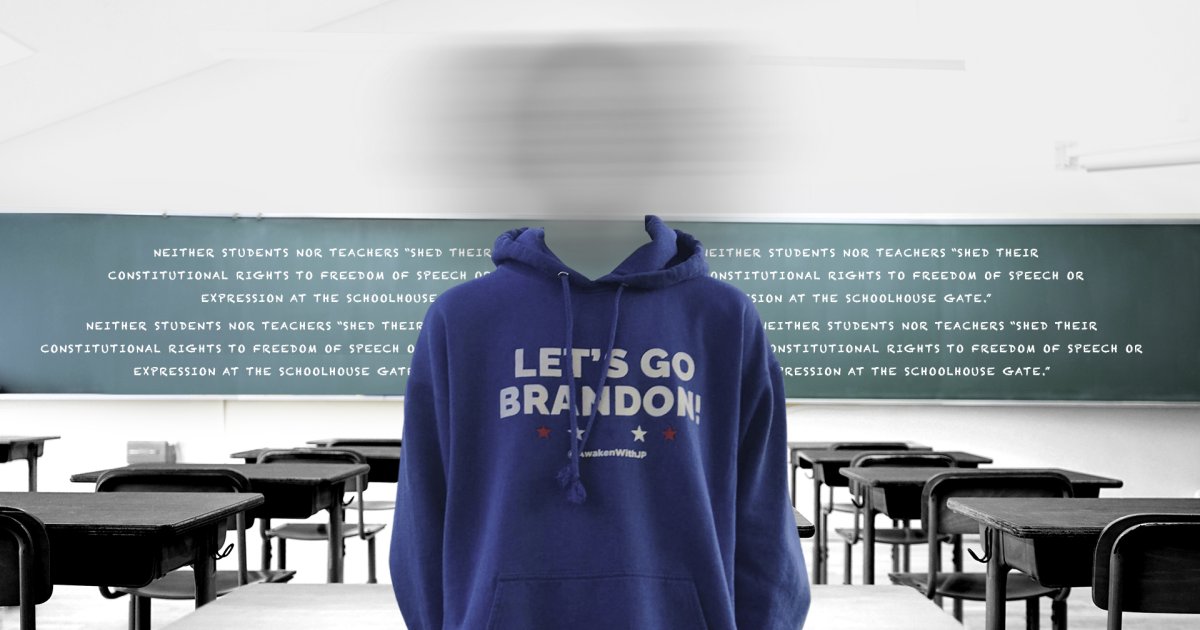
FIRE, supported by a wave of prominent organizations and scholars as “friends of the court,” has appealed a district court’s ruling that limited the rights of students to attend middle and high school wearing clothes bearing the “Let’s Go Brandon” political slogan. FIRE is asking a federal appeals court to strike down the decision below and uphold freedom of expression for public school students, and a broad spectrum of free speech advocates and language experts are backing us up.
So what happened? In April 2023, FIRE sued a west Michigan school district and two administrators for preventing two students from wearing “Let’s Go Brandon” sweatshirts. The “Let’s Go Brandon” slogan originated during an October 2021 NASCAR race. After the race, won by Brandon Brown, members of the crowd chanted “Fuck Joe Biden” during Brown’s post-race interview. A commentator remarked that the fans were shouting “Let’s Go Brandon!”
WATCH VIDEO: NASCAR fans chant “Fuck Joe Biden” after the race.
Since then, the presidential campaign of Donald Trump and Republican members of Congress have used the phrase widely, including during Congressional floor speeches, to show their displeasure with the Biden administration. The “Let’s Go Brandon” slogan airs uncensored on broadcast television, national cable news, and broadcast radio for all to hear. In the case on appeal, FIRE’s clients wore their “Let’s Go Brandon” sweatshirts to school to express their disapproval of Biden and his administration.
During the lawsuit, the school acknowledged the students did not cause any disruption with their apparel. Yet this past August, the District Court for the Western District of Michigan upheld the school district’s censorship of “Let’s Go Brandon” apparel, holding “Let’s Go Brandon” is legally indistinguishable from “Fuck Joe Biden” and therefore constitutes “profanity.”
As FIRE’s appeal argues, that’s not how speech works. “Heck” is not the same as “hell,” “darn” is not the same as “damn,” and “Let’s Go Brandon” is not the same as “Fuck Joe Biden.” The government may not censor public school students’ political expression absent substantial disruption. Nor may school districts bypass this First Amendment protection by dubbing disfavored political speech “profane.”
This case will play a critical role in protecting the rights of other minor students to engage in non-disruptive political expression as guaranteed under the First Amendment.
Last week, 18 individuals and organizations, including some of the world’s foremost linguistic experts, joined together to file eight amicus curiae, or “friend of the court” briefs in support of minors’ free speech rights. These briefs urge the Sixth Circuit to recognize what has long been understood outside the courtroom — sanitized expression is, by design, distinguishable from the profane language it replaces:
Linguistic Scholars: Dr. Melissa Mohr, Dr. Rebecca Roache, Professor Timothy Jay, Professor John H. McWhorter, and Professor Steven Pinker are internationally recognized linguistic scholars whose works focus on the history, psychology, and sociology of swearing. Each has written extensively on how language works and the role it continues to play in society. Together, they submitted a brief through Quinn Emanuel Urquhart & Sullivan, LLP, helpfully delineating the different types of “sanitized expression,” including euphemisms like “Let’s Go Brandon,” and describing their ubiquity and importance in political discourse. As they state at the beginning of their brief: “This case is not about swearing; it is about not swearing.”
First Amendment Scholars: Dean Erwin Chemerinsky, Professor Clay Calvert, Professor Roy Gutterman, Professor Mary-Rose Papandrea, and Professor Joseph A. Tomain submitted an amicus brief through Cornell Law School’s First Amendment Clinic and attorney Michael Grygiel. Drawing on decades of study, the scholars methodically apply seminal First Amendment decisions to this particular case. Their brief argues: “the lower court failed to apply Tinker’s ‘substantial disruption’ test, as required when schools seek to prohibit student expression within the school environment that communicates a political message,” and thus “departed from longstanding public student constitutional free speech principles.”
Liberty Justice Center: The Liberty Justice Center’s amicus brief asserts the district court’s decision represents an unprecedented expansion of “profanity” and is part of a nationwide increase in political censorship. The brief describes how “censorship of entirely mainstream political discourse has become all too common around the country” and school authorities increasingly seek to restrict free expression. The LJC argues that the district court’s opinion exacerbates this growing problem, by authorizing schools to treat “every euphemism . . . as the equivalent of its reference.”
Dhillon Law Group, Young America’s Foundation, and Hamilton Lincoln Law Institute: These organizations submitted an amicus brief asserting the lower court’s failed to properly apply Tinker and its progeny to the students’ “Let’s Go Brandon” sweatshirts, which likewise represented political, non-profane student speech. Through careful analysis of First Amendment doctrine, their brief explains that the “district court erred in disregarding the political nature of appellants’ ‘Let’s Go Brandon’ apparel” and undervaluing the importance of First Amendment protections in K-12 public schools.
National Coalition Against Censorship: The National Coalition Against Censorship submitted an amicus brief through Covington & Burling LLP to challenge the district court’s categorization of “Let’s Go Brandon” as unprotected “profane” expression. The brief argues that the “district court’s analysis would create a new, ill-defined category of ‘euphemistic’ profanity,” and “give school officials wide latitude to silence viewpoints they find objectionable, a result at odds with existing First Amendment doctrine.” The brief asserts that the lower court’s decision “represents a serious departure from our nation’s historical commitment to protecting political speech” and urges the Sixth Circuit to reverse.
Manhattan Institute: The Manhattan Institute’s amicus brief emphasizes the critical importance of preserving free speech rights in K-12 public schools, where students develop the skills necessary to productively engage in democratic society. The brief describes case law reflecting the importance of these freedoms in primary and secondary schools — and argues the district court’s opinion fails to “accurately reflect this understanding.”
Parents Defending Education: Parents Defending Education submitted an amicus brief through Consovoy McCarthy PLLC arguing that the district court’s decision cannot be reconciled with First Amendment principles. The brief emphasizes how the school codes at issue in this case are part of a growing and concerning “trend of schools adopting speech codes prohibiting controversial speech.” And the brief asserts each of the cases relied on by the lower court are distinguishable.
Buckeye Institute: The Buckeye Institute’s amicus brief contends that under established First Amendment doctrine, “[r]egulation of speech under the First Amendment should constitute a rare exception.” Yet, they argue, the Michigan school district, motivated by desire to censor what it deems undesirable speech, disregarded that doctrine in order to censor non-disruptive political speech “that does not fall within one of the Supreme Court’s approved exceptions” to the First Amendment’s protection.
Our clients and their counsel are grateful for the support of this impressive and diverse amicus coalition. This case will play a critical role in protecting the rights of other minor students to engage in non-disruptive political expression as guaranteed under the First Amendment.
On November 15, a federal judge in the Eastern District Court of Texas ruled to strike down the Biden administration’s Fair Labor Standards Act (FLSA) overtime final rule. The ruling strikes down all components of the rule, meaning both the July and January salary thresholds are no longer in effect, and the triennial automatic updates will not take place. The decision applies to all covered employers and employees under the FLSA nationwide.
The Eastern District Court of Texas held a hearing on the business groups’ lawsuits challenging the overtime regulations on November 8. During the hearing, the judge suggested that it would be problematic if DOL’s salary basis replaced the duties test established under the FLSA regulations. He also noted that the Biden administration’s regulations were projected to have a larger number of workers impacted by the salary threshold increase than the Trump administration’s 2019 rule. The judge did not rule from the bench, but his remarks showed skepticism about the Biden administration’s rule.
Background
As a reminder, the final rule implemented a two-phase approach to increasing the minimum salary threshold under the FLSA overtime regulations. The first increase took effect on July 1, increasing the minimum salary threshold from the current level of $684 per week ($35,568 per year) to $844 per week ($43,888 per year). The second increase was set to take effect on January 1, 2025, and it would have increased the minimum salary threshold again to $1,128 per week ($58,656 per year). The final rule also adopted automatic updates to the minimum salary threshold that would occur every three years.
Soon after the final rule was published, several lawsuits were filed challenging the final rule. The suit claimed that the salary threshold that was supposed to go into effect on January 1, 2025, was so high it would result in more than 4 million individuals being denied exempt status, even though these individuals could be reasonably classified as exempt based on their duties, and in doing so, the rule violated both the statutory language of the FLSA and prior court decisions. The suits also challenged the automatic updates. The Eastern District Court of Texas granted a preliminary injunction for public employers in Texas prior to the July 1 effective date, stopping the rule from taking effect for those employers only. For private employers in Texas and all other employers in the country, the rule went into effect on July 1, and the January 1 effective date was still in play.
Looking Ahead
With the decision, the salary threshold set in the 2019 regulations ($35,568 per year or $683 per week) will be the salary threshold employers should adhere to. Whether President-elect Trump decides to increase the minimum salary threshold during his second term remains to be seen, but there will be no effort from his incoming administration to appeal the decision in favor of the Biden administration’s threshold. CUPA-HR will continue to keep members apprised of any updates related to the FLSA overtime regulations.
On November 5, the 9th U.S. Circuit Court of Appeals reversed a lower district court’s decision to dismiss a lawsuit challenging the Biden administration’s executive order and the Department of Labor (DOL)’s final rule to increase the minimum wage for federal contractors. The ruling orders the legal challenge to proceed, which could ultimately strike down the executive order and final rule.
In April 2021, the Biden administration published executive order 14026, which directed DOL to issue regulations to increase the minimum wage for federal contractors to $15 per hour beginning on January 30, 2022. Subsequently, in November 2021, DOL issued its final rule to implement the executive order, setting the minimum wage for federal contractors to $15 per hour on January 30, 2022, and requiring the secretary of Labor to annually review and determine the minimum wage amount beginning in January 2023.
The executive order and final rule were challenged by five states: Arizona, Idaho, Indiana, Nebraska and South Carolina. In their suit, the states claimed that the Biden administration violated the Federal Property and Administrative Services Act (FPASA) and exceeded its authority granted under the law by imposing a wage mandate through an executive order. They also argued that DOL violated the Administrative Procedure Act (APA), which governs how federal agencies proceed through the notice-and-comment rulemaking process, when implementing the final rule. The lawsuit was originally dismissed by a federal judge in the U.S. District Court of Arizona, leading the states to appeal to the 9th Circuit.
In the 9th Circuit’s ruling, two of the three judges on the panel sided with the states’ arguments, reversing the dismissal of the case from the lower district court. The majority opinion held that the minimum wage mandate exceeded the president’s authority under FPASA and that DOL’s final rule was subject to arbitrary-or-capricious review under the APA. As such, the circuit court sends the case back to the district court, where the federal judge will proceed with the case and issue a further ruling to uphold or strike down the executive order and final rule. For now, the order and final rule are still in place, but the future of both is uncertain. CUPA-HR will keep members apprised of any updates related to this lawsuit and further laws and regulations impacting federal contractors.
Updates: On June 17, a federal judge in the Eastern District Court of Kentucky issued a second preliminary injunction against the Title IX rule, blocking the final rule from taking effect on August 1 in Virginia, Kentucky, Tennessee, Indiana, Ohio and West Virginia.
On June 24, the Biden administration filed a notice of appeal for the preliminary injunction granted in the Western District Court of Louisiana to block the Title IX final rule from going into effect on August 1, 2024. The appeal will be filed in the 5th U.S. Circuit Court of Appeals. The preliminary injunction remains in effect until the 5th Circuit Court issues a decision. CUPA-HR will keep members apprised of any updates on this appeal as well as the status of the second preliminary injunction granted in the Eastern District Court of Kentucky.
On July 2, a federal judge in the U.S. District Court of Kansas issued a third preliminary injunction to block the Biden administration’s Title IX rule from taking effect on August 1. The preliminary injunction applies to four states: Alaska, Kansas, Utah and Wyoming. The preliminary injunction also applies to schools where members of the Young America’s Foundation, Female Athletes United, and Moms for Liberty attend, even if the state in which the school is located is not challenging the rule or is not included in another preliminary injunction. The Title IX rule is now blocked from being enforced beginning on August 1 in a total of 14 states, as well as over 360 institutions in 24 states, Washington D.C., and Puerto Rico that are not suing the Biden administration over the Title IX rule.
On July 11, Republicans in the U.S. House of Representatives passed a Congressional Review Act resolution to block the Department of Education from implementing and enforcing its Title IX final rule. The vote is largely symbolic as the Democrat-controlled Senate is unlikely to take up the measure and President Biden would veto the resolution if it ended up on his desk.
On July 11, a federal judge in the Northern District Court of Texas granted a fourth preliminary injunction to block the Title IX final rule from taking effect on August 1 in the state of Texas. The Title IX final rule is now blocked from taking effect in 15 states.
On July 24, a federal judge from the Eastern District Court of Missouri issued another preliminary injunction to block the Title IX rule from taking effect in six more states. The states included in this decision were Arkansas, Missouri, Iowa, Nebraska, North Dakota, and South Dakota. The Title IX final rule is now blocked from taking effect on August 1 in a total of 21 states.
On July 31, a federal judge in the Western District Court of Oklahoma granted a preliminary injunction to block the Title IX final rule from taking effect on August 1. Additionally, the 11th U.S. Circuit Court of Appeals granted a preliminary injunction in Alabama, Florida, Georgia, and South Carolina, overturning a lower court’s previous decision to deny the preliminary injunction in those states. There are 26 states in which the Title IX rule is now blocked from taking effect on August 1.
On June 13, a federal judge in the Western District Court of Louisiana issued a preliminary injunction on the Department of Education (ED)’s recent Title IX final rule. The order blocks the final rule from taking effect on August 1 in Louisiana, Mississippi, Montana and Idaho until a final decision has been issued by the judge on a lawsuit challenging the validity of the final rule.
ED’s Final Rule and Subsequent Lawsuits
In April, ED released its highly anticipated final rule to amend the Title IX regulations. Notably, the final rule expands protections against sex-based discrimination to cover sexual orientation, gender identity, and pregnancy or related conditions. Soon after it was published, several lawsuits were filed by states and advocacy groups challenging ED’s decision to expand Title IX protections to include gender identity and sexual orientation.
Judge’s Order
In the order to grant a preliminary injunction, the federal judge asserted that the Title IX rulemaking is “contrary to law” and “exceeds statutory authority,” especially with the expanded protections for transgender students. Specifically, the judge explained that Congress intended to protect biological women from discrimination when enacting Title IX, and that “enacting the changes in the final rule would subvert the original purpose of Title IX.”
As a result, ED is blocked from enforcing the final rule in the four states listed in the order, and the final rule will not take effect on August 1 in those four states until further orders are issued by the court.* The judge will now consider the lawsuit challenging the final rule and decide to either uphold or strike down the rule. A final decision may take months or a year or more to be released, as any decision is likely to be appealed to a higher court. In the meantime, CUPA-HR encourages HR leaders in the states impacted by this preliminary to work with their institution’s general counsel on best practices for navigating Title IX compliance.
CUPA-HR will keep members apprised of additional updates on the legal challenges against the Title IX final rule.
* Over two dozen states have joined lawsuits challenging the Title IX final rule. Though the order in this blog post applies only to Louisiana, Mississippi, Montana and Idaho, decisions for the additional lawsuits could result in similar injunctions for other states.
On May 23, a group of 13 local and national associations and Texas businesses filed suit in federal court in Texas, challenging the U.S. Department of Labor’s rule setting new minimum salary thresholds for the white collar overtime pay exemptions under the Fair Labor Standards Act (FLSA).
The final rule of April 23, 2024 increases the minimum salary threshold to $43,888 on July 1, 2024, and then to $58,656 on January 1, 2025. The rule also implements automatic updates to the threshold that will occur every three years. The suit claims that the salary threshold that goes into effect on January 1, 2025, is so high it will result in more than 4 million individuals being denied exempt status, even though these individuals could be reasonably classified as exempt based on their duties, and in doing so, the rule violates both the statutory language of the FLSA and prior court decisions. The suit also challenges the automatic updates.
The following are plaintiffs in the case: Plano Chamber of Commerce, American Hotel and Lodging Association, Associated Builders and Contractors, International Franchise Association, National Association of Convenience Stores, National Association of Home Builders, National Association of Wholesaler-Distributors, National Federation of Independent Business, National Retail Federation, Restaurant Law Center, Texas Restaurant Association, Cooper General Contractors and Dase Blinds.
CUPA-HR will be following the case closely and provide you with regular updates.
On February 23, a federal judge with the District Court for the Eastern District of Tennessee issued a preliminary injunction barring the NCAA from enforcing its rules prohibiting name, image and likeness compensation for recruits. The injunction applies nationwide.
The policy in question prohibited student-athletes from negotiating and signing NIL contracts prior to enrolling at a college or university. This meant NIL compensation could not be used to “induce” a recruit to a specific school. This policy stood in contrast to the NCAA’s policy for student-athletes already enrolled at a college or university, who, as of 2021, have been allowed to seek NIL compensation.
In his decision, U.S. District Judge Clifton Corker explained, “The NCAA’s prohibition likely violates federal antitrust law and harms student-athletes.” He clarified, “Without the give and take of a free market, student-athletes simply have no knowledge of their true NIL value. It is this suppression of negotiating leverage and the consequential lack of knowledge that harms student-athletes.” He further argued that the NCAA “fails to show how the timing of when a student-athlete enters such an agreement would destroy the goal of preserving amateurism,” thereby not establishing rationale for treating recruits differently than enrolled student-athletes.
The lawsuit was filed by the attorneys general of Tennessee and Virginia after the NCAA investigated the University of Tennessee for potential violations of the policy. The NCAA will likely appeal the case to the 6th U.S. Circuit Court of Appeals overseeing Tennessee, Kentucky, Ohio and Michigan, but in the meantime, reports indicate the organization is already considering potential policy changes.
This case is only one of the lawsuits targeting the NCAA and its policies towards student-athletes. Several lawsuits are currently pending before various federal courts, alleging the NCAA in its current form violates federal antitrust law. Additionally, the National Labor Relations Board recently ruled that the Dartmouth men’s basketball team are employees of the university, allowing them to organize and schedule a union representation election for early March. The NLRB has also issued a complaint against the University of Southern California, the PAC-12 Conference and the NCAA, alleging the three have misclassified USC’s football and men’s and women’s basketball players as student-athletes rather than employees and that the three organizations are joint employers of the athletes.
CUPA-HR will continue to monitor for and keep members apprised of any updates on these cases.