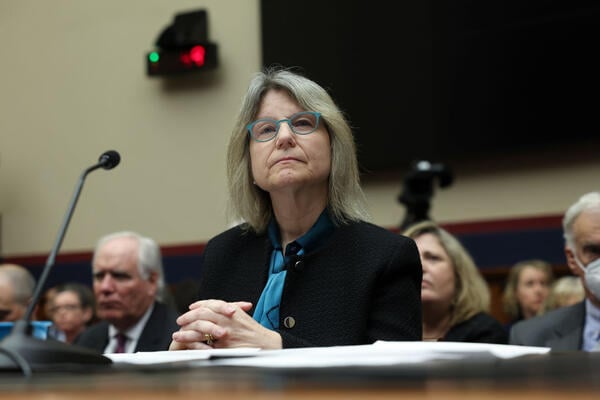
Massachusetts Institute of Technology has rejected the Trump administration’s proposal to sign on to the “Compact for Academic Excellence in Higher Education,” which would mandate sweeping changes across campus in exchange for preferential treatment on federal funding.
MIT is the first of the nine universities invited to join the compact to publicly reject the proposal that has ignitedfierce pushback from other higher ed leaders, faculty and experts who see the document as a way to strip institutions of their autonomy. The Trump administration also asked Brown University, Dartmouth College, the University of Arizona, the University of Pennsylvania, the University of Southern California, University of Texas at Austin, the University of Virginia and Vanderbilt University to sign. Most have provided vague statements saying that they are reviewing the compact, though Texas officials have expressed some enthusiasm about the offer.
MIT President Sally Kornbluth announced the move in a Friday morning letter to the campus community, which included a copy of her response to Education Secretary Linda McMahon.
Kornbluth highlighted in the response to McMahon a number of areas emphasized by the White House in the compact, such as focusing on merit, keeping costs low for students and protecting free expression.
“These values and other MIT practices meet or exceed many standards outlined in the document you sent. We freely choose these values because they’re right, and we live by them because they support our mission—work of immense value to the prosperity, competitiveness, health and security of the United States. And of course, MIT abides by the law,” Kornbluth wrote.
She also noted that MIT disagreed with a number of the demands in the letter, arguing that it “would restrict freedom of expression and our independence as an institution” and that “the premise of the document is inconsistent” with MIT’s belief that funding should be based on merit.
“In our view, America’s leadership in science and innovation depends on independent thinking and open competition for excellence,” Kornbluth wrote. “In that free marketplace of ideas, the people of MIT gladly compete with the very best, without preferences. Therefore, with respect, we cannot support the proposed approach to addressing the issues facing higher education.”
This is a breaking news article and will be updated.
This audio is auto-generated. Please let us know if you have feedback.
Dive Brief:
Carnegie Mellon University has laid off 75 employeesin its Software Engineering Institute as it wrestles with disruptions to federal funding,according to a community message Wednesday from Vice President for Research Theresa Mayer.
Mayer tied the cuts — which amount to 10% of SEI’s workforce — to the engineering institute’s “unique financial structure as a federally funded research and development center as well as the shifting federal funding priorities that are shaping the research landscape.”
Carnegie Mellonas a whole is in a “strong financial position” for fiscal 2026, university President Farnam Jahanian said in August, noting that the Pittsburgh institution cut its expenses by $33 million.
Dive Insight:
Jahanian said in an August community message that Carnegie Mellon is poised to get through the current fiscal year without a deficit, which is more than some of its peer institutions can say.
But the university faces stiff financial headwinds — and what its president described as “existential challenges” —from the Trump administration’s disinvestment in scientific and academic research.
To tighten its budget, Carnegie Mellon has paused merit raises, reduced nonessential expenditures, limited new staff and faculty hiring, and has reduced staff in certain units through voluntary retirements and employee reductions.
In the August message, Jahanian described “signs of a marked decline in the pipeline of new federal research awards nationally and at Carnegie Mellon.”He added that university officials expect more cutbacks in federal agencies’ research budgets under a Republican-led Congress.
The university’s Software Engineering Institute, which Mayer described as integral to Carnegie Mellon’s overall research enterprise, is one of the institution’s biggest recipients of federal research funding. Sponsored by the U.S. Department of Defense, SEI develops new technologies and studies complex software engineering, cybersecurity and AI engineering problems, in large part to advance the strategic goals of federal agencies.
The institute took in $148.8 million in grants and contracts revenue in fiscal 2024.
Prior to this month’s job cuts, officials at the institute took “extensive steps to avoid this outcome, including implementing cost-saving measures in recent months,” Mayer said Wednesday. “Despite these efforts, SEI was unable to reallocate or absorb costs, so staff reductions were unavoidable.”
Along with a slackening grant pipeline, Jahanian’s August message pointed to the possibility of reduced funding for research overhead costs.
The Trump administration has sought to unilaterally cap reimbursement rates for indirect research costs at 15% across multiple agencies, though these policies have been blocked by courts.
Carnegie Mellonis a plaintiff in one of the lawsuits that led to the 15% cap being permanently blocked at the National Institutes of Health, though the Trump administration has appealed the ruling. The university is also represented in lawsuits against other agencies through its membership in the Association of American Universities.
If a 15% cap were implemented on research overhead, that would create an additional $40 million annual shortfall for Carnegie Mellon, according to Jahanian. Indirect research costs include overhead expenses such as laboratories and support staff.
Beyond federal funding woes, Jahanian also noted in August that Carnegie Mellon’s projected $365 million in graduate tuition revenue for the current fiscal year is about $20 million short of initial estimates due to “lower-than-expected enrollment.”
While Jahanian didn’t offer reasons for the shortfall, he did note that going forward Carnegie Mellon was examining its balance of undergraduate to graduate and international to domestic students to “ensure long-term stability.”
Other universities have experienced major declines in their international enrollment amid the Trump administration’s disruptions to the visa approval process and aggressive immigration policies.
Officials at DePaul University, in Chicago, said recently that new international graduate student enrollment fell by 62% year over year this fall, contributing heavily to a budget crunch at the institution.
One group has predicted that international enrollment could drop by as much as 150,000 students this fall.
In recent years, Carnegie Mellon’s enrollment has grown, as has its graduate student ranks. Between 2018 and 2023, overall enrollment increased 11.2% to 15,596 studentsand graduate enrollment grew 11.7% to 8,307 students.
Employees who had the messages put on their accounts told Inside Higher Ed that it was “wild to see your name attached to a message that you had nothing to do with.”
J. David Ake/Getty Images
The American Federation of Government Employees, a union representing federal workers, sued the Trump administration Friday, challenging the automated out-of-office email responses it placed on many employees’ email accounts when the government shut down.
The message, which was placed on the email accounts of all furloughed staff members without their consent, blamed Democrats in the Senate for causing the shutdown.
AFGE’s members, who will be represented by the legal firms Democracy Forward and Public Citizen Litigation Group, argue in the complaint that the message Trump attached to their email accounts is “partisan political rhetoric.” Not only does it violate the Hatch Act, a federal law that requires nonappointed government staff to stay nonpartisan, but it also violates the First Amendment rights of the individual employees, they argue.
“The Trump-Vance administration is losing the blame game for the shutdown, so they’re using every tactic to try to fool the American people, including taking advantage of furloughed civil servants,” Skye Perryman, president of Democracy Forward, said in a news release. “Even for an administration that has repeatedly demonstrated a complete lack of respect for the Constitution and rule of law, this is beyond outrageous. The court must act immediately to stop this flagrant unlawfulness.”
This audio is auto-generated. Please let us know if you have feedback.
Dive Brief:
A federal judge dismissed a case Thursdaythat challenged the legality of the Biden administration’s gainful employment rule,which aims to ensure that graduates of career education programs earn enough to pay off their student loan debt.
U.S. District Judge Reed O’Conner— a George W. Bush appointee — rejected arguments from cosmetology school groups that the gainful employment rule overstepped the U.S. Department of Education’s authority and violated their constitutional rights.
Although the Biden-era rule survived the legal challenge,the Trump administration is considering potential changes to the gainful employment regulations in the coming months.
Dive Insight:
The Biden administration finalized the gainful employment rule in 2023. Under the rule, career education programs must prove that they provide graduates with an earnings bump and don’t leave borrowers with more debt than they can manage.
To do so, the gainful employment rule establishes two separate tests.Under one, the median program graduate must pay no more than 8% of their annual earnings or 20% of their discretionary income toward their debt. Under the other, at least half of a program’s graduates must outearn workers in their state with only a high school diploma.
College programs that fail either of these metrics in two out of three consecutive years risk losing access to federal financial aid. The rule primarily impacts programs at for-profit colleges, but also applies to certificates at all institutions.
Thursday’s ruling addresses two consolidated lawsuits against the rule. The cosmetology school groups had argued that the Education Department had overstepped its authority when issuing the regulations, as the Higher Education Act doesn’t define gainful employment.
However, O’Connor wrote that the Education Department’s rule follows the plain meaning of the statute.
“Although the 2023 Rule is in the form of an equation, it no less does the same work as the words ‘gainful employment,’ by ensuring the programs lead to profitable jobs, instead of loan deficits,” O’Connor wrote.
The plaintiffs had also alleged that they would be unfairly penalized by the rule, arguing that a large share of income in the cosmetology industry goes unreported because it is earned through cash tips. Because of that, they said, the Education Department’s calculations would fail to accurately capture how much their graduates earn.
O’Connor rejected those arguments, noting that the Education Department had cited studies showing that underreporting is not widespread.
National Student Legal Defense Network,an advocacy and legal group for students, praised the ruling Thursday.
“Higher education is supposed to offer students a path to a better life, not a debt-filled dead end,” Student Defense Vice President and Chief Counsel Dan Zibel said in a statement. “The 2023 Gainful Employment Rule reflects a common-sense policy to ensure that students are not wasting time and money on career programs that provide little value.”
Jason Altmire, president and CEO of Career Education Colleges and Universities, an association that represents the for-profit college sector, decried Thursday’s ruling but sounded optimistic about forthcoming regulatory changes under the Trump administration.
“Although we strongly disagree with the ruling today, we look forward to this issue being revisited by the current Department of Education,” Altmire said in a statement that day. “We are confident the Biden Gainful Employment Rule will be revised to incorporate a fairer accountability measure that will apply equally to all schools, ensuring all students can benefit.”
This audio is auto-generated. Please let us know if you have feedback.
Dive Brief:
Harvard University could lose access to all federal grants and contracts under proceedings initiated by the U.S. Department of Health and Human Services on Monday.
The agency’s Office for Civil Rights has referred the university for suspension and debarment, the process by which the agency can cut off entities from federal grants and contracts if it determines that wrongdoing renders them “not responsible enough to do business” with the government.
The move represents the latest federal effort to bend Harvard to the Trump administration’s will through financial pressure. The administration has sought to use multiple federal agencies to gain increased influence over the higher education sector, singling out Harvard as a prime target.
Dive Insight:
On Monday, HHS’ OCR recommended excluding Harvard from federal funding, arguing the move would protect the public interest. The agency cited its June notice that formally accused Harvard of being in “violent violation” of Title VI by being “deliberately indifferent” to harassment of Jewish and Israeli students on its campus.
Title VI forbids institutions that accept federal funds from discriminating based on race, color or national origin.
HHS can pursue the debarment process when an entity — in this case Harvard — does not voluntarily agree with the agency’s terms to return to compliance with Title VI,according to Paula Stannard, director of HHS’ OCR. HHS and three other federal agencies on the Trump administration’s Joint Task Force to Combat Anti-Semitism in June called for Harvard to “institute adequate changes immediately”but did not publicly detail what those changes should be.
Stannard said Monday that Harvard has the right to a formal hearing during the suspension and debarment process.
“An HHS administrative law judge will make an impartial determination on whether Harvard violated Title VI by acting with deliberate indifference towards antisemitic student-on-student harassment,” Stannard said.
Harvard has 20 days to request the hearing. The university did not immediately respond to a request for comment on Tuesday.
Suspension and debarment applies to all federal grants and contracts, not just those from HHS. And agencies across the federal government can initiate suspension and debarment proceedings. If sustained, debarment is not permanent and typically lasts under three years, according to a 2022 HHS report.
Monday’s announcement is unrelated to HHS’ joint civil rights investigation with the U.S. Department of Education into Harvard and the Harvard Law Review.The agencies opened the probe in April,citing allegations of “race-based discrimination permeating the operations” of the student-run journal.
Months before HHS formally determined Harvard had violated Title VI, the Trump administration’s antisemitism task force froze over $2.2 billion of the university’s grants and contracts.
The halt cameafter Harvard President Alan Garber publicly rebuked the Trump administration’s call for increased federal control of the institution. Its demands includedthat the university hire a third party to audit the viewpoints of Harvard students and employees,halt all diversity, equity and inclusion efforts,and reduce the power of certain faculty and administrators involved in activism.
A federal judge ruled in early September that the Trump administration violated the university’s First Amendment rightsand didn’t follow proper steps when it suspended the funding. No evidence indicated that “fighting antisemitism was Defendants’ true aim in acting against Harvard,” the judge wrote.
The judge’s decision barred the Trump administration from cutting off Harvard’s federal funding in retaliation for the university exercising its free speech rights or without following the procedural requirements of Title VI. However, the judge noted that her ruling didn’t prevent the Trump administration from “acting within their constitutional, statutory, or regulatory authority.”
Trump administration officials appealed the decision and said it would keep Harvard “ineligible for grants in the future.”
Purdue University is ending its GEAR UP program after the Trump administration canceled a $34.9 million federal grant to support its activities, WFYI reported. The program provided college-prep programming for more than 13,000 low-income students in Indiana, according to a 2024 press release from Purdue’s College of Education.
The grant, awarded last year, was expected to run through 2031. But the U.S. Department of Education told Purdue in a Sept. 12 termination letter that the grant application flouted the department’s policy of “prioritizing merit, fairness, and excellence in education” and ran afoul of civil rights law. The letter referenced parts of the application, including plans to provide DEI training to hiring managers and professional development in “culturally responsive teaching.”
The program is “inconsistent with, and no longer effectuates, the best interest of the Federal Government,” the letter read. The GEAR UP program shut down on Tuesday. Purdue did not appeal the grant termination, WFYI reported.
The Education Department has canceled at least nine GEAR UP grants, EducationWeekreported, though it continued awards for other programs last week.
Harvard is facing increasing pressure from the Trump administration after winning back its frozen grants in court.
Joseph Prezioso/AFP/Getty Images
The U.S. Department of Health and Human Services’ Office for Civil Rights announced Monday that it’s moving to cut off Harvard University’s eligibility to receive federal funding.
The announcement comes amid a power struggle between Harvard and the White House.
While the Trump administration has accused Harvard of allowing antisemitism to run amok on campus—and the university has acknowledged concerns on the front—it has sought sweeping power over the institution and changes that go beyond addressing antisemitism. The HHS Office for Civil Rights previously found that Harvard violated Title VI of the Civil Rights Act of 1964, which bars discrimination based on race, color and national origin, and acted with “deliberate indifference toward discrimination and harassment against Jewish and Israeli students,” according to an HHS news release.
Now HHS OCR has recommended cutting off federal funding to Harvard “to protect the public interest” through a suspension and debarment process operated by the HHS Office of the Assistant Secretary for Financial Resources. Suspension would be temporary and debarment would last “for a specified period as a final determination that an entity is not responsible enough to do business with the federal government because of the wrongdoing,” according to the agency. The move comes less than two weeks after the Education Department placed Harvard on heightened cash monitoring—a highly unusual move given the university’s significant resources.
Harvard did not immediately respond to a request for comment Monday.
“OCR’s referral of Harvard for formal administrative proceedings reflects OCR’s commitment to safeguard both taxpayer investments and the broader public interest,” HHS OCR director Paula M. Stannard said in a statement. “Congress has empowered federal agencies to pursue Title VI compliance through formal enforcement mechanisms, including the termination of funding or denial of future federal financial assistance, when voluntary compliance cannot be achieved.”
Harvard has 20 days to request a hearing in front of an HHS administrative law judge, who will decide whether the university violated Title VI.
Monday’s announcement is the latest salvo by the federal government after Harvard emerged initially victorious in a legal battle over more than $2 billion in frozen federal research funding. While a judge ruled that the Trump administration illegally froze funds granted to Harvard, the federal government has continued to pressure the private institution to make changes to disciplinary processes, admissions, hiring and more. Other Ivy League institutions, such as Columbia University and Brown University, have agreed to such deals, under federal scrutiny.
ASHE COUNTY, N.C. — In the time it took to read an email, the federal money vanished before Superintendent Eisa Cox’s eyes: dollars that supported the Ashe County school district’s after-school program, training for its teachers, salaries for some jobs.
The email from the Department of Education arrived June 30, one day before the money — $1.1 million in total — was set to materialize for the rural western North Carolina district. Instead, the dollars had been frozen pending a review to make sure the money was spent “in accordance with the President’s priorities,” the email said.
In a community still recovering from Hurricane Helene, where more than half of students are considered economically disadvantaged, Cox said there was no way they could replace that federal funding. “It is scary to think about it, you’re getting ready to open school and not have a significant pot of funds,” she said.
School leaders across the country were reeling from the same news. The $1.1 million was one small piece of a nearly $7 billion pot of federal funding for thousands of school districts that the Trump administration froze — money approved by Congress and that schools were scheduled to receive on July 1. For weeks, leaders in Ashe County and around the country scrambled to figure out how they could avoid layoffs and fill financial holes — until the money was freed July 25, after an outcry from legislators and a lawsuit joined by two dozen states.
“I had teachers crying, staff members crying. They thought they were going to lose their jobs a week before school,” said Curtis Finch, superintendent of Deer Valley Unified School District in Phoenix.
About $1.1 million was at stake for the Ashe County school district in western North Carolina this summer when a portion of K-12 schools’ federal funding was frozen. Credit: Ariel Gilreath/The Hechinger Report
Now, as educators welcome students back to classrooms, they can no longer count on federal dollars as they once did. They must learn to plan without a playbook under a president intent on cutting education spending. For many districts, federal money is a small but crucial sliver of their budgets, potentially touching every part of a school’s operations, from teacher salaries to textbooks. Nationally, it accounts for about 14 percent of public school funding; in Ashe County, it’s 17 percent. School administrators are examining their resources now and budgeting for losses to funding that was frozen this summer, for English learners, after-school and other programs.
So far, the Trump administration has not proposed cutting the largest pots of federal money for schools, which go to services for students with disabilities and to schools with large numbers of low-income students. But the current budget proposal from the U.S. House of Representatives would do just that.
At the same time, forthcoming cuts to other federal support for low-income families under the Republican “one big, beautiful bill” — including Medicaid and SNAP — will also hammer schools that have many students living in poverty. And some school districts are also grappling with the elimination of Department of Education grants announced earlier this year, such as those designed to address teacher shortages and disability services. In politically conservative communities like this one, there’s an added tension for schools that rely on federal money to operate: how to sound the alarm while staying out of partisan politics.
For Ashe County, the federal spending freeze collided with the district’s attempt at a fresh start after the devastation of Helene, which demolished roads and homes, damaged school buildings and knocked power and cell service out for weeks. Between the storm and snow days, students here missed 47 days of instruction.
Cox worries this school year might bring more missed days: That first week of school, she found herself counting the number of foggy mornings. An old Appalachian wives’ tale says to put a bean in a jar for every morning of fog in August. The number of beans at the end of the month is how many snow days will come in winter.
“We’ve had 21 so far,” Cox said with a nervous laugh on Aug. 21.
Fragrant evergreen trees blanket Ashe County’s hills, a region that bills itself as America’s Christmas Tree Capital because of the millions of Fraser firs grown for sale at the holidays. Yet this picturesque area still shows scars of Hurricane Helene’s destruction: fallen trees, damaged homes and rocky new paths cut through the mountainsides by mudslides. Nearly a year after the storm, the lone grocery store in one of its small towns is still being rebuilt. A sinkhole that formed during the flooding remains, splitting open the ground behind an elementary school.
Ashe County Schools Superintendent Eisa Cox visits classrooms at Blue Ridge Elementary School during the first week of the school year in Warrensville, N.C. Credit: Ariel Gilreath/The Hechinger Report
As students walked into classrooms for the first time since spring, Julie Taylor — the district’s director of federal programs — was reworking district budget spreadsheets. When federal funds were frozen, and then unfrozen, her plans and calculations from months prior became meaningless.
Federal and state funding stretches far in this district of 2,700 students and six schools, where administrators do a lot with a little. Even before this summer, they worked hard to supplement that funding in any way possible — applying to state and federal grants, like one last year that provided money for a few mobile hot spots for families who don’t have internet access. Such opportunities are also narrowing: The Federal Communications Commission, for example, recently proposed ending its mobile hot spot grant program for school buses and libraries.
“We’re very fiscally responsible because we have to be — we’re small and rural, we don’t have a large tax base,” Taylor said.
When the money was frozen this summer, administrators’ minds went to the educators and kids who would be most affected. Some of it paid for a program through Appalachian State University that connects the district’s three dozen early-career teachers with a mentor, helps them learn how to schedule their school days and manage classroom behavior.
The program is part of the reason the district’s retention rate for early career teachers is 92 percent, Taylor said, noting the teachers have said how much the mentoring meant to them.
Also frozen: free after-school care the district provides for about 250 children throughout the school year — the only after-school option in the community. Without the money, Cox said, schools would have to cancel their after-school care or start charging families, a significant burden in a county with a median household income of about $50,000.
Sixth grade students make self-portraits out of construction paper during the first week of the school year at Blue Ridge Elementary School in Warrensville, N.C., in August. Credit: Ariel Gilreath/The Hechinger Report
The salary for Michelle Pelayo, the district’s migrant education program coordinator for nearly two decades, was also tied up in that pot of funding. Because agriculture is the county’s biggest industry, Pelayo’s work in Ashe County extends far beyond the students at the school. Each year, she works with the families of dozens of migrant students who move to the area for seasonal work on farms, which generally involves tagging and bundling Christmas trees and harvesting pumpkins. Pelayo helps the families enroll their students, connects them with supplies for school and home, and serves as a Spanish translator for parent-teacher meetings — “whatever they need,” she said.
Kitty Honeycutt, executive director of the Ashe County Chamber of Commerce, doesn’t know how the county’s agriculture industry would survive without the migrant students Pelayo works with. “The need for guest workers is crucial for the agriculture industry — we have to have them,” she said.
A couple of years ago, Pelayo had the idea to drive to Boone, North Carolina, where Appalachian State University’s campus sits, to gather unwanted appliances and supplies from students moving out of their dorm rooms at the end of the year to donate to migrant families. She’s a “find a way or make a way” type of person, Honeycutt said.
Cox is searching for how to keep Pelayo on if Ashe County loses these federal funds next year. She’s talked with county officials to see if they could pay Pelayo’s salary, and begun calculating how much the district would need to charge families to keep the after-school program running. Ideally, she’d know ahead of time and not the night before the district is set to receive the money.
Districts across the country are grappling with similar questions. In Detroit, school leaders are preparing, at a minimum, to lose Title III money to teach English learners. More than 7,200 Detroit students received services funded by Title III in 2023.
In Wyoming, the small, rural Sheridan County School District 3 is trying to budget without Title II, IV and V money — funding for improving teacher quality, updating technology and resources for rural and low-income schools, among other uses, Superintendent Chase Christensen said.
Schools are trying to budget for cuts to other federal programs, too — such as Medicaid and food stamps. In Harrison School District 2, an urban district in Colorado Springs, Colorado, schools rely on Medicaid to provide students with counseling, nursing and other services.
The district projects that it could lose half the $15 million it receives in Medicaid next school year.
“It’s very, very stressful,” said Wendy Birhanzel, superintendent of Harrison School District 2. “For a while, it was every day, you were hearing something different. And you couldn’t even keep up with, ‘What’s the latest information today?’ That’s another thing we told our staff: If you can, just don’t watch the news about education right now.”
There’s another calculation for school leaders to make in conservative counties like Ashe, where 72 percent of the vote last year went for President Donald Trump: objecting to the cuts without angering voters. When North Carolina’s attorney general, a Democrat, joined the lawsuit against the administration over the frozen funds this summer, some school administrators told state officials they couldn’t publicly sign on, fearing local backlash, said Jack Hoke, executive director of the North Carolina School Superintendents’ Association.
Cox sees the effort to slash federal funds as a chance to show her community how Ashe County Schools uses this money. She believes people are misguided in thinking their schools don’t need it, not malicious.
“I know who our congresspeople are — I know they care about this area,” Cox said, even if they do not fully grasp how the money is used. “It’s an opportunity for me to educate them.”
If the Education Department is shuttered — which Trump said he plans to do in order to give more authority over education to states — she wants to be included in state-level discussions for how federal money flows to schools through North Carolina. And, importantly, she wants to know ahead of time what her schools might lose.
As Cox made her rounds to each of the schools that first week back, she glanced down at her phone and looked up with a smile. “We have hot water,” she said while walking in the hall of Blue Ridge Elementary School. It had lost hot water a few weeks earlier, but to Cox, this crisis was minor — one of many first-of-the-year hiccups she has come to expect.
Still, it’s one worry she can put out of her mind as she looks ahead to a year of uncertainties.
Meanwhile, the anxiety about this school year hasn’t reached the students, who were talking among themselves in the high school’s media center, creating collages in the elementary school’s art class and trekking up to Mount Jefferson — a state park that sits directly behind the district’s two high schools — for an annual trip.
They were just excited to be back.
Marina Villeneuve contributed data analysis to this story.
Contact staff writer Ariel Gilreath on Signal at arielgilreath.46 or at [email protected].
The Hechinger Report provides in-depth, fact-based, unbiased reporting on education that is free to all readers. But that doesn’t mean it’s free to produce. Our work keeps educators and the public informed about pressing issues at schools and on campuses throughout the country. We tell the whole story, even when the details are inconvenient. Help us keep doing that.
This audio is auto-generated. Please let us know if you have feedback.
Dive Brief:
A federal judge on Wednesday declined to restore more than $1 billion in research grants cut by the National Science Foundation over research related to diversity, equity and inclusion while a lawsuit against the agency goes forward.
In the ruling, U.S. District Judge Jia Cobb concluded that the court didn’t have the jurisdiction to temporarily restore the grants and that plaintiffs failed to show they would experience “irreparable harm” from the agency’s new anti-DEI policies while the case proceeds.
Cobb cited in part a recent U.S. Supreme Court ruling that universities and researchers facing mass federal agency cuts must pursue their monetary claims in a separate federal court that handles economic and contractual disputes with the U.S. government.
Dive Insight:
In April, NSF issued a new statement of priorities asserting that grant awards “should not preference some groups at the expense of others, or directly/indirectly exclude individuals or groups.”
“Research projects with more narrow impact limited to subgroups of people based on protected class or characteristics do not effectuate NSF priorities,” the agency added. NSF also noted grants related to environmental justice and the study of disinformation would also fall short of the agency’s objectives under the Trump administration.
Mass cancellations of previously awarded grants followed. In June, a group of unions and higher education associations — including the American Association of Colleges and Universities and the American Association of University Professors — sued NSF.
They counted 1,600 canceled grants amounting to over $1 billion funding, including many that aimed at broadening participation of women, underrepresented groups and those with disabilities in scientific and technical fields.Commonly appearing typos and boilerplate language in many of the termination notices to researchers showed the mass, automatic nature of the cancellations.
“NSF afforded recipients of terminated grants no advance notice, and indeed no process whatsoever, before the terminations,” the complaint stated.
Plaintiffs argued that NSF’s anti-DEI directive and cancellations violated the law as well as the constitutional principles of separation of powers and due process. Among other things, plaintiffs said the grants carried out NSF’s “statutory directive to support an increase in the participation of underrepresented populations in STEM fields, including women, minorities, and people with disabilities.”
In her ruling Wednesday, Cobb, a Biden appointee, wrote that her court likely had jurisdiction to decide if NSF’s anti-DEI policies could be applied to future grants. But retroactively restoring the grants that had been canceled, as the plaintiffs had requested, would likely need to be handled by the U.S. Court of Federal Claims.
Among other precedents, she cited last month’s Supreme Court ruling in a case against the National Institutes of Health over similar DEI-related grant cancellations at that agency. While the top court declined to block a district court’s order that struck down the NIH’s anti-DEI guidance, it said the plaintiffs must seek relief for the canceled grants in federal claims court.
Critics of the decision — including justices in the liberal minority — said that the ruling would add new complications and delays while research projects and laboratories suffer.
Cobb further concluded that plaintiffs’ argument that their constitutional rights were violated was unlikely to succeed, finding that their claims were instead statutory in nature. There again Cobb cited a recent case against the Trump administration, this one brought by the Global Health Council over mass cuts at the U.S. Agency for International Development.
Democracy Forward, a nonprofit legal organization representing plaintiffs in the lawsuit, called Cobb’s decision not to block NSF’s terminations disappointing and “a loss for American innovation and excellence.”
“This case is not over and we are eager to defend the important role the NSF plays in the daily lives of Americans,” the group said in a statement.
Monday, we looked at the country’s overall financial situation (dire), and yesterday we looked at how cuts of a magnitude of 15% might affect key programs like the Canada Education Savings Program and the Canada Student Financial Assistance Program. Today, we’re going to look at how a 15% cut might affect the Government of Canada’s research subsidies, which in the main are run through the Ministry of innovation, Science and Economic Development (ISED).
(I will be speaking about “the tri-councils” as a single funding line; I am aware that the Canadian Institute for Health Research (CIHR) is funded through Health Canada but for this exercise it is easier just to lump them together).
Let’s start by acknowledging that ISED is a sprawling mess of a department with small programs with very little political protection littered all over the place. I wouldn’t bet the farm on the $12 million “Futurpreneur Canada” making it out of this budget round alive. I also doubt the Universal Broadband Fund is going to continue at $900 million per year. Computers for Schools (sounded great in the 90s, less so now) and Computers for Schools Interns would also be on my endangered list. I suspect that the various regional development funds might be in for an outsized hit as well. All of which is to say that it is possible that the research enterprise – that is, the tri-Councils, the National Research Council (NRC), the Canada Foundation for Innovation (CFI) and all those organizations that get part or all their money through the Strategic Science Fund – might not get hit with a 15% cut. It’s quite possible all these other areas might take an outsized hit and allow the actual science stuff to get off with a lighter cut.
That said, remember this key point: the budget exercise is not about cutting 15% of funding from where it should theoretically be in three years’ time (the government has a fiscal framework that extends out four or five years). It is about cutting expenditures from a 2024-25 baseline. That means that to get through any previously planned increase in spending, the cuts to existing programs must be more than 15%.
This matters for two reasons. First, it is because the government runs its subsidies to electric vehicles manufacturers through ISED. Those subsidies were worth $39M in 2024-25; they were planned to cost $2.1 billion this year and $4.2 billion in 2027-28 (i.e. it’s about half the department’s direct budget spend come two years from now, and about a third of total sci/tech spend if you include the tri-councils). To accommodate that increase while following the letter of the budget reduction request would basically mean requiring the entire department to shut down. That’s probably not happening (though one presumes that Carney’s announcement last week releasing Canadian auto manufacturers from their 20% EV sales target in 2026 might also lead to a reduction in EV subsidies to manufacturers).
Second, remember budget 2024? The one where the Liberals promised $1.8 billion in new spending on research and the whole sector cheered with relief? Yeah, well only $75 million went into the budget framework for 2024-25; 87% of that 1.8 billion is backloaded until after spring 2026. So, basically none of it is protected, and it’s all at risk. I wouldn’t be surprised in the least if they just cancelled the whole thing. And then, on top of that, we must worry about what happens to existing programs, and whether they take a 15% hit.
CIHR transfers about $1.2 billion to Canadian post-secondary institutes each year, while the National Science and Engineering Research Council (NSERC) transfers about $1 billion, and the Social Sciences and Humanities Research Council (SSHRC) transfers about $440 million (although a fair bit of that last one includes combined tri-council projects which administratively run through SSHRC, including – if I am not mistaken – funding for the Canada First Research Excellence Fund). CFI is another $550 million a year or so. NRC is about $1.7 billion per year. The Strategic Science Fund is another $900 million or so, closer to a billion if you include base funding for Genome Canada. Canada Research Chairs are another $300 million. Call it $6.2 billion in total. Required savings to get to a 15% cut is therefore just under $1 billion.
Where to start?
Ask most researchers at universities what they would prefer, and the answer is likely that they would eliminate everything except the tri-council funding. Ditch CFI, significantly cut NRC, definitely obliterate the Strategic Science Fund – anything, anything, anything but touch tri-Council grants. I understand the preference, but as I noted last week, this is a monumentally detrimental position for the sector to take. Yes, basic research and the existing grant system are the basis of the existing tenure and promotion system, and as such is naturally dear to those in the system, but almost no one in Ottawa thinks that’s what these systems are for. If we’re going to keep research funding afloat, it’s probably going to be through more spending on things like the Strategic Science Fund.
I have very little insight into the state of official Ottawa’s current thinking on the relative value of these various programs, but I could imagine three basic scenarios that get us to $1 billion in savings.
Option 1 is a straight 15% cut across the board. Take out $400 million or so from the granting councils, $80 million from CFI, $250 million from NRC, cut the Strategic Science Fund and Genome Canada to the tune of $150 million or so, and lose about 350 Canada Research Chairs.
Option 2 would be the spare the professors approach. Now, you probably can’t spare them entirely, because they are such a big proportion of the overall expenditure, but if you jacked up the cuts to CFI, NRC and Strategic Science to say 25%, you could hold the losses to CRCs and the tri-councils to under $100M. I think this is unlikely, but it is a possible scenario.
Option 3 would be the hammer the tri-councils approach. Because, as I said, I don’t think they are particularly well-liked at Finance/PMO. This is close to the inverse of option 2; zero cuts to NRC and Strategic Science, keep the CFI cut at 15% and take the rest of the necessary money out of the tri-councils. That would mean a cut of about $800 million or about 30% to council funding.
And remember, all of this is on top of walking back the measures announced in the 2024 Budget. Ugly doesn’t even begin to cover it.
To be clear: I suspect it is unlikely that the research area will get a cut of 15%, in part because officials will feel bad about doing serious damage to existing budgets after, I suspect, already taking away the Budget 2024 measures. If I had to guess, I would say that the department will probably come down hardest on regional development subsidies. Nevertheless, the scenarios above are possible even if not probable. Universities should start thinking about what they might mean and how they might cope.