

Tag: Fees

  • Tuition fees are a social contract with small print

    Tuition fees are a social contract with small print

    Amid continued growing global uncertainty, the First Minister has announced Scotland’s Programme for Government for 2025/26, its last before the Scottish election in May next year.

    Amongst its many promises is a commitment to “work with partners to secure a long-term and sustainable future for further and higher education”.

    Does that mean we can draw a collective sigh of relief? Well, not quite. Despite Scotland’s universities continuing to face an uncertain future, there’s little in the government’s plan for the next twelve months which is likely to give the higher (or wider tertiary) education sector much comfort.

    In March, the Carnegie Trust for the Universities of Scotland published our first research report, marking the beginning of a new direction for the charity as we seek to increase our impact and voice on issues of equity and inclusion in higher education in Scotland.

    The report by Ipsos highlighted public views on the value, accessibility and funding of universities. The study, the first of its kind in many years, was featured widely in the Scottish media, and appeared on the front pages of the Scotsman, the Herald and the Daily Telegraph.

    Most newspapers led with the headline figure that 48 per cent of respondents to Ipsos’ poll would support a change to Scotland’s university tuition fee model based on ability to pay.

    However, other than on Wonkhe, what wasn’t picked up by many was what the polling tells us about the varied ways in which age, geography and wealth appear to have shaped how Scottish people have experienced and benefitted from the current post-school system.

    Understanding the public’s views

    The Trust’s interest in commissioning the research was to fill a hole in the evidence base – the public voice having been all but absent from recent discussions around the future of post-school education and skills in Scotland. Whether we or our politicians agree with the public is not really the point. Instead, we have a duty to ask why those views exist and what they might mean for the future of the system.

    Alongside the 48 per cent who would support a change in the tuition fee model, a similar figure (49 per cent) expressed the view that studying courses that don’t directly lead to a profession is a waste of time. There are many ways in which higher education brings value to the individual and society underpinned by evidence, but clearly something in that messaging is falling short.

    As a Trust that has always championed funding across the full curriculum, and as someone whose own undergraduate degree did not point to obvious employment, that is a challenging outlook. However, it’s important to acknowledge this opinion and to reflect on the reasons why nearly half the Scottish public feels this way.

    In highlighting some of the nuance within public attitudes, we had hoped that the debate on funding might be able to move forwards from its current stasis – that the ground might be laid or a more open, grown-up and intelligent discussion on how we might address some of the challenges in the current system.

    Unfortunately, the immediate reaction from the government wasn’t to acknowledge the public’s opinions, but to double down on the current policy.

    I suppose, on reflection, this shouldn’t be surprising. Free tuition is a hallmark of Scottish devolution and a promise of what a modern Scotland would offer its people; part of a “social contract” between the government and its citizens.

    To question it would be to question the social and democratic principles which underpin it and, it follows, that stepping away from it, even showing a willingness to entertain alternatives, would be to betray those values. It would certainly involve admission and acceptance that, despite its aspirations, the policy does not necessarily reflect the reality of the structures in which it is implemented.

    But the reality is that free tuition sits in a wider operating context. The policy might be uniquely Scottish (at least in the UK), but as we have seen, the external factors that impact on it, are not within the current government’s direct control.

    Our report was published just days after the latest statistics showed a sharp drop in international students attending university in Scotland, and in the same week as the UK Chancellor’s Spring Statement which the IFS estimated will cut the Scottish Budget by £400m by 2030.

    It also came days before the Scottish Government announced that it had failed to deliver its interim child poverty targets, despite significant additional investment in social security. Continuing to operate the current higher education funding policy, already under strain, against this backdrop looks set to become considerably more challenging in coming years.

    What should the priorities be for post-school education funding?

    Delivering “free tuition” in the current context already means drawing lines in the sand. Currently these are drawn around full-time education (those studying part-time are means-tested and can’t currently access maintenance loans), the number of years of public support (for most people the length of the course plus one – the Trust picks up the tab for many students whose learner journeys are atypical), and around the number of places available to Scottish students (controversially capped according to the available budget and, as such, allegedly more competitive than rUK and international places).

    They are also drawn around undergraduate courses (there are no government grants available for students to access postgraduate study) and university funding itself, despite the implications for colleges and apprenticeships which come from the same portfolio budget. It’s these choices – and they are choices – which determine who benefits from post-school education funding and have led some people to claim the current system is not only unaffordable, but unfair.

    In defending the government’s policy, the Minister was unequivocal that “our support for free tuition is about more than ideology – it was founded on an equity-of-access approach [and] is based on simple logic”.

    This deserves some unpicking because there is a clear difference between a universal approach based on equality, where everyone gets the same, and equity, where resources are directed to those who need them the most in order to deliver equal outcomes.

    In a system of finite and diminishing resources, the former approach can simply serve to further embed inequalities as those with capital (be that economic or social) are better able to navigate the system, making them more likely to reap the rewards. Put simply, it’s not so easy to draw a direct line between free tuition and fair access.

    A more equitable approach?

    When Andrew Carnegie set up the Carnegie Trust for the Universities of Scotland, it was equity that was the driving force. His treatise on philanthropy, The Gospel of Wealth sets out that he saw it as the responsibility of those who were fortunate enough to be rich, to use their surplus wealth in a manner which would benefit society.

    Carnegie sought to instill this ideology within the Trust, to ensure that ‘no capable student should be de-barred from attending the university on account of the payment of fees.’ However, he was clear about who should benefit, noting that the honest pride for which my countrymen are distinguished would prevent applications from those who didn’t need the Trust’s assistance.

    He went further and built this benevolence into the Trust’s governance as it became the only one of his Trusts to date that could accept donations to:

    …enable such students as prefer to do so to consider the payments made on their account merely as advances which they resolve to repay if ever in a position to do so….

    In the first half of the 20th century this approach was instrumental in expanding access to higher education to enable individuals from disadvantaged backgrounds, including record numbers of women, to benefit from its rewards.

    By 1910 the Trust was responsible for funding around half of the students going to university in Scotland. To put that in today’s terms, that’s 50 per cent of students in Scotland from “widening access” backgrounds.

    Compare that to the current day. On paper Scotland has made impressive progress on widening access in the last ten years. Recent statistics show 16.7 per cent of Scottish first-degree entrants in 2023/24 were from the poorest neighborhoods.

    But as many have highlighted the current national indicator for widening access, SIMD20, is not a measure of household or individual deprivation, and therefore masks a complex landscape of inequality. In other words, in spite of nearly two decades of free tuition, inequalities exist and persist. Data on graduate outcomes suggests that those from wealthier backgrounds are more likely to complete their degrees and to benefit most in the labour market, and we can see from the Ipsos survey that those from high earning households are also less likely to support changes to funding in which they or their families aren’t direct beneficiaries.

    Is university still worth it?

    To demonstrate the success of free tuition, the government has pointed to the record numbers of students from Scotland securing places at university. But the rewards for those students are also changing. The IFS has noted a worrying downward trend in the graduate premium (the amount a graduate can expect to earn compared to a non-graduate) which has fallen by at least 10 per cent in the period 1997 to 2019.

    This perhaps explains why the Ipsos polling shows that the public are less certain about the value of attending university nowadays. The IFS also note issues of underemployment of graduates. In 2021/22, around a quarter of graduates who participated in the HESA graduate outcomes survey weren’t in graduate jobs and if we dive into access to postgraduate qualifications, where it’s suggested the wage premium jumps by around 20-40 per cent, we would be forgiven for questioning whether inequality has simply shifted further up the pipe.

    It is in this light that the Scottish Government response disappoints. Rather than showing desire to understand the views of their constituents, or to explore the evidence, we just keep returning to the same unqualified maxim, that access to higher education should be based on “ability to learn” rather than “ability to pay”.

    A more intelligent response would surely be to acknowledge the ideals and aspirations underpinning free tuition and engage in an exploration of whether those are being met through the current approach and, if not, how best to deliver them in the current context.

    Were that to happen we might instead be able to have a discussion, not about the concept of free tuition, but about whether it is possible to identify a funding approach that is at once “free”, “equitable” and “sustainable” and about where we might draw lines around public investment in tertiary education in a way that will best deliver on Scotland’s outcomes and ambitions.

    Injecting some democracy into the funding debate

    Central to the success of such a debate should also be a commitment to engage with the public on what they want from the post school system and how we can deliver that in today’s Scotland.

    Our sister organization, Carnegie UK’s Life in the UK 2024 index for Scotland shows that public trust in government and politics has reached a record low with nearly two thirds of people feeling that they have no influence over decisions affecting the country. That’s likely in no small part due to the gap between policy promises and the ways in which they find expression in Scotland’s communities. In this context, continuing to stick to a now decades-old policy position without attempting to evaluate it appears, at best, short-sighted and, at worst, undemocratic.

    To address this there are calls for more participative forms of engagement which have been shown to provide opportunities for diverse groups to be involved in decision-making; shaping and enhancing policy development to deliver improved outcomes that meet a wider range of needs. The Citizen Jury we’ll be running with Ipsos this year intends to do just that.

    It will bring together a diverse group of people from across Scotland to consider evidence on tertiary education funding and make recommendations for the future. This could be an opportunity to rebuild public trust and to develop a new social contract, one that is co-produced with citizens. Our political leaders in Scotland should care about that and not be too quick to dismiss the public attitudes we’re working to uncover.

    Source link

  • The government’s in a pickle over fees and funding

    The government’s in a pickle over fees and funding

    We’re increasingly relying on Wales to get intel on where the Westminster government’s thinking is on higher education finance.

    As DK notes elsewhere on the site, Vikki Howells, Minister for Further and Higher Education in the Welsh Government, has announced an additional £18.5m in capital funding for estate maintenance and digital projects to reduce costs, improve sustainability, and enhance the student experience.

    But the other thing that happened was disclosed in the papers outlining the 2024–25 supplementary budget process. That contains a change in the student loan resource budget from £277m in October to £428m now. That feels like a big thing, and it’s worth unpacking why.

    Imagine for a minute that you own a pub, and you let students run up a tab. Then imagine that you expect them to gradually pay you back over decades – “pay us back when you can afford it mate”, or an “income contingent” loan.

    If you were trying to work out how well off you are now by thinking of how much that group of students will pay you back, you’d have to guess how much money they’ll have and when, and how much of that they’ll give you at a given point.

    But you’d need to guess how much that future money will be worth.

    The thing about student loans – and how they’re treated in the national accounts (including the “devolved” national accounts of the nations) – is that that’s broadly how it’s done.

    Before 2020, the government accounted for student loans in a way that understated their real cost. Every loan was recorded in the national accounts as if it would be fully repaid, plus interest.

    But a significant portion of loans would always be written off, but this wasn’t properly accounted for. This made the government’s books look better – despite knowing that many students would never repay in full. That “fiscal illusion” allowed George Osborne to spare higher education from austerity while your local council was cutting bin collections.

    Then ONS forced the government to acknowledge that much of the money lent to students wouldn’t be repaid. The removal of the “fiscal illusion” means that now, every loan is split into two parts – the part expected to be repaid, which is counted as an asset, and the part likely to be written off, which is counted as spending immediately.

    That sounds sensible – it makes the true cost of student loans more transparent in government accounts. But then, things got complicated – because that calculation has to be constantly revised.

    A scenario

    Imagine a student owes you £10,000 in 30 years. How much is that worth to you today? If you expect high investment returns elsewhere, future money is worth less today because you could invest it and earn more. Conversely, if expected returns are low, future money retains more value in today’s terms.

    So if you expect high investment returns elsewhere, you might say: “That £10,000 in 30 years is worth only £3,000 to me today.” If you expect low investment returns, you might say: “That’s still worth £7,000 to me today.”

    And so for the government, the “discount rate” is how they decide how much future student loan repayments are worth in today’s money.

    The higher the discount rate, the less future repayments are worth today and the more expensive student loans appear in the accounts. The lower the discount rate, the more valuable future repayments seem, and the cheaper student loans look on paper.

    Every so often, His Majesty’s Treasury (HMT) revises the discount rate – and a wander down the rabbit hole reveals that it’s gone up again – which means the government is now valuing future student loan repayments less in today’s terms. Hence the change in Wales.

    Why? Because the government’s own borrowing costs have risen.

    Lend us a fiver mate

    The government raises money by selling bonds (gilts), and the interest rates on those bonds (gilt yields) have gone up. Money is loaned to the government but those loaning it expect higher returns.

    Because the government is borrowing more money, lending to it is riskier. Inflation is higher, so investors want more interest to protect the value of their money. And there’s more economic uncertainty, so investors demand higher returns to compensate for potential risks.

    Then, as other investment options become more attractive, the government needs to offer better rates to compete for investors’ money. All of that combined makes investors ask for higher interest rates when lending to the government.

    So the government now pays more to borrow money. Then when it lends it out, like those lending to the government, it expects higher returns to match its increased costs. That makes the government value future student loan repayments less in today’s money. It’s like saying, “If I’m paying more to borrow, I need to earn more when I lend.”

    As a result, the government sees student loans as less valuable now, even though students will still repay the same amount in the future – and so when that discount rate changes, it suddenly makes loans look more expensive in government accounts.

    So what?

    In theory, if the interest rate on student loans goes up, expected total repayments grow faster. It should make the loan book appear more valuable today – because the government would record a lower upfront cost for issuing the loans.

    Then if it wanted to reduce the reported cost of student loans, you’d think they would increase interest rates, which lowers the “cost” of issuing loans in the accounts. Graduates would pay more, but in the government accounts, loans would look cheaper to taxpayers.

    But in 2023, Rishi Sunak’s reforms actually lowered interest rates for new students – from RPI+3% to RPI. This means future repayments won’t grow as quickly, so the value of the loan book shrank. Why did he do that with no obvious political benefit?

    The weird thing is that lowering interest rates on student loans can actually make them look less expensive for the government in the short term, even though the actual long-run costs have increased.

    That’s because the government only records the part of loans that won’t be repaid as a cost upfront, while treating the rest as an asset. Because lower interest rates mean students are expected to repay less overall, the unpaid portion of loans (write-off) shrinks – so the immediate cost to the government looks smaller.

    But because the government borrows money to fund these loans, and its own borrowing costs are rising, a big financial hit comes later when it earns less from student loan interest while still paying more to finance the system.

    And when the Treasury gets round to noticing that second part, it adjusts the discount rate – and then the hit appears in the accounts. Cheers, Rishi.

    As IFS says, all of the above means that the official statistics are likely constantly understating the true cost of the student loans system to the taxpayer:

    The ONS [government accounts] measure focuses only on the share of loans that is not repaid in full and thus misses the spread between government borrowing costs and student loan interest rates, which is now expected to be negative.

    And that all then ends up having implications for future reform.

    What next?

    The Russell Group’s spending review submission doesn’t touch on any of this. Nor does Guild HE’s. Universities UK’s submission is silent on it too.

    But Rachel Reeves has set a spending envelope. Her new Public Sector Net Financial Liabilities (PSNFL) measure is a broader measure of government debt that includes both traditional borrowing (like gilts) and other financial commitments, including student loans.

    It differs from the old Public Sector Net Debt (PSND) because PSND only counts traditional government borrowing, whereas PSNFL includes all financial assets and liabilities – including the value of student loans.

    So increasing the value of student loans – tuition or maintenance – would classify these loans as financial assets under PSNFL. But the Office for Budget Responsibility (OBR) says that practices like that might hide underlying fiscal risks, because loans are recorded as assets regardless of the probability of repayment. If a big(ger) portion of these loans is not repaid that would hit the public finances.

    Providing bigger (tuition or maintenance) grants instead of loans would result in immediate government expenditure, increasing the deficit in the short term. That could conflict with the government’s fiscal mandate to achieve a balanced or surplus current budget by 2029–30. Grants don’t add to future liabilities, but they do directly impact day-to-day spending, making it harder to adhere to Reeves’ fiscal rules.

    Government investment in university infrastructure – like funding for new buildings and research facilities – is capital expenditure, typically financed through borrowing. Under current fiscal rules, the government has to ensure that Public Sector Net Financial Liabilities (PSNFL) fall as a share of the economy by 2029–30. Investments like that might be crucial for long-term growth, but increased borrowing adds to public debt. So to stay within fiscal limits, the government has to manage the spending to prevent an unsustainable rise in its future financial liabilities.

    Politically, it may also want to consider relieving the pressure on young/new graduates – by raising the repayment threshold, or introducing stepped repayments. But then to pay for any or all of the above, it would need to introduce steeper interest rate bands so that higher earners pay more, have a higher repayment rate for higher earners, or look again at early repayment penalties to maintain long-term repayment contributions. And they would all bring political costs.

    The iceberg and the tip

    And that’s the irony. When the last government gave a (graduate) tax cut to higher earners by cutting interest to RPI, the idea was that they would pay no more, no less than the “real” cost of their HE – and that was paid for by lower earners paying more back, rather than having profit from higher earners subsidising lower earners.

    But once the cost of borrowing the money to loan to students starts to exceed inflation, the government loses money on every loan. That’s why from a government point of view, aligning student loan interest rates with the government’s long-term borrowing costs would make more sense.

    Having interest rates that are significantly lower than the government’s borrowing costs results in an expensive subsidy spent on the rich – it benefits higher earners who would repay their loans even with higher interest rates. Low-earning graduates, who are less likely to repay their loans in full, get no benefit.

    So the rich either pay upfront through the great boomer wealth transfer, or go into the loan scheme and pay less than the loan costs. While everyone, and everything, else suffers.

    Just like the student housing problem, financing things through borrowing is fine when the costs of borrowing are low, and crucially lower than inflation. But once that becomes your default way of financing something, it’s like an iceberg – at the tip you have the tuition fee, below that there’s the value of maintenance, below that is the terms you offer for paying you the money back that you lend out, but what ends up driving everything deeper down is the cost of borrowing it to lend out in the first place.

    Put another way, and to return to the pub, what I didn’t say at the start was that you as the landlord of the Dickinson Arms used to be able to borrow money at low rates to buy stock, pay staff, and maintain the premises. You offered loans or credit to regulars who weren’t able to pay immediately, figuring that the low cost of borrowing made it a sustainable business model. You offered affordable pints and generous credit terms, confident that the costs of borrowing were lower than the rate of inflation.

    But the cost of borrowing is up. Each barrel of beer bought on credit now costs you more to finance than it did before. You continue offering low-interest loans to your punters, but the true cost of financing is being hidden beneath the surface, gradually growing into a larger financial burden. And at some stage, the pub becomes insolvent. That’s the real problem the government faces now over HE reform – one that spending review submissions from sector bodies really did need to address.

    Source link

  • Tuition and Fees at Flagship and Land Grant Universities over time

    Tuition and Fees at Flagship and Land Grant Universities over time

    If you believe you can extract strategy from prior activities, I have something for you to try to make sense of here.  This is a long compilation of tuition and fees at America’s Flagship and Land Grant institutions.  If you are not quite sure about the distinction between those two types of institutions, you might want to read this first.  TLDR: Land Grants were created by an act of congress, and for this purpose, flagships are whoever I say they are.  There doesn’t seem to be a clear definition.  

    Further, for this visualization, I’ve only selected the first group of Land Grants, funded by the Morrill Act of 1862.  They tend to be the arch rival of the Flagship, unless, of course, they’re the same institution.

    Anyway, today I’m looking at tuition, something you’d think would be pretty simple.  But there are at least four ways to measure this: Tuition, of course, but also tuition and required fees, and both are different for residents and nonresidents.  Additionally, you can use those variables to create all sorts of interesting variables, like the gap between residents and nonresidents, the ratio of that gap to resident tuition, or even several ways to look at the role “required fees” change the tuition equation.  All would be–in a perfect world–driven by strategy.  I’m not sure I’d agree that such is the case.

    Take a look and see if you agree.

    There are five views here, each getting a little more complex.  I know people are afraid to interact with these visualizations, but I promise you can’t break anything.  So click away.

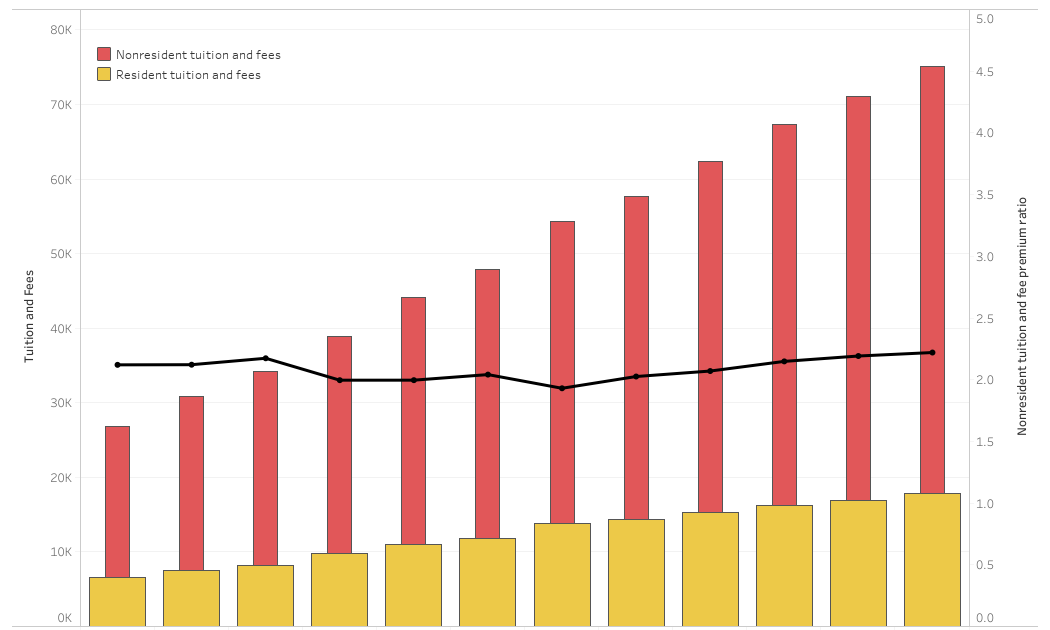
    The first view (using the tabs across the top) compares state resident full-time, first-time, undergraduate tuition and required fees (yellow) to those for nonresidents (red bar). The black line shows the gap ratio.  For instance, if resident tuition is $10,000 and nonresident tuition is $30,000, the gap is $20,000, and that is 2x the resident rate.  The view defaults to the University of Michigan, but don’t cheat yourself: Us the filter at top left to pick any other school. If you’ve read this blog before, you know why Penn State is showing strange data.  It’s not you, it’s IPEDS, so don’t ask.)

    The second tab shows four data points explicitly, and more implicitly.  This view starts with the University of Montana, but the control lets you change that.  On top is resident tuition (purple) and resident tuition and fees (yellow). Notice how the gap between the two varies, suggesting the role of fees in the total cost of attendance.  The bottom shows those figures for nonresidents.

    The third view looks a little crazy. Choose a value to display at top left, and the visualization will rank all 77 institutions from highest to lowest.  Use the control at top right to highlight an institution to put it in a national context.  Hover over the dots for details in a popup box.  If you want to look at a smaller set of institutions, you can do that, too, using the filters right above the chart.  The fourth view is the exact same, but shows the actual values, rather than the rank.  As always, hover for details.

    Finally, the fifth view is a custom scatter plot: Choose the variable you want on the x-axis and the variable to plot it against on the y-axis.  Then use the filters to limit the included institutions. As always, let me know what you find that’s interesting.

    Source link