Tag: female

  • Feel burned out? Ruth C. White, PhD on burn out for female academics

    Feel burned out? Ruth C. White, PhD on burn out for female academics

    We’re back with Dr. Ruth C. White to talk about her life beyond academia. Join us for this conversation about why female academics suffered through the pandemic, and why they are feeling so burned out.

    What is burnout? Why are women academics especially feeling it in 2025?

    Ruth C. White, PhD, MPH, MSW, RSW is on a mission to help women find success that feels like them.

    Dr. White’s career has taken a meandering path with success in many roles. She has worked as a social worker in the USA, Canada and the UK, and gave up tenure in the social work program at Seattle University to teach in the ground-breaking virtual program at the University of Southern California. Yes… She gave up tenure! Then she left academia for a role as a DEI executive at a Silicon Valley tech firm, and followed up with another DEI role in academia.

    Ruth C. White, PhD, MPH, MSW, RSW

    Ruth is the author of four books, and has written articles on mental health for Harvard Business Review, Fast Company, and Tracy Anderson Magazine. She built a consulting practice in DEI and mental health, with clients such as PwC, Indeed, JPMorgan Chase, Premera Blue Cross, Aetna, Applied Materials, Protiviti, Gainsight, among others. Since 2020, Dr. White has appeared 30+ times as a mental health commentator on KRON4-TV Bay Area, and she has also appeared as an expert on The Today Show, BBC, podcasts, and radio. Her groundbreaking research on the LGBTQ+ community in Jamaica, led her to be an expert witness in more than a dozen cases in collaboration with Yale, Columbia and NYU Law Schools, and advocacy groups across the USA.

    In addition, Ruth has a modeling career, that has included major campaigns, and representation by agencies in Toronto, San Francisco, Paris and London. Recently she merged her love for words and travel to become an in-demand travel writer, with articles in CN Traveler UK & US editions.

    And she accomplished all this as a mom with an atypical brain: one labeled with ADHD and bipolar disorder. Her sense of adventure has led to PADI diving certifications, kayaking across San Juan Islands and rapids on the White Nile and Pacuare, hiking solo up Mt. Ellinor, and racing sailing boats in the San Francisco Bay for several years. She is also competent with crochet hooks, knitting needles and sewing machines.

    Source link

  • Alabama A&M Names Thai Floyd as First Female Football Play-by-Play Announcer

    Alabama A&M Names Thai Floyd as First Female Football Play-by-Play Announcer

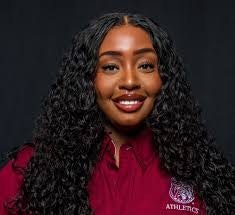
    Thai FloydAlabama A&M University has broken new ground in collegiate sports broadcasting by appointing Thai Floyd as the first woman to serve as the football team’s full-time play-by-play announcer. The historic appointment also makes Floyd the first woman to hold this position at any Historically Black College and University (HBCU) nationwide.

    Floyd will serve as the voice of the Bulldogs throughout the 2025 season at the Huntsville, Alabama institution, which competes in the Southwestern Athletic Conference (SWAC). Her appointment represents a significant milestone in diversifying sports broadcasting at the collegiate level.

    A Florida A&M University alumna, Floyd brings broadcasting experience to her new role. She previously worked as a digital media specialist for Alabama A&M athletics and has covered sporting events across high school, college, and professional levels. Her portfolio includes work as a sideline reporter and play-by-play commentator for ESPN+ and ESPNU, with assignments covering FBS bowl games and the Celebration Bowl.

    Floyd’s work has been featured across major media platforms including NBC Sports Philadelphia, HBCU Legends on Sports Illustrated, and ESPN’s Andscape, establishing her as a respected voice in sports journalism.

    Floyd’s path to the broadcast booth was influenced by her father, William Floyd, a Super Bowl champion with the San Francisco 49ers who transitioned to broadcasting after his NFL career. 

    “I grew up watching my dad work as a broadcaster after he retired from the NFL, so I’ve been around the game and the business my whole life,” Floyd said.

    Her long-term aspirations extend beyond her current role. 

    “I’d love to call college football on TV one day — that’s definitely the goal. Just staying focused, learning, and trusting the process,” she said.

    Floyd’s appointment comes at a time when female representation in play-by-play announcing remains limited. Research indicates that women comprise approximately nine percent of play-by-play announcers in sports broadcasting. Notable pioneers include Beth Mowins, who became the first woman to call a nationally televised NFL game, and Tiffany Greene, the first African American woman to serve as a play-by-play commentator for college football on a major network.

    Floyd views her role as part of a broader movement toward inclusivity in sports media. 

    “Having a seat at the table means making space for every Black woman who’s ever been overlooked or told she didn’t belong in this industry,” she said. “I’m just blessed to be walking in purpose and hoping my journey reminds the next Black woman that we’re not here to fit in — we’re here to take up space and change the game.”


    Source link

  • Top female district leaders share do’s and don’ts of climbing the professional ladder in 2025

    Top female district leaders share do’s and don’ts of climbing the professional ladder in 2025

    Key points:

    Professional growth is often at the top of New Year’s Resolution lists. As educators and education leaders plan for the year ahead, we asked some of the nation’s top female school district leaders to give fellow women educators the do’s and don’ts of climbing the professional ladder. Here’s what they said.

    Do: Believe in yourself.

    Though women make up 76 percent of teachers in K-12 school settings, just a small percentage of women hold the most senior role in a district. But the climb to leadership isn’t an easy one; women in educational leadership report a range of biases–from interpersonal slights to structural inequities–that make it difficult to attain and persist in top positions.

    Professional groups like Women Leading Ed are working to change that by highlighting long standing gender gaps and calling for policies and practices to improve conditions at all levels. Female education leaders are also working to rewrite the narrative around what’s possible for women educators and encouraging their peers.

    Among those education leaders is Shanie Keelean, deputy superintendent of Rush-Henrietta Central School District in New York. When asked to share advice to her peers, she said, “You just have to continually push yourself forward and believe in yourself. So very often women, if they don’t check all the boxes, they decide not to go for something. And you don’t have to check all the boxes. Nobody knows everything in every job. You learn things as you go. Passion and energy go a long way in being really committed.”

    Nerlande Anselme, superintendent of Rome City School District in New York, agreed: “We have directors in this field, we have coordinators in this field, we have psychologists who are doing amazing work, but they will dim themselves and figure that they cannot get to the top. Don’t dim your light.”

    Don’t: Keep your career goals a secret.

    When you decide to pursue a leadership position, don’t keep it a secret. While it may feel “taboo” to announce your intentions or desires, it’s actually an important first step to achieving a leadership role, said Kathleen Skeals, superintendent of North Colonie Central School District in New York.

    “Once people know you’re interested, then people start to mentor you and help you grow into the next step in your career,” Skeals said.

    Kyla Johnson-Trammell, superintendent of Oakland Unified School District in California, echoed: “Make your curiosity and your ambition known. You’ll be pleasantly surprised how that will be received by many of the folks that you work for.”

    Do: Find a strong mentor.

    A strong mentor can make all the difference in the climb to the top, leaders agreed.

    “Seek out a leader you respect and ask for a time where you could have a conversation about exploring some possibilities and what the future might bring to you,” said Mary-Anne Sheppard, executive director of leadership development for Norwalk Public Schools in Connecticut.

    It’s especially helpful to connect with someone in a position that you want to be in, said Melanie Kay-Wyatt, superintendent of Alexandria City Public Schools in Virginia. “Find someone who’s in the role you want to be in, who has a similar work ethic and a life that you have, so they can help you,” she said.

    Don’t: Be afraid to ask questions.

    “Start asking a lot of questions,” said Keelean. She suggested shadowing a mentor for a day or asking for their help in creating a career map or plan.

    And don’t be afraid to take risks, added Johnson-Trammell. “Could you get me 15 minutes with the superintendent or the chief academic officer?”

    Do: Build your skill set and network.

    “Increase your impact by developing relational skills and leadership skills,” said Rachel Alex, executive director of leadership development of Aldine Independent School District in Texas.

    And cultivate a network, said Heather Sanchez, chief of schools for Bellevue School District in Washington. “We can’t do it alone. Find that network, cultivate that network.”

    Don’t: Give up.

    “People are always going to tell you no, but that does not stop you,” said Kimberley James. “Continue to live beyond the noise and the distractions and stay focused on what it is that you want to accomplish for our students.”

    “I would say to any woman aspiring to any level of leadership that first of all, never sell yourself short,” said Sanchez. “You have it in you.”

    Interviews were conducted as part of the Visionary Voices video series. Responses have been edited for clarity and brevity.

    Latest posts by eSchool Media Contributors (see all)

    Source link

  • New Research Shows Women in the Leadership Pipeline in Higher Education Have Better Representation and Pay in Institutions With Female Presidents and Provosts – CUPA-HR

    New Research Shows Women in the Leadership Pipeline in Higher Education Have Better Representation and Pay in Institutions With Female Presidents and Provosts – CUPA-HR

    by CUPA-HR | January 24, 2022

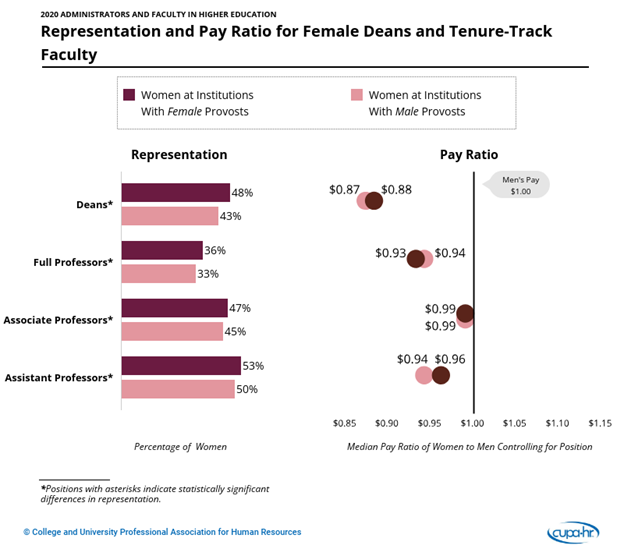
    New research by CUPA-HR has found that U.S. colleges and universities with women presidents or provosts have higher representation of women in administrative, dean and faculty positions than institutions led by men. The study also found that colleges and universities with women presidents have higher pay for women in administrative positions than institutions led by men. These positions tend to be pipelines for the senior-most executive positions in higher ed, which underscores the significance of the findings.

    Women Administrators Pay and Representation in Institutions With Female Presidents

    Findings show that institutions with female presidents have a higher percentage of women in all administrative categories — senior institutional officers, institutional administrators and heads of divisions. Although female administrators are generally paid less than male administrators in the same positions regardless of the sex of the president, female senior institutional officers, institutional administrators, and heads of divisions are paid more equitably at institutions with a female president than at institutions with a male president.

    Female Deans and Faculty Pay and Representation in Institutions With Female Provosts

    Institutions with female provosts have a significantly higher representation of women in dean positions and in all faculty ranks. Provost sex does not have a strong or consistent impact on pay equity for deans and faculty; however, it is worth noting that better representation at higher faculty ranks and in dean positions has an impact on pay, as these positions make higher salaries.

    The representation of women drops with successive faculty ranks (from assistant to associate to full professor). These promotions represent the few times in a faculty member’s career when appreciable salary increases are granted. If women are not being promoted, they are not receiving these pay raises. In addition, those in dean positions are generally promoted from senior faculty ranks. Therefore, if women are not adequately represented in senior faculty, they will not have the same likelihood as men of being considered for a higher-paying dean position.

    To sum up the findings, higher ed institutions with female executives have better representation of women throughout their institutions in positions that: a) are paid higher salaries and b) serve as key points in the executive leadership pipeline. Jackie Bichsel, CUPA-HR’s director of research and co-author of the new report, noted that, “In an era where institutions are adapting to shifting workforce expectations, adjusting to continuous decreases in budgets, contemplating changes in enrollment, addressing challenges of recruitment and retention, and rethinking their mission, more openness to change and less tolerance of risk may be just what is needed to navigate this new landscape. Providing more (and more equitable) opportunities for women to advance within higher education seems an obvious path forward in this navigation.”

    Read the full report, Women in the Leadership Pipeline in Higher Education Have Better Representation and Pay in Institutions With Female Presidents and Provosts.


    Source link