Tag: fight
-

What do we do? Stand up fight back (AFT Higher Education)
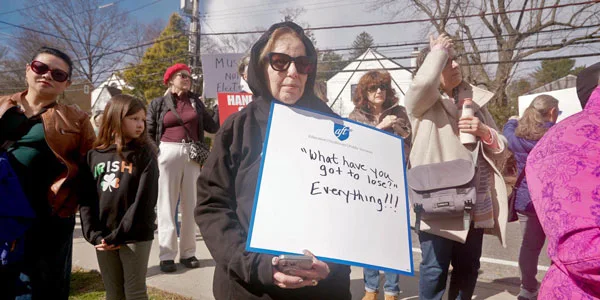
President Donald Trump has declared war on America’s colleges and universities, demanding they bow to his demands on what they can teach and whom they can admit or hire. Trump’s illegal and autocratic actions are tantamount to a war on knowledge intended to make schools bend the knee to his ideology and chill free speech and academic pursuit. In her latest column, AFT President Randi Weingarten debunks the lie that Trump’s punitive behavior toward universities and students has anything to do with fighting antisemitism.
In early March the Trump administration froze $400 million in federal funding for scientific research at Columbia University, citing antisemitism and referencing pro-Palestinian protests on campus. The AFT has members at Columbia, but the implications are far broader as other institutions are also targeted. The AFT and the American Association of University Professors have filed a lawsuit to stop interference with academic freedom and research. This AFT Voices post features three professors who are affected by the funding cuts. “Trump’s administration has terminated and taken hostage our grants, igniting frictions around issues of free speech and discrimination,” writes one, though academic activism is giving her hope.
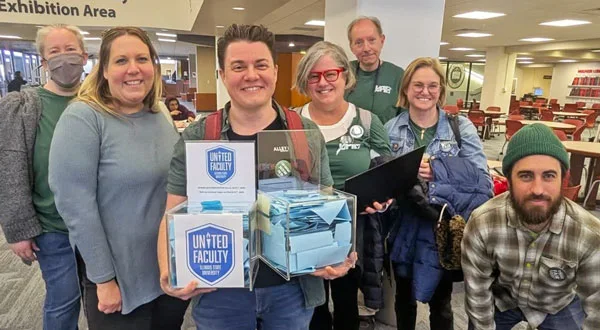
The AFT’s higher education affiliates have been generating a flurry of activity: This fast-growing sector of our union has two brand-new affiliates, at Ohio University and Nevada State University, and five affiliates that are celebrating groundbreaking contracts. In a landscape that includes relentless attacks on higher education funding and academic freedom, these gains are especially significant and show the importance and promise of union solidarity. Above, United Faculty of Illinois State University members show their strike authorization ballots, one step on their way to their new contract. Read more here.
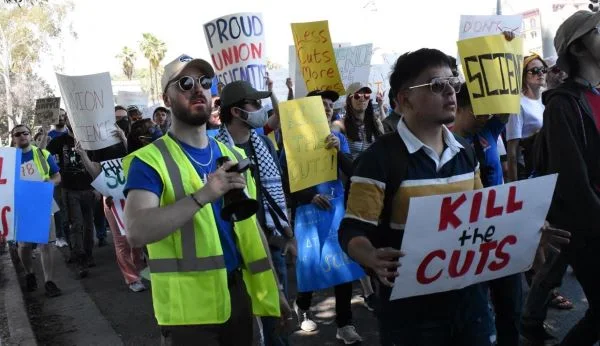
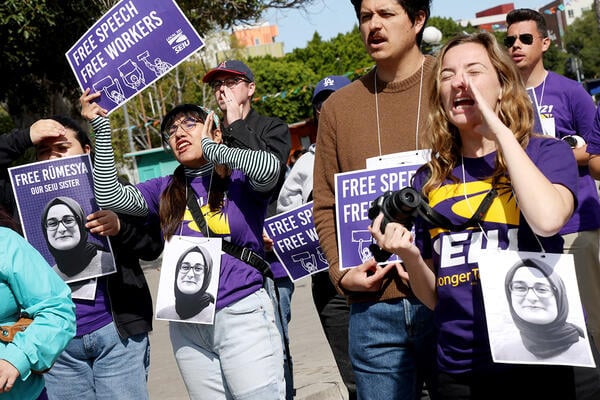
On April 5, hundreds of thousands of people flooded the streets in more than 1,300 “Hands Off!” peaceful protests in cities across all 50 states. The message was clear and thunderous: Enough is enough. Protesters demanded an end to the escalating authoritarianism and attacks on everyday Americans led by President Donald Trump and Elon Musk. Then on April 8, thousands more—many of them associated with colleges and universities—stood up to say “Kill the Cuts” to education and scientific research. Turnout—including AFT members from coast to coast—signaled a growing, powerful movement ready to defend democracy, civil rights, public education and academic freedom. Above, unionists march in Los Angeles. Photo: AAUP.
This month, President Donald Trump announced the highest and most wide-ranging tariffs—taxes on goods that Americans buy—since President Herbert Hoover’s Smoot-Hawley Tariff Act, which made the Great Depression worse. Trump’s tariffs apply to every one of our nation’s trading partners. And the chaos has come quickly: stock markets in freefall, business confidence at the lowest level since the 2008 financial crisis, respected economists warning that a recession is likely, and higher prices for Americans. What explains this seemingly self-destructive attack on our nation’s economy? Read this AFT Voices post by AFT President Randi Weingarten and Damon Silvers for understanding and a way forward.
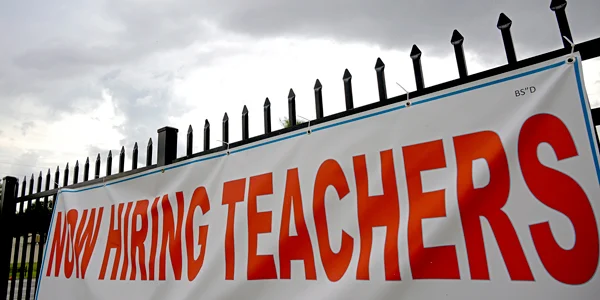
Just when the teacher shortage is at its worst, university programs that prepare new teachers to fill the gap have been shuttered by the Trump administration: In February, the Department of Education abruptly axed $600 million in Teacher Quality Partnership and Supporting Effective Educator Development grants established by Congress specifically to bolster the teacher workforce. Read this AFT Voices account from faculty members who are feeling the cuts and teachers experiencing staff shortages in their North Florida schools. -

OPINION: Policy changes sweeping the nation are harming our students. Educators must fight back
Here’s a true story from North Carolina. Two elementary school children under the age of 10 waited for their parents to come home. We know they cleaned the dishes; the house was immaculate when someone finally came.
The children did not attend school for a number of days. After three days, someone from their school reached out to a community member with concern for their well-being.
While they were home alone instead of in school, the children made their own food and drank water. Their parents, who had been detained by ICE, had nurtured these skills of independence, so the children were not yet hungry or thirsty when someone finally came.
Similar scenes are likely happening across the U.S. as President Trump aggressively steps up efforts to deport undocumented immigrants. The new policies sweeping the nation deeply affect and harm our children.
Related: A lot goes on in classrooms from kindergarten to high school. Keep up with our free weekly newsletter on K-12 education.
Teachers: This is the moment when we need to rise to the occasion, because children are being wronged in uncountable ways. Protections that allow them to express their gender identities are under threat. Their rights to learn their diverse histories and understand the value of their communities are being chipped away bit by bit.
These threats, one at a time, layer after layer, amount to profound harm. So let us be especially vigilant.
The responsibility to challenge these threats cannot fall solely on the shoulders of individual teachers. We must have systems in place that allow us to swiftly raise concerns about student well-being.
Schools, districts, and states must provide resources and structures — like wellness checks, counseling and communication with community services — that allow us to act swiftly when the safety of our students is at risk.
As public servants, we must live out our charge to protect and advocate for the children we serve by taking immediate action to ensure their safety in whatever ways we are able. That means actively noticing when students are missing and when they are struggling.
Public education has long wrestled with the role of politics in schools. No matter how we answer questions about political content, educators have been unified in the goal of nurturing children’s thinking and flourishing.
Our state constitution and many others’ declare that all children are entitled to a “sound basic education,” and our professional responsibilities extend to their safety. In North Carolina, the first category of the code of ethics for educators pertains to professional ethical commitments to students.
To uphold these professional commitments, the educator “protects students from conditions within the educator’s control that circumvent learning or are detrimental to the health and safety of students.”
This protection must be more than theoretical. When our students are at risk, we have our constitutional guarantees and ethical commitments.
The brutal example of the children whose parents were taken away is one of many. We cannot fathom all that the children needed to know in order to survive those harrowing few days alone in their home. We do know they were ready.
We can assume that perhaps they read their favorite books or calculated measurements while cooking themselves dinner, utilizing skills they learned in our classrooms. What we do know is that the knowledge taught to them by their families and community ensured their safety.
The community member who ultimately went to check in on the missing students used a “safe word” — one that the children had been taught to listen for before ever opening their door to a stranger.
The children did not open the door until that word was spoken. Hearing that word, they reportedly asked: “Are Mommy and Daddy OK? ICE?”
These are the lessons young children are living by today. Safe words to protect themselves from adults who prey on their families. Skills of survival to hide at home, cooking and caring for themselves without seeking help from others if they find themselves alone.
Related: Child care centers were off limits to immigration authorities. How that’s changed
A protective silence now envelops all the children in the community where those parents were seized. An example has been made and now those in their community are hiding in fear or fleeing. The idea that this example is a model to be followed is a transgression of our ethical compact to care for these children, who are no longer in school, due to their fear, hiding with family members.
Recognizing, acting on and speaking back to this injustice is precisely the sort of resistance and professionalism that binds our practice as educators. It is what we write of today.
The children were ready. Educators need to be as well.
We must use our voices to illuminate the harm being done to the children we know, honor and teach. Let us replace silences with spoken truths about their power and ours to survive and to resist; let us live out the expectation that public service must be enacted with humanity.
We have a professional responsibility to not look away. This is not just a moral argument. We are their teachers, and we must ask: How will the students in my classroom survive? And how can we help them?
Simona Goldin is a research professor in the Department of Public Policy at the University of North Carolina. Debi Khasnabis is a clinical professor at the University of Michigan’s Marsal School of Education.
Contact the opinion editor at [email protected].
This story about Trump administration policy changes and students was produced by The Hechinger Report, a nonprofit, independent news organization focused on inequality and innovation in education. Sign up for Hechinger’s weekly newsletter.
-

FAQ: Responding to common questions about the fight between Harvard and the Trump administration
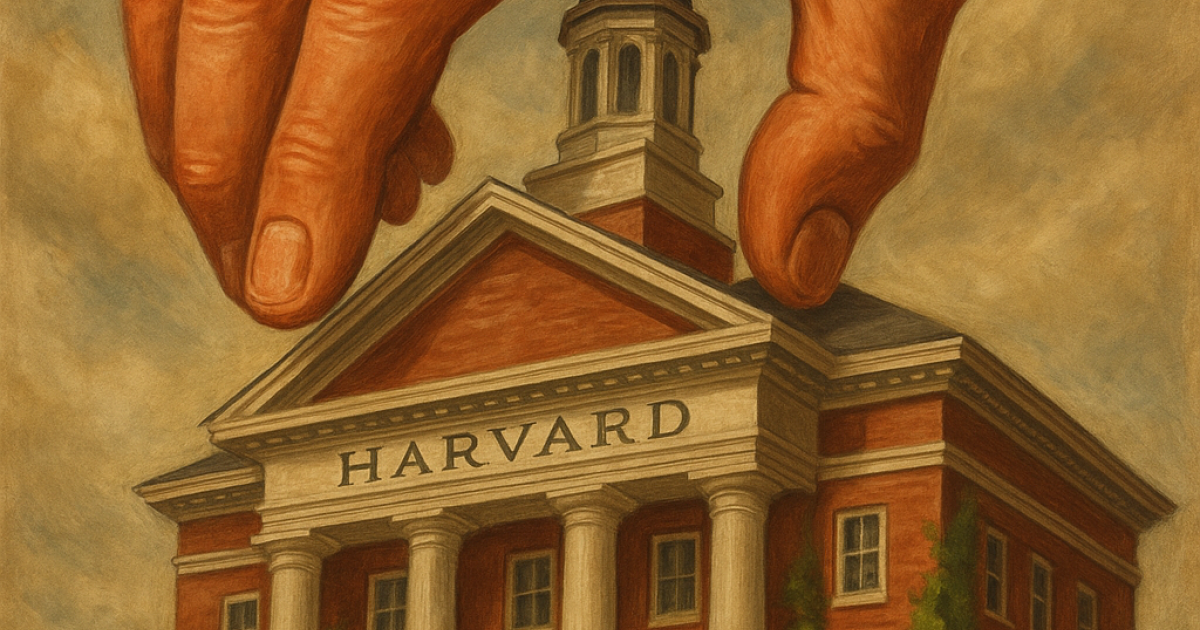
On April 21, 2025, Harvard University filed a lawsuit against the Trump administration after the federal government froze $2.2 billion in federal research funding with threats of more cuts to come. The administration claimed Harvard failed to address anti-Semitism on campus, especially in the aftermath of Hamas’ attack against Israel on Oct. 7, 2023, and issued a list of demands in exchange for lifting the freeze.
These demands included adopting an ideological litmus test for foreign students, a comprehensive mask ban, an audit of disfavored academic departments, mandated reforms to the university’s internal governance structure, and eliminating diversity programs. Harvard argued that these demands and the funding cuts that followed violated its institutional autonomy and constitutional right free speech and academic freedom. In the lawsuit, the university is asking the court to restore its funding and block the government from imposing such requirements in the future.
FIRE agrees that the Trump administration’s approach is unlawful. Below are answers to some common questions we have received about the situation.
Harvard isn’t entitled to federal funds. Why is FIRE defending it?
You’re right. Harvard isn’t entitled to federal funding. No institution is.
But Harvard — just like you (or FIRE, or any person or organization) — is entitled to a federal government that follows the law. And just as the law gives us certain protections, it also says the government can’t cancel funding on a whim, like the administration did last week.
Let’s take a closer look.
The vast majority of colleges and universities receive federal funds. These funds mostly consist of financial aid, like Pell grants, and grants for scientific and medical research. Of the $9 billion reportedly under review by the Trump administration, the Harvard Crimson estimates over $6 billion comes in the form of funding for five regional hospitals associated with the university, along with $2.7 billion in research funding at the university itself.
To be eligible to receive federal funding, institutions pledge to follow federal anti-discrimination laws. Those laws include Title VI, the federal law that prohibits colleges and universities from discriminating on the basis of race, color, and national origin. Since the George W. Bush administration, the federal government has interpreted Title VI as prohibiting anti-Semitic discrimination, too.
So far, so good. Colleges get government funding for students and research. The federal government in return gets (among other things) a commitment that those colleges won’t engage in or tolerate discrimination. That’s the deal.
And the deal has rules to protect colleges, the government, and the taxpayers who foot the bill from being negatively affected by arbitrary decisions. Before the federal government can pull funds from an institution, it has to take a series of steps.
First, the Department of Education must investigate complaints about discrimination. If it finds problems, ED is required to work with an institution to address those problems “by informal means whenever possible.” This is the most common process, where the department’s Office for Civil Rights enters into a “resolution agreement” with an institution to ensure compliance with Title VI.
If that doesn’t work, for whatever reason, here’s what happens next. In order to strip federal funding, the department must give notice to the institution again and provide an opportunity for an administrative hearing where the institution can challenge the determination. If the determination stands, ED then has to report this to Congress and give 30 days’ notice before it actually terminates funding to the affected programs. ED may also refer the matter to the Department of Justice for litigation.
In short, one way or another, the federal government is going to have to provide evidence and prove its case if it wants to pull out of the deal.
Those are a lot of steps, but they’re important. They protect students by making sure colleges live up to their obligations. And they protect colleges by making sure they have an opportunity to contest the allegations as well as a chance to make things right.
These rules are also important because they provide a safeguard against political bias, risk of error, and governmental overreach.
Even the federal government acknowledges the role of due process and following existing statute. In a federal court filing earlier this month, the government wrote, “But ED’s only power is to withhold funding from institutions receiving federal funding, after a robust process required by statute and aimed at ensuring compliance.” In that same court filing, the government reiterated that point, writing that “by statute and regulation, numerous steps aimed at ensuring compliance must occur before ED may withdraw funding.”
Without these rules, an administration could, for example, decide to dramatically expand the definition of “sexual harassment” to include core protected speech and to remove due process protections from sexual misconduct hearings, using the threat of federal funding to force schools to go along with it. That’s exactly what happened under President Obama — and FIRE fought back.
And without these rules, nothing prevents the federal government from arbitrarily declaring a university in violation of federal law, yanking federal funding, and demanding fealty and censorship.
That’s what President Trump is doing now. And again, FIRE is fighting back.
Is FIRE saying that what happened to Jewish students at Harvard and other colleges is OK?
No. As FIRE has consistently noted, some campus protests veered into violations of both campus rules and the law. Examples include when protesters took over buildings, blocked access and exit to and from areas of campus, disrupted classes, or committed acts of violence against Jewish students.
In responding to these incidents — or failing to respond — Harvard, Columbia, and other colleges may well have been in violation of their obligations under Title VI. If they refused to correct their mistakes as the process played out, revoking their funding might have been justified and legal.
But the process matters.
What FIRE is saying is that the law is important. Following it isn’t optional. It protects all of us — students, faculty, administrators, families, scientists, hospitals, and the entire country. The administration can’t just decide unilaterally to skip steps.
If you support President Trump — or just don’t like Harvard — remember this: Any power the president seizes to ignore the law now won’t magically disappear when he leaves office. It will be wielded by his successors, too. And this time, it might well target schools or other organizations you like.
Didn’t Harvard rank last for free speech on your list?
It sure did — two years in a row, in fact.
But one of the reasons we created our rankings was to give colleges and universities an incentive to do better. Protecting expressive rights on campus is a big part of our mission, and Harvard has a long way to go. Indeed, Harvard (like Columbia) makes a politically popular target precisely because so many people resent its years of engaging in the kind of behavior towards dissenting students and faculty that FIRE was founded to combat.
But lately Harvard has been making an effort, and we won’t succeed by writing schools off. And we definitely won’t succeed by allowing the federal government to take them over, trading one dominant ideology for another.
You can’t censor your way to free speech.
-

Boards Must Fight for Institutional Independence (opinion)
The academy is facing a crisis of confidence. Where shared governance once nurtured robust debate and institutional progress, a climate of fear is taking hold, stifling dialogue and endangering the very mission of higher education. Decision-makers, ensnared in an atmosphere marked by uncertainty, are both terrified to act and paralyzed by inaction. They are troubled by a well-orchestrated effort that seeks to fundamentally alter higher education, forcing the sector into a state of existential terror for the foreseeable future. Consequently, we are witnessing a shift from shared governance to scared governance, and the consequences are profound.
At present, presidents seem to be thunderously quiet, boards approach critical issues with trepidation and faculty members feel suppressed in their teaching and research. The insidious costs of these constraints—the lost opportunities, the stifled innovation, the further erosion of trust—are staggering. These costs must be exposed to public scrutiny, as they are not confined to higher education. The repercussions of external intrusion will manifest in every facet of our society.
Governing boards—guardians of institutional mission and values—must recognize the gravity of this moment. This isn’t simply about diversity, equity and inclusion, though the attacks on DEI initiatives are a major part of the problem. This is about institutional independence, the freedom to pursue knowledge and the very DNA of our nation’s colleges and universities. Too often board members have permitted faculty or presidents to take the lead in governance and have used shared governance as an excuse, explanation or cover for their own lack of involvement. They have successfully hidden in plain sight.
Governance, however, is not a spectator sport. Boards have to champion the preservation of institutional independence and recognize that inaction under the guise of shared governance is still inaction. They cannot afford to be passive observers, expecting others to shoulder the burden of defending the institution’s core values while they remain detached. This is not a middle school group project; everyone has to participate or we will all fail the assignment.
The threats are widespread: curricula are under siege, co-curricular life is being dismantled, research programs are targeted, medical schools are undermined and free speech is gagged. This is not a series of isolated incidents; it is an orchestrated campaign to upend the foundations of higher learning, and it demands a unified, unwavering response.
The responsibility falls on governing boards to work with presidents to answer (clearly and immediately) some key questions:
- What principles defined our institutions before the current political climate?
- Do we still stand for these principles? If so, how can we hold fast to them now?
- What price are we willing to pay to uphold those foundational values?
- If we abandon our values now, what remains of our institutional identity?
Autonomy is not merely a privilege; it’s the bedrock of our academic mission. It is not only our institutional independence at stake, but our very integrity.
Many boards, understandably, are hesitant to address these challenges directly. But silence and inaction are not options. Board members are the ultimate arbiters of their institutions’ destinies. It is time to abandon the narrow focus on isolated initiatives and confront the broader, systemic assault on academic freedom and institutional autonomy. Board leadership will determine how we navigate this defining moment.
Boards of trustees are the protectors of institutional values. They carry the legacies of their institutions forward. If they fail in this duty, the consequences may be irreversible. While other higher education decision-makers respond to executive orders, policy shifts and legal rulings, the board’s role is clear and unchanging. The only uncertainty is whether members will fulfill their responsibilities in alignment with the institution’s mission.
The future of higher education depends on boards of higher education. The 1966 Statement on Government of Colleges and Universities makes it clear that “The governing board has a special obligation to ensure that the history of the college or university shall serve as a prelude and inspiration to the future … When ignorance or ill will threaten the institution or any part of it, the governing board must be available for support. In grave crises, it will be expected to serve as a champion.”
Board members: This is that moment. Your institutions—and the public they serve—are waiting for you to lead. The future of higher education depends on your courage, your convictions and your willingness to champion the values upon which your institutions were built. Will you rise to the occasion? We need you now more than ever.
We’ve recently made some suggestions for concrete actions trustees and senior leaders of institutions can take immediately to advance the great work higher education does while partnering with good-faith collaborators to address the field’s challenges. For those boards that want to be proactive and not just reactive, here are a few ideas.
One key action is to highlight the implications for resources. A public, transparent review of the university’s budget should explicitly showcase areas under threat—like research and DEI programs. To take this further, institutions could consider reallocating funds from traditionally “untouchable” areas, such as athletics, to fortify initiatives focused on inclusivity and academic freedom. Publicly challenging politicians to justify cuts in the face of these demonstrated priorities could push the conversation beyond rhetoric.
Fundraising strategies also need reimagining. Universities could launch targeted campaigns specifically designed to offset federal funding cuts and support programs under siege. A bolder approach might frame these efforts as “impact investments,” emphasizing the societal returns on supporting research and DEI. This reframing could inspire donors who care deeply about the university’s role in shaping a more equitable future.
Equally important is stressing the human cost. Universities should conduct and publish comprehensive reports that quantify the real-world consequences of funding cuts—measuring lives impacted, medical treatments delayed, rising attrition rates and mental health issues among students and staff. Presenting these findings to legislators and the public forces a direct reckoning with the human toll of these policy decisions. The facts, laid bare, can speak louder than fear.
Finally, institutions must build collective strength through research consortia. By forming inter-institutional partnerships to pool resources and expertise, universities can ensure the continuation of vital research projects at risk. A more assertive stance could position these consortia as a direct counter to political interference, underscoring the importance of academic inquiry free from external pressure.
The path forward is clear: Governing boards must lead with transparency, strategy and courage. Higher education’s survival—and its ability to serve the public good—depends on it.
-

As Universities Yield to Trump, Higher Ed Unions Fight Back
From the day he retook office, President Donald Trump’s campaign to disrupt higher education has been unrelenting. He’s targeted diversity, equity and inclusion. His administration slashed more than a billion dollars in federal grants and contracts for universities, and it plans to cut more. It’s also attempted to deport pro-Palestinian international scholars, accusing them of sympathizing with terrorism.
Prominent—or infamous—among the administration’s escalating actions was its decision last month to cut $400 million from Columbia University for allegedly failing to address on-campus antisemitism. Trump officials followed this by demanding that the university, among other things, place its Middle Eastern, South Asian and African Studies Department in academic receivership.
As the disruption has mounted, many college and university presidents have kept silent. But unions representing higher ed employees have stepped up to the plate. They’ve protested in Washington, D.C., and on their campuses, organized open letters and filed a flurry of lawsuits against the Trump administration. Union leaders say they are filling a void in an existential fight for higher ed’s future. They wish others would join their resistance, but their unified strength in numbers may protect their members from federal retaliation in ways that higher ed officials aren’t.
Concerns about higher ed’s future under Trump and calls for a forceful response to his actions pervaded a recent gathering on collective bargaining in higher ed. The conference—held in Manhattan just two days after Columbia announced it would capitulate to multiple demands the administration made—offered a snapshot into a large pocket of resistance.
We couldn’t actually be better positioned to fight back against the kind of authoritarian attacks that we’re seeing.”
—Ian Gavigan, national director of Higher Ed Labor United
William A. Herbert, executive director of the National Center for the Study of Collective Bargaining in Higher Education and the Professions, kicked off the event addressing what he has called the Trump administration’s “assault on higher education.”
“We gather today during a very perilous time. To paraphrase Tom Paine, these are the times that try our souls,” Herbert said, adding that “in this crisis, we must care for ourselves and others—particularly our students, our immigrants and others most vulnerable in this time of danger.”
He spoke to roughly 150 people gathered in the historic home of Franklin Delano Roosevelt. Invoking the wartime president’s Four Freedoms speech, Herbert said FDR’s listed freedoms—of speech and worship, and from want and fear—“are threatened more today than ever before. So it is our obligation to those who came before us to fight for freedom and to fight against tyranny.”
Rejecting nonintervention, Herbert said, “Neutrality in defense of higher education’s mission and the principles of collective bargaining is not an option. We must reject appeasement. We must reject capitulation to the enemies of higher education and collective negotiations.”
As the conference progressed last week, unions showed they weren’t capitulating. The American Association of University Professors, an organization of scholars that also represents many of them as a union, alongside the American Federation of Teachers, with which the AAUP is affiliated, filed together or individually three lawsuits against the Trump administration’s moves. These suits seek to stop the dismantling of the Education Department, end deportations of noncitizen students and faculty who demonstrated for Palestinians, and restore Columbia’s lost $400 million.
Even before last week, the AFT had sued the Education Department to stop it from enforcing a sweeping Dear Colleague letter targeting DEI, and together with the AAUP sued the department and Trump to overturn his anti-DEI executive orders. The AAUP and its partners did secure a temporary injunction blocking parts of the anti-DEI orders—an early victory—but an appeals court overturned that court order. (Other higher ed groups and unions have sued, but the AAUP and AFT are involved in multiple lawsuits that Inside Higher Ed is tracking.)
Atop the litigation, presidents and members of those unions and others—such as the United Autoworkers, a major organizer of graduate student workers—have rallied in Washington, D.C., against cuts to universities and federal research agencies. This week, the UAW joined other, nonunion organizations in suing to overturn the administration’s cancellations of National Institutes of Health grants.
Attempts at more national shows of force are coming. Across dozens of campuses, multiple unions are sponsoring a “Kill the Cuts” day of action on April 8, focused on reversing the NIH cuts and other federal funding reductions, followed by a more general protest April 17. It all adds up to campus unions taking a public stand where administrators largely haven’t.
“I think that labor needs to fill the vacuum of leadership we’re seeing in the sector,” said Todd Wolfson, national president of the AAUP. “I don’t see another way forward.”
A Large Presence
Expecting powerful resistance from labor organizations might seem irrational in the U.S., where union membership among workers over all dropped to 10 percent in 2024—a record low since data collection began in 1983. But the picture is starkly different when you look at faculty and grad student workers alone.
Bucking the national trend, grad workers’ unionized ranks increased 133 percent from 2012 to the start of 2024. Roughly 38 percent of them are now unionized. That’s according to a report released last year by Herbert’s collective bargaining study center at Hunter College; Herbert said the share of unionized grad workers is even greater today, but he didn’t have an updated figure.
The number of unionized faculty also increased over that 12-year period, from roughly 374,000 in 2012 to 402,000 in January 2024. Roughly 27 percent of faculty are now unionized. And the Biden years saw a growing phenomenon of postdoctoral and undergraduate student workers unionizing. Trump has shaken up the National Labor Relations Board and experts predict a rollback in rights for union workers, but higher ed strikes are continuing into his administration in Massachusetts and California.
“We have more power now on our campuses than we’ve had in recent memory,” said Ian Gavigan, national director of Higher Ed Labor United, or HELU, and formerly a unionized grad worker himself. “And we couldn’t actually be better positioned to fight back against the kind of authoritarian attacks that we’re seeing.”
“I’m scared,” Gavigan said, but “that power gives me hope.”
The White House didn’t return Inside Higher Ed’s requests for comment.
HELU seeks to unify all types of higher ed workers—including nonacademic workers, and regardless of whether they’re unionized or not—into a single, national coalition. Gavigan spoke during a late-addition panel to the conference. (The whole conference was renamed, after Trump’s election, “Unity in Defense of Higher Education and Collective Bargaining.”)
Panelists and the audience discussed the Trump administration’s ongoing targeting of higher ed and how to respond.
“We are under absolutely relentless assault,” said Rebecca Givan, general vice president of the Rutgers University AAUP-AFT and a HELU steering committee member. “It’s constant, it’s everywhere, it’s in every direction, but it would be so much worse if we didn’t have our unions. And so we have these structures and we need to use them to fight back.”
Givan said that “none of us have been sleeping,” but “if we can’t organize within our unions to fight back, we have nothing.” She said unions have to work within state and federal politics and agencies, fighting for changes such as higher taxes on the rich to fund higher ed.
“We also have to give our university administrators a strong invitation to do the right thing,” Givan said. “And if they do not, we have to fill that leadership vacuum. We cannot let them back down. We cannot let them do a Columbia and capitulate.”
Some other higher ed groups beyond unions are resisting as well. The American Council on Education, which represents colleges and universities, has sued to stop the NIH from capping reimbursements for costs indirectly related to research. As for why many presidents aren’t publicly speaking up, Jon Fansmith, ACE’s senior vice president for government relations, told Inside Higher Ed that they have an “incredible tightrope to walk.”
“They are responsible for the jobs and livelihood of thousands—tens of thousands—of people in some cases,” Fansmith said.
They’re also responsible for the continuation of university work that includes treating patients and other important concerns. Speaking up could come at a price. Fansmith noted that the Trump administration froze about half of Princeton University’s federal grants after President Christopher Eisgruber wrote in The Atlantic that the “Trump administration’s recent attack on Columbia” represented “the greatest threat to American universities since the Red Scare of the 1950s.”
Wolfson, the AAUP president, told Inside Higher Ed that individual university presidents might not speak out because that puts targets on their backs. But there’s “no reason why we haven’t seen a letter signed by 1,000 presidents” speaking out against what the administration did to Columbia, Wolfson said.
“It’s a real disappointment,” he said, adding that “labor has to step in and be the main focal point of a strong, powerful and vigorous response to the federal government.”
-

Researchers, Higher Ed Union Fight NIH Grant Terminations
Brittany Charlton (right), a plaintiff in the lawsuit and founding director of the LGBTQ Health Center of Excellence at Harvard University, has lost multiple NIH grants amid the Trump administration’s ideological overhaul of the agency.
Suzanne Kreiter/The Boston Globe/Getty Images
Individual university researchers, a public health advocacy organization and a union representing more than 120,000 higher education workers are suing the National Institutes of Health after the agency terminated more than $2.4 billion in grants it claims support “non-scientific” projects that “no longer” effectuate agency priorities.
“Plaintiffs and their members are facing the loss of jobs, staff, and income. Patients enrolled in NIH studies led by Plaintiffs face abrupt cancellations of treatment in which they have invested months of time with no explanation or plan for how to mitigate the harm,” according to a complaint of the lawsuit filed Wednesday afternoon. “As a result of Defendants’ Directives scientific advancement will be delayed, treatments will go undiscovered, human health will be compromised, and lives will be lost.”
It’s the latest in a mounting series of legal challenges against the Trump administration’s blitz of executive actions aimed at rooting out so-called gender ideology; diversity, equity and inclusion initiatives; and alleged waste, fraud and abuse of taxpayer funds. Some of those lawsuits have already resulted in federal judges ordering injunctions and restoration of canceled grants.
But this is one of the first to directly challenge the NIH’s grant cancellations; more legal challenges are expected.
The lawsuit was filed by the American Public Health Association; the United Automobile, Aerospace and Agricultural Implement Workers and NIH-funded medical researchers from Harvard University; the Universities of Michigan and New Mexico; and the Center for Science in the Public Interest, which have all lost their grants. The American Civil Liberties Union is representing the plaintiffs.
A NIH spokesperson said that the agency doesn’t comment on pending litigation.
‘Erosion of Scientific Freedom’
The plaintiffs want the Massachusetts district court to declare the actions of the NIH “unlawful,” restore funding for at least the plaintiffs’ terminated grants and prevent the agency “from terminating any grants based on allegedly no longer effectuating agency priorities, or withholding review of applications.”
The majority of the terminated grants focused on topics related to vaccine hesitancy, climate change, diversifying the biomedical research workforce, “countries of concern” (including China and South Africa), and the health of women, racial minorities and members of the LGBTQ+ community, according to the lawsuit.
One of the plaintiffs, Brittany Charlton, who is the founding director of Harvard University’s LGBTQ Health Center of Excellence, has had five NIH grants terminated since President Donald Trump took office in January and launched a crusade to root out so-called gender ideology and diversity, equity and inclusion initiatives.
Charlton said in an email to Inside Higher Ed that she’s lost nearly $6 million in NIH grants as a result of the agency’s directives, signifying “a potential end to my academic career.”
But her motivation for signing on to the lawsuit extends beyond concern for her own livelihood.
“This isn’t just a fight for my professional survival but a stand against the erosion of scientific freedom,” Charlton said. “[The grant cancellations set] a worrying precedent where scientific inquiry becomes vulnerable to political rhetoric. The concern here is not merely academic; it affects the very foundation of public health policy and the health of vulnerable communities.”
Another plaintiff, Katie Edwards, a social work professor at the University of Michigan who researches violence prevention in minority communities, has had six NIH grants pulled this year. And a third plaintiff, Nicole Maphis, a first-generation college student and postdoctoral fellow at the University of New Mexico’s School of Medicine who researches the link between alcohol use and Alzheimer’s, is no longer in consideration for an NIH grant designed to help underrepresented researchers become faculty members.
‘Arbitrary and Capricious’
The lawsuit argues that NIH didn’t have the authority to cancel those or any of the other grants the agency claims no longer effectuate agency priorities. That’s because the “no longer effectuates agency priorities” regulatory language the NIH has cited to justify its termination of particular grants won’t go into effect until October.
Additionally, canceling the grants disregards “Congress’s express mandate that NIH fund research to address health equity and health disparities, include diverse populations in its studies, improve efforts to study the health of gender and sexual minorities, and enhance diversity in the bio-medical research profession,” according to the complaint.
The lawsuit also says that the government violated numerous aspects of the Administrative Procedure Act—including a provision prohibiting agency action considered “arbitrary, capricious, an abuse of discretion, or otherwise not in accordance with law”—when it terminated the grants. It further asserts that the agency usurped Congress’s “exclusive power over federal spending” and violated the Fifth Amendment by offering “vague” justifications for terminating grants, including involvement with “transgender issues,” “DEI” or “amorphous equity objectives.”
“Defendants have failed to develop any guidelines, definitions, or explanations to avoid arbitrary and capricious decision-making in determining the parameters of the agency’s prohibitions against research with some connection to DEI, gender, and other topics that fail Defendants’ ideological conformity screen,” the suit alleges.
That leaves grantees “unsure, for example, which areas of study they can pursue, which populations they can focus on as study subjects, what they might argue to appeal grant terminations, and what the demographics of study participants must be” and “makes it impossible to determine how to reconfigure future research to stay within the bounds of NIH’s newest ‘priorities.’”
-

Join Us on April 17, 2025 to Fight For Higher Education (Coalition for Action in Higher Education)
As campus workers and citizens, educators and researchers, staff, students, and university community members, we exercise a powerful collective voice in advancing the democratic mission of our colleges and universities. It is our labor and our ideas which sustain higher education as a project that preserves and extends social equality and the common good—as a project of social emancipation.
On
April 17, 2025, we will hold a one-day action on and around our
campuses to renew this vision of higher education as an autonomous
public good, and university workers as its most important resource.Free Higher Ed Now! will
demand FIRST that public higher education in the U.S. be fully funded,
politically independent, and FREE to all students and SECOND that higher
ed be FREE of political interference that reduces the rights and
autonomy of campus workers and students to teach, study, learn, speak,
organize, and dissent. Read and endorse our agenda here. -

The Fight for Democracy in America (CUNY School of Labor and Urban Studies)
Fri. March 7 — 12:00pm-1:30pm:
“From Multiracial Democracy to Multiracial Fascism?:
What is the Future of the American Experiment?”
Guest Speakers:
Alexis McGill Johnson (she/her) – President and CEO,
Planned Parenthood Federation; Planned Parenthood Action Fund
Eric Ward (he/him) – Executive Vice President, Race Forward
Dorian Warren (he/him) – Co-President, Center for Community Change; Community Change Action
Moderator:
Alethia Jones (she/her) – Director, Civic Engagement and Leadership Development, CUNY School of Labor and Urban Studies