Tag: Fights

  • SUNY Service Corps Fights Food Insecurity in New York

    SUNY Service Corps Fights Food Insecurity in New York

    As food insecurity continues to rise across New York, the State University of New York’s public service program has stepped in to address the growing need.

    The SUNY Empire State Service Corps, a paid, student-driven initiative with more than 500 members, has ramped up its on-the-ground efforts in recent months.

    Launched in May 2024, the group was funded with $2.75 million from the state budget and is New York’s largest AmeriCorps program. SUNY Corps students assist New York residents in high-need communities with K–12 tutoring, Supplemental Nutrition Assistance Program and basic needs outreach, peer mental health support, sustainability projects, hate and bias prevention, nonpartisan civic engagement, and FAFSA completion.

    SUNY chancellor John B. King Jr. said the program played an integral role during the federal government shutdown this fall as New York residents faced cutbacks to federal food-assistance benefits.

    “The threats to the SNAP program presented a huge challenge for New York,” King said. “Many of our food pantries saw a significant uptick in usage before the shutdown, and then certainly during the shutdown as people anticipated not being able to access SNAP benefits.”

    SUNY chancellor John B. King Jr. (center, in light blue shirt) joins students and staff as they pack backpacks with supplies for New York elementary students.

    State University of New York at Binghamton

    In response, New York governor Kathy Hochul provided $200,000 in additional funding to bring on more SUNY Corps students to help families at risk of losing aid. The funding will support the added students for the remainder of the academic year.

    King said the additional paid hours were essential and allowed campuses to quickly mobilize students to support food pantries and community centers.

    “Many of our students know what it’s like to be in a situation where your family finances feel incredibly fragile,” King said. “So when our students see classmates who are food insecure, who are skipping meals in order to make ends meet or who are distracted in class because they’re hungry, they worry a lot about them.”

    Inside the Service Corps

    SUNY Corps students dedicate at least 300 hours to paid community service and are eligible to receive an AmeriCorps Segal Education Award of up to $1,500.

    “They’re from every part of the state, every socioeconomic background, every ethnic background, every faith background, and they are excited to work together to make the community better,” King said. “It’s exactly what we should be doing in higher ed, and it’s exactly what we need as a country.”

    More than 500 students from 45 SUNY campuses participated in the program this year, and interest continues to outpace availability; applications exceeded campus placements by more than three to one over the last two years.

    Sarah Hall, an Empire State Service Corps coordinator and senior assistant director at the State University of New York at Binghamton, said her campus received more than 200 applications for just 50 spots this year.

    “Every time I talk to a student who is part of our Empire State Service Corps, you can really feel how meaningful this is to their own personal and professional growth,” Hall said. “I really think this is setting them on a path of service in their future.”
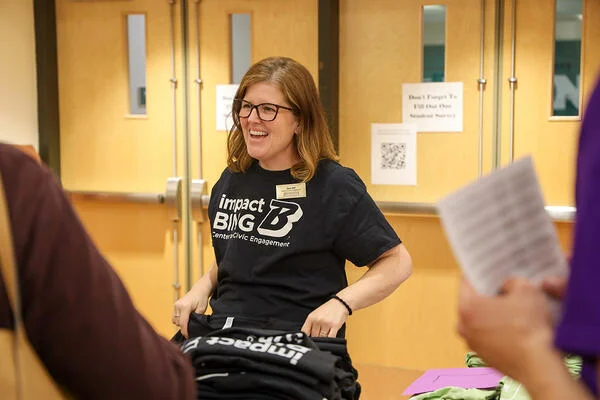
    Sarah Hall, an Empire State Service Corps coordinator at SUNY Binghamton, a white woman with shoulder-length brown hair, wearing glasses and a black Impact Bing T-shirt.

    Sarah Hall, an Empire State Service Corps coordinator at SUNY Binghamton.

    State University of New York at Binghamton

    Following the federal government shutdown, Hall said, her students quickly mobilized a meal kit assembly effort after Hochul provided the additional funding.

    “We purchased over $4,000 worth of food … so when families go to a pantry or food bank, they’re able to just pick up an entire meal that will feed a family of four,” Hall said, adding that her students put together more than 560 kits.

    Beyond Binghamton, the first cohort of SUNY Corps students statewide, logged over 100,000 hours of service and served more than 70,000 New York residents during the 2024–25 program year.

    “It’s a reflection that young people really want to serve and want to contribute to the community and are eager for these opportunities,” King said.

    What’s Next

    The chancellor said the government shutdown underscored how essential sustained investment in public service programs will be in the years ahead.

    “I’d love to see federal investment in this space,” King said. “There continues to be bipartisan support for the AmeriCorps program, so my hope is that we can continue to grow national service efforts around the country.”

    He noted that New York was recently selected as one of four states—along with California, Colorado and Kentucky—to join the Service Year Alliance, an inaugural cohort seeking to grow the number of paid service opportunities throughout the United States.

    Looking ahead, King said the SUNY Empire State Service Corps could serve as a model for colleges and states seeking to build or expand their public service initiatives because it’s “highly replicable.”

    “There’s a lot of reasons for people to feel discouraged about the health of our democracy,” King said. “But when you’re with these students who are committing 300 hours plus a year to service, it makes you quite hopeful.”

    Get more content like this directly to your inbox. Subscribe here.

    Source link

  • Miami Dade Fights Hearing on Trump Library Land Deal

    Miami Dade Fights Hearing on Trump Library Land Deal

    Ever since Miami Dade College announced last month that it was donating land for the construction of Donald J. Trump’s presidential library, the community college has faced criticism. Now it is fighting in court to prevent a public hearing on the deal, which would resolve a lawsuit brought by a citizen who has argued the move is illegal.

    At a Sept. 23 board meeting, Miami Dade College transferred land to the state of Florida to be used for Trump’s presidential library. Critics alleged that the meeting was rushed, failed to offer adequate public notice on the specifics of the deal and lacked any discussion or debate; a public notice referenced only a “potential real estate transaction” as the reason for the meeting.

    Some estimates have put the value of the 2.6-acre site in downtown Miami at $250 million to $300 million, though others say it is worth $67 million. But regardless of the dollar amount, Miami Dade College is giving the land away for free.

    Marvin Dunn, a local historian, sued to block the transfer, alleging in his lawsuit that the Board of Trustees “unquestionably violated” state anticorruption laws. Dunn argued in a court filing that “depriving the public of reasonable notice of this proposed decision was a plain violation of the Sunshine Act and of the Florida Constitution” and asked for an injunction to block the transfer.

    Judge Mavel Ruiz of Florida’s 11th Judicial Circuit granted Dunn a temporary injunction earlier this month, noting that he is likely to prove his claims about sunshine law violations, but she did not altogether block the land transfer. She also left the door open for the Board of Trustees to redo the deal.

    “It is understood that the board can provide the reasonable disclosure and convey this property as they see fit,” Ruiz said. “That’s why this is not a case, at least for this court, rooted in politics.”

    Jesus Suarez, an attorney for Continental Strategy (founded in 2022 by former Republican lawmaker Richard Corcoran, who was later tapped to lead New College of Florida), which is representing Miami Dade College, has contended that the deal is completely aboveboard.

    “The law doesn’t require that there be any specificity in the notice,” Suarez has argued. College lawyers also said they would appeal the ruling to temporarily block the transfer.

    State officials have bristled at Ruiz’s temporary injunction. Florida attorney general James Uthmeier, who has assigned members of his staff to assist the college in its legal battle, told The Miami Herald the temporary injunction is not technically in place because it was not issued as a written order.

    Dunn, meanwhile, is seeking to expedite legal proceedings, aiming for a trial to begin by January.

    While Ruiz emphasized that the case is not about politics, the MDC board, which is appointed by Republican governor Ron DeSantis, is overwhelmingly comprised of Republican donors. Board chair Michael Bileca and trustee Jose Felix Diaz are also former GOP lawmakers.

    Of the seven trustees, six have donated to Republican candidates and causes. Miami Dade College president Madeline Pumariega, who has defended the way the board handled the transfer, has also donated to GOP candidates, though she has given to Democrats in the past as well. (Most of the presidents at Florida’s 40 public institutions have either Republican ties or past donations.)

    Miami Dade College officials did not respond to a request for comment from Inside Higher Ed.

    Source link

  • Did union fights for better conditions unintentionally casualise the workforce? – Campus Review

    Did union fights for better conditions unintentionally casualise the workforce? – Campus Review

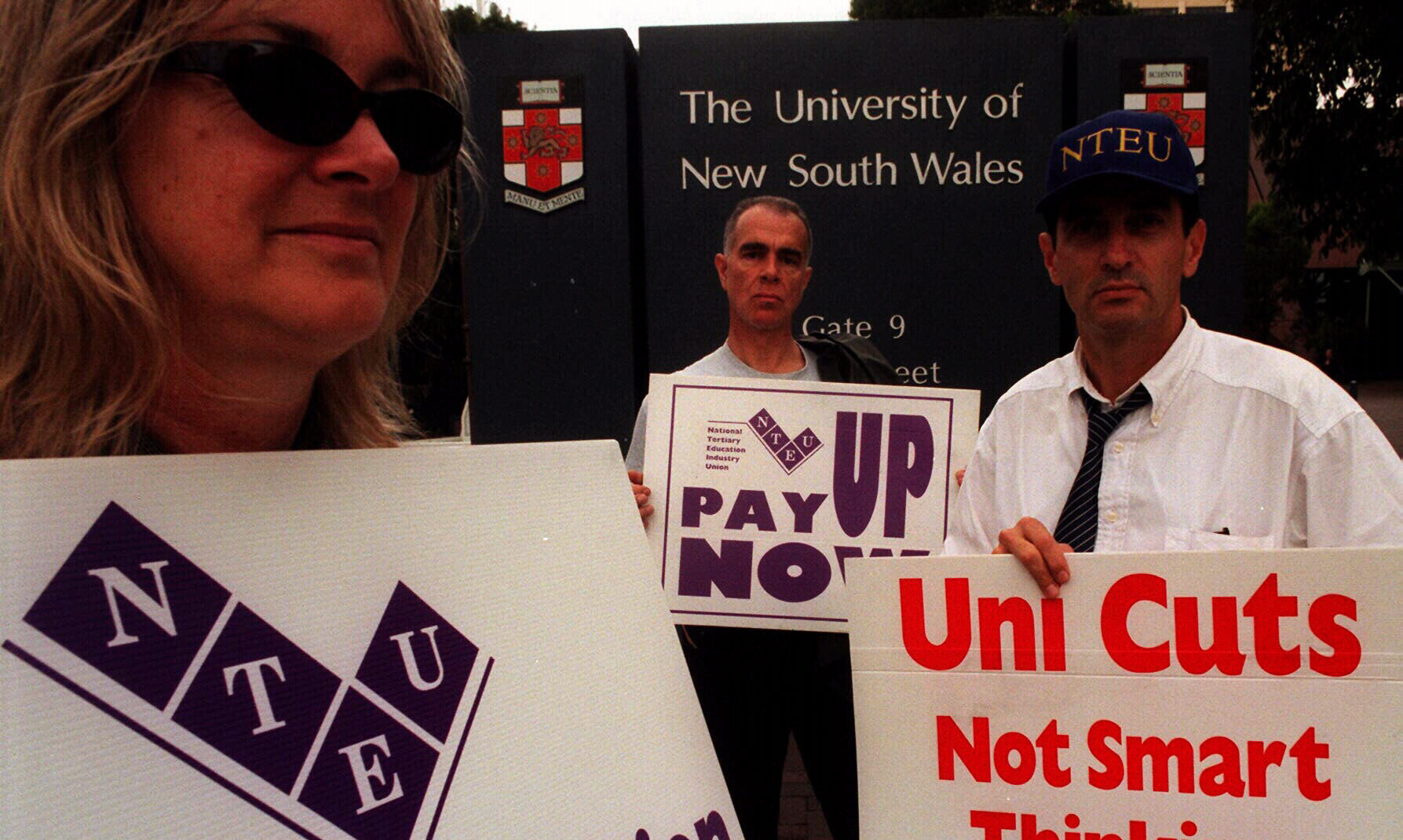
    A new research paper has investigated the factors that have “legitimised” the creation and acceptance of a casual academic workforce in Australia.

    Please login below to view content or subscribe now.

    Membership Login

    Source link

  • Former Kansas City School Police Officer Fights for Student Safety Via Nonprofit – The 74

    Former Kansas City School Police Officer Fights for Student Safety Via Nonprofit – The 74

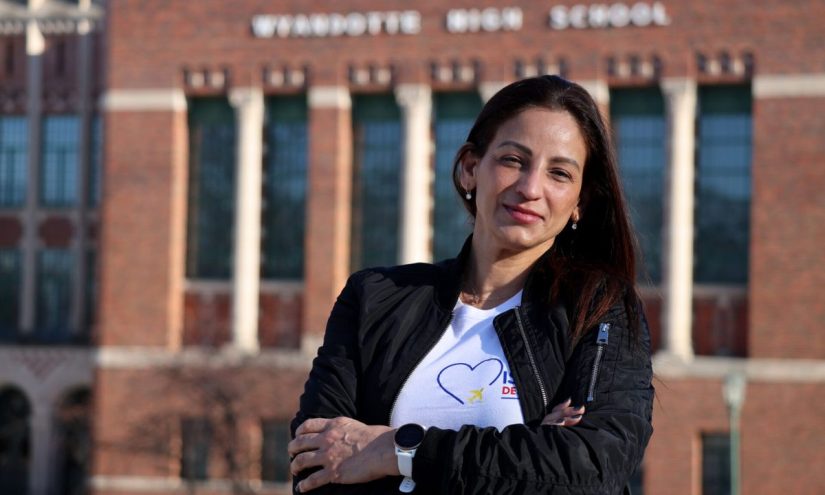
    KANSAS CITY, Kan. — Marialexa Sanoja publicly quit her job as a Kansas City, Kansas, Public Schools police officer over concerns with the district’s handling of student safety needs and founded a nonprofit to help kids escape the challenges in Wyandotte County.

    In the three-and-a-half months Sanoja was stationed at Wyandotte High School, the district’s largest school with 1900 students, Sanoja said she filed 140 incident reports and that in most instances the district failed to take action. The district, through its YouTube channel, disputed her figures and asserted it handled concerns responsibly.

    “It didn’t take long for me to find out that the students were not in the best interest of anybody,” Sanoja said. “When the police officer becomes a safe space for students, there is something wrong with that.”

    After her resignation in December 2023, Sanoja founded Missión Despegue, translated to “mission takeoff,” a nonprofit that helps parents and students document their grievances with the school district to hold the district accountable for its handling of safety issues.

    Sanoja saw the district’s response to a sexual assault case and its communication as inadequate, and experts echo her concerns. Now, Sanoja works with current and former students to get their GED certificates, drivers licenses, mental health care and prevent substance abuse.

    Sanoja’s concerns

    Sanoja said much of the Latino community, which makes up 72% of Wyandotte High School, is afraid to complain or make a scene because many of them are new to the country. She aims to empower them, and help them achieve the “American dream.”

    One reason Sanoja resigned — and a former student dropped out — was because of the district’s response to the former student’s experience of being sexually assaulted at school. Kansas Reflector doesn’t identify minors who have been sexually assaulted.

    According to an incident report filed by Sanoja, the former student was a freshman and alone in the Wyandotte High School stairwell when a group of older boys groped her and made sexual remarks. She began recording the boys with her phone, which prompted them to leave, the report said.

    Sanoja was off duty that day. The former student asked the on-duty officer to file a report, which Sanoja says she never saw. The day after, Sanoja and the former student said they filed an incident, criminal, and Title IX report. The former student wanted to press charges.

    “After that, I just stopped going to school, because I didn’t feel safe,” the former student said in an interview with Kansas Reflector.

    Sanoja said security camera footage and the former student’s video showed the boys’ faces. The former student said the district told her that because the boys never returned to school, it could not suspend them. However, the former student said she continued to see the boys on campus.

    “Ultimately, the district didn’t do anything about it. We were asking, at least, for suspension. That didn’t happen,” Sanoja said.

    A spokesperson from the district told Kansas Reflector it was unable to provide comment on the former student’s case, or the district’s responsibility to handle reports of sexual assault.

    Sanoja publicly resigned with a letter that accused the district of failing to communicate with parents. She wrote that she was worried about instances where students brought guns to school property and all parents weren’t notified.

    In a response video to Sanoja’s resignation, district superintendent Anna Stubblefield said “those incidents are not always relayed to all families. Not because we’re hiding anything, but because the impact is low and to protect the privacy of our students.”

    A district spokesperson told Kansas Reflector the “administration is required to contact parents regarding student issues — such as absences, drug-related concerns, or fights — in accordance with the Student Code of Conduct.”

    Expert opinions

    Ken Trump, an expert in school safety communications who is not related to the president, said parental anxiety over school safety is rising nationwide.

    “It’s very easy to get caught up if you’ve got a couple thousand kids in a school, dealing with incidents and other things. But you need to take a tactical pause in this, and go back to looking at the communications,” Trump said. “You can’t go back to the old-school mindset of if someone finds out about it we’ll talk. That doesn’t work anymore.”

    Sanoja said that after a student overdosed at school and she contacted the parents directly, the high school principal told Sanoja to route all communication with parents through administration.

    Sanoja said that she continues to receive videos of physical fights in the schools, totaling in the hundreds, since her resignation.

    Michael Dorn, a school safety expert who assists schools after major acts of violence, said  Sanoja’s allegations were concerning. He said he would have responded to her concerns differently than the school district did.

    “I was a school district police chief for 10 years,” Dorn said. “If an officer in my department wrote that kind of resignation letter, I would request a state police investigation. I would ask for a polygraph test, and I would ask that she be polygraphed. I wouldn’t do anything like that, but if someone alleged that I did and I didn’t do it, I would request that to clear my name.”

    Sanoja worked as a police officer in Lenexa before transitioning to the school district and said Wyandotte High School presented the most significant challenges she’s seen. She believes the problems are “within the culture” of the school.

    “Everybody’s tired of the way the district is handling things,” Sanoja said. “They’ve been failing these kids for years.”

    Fixing root causes

    Through her nonprofit, Sanoja helps students who leave the district, like the former student who was sexually assaulted, earn their GED certificate.

    When they’re out of the school environment, Sanoja said, they thrive.

    Sanoja said most of the families she works with are immigrants, and the parents do not speak English.

    “We face the daunting task of ending the stigma, shame and judgement that come with our culture,” Sanoja said.

    Missión Despegue seeks to fix the root causes of the problems seen in school — like substance abuse, violence, bullying, and mental health issues. Sanoja said she sees these problems reflected in things like the graduation rate of the district. For the 2023-2024 school year it was 78.1%, which is 11.4 percentage points lower than the state average.

    Through donations, Sanoja covers the cost of mental health appointments, DMV license and GED class registrations, and laptop purchases for students pursuing their GED certificate without one. In February, she began converting first-time offenders’ court fees, in hopes of reducing recidivism.

    With the help of more than 100 volunteers, Sanoja has hosted events where she provides Narcan and educates parents about the dangers of substance abuse. She also guides volunteers to further training, like drug prevention and compassion fatigue workshops.

    Sanoja said she doesn’t get paid for her work with Missión Despegue. She said she needs an assistant, because she has “a long list of people that need help.”

    “I see something in them. I know they’re going to be successful,” Sanoja said. “I want that opportunity for every kid I have.”

    Kansas Reflector is part of States Newsroom, a nonprofit news network supported by grants and a coalition of donors as a 501c(3) public charity. Kansas Reflector maintains editorial independence. Contact Editor Sherman Smith for questions: [email protected].


    Get stories like these delivered straight to your inbox. Sign up for The 74 Newsletter

    Source link