Get stories like this delivered straight to your inbox. Sign up for The 74 Newsletter
Does your child’s public school have a library?
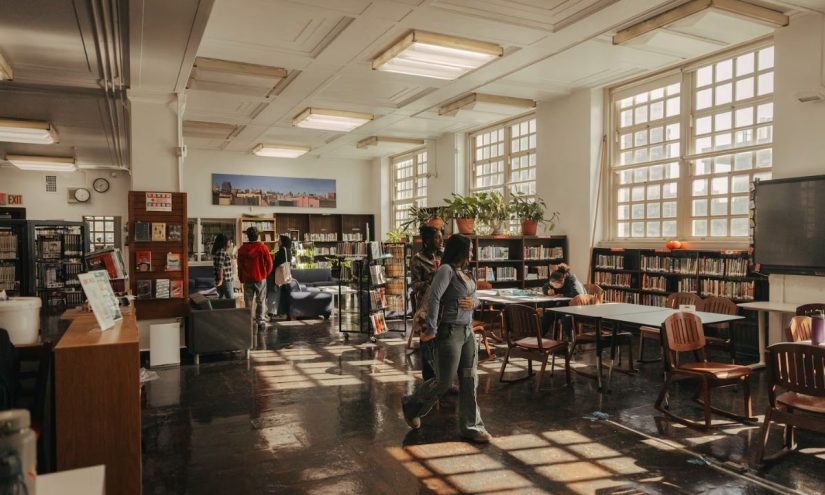
The City Council now requires New York City’s Education Department to report data on school librarians and library access.
The first-ever report of public school library data was released last month, and revealed that across 1,614 public schools, 1,016 have a library. Yet, there were only 273 full-time librarians and 12 part-time librarians.
Research has shown access to school libraries with certified librarians tends to result in better academic performance and higher graduation rates at those schools. One study showed that a loss of librarians is associated with lower reading scores.
City Council passed school librarians data law after years of advocacy from parents and librarians who warned of a drastic loss in librarians across the city. In 2023, Chalkbeat analyzed school budget item lines to find that nearly a third of schools with more than 700 students did not have a librarian listed in their budget, even though state standards require all secondary schools with more than 700 students to have a full-time certified librarian.
This year’s data paints a similarly dire picture, and advocates have concerns about both what the data reveals and the accuracy of the data itself. For one, they are critical of the method the Education Department used to report on the number of schools that have libraries. Also, having a library space without a librarian remains a concern.
“Even if all the numbers are accurate, it still … paints a picture that there’s still so much work that needs to be done,” said Roy Rosewood, a school librarian in Queens who’s been advocating for librarians since 2013.
Rosewood and other advocates are concerned that the Education Department used a school’s operating hours as a proxy for the school’s library hours, according to the data. Advocates and librarians told Chalkbeat that this is not a reliable measurement of a library’s open hours, since libraries can often be shut down for testing, meetings, or other purposes.
“Last year, the library was pretty much closed all of April and May for testing,” said one librarian who is untenured and spoke on the condition of anonymity for fear of retaliation. “A lot of times when they shut down the libraries for testing, they don’t even put the librarian to proctor those tests. So we’re not even in the space that is closed down.”
For those two months, she spent most of her time in the teachers’ cafeteria and periodically, she walked around the school with a cart of books for students to check in or out.
Advocates also pointed out the importance of having a librarian, not just a library.
“A physical space means nothing,” said Jenny Fox, a New York City public school parent and founder of Librarians = Literacy, an advocacy group focused on raising awareness about the city’s library desert. Fox said she spends a lot of time educating people on what librarians do, something that is often misunderstood or overlooked.
“They’re not just checking books in and out. They’re teaching your kids about media literacy, safety online, how to vet an article for truthfulness,” Fox said. Librarians build their own curriculum, help students with research skills, and are one of the only people in the school who interact with every child.
An Education Department spokesperson said the department recognizes that school libraries are “essential,” and noted, “There’s still room to grow, and we will continue expanding these numbers to bring more knowledge, books, and a culture of reading to more students.”
On his fourth day as New York City schools chancellor, Kamar Samuels visited a Brooklyn school, and parents and educators pressed him about the lack of librarians. He agreed that school libraries were “critical,” saying when schools in the districts he worked in got libraries put into their buildings, “you could see the difference in the culture that changes.”
Parts of the City Council’s school library law have yet to be implemented. State law states that students in seventh and eight grades are required to receive at least one period of library and information instruction per week. Only about 20% of K-8 schools and junior high schools have a full-time librarian, according to a data analysis from Librarians = Literacy, suggesting the law’s requirements aren’t being met. The anonymous librarian said she is only teaching four library classes, but there are about 60 classes of seventh and eighth graders at her school.
The data on the number of students in those grades who receive library instruction is set to be released on June 1. Next year’s data will also include information such as the number of non-licensed school librarians that are assigned to help fill the librarian gap, the number of hours per day licensed librarians are assigned to do school library work, and more.
Chalkbeat is a nonprofit news site covering educational change in public schools. This story was originally published by Chalkbeat. Sign up for their newsletters at ckbe.at/newsletters.
Did you use this article in your work?
We’d love to hear how The 74’s reporting is helping educators, researchers, and policymakers. Tell us how