Tag: Financial

  • 5 not so good FINANCIAL GIFTS TO GIVE TO OUR CHILDREN (The last one is the worst)

    5 not so good FINANCIAL GIFTS TO GIVE TO OUR CHILDREN (The last one is the worst)

    The VERY BEST Financial Gift we could give our kids is to not be dependent on them financially later in our lives, while they are trying to raise and educate their kids.

    Most parents love their kids dearly and would die for them. My question is always – “Should We?” Here are some decisions that start out with good intentions but could actually end up having bad consequences for our loved ones.

    1. Getting a Parent PLUS loan that the student has to pay.

    There is a reason that there is a limit on how much the government will lend to your student in their name. It’s because they should not have a massive burden coming out of college, and most students coming out of college cannot afford to pay more than the federal lending limit to them.

    Many parents are struggling to fund college AND save for retirement at the same time. If you don’t have enough money to do both, then it is probably unwise to expect your children to pay back Parent Plus Loans that you have signed for.

    Remember that if we have not saved enough for retirement and have depended on Parent loans to get the kids through college, then we might be reliant on help from our kids when we age. Is this what we really intended? Thanks a lot Dad!

    • Whole life insurance (The wrong type)

    Whole Life insurance could be a great product if structured properly, but on the PARENTS. I have seen some policies purchased with kids insured, from the same company that they buy baby food from. These are horribly inefficient policies and, in most cases, a bad idea. Most times, insurance on young kids is much more expensive than insurance for parents.

    Firstly, we should consider what the purpose of the insurance is. If we purchase with the kids as the insured, it only pay out if the child dies, which means it is pays out for your future grandchildren 2 generations away! Is that what we meant to happen? We should consider who we want to protect?

    Typically, we would want to insure the parent who is the main breadwinner, so that if something happened to them, their spouse and children would not have to face devastating financial consequences. That way they would be leaving a positive legacy for the family and not a burden.

    I STRONGLY advocate for good insurance, and personally practice what I preach so feel free to give me a call if you would like to see what is wise for your family.

    If you want to purchase timeshare, do it for yourself, and accept the long-term consequences, but don’t burden your kids with it.

    Here is something to think about:

    * The Internal Revenue Service values your timeshare, and all timeshares, as worthless.
    * No legitimate charity wants your donated timeshare. Period.

    If so, why would we think that our timeshare has any value. It has to be paid for each year and most people cannot GIVE their timeshare away. Don’t burden your kids by buying timeshare for them. With technology today and Airbnb we have so much more flexibility without the burden.

    • Champagne Taste on a Beer Budget

    If our children leave our house with the expectation that everyone can go to a private school, vacation in Hawaii or France every year, shop at expensive stores and drive expensive cars, then we have probably done them a disservice.

    Their first shock comes when they see their first paycheck, wonder why so much of it has gone to taxes and other deductions, and the realization that they have to pay for their own car and place to live. Sometimes we love to spoil our kids too much, but it ends up hurting them in the long run. The worst is when they realize that we cannot retire because we didn’t teach them.

    • Parent Financial InsecurityI have saved the toughest one for last.

    Remember the lecture we always get when we fly? “In the unlikely case of an emergency, put your own mask on before you help your children” This is the way it should be with our finances.

    I speak to families all the time who have parents who are not financially stable, who could not control their spending, who did not save enough for retirement, or didn’t have life insurance when needed or Long Term Care, who are in such bad financial shape that their children spend their nights worrying about their parents.

    One of the most wonderful financial gifts that we can give to our kids is our own financial security. That way we can be a blessing to our kids and not drag on their lives.

    As a counter to the perhaps perceived negative connotation of what we should perhaps NOT be doing, here are some things that we might think of that we SHOULD be doing.

    Five smart financial habits to teach our children early in life – can set them up for a future of success.

    Someone told me once – the way to teach our kids the value of money, borrow some from them

    1. The miracle of compounding – the earlier the better – As parents, we often wish we knew this
    • We Value What We Earn, Not What We Are Given

    Allowances – Given or Earned? Allowances are not just about money, but what lessons we could teach our kids in the process. Humans learn a lot when we earn things because of effort and dedication, rather than just being given something. My daughter once worked really hard to earn a surfboard by walking around our neighborhood selling cookie dough for her school. I will never forget when I asked her how many people said “No” to her, she told me “I don’t know dad, I was just focused on getting 75 people to say “Yes”

    It is a valuable lesson to see firsthand how effort translates into earnings and this in turn translates into the behaviors to become an “earner” in life.

    • Teach Your Kids How to Lose Money

    Yes, lose money. You see, no matter what courses they take in high school or college around personal finance, there is no greater teacher for all of us in life on what NOT to do with our money until we experience losing some money.  

    No matter which custodian we help them set up a brokerage account with, perhaps we could get them started saving into some type of investment and sit down quarterly with them to track it and teach them how their investment is performing.  

    Have them pick one stock of their favorite company and even if they lose money, they win in the long-term gaining interest on how investments work and how to make good investment decisions.

    • Spending – Questions to ask first
    • Do I want it?
    • Do I need it?
    • Can I afford it?

    If the answer to any of these is “No”, then probably think twice about it.

    Only once we have SAVED money, should we use it for our WANTS

    One thing that I learned in life is that giving early when you don’t make much, is really helpful rather than trying to start giving when you are making a lot. It just seems such a lot to get going when the number is high, but when it grows incrementally it becomes a great and rewarding habit.

    I go back to my first statement – Most parents love their kids dearly and would die for them. My question is always – “Should We?”

    If you would like to discuss how you can make wise decisions for Retirement Planning and College Planning for your family? Please don’t hesitate to contact Dave Coen to set up a no-cost consultation.

    You can see more about my role as a Financial Advisor with SageView Advisory  HERE

    Tel:714-813-1703
    dcoen@sageviewadvisory / [email protected]

    Source link

  • Ireland’s ELE sector slams sharp rise in financial threshold

    Ireland’s ELE sector slams sharp rise in financial threshold

    The national body representing over 60 accredited English language schools has warned the move could lead to mass cancellations, reputational damage to Ireland, and loss of key emerging markets that have helped rebuild the sector post-pandemic.

    Starting from 30 June 2025, students from countries such as Argentina, Brazil, and Mexico will be asked to show €6,665 in available funds to study in Ireland for eight months – a 120% increase on the 2023 threshold of €3,000.

    “This change has come without consultation, justification, or notice. It is difficult to see how a 120% increase in two years can be considered proportionate when the cost of living has risen just 2% annually,” said Lorcan O’Connor Lloyd, CEO of EEI.

    The affected students are legally permitted to work part-time in Ireland, yet are now being required to show financial backing as if they were not, argued O’Connor Lloyd, who said the policy “undermines the entire work-study visa model that Ireland has in place”.

    It is difficult to see how a 120% increase in two years can be considered proportionate when the cost of living has risen just 2% annually
    Lorcan O’Connor Lloyd, English Education Ireland

    Stakeholders have also raised concerns around the short period of notice of just over 90 days, which means that students who have already paid, booked flights, and made arrangements will be forced to find an extra €2,000 or risk losing their place.

    EEI is therefore calling for an immediate pause and review of the policy, a transition period to protect students who have already booked, and a full consultation with the education sector moving forward.

    Source link

  • How colleges can improve financial transparency in fee payments

    How colleges can improve financial transparency in fee payments

    Effective higher education fee management maximizes revenue, reduces losses, and builds confidence with students and parents. However, 65% of institutions lose money owing to obsolete, manual processes (EDUFinance 2024). This is where student fees collection software shines.

    Let’s look at 10 data-driven strategies to improve student fee collection software for transparency and efficiency.


    Why Modern Student Fees Collection Software Matters

    Did you know 37% of college finance teams track fees using spreadsheets, which can lead to errors and miscalculations (Campus Finance Survey, 2024)? Student finance cloud technologies automate complex operations, reduce manual errors, and offer a transparent, real-time financial environment.


    How colleges can improve financial transparency in fee payments? 10 proven ways. 


    1. One seamless student registration and data sync

    Create comprehensive student profiles automatically matched with student information systems (SIS) including demographic data, course information, and financial details. Institutions running linked data systems report 23% faster fee processing.


    2. Clearly structured fees

    Fee breakdowns cause 48% of parents to argue (EdTech Insights, 2023). Flexible fees per department, course, or service offer upfront transparency and easier payments.


    3. Channel-wide fee collection automation

    Students prefer mobile payments 72% (Higher Ed Payment Trends, 2024). Make websites, mobile apps, and self-service portals accept rapid payments. Automated schools collected fees 27% faster and missed 15% fewer.


    4. Fine automation, absenteeism tracking

    Establish absenteeism and late payment penalties. Automation has reduced fee defaulters by 19% and ensures regular sanctions without manual follow-up.


    5. Role-based security to protect finances

    Role-based access control is non-negotiable even if 63% of higher education institutions report financial intrusions (EduCyberReport, 2024). Minimizing fraud and mistakes, only authorised staff should handle fee data.


    6. Parent portals for real-time fee visibility

    Parents demand more financial participation in their children’s education (82%, ParentPulse Survey, 2024). Parents receive transparent information regarding dues, invoices, and payment schedules via a portal, decreasing late payments.


    7. Automatic fee calculations for billing free of errors

    Errors in manual fee computation affect institutions’ annual income up to 4%. Calculate fees automatically using pre-defined criteria to guarantee correct, current billing for every student.


    8. Waivers, fee concessions, and flexible payment options

    Offer waivers, discounts, and flexible payment arrangements without any confusion on the back end. Supporting financially challenged students with structured payment plans resulted in 12% higher retention rates for colleges that have implemented this approach.


    9. Automatic fee reminders for on-time payments

    According to EduFinance Insights (2024), overlooked reminders account for 43% of late payments. Send automated fee reminders via email, SMS, and push notifications to significantly reduce the number of late payments.


    10. Real time financial transparency reports

    Access transaction history, income breakdowns, and outstanding amounts instantly. Real-time reporting improved financial forecasting and reconciliation for 89% of finance directors.


    The Bottom Line: Future-Proof Your Fee Management with Creatrix Campus

    Why let outdated processes drain your institution’s revenue? With Creatrix Campus Fee Management Software, higher education institutions can achieve:

    • Faster fee collection with automation and mobile payments
    • Enhanced financial transparency for students, parents, and administrators
    • Stronger security with role-based access and encrypted data
    • Real-time insights for smarter, data-driven financial decisions

    Ready to transform your fee collection process? Let Creatrix Campus help you boost efficiency, ensure transparency, and future-proof your institution’s financial operations.

    Source link

  • How colleges can improve financial efficiency with accounting software

    How colleges can improve financial efficiency with accounting software

    Today’s higher education requires financial efficiency. Outdated accounting processes cause financial inefficiencies in 73% of higher education institutions, according to a 2024 EDUCAUSE analysis. Right software can fix that. Here are 7 benefits of utilizing the best college accounting software, backed by numbers, automation, and improved decision-making.


    Why College Accounting Systems Need Improvement

    College economics are more complicated than ever due to shifting enrollments, diversified revenue streams, and escalating operational expenditures. Reports confirm that up to 30% of administrative time is wasted on manual accounting, resulting in errors, lost income, and lost productivity. Automation for college accounting is no longer optional—it’s game-changing.


    How Colleges Can Improve Financial Efficiency with Accounting Software. 7 Advantages


    1. Usability—simplify complex financial processes

    Do you know 43% of institutions prioritize user-friendliness when purchasing accounting software? The finest solutions enable non-financial workers to manage accounts using intuitive dashboards, drag-and-drop features, and automated reporting.


    2. Flexibility and scalability—grow without financial limits

    Many institutions have 12% yearly enrollment fluctuations, making scalability important. The ideal software expands with your organization as you add programs and revenue streams. Cloud-based upgrades minimize downtime, ensuring operations.


    3. Custom reporting – faster data-driven decision making

    Real-time reporting, according to 67% of officials in higher education, greatly enhances financial decision-making. Imagine being able to instantly have thorough knowledge on grant distributions, operating expenses, and tuition rates, therefore enabling leadership to act on facts rather than speculation.


    4. Reliability – Bid farewell to mistakes and lost data.

    Errors in manual accounting can cost organizations up to 5% of their yearly budget, an intolerable loss. Reliable accounting systems guarantee accurate, real-time tracking of payments, debts, and financial projections. For better processes, it also easily interacts with other campus administration systems.


    5. Automate and synchronize data to reduce administrative tasks

    Accounting automation reduced administrative tasks by 40%. Colleges can distribute resources faster, speed up approvals, and eliminate human error-related income leakage with synchronized data across admissions and payroll systems.


    6. Security – Guard private financial information

    Given 63% of higher education institutions having attacked recently, financial security is not negotiable. Modern accounting systems guarantee that your financial documents are untouchable by illegal hands by means of role-based access, encrypted data storage, and automatic backups.


    7. Efficiency — Save time, cut costs, increase revenue

    Saving time makes money. Academic institutions with accounting automation collect fees 25% faster and spend 18% less. Monitoring finances on the go using mobile and cloud capabilities reduces overhead and improves transparency and cash flow.


    The Bottom Line

    Choice of college accounting software is about developing a smarter, faster, and more robust financial ecosystem, not just convenience. The appropriate software helps universities maximize financial efficiency and future-proof operations through automation, real-time analytics, and cost reductions.

    Has your college been trapped in outmoded accounting? We must embrace intelligent automation-powered financial efficiency. Contact team Creatrix Campus today! 

    Source link

  • Financial sustainability in UK higher education: the limits of self-help?

    Financial sustainability in UK higher education: the limits of self-help?

    • Matthew Howling, Principal Associate at Mills & Reeve LLP, and Poppy Short, Partner at Mills & Reeve, reflect on a February round table discussion amongst university leaders chaired by Nick Hillman of HEPI.

    On 26 February 2025, a group of 18 university leaders, advisors and stakeholders met to reflect on how universities can best position themselves in the current financial climate. The meeting was a follow-up to our joint dinner with HEPI on 10 October 2024 at the Royal Society in London. As we remarked at the time, there was a clear desire to continue the conversation, and the fast-paced and content-rich discussion here was a testament to that desire.

    Our theme was the limits of self-help. Given the current financial headwinds, institutions have been restructuring their activities on an unprecedented scale. However, once the severance schemes, asset sales and course closures have come to pass, will these remedies be sufficient to put institutions back on a sound enough financial footing to continue to serve their students and communities for the longer term? The unspoken and yet resounding understanding across the group was that further and more radical changes are needed across the sector to stabilise the situation.

    What is the role of the private providers in helping to improve the financial health of the sector? Several voices suggested that foreign investment could help to save certain British universities and that the sector needs to be less reticent about such investment. Other participants thought that, while foreign investment might work in the context of smaller providers, it was less likely to be successful when dealing with larger, more complex institutions, particularly those that have a legacy of contracts with trade unions and other stakeholders. It is well known that a number of private providers and foreign investors are waiting in the wings to acquire UK degree-awarding powers from distressed higher education providers if the opportunity presents itself. The sector should be prepared to consider its response to this.

    In a recent HEPI poll, when students were presented with a list of 10 options for what could happen if their own higher education institution were to fall over financially, a takeover by a foreign company was the joint least popular option. Foreign investors would have to work hard to tackle these negative perceptions.

    In some ways, the antithesis of self-help is a forced merger. It was noted that, in other jurisdictions, forced mergers are not as uncommon as might be thought. Estonia, France, Germany and Denmark had all experienced forced university mergers. Is this the direction of travel for the United Kingdom? There was a feeling that, in Wales and Scotland, there was a willingness to consider higher education provision on a more holistic basis than in England.

    In terms of state support, it was felt that the sector had to acknowledge government spending pressures. The evidence of cuts to budgets elsewhere (such as foreign aid) strongly suggests that there will be no chance of further increases to the home undergraduate tuition fee in the foreseeable future and despite the need, other forms of financial help are not expected.

    If government funding will not be forthcoming, the other obvious source of funds is existing lenders. Participants observed that, while sector borrowing was high, much of the recent debt taken on by providers was in the form of revolving credit facilities (which provide short-term funds up to a specified limit for a stipulated period of time, all or part of which can be repaid and re-borrowed as required), rather than the term loans that universities have traditionally found more attractive (which provide long-term funds for a specified period of time). There was concern that, in some cases, banks might be considering withdrawing those lines of credit when they come up for renewal. There was also a concern about how many institutions might be relying on revolving credit facilities to satisfy the OfS’s minimum liquidity requirements. There was anecdotal evidence that certain banks were focussing their new lending on higher tariff institutions, partly because of credit risk but also because of the ancillary opportunities to make money from larger institutions. This risks a self-fulfilling cycle of winners and losers.

    It was generally felt that a new Special Administration Regime would make life easier as opposed to harder in terms of access to funds. It is not necessarily about encouraging enforcement by banks. It is highly unlikely that a UK clearing bank would want the adverse publicity associated with enforcing against a UK university (although foreign lenders may be less PR squeamish). However, giving lenders a clear line of sight as to a recovery process, even if not used in practice, may further encourage commercial lending to the sector. 

    Beyond the question of more money, there was a feeling that certain sector skills were lacking to navigate these troubled waters. As one participant put it, transformation expertise was what was needed, not just transformation funds. And how does all this transformation happen at pace?

    Above all, there was a sense that the sector needed to move as one on certain key issues. One example was the increased costs for post-92 institutions associated with the Teachers’ Pension Scheme. Another key area where the sector needs to work together is soliciting the opinion of the Competition and Markets Authority (CMA) on how universities can collaborate without breaching competition law. There were grounds for optimism: the CMA guidance on applying the competition rules to sustainability agreements and collaborations is an example of the CMA taking a proactive approach to assuage concerns that competition law should not hinder legitimate collaboration where this was in the public good. In other areas, such as procurement and shared services, it was felt that there was much that the sector could be doing together to be more efficient and reduce the cost of delivery.

    As an hour of rapid and informed discussion drew to a close, perhaps the overall conclusion was that it is only by acting collectively that the sector can arrive at solutions to allow institutions to truly put their houses in order at an individual level. Universities need to start planning how they will support themselves through this next phase. To survive they will need to mobilise themselves to work at pace to foster local and regional connections to drive forward the priorities for their regions.


    Source link

  • Mental Health and Financial Barriers Threaten College Student Success (TimelyCare)

    Mental Health and Financial Barriers Threaten College Student Success (TimelyCare)

    Seven in 10 students have considered taking a break or dropping out.

    FORT WORTH, Texas, March 12, 2025
    /PRNewswire/ — Mental health struggles and financial pressures are
    jeopardizing college students’ ability to complete their education,
    according to a new study by TimelyCare, higher education’s most trusted virtual health and well-being provider,

    “Many students are slipping through the cracks due to unmet financial, academic, and emotional needs.”

    The
    survey, which gathered responses from 740 students attending two- and
    four-year colleges across the U.S., exposes significant barriers to
    student success and calls for specific action by educational
    institutions to address pressing concerns.

    Key Findings:

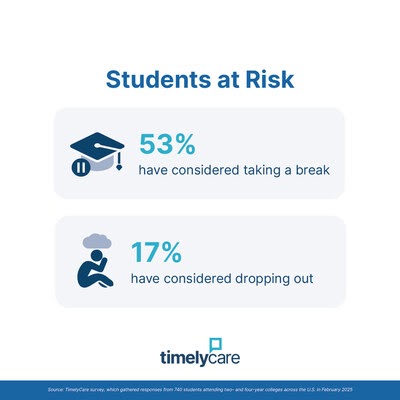
    Students at Risk of Stopping – More than half (53%) of current
    college and university students said they had considered taking a break
    from school, and 17% considered dropping out and not returning.

    Financial Strain – Nearly one-third (31%) of respondents cited
    financial strain as a primary reason for considering withdrawal.
    Additionally, a significant portion of students reported relying on a
    combination of financial aid, scholarships, and part-time or full-time
    work to cover costs.

    Success Barriers – An overwhelming 95% identified at least one
    obstacle impacting their success. Mental health (53%) and finances
    (49%) were the top challenges, followed by physical health (33%),
    academics (28%) and social belonging (26%).

    Gaps in Support Access – While 90% of students had used at
    least one school-provided resource such as academic advising, tutoring,
    or mental health counseling, issues like lack of awareness, inconvenient
    office hours, and inaccessible locations kept many from getting the
    needed help.

    Success Defined
    Students identified GPA, gaining knowledge,
    and graduating or completing their coursework as their top measures of
    success in line with a 2024 survey. Interestingly, non-traditional students placed graduating and gaining knowledge above GPA.

    “This study makes it crystal clear that many students are slipping
    through the cracks due to unmet financial, academic, and emotional
    needs,” said Nicole Guerrero Trevino,
    PhD, Vice President for Student Success, TimelyCare. “Our institutions
    must rise to the occasion to ensure no student is left behind.”

    What Can Be Done?
    In an open-ended question, students identified several ways institutions can better support their success, including:

    Promoting Awareness of Resources: Students called for more
    accessible and transparent communication about resources like tutoring,
    counseling, and career services.
    “Make a comprehensive list of all resources in one place.”
    “Talk about these services more openly. I didn’t know they existed when I needed them.”

    Tailoring Support for Non-Traditional and First-Generation Students: Develop
    targeted programs and policies, such as childcare options and
    evening/online classes, to support students balancing multiple roles.
    “Offer different hours for people who work full time during regular work hours.”

    Engaging Faculty and Staff: Train educators and advisors to proactively identify struggling students and provide personalized support.
    “Make
    it feel more normal that all students are impacted in some way and
    encourage all students to look into getting the help they need. It still
    feels almost taboo to seek out help in most situations.”

    Expanding Mental Health and Financial Well-Being Resources: Increase
    counseling availability, destigmatize mental health challenges, and
    offer virtual and flexible options for access. Streamline communication
    about scholarships, grants, and emergency funding while providing robust
    financial literacy resources.
    “Give access to virtual services or anonymous services”

    TimelyCare virtual success coaching
    supplements on-campus academic preparedness, career readiness, and
    financial wellness support with an integrated 1:1 care and coaching
    model.

    A complete list of questions and responses from the February 2025 survey may be found here. Click here to download a related infographic.

    About TimelyCare
    TimelyCare
    is the most trusted virtual health and well-being solution for learning
    communities, offering personalized, clinically proven care that fosters
    student success and delivers life-changing outcomes. With an unmatched
    range of service options on one seamless, easy-to-access platform,
    including mental health counseling, on-demand emotional support, medical
    care, psychiatric care, health coaching, success coaching, basic needs
    assistance, faculty and staff guidance, peer support and self-guided
    wellness tools, we extend the efforts of 400+ campus wellness teams,
    ensuring millions of students have direct, anytime access to our
    culturally competent and diverse care providers. Recognized as a
    Princeton Review Top 5 Need to Know Organization for Mental Health
    Awareness, TimelyCare drives measurable and meaningful improvements in
    depression and anxiety, empowering every student on their wellness
    journey while strengthening learning environments.

    Source link

  • Another reprieve for gainful employment, financial value transparency reporting deadline

    Another reprieve for gainful employment, financial value transparency reporting deadline

    This audio is auto-generated. Please let us know if you have feedback.

    Dive Brief:

    • The U.S. Department of Education is extending the reporting deadline for the gainful employment and financial value transparency regulations to Sept. 30, according to an agency announcement last week. 
    • The seven-month extension aims to give college officials more time to submit the required information and to allow institutions that have already sent in their data to make corrections. 
    • The Education Department has pushed back the reporting deadline several times amid concerns that colleges didn’t have enough time or guidance to provide the data required under the new regulations. This extension, the first one under the Trump administration, will be the last, the announcement said.

    Dive Insight:

    The Education Department originally asked colleges to submit the gainful employment and financial value transparency data by July 2024, but higher education institutions requested more time given last year’s bumpy rollout of the revamped Free Application for Federal Student Aid. 

    The Biden administration released final gainful employment and financial value transparency regulations in 2023. 

    Under the gainful employment rules, career education programs must prove that their graduates earn enough money to pay off their student loans and that at least half of them make more than workers in their state who only have high school diplomas. Programs that fail those tests risk losing their access to Title IV federal financial aid. 

    Although the financial value transparency regulations don’t threaten federal financial aid, they create new reporting requirements for all colleges. Under the rule, the Education Department will post data collected from institutions about their programs — such as costs and debt burdens — on a consumer-facing website to help students make informed decisions about their college attendance. 

    The Biden administration extended the deadline for reporting requirements three times. Despite the delays, Education Department officials said late last year that they still expected to produce data in the spring to help students select their colleges. 

    With its latest announcement, the Trump administration’s Education Department is delaying that timeline also. 

    “The Department does not plan to produce any FVT/GE metrics prior to the new deadline and will take no enforcement or other punitive actions against institutions who have been unable to complete reporting to date,” it said. 

    It’s so far unclear how the Trump administration will handle the gainful employment regulations. In President Donald Trump’s first term, then-Education Secretary Betsy DeVos rescinded the Obama-era version of the rules, saying they unfairly targeted the for-profit college sector. 

    The Education Department is facing at least one lawsuit over the Biden administration’s version of the gainful employment rule. However, a federal judge earlier this month paused legal proceedings for 90 days after the new administration sought more time “to become familiar with and evaluate their position regarding the issues in the case,” according to court documents.

    The National Association of Student Financial Aid Administrators — one of the organizations that pushed for a delay — applauded the move to extend the regulatory reporting deadline.

    The change “is a sensible and welcome decision that will give financial aid offices much needed breathing room while they navigate unresolved issues in submitting their data and make necessary corrections to ensure the data they submit is accurate,” NASFAA Interim President and CEO Beth Maglione said in a statement last week.

    Source link

  • Making better decisions on student financial support

    Making better decisions on student financial support

    By Peter Gray, Chief Executive and Chair of the JS Group.

    As the higher education sector starts to plan its next budget cycle and many may need to make savings, there is a concern about the impact of any cuts on students and how this could negatively affect their university experience and performance.

    Universities are bound to look at a range of options to save money, especially given the stormy operating context. But one less-often highlighted aspect of university finances is the cost (and benefit) of the additional financial support universities devote to many of their students. Through cash, vouchers and other means, many universities provide financial help to support with the costs of living and learning.

    Using Universities UK’s annual sector figures as one indicator, roughly 5% of universities’ overall expenditure has gone towards financial support and outreach, equivalent to around £2.5 billion. Although some of this money will inevitably not go directly to students themselves, this is still a significant amount of spending.

    There are, naturally, competing tensions when it comes to considering any changes to targeted financial support. With significant financial pressures on students, exacerbated by the cost-of-living crisis, there is always a very justifiable case for more money. However, with the significant financial pressures universities are facing, there is an equally justifiable case to control costs to ensure financial sustainability. Every university has to manage this tension and trade-offs are inevitable when understanding just how much financial support to give and to whom.

    In many respects, the answers to those questions are partially governed by Access & Participation Plans, with the clear intention that these financial interventions really change student outcomes. However, properly measuring those outcomes is incredibly difficult without a much deeper understanding of student ‘need’ – and understanding these needs comes from being able to identify student spending behaviour (and often doing this in real-time).

    It always amazes me that some APPs will state that financial support ‘has had a positive impact on retention’ and some quite the opposite and I think part of this is a result of positioning financial support from the university end of the telescope rather than the student end.

    Understanding real and actual ‘need’ helps to change this. Knowing perhaps that certain groups (for example Asylum Seekers or Gypsy, Roma, Traveller, Showman and Boater students) across the sector will have similar needs would be helpful and data really help here. Having, using, and sharing data will allow us to draw a bigger picture and better signpost to where interventions are most effectively deployed so those particular groups of students who need support are achieving the right outcomes.

    Technology is at hand to help: Open Banking (for example) is an incredible tool that not only can transform how financial support can be delivered but also helps to build an understanding of student behaviour.

    Lifting the bonnet and understanding behaviour poses additional questions, such as: When is the right time to give that support? And what form should that support take?

    I am a big proponent of providing financial support as soon as a student starts. When I talk to universities, however, it is clear that the data needed to identify particular groups of students are not readily available at the point of entry and students’ needs are not met. Giving a student financial support in December, when they needed it in September, is not delivering at the point of student need, it is delivering at the point where the university can identify the student. I think there is a growing body of evidence that suggests the large drop off in students between September and December is, in part, because of this.

    Some universities in the sector give a small amount of support to all students at the start of the year, knowing that by doing so they will ensure that they can meet the immediate needs of some students. But clearly, some money must also go to those who do not necessarily need it.

    However, and this is where the maths comes in, if the impact of that investment keeps more students in need at university, then I would argue that investment is worth the return. And the maths is simple: it really doesn’t take many additional students to stay to have a profoundly positive impact on university finances. Thus it is certainly worthy of consideration.

    To me, this is about using financial support to drive the ultimate goal of improving student outcomes, especially the retention of students between September and December, which is when the first return is made, where the largest withdrawal is seen and where the least amount of financial support is given.

    As to the nature or format of support: of course, in most cases, it is easier to provide cash. However, again, this is about your investment in your student, and, for example, if you have students on a course with higher material and resource costs, or students who are commuting, then there is an argument to consider more in-kind support and using data to support that decision.

    Again, I am a proponent of not just saying ‘one size fits all’. Understanding student need is complex, but solutions are out there. It is important to work together to identify patterns of real student need and understand the benefits of doing so.

    My knowledge draws on JS Group’s data, based on the direct use of £40 million of specialist student financial support to more than 160,000 students across 30 UK universities in the last full academic cycle.

    I have also looked at the student views on such funding and there is an emerging picture that connects student financial support with continuation, participation and progress. A summary of student feedback is here: https://jsgroup.co.uk/news-and-views/news/student-feedback-report-january-2025/

    The real positive of this is that everyone wants the same goal: for fewer students to withdraw from their courses and for those students to thrive at university and be successful. We need to widen the debate on how financial support is delivered, when, and in what format to draw together a better collective understanding of student need and behaviour to achieve that goal.

    Source link

  • An early look at 2023–24 financial returns shows providers working hard to balance the books

    An early look at 2023–24 financial returns shows providers working hard to balance the books

    In most larger UK providers of higher education, the 2023–24 financial year ended on 31 July 2024.

    Five months and two weeks after this date (so, on or before 14 January 2025) providers are obliged to have published (and communicated to regulators) audited financial statements for that year.

    I’ve got a list of 160 large, well known, providers of higher education who should, by now, have made this disclosure – 43 of them are yet to do so. Of the 117 that have, just 15 (under 13 per cent) posted a deficit for that financial year (to be fair, this includes eight providers in Wales, where the deadline – for bilingual accounts – is the end of the month). This was as of the data of publication, there’s been a few more been discovered since then and I have added some to the charts below.

    If you’ve been aware of individual providers, mission groups, representative bodies, trade unions, regulators, and politicians coming together to make the case that the sector is severely underfunded this may surprise you. If you work in an institution that is curtailing courses, making staff redundant, and undergoing the latest in a long series of cost-cutting exercises, the knowledge that your university has posted a surplus may make you angry.

    But these results are not surprising, and a surplus should not make you angry (there are plenty of other reasons to be angry…) Understanding what an annual account is for, what a surplus is, why a university will pull out all of the stops to post a surplus, and what are the more alarming underpinning signals that we should be aware of will help you understand why we have what – on the face of it – feels like a counter-intuitive position in university finances.

    Why are so many results missing?

    There’s a range of reasons why a provider may submit accounts late – those who are yet to publish will already be deep in conversation with regulators about the issues that may have caused what is, technically, a breach of a regulatory condition. In England, this is registration condition E3. which is underpinned by the accounts direction.

    If you are expecting regulators to get busy issuing fines or sanctions for late submissions – you should pause. There’s a huge problem with public sector audit capacity in the UK – the big players have discrete teams that move on an annual cycle between higher education, NHS, and local government audit. You don’t need to have read too much into public finances to know that our councils are under serious pressure right now – and this pressure results in audit delays, hitting the same teams who will be acting as external university auditors.

    That’s one key source of delay. The other would be the complexities within university annual accounts, and university finances more generally, that offer any number of reasons why the audit signoff might happen later than hoped.

    To be clear, very few of these reasons are going to be cheerful ones. If a provider has yet to publish its accounts because they have not signed off their accounts, it is likely to be engaging with external auditors about the conditions under which they will sign off accounts.

    To give one example of what might happen – a university has an outstanding loan with a covenant attached to it based on financial performance (say, a certain level of growth each year). In 2023–24, it did not reach this target, so needs to renegotiate the covenant, which may make repayments harder (or spread out over a longer period). The auditor will need to wait until this is settled before it signs off the accounts – technically if you are in breach of covenant the whole debt is repayable immediately, something which would make you fail your going concern test.

    We’ve covered covenants on the site before – a lender of whatever sort will offer finance at an attractive rate provided certain conditions are met. These can include things like use of investment (did you actually build the new business school you borrowed money to build?), growth (in terms of finances or student numbers), ESG (are you doing good things as regards environment, society, and governance?) and good standing (are you in trouble with the regulator?) – but at a fundamental level will require a sense that your business is financially viable. If covenant conditions are breached lenders will be keen to help if they hear in advance, but your cost of borrowing (the interest rate charged, bluntly) will rise. And you will find it harder to raise finance in future.

    This is an environment where it is already hard to raise finance – and in establishing new borrowing, or new revolving credit (kind of like an overdraft facility) many universities will end up paying more than in previous years. This all needs to be shown in the accounts.

    Going concern

    When your auditor signs off your accounts, you would very much hope that it will agree that they represent a “going concern” – simply put, that in most plausible scenarios you will have enough money to cover your costs during the next 12 months. If your auditor disagrees that you are a going concern you are in serious trouble – all of the 117 sets of accounts I have read so far have been agreed on a going concern basis.

    This designation tells everyone from regulators to lenders to other stakeholders that your business is viable for the next year – and comes into force on the day your accounts are signed off by the university and external auditor. This is nearly always for a specific technical reason – additional information that is needed in order to make the determination. For some late publications, it is possible that the delay is a deliberate plan to make the designation last as far into the following financial years as possible. This year (2024–25) is even more bleak than last year – anything that keeps finance cheaper (or available!) for longer will be helpful.

    Breaking even and beyond

    So your provider had a surplus last year – that’s good right? It means it took in more money than it spent? Up to a point.

    In 2023–24 we got the very welcome news that Universities Superannuation Scheme (USS) has been revalued and contributions reduced for both members and employers. From the annual accounts perspective, this will have lowered staff costs (very often one of the most significant costs, if not the most significant cost, for most) in USS institutions. Conversely, the increase in Teachers Pension Scheme (TPS) contributions will have substantially raised costs in institutions required by law (yes, really!) to offer that scheme to staff.

    That’s some of the movement in staff costs. However, for USS, the value of future contributions to the current calculated scheme debt (which is shared among all active employers in the scheme) has also fallen. Indeed, as the scheme is currently in surplus, it shows as income rather than expenditure This is not money that the university actually has available to spend, but the drop shows out in staff costs – though most affected separate this out into a separate line it also shows up in the overall surplus or deficit (to be clear this is the accounting rules, there’s no subterfuge here: if you are interested in why I can only point you to BUFDG’s magisterial “Accounting for Pensions” guidelines).

    For this reason, many USS providers show a much healthier balance than accurately reflects a surplus they can actually spend or invest. This gives them the appearance of having performed as a group much better than TPS institutions, where the increase in contributions has made it more expensive to employ staff.

    Here I show the level of reported surplus(deficit) after tax, both with and without the USS valuation effect. Removing the impact of valuation puts 35 providers (including big names like Hull, Birmingham, and York) in deficit based on financial statements published so far.

    [Full screen]

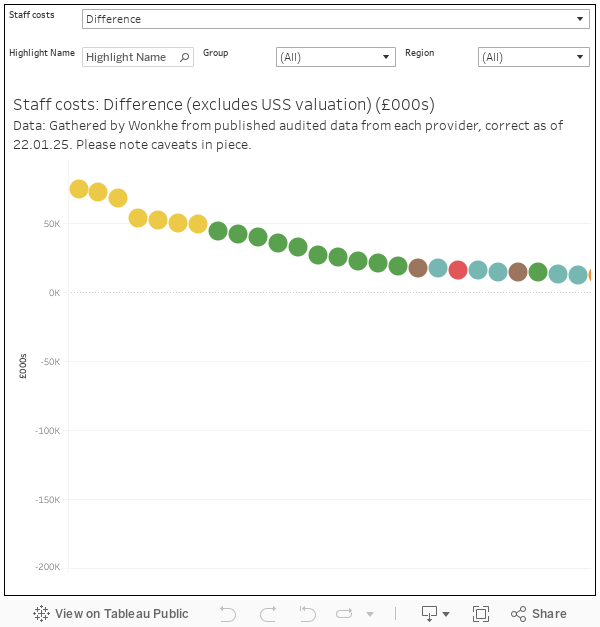
    And here I show underlying changes in staff costs (without the USS valuation effect). This is the raw spend on employing staff, including pay and pensions contributions. A drop could indicate that economies have been sought – employing fewer staff, employing different (cheaper) staff, or changes in terms and conditions. But it also indicates underlying changes in TPS contributions (up) or USS contributions (down) with respect to current employees on those schemes.

    [Full screen]

    Charts updated 11am 27 January to remove a handful of discrepancies.

    Fee income

    For most universities the main outgoing is staff costs, and the main source of income is tuition fees. Much has been made of the dwindling spending power of home undergraduate fees because of a failure to uprate with inflation, but this line in the accounts also includes unregulated fees – most notably international fees and postgraduate fees. The full name of the line in the accounts is “tuition fees and educational contracts”, so if your provider does a lot of bespoke work for employers this will also show up here.

    Both of these areas of provision have seen significant expansion in many providers over recent years – and the signs are that 2023–24 was another data point aligned with this trend for postgraduate provision. For this reason, the total amount of fee income has risen in a lot of cases, and when we get provider level UCAS data shortly it will make it clear that just how much of this is due to unregulated fees. International fees are another matter, and again we need the UCAS end of cycle data to unpick it, but it appears from visa applications and acceptances that from some countries (China, for example) demand has remained stable, while for others (Nigeria, India) demand has fallen.

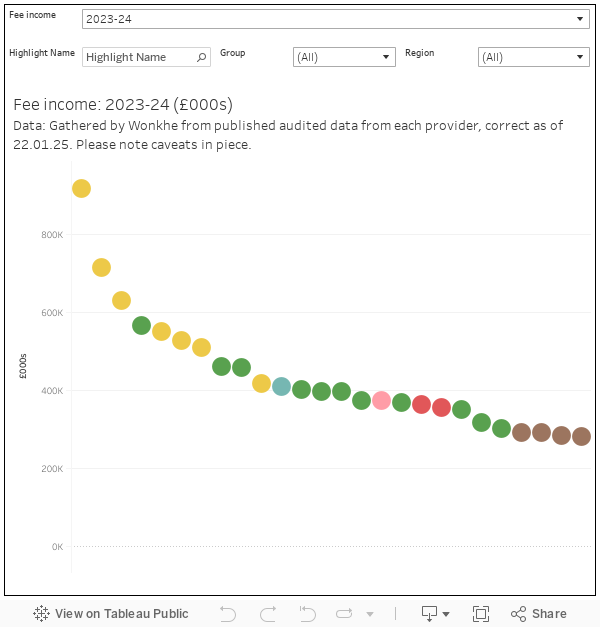
    Here I show fee income for the past two years, and the difference. This is total fee income, and does not discriminate between types of fees.

    [Full screen]

    One very important thing to bear in mind is that these are figures for the financial year, and represent fees relating to that year rather than the total amount of fees per student enrolled. For example, if a student started in January (an increasingly common start point for some courses at some institutions) you will only see the proportion of fees that had been paid by 31 July shown in the accounts. If you teach a lot of nursing students who start at non-traditional times of the year this will have a notable impact, as will a failure to recruit as many international students as you had hoped to do in January 2024 (though this will also show up in next year’s accounts).

    And it is also worth bearing in mind that income from fees paid with respect to students registered at the provider but studying somewhere else via an academic partnership, or involved in a franchise arrangement (something that has seen a lot of growth in some providers) shows up in this budget line.

    Other movements

    Quite a number of providers have drawn down investments or made use of unrestricted reserves. This is very much as you would expect, these are very much “rainy day” provisions and even if it is not actually raining now the storm clouds are gathering. Using money like this is a big step though – you can only spend it once, and the decision to spend it needs to link to plans not to need to spend it in the near future. So even if your balance looks healthy, a shift like this speaks eloquently of the kinds of cost-saving measures (up to and including course closures and staff redundancy) that you may currently see happening around you.

    Similarly, a provider may choose to sell assets – usually buildings – that it does not have an immediate or future use for. The costs of running and maintaining a building can quickly add up – a decision to sell releases the capital and can also cut running costs. Other providers choose to hang on to buildings (perhaps as assets that can be sold in future) but drastically cut maintenance and running costs for this reason. Again, you can (of course) only sell a building once, and a longer term maintenance pause can make it very expensive to put your estates back into use. I should note that the overall condition of university estates is not great and is declining (as you can read in the AUDE Estates Management Report) , precisely because providers have already started doing stuff like this. If the heating seems to be struggling, if the window doesn’t open, that’s why.

    In some cases we have seen decisions to pause capital programmes – not borrowing money and not building buildings as was previously planned. Here, the university makes an on-paper saving equivalent to the cost of finance if it was going to borrow money, or frees up reserves for other uses if it was using its own funds. Capital programmes don’t just include buildings – perhaps investment in software (the kind of big enterprise systems that make it possible to run your university) has been paused, and you are left struggling with outdated or unsuitable finance, admissions, or student record systems.

    Where we are talking about pausing building programmes it is important to remember that these exist to facilitate expansion or strategic plans for growth. The “shiny new building” is often perceived as a vice chancellor’s vanity project – in reality that new business school and the recruitment it makes possible may represent the university’s best hope of growing home fee income faster than inflation.

    What’s next?

    We see financial information substantially after the financial year ends – and for most larger providers this comes alongside the submission of an annual financial return to their regulator. We know for instance that the Office for Students is now looking at ways of getting in year data in areas where it has significant concerns, but financial data (by dint of it being checked carefully and audited) is generally historic in nature.

    For this reason what is happening on your campus right now is something that only your finance department has any hope of understanding, and there may be unexpected pressures currently driving strategy that are not shown (or even hinted at) in last years’ accounts. Your colleagues in finance and planning teams are working hard to forecast the end of year result, to calculate the KFIs (Key Financial Indicators) that others rely on, and to plan for the issues that could arise in the 2025 audit. The finance business partners or faculty accountants – or whatever name they have where you work – will be gathering information, exploring and explaining scenarios, and anticipating pressures that may require a change in financial strategy.

    The data I have presented here is drawn from published accounts – the data submitted to regulators that eventually ends up on HESA may be modified and resubmitted as understanding and situations change – for this reason come the early summer figures might look very different than what are presented here (I should also add I have transcribed these by hand – for which service you should absolutely buy me a pint) – so although I have done my best I may have made transcription errors which I will gladly and speedily correct.

    However scary your university accounts may be, I would caution that the next set (2024–25 financial year) will be even more scary. The point at which the home undergraduate fee increase in England kicks in for those eligible to charge it (2025–26) feels a long way off, and we have the rise in National Insurance Contributions (due April 2025) to contend with before then.

    There are a small but significant number of large providers looking at an unplanned deficit for 2024–25, as you might expect they will already be in contact with their regulator and their bank. Stay safe out there.

    If you are interested in institutional finances, I must insist that you read the superb BUFDG publication “Understanding University Finance” – it is both the most readable and the most comprehensive explanation of annual university accounts you will find.


    Source link

  • Rethinking the Financial Challenge of English Universities

    Rethinking the Financial Challenge of English Universities

    By Adam Habib, Vice-Chancellor at SOAS University of London, and Lord Dr. Michael Hastings of Scarisbrick CBE, Chair of the Board of Trustees at SOAS.

    The business model of English higher education is broken. We are not sure that this simple fact is sufficiently understood by all stakeholders in higher education. Do not mistake us: we all recognise the serious financial crises that most English universities are confronting. But this is not the same as understanding its causal features and what to do about it. The latest financial report from the Office for Students (OfS), released in mid-November, suggests 72% of English universities will be in deficit by the end of the academic year if they continue as is. It does not suggest much about how to address it. In fact, it does not even ask why the other 28% of universities are not in deficit. Is this because of their historical endowments or their specific student profile, or are they doing something the others are not?

    But the OfS is not the only stakeholder reluctant to ask the hard questions: how we got here and what to do about it. This malady afflicts almost all other stakeholders. Let’s begin with the basics. Almost three decades ago, the British government committed to massifying education and ensuring that at least 50% of their school-leaving population had the privilege of going to university. The challenge was how to pay for it. They introduced fees, first as a small proportion of the actual cost in 2006, and then to cover the entire cost in 2012 (at least for Business degrees, Humanities and the Social Sciences). The popular backlash this generated, especially since almost all universities rushed to implement the maximum permitted fee, led the politicians to subsequently avoid increasing fees in line with inflation. The net effect was that within a few years, the actual cost of university education outstripped the fees.

    The solution followed by most universities was to increase international fees and their intakes of foreign students. To attract more of these students, universities borrowed heavily, built shiny new facilities, expanded their pastoral services and grew their student numbers. This was assisted in part by the removal of student number caps on home students. Costs increased, and to cover these, more income was required, which led to even higher international fees and more foreign students.

    All higher education stakeholders were complicit in this. The Government initially supported this solution because it obviated the need for more government subsidies and enabled foreign currency earnings. Vice-chancellors and higher education executives deluded themselves in thinking that the international postgraduate masters students came to the UK universities because of their institutions’ research reputations, even though survey after survey demonstrated that these students were increasingly attracted by the prospect of employment prospects and the post-study visa. Unions, both academic and professional service ones, acquiesced given that these international fees enabled higher salaries and subsidised greater research time for academics. There was even broader public support as it contained the fees for domestic students.

    Until of course, a new breed of ethnically oriented right-wing politicians mobilised on the chauvinistic instinct of there being too many foreigners in Britain. This first manifested in Brexit, then China and subsequently all foreigner-bashing, and finally visa restrictions on dependents. The net effect was a dramatic fall in applications and enrolment of international students, with the ensuing financial crisis of universities in the UK. A positive spin-off of this state of affairs is that almost all stakeholders now recognise the flimsy fiscal foundation of universities. The negative feature is that it still has not generated an honest reflection and behaviour on the part of all stakeholders or a sufficiently deep deliberation on the business model of higher education in the UK and what to do about it.

    Take, for instance, the stance of government. The Secretary of State for Education announced in the House of Commons on 4 November 2024 the first university fee increase for undergraduate students in eight years. Yet the Chancellor had increased the Employer National insurance a few days before from 13.8 to 15 percent. The net effect is a further loss of £59 million for universities in the UK from the 2025/26 academic year.

    Neither is the debate in universities more imaginative on what to do about the financial crisis and the business model of higher education. University vice-chancellors and Universities UK have recognised the need to revert to greater public funding for higher education, although there is a broad recognition that this is an unlikely solution in the near future given the fiscal crisis of the state. They have suggested through individual vice-chancellor advocacies that universities would require the financial equivalence of £12,000 fees, but again, almost all recognise the political challenge of achieving this during a cost-of-living crisis. The reluctant fallback back? A retreat to international student fees by retracting or reforming the visa restrictions, thereby allowing for further increases in income from foreign students.

    But this is just not a feasible solution for the long term. Higher education in the UK has priced itself out for ordinary international students looking solely for a higher education qualification. The only rationales for postgraduate master’s students accessing UK universities, given their high-cost structure, are either post-study employment or the learning of a specific qualification not available in alternative higher education settings. The former is increasingly becoming politically unfeasible, and the latter is not a sufficiently large market to financially sustain British universities.

    This is in addition to the moral and commercial challenges of this business model. As we have suggested elsewhere, there should be serious objections to this model, which is effectively directed towards sucking out resources from countries far more impoverished than the UK, to essentially cross-subsidise domestic citizens. Moreover, it accelerates the brain drain, weakening institutional capacities and human capabilities in the majoritarian world at precisely the moment when such societies require an enhancement of capabilities to address the local manifestations of transnational challenges like climate change, pandemics, food insecurity and war.

    Where to go from here, then? First, there is an urgent need for an honest conversation led by government without any smoke and mirrors on the fiscal latitude available to it and the consequences thereof for the financing of higher education. Second, there is a need for a thorough reflection on what has fiscally worked, and what has not in the recent past on the management and executive stewardship of universities in the UK. Third, there is a need for an honest discussion in universities on the fiscal viability of excessively small classes and unduly low staff-student ratios, 40% research time for all teaching and research contracts, and the importance of institutional differentiation in mandates and how these should speak to the former two elements. Finally, we need to think through the limits of cross-subsidising from international student fees and what new opportunities are opening up globally for fulfilling our institutional mandates.

    One opportunity, that has not been sufficiently explored by British universities, is how to assist in the education and training of hundreds of millions of young people in the majoritarian world. This is an urgent necessity not only for the economic development of these societies but also for enabling societies across the world to manage the transnational challenges of our time, without which we may not survive as a human species. Obviously, this will not be possible on the existing cost structures or business models of higher education. But partnering with universities in the Global South, involving the joint development of curricula, co-teaching and co-assessment, could bring down cost structures of higher education. This could then feed into more reasonable fees being charged, thereby opening up new higher education markets for British universities. Cost structures could also be reconsidered in relation to scale. The more students there are within a program, limited to pedagogical requirements, the more cost per student is reduced, and the more competitive fees can become. New technologies involving online teaching and global classrooms, many of which were pioneered for our own students during the Covid-19 Pandemic, can make this equitable transnational teaching even more feasible.

    Some forms of transnational teaching are already underway in UK universities. But these often take the form of online learning, overseas campuses and franchise models of higher education, all of which are only directed at obviating the financial challenges of British universities. While we would be reluctant to take rigid positions against these models – they may indeed be relevant in certain contextual circumstances – we do hold that the equitable partnership model identified above holds the pedagogical benefit of enabling learning that is both globally grounded and locally relevant. It also does not pit the financial security of British universities against that of universities of the majoritarian world. Essentially, these equitable teaching partnerships can pioneer one element of a new business model that enhances collaboration and mutual benefit for universities in the UK and the majoritarian world.

    Such a model of higher education could also become part of the soft power arsenal of the UK. Increasingly, government has broached the idea of a global Britain. This would be a Britain recognised as a collaborative partner of other nations, enabling them to achieve their national objectives, while enabling itself to be economically competitive and socially responsive to both its own citizens and its international obligations. An equitable orientation to its higher education system would assist this strategic national agenda.

    We are by no means suggesting that equitable transnational learning should replace all other forms of teaching in UK higher education. This would be unrealistic and, frankly, would violate the responsibility of British universities to be nationally responsive. Instead, we recommend that in the pursuit of a financially sustainable higher education system, a diverse set of income strategies – subsidy, domestic fees, international fees, ODL, executive education and equitable transnational educational partnerships – is required. This final strategy not only opens up a new higher education student market at a different price point but also enables us to square our imperative to be financially sustainable with our commitment to be socially and globally responsive.

    The strategic challenge of managing higher education institutions in the contemporary era is the management of tensions between competing imperatives. It also requires thinking outside the box, innovating and finding new markets, and servicing these at new price points, while continuing to meet the social obligations implicit in the mandate of universities. This is what we believe is sometimes missing from the deliberations on making British universities financially sustainable. The debate can only be enriched and the recommendations made more robust if we are prepared to think beyond what we are comfortable with.

    Source link