[Editor’s note: This article first appeared at BryanAlexander.org.]
Is a college degree still worth it?
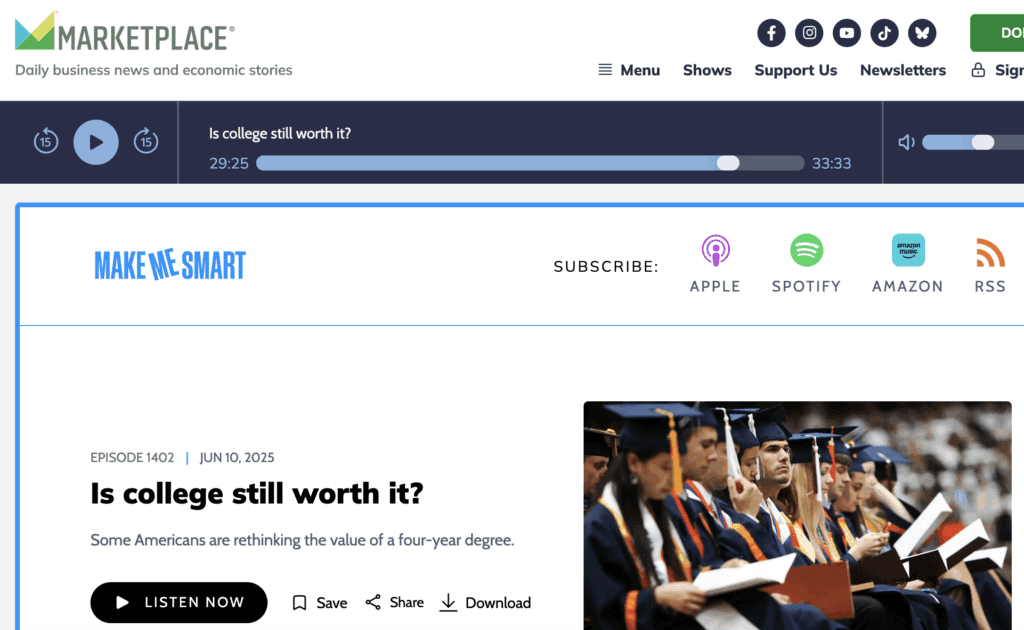
The radio program/podcast Marketplace hosted me as a guest last week to speak to the question. You can listen to it* or read my notes below, or both. I have one reflection at the end of this post building on one interview question.
One caveat or clarification before I get hate mail: the focus of the show was entirely on higher education’s economics. We didn’t discuss the non-financial functions of post-secondary schooling because that’s not what the show (called “Marketplace”) is about, nor did we talk about justifying academic study for reasons of personal development, family formation, the public good, etc. The conversation was devoted strictly to the economic proposition.
The hosts, Kimberly Adams and Reema Khrais, began by asking if higher ed still made financial sense. Yes, I answered, for a good number of people – but not everyone. Much depends on your degree and your institution’s reputation. And I hammered home the problem of some college but no degree. The hosts asked if that value proposition was declining. My response: the perception of that value is dropping. Here I emphasized the reality, and the specter, of student debt, along with anxieties about AI and politics. Then I added my hypothesis that the “college for all” consensus is breaking up.
Next the hosts asked me what changing (declining) attitudes about higher education mean for campuses. I responded by outlining the many problems, centered around the financial pressures many schools are under. I noted Trump’s damages then cited my peak higher education model. Marketplace asked me to explain the appeal of alternatives to college (the skilled trades, certificates, boot camps, etc), which I did, and then we turned to automation, which I broke up into AI vs robotics, before noting gender differences.
Back to college for all: which narrative succeeds it? I didn’t have a good, single answer right away. We touched on a resurgence of vocational technology, then I sang the praises of liberal education. We also talked about the changing value of different degrees – is the BA the new high school diploma? Is a master’s degree still a good idea? I cited the move to reduce degree demands from certain fields, as well as the decline of the humanities, the crisis of computer science, and the growing importance of allied health.
After my part ended, Adams and Khrais pondered the role of higher education as a culture war battlefield. Different populations might respond in varied ways – perhaps adults are more into the culture war issues, and maybe women (already the majority of students) are at greater risk of automation.
So what follows the end of college for all?
If the American consensus that K-12 should prepare every student for college breaks down, if we no longer have a rough agreement that the more post-secondary experience people get, the better, the next phase seems to be… mixed. Perhaps we’re entering an intermediary phase before a new settlement becomes clear.
One component seems to be a resurgence in the skilled trades, requiring either apprenticeship, a short community college course of study, or on the job training. Demand is still solid, at least until robotics become reliable and cost-effective in these fields, which doesn’t seem to be happening in at least the short term. This needs preparation in K-12, and we’re already seeing the most prominent voices calling for a return to secondary school trades training. There’s a retro dimension to this which might appeal to older folks. (I’ve experienced this in conversations with Boomers and my fellow Gen Xers, as people reminisce about shop class and home ec.)
A second piece of the puzzle would be businesses and the public sector expanding their education functions. There is already an ecosystem of corporate campuses, online training, chief learning officers, and more; that could simply grow as employers seek to wean employees away from college.
A third might be a greater focus on skills across the board. Employers demand certain skills to a higher degree of clarity, perhaps including measurements for soft skills. K-12 schools better articulate student skill achievement, possibly through microcredentials and/or expanded (portfolio) certification. Higher education expands its use of prior learning assessment for adult learners and transfer students, while also following or paralleling K-12 in more clearly identifying skills within the curriculum and through outcomes.
A fourth would be greater politicization of higher education. If America pulls back from college for all, college for some arrives and the question of who gets to go to campus becomes a culture war battlefield. Already a solid majority of students are women, so we might expect gender politics to intensify, with Republicans and men’s rights activists increasingly calling on male teenagers to skip college while young women view university as an even more appropriate stage of their lives. Academics might buck 2025’s trends and more clearly proclaim the progressive aims they see postsecondary education fulfilling, joined by progressive politicians and cultural figures. Popular culture might echo this, with movies/TV shows/songs/bestsellers depicting the academy as either a grim ideological factory turning students into fiery liberals or as a safe place for the flowering of justice and identity.
Connecting these elements makes me recall and imagine stories. I can envision two teenagers, male and female, talking through their expectations of college. One sees it as mandatory “pink collar” preparation while the other dreads it for that reason. The former was tracked into academic classes while the latter appreciated maker space time and field trips to work sites. Or we might follow a young man as he enters woodworking and succeeds in that field for years, feeling himself supported in his masculinity and also avoiding student debt, until he decides to return to school after health problems limit his professional abilities. Perhaps one business sets up a campus and an apprenticeship system which it codes politically, such as claiming a focus on merit and not DEI, on manly virtues and traditional culture. In contrast another firm does the same but without any political coding, instead carefully anchoring everything in measured and certified skill development.
Over all of these options looms the specter of AI, and here the picture is more muddy. Do “pink collar” jobs persist as alternatives to the experience of chatbots, or do we automate those functions? Does post-secondary education become mandatory for jobs handling AIs, which I’ve been calling “AI wranglers”? If automation depresses the labor force, do we come to see college as a gamble on scoring a rare, well paying job?
I’ll stop here. My thanks to Marketplace for the kind interview on a vital topic.
*My audio quality isn’t the best because I fumbled the recording. Sigh.