In his criminally underread 1978 book The Grasshopper, the philosopher Bernard Suits takes seriously the science-fiction commonplace that, once robots are doing everything for us, humans will have to find something else to do.
His response is that we’d play, living lives of leisure, like Aesop’s grasshopper, and engaging in activities with a lusory attitude: living playfully, engaging in activities not because we have to, but because we want to. Fully-automated luxury play! As much as I could easily play videogames all day, work isn’t going anywhere any time soon. But the rise of AI in education has prompted me to revisit this topic.
Universities are, quite rightly, thinking very carefully about what their staff and students do with AI, emphasising the ways in which it can enhance, and perhaps even replace, aspects of our work. But there are separate, parallel questions: what can’t AI do for us, and what shouldn’t it do? And what are we going to do with all the time it saves us?
Doing and being seen to have done
Human lives are full of experiences, and there’s a danger with the rise of AI that we weaken our connection with the actual doing of things. AI might help us to plan a holiday itinerary, book a hotel or draft a jealousy-inducing social media post (or even deepfake pics from a holiday that didn’t happen), but it can’t go on holiday for us. And similarly, in learning environments, whilst it can enhance learning, overreliance on AI runs the risk of hollowing out the experiential core of learning and leaving students not having actually done anything.
A real challenge for educators is to know how to get students to understand the value of experience in a world that incentivises taking shortcuts. I lead Rise at Manchester Met: a co-curricular programme that is designed to draw together all the things that students do that aren’t their degree, and our team works hard to help students to understand that they are more than their degree subject.
The traditional catch-all term for this is “extra-curricular” – it’s the things that students do in addition to the curricula they are following. But in practice “co-curricular” is a more accurate term. “Co” indicates that activity happens alongside and with the curriculum. There is a crossover in the experiences that students are having. Picture the curriculum and co-curricular activities as two streams that are sometimes totally divergent, sometimes parallel, and often overlapping in productive ways.
Identity shapes participation
Students don’t stop being students when they engage in co-curricular activities, but similarly they don’t stop being a community organiser, or a hockey player, or a freelance arts journalist, when they’re in the classroom. My doctoral thesis argued that half of the “game” of higher education is students understanding how they can bring their own identities to transform their participation, and “position-switch” between roles. The co-curricular is at its most powerful when these distinct identities and experiences begin to transform and enhance each other.
Moving from “extra” to “co” also challenges the primacy of the core curriculum as the foundation of student experience, and acknowledges that, for many of our students, “student” might not be their primary identity. We must accept that, for some students, their co-curricular activity might be more engaging, more relevant and more career-focused than their core degree programme. For others, the stuff they are doing outside their degree programme might be necessary and unavoidable, and will often pre-date their involvement at university; paid-work and caring responsibilities tend to take precedence over lectures, and there may be ways to make this count too.
However, when you type “co-curricular” into your search engine of choice, you won’t really see university websites. It’s a term that, at present, seems to be owned by the upper-end of British private boarding schools. In a sense this stands to reason; pupils essentially live in these schools during term time, and activities take place as part of their wider life at school. Here “co-curricular” is an expectation, and provides the social and cultural capital building for which British private schools are famous.
This conceptual dominance raises an issue of social justice, though. There is a sense that all of the “extra” stuff, at both schools and universities, is the domain of students who are privileged enough to take part, and who have the time and resources to make it happen. Working outside the curriculum is too often seen as a privilege for the privileged, and effectively becomes self-fulfilling as students with the free time to volunteer reap the developmental benefits of volunteering their time. Other students are already on the back foot when it comes to claiming their share of experience.
Embarrassment of riches
Rise was set up to challenge this narrative, by giving students time and resource to develop their social capital in flexible ways, and to recognise developmental activities that might not have traditionally been included under the extra-curricular umbrella. There’s a broader conversation to be had in the sector, not about how we encourage already busy students to do more, but about how we encourage students to recognise their learning beyond the curriculum.
In Manchester and beyond, the skills pendulum seems to swinging once more away from digital skills and towards “soft skills” – again, reflecting AI’s dominance of education conversations. Co-curricular space has a valuable contribution to make to developing empathy, critical thinking and interacting with other human beings. It is, ultimately, about sharing experiences, and the more we can expand this, the more everyone will benefit.
Students will have experiences outside of their degree programmes whether we design for it or not, but a renewed emphasis on co-curricular activity would allow them (and us) to understand that formal education settings don’t have a monopoly on learning and development. We worry so much about students being “time-poor”; what happens if we understand this as “experience-rich” instead, and recognise their learning accordingly?
In an AI-dominated dystopia, the co-curricular might be where we find the last vestiges of human experience in higher education. Being more optimistic, in a Grasshopper-influenced utopia, we’d all have the time to luxuriate in human experience. Co-curricular space provides insight into what this might look like, and gives students ways to develop away from the curriculum that might speak to future possibilities.
Interested in thinking more about co-curricular experience? At Manchester Met we’re pulling together a cross-sector group of HE professionals working in co-curricular space, and we’d love your input. Click here to sign up for updates.
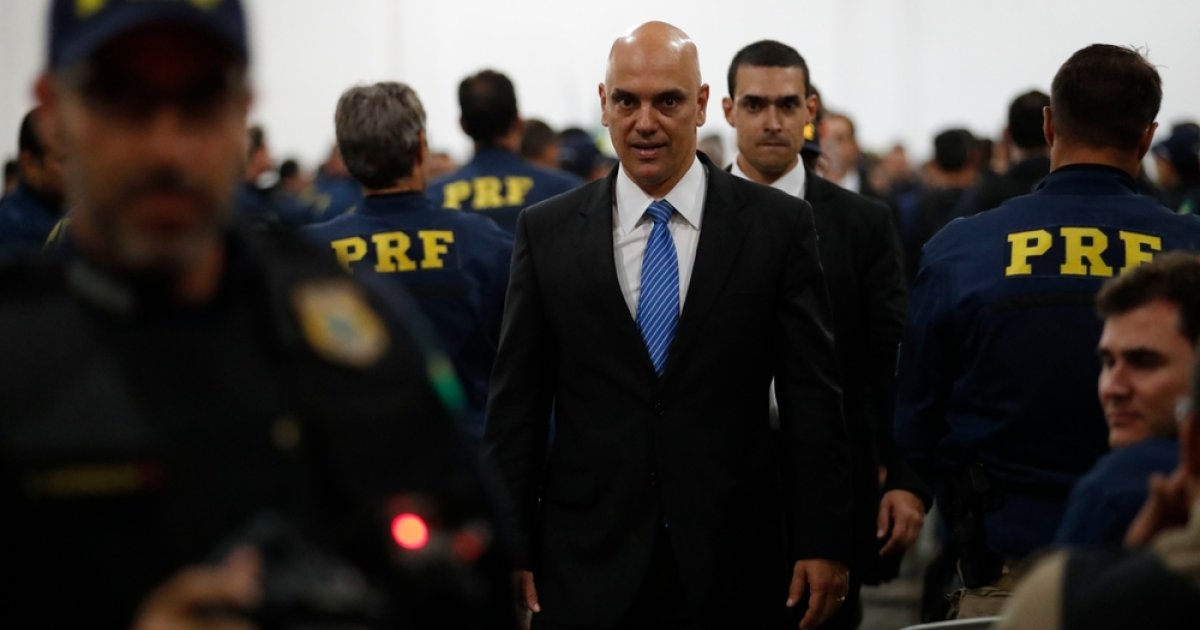
Alexandre de Moraes, the polarizing Brazilian Supreme Court Justice, is no friend to free speech. Though he is a popular figure within Brazil among those who see him as a protector of democracy, he has aggressively wielded his authority to censor, especially on the internet, with little transparency.
From his position in Brazil’s Supreme Court, de Moraes has doggedly pursued wide swaths of speech and speakers off and on the internet, as well as the tech companies hosting them. In a highly public incident last year, Brazil blocked X — and even threatened VPN users accessing it with massive fines — over the company’s noncompliance with de Moraes’ orders.
The actions of de Moraes, and Brazil’s Supreme Court more broadly, have repeatedly drawn the ire of the Trump administration. But chief among President Trump’s grievances is the prosecution of his political ally, former Brazilian President Jair Bolsonaro, who is accused of attempting a coup to overturn his 2022 election loss to President Luiz Inácio Lula da Silva.
How has the Trump administration responded?
Last month, the administration enacted a series of punishments against Brazil’s leadership and de Moraes specifically. In a July 30 executive order, Trump announced tariffs and other sanctions due to Brazil’s prosecution of Bolsonaro and other actions that “conflict with and threaten the policy of the United States to promote free speech and free and fair elections at home and abroad.” The order follows Trump’s weeks-earlier threat of tariffs over the “witch hunt” against Bolsonaro.
Secretary of State Marco Rubio also revoked the visas of de Moraes “and his allies on the court” and their families. And under the Global Magnitsky Human Rights Accountability Act, usually reserved for the most serious human rights abuses, the Department of the Treasury announced sanctions targeting any of de Moraes’s U.S. assets.
Unprincipled, partisan free speech advocacy is no free speech advocacy at all
There is plenty to debate about how to best protect free speech on the global internet, and around the world more generally, and what actions the United States can take in its defense. But, even though Brazil’s adversarial relationship with free expression is deeply alarming, it’s impossible to ignore the incongruity of the Trump administration putting itself in the position of diagnosing and treating government censorship.
Physician, heal thyself.
The opening months of Trump’s second term in office have offered a nonstop, headspinning bonanza of violations, threatened and enacted, against Americans’ First Amendment rights.
I write regularly in the Free Speech Dispatch about the myriad threats to freedom of expression, from Russia to the UK to India to Hong Kong. It’s painfully, brutally clear we need leadership to push back against the wave of global repression that threatens all of our rights. But that leadership must practice what it preaches and avoid simply using concerns about free speech as a pretext to fight partisan political battles. On both counts, this administration has failed.
You will make no converts to the free speech cause by proving right the critics who suspect its advocates are guided by partisan aims, not principled ones. Instead, you will breed cynicism and harm the very cause you claim to support.
This same posturing marred Vice President JD Vance’s objections to European censorship, an ugly trend that’s in dire need of principled critiques. Instead, Vance claimed that under Trump, the “new sheriff in town,” the administration “may disagree with your views, but we will fight to defend your right to offer them in the public square.”
The ugly reality is that the U.S. is rapidly ceding its moral authority to criticize foreign governments’ censorship, like that emanating from Brazil’s Supreme Court, when its own president and agencies are gleefully flouting the First Amendment and free speech principles day in and day out.
Perhaps most baffling was the administration’s objection to the Brazilian government’s targeting of Paulo Figueiredo, a Brazilian journalist, and “U.S. resident, for speech he made on U.S. soil.” Readers may also be able to think of some more government officials targetingimmigrants legally residing in the U.S. for protected speech made on U.S. soil — and they’re doing so from our White House and State Department, not thousands of miles away.
Global censorship is a real challenge, and it’s only getting worse. But until the U.S. removes the censorial beam from its own eye, we may find that other nations are unmoved by our criticisms and cures. Or, they may perhaps even be interested in doling them out to us.
This story about AmeriCorps jobs was produced by The Hechinger Report, a nonprofit, independent news organization focused on inequality and innovation in education. Sign up for the Hechinger newsletter.
Lily Tegner didn’t know what she wanted to do when she graduated from Oregon State University with a chemical engineering degree five years ago. She entered the workforce at a point when unemployment briefly skyrocketed and companies were freezing hiring because of the Covid pandemic. “I didn’t have a very clear direction as far as where I was going in life,” she said.
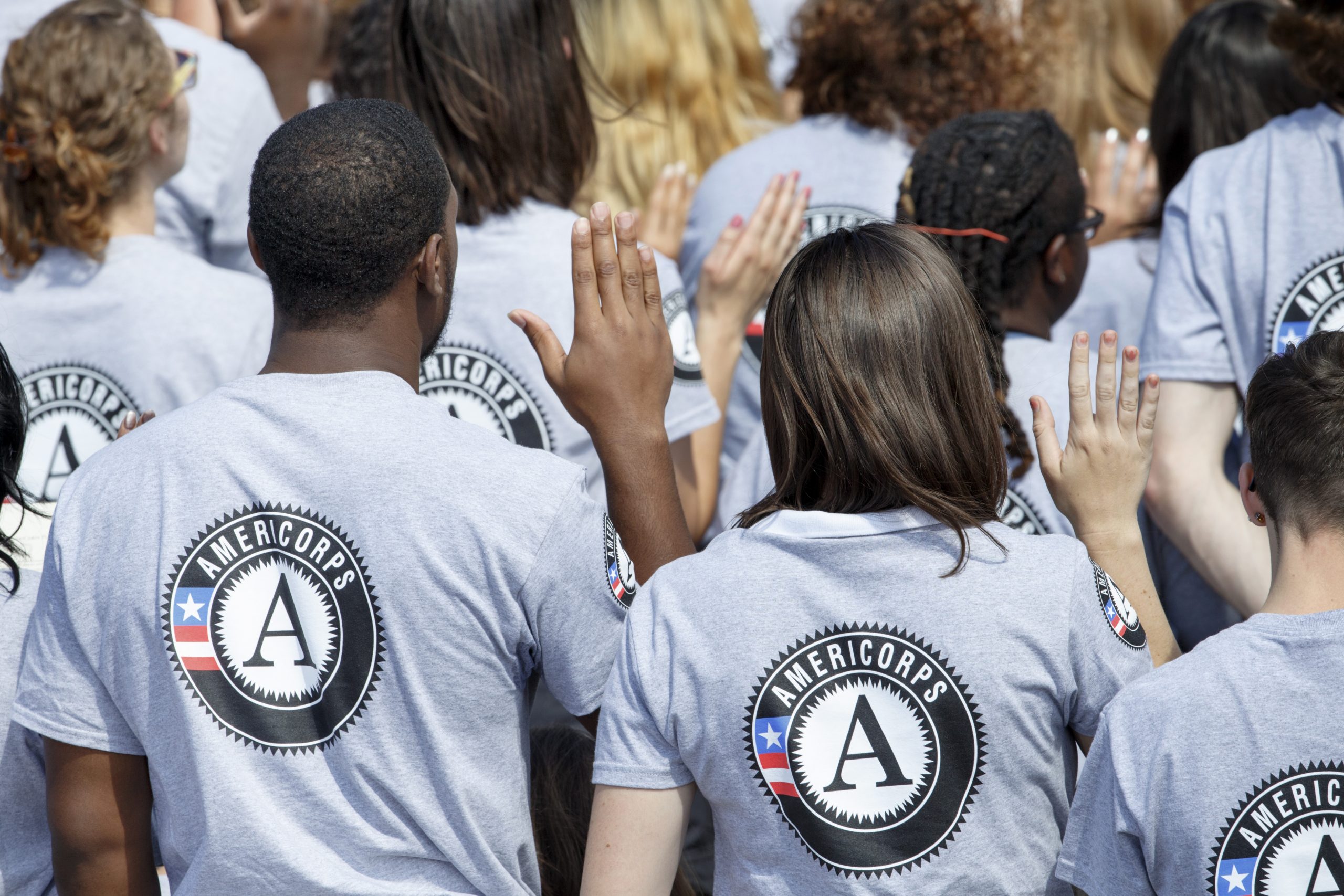
Like hundreds of thousands of other young adults, Tegner kick-started her career through AmeriCorps, a federal agency that sends its members to communities across the country to tutor students, help after disasters strike and restore wildlife habitats, among other activities. She took a position at the Alaska Afterschool Network, where her job was to help find ways to expand science, technology, engineering and math access in its programs. Four years later, she’s still there — now, as a full-time employee managing the nonprofit’s AmeriCorps program.
“This state became my home,” Tegner said, adding that her year in AmeriCorps “completely changed the trajectory of my career.”
An AmeriCorps member poses with a student in one of the Alaska Afterschool Network’s funded programs. The organization lost its AmeriCorps funding last spring. Credit: Courtesy of Alaska Afterschool Network
This spring, Alaska Afterschool Network was one of hundreds of organizations abruptly notified that its AmeriCorps funding had been terminated. Federal funding cuts forced the nonprofit to eliminate three full-time positions and cancel 19 internships scheduled for this summer. Tegner’s job is also at risk, though the organization is trying to find a way to keep her on.
In late April, the Trump administration slashed 41 percent of AmeriCorps’ funding, cutting about $400 million in grants and letting go of more than 32,000 members serving in hundreds of programs across the United States. In June and also this month, judges ordered the government to restore some funding, but the ruling does not reinstate all the money that was taken away. Shrinking AmeriCorps is among the many steps the Trump administration has taken to curb what he has called “waste, fraud and abuse” of federal funds. More action is expected in the months ahead.
Related: Become a lifelong learner. Subscribe to our free weekly newsletter featuring the most important stories in education.
Over the years, the program former President Bill Clinton created has deployed more than a million people.On top of gutting AmeriCorps, the cuts have diminished the reach of an agency that has been a critical path to a career for recent high school and college graduates at a time when entry-level jobs can be difficult to find.
AmeriCorps was created more than three decades ago to oversee expanded federal volunteer programs, incorporating existing projects including Volunteers in Service to America and the National Civilian Community Corps. Its members take on community service positions across the country that can last for up to two years. They receive a small living stipend, and full-time members are eligible for health insurance. At the end of their terms, members are awarded a grant that can be used to pay college tuition or student loans.
“AmeriCorps dollars have a powerful ripple effect, for both the AmeriCorps members and the students that they serve,” said Leslie Cornfeld, founder and CEO of the National Education Equity Lab, a nonprofit that brings college courses to high-poverty schools. “In many instances, it helps them define their careers.”
About half of the AmeriCorps funding for the Philadelphia Higher Education Network for Neighborhood Development was cut this spring. Credit: Courtesy of PHENND
Federal surveys of AmeriCorps members from 2019, 2021 and 2023 show that 90 percent of members joined the national program in part to gain skills that would help them in school and work, and well over 80 percent said their experience in AmeriCorps helped further their “professional goals and endeavors.”
The Trump administration cited fraud as part of its reason for nearly halving the AmeriCorps budget. Audits of the agency have raised questions about its financial management.
Peter Fleckenstein, 23, joined Aspire Afterschool in Arlington, Virginia, through AmeriCorps last year after graduating from the University of Delaware with a degree in psychology. He saw AmeriCorps as a way to build out his resume; even the entry-level positions he encountered during his job search required experience in the field.
In his position at the after-school program, Fleckenstein leads daily activities for a group of about two dozen fourth grade students. The experience has helped him crystallize his career aspirations: Before AmeriCorps, he was considering clinical social work or teaching. Now, he wants to become a counselor.
“Working with the kids here is a lot of behavior management: problem solving, helping them regulate themselves,” Fleckenstein said. “Doing one-on-one work with them, building habits and routines with them — that is something that I could focus on more if I was in a counseling job.”
Fleckenstein’s position was cut in April before he could complete his one-year term set to end in August, but Aspire Afterschool was able to raise money through donations to hire him and some of the nonprofit’s other AmeriCorps members part-time to finish out their grant year.
The Philadelphia Higher Education Network for Neighborhood Development lost half of its AmeriCorps funding this past spring when the federal agency was slashed. Credit: Courtesy of PHENND
While some members have joined Americorps after graduating, student Deja Johnson, 24, joined as a way to help pay for college. Her term at The Scholarship Academy — a nonprofit in Atlanta helping low-income high school students navigate financial aid applications — was supposed to end with a $7,400 education grant. Because the terms were cut short, members have been told they’ll get only a prorated portion of the money.
“It’s a little bit of a shame,” said Johnson, who is using the education grant to pursue a bachelor’s degree in nonprofit leadership.
“That’s what a lot of us look forward to with this work that we’re doing, because we know how much of a sacrifice it can be at times. It’s that ‘pouring into our community’ — and that’s how our community pours into us,” Johnson said.
The AmeriCorps termination letters told grantees that their programs no longer met agency priorities, but the nonprofits were not told what those priorities are. Programs with different missions, in both Democratic- and Republican-led communities, were cut.
Sira Coulibaly, a member with the Philadelphia Higher Education Network for Neighborhood Development’s Next Steps AmeriCorps program, packs bags of food for the Metropolitan Area Neighborhood Nutrition Alliance. Credit: Courtesy of PHENND
The Hindman Settlement School, a nonprofit in rural Kentucky, was one victim of the cuts. The organization receives about $1 million a year from AmeriCorps for its program tutoring students with math and reading learning disabilities in more than two dozen schools. Losing that funding means drastically scaling back services, said Josh Mullins, senior director of operations at the Hindman Settlement School. He said he does not know why Hindman’s grants were terminated: The nonprofit regularly passes its audits, and its last annual report showed an average gain of seven months in reading levels among students in its dyslexia intervention program.
A statement published in January on an AmeriCorps webpage says the agency is in the process of “conducting a full review” to comply with President Donald Trump’s executive order banning diversity, equity and inclusion in federal programs. But Mullins and other AmeriCorps grantees said diversity, equity and inclusion efforts were not listed anywhere as part of their operations.
“That’s what’s devastating,” Mullins said. “It was completely out of our control. There was nothing you could do.”
The administration also gutted 85 percent of the agency’s federal staff, which has caused problems even for programs that are still receiving AmeriCorps funding.
The federal government terminated about half of the AmeriCorps grants for the Philadelphia Higher Education Network for Neighborhood Development. The group uses the funding to place members in local nonprofits and to help develop community partnerships in high-poverty schools. Director Hillary Kane said she’s been experiencing delays from the national AmeriCorps office in getting members approved for the programs that are still operating.
“We need the humans in D.C. to do the stuff that they do, so we can do the stuff that we do,” Kane said. “The person we communicate with isn’t there.”
About half of the AmeriCorps funding for the Philadelphia Higher Education Network for Neighborhood Development was cut this spring. Credit: Courtesy of PHENND
On June 5, a federal judge granted a temporary injunction ordering the Trump administration to restore AmeriCorps funding in states that had sued over the budget cuts. The lawsuit, which was filed by two dozen Democratic-led states in May, challenges the administration’s authority to cancel the funding without Congressional approval. But the judge’s injunction does not require the Trump administration to reinstate AmeriCorps’ federal employees, and funding is not being restored to programs in states that did not sign on to the lawsuit, including Alaska, home of the Alaska Afterschool Network, or Virginia, where Aspire Afterschool is based.
The Hindman Settlement School in Kentucky was one organization whose funding was restored this summer because of the lawsuit. Mullins said he’s hopeful the nonprofit will continue to receive AmeriCorps funding for the upcoming grant cycle in the fall.
For Kane, the injunction does not undo the chaos caused by the abrupt cancellation of half of her Philadelphia organization’s funding. Many terminated members that were with Kane’s organization have already moved on.
Programs whose grants were cut can apply again in the next grant cycle, but the president’s 2026 budget calls for shutting down AmeriCorps entirely.
While the debate in Washington rages, current and former volunteers mourn the potential loss of a program they said gave their lives meaning and led to employment. The avenue AmeriCorps provided for Tegner to start a career at the Alaska Afterschool Network gave her purpose in life, she said. She’s worried if the program ends, there won’t be another pathway on the same scale for young idealists who aren’t sure what they want to do with their lives.
“It helps young people of all ages grow and try new things,” Tegner said. “That’s very much what it was for me.”
Contact staff writer Ariel Gilreath on Signal at arielgilreath.46 or at [email protected].
The Hechinger Report provides in-depth, fact-based, unbiased reporting on education that is free to all readers. But that doesn’t mean it’s free to produce. Our work keeps educators and the public informed about pressing issues at schools and on campuses throughout the country. We tell the whole story, even when the details are inconvenient. Help us keep doing that.
DES MOINES, Iowa — Macon Smith stood in front of a nearly empty classroom 1,000 miles from home. He asked his opponent and the two judges in the room if they were ready to start, then he set a six-minute timer and took a deep breath.
“When tyranny becomes law, rebellion becomes duty,” he began.
In front of Macon, a 17-year-old high school junior, was a daunting task: to outline and defend the argument that violent revolution is a just response to political oppression.
In a few hours, Macon would stand in another classroom with new judges and a different opponent. He would break apart his entire argument and undo everything he had just said.
“An eye for an eye makes the whole world blind,” Macon started.
It doesn’t really matter what opinion Macon holds on violence or political oppression. In this moment in front of the judges, he believes what he’s saying. His job is to get the judges to believe with him.
Macon was one of more than 7,000 middle and high school students to compete in the National Speech and Debate Tournament this summer in Iowa, run by an organization that is celebrating a century in existence.
In that time, the National Speech and Debate Association has persevered through economic and social upheaval. It is entering its next era, one in which the very notion of engaging in informed and respectful debate seems impossible. The organizers of this event see the activity as even more important in a fracturing society.
“I don’t think there’s an activity in the world that develops empathy and listening skills like speech and debate,” said Scott Wunn, the organization’s president. “We’re continuing to create better citizens.”
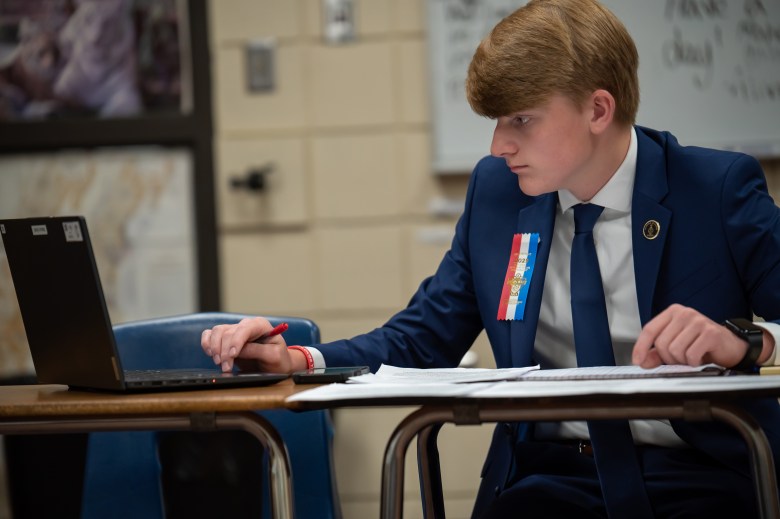
Macon Smith, a rising senior from Bob Jones Academy in South Carolina, competes in the third round of the Lincoln-Douglas Debate at the National Speech and Debate Tournament in Iowa this summer. Credit: Meenakshi Van Zee for The Hechinger Report
Though the tournament is held in different cities around the country, for the 100th anniversary, the organizers chose to host it in Des Moines, where the association’s headquarters is based.
Preparing for this competition was a year in the making for Macon, who will be a senior at Bob Jones Academy, a Christian school in Greenville, South Carolina, this fall. Students here compete in more than two dozen categories, such as Original Oratory, in which they write and recite their own 10-minute speeches, or Big Questions, where they attempt to argue broad, philosophical ideas.
Macon’s specialty, the Lincoln-Douglas Debate, is modeled after a series of public, three-hour debates between Abraham Lincoln and Sen. Stephen Douglas in 1858. In this event, two students have just 40 minutes to set up their arguments, cross-examine each other and sway the judges.
“Even if I don’t personally believe it, I can still look at the facts and determine, OK, this is a good fact, or it’s true, and argue for that side,” Macon said.
Debaters often have to tackle topics that are difficult, controversial and timely: Students in 1927 debated whether there was a need for a federal Department of Education. In 1987, they argued about mandatory AIDS testing. In 2004, they debated whether the United States was losing the war on terror. This year, in the Public Forum division, students debated whether the benefits of presidential executive orders outweigh the harms.
While the speech and debate students practiced for their national event, adults running the country screamed over each other during a congressional hearing on state sanctuary policies. A senator was thrown to the floor and handcuffed during a press conference on sending the National Guard to immigration enforcement protests in Los Angeles. Most Americans feel political discourse is moving in the wrong direction — both conservatives and progressives say talking politics with someone they disagree with has become increasingly stressful and frustrating.
Speech and debate club, though, is different.
“First of all, it gives a kid a place to speak out and have a voice,” said Gail Nicholas, who for 40 years has coached speech and debate at Bob Jones Academy alongside her husband, Chuck Nicholas, who is Macon’s coach. “But then also learn to talk to other people civilly, and I think that’s not what’s being modeled out there in the real world right now.”
Macon Smith, a rising senior from Bob Jones Academy in South Carolina, shows off the notes that he took during debates at the National Speech and Debate Tournament in Iowa. Credit: Meenakshi Van Zee for The Hechinger Report
On the second day of the competition in a school cafeteria in West Des Moines, Macon was anxiously refreshing the webpage that would show the results of his rounds to learn whether he would advance to semifinals.
For most of the school year, Macon spent two days a week practicing after school, researching and writing out his arguments. Like many competitors, he has found that it’s easy to make snap judgments when you don’t know much about an issue. Decisively defending that view, to yourself and to others, is much harder.
“I tend to go in with an opinion and lose my opinion as the topic goes on,” said Daphne DiFrancesco, a rising senior from Cary Academy in Cary, North Carolina.
Traveling for regional events throughout the school year means Macon has become friends with students who don’t always share his conservative views. He knows this because in debate, discussing politics and religion is almost unavoidable.
“It doesn’t make me uncomfortable at all,” Macon said. “You don’t want to burn down a bridge before you make it with other people. If you stop your connection with a person right at their political beliefs, you’re already cutting off half of the country. That’s not a good way to conduct yourself.”
Macon, and other students in the clubs, said participating has made them think more deeply about their own beliefs. Last year, Macon debated a bill that would defund Immigration and Customs Enforcement, an agency he supports. After listening to other students, he developed a more nuanced view of the organization.
“When you look at the principle of enforcing illegal immigration, that can still be upheld, but the agency that does so itself is flawed,” he said.
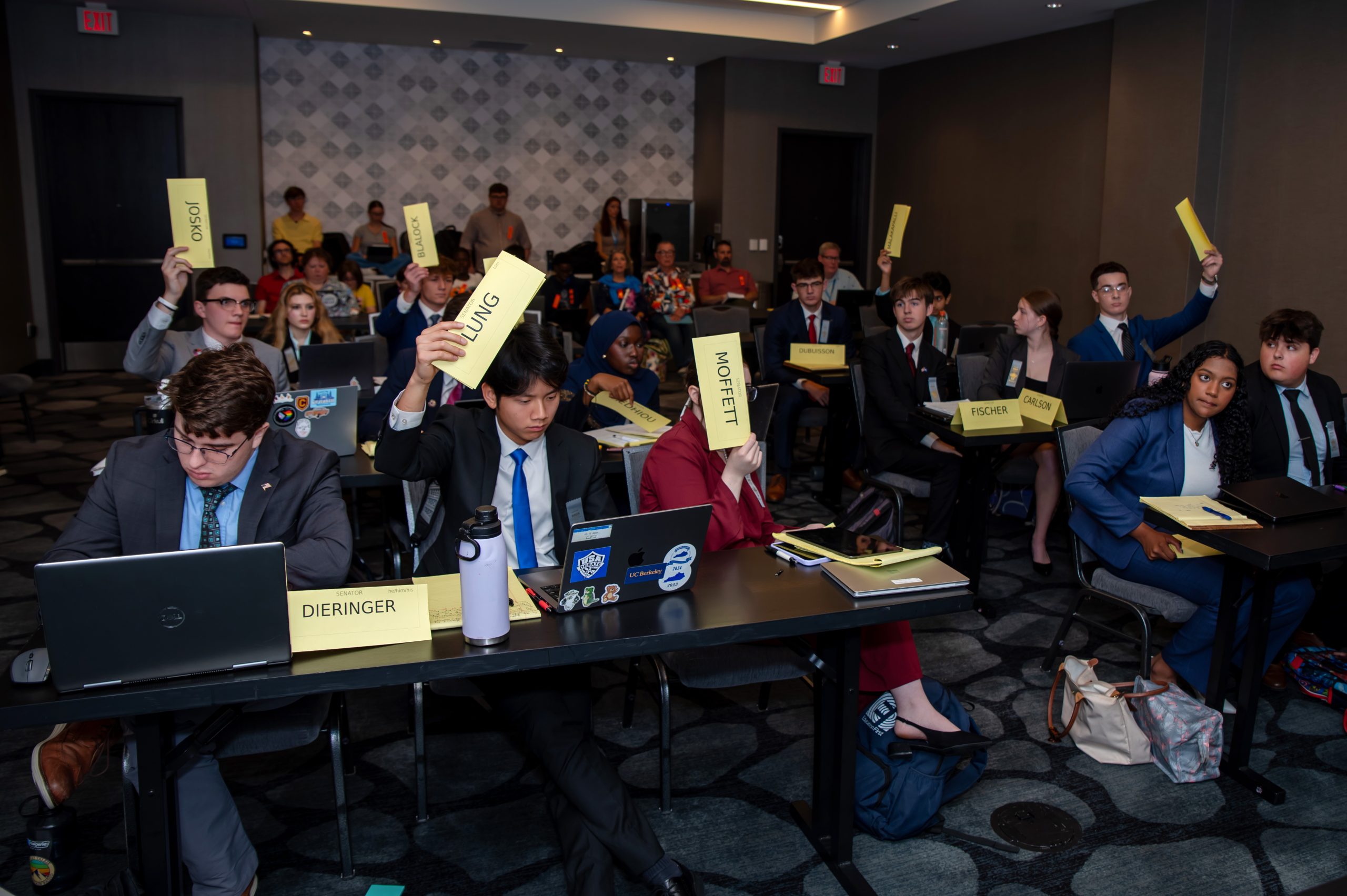
Henry Dieringer, a senior from L.C. Anderson High School in Austin, Texas, went into one competition thinking he would argue in favor of a bill that would provide work permits for immigrants, which he agrees with. Further research led him to oppose the idea of creating a federal database on immigrants.
“It made me think more about the way that public policy is so much more nuanced than what we believe,” Henry said.
On the afternoon of the second day of the national tournament, Macon learned he didn’t advance to the next round. What’s sad, he said, is he probably won’t have to think this hard about the justness of violent revolution ever again.
“There’s always next year,” Macon said.
Callista Martin, 16, a rising senior from Bainbridge High School in Washington state, also didn’t make the semifinals. Callista and Macon met online this year through speech and debate so they could scrimmage with someone they hadn’t practiced with before. It gave them the chance to debate someone with differing political views and argument styles.
Macon Smith, a rising senior from Bob Jones Academy in South Carolina, takes notes during a round of the Lincoln-Douglas Debate at the National Speech and Debate Tournament in Iowa. Credit: Meenakshi Van Zee for The Hechinger Report
“In the rounds, I’m an entirely different person. I’m pretty aggressive, my voice turns kind of mean,” Callista said. “But outside of the rounds, I always make sure to say hi to them before and after and say things I liked about their case, ask them about their school.”
Talking to her peers outside of rounds is perhaps the most important part of being in the club, Callista said. This summer, she will travel to meet with some of her closest friends, people she met at debate camps and tournaments in Washington.
Since Callista fell in love with speech and debate as a freshman, she has devoted herself to keeping it alive at her school. No teacher has volunteered to be a coach for the debate club, so the 16-year-old is coaching both her classmates and herself.
A lack of coaches is a common problem. Just under 3,800 public and private high schools and middle schools were members of the National Speech and Debate Association at the end of this past school year, just a fraction of the tens of thousands of secondary schools in the country. The organization would like to double its membership in the next five years.
That would mean recruiting more teachers to lead clubs, but neither educators nor schools are lining up to take on the responsibility, said David Yastremski, an English teacher at Ridge High School in New Jersey who has coached teams for about 30 years.
It’s a major time commitment for teachers to dedicate their evenings and weekends to the events with little supplemental pay or recognition. Also, it may seem like a risk to some teachers at a time when states such as Virginia and Louisiana have banned teachers from talking about what some call “divisive concepts,” to oversee a school activity where engaging with controversial topics is the point.
“I primarily teach and coach in a space where kids can still have those conversations,” Yastremski said. “I fear that in other parts of the country, that’s not the case.”
Dennis Philbert, a coach from Central High School in Newark, New Jersey, who had two students become finalists in the tournament’s Dramatic Interpretation category, said he fears for his profession because of the scrutiny educators are under. It takes the fun out of teaching, he said, but this club can reignite that passion.
“All of my assistant coaches are former members of my team,” Philbert said. “They love this activity [so much] that they came back to help younger students … to show that this is an activity that is needed.”
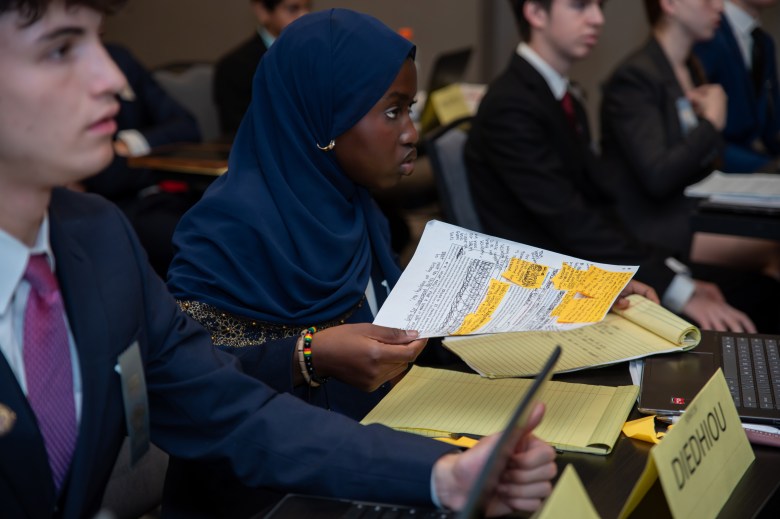
On the other side of Des Moines, Gagnado Diedhiou was competing in the Congressional Debate, a division of the tournament that mimics Congress and requires students to argue for or against bills modeled after current events. During one round, Gagnado spoke in favor of a bill to shift the country to use more nuclear energy, for a bill that would grant Puerto Rico statehood, and against legislation requiring hospitals to publicly post prices.
Gagnado Diedhiou, a senior from Eastside High School in South Carolina, competing in the first round of the Congressional Debate at the National Speech and Debate Tournament in Iowa in June. Credit: Meenakshi Van Zee for The Hechinger Report
Just like in Congress, boys outnumbered girls in this classroom. Gagnado was the only Black teenager and the only student wearing a hijab. The senior, who just graduated from Eastside High School in Greenville, South Carolina, is accustomed to being in rooms where nobody looks like her — it’s part of the reason she joined Equality in Forensics, a national student-led debate organization that provides free resources to schools and students across the country.
“It kind of makes you have to walk on eggshells a little bit. Especially because when you’re the only person in that room who looks like you, it makes you a lot more obvious to the judges,” said Gagnado, who won regional Student of the Year for speech and debate in her South Carolina district this year. “You stand out, and not always in a good way.”
Camille Fernandez, a rising junior at West Broward High School in Florida, said the competitions she has participated in have been dominated by male students. One opponent called her a vulgar and sexist slur after their round was over. Camille is a member of a student-led group — called Outreach Debate — trying to bridge inequities in the clubs.
“A lot of people think that debate should stay the same way that it’s always been, where it’s kind of just — and this is my personal bias — a lot of white men winning,” Camille said. “A lot of people think that should be changed, me included.”
Despite the challenges, Gagnado said her time in debate club has made her realize she could have an influence in the world.
“With my three-minute speech, I can convince a whole chamber, I can convince a judge to vote for this bill. I can advocate and make a difference with some legislation,” said Gagnado, who is bound for Yale.
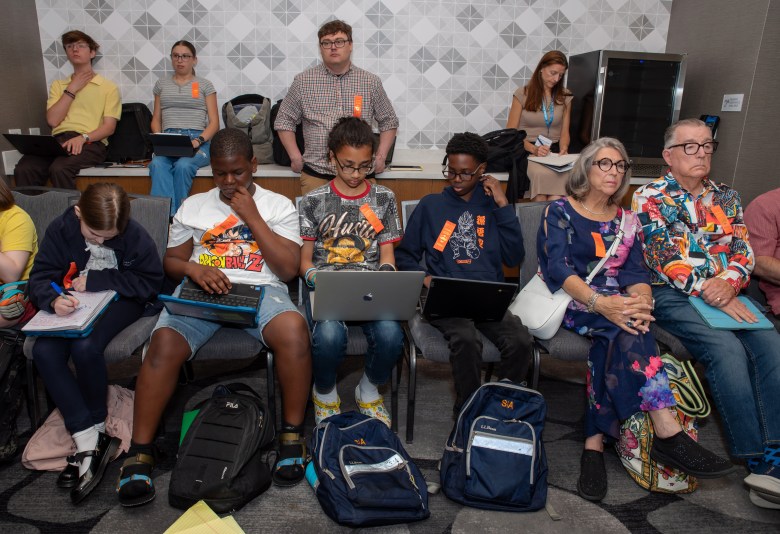
About 10,000 people attended the National Speech and Debate Tournament in Iowa this June during the organization’s centennial anniversary. Credit: Meenakshi Van Zee for The Hechinger Report
A day before the national tournament’s concluding ceremony, a 22-year-old attendee rushed the stage at the Iowa Event Center in Des Moines during the final round of the Humorous Interpretation speech competition, scaring everyone in the audience. After he bent down to open his backpack, 3,000 people in the auditorium fled for the exits. The man was later charged with possession of a controlled substance and disorderly conduct. For a brief moment, it seemed like the angry discourse and extreme politics from outside of the competition had become a part of it.
In response, the speech and debate organization shifted the time of some events, limited entrances into the building and brought in metal detectors, police officers and counselors. Some students, Gagnado among them, chose not to return to the event.
Still, thousands of attendees stayed until the end to celebrate the national champions. During the awards ceremony, where therapy dogs roamed the grounds, Angad Singh, a student from Bellarmine College Preparatory in California competing in Original Oratory, took the national prize for his speech on his Sikh identity and the phrase “thoughts and prayers” commonly repeated by American leaders after a tragedy, titled “Living on a Prayer.”
“I’ve prayed for change,” Singh told the audience. “Then I joined speech and debate to use my voice and fight for it.”
The Hechinger Report provides in-depth, fact-based, unbiased reporting on education that is free to all readers. But that doesn’t mean it’s free to produce. Our work keeps educators and the public informed about pressing issues at schools and on campuses throughout the country. We tell the whole story, even when the details are inconvenient. Help us keep doing that.
The college search can be daunting, with an overwheling array of options and no clear start line. The graphic below shows you how to take two simple but powerful steps on the way to the University of You, and you can here me talk more about these steps on episode 24 of the Tom Talks College podcast.
How do I find the right colleges, and where do we start?
#1 Clarify your needs + wants.
Fill in as much of the University of You Matrix as possible. Don’t sweat what you don’t know yet. It’s a work in progress. Avoid lazy words such as “good” and “big.” You’re better than that.
Check out Zoe’s matrix. She’s a rockstar!
Take time to explore colleges online and follow my campus visit rule: Visit early. Visit Often. You’ll be amazed how quickly you’ll go from “um, not sure” to “this is what I need and want,” but it doesn’t happen without effort and energy.
#2 Start by finding A+A options.
Skip those reach schools for now that get you all bunged up about not getting in. Match your matrix with colleges that fit both A’s.
ACCESSIBLE = I will get in.
AFFORDABLE = We can afford it.
Opening your mind to a great experience at a college that ALREADY loves you is the best way to take the stress level down a notch. Maybe the best fit isn’t the one that tells the most students “no.”
The goal is to create a great set of options from which to choose — when it’s time to choose
None of this is intended to create a “drive through” college search process. To do this well, it takes time, energy, patience and sometimes endurance. But it’s 100% worth it.
Next up: How to visit campuses the right way
In two weeks I’ll return to one of my favorite topics, and one which I’ve featured on numerous episodes.
I have no idea what I’ll say, but I’ll come up with something YOU can use to get the most from campus visits on your way to the University of You.
Reading my colleague Jackie Mader’s latest story about the vital importance of warm, interactive exchanges between caregivers and children brought back the terrifying feeling that comes with leaving your baby in the hands of someone you don’t really know — and the relief when you see an experienced, loving educator taking charge.
Mader’s story details how a growing number of cities and states — red and blue — are pouring resources into training teachers and even evaluating programs on how warm and responsive teachers are. As Bridget Hamre, a research associate professor at the University of Virginia, told Mader, other elements of quality, like teacher education are “only important to the degree to which they change the way that teachers interact with kids.”
The story, as well as a documentary that I saw last week at the SXSW EDU conference on model child care programs, left me feeling inspired about the future of child care in America for the first time in a while. The documentary, “Make a Circle,” tells the story of highly trained and qualified child care workers in the California Bay Area, and their efforts to transform the way society views their industry. It will be available on PBS in the fall, and is being shown at film festivals and other events across the U.S.
Throughout the film, you see the intricate and important work of early educators as they play with children, teach them letters, colors and sounds, and take them for walks in the woods. That might sound basic but, like the thoughtful interactions described in Mader’s piece, can ultimately make a huge difference in the lives and well-being of children. And sadly, this kind of child care is not widely available or affordable.
Fortunately, it was for the children of the filmmakers, husband-and-wife team Todd Boekelheide and Jen Bradwell. They actually knew some preschool owners and teachers featured in the film: Their own two children attended one of them. Bradwell calls the documentary “a love letter to early educators and a rallying cry for a child care system in crisis.”
The system needs all of the love it can get: a point that Isabelle Hau makes in her new book, “Love to Learn,” a deep dive into the importance of building quality relationships in early childhood care. (I’ll be moderating a discussion of some of her findings at the ASU+GSV conference in San Diego next month.)
“Close, nurturing relationships in the early years are like the foundation of a house,” Hau writes. “If the foundation is not solid, the house may shake apart later in strong winds.”
Both Bradwell and Hau had a chance to expound on their findings at another early childhood event: a celebration of Hau’s book at the Austin, Texas, home of Libby Doggett, who over the years taught me a great deal about the importance of quality early childhood education as the former director of Pre-K Now, a 10-year campaign to advance high-quality, voluntary pre-K for all 3- and 4-year-olds across the U.S.
Here was a crowd committed to improving the way we teach our littlest learners and training their teachers during this difficult time for the early childhood industry. The Hechinger Report is documenting cuts to research and other shifts in early childhood spending under the Trump administration. We keep an updated Trump tracker on our site to catalog everything we know. We also love hearing from you on these issues, so please respond to this newsletter to get in touch!
This story about responsive teachers was produced by The Hechinger Report, a nonprofit, independent news organization focused on inequality and innovation in education. Sign up for the Hechinger newsletter.
The Hechinger Report provides in-depth, fact-based, unbiased reporting on education that is free to all readers. But that doesn’t mean it’s free to produce. Our work keeps educators and the public informed about pressing issues at schools and on campuses throughout the country. We tell the whole story, even when the details are inconvenient. Help us keep doing that.
How do you get someone who lives in India to care about people in Uganda?
That’s the challenge for journalists who try to tell stories about parts of the world that most of the press ignores. Correspondent Enock Wanderema is from Uganda and wants the world to know what happens there.
For a story about the widespread government corruption he focused on one woman, Aloikin Praise Opoloje. Wanderema tells us this story about Opoloje giving birth in a hospital that had been starved of resources because of government corruption. He writes:
…she watched the midwife try to manage multiple births at once. Opoloje could tell she was exhausted. “One of the women was in critical condition, but the surgeon who was supposed to operate was nowhere to be found,” Opoloje said. “We tried calling him, but he wasn’t picking up.”
Wanderema used what we call an anecdote to help bring the complicated story of government corruption to life. Anecdotes are little stories about something that happened to someone. People tell little stories about themselves all the time.
Bring the story to life.
In interviews savvy reporters will focus attention on these little stories and try to get as many details as they can. When did this happen? Where were you exactly? What time of day was it? Were there people around? What did it sound like?
A good reporter knows that the little details help make a story three-dimensional for readers or listeners. It helps place the reader there as it is happening. And if people feel like they are there, they will care.
High school student Helen Milito wrote about her experience spending a year studying in Italy with School Year Abroad. To show how different she felt and how much it took her out of her comfort zone she gave this story:
We were split into two teams scrimmaging against each other. The boys I play with are competitive so there was the usual light trash talking, jersey pulling and agile foot skills.
We were playing friendly rules with no corner kicks. My teammate, Gugu, was fouled in the makeshift goalie box and dramatically fell to the ground yelling for a penalty kick.
None of us expected the coach to listen to him, but surprisingly he gave it to our team on the condition that I take the kick. All the players lined up around the box as I prepared to shoot, choosing to aim for the bottom right corner.
Two things you should know: First this is in Italy and I’m an American teenager who speaks little Italian. Second, I’m the only girl on the team.
The coach blew the whistle. I confidently ran, kicking the ball with all my strength. It went soaring over the crossbar into the fence behind. I wanted to crawl into a hole and hide.
Note how she shows us visually what is happening through action: “there was light trash talking, jersey pulling and agile foot skills.” She includes the sound of the coach’s whistle. And she gives us emotion: “I confidently ran…”, “I wanted to crawl into a hole…”
Telling other people’s stories
Correspondent Leah Pattem felt compelled to report how people in Madrid were suffering from high rents. To do that, like Wanderema, she found one woman whose story she could tell.
Pattem wrote:
Now in her 80s, [Marjorie] Kanter is at the peak of her career, author of three books and an active member of Madrid’s writing community. “I don’t have many more years left, so I really want to enjoy being a successful writer for as long as I can,” she said.
However, Kanter is facing a major setback. In September, a registered letter demanded she vacate her home at the end of October. A Galician vulture fund had purchased her apartment and didn’t offer her a new higher-priced rental contract. She suspects that means they will convert her home into a tourist flat.
The thing is, people don’t offer up anecdotes without prompting. They don’t think reporters are interested in the little stories they tell their friends. And there is a general rule in interviewing that people won’t answer unasked questions. So to get the anecdote you need to tease it out of the person you interview question by question.
Here are some questions that are useful in teasing out a little story:
Can you remember the first time you did that?
Can you remember the scariest time?
Can you think of a time when that happened to you?
Drilling down
Ask questions to jog a person’s memory. They’ll say, “There was this one time that …”
All the time, write down what they say and pester them for details. Imagine that the person is your grandfather and you are five years old. You will keep interrupting him to ask for details he doesn’t think is important but is important to a five-year old: What were you wearing? Was it cold? What did it smell like? Were you scared? Were you hungry? How old were you? How tall were you?
The key is to drill down. When someone says something, ask for specifics. When did that happen exactly? Where was that? Who else was there? No detail is too small or insignificant because to recreate a scene and you need to paint a complete picture.
Anecdotes are great ways to start articles. They grab the attention of readers and get them interested enough to read on.
After all, who doesn’t want to hear a good story?
Three questions to consider:
1. What is an anecdote? 2. How can anecdotes help you tell a complicated story? 3. Can you think of a little story you have told your friends or family about yourself?
If you’ve seen the award-winning film “Conclave”, you now know how exciting it can be when Catholicism’s cardinals gather behind closed doors to elect a new pope. The declining health in Pope Francis, 88, means another conclave is coming sooner rather than later.
So who is likely to win? The truth is — we have no idea.
What are the issues the world’s 1.3 billion Catholics would like the next head of their worldwide Church to tackle? We don’t know that for certain either.
In his 12 years as pope, Francis has so scrambled the Church and the traditional paths toward becoming its leader that the conclave — already the strangest election you’ll never see — is even harder than ever to predict.
With the 120 cardinal electors so unsure, unforeseen events like a stirring speech behind closed doors can produce big changes. That’s how Buenos Aires Cardinal Jorge Bergoglio became Pope Francis back in 2013.
Don’t trust the early bets.
Another lesson from recent conclaves is to be very wary of any lists of leading candidates. They are not based on opinion polls or popularity contests like forecasts before political elections.
They are in fact little more than educated guesses by journalists and bookmakers, and can be laughingly far off the mark.
Many lists prior to the 2005 conclave named Milan Cardinal Dionigi Tettamanzi as a leading candidate; he reportedly got only two votes. In 2013, the pro-conclave lists of papabili — potential popes — did not even mention the eventual winner.
But readers always want to know what will happen, and the final result we can’t predict. Since this will be the third conclave I’ve either covered or commented on, let me at least say what to expect.
First of all, if you want, go see the film “Conclave” — at best before we learn if it has won any Oscars. Sure, the film is tenser and more action-packed than a real conclave, and its ending seems improbable. Due to timing limits, the leading characters are painted with a rather cartoonish brush. There are some small mistakes.
But this is entertainment, not a documentary. It is beautifully filmed. It gives an idea of the predictable ritual and possible mishaps that could influence the outcome. It’s worth seeing even if not totally believing.
Politicking for popedom
As the film shows, hopeful candidates drum up support without publicly declaring their candidacy. Open campaigning is out but supporters eagerly swap information about favorites and opponents.
Speeches about the Church during the closed-door “general congregations” meeting the week before the conclave become veiled campaign pitches for the ambitious.
Once they enter the Sistine Chapel for the conclave, the cardinals are cut off from the outside world and sworn to secrecy. This lasts for a few days of voting — a two-thirds majority is needed — until white smoke goes up from the chapel’s chimney and the new pope appears in public for the first time on the balcony of St. Peter’s Basilica next door.
What makes this conclave even more unpredictable than earlier ones is that Pope Francis has often overlooked traditional cardinal’s seats in Europe to give red hats to lesser-known and more pastorally-minded bishops from his beloved “peripheries.”
There are now cardinals in unlikely places such as Yangon, Ulaanbaatar, Algiers and Tehran, representing minuscule communities of Catholics. It’s hard to say what these prelates think or how they will vote.
A new pope could mean a new direction.
Pope Francis has appointed about 80 of the current cardinal electors out of 120, so the two-thirds majority needed for election should be there. But since so many of them are not known in Rome, it’s hard to say whether they want to continue his policies or take the Church in a different direction.
After the 2013 conclave, several conservative Catholic groups — mostly in the United States — disapproved of Pope Francis’s more open style. They said cardinals did not have enough information before they voted him in, and vowed to publish detailed profiles of all prelates on the internet.
The College of Cardinals Report seems the furthest advanced, with profiles of 40 cardinals with their positions on key issues like abortion or woman priests. It is headed by Edward Pentin, a conservative Vatican watcher.
Another project, the Red Hat Report, began in 2018 with lots of publicity saying ex-FBI agents would do some of the research and freelancers would help edit cardinals’ Wikipedia pages. It also leans conservative but has not made much noise recently.
Their main candidate appears to be Budapest Cardinal Péter Erdő, who headed the Council of the Bishops’ Conferences of Europe from 2006 to 2016.
Considered close to Hungarian Prime Minister Viktor Orbán, he seems not to share Pope Francis’s very welcoming views on migration but has hosted two visits by Pope Francis to Budapest.
Power in the Global South
Another conservative noticed is Kinshasa Cardinal Fridolin Ambongo Besungu, although the very traditional stances African prelates take turn off other cardinals.
Progressives mentioned include Bologna Cardinal Matteo Zuppi, head of the Italian Bishops Conference, and Curia Cardinal Luis Tagle, a Filipino once dubbed the “Asian Francis.” But it’s unclear whether a majority of cardinals wants an extension of the Francis years.
There are also moderates such as two Italians — possibly too diplomatic Cardinal Pietro Parolin, the current Secretary of Stage (number two man at the Vatican), and Cardinal Pierbattista Pizzaballa, the Latin Patriarch of Jerusalem — as well as French Cardinal Jean-Marc Aveline, who shares Pope Francis’s interest in the Mediterranean and caring for its migrants.
But with two-thirds of all Catholics now in the Global South, will the conclave return to the Italian and then European monopoly on the papacy after an Argentinian pope?
There are far more questions than answers. We’ll only start to know the responses after the white smoke rises.
Three questions to consider:
1. Why was Pope Francis hailed as a rule-breaker when he was elected to head the Catholic Church in 2013? 2. How does politics play out in the election of a new pope? 3. If you were part of the next conclave what would you be looking for in the candidates for pope?
If the pandemic has taught me anything its that you need to find joy in the small things. These last couple of years have been hard and unforgiving and it has been hard to find joy amongst the mess. I have had to teach myself to find joy in the small things so that I don’t completely lose my mind. Since it has been a long journey to get here, I’m going to give you a list of some of the small things I have learned to appreciate a little more.
Treats
I have learned to get excited and to enjoy even the small treats like a cupcake or a special drink. I have found that a bad day can get better with a cupcake or currently because I haven’t had them all winter a bowl of berries! They aren’t much in the grand scheme of things but doing a happy dance because I have a small bowl of strawberries has made a big difference in my day. I have also found that there are non-food treats that I have gotten excited about that again are small but make the day a little brighter. One being a new water bottle, or a new book. They are small but have a large impact!
Music
The last couple of years music has been a great outlet. I have been using music to help curb my mood. When I’m having a bad day, I blare a song I know I can’t help but move to and it helps to boost my mood. Sometimes its only a little bit but that little bit helps.
A small luxury
The most recent small joy I have found is in bath bombs. Normally I only take a 45-minute bath which again isn’t that long in the grand scheme of things but it is enough. I have found a great local business BombzRUs who makes fantastic bath bombs and the colours and smells that come from them are just wonderful. The 45-minutes I spend just enjoying the colourful sparkly water is just what I needed to make the day better or to set myself up for a good sleep for the next day.
Sunrises
Since I work at 8am and I take transit I leave the house at 7am. I am not a morning person but I have had to learn how to be. Recently there has been one upside to getting up and leaving the house by 7am and that is the sunrises. The only way I would have been able to see them is if I was up early. So, I will take the small joy of a beautiful sunrise since I have to be up early anyways.
While I am sure there are more these are currently the small joys that I have been focusing on while I try to minimize the impacts of rough days.