Tag: finds

  • Antisemitic beliefs rare among faculty, Brandeis University study finds

    Antisemitic beliefs rare among faculty, Brandeis University study finds

    Dive Brief:

    • Just 3% of non-Jewish faculty members hold views about Israel that would fit definitions of antisemitism put forward by Jewish groups, according to a spring survey of over 2,300 faculty members at 146 research universities released by Brandeis University in July. 
    • Less than 10% of faculty reported actively teaching about the Israel-Palestine conflict. Despite widespread media attention to campus protests and targeted attacks on universities by the Trump administration over allegations of antisemitism, more than three-fourths said the Israel-Palestine conflict never came up in class discussions. 
    • Only a minority of faculty were politically active or posted on social media about major current issues, including the Israel-Palestine conflict, racism in America, climate change and President Donald Trump’s impact on American democracy, the survey found. 

    Dive Insight:

    The new study comes at a time of roiling political tensions around college campuses. 

    On the campaign trail, Trump described colleges as being “dominated by Marxist maniacs and lunatics.” Since taking office in January, his administration has launched investigations and pulled research funding from major institutions — Columbia and Harvard universities, among others — over claims of rampant antisemitism on campus. 

    The administration has also sought to impose “intellectual diversity” on college faculties, including through an executive order on accreditation and in its dealings with individual universities. 

    While the Brandeis study found that nearly three-quarters of faculty — 72% — identify as liberal, they also hold “a wide range of views on controversial political issues,” the researchers wrote.

    For instance, when looking at the intensity of opinions, over 60% said they “strongly” believed that climate change was a crisis requiring immediate attention and that Trump represented a threat to democracy. 

    But only 33% expressed strong belief that racism was widespread in America and 14% that Israel is an apartheid state. (Overall, a majority of faculty backed those statements, including only those who somewhat agreed, with a much larger majority agreeing with the racism statement.) 

    That said, activism around any of those topics was relatively scant. With the Israel-Palestine conflict, 78% of faculty reported no activism at all, including on social media. Around two-thirds reported no activism around racism or climate change. 

    When it comes to teaching, a majority of faculty said they would present a variety of perspectives on those news topics, with the exception of climate change. Only 45% of faculty said they would present a variety of perspectives on climate change while another 40% said they would do so but with some perspectives “more justified than others.”

    When it came to the Middle East conflict, even among the 14% of faculty who said they strongly believed Israel to be an apartheid state, a majority (56%) said they would present a variety of perspectives when teaching about the issue.

    The researchers posed questions intended to study when faculty views of Israel veered into antisemitism as defined by Jewish groups, including the International Holocaust Remembrance Alliance, and that Jewish students frequently agree are antisemitic. They also used the definition by the Jerusalem Declaration on Antisemitism, which has accused the IHRA’s version of blurring the line between antisemitism and criticism of Israel. 

    The researchers asked whether survey respondents agreed with statements such as “Israel does not have the right to exist,” “all Israeli civilians should be considered legitimate targets for Hamas,” and “I wouldn’t want to collaborate with a scholar who supports the existence of Israel as a Jewish state.”

    Large majorities strongly disagreed with those statements, and fewer than 10% agreed with them with any intensity. Those who did were more likely to identify as liberal. 

    Likewise, a small minority of non-Jewish faculty — 7% — expressed views considered antisemitic about Jewish people as a group rather than Israel. Those faculty were more likely to be politically conservative, according to the study. 

    Amid the Trump administration’s attacks on colleges, close to half (46%) of faculty and a majority of those identifying as liberals expressed serious concerns about being targeted by the federal government for their political views, the study found.

    Source link

  • College business officers survey finds risks, resilience

    College business officers survey finds risks, resilience

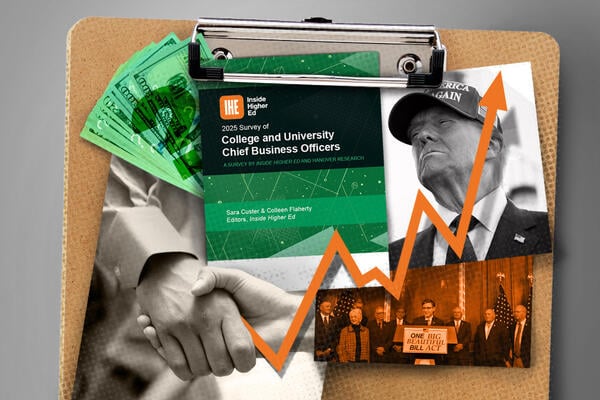
    The latest Inside Higher Ed/Hanover Research Survey of College and University Chief Business Officers, released today, reveals concerns about near-term uncertainty and financial sustainability—buoyed by confidence in the longer-term outlook.

    One of the most significant findings is that federal policy uncertainty has created difficulties in conducting basic financial planning as the Trump administration has introduced a flurry of changes impacting federal funding for higher education, international students, how students pay for college and more.

    That uncertainty, experts noted, has had a palpable effect on the sector.

    “Chief business officers like certainty, whether it’s certainty about revenue streams or potential costs,” said Kara Freeman, president and CEO of the National Association of College and University Business Officers. “And right now they just are not getting it and that leads to anxiety.”

    The annual Survey of College and University Chief Business Officers, now in its 15th year, offers insights from financial leaders at 169 institutions in 2025, both public and private nonprofits. Responses were gathered in April and May.

    Amid the uncertainty, about three in five CBOs (58 percent) rate their institution’s financial health as good or excellent, with differences by institution type.

    Pressure Tests

    In last year’s survey, 56 percent of CBOs expected that their institution would be in better financial shape a year later. That number fell to 43 percent in this year’s survey, which asked the same question.

    CBOs who believe their institution will be worse off financially next year cited concerns about the federal policy/funding environment for the sector (82 percent), potential increases to nonlabor operating costs (67 percent), rising labor costs (67 percent) and general economic concerns (62 percent).

    More on the Survey

    On Wednesday, Aug. 20 at 2 p.m. E.T., Inside Higher Ed will present a free webcast to discuss the results of the survey, with experts who can answer your most pressing questions about higher education finance—including how to plan effectively amid the current financial and policy uncertainty. Please register here.

    The 2025 Survey of College and University Chief Business Officers was made possible by support from Strata Decision Technology and CollegeVine.

    Inside Higher Ed’s 15th annual Survey of College and University Chief Business Officers was conducted by Hanover Research. The survey included chief business officers, mostly from public and private nonprofit institutions, for a margin of error of 7 percent. The response rate was 7 percent. A copy of the free report can be downloaded here.

    Larry Ladd, a subject matter specialist at AGB Consulting, noted that colleges are taking a number of measures to protect themselves in the short term, such as delaying building projects, freezing hiring and/or travel, and pulling other levers to protect themselves this coming fall.

    “You’re seeing colleges do everything they can to preserve their liquidity,” Ladd said. “The biggest reason to do that of course is that they don’t know what their fall enrollment will be.”

    Of particular concern, he noted, is the potential for disruption to federal financial aid funds, given mass layoffs at the Education Department, which has raised concerns about disbursement. Just 12 percent of CBOs support the elimination of the department.

    Other possible signs of caution: On deferred maintenance, 63 percent of respondents said that their institution was poised to fund less than a quarter of identified needs in the then-current fiscal year. Some 24 percent said their institution was freezing hiring to control costs for students; another 62 percent said their institution would consider doing this.

    Despite these challenges, respondents were much more confident in their institution’s five- to 10-year outlooks, with 73 percent believing their college or university will be financially stable over the next five years and 71 percent expressing that same level of confidence over the next decade. For reference, in 2024, 85 percent of CBOs were confident in the five-year outlook, and 73 percent in the 10-year outlook.

    Some 11 percent of CBOs say senior administrators at their institution have had serious internal discussions in the last year about merging with another college or university, about the same as last year’s survey. Most of these CBOs indicate such conversations are about proactively ensuring the institution’s financial stability rather than risk of imminent closure.

    Another 16 percent of CBOs report serious internal discussions about consolidating some programs or operations with another college or university. Two in five (42 percent) say it’s highly likely that that their college will share administrative functions with another institution within five years. CBOs in the Northeast, with its relative concentration of institutions, are especially likely to say so, at 63 percent.

    Beyond the Fog

    Ruth Johnston, vice president of NACUBO consulting, said that while business officers may be stressed by the immediate pressures, they are confident in their scenario planning for the future.

    “I think we’ll figure it out. Higher ed, even if it’s slow to change, is resilient. So I expect that we’re going to see new, creative solutions that will help bolster higher education,” Johnston said.

    That said, just 28 percent of CBOs described themselves as very or extremely confident in their institution’s current business model. Another third expressed moderate confidence.

    View online

    Top issues for those CBOs with just some or no confidence in their institution’s business model: lack of diverse revenue streams (64 percent of this group), ineffective cost containment and/or operational efficiency (54 percent), and insufficient cash reserves for “rainy days” or strategic investments (50 percent).

    Tuition discounting is another standing concern. Among all CBOs, more than half (54 percent) are at least moderately concerned about the financial sustainability of their institution’s tuition discount rate; two in 10 (21 percent) are highly concerned. Similarly, 50 percent of CBOs are at least moderately concerned about the sustainability of their institution’s tuition sticker price increases. In both cases, private nonprofit CBOs are the most concerned, by sector.

    Respondents also saw government efforts to influence institutional strategy and policy as an increasing risk to their institutions, with 71 percent registering this as a concern. That number is up slightly from last year’s 65 percent.

    CBOs in 2025 were much less concerned about donor efforts to influence institutional strategy, with 16 percent worrying that this amounts to an increasing financial risk to their college or university.

    Internally, at least, some 81 percent of CBOs agree that they have sufficient agency influence within their institution to ensure its financial stability. Most also report a strong working relationship with their president, and understanding among trustees of the financial challenges facing their institution.

    Survey respondents were notably concerned about federal student aid policies, overwhelmingly picking that as the top federal policy-related risk over the next four years, at 68 percent. Some experts suggest that concerns about other federal policy matters may have been heightened if the survey were administered after the One Big Beautiful Bill Act passed earlier this month. It included major changes for higher education as well as cuts to other public programs that could have downstream effects on the sector.

    “There are both direct and indirect implications of the bill, some of which have not fully been explored by colleges and universities,” Ladd said. “I think of the Medicaid cuts—even those will have implications for colleges and universities.”

    When asked about general financial risks to their institution over the next five years, many CBOs—especially those at publics—flagged state and federal policy changes, along with state and federal funding reductions. Enrollment declines, rising personnel costs and infrastructure and deferred maintenance costs also registered.

    As for what would most improve their institution’s financial situation and sustainability, CBOs’ top responses from a list of options were: growing enrollment through targeted recruitment and improved retention programs; optimizing operational efficiency through process improvement and strategic cost management; and—in a more distant choice—forming strategic partnerships with employers, community organizations and/or other educational institutions. Cutting faculty and cutting staff were especially unpopular options.

    Asked about value and affordability, CBOs largely agreed that their institution offers good value for what it charges for an undergraduate degree (93 percent) and that its net price is affordable (88 percent). Two in three (65 percent) said their institution has increased institutional financial aid/grants in the last year to address affordability concerns.

    The survey also found that CBOs are increasingly using artificial intelligence. Nearly half of respondents—46 percent—indicated that AI helps them make more informed decisions in their role. That number is up from 33 percent in last year’s survey.

    Despite that uptick, respondents at most institutions aren’t all-in on artificial intelligence yet. Only 6 percent reported that their college has made a comprehensive, strategic investment in AI. But many are experimenting: 39 percent of CBOs noted that their institution is in the early exploration phase with AI, while another 28 percent are piloting such tools in select departments.

    “AI is here to stay,” Johnston said.

    Source link

  • NTEU finds bullying, secrecy on uni councils – Campus Review

    NTEU finds bullying, secrecy on uni councils – Campus Review

    The sector union has once again called for transparency in university governing bodies after staff reported a culture of secrecy, bullying and intimidation in university councils and senates.

    Please login below to view content or subscribe now.

    Membership Login

    Source link

  • Voters strongly support prioritizing freedom of speech in potential AI regulation of political messaging, poll finds

    Voters strongly support prioritizing freedom of speech in potential AI regulation of political messaging, poll finds

    • 47% say protecting free speech in politics is the most important priority, even if that lets some deceptive content slip through
    • 28% say government regulation of AI-generated or AI-altered content would make them less likely to share content on social media
    • 81% showed concern about government regulation of election-related AI content being abused to suppress criticism of elected officials

    PHILADELPHIA, June 5, 2025 — Americans strongly believe that lawmakers should prioritize protecting freedom of speech online rather than stopping deceptive content when it comes to potential regulation of artificial intelligence in political messaging, a new national poll of voters finds.

    The survey, conducted by Morning Consult for the Foundation for Individual Rights and Expression, reflects a complicated, or even conflicted, public view of AI: People are wary about artificial intelligence but are uncomfortable with the prospect of allowing government regulators to chill speech, censor criticism and prohibit controversial ideas.

    “This poll reveals that free speech advocates have their work cut out for them when it comes to making our case about the important principles underpinning our First Amendment, and how they apply to AI,” said FIRE Director of Research Ryne Weiss. “Technologies may change, but strong protections for free expression are as critical as ever.” 

    Sixty percent of those surveyed believe sharing AI-generated content is more harmful to the electoral process than government regulation of it. But when asked to choose, more voters (47%) prioritize protecting free speech in politics over stopping deceptive content (37%), regardless of political ideology. Sixty-three percent agree that the right to freedom of speech should be the government’s main priority when making laws that govern the use of AI.

    And 81% are concerned about official rules around election-related AI content being abused to suppress criticism of elected officials. A little more than half are concerned that strict laws making it a crime to publish an AI-generated/AI-altered political video, image, or audio recording would chill or limit criticism about political candidates.

    Voters are evenly split over whether AI is fundamentally different from other forms of speech and thus should be regulated differently. Photoshop and video editing, for example, have been used by political campaigns for many years, and 43% believe the use of AI by political campaigns should be treated the same as the use of older video, audio, and image editing technologies.

    “Handing more authority to government officials will be ripe for abuse and immediately step on critical First Amendment protections,” FIRE Legislative Counsel John Coleman said. “If anything, free expression is the proper antidote to concerns like misinformation, because truth dependably rises above.”

    The poll also found:

    • Two-thirds of those surveyed said it would be unacceptable for someone to use AI to create a realistic political ad that shows a candidate at an event they never actually attended by digitally adding the candidate’s likeness to another person.
    • It would be unacceptable for a political campaign to use any digital software, including AI, to reduce the visibility of wrinkles or blemishes on a candidate’s face in a political ad in order to improve the appearance of the candidate, 39% say, compared to 29% who say that it would be acceptable.
    • 42% agree that AI is a tool that facilitates an individual’s ability to practice their right to freedom of speech.

    The poll was conducted May 13-15, 2025, among a sample of registered voters in the US. A total of 2,005 interviews were conducted online across the US for a margin of error of plus or minus 2 percentage points. Frequency counts may not sum to 2,005 due to weighting and rounding.

    The Foundation for Individual Rights and Expression (FIRE) is a nonpartisan, nonprofit organization dedicated to defending and sustaining the individual rights of all Americans to free speech and free thought — the most essential qualities of liberty. FIRE educates Americans about the importance of these inalienable rights, promotes a culture of respect for these rights, and provides the means to preserve them.

    CONTACT
    Karl de Vries, Director of Media Relations, FIRE: 215-717-3473; [email protected] 

    Source link

  • Data breach reporting lags in education, study finds

    Data breach reporting lags in education, study finds

    This audio is auto-generated. Please let us know if you have feedback.

    Dive Brief:

    • It took the education sector 4.8 months on average to report data breaches following ransomware attacks between 2018 and 2025, according to a report released last week by Comparitech.
    • Colleges and schools had the highest average reporting time for ransomware data breaches when compared to the business, government and healthcare sectors, Comparitech found in its analysis of over 2,600 U.S. ransomware attacks. 
    • At the same time, education companies — counted separately from colleges and schools — saw even higher reporting times at 6.3 months. Waiting months to disclose a data breach is dangerous, given that stolen data can be on the dark web before victims even know a breach happened, wrote the researchers for Comparitech, a cybersecurity and online privacy product review website.

    Dive Insight:

    Delayed reporting of data breaches comes at a time when schools and ed tech companies alike are grappling with the ongoing threat of ransomware attacks.

    Illustrating the prolonged response times for ransomware breaches, the latest Comparitech report pointed to Texas’ Alvin Independent School District confirming just this month that a June 2024 data breach impacted nearly 48,000 people. The data involved names, Social Security numbers, credit and debit card numbers, financial account information, medical and health insurance information, and state-issued IDs. 

    Organizations often wait to disclose a data breach because they are unsure if data was stolen following a ransomware attack until the hacker posts the stolen information on the dark web, Comparitech said. 

    “Data theft is a common component of ransomware attacks, so it’s not unreasonable for companies to assume hackers stole data, even if there isn’t any evidence to suggest data theft at first,” researchers wrote. “The worst thing to do is to jump to the conclusion that data hasn’t been stolen.”

    The FBI also advises against paying threat actors following a ransomware attack. If organizations pay a ransom, it still doesn’t guarantee any data will be recovered, the agency’s website states, adding that ransom payments can actually encourage more attacks.

    K-12 school districts have been especially concerned about a widespread breach of student and staff data across North America following a December 2024 ransomware attack on ed tech provider PowerSchool. 

    Though PowerSchool disclosed the cybersecurity incident about a week later, the company allegedly told districts not to worry about sensitive student and staff information being exposed. Five months later, however, PowerSchool publicly confirmed that, despite paying a ransom to threat actors, multiple school districts were being extorted with the same information stolen in the December incident.

    Since then, over 100 school districts — including Tennessee’s largest school system, Memphis-Shelby County Schools — have sued PowerSchool for negligence, breach of contract and false advertising.

    Source link

  • 56% of adults disapprove of Trump’s approach to colleges, AP-NORC poll finds

    56% of adults disapprove of Trump’s approach to colleges, AP-NORC poll finds

    This audio is auto-generated. Please let us know if you have feedback.

    Dive Brief:

    • More than half of Americans, 56%, disapprove of how President Donald Trump is handling issues related to colleges, according to a new poll from the Associated Press and NORC at the University of Chicago.
    • However, opinions varied dramatically depending on political affiliation. A strong majority of Democrats, 90%, disapprove of Trump’s response to college issues, while 67% of Independents said the same.
    • But among Republicans, 83% approve of the president’s approach, highlighting the stark political divide in how Americans believe higher education policy should be managed.

    Dive Insight:

    Trump has repeatedly criticized the higher education sector and has used much of his nascent second term to attempt to exert control over it.

    For instance, the National Institutes of Health, the U.S. Department of Energy and National Science Foundation have moved to cap reimbursement rates for indirect research costs at 15%, though all three agencies have faced legal challenges. 

    Federal departments have also cut hundreds of millions in grant funding from colleges. In a little over a month, NIH cut $1.8 billion in grants, hitting minority health research the hardest, according to findings published in JAMA.

    Amid this fast-changing policy landscape, AP-NORC researchers interviewed 1,175 adults from May 1 to 5. Their responses offer insight into how the public views higher education and Trump’s actions in the sector.

    Overall, 62% of adults support maintaining the level of federal funding colleges receive for medical and scientific research, the poll found. And support was largely bipartisan, with 75% of Democrats and 57% of Republicans in favor.

    The Trump administration has also attempted to exert influence over Harvard and Columbia universities by demanding they complete unprecedented to-do lists — such as eliminating diversity initiatives and auditing faculty and student views — to continue to receive federal funding.

    Harvard rebuked the Trump administration’s demands and sued over what the lawsuit described as its efforts to gain “control of academic decisionmaking.” In turn, the administration has frozen $2.2 billion in Harvard’s funding and said it will cut off the university from future federal research dollars.

    Columbia initially took a different tack. After the Trump administration froze $400 million of its funding, the university complied with a similar round of demands, to the praise of federal officials. 

    But the Trump administration has yet to publicly reinstate its funding, and Columbia now appears to be following Harvard’s lead. Acting President Claire Shipman said in April that the university would reject “heavy-handed orchestration from the government that would undercut its mission.

    Trump appears to be tightening the screws on Columbia and is pursuing a consent decree against it. A consent decree would task a federal judge with ensuring the university complies with the Trump administration’s demands. 

    About half of Republicans, 51%, said they favored the federal government withholding higher ed funding unless colleges comply with requirements related to Trump’s political goals. One-third, 32%, said they had no opinion on the matter.

    In comparison, 73% of Democrats opposed the use of federal funding as a means for Trump to achieve his goals.

    The public’s view of how the president is handling higher education falls in line with his overall approval rating of 41%, the poll said.

    Trump has also threatened to revoke Harvard’s tax-exempt status — a decision that is meant to fall under the independent authority of the IRS. About half of Republicans, 49%, approved of the effort, the poll found. The idea had just a 30% approval rating overall.

    Views about Trump’s specific policy goals, such as banning campus diversity efforts, also fell along party lines.

    Among Democrats, 70% supported campus services such as clubs and mentorship programs for students from underrepresented groups, and 24% had no opinion. A third of Republicans, 31%, approved of such programs, and 41% had no opinion.

    But support among conservatives fell further when pollsters asked about “diversity, equity and inclusion programs, sometimes called DEI.” A majority of Republicans, 60%, opposed programs labeled as DEI, while 23% said they neither favored nor opposed them.

    Approval among Democrats stayed largely the same, with 68% in favor.

    Republicans were also more likely to oppose classes that teach about racism than Democrats, 44% compared to 8%.

    Source link

  • Class of 2025 grads are experiencing disconnect between job expectations and reality, study finds

    Class of 2025 grads are experiencing disconnect between job expectations and reality, study finds

    This audio is auto-generated. Please let us know if you have feedback.

    Class of 2025 graduates’ expectations seem to be clashing with reality during their job search, especially when it comes to pay, job preferences and beliefs about the job market, according to an April report from ZipRecruiter. 

    For instance, some graduates have found that the job search is taking longer than they expected. About 82% of those about to graduate expect to start work within three months of graduation, but only 77% of recent graduates accomplished that, and 5% said they’re still searching for a job.

    “Navigating the transition from campus to career can be a challenge for new grads, especially given the unpredictable market this class is stepping into,” Ian Siegel, co-founder and CEO of ZipRecruiter, said in a statement.

    In a survey, additional disconnects surfaced. About 42% of recent graduates reported they didn’t secure the pay they wanted. Although soon-to-be graduates said they expected to make six figures — $101,500 on average — the average starting salary for recent graduates was $68,400.

    Those about to graduate also said they want flexibility, but recent graduates said that’s harder to achieve than they hoped. About 90% of recent graduates said schedule flexibility is important to them, yet only 29% said they had flexible jobs.

    Amid shifting job market conditions, college graduates feel both confident yet cautious about their job prospects and the economy, according to a Monster report. Employers that offer flexibility, purpose and growth opportunities will attract and retain the next generation of top talent, a CareerBuilder + Monster executive said.

    Compensation conversations could remain a challenge in 2025, especially as pay transparency feels contentious, according to a report from Payscale. To combat this, employers can listen to employees and lead with fairness through pay transparency, a Payscale executive said. 

    Despite the challenges, job seekers entered 2025 with optimism, according to an Indeed report. Job seekers’ interest will likely remain steady but face more competition since job availability has remained stagnant in recent months, an Indeed economist said.

    Source link

  • HHS Condemns Gender-Affirming Care in Report That Finds ‘Sparse’ Evidence of Harm – The 74

    HHS Condemns Gender-Affirming Care in Report That Finds ‘Sparse’ Evidence of Harm – The 74


    Get stories like this delivered straight to your inbox. Sign up for The 74 Newsletter

    This story was originally reported by Orion Rummler of The 19th. Meet Orion and read more of his reporting on gender, politics and policy.

    On Thursday, the Department of Health and Human Services (HHS) published a 400-page analysis of research on gender-affirming care for transgender youth, as directed by President Donald Trump. The agency used the release of the report to declare that available science does not support providing gender-affirming care to trans youth. LGBTQ+ advocacy groups worry the report will be used to further restrict gender-affirming care and to change medical guidelines in ways that harm trans youth.

    The president mandated the report in an executive order condemning the medical treatment — without evidence — as a form of mutilation, amid a broader push by the administration to exclude trans people from public life. Trump’s order asked the health agency to review the “best practices for promoting the health of children who assert gender dysphoria,” while pressuring youth clinics to halt treatment or lose federal funding.

    Now, the HHS has produced that report. The agency combed through research on the outcomes of puberty blockers, hormone replacement therapy, social transition, psychotherapy, and the rare cases of surgeries on adolescents and young adults diagnosed with gender dysphoria. 

    Gender dysphoria, the reason that most trans people undergo gender-affirming care, is a strong and persistent distress felt when one’s body is out of sync with their gender identity. Without treatment, gender dysphoria can lead to severe negative impacts in day-to-day life. 

    The agency states in its executive summary of the report that the document is not meant to provide clinical practice guidelines or issue legislative or policy recommendations. However, the report does imply that health care providers should refuse to offer gender-affirming care to adolescents and young adults on the basis that such care comes with the potential for risk — despite little evidence for that risk actually being found in the report. 

    “The evidence for benefit of pediatric medical transition is very uncertain, while the evidence for harm is less uncertain,” the executive summary states. “When medical interventions pose unnecessary, disproportionate risks of harm, healthcare providers should refuse to offer them even when they are preferred, requested, or demanded by patients.”

    In its research review, the HHS determined that evidence measuring the effects of gender-affirming care on psychological outcomes, quality of life, regret and long-term health is of “very low” quality. This conclusion ignores decades of research, as well as a recent survey of more than 90,000 transgender people in the United States that found an overwhelming majority report more life satisfaction after having transitioned. Access to gender-affirming care has been linked to lower odds of suicidality and depression in trans youth, while gender-affirming surgeries have been found to lower psychological distress for adults.

    Even when analyzing research that the administration deemed low-bias, the HHS found “sparse” to no evidence of harm from gender-affirming care. What’s more, the report frequently found evidence demonstrating the benefits of gender-affirming care — though it ultimately downplays those findings as not significant. 

    Available research on puberty blockers found high satisfaction ratings and low rates of regret. A systematic review of hormone replacement therapy described improved gender dysphoria and body satisfaction. Another found that hormone treatment leads to improved mental health. Two before-and-after studies reported reduced treatment needs or lower levels of suicidality and self-harm after hormone treatment. When measuring safety outcomes of hormone treatment, side effects did not have a major impact on treatment and complications were limited. 

    Despite these findings, the Department of Health and Human Services advertised the report in a Thursday news release as one that “highlights a growing body of evidence pointing to significant risks” of gender-affirming care. At the White House briefing room Thursday, deputy chief of staff for policy Stephen Miller touted the new report and attributed the idea of being transgender as part of a “cancerous communist woke culture” that is “destroying this country.” 

    There are side effects to many of the medications that transgender people — and cisgender people — take to receive gender-affirming care, as is the case with most medical treatments. These side effects, like the risk of decreased bone density when taking puberty blockers, are closely monitored and treated by doctors and communicated to patients.

    LGBTQ+ advocacy organizations denounced the report as a political attack on transgender youth. Multiple groups said that the report’s endorsement of psychotherapy as a “noninvasive alternative” to puberty blockers and hormone treatment amounts to an endorsement of conversion therapy — a practice wherein mental health professionals try to change a youth’s sexual orientation or gender identity.

    “It is already clear that this report is a willful distortion of the evidence intended to stoke fear about a field of safe and effective medicine that has existed for decades, in order to justify dangerous practices which amount to conversion therapy,” said Sinead Murano Kinney, health policy analyst at Advocates for Trans Equality. 

    The Human Rights Campaign, the country’s largest LGBTQ+ rights organization, accused the HHS of producing a report that is attempting to lay the groundwork to replace medical care for trans and nonbinary people with conversion therapy. 

    “Trans people are who we are. We’re born this way. And we deserve to live our best lives and have a fair shot and equal opportunity at living a good life,” said Jay Brown, chief of staff at the Human Rights Campaign. “This report … lays the groundwork to push parents and doctors aside and allow politicians to subject our kids to the debunked practice of conversion therapy.” 

    No authors or contributors are named in the report or in its executive summary. The agency says these names are being initially withheld to “maintain the integrity of this process,” and states that chapters of the document were subject to peer review.


    Get stories like these delivered straight to your inbox. Sign up for The 74 Newsletter

    Source link

  • DEI statements could function as ideological firewalls, new study finds

    DEI statements could function as ideological firewalls, new study finds

    Findings from my study — released as an issue brief by Manhattan Institute — provide the first available empirical evidence that DEI statements in faculty hiring and promotion could be used as political firewalls to enforce ideological conformity and screen out candidates who hold dissenting views.

    In the study, applicants who discussed having engaged in specific DEI-related efforts — such as building outreach programs targeting students and faculty of color or chairing a committee on race relations — received higher scores from faculty evaluators.

    All told, data from seven experimental studies involving 4,953 tenured/tenure-track university faculty together show that faculty exhibit a clear preference for DEI statements that discuss race/ethnicity and gender, while down-rating those that do not.

    Even if applicants began their statements by explicitly saying, “I have long been committed to equity, diversity, and inclusion,” and then detailed work on mentoring and outreach to students in rural communities — but not race-based or feminist efforts — they were far less likely to be recommended for further review.

    In fact, one of the studies found that only 45% of faculty who evaluated a viewpoint diversity DEI statement recommended advancing the candidate for further review, compared to 88% of faculty who recommended advancing the candidate who discussed race or gender-based efforts.

    FIRE has long argued that requiring DEI statements can too easily function as a political litmus test in hiring and promotion, forcing faculty to express prevailing ideological positions on DEI — or face the consequences. 

    Moreover, even among college and university faculty, opinions on DEI statements are mixed. In two different large national surveys, FIRE found that faculty were split on whether colleges should require DEI statements in job applications. 

    There are still many unexplored questions about DEI statements, and their future remains uncertain. That said, it remains to be seen whether DEI statements are being eliminated entirely by some institutions, or whether they are simply being rebranded

    But insofar as DEI statements function as a form of viewpoint discrimination disguised as an anti-discrimination initiative, colleges and universities should reconsider their continued use.

    FIRE has model legislation to prohibit the use of political litmus tests in faculty hiring, promotion, and tenure awards, and in student admissions at public institutions of higher education. 


    For more information about this work, please see the now available issue brief or the underlying academic pre-print.

    Source link

  • Heterodox Academy report finds spike in neutrality statements

    Heterodox Academy report finds spike in neutrality statements

    Since Hamas attacked Israel on Oct. 7, 2023, triggering a brutal retaliatory war in Gaza, at least 140 colleges and universities have adopted statements of institutional neutrality—up from just eight prior to the attacks, according to a new report from Heterodox Academy, a nonprofit advocacy group seeking to promote viewpoint diversity on college campuses.

    The vast majority of institutions—97 percent—cited the values of “community and inclusion” to justify their embrace of statement neutrality. “Free speech and academic freedom” and “public trust” were each referenced as a rationale by 88 percent of institutions; 64 percent attributed the move to “balancing rights and responsibilities.”

    Of the institutions that have adopted neutrality statements since 2023, 78 percent are public and 22 percent private. Governing boards drove the change at 68 percent of the public institutions; at more than a quarter of those—including in Indiana, Utah and North Carolina—state legislatures mandated the shift. At private institutions, presidents and faculty were much more likely than governing boards to instigate the push for institutional neutrality.

    “The rapid adoption of institutional statement neutrality policies marks a major shift in how colleges and universities engage with broader societal debates,” the Heterodox report reads. “Statement neutrality not only empowers students, faculty, and staff to engage in robust debate, it also reinforces the critical values of seeking truth and generating knowledge rather than advocating for partisan political positions. In an era of declining public confidence in higher education, these policies represent a critical step toward restoring universities as trusted spaces for free inquiry and intellectual growth.”

    Source link