This audio is auto-generated. Please let us know if you have feedback.
Dive Brief:
College operating costs increased 3.6% in fiscal 2025, according to the latest Higher Education Price Index, which tracks the sector’s inflation.
“HEPI inflation rates are again elevated above what many consider the norm, set by expectations from prior decades,” according to a report from Commonfund Institute, which is responsible for the index. For the past five years, the HEPI rate has been above the prior decade’s annual average of 2.2%.
HEPI’s latest inflation rate continues a period of elevated cost increases for colleges and universities that began with the COVID-19 pandemic. The latest annual price increase of 3.6% is higher than the prior year’s rate of 3.4%. However, it’s much lower than the most recent peak of 5.2% in fiscal 2022.
Dive Insight:
HEPI found cost increases for colleges outpaced those tracked by the Consumer Price Index, which showed inflation for the general public rising 2.6% in fiscal year 2025. HEPI’s inflation rate has been higher than the CPI’s in nine out of the past 11 years.
The cost increases are putting immense pressure on many colleges. Some institutions that have closed in recent years have even cited inflation as one of the reasons they’re shutting down.
For others, the price hikes mean shrinking margins and the need for budget cuts. All three major credit rating agencies issued a gloomy 2026 outlook for either nonprofit colleges or the entire higher education sector, with each citing rising costs as a factor.
Out of eight cost categories that the HEPI tracks, administrative salaries grew the most in fiscal 2025, increasing by 4.8%.
Similarly, faculty salaries rose 4.3%, the highest rate recorded since HEPI began tracking inflation in the category in 1998. Inflation in faculty salaries has only reached 4% or higher two other times — a 4% increase in 2023 and a 4.1% increase in 2008. Faculty salaries have the most impact on the index.
Increases for the other categories were:
4.2% for utilities.
4.1% for service employees.
3.7% for miscellaneous services.
3.3% for clerical costs.
2.4% for fringe benefits.
Only supplies and materials saw deflation, with a 0.2% decline in costs.
Across institutions, two-year public colleges saw the highest overall cost increases at 4.6%. No other institution type had inflation above 4%. Part of this was due to inflation in faculty salaries at those institutions reaching 8.7% in fiscal 2025 — by far the highest out of any institution type.
Overall, public institutions had higher increases in faculty salaries than public colleges, 4.7% versus 3.6%. This breaks with the trend of private institutions more often seeing higher annual inflation in faculty costs, according to the Commonfund Institute report.
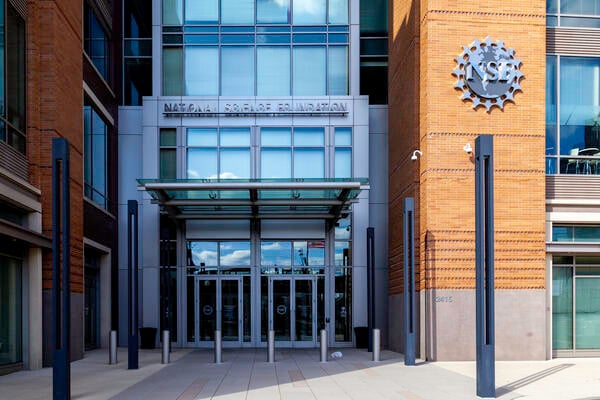
An analysis found that NSF grant funding remained about level in the recently ended fiscal year.
The National Science Foundation and National Institutes of Health doled out about as much total grant funding in the recently ended fiscal year as they did the year before, despite the Trump administration’s “unprecedented” earlier slowdown of federal science funding, Science reported Wednesday.
According to the journal’sanalysis, “NSF committed approximately $8.17 billion to grants, fellowships, and other funding mechanisms in the 2025 fiscal year”—which ended Sept. 30—“about the same as in 2024.” It found that NIH spending also remained level.
But both federal research funding agencies still reduced the number of new grants they awarded, Science reported. It wrote that NSF funded about 8,800 new research project grants, down from 11,000 in 2024, adding that an anonymous NSF staffer said this “was one of several changes designed to reduce the agency’s future financial obligations, in case Trump’s proposed budget cut is realized.” The analysis also found that the agency reduced from 2,600 to 1,100 “the number of new continuing grants, and ‘forward funded’ a number of existing continuing grants.”
NSF declined to confirm or deny Science’s figures. NIH spokespeople didn’t return Inside Higher Ed’s requests for comment Thursday.
Congress has yet to decide how much to fund NSF in the current fiscal year; most of the federal government is currently funded by a continuing resolution that expires Jan. 30, and the government could shut down again if lawmakers don’t pass appropriations bills by then. But Republicans from both chambers have indicated they don’t plan to cut $5 billion from NSF, as Trump has requested; in July, Senate appropriators put forth a cut of only $16 million, while the suggestion in the House was to slash the NSF budget by $2 billion.
Developed with the help of volunteer leaders and member institutions across the country, The Job Descriptions Index provides access to sample job descriptions for positions unique to higher education.
Descriptions housed within the index are aligned with the annual survey data collected by the CUPA-HR research team. To aid in the completion of IPEDS and other reporting, all position descriptions are accompanied by a crosswalk section like the one below.
Crosswalk Example
Position Number: The CUPA-HR position number BLS SOC#: Bureau of Labor Statistics occupation classification code BLS Standard Occupational Code (SOC) Category Name: Bureau of Labor Statistics occupation category title US Census Code#: U.S. Census occupation classification code VETS-4212 Category: EEO-1 job category title used on VETS-4212 form
***SOC codes are provided as suggestions only. Variations in the specific functions of a position may cause the position to better align with an alternate SOC code.
Sample Job Descriptions
Chief Cost Accounting Administrator
Directs institution-wide cost accounting activities, including development of facilities and administrative fringe benefit rates. Negotiates fringe benefit rates with the federal government, manages fixed assets for the institution, develops and maintains institution’s disclosure statement required by federal government, and develops institutional policy and procedures.
CROSSWALKS Position Number: 178000 BLS SOC #: 11-3031 BLS Standard Occupational Code (SOC) Category Name: Financial Managers US Census Code: 0120 VETS-4212 Category: First/Mid-Level Officials
Responsible for the coordination of pre-award and/or post-award activities relating to grant and contract proposals. Pre-award activities include assisting departmental faculty in the development, preparation, and submission of grant and contract proposals. Also ensures that all applications meet agency and university guidelines and published time tables and deadlines. Post-award activities include establishment of accounts in the financial accounting system, re-budgeting of funds, and making of changes to the award or expenditures. Requires a bachelor’s degree or equivalent plus 2-3 years’ related experience.
CROSSWALKS Position Number: 433110 BLS SOC #13-2031 BLS Standard Occupational Code (SOC) Category Name: Budget Analysts US Census Code # 0840 VETS-4212 Category: Prof
Grant Writer, Sponsored Contracts/ Grants Administration
Assists the Principal Investigator (PI) with the development or completion of non-technical aspects of grant proposals. Typically responsible for editing, formatting, and the submission of grant proposals. May also research sources for grant opportunities for the principle investigators. Can assist with fundamental budget preparation for grant proposals.
CROSSWALKS Position Number: 433130 BLS SOC # 13-2031 BLS Standard Occupational Code (SOC) Category Name: Budget Analyst US Census Code # 0840 VETS-4212 Category: Prof
Coordinates the budget portion of the pre-award cycle and manages the post-award cycle of sponsored projects, grants, contracts, and special funds. Position often reports to the Comptroller.
CROSSWALKS Position Number: 433120 BLS SOC # 13-2031 BLS Standard Occupational Code (SOC) Category Name: Budget Analysts US Census Code # 0840 VETS-4212 Category: Prof
Endowment returns climbed in fiscal year 2024, offering a boost to university coffers at a time when even the richest institutions have been gripped with financial uncertainty amid the Trump administration’s attempts to freeze federal funding and change research reimbursements.
One-year returns averaged 11.2 percent for FY 2024, according to the latest study by the National Association of College and University Business Officers and the Commonfund Institute—up from 7.7 percent in FY 2023 and negative returns in FY 2022.
The overall 10-year return averaged 6.8 percent, the study found.
In a press call Tuesday, Commonfund Institute executive director George Suttles noted that FY24 “was characterized by a strong U.S. economy, steady consumer spending, strong employment data, including higher wages, easing inflation accompanied by the prospect of lower interest rates, reasonable energy costs” and a prosperous technology sector, among other factors.
The endowment study also noted increased philanthropy in FY 2024. Donors contributed $15.2 billion in new gifts to university endowments included in the study—a nearly 20 percent bump from the $12.7 billion donated in FY23.
Altogether, 658 institutions with combined endowment values of almost $874 billion participated in the voluntary survey, with the median endowment value at $243 million. Nearly a third (30 percent) of the respondents reported an endowment valued at $100 million or less.
“While a handful of institutions receive wide public attention for the size of their endowments, the vast majority of colleges and universities are working with a much smaller set of resources,” NACUBO CEO Kara Freeman said on Tuesday’s press call. “And as we review the total market value, 86 percent was held by endowments with more than $1 billion in assets.”
NACUBO has conducted annual college endowment studies since 1974. This year’s iteration had slightly fewer participants than the 688 who responded last year.
Top Endowments
The nation’s richest institutions kept their status in this year’s study, with no changes among the top 10 and only minor fluctuations among the 25 universities with the largest endowments.
Harvard University is still the nation’s wealthiest institution with an endowment of almost $52 billion, followed by the University of Texas system ($47.4 billion), Yale University ($41.4 billion), Stanford University ($37.6 billion) and Princeton University, with just over $34 billion.
Endowment values grew at all of the five wealthiest universities except Princeton.
Though average annual one-year returns for FY 2024 were 11.2 percent, the nation’s top 25 wealthiest universities mostly missed that mark. The outlier among those was Johns Hopkins University, which had a nearly 24 percent one-year return in FY 2024.
In all, 149 of the 658 participating institutions reported endowments valued at or over $1 billion.
Endowment Performance
Like last year, smaller endowments performed better on one-year returns than large ones. Institutions with endowments valued under $50 million saw an average return of 13 percent, while those with endowments over $5 billion had the lowest one-year returns, with an average of 9.1 percent.
However, larger endowments outperformed smaller ones over the long term.
Across the 10-year mark, institutions with assets above $5 billion reported returns of 8.3 percent, compared to 6.5 percent for those with less than $50 million. Large endowments also fared better on 25-year returns, reporting 8.5 percent compared to 4.5 percent for those under $50 million.
On the spending side, endowments funded an average of 14 percent of the annual operating budgets at the institutions surveyed, up from 10.9 percent in FY23. That figure was slightly higher at institutions with multibillion-dollar endowments.
Study respondents spent a total of $30 billion from their endowments in FY24, up from $28.4 billion in FY23. The most common use of endowment dollars was for financial aid.
Issues Affecting Endowments
With the return of Donald Trump to the White House, college leaders have publicly and privately fretted about the likelihood that Republicans will ratchet up endowment taxes.
During his first term, the Trump administration passed an endowment excise tax of 1.4 percent on investment income at universities with endowment holdings of at least $500,000 per student and a minimum of 500 students. Earlier this month, Republican congressman Mike Lawler proposed raising that rate to 10 percent and changing the per-student endowment threshold from $500,000 to $200,000, which would affect more institutions. Another legislative proposal would raise that rate to 21 percent.
In a question-and-answer session on Tuesday’s press call, the tax issue was the first to arise.
Freeman said NACUBO “remains opposed to the endowment excise tax,” arguing that it “diminishes the charitable resources that would otherwise be available” to universities for financial aid, student services, academic support, research and innovation, among other uses.
Mark Anson, CEO of Commonfund, said the tax could hit some universities hard, including many Ivy League institutions whose robust endowments make up a higher percentage of their operating budgets.
On the press call, Inside Higher Ed asked about the fallout of last spring’s pro-Palestinian protests, in which students at numerous universities demanded divestment of their endowment holdings from Israel or companies profiting off the war in Gaza. While the study did not touch on that issue, experts noted the protests sparked questions from colleges; Anson said some asked for more information about their holdings.
“What’s come out of this is a continued push for transparency around how endowments are invested,” Suttles said. “Thinking about transparency for stakeholders is an important part of this work. I am encouraged by the calls for transparency, but in terms of actual investment or divestment strategies and a shift in that, we haven’t seen much from our perspective.”
On December 29, 2022, President Biden signed the $1.7 trillion Consolidated Appropriations Act of 2023 (omnibus bill) to fund the federal government through fiscal year 2023 (FY 2023). Given the “must-pass” nature of the bill, the omnibus bill also served as a vehicle for policy unrelated to government funding that was unlikely to pass as a standalone bill in Congress. Below outlines some of the highlights that will impact higher education generally and human resources specifically.
SECURE 2.0
Notably, the new law includes changes to the access and use of individual retirement funds. Provisions from a package of retirement-related bills, referred to as SECURE 2.0, were ultimately included in the final omnibus package. Specifically, the new law included the following provisions, in addition to others not listed here:
Automatic 401(k) and 403(b) plan enrollment: The new law requires employers to automatically enroll employees into newly created 401(k) and 403(b) retirement plans at a rate between 3 to 10 percent of eligible wages. Employees will then have the option to opt out of the enrollment. Employers with 10 or fewer employees and companies in business for less than three years are excluded from this requirement.
Expanded eligibility for part-time employees: The law requires employers to provide the option to participate in employer retirement plans for part-time employees who work between 500 and 999 hours for at least two consecutive years (lowered from three consecutive years previously required).
Emergency expenses and savings accounts: Employees would be allowed to withdraw up to $1,000 from retirement accounts for qualified emergency expenses without facing early withdrawal penalties if the worker is under 59.5 years old. Additionally, the law allows employers to offer employees an emergency savings account through payroll deductions for amounts up to $2,500.
Matching employer contributions for student loan payments: Employers will be allowed to make contributions to their company retirement plan on behalf of employees who are paying student loans and are not contributing to a retirement account as a result.
Roth treatment of employer contributions: The new law grants employers the option to amend their retirement plans and allow employees to choose their employer’s matching and non-elective contributions to be made as Roth contributions.
Multiple Employer and Pooled Employer Plans for 403(b) plans: The new law allows employers to participate in Multiple Employer Plans (MEPs) and Pooled Employer Plans (PEPs) for 403(b) plans.
The final law also included several changes to individual activity with respect to their retirement plans, including an increase to the “catch-up” contribution limits of up to $10,000 for older retirement savers and an increase to the age an individual is required to begin taking minimum distributions from their retirement accounts, which is now effective at age 73 and effective at age 75 effective in 2033.
Workplace Protections for Pregnant Workers
Additionally, Congress was able to agree on the inclusion of the Pregnant Workers Fairness Act (PWFA) and the Providing Urgent Maternal Protections (PUMP) for Nursing Mothers in the omnibus bill.
Pregnant Workers Fairness Act
Passed by the House in May 2021, the PWFA specifically declares that it is an unlawful employment practice for employers with 15 or more employees to do any of the following:
fail to make reasonable accommodations to known limitations of such employees unless the accommodation would impose an undue hardship on an entity’s business operation;
require a qualified employee affected by such condition to accept an accommodation other than any reasonable accommodation arrived at through an interactive process;
deny employment opportunities based on the need of the entity to make such reasonable accommodations to a qualified employee;
require such employees to take paid or unpaid leave if another reasonable accommodation can be provided; or
take adverse action in terms, conditions or privileges of employment against a qualified employee requesting or using such reasonable accommodations.
Though the bill enjoyed bipartisan support in both the House and Senate, Republicans opposed bringing the bill to a Senate vote without the inclusion of a religious exemption for employers. Such exemptions were provided in the omnibus bill’s version of the PWFA, ultimately helping lead to its passage.
PUMP for Nursing Mothers Act
The PUMP for Nursing Mothers Act passed the House of Representatives in October 2021 with bipartisan support. The bill aims to amend the Fair Labor Standards Act (FLSA) to expand access to breastfeeding accommodations in the workplace for lactating employees and builds upon existing protections in the 2010 Breaktime for Nursing Mothers Act by broadening breastfeeding accommodations and workplace protections. In the new law, the PUMP for Nursing Mothers Act is expanded to include salaried employees exempt from overtime pay requirements under the FLSA as well as other categories of employees currently exempt from such protections, such as teachers, nurses and farmworkers. It also clarifies that break time provided under this bill is considered compensable hours worked so long as the worker is not completely relieved of duty during such breaks, and it ensures remedies for nursing mothers for employer violations of the bill.
Similar to the PWFA, the PUMP for Nursing Mothers Act did not reach a Senate floor vote, leaving the omnibus bills as one of the last options for passage before the 117th Congress’s term expired.
Immigration Provisions
Due to the situation at the southern border, the new law excluded any major immigration overhauls, such as the Equal Access to Green cards for Legal Employment (EAGLE) Act, which would have addressed the immigration visa backlog and made changes to the H-1B visa program. Additionally, protections for the Deferred Action for Childhood Arrivals (DACA) program and Dreamers that have been threatened by recent court decisions were not included in the final bill enacted into law.
Despite the exclusion of important reforms, the new law reauthorized several expiring immigration programs that are already utilized by institutions of higher education, including additional funds for the E-Verify program.
Higher Education Funding
Several provisions were included in the omnibus package that will increase funding for a variety of higher education programs. Notably, the bill includes a $500 increase to the maximum Pell Grant a recipient can receive, raising the total to $7,395 for the 2023-24 award year. Additionally, the bill included funding increases for Federal Work-Study grants, Title III and V programs, Postsecondary Student Success Grants, and the TRIO and GEAR UP programs.
CUPA-HR will continue to analyze the provisions included in the FY 2023 funding bill and will keep members apprised of any additional noteworthy provisions included in the law.