Tag: Fla

  • Fla. Board Says Syllabi, Reading Lists Must Be Posted Publicly

    Fla. Board Says Syllabi, Reading Lists Must Be Posted Publicly

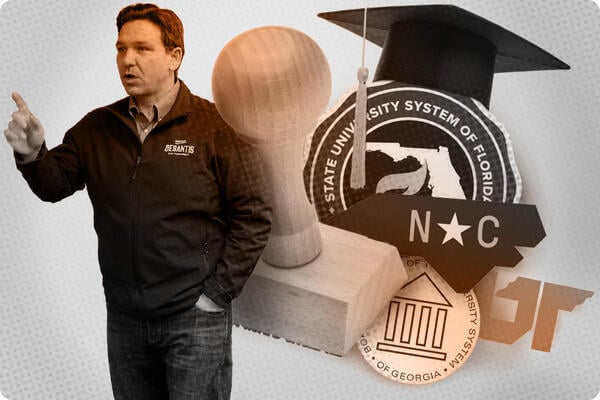
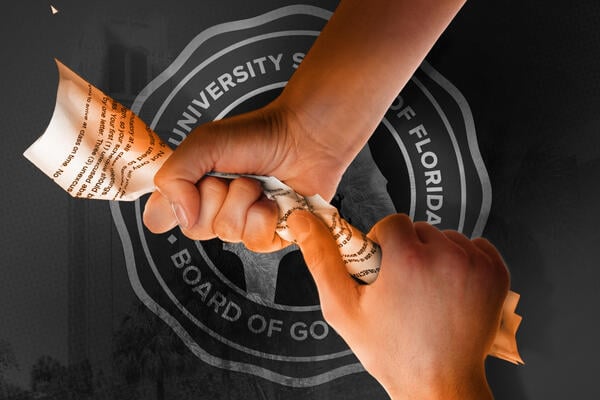
    Photo illustration by Justin Morrison/Inside Higher Ed | Liudmila Chernetska, Davizro and DenisTangneyJr/iStock/Getty Images

    Faculty at all Florida public universities must now make syllabi, as well as a list of required or recommended textbooks and instructional materials for each class, available online and searchable for students and the general public for five years.

    The new policy is part of an amendment to the Florida Board of Governors’ regulation on “Textbook and Instructional Materials Affordability and Transparency,” and it passed unanimously without discussion at a board meeting Thursday. On the agenda item description, board officials cited improved transparency as the impetus for the rule, which is meant to help students “make informed decisions as they select courses.” But some faculty members say it’s designed to chill academic freedom and allow the public to police what professors teach in the classroom.

    “Many of my colleagues and I believe that this is yet another overreach by political appointees to let Florida’s faculty know that they are being watched for potentially teaching any content that the far right finds problematic,” said John White, a professor of English education and literacy at the University of North Florida. He said officials at his institution told faculty members they must upload their syllabi for 2026 spring semester classes to Simple Syllabus, an online syllabi hosting platform, by December.

    “Florida’s universities are being run in an Orwellian manner, and working as a faculty member in Florida is increasingly like living in the world of Fahrenheit 451,” he said.

    According to the approved amendment, professors must post the syllabi “as early as is feasible” but no fewer than 45 days prior to the start of class. Public syllabi must include “course curriculum, required and recommended textbooks and instructional materials, goals and student expectations of the course, and how student performance will be measured and evaluated, including the grading scale.” Individualized courses like independent study and theses are exempt from the rule.

    The Florida Board of Governors did not respond to Inside Higher Ed’s questions about the amended policy, including a question about when it will start being enforced.

    Concerns About Faculty Safety

    It’s not a unique policy, even in Florida. Since 2013, the University of Florida has required professors to post their syllabi online—but only three days prior to the start of class, and they have to remain publicly available for just three semesters. Now, all Florida public universities, including the University of Florida, must follow the new rules. A UF spokesperson told Inside Higher Ed the university is waiting for the Board of Governors to share guidance about when the new policy will be enforced.

    “Even before the rule, most faculty members have been posting anyway to advertise their course. Faculty members in fact prefer to post in advance and certainly have nothing against posting,” said Meera Sitharam, a professor in the department of computer and information science and engineering, and president of the University of Florida’s 2,150-member United Faculty of Florida union. The faculty she spoke with primarily took issue with the new 45-day deadline, which is “quite early for a posting containing all the details” of a syllabus, she said. They are also concerned that they will no longer be able to make changes to reading lists midsemester.

    “A good-quality discussion class would permit the instructor to assign new reading as the course proceeds. This would now be disallowed,” Sitharam said. “The effect of this is likely to be that an overlong reading list is posted by the faculty member just to make sure that they don’t miss anything they might want to assign. And much of the reading list may never be assigned.”

    Texas similarly requires all faculty at public institutions to make a version of their syllabus public. Indiana implemented a law in July requiring public institutions to publish all course syllabi on their websites, and this fall, the University System of Georgia introduced a new policy requiring faculty to post syllabi and curriculum vitae on institution websites.

    Some faculty members in those states have seen firsthand the risks of posting syllabi online; several professors have been harassed and doxed over course content in their online syllabi. Florida faculty are concerned the same thing could happen to them; several faculty members believe that the board passed the rule with the intent of siccing the general public on professors who teach about topics that conservative politicians don’t like.

    “The sole purpose is to subcontract out the oversight of all of our courses, so that if there’s some independent entity or individual that wants to look at the College of Education at Florida State, and they spend two months doing a deep dive into all of the classes, then they’ll come up with: ‘Here at Florida State we found these five classes that don’t meet [our standards],’” said William Trapani, communications and multimedia studies professor at Florida Atlantic University. “Why else would you have that capacity to make this data bank and make it publicly accessible for five years?”

    Stan Kaye, a professor emeritus of design and technology at the University of Florida, sees concerns about the policy as overblown. “I cannot see why making syllabi public at a public institution is a problem for anyone—I would think that promoting your work and subject is generally a good thing,” he said. “If you are afraid you are teaching something illegal or that lacks academic integrity and you want to keep it secret, that should be a problem.”

    Faculty safety is the primary concern for James Beasley, an associate professor of English and president of the faculty association at North Florida.

    “The most important issue related to this requirement is the safety of our faculty, both online and in person. The concern is that faculty will be exposed to external trolls of course content and that the publication of course locations will expose faculty to location disclosures,” Beasley said in an email. While it is typical for syllabi to include course meeting times and locations, the new board policy does not require that information to be posted online.

    Trapani also said that because of the five-year syllabus retention period, faculty are worried they could be retroactively harassed for teaching about something the public finds unfavorable from a class several years ago. White has similar concerns.

    “I’m teaching a course that utilizes neo-Marxist theory to critique the idea of meritocracy—will the Board of Governors or members of the public falsely claim I’m teaching communism or that I’m teaching students to hate their country? If a history professor or a social studies education professor is discussing redlining or Jim Crow laws, will they later be critiqued for teaching students about institutionalized racism or sexism?” White said.

    Ultimately, Trapani believes the amended syllabi policy is an attempt to insulate the Board of Governors from public criticism.

    “Florida will make a lot more sense to outsiders if its policymaking is viewed through a lens of fear,” he said. “They’ve deputized an army of outsiders to pore through records older than most students’ time at the university—all so that they cannot be accused of missing something … It’s just another way in which faculty employment conditions and physical safety are made more precarious by the endless barrage of false claims about our teaching practices.”

    Josh Moody contributed to this report.

    Source link

  • English skills are more essential than ever – the first PISA FLA proves it

    English skills are more essential than ever – the first PISA FLA proves it

    There has been much hype over the role AI can play, with increased speculation that, as this technology evolves, the need for learning languages will become less important. 

    This is obviously not the case.

    Used properly, AI can bring enormous benefits to classrooms. But there’s really no substitute for human-to-human learning with a skilled language teacher. It remains critical for students in school systems around the world to continue to learn real-life communicative language skills. AI can teach you a substantial amount of words and grammar, but language is about real-life communication, and this takes practise and guidance that AI just can’t provide.

    When it comes to testing language skills, it’s the same picture. AI can give an indication of knowledge, but it cannot reliably measure what students can do with the language and how well they can communicate.

    The Introduction of the in-depth English test for PISA

    The need for quality English skills in the age of AI is recognised worldwide. This is best proved by the fact that, for the first time, the PISA survey has added an assessment of foreign language skills – starting with English.

    The PISA Foreign Language Assessment (FLA) is using in-depth high-quality tests, developed by Cambridge, to make sure that it gives a really accurate picture of each participant’s language skills. By this, we mean their ability to interact, understand nuance and apply their language skills to real-world situations.

    This first PISA FLA is currently testing the English skills of thousands of students in 21 countries and economies around the world, providing unprecedented insights into what makes English language teaching and learning effective. Insights that are vital during this time of rapid change. Having a clear picture of what works in terms of language teaching in schools around the world, as a basis for improving future generations’ language skills, means we can measure change, learn and evolve.

    Why communicative language skills matter

    The benefits of learning communicative language skills are well documented. A recent paper by Cambridge and the OECD describes the benefits of learning another language in terms of the positive impact it can have on employability, critical thinking skills, and boosting cultural awareness – essential skills in today’s interconnected world.

    The importance of quality English skills was highlighted further in a recent article in the Financial Times, where journalist Simon Kuper comments that fluency in English “has become a non-negotiable qualification for high-level jobs in many professions.” He references a paper for the OECD that studied job vacancies across the EU and in the UK in 2021: 22% explicitly required knowledge of English. This is meaningful – as generative AI makes it easier for people to have a “passable grasp” of English, excellence in a language becomes a true differentiator in business and elsewhere.

    But of course, it’s not just about learning English. While English is an essential skill in so many areas, it’s equally important that people do not neglect their first language and that they take the time to learn other languages. Whether it’s a foreign language, the regional language of the place they live, the language of their parents or communities, or even the language of their favourite holiday destination, individuals can gain enormous benefits from learning more than one language.

    The impact of the PISA FLA

    We have a clear understanding of the benefits that English skills can bring. So, it is surprising that there has not been a comprehensive study in this area since 2011, when SurveyLang assessed the language competence of 50,000 pupils across 15 countries in Europe. The findings highlighted the importance of starting to learn English at an early age – and the benefits of exposure to language outside the classroom, through films, music, travel and other opportunities, to incorporate the language into the students’ lives. Whilst this is insightful, this was over 14 years ago, and we need contemporary and reliable data.

    For this reason, the results of the PISA FLA will mark a turning point for language education. Although it’s too early to speculate on the findings, the impact of the survey’s data has the unprecedented potential to transform language policy around the world. Leaders and policymakers will get access to the data they need to make decisions on which teaching methods and learning environments really work, where to focus resources and how to design curriculums. One of the ways it will achieve this is by assessing against the Common European Framework of Reference for Languages (CEFR).

    The PISA FLA also demonstrates how meaningful language testing can be delivered at scale. The English test used in PISA – and developed through a partnership between Cambridge and the OECD – is a cutting-edge, multi-level, computer-adaptive assessment, and tests the spoken production of language via a computer-delivered test for the first time in a global survey of this kind.

    We are at an exciting moment of change. How we teach, how we learn, how we work and how we live is evolving every day. As providers of quality education, we have a responsibility to stay abreast of this change and ensure we are continually adding value – serving the current and very real needs of our learners.

    When it comes to language education, that means understanding how we can shape learning, teaching and assessment that will empower generations of learners to come. It also means understanding how we can contribute to an educational system fuelled by insights and data. The PISA FLA is the first step on this journey.

    Written by: Francesca Woodward, Global Managing Director, English at Cambridge University Press & Assessment

    Source link

  • Fla. Board of Governors to Vote on Creating New Accreditor

    Fla. Board of Governors to Vote on Creating New Accreditor

    Photo illustration by Justin Morrison/Inside Higher Ed | Joe Raedle/Getty Images | ricul/iStock/Getty Images 

    The governing board of the State University System of Florida is set to vote Friday on whether to form a new accrediting agency focused on public universities, known as the Commission for Public Higher Education. While some accreditation experts say the move could be a positive development, they also worry it may lead to undue political influence in the accreditation process.

    If the vote goes as planned, the Florida governing board will create the proposed agency along with five other public university systems: the University System of Georgia, University of North Carolina system, University of South Carolina, University of Tennessee system and the Texas A&M University system.

    “The launching of a new institutional accreditor is a major undertaking, and CPHE’s Founding University Systems have not undertaken it lightly,” reads the business plan for the Commission for Public Higher Education. “Growing dissatisfaction with current practices among the existing institutional accreditors and the desire for a true system of peer review among public institutions have led to this endeavor.” The plan accuses some existing accreditors of “bureaucratic bloat, delays, and increased costs.”

    University of North Carolina system president Peter Hans dropped the news in May that UNC was in talks with other public university systems to launch a new accrediting agency—an idea Inside Higher Ed discovered they’d been discussing for at least a year. The project has taken on distinct political undertones; last month Florida governor Ron DeSantis announced the effort in a speech largely focused on what he calls “woke ideology.”

    “What we’ve seen develop is an accreditation cartel,” he said in his address. “And the accreditors by and large are all singing from the same sheet of music, and it’s not what the state of Florida wants to see reflected in its universities in many different respects.”

    According to the business plan, the new agency “will laser-focus on student outcomes, streamline accreditation standards, focus on emerging educational models, modernize the accreditation process, maximize efficiency without sacrificing quality, and ensure no imposition of divisive ideological content on institutions.”

    How It Would Work

    The Commission for Public Higher Education would be incorporated as a nonprofit organization in Florida, initially funded by a $4 million appropriation from the Florida State Legislature, according to the business plan. Other involved higher ed systems are expected to cough up similar funds. A board of directors representing each of the founding systems would oversee the new accreditor.

    The goal is to accredit six institutions by next summer and secure Department of Education recognition by June 2028, according to the business plan. (A new accreditor typically has two years to prove it is operating in accordance with federal regulations to receive federal approval.)

    In the meantime, higher ed institutions pursuing accreditation from CPHE can retain their current accreditors, the plan notes. Later, when CPHE gains department recognition, they can adopt CPHE as their primary accreditor.

    Accreditation experts say that the time frame is doable but optimistic if the Department of Education maintains the rigor of its current recognition process for new accreditors.

    “The timeline proposed by Florida seems aggressive since in the past, it usually took the [Education Department] more time to approve new accreditors,” Cynthia Jackson Hammond, president of the Council for Higher Education Accreditation, wrote in a statement to Inside Higher Ed.

    But the Trump administration has shown interest in making it easier for new accreditors to form. President Trump signed an executive order in April that spoke of “recognizing new accreditors” among other reforms.

    Mixed Views

    Jackson Hammond said CHEA isn’t against new accreditors, as long as they go through the standard recognition process and show they’re following federal regulations for ensuring institutions’ quality. But she and her colleagues have qualms about the idea of state-sponsored accrediting bodies like the Commission for Public Higher Education.

    “CHEA does not believe that states are likely to be effective accreditors,” she wrote. “Historically, states have not had the staff, experience, or knowledge necessary to create a higher education accreditor. It is critically important that higher education reflects an impartial and unbiased accrediting review process that is focused on student learning outcomes. To date, there has not been a state that has accomplished this.”

    Robert Shireman, a senior fellow at the Century Foundation, a progressive think tank, worries the structure of the new accrediting agency may make unbiased evaluations more challenging, given the involvement of state policymakers.

    State university systems are “essentially run by the governors and their appointees,” said Shireman, who was a deputy under secretary at ED during the Obama administration. So “it really detracts from the independence of public institutions from political meddling. This feels like it’s part of an effort for closer political control over colleges and that would just embroil them in culture war issues and sort of the political issue of the day.”

    But he doesn’t rule out the potential positives of having an accreditor focused on public universities. He said such an agency could emphasize college access and affordability in ways that accreditors that oversee private colleges don’t.

    As state higher ed systems, “they’re all government actors,” he said. In an ideal scenario, “they can work together [to say], ‘Let’s be affordable. Let’s make sure students get served.’”

    Jamienne Studley, former president of the WASC Senior College and University Commission, also emphasized that agencies that accredit “like-type” institutions can benefit from their similarities—“as long as the federal oversight of agencies is consistent, the standards are solid and their application is rigorous.”

    Source link