Tag: flat

  • Hiring Flat for 2026 Grads

    Hiring Flat for 2026 Grads

    fizkes/iStock/Getty Images Plus

    Forty-five percent of employers consider the job market to be “fair,” and they are projecting a 1.6 percent year-over-year increase in hiring for the Class of 2026, according to a new report from the National Association of Colleges and Employers.

    The last time a plurality of employers gave the job market a “fair” rating was in 2021, when hiring projections were also flat. During the four interim years, most employers rated the job market as “good” or “very good,” the report shows.

    About 60 percent of the 183 employers NACE polled for the 2026 Job Outlook Survey said they are planning to keep the number of people they hire stable next year. A quarter of employers said they plan to increase the number of hires, primarily citing a commitment to succession planning and the talent pipeline, as well as company growth, as key reasons. The top five industries for projected hiring growth are miscellaneous professional services; engineering services; construction; finance, insurance and real estate; and management consulting.

    About 14 percent of employers said they plan to decrease the number of people they hire next year, citing reductions in business needs and projects, an uncertain economy and budget cuts. These employers are primarily concentrated in the chemical pharmaceutical manufacturing, transportation, wholesale trade, food and beverage manufacturing, and miscellaneous manufacturing industries.

    NACE surveyed employers between Aug. 7 and Sept. 22 of this year for their thoughts on the job market, hiring trends and salaries. About 40 percent of employers plan to increase salaries for bachelor’s degree holders in 2026, and 28.3 percent will do the same for master’s degree holders. No employers reported plans to decrease salaries for either group next year, the report states.

    Skills-based hiring remains popular—69.5 percent of employers reported they use the approach. Asked how students can best prepare for a skills-based hiring process, employers primarily said applicants should “prepare for interviews that demonstrate their skills,” “participate in experiential learning or work during college” and “translate college coursework into a skills language.”

    Meanwhile, fewer employers care about applicants’ GPAs—only 42.1 percent of employers plan to screen GPAs in 2026, compared with 73.3 percent in 2019. Academic majors, industry experience and internships, and internships at the employer’s organization are top decision-making factors for employers that don’t screen for GPAs.

    Artificial intelligence is also top of mind, but many employers are still figuring out exactly how AI will integrate into their business, said Christine Cruzvergara, chief education strategy officer at the job and internship platform Handshake. NACE data reflects a similar sentiment toward AI among employers—nearly 59 percent said they are not planning to or unsure whether they’ll augment entry-level jobs with AI, and 25 percent said they’re currently discussing it. About 13 percent of jobs require AI skills, the report shows, and 10.5 percent of entry-level jobs include AI in their descriptions.

    “I think the majority of employers are still experimenting with how AI will supplement or augment the work that their employees are doing from entry level all the way to more senior folks,” Cruzvergara said. “And I think some functions have probably already started to figure that out a little bit more, like in some of the technical roles, or marketing is another big one, versus customer success or some of the other types of roles that people have. It’s a varied spectrum that you’re seeing at the moment.”

    The percentage of fully hybrid jobs has declined since spring 2025, from 47 percent to 42 percent, while the percentage of fully in-person jobs increased from 43 percent to 48 percent, the report shows. The percentage of fully remote jobs has held steady at 10 percent. More entry-level jobs are fully in-person—50 percent—and fewer are fully remote, 6 percent.

    Ashley Mowreader contributed to this report.

    Source link

  • Flat Federal Funding Stymies Head Start as State Child Care Resources Diminish – The 74

    Flat Federal Funding Stymies Head Start as State Child Care Resources Diminish – The 74


    Get stories like this delivered straight to your inbox. Sign up for The 74 Newsletter

    Despite having some of the most resources and economic support, a recent national study ranked Indiana’s early education system 42nd in the country — and second-to-last when it came to accessibility.

    The WalletHub story, shared earlier this week, is simply the latest confirmation for Hoosier parents that Indiana’s child care market is struggling. Experts, business leaders and politicians agree that Indiana needs more child care, but can’t seem to agree on the best way to meet the moment.

    Facing budgetary pressures and depressed revenue forecasts, state leaders opted to trim funding and narrow eligibility for early learning and child care resources earlier this year. Seats for state-funded preschool, known as On My Way Pre-K, have been halved while vouchers for subsidized child care have more 21,000 children on a waitlist.

    One federal program, Head Start Indiana, hopes to help close the gap left by vanishing state funding, but faces its own challenges with flat federal funding.

    “We are the quietest, most successful 60-year old program in the federal government’s history,” boasted Rhett Cecil, the organization’s executive director. “… (our programs) are going to support their families and children. They’re allowing families to work or get job training or further education. And our services — that child care and early education — are free for those families.”

    Just under 13,000 families in all 92 counties utilize the program, which receives roughly $181 million in federal funding annually. That budget line was briefly threatened by the Trump administration, which walked back proposed cuts in favor of flat funding — which does mean services will be lost as inflation and other costs eat into the bottom line.

    The second-term president also eliminated the federal Head Start office covering Indiana back in April — though the federal Administration for Children and Families announced it would dedicate one-time funding to Head Start locations earlier this week explicitly for nutrition, but not for other programming costs.

    Additional federal support could allow it to expand to meet the need following state cuts, leaders hope, and continue employing almost 4,000 Hoosiers.

    “Let’s say, hypothetically, we get $100 million more dollars. How many more teachers and classrooms could be opened?” Cecil mused. “How many kids could we serve off that waitlist?”

    Importance of child care

    Participating in and access to child care resources reaps benefits for young Hoosiers, such as better school readiness skills. Some national research has found that early education may also decrease future crime and could generate $7.30 for every one dollar invested.

    In Indiana, the shortage of child care options costs the state an estimated $4.2 billion annually, over a quarter of which is linked to annual tax revenue lost.

    The 2024 study from the Indiana Chamber of Commerce emphasized the need to free up parents, mostly women, who’ve left the workforce “as a direct result of childcare-related issues.”

    “There’s some data out there that one in four Hoosier parents leave their job over child care gaps, and it really impacts talent and workforce,” said David Ober, the chamber’s vice president of taxation and public finance. “It’s hindering economic momentum in the state and so it is a huge deal for us.”

    For the last few years, tackling the state’s child care crisis has been a top legislative priority for the organization, which represents the interests of thousands of Hoosier employers. Ober said the chamber is working to plan a child care summit later this year to identify potential solutions.

    According to Brighter Futures Indiana, average full-time weekly care costs families $181 per week — with even higher prices for infants and toddlers. That doesn’t factor in type of care or quality, and prices vary by community.

    Families can spend more on their young children’s care than on a college education — if it’s even available in their communities. Rather than pay the price, many Hoosier parents simply drop out of the workforce at the same time that employers are scrambling to hire talent.

    Ober highlighted recent legislative efforts to expand child care, including one that expanded a tax credit for employers directly providing their employees with child care resources. Other bills have tweaked staffing ratios and created a pilot program for so-called microcenters.

    But workforce remains a challenge, even for Head Start centers, earning its own legislative study carveout. Over 20% of Indiana’s child care workers left the field during the pandemic — a shock that “has not really fully healed,” Ober said.

    “If you ask any provider in the state, workforce is the hardest problem,” Ober said. “… How do you get educators and keep them? There’s so much more work to be done there and it’s challenging.”

    Traditional market forces struggle to balance affordability for parents against costs for child care, a gap sometimes covered by government subsidies.

    But Ober insisted that “child care is infrastructure,” especially for the businesses reliant upon employees who are parents. Changing funding is “going to just exacerbate underlying problems,” he added.

    “Those numbers are pretty stark,” Ober said. “And then when you add in changes at the state and the federal level, it creates new problems that we all have to come together and work on,” he concluded.

    Indiana Capital Chronicle is part of States Newsroom, a nonprofit news network supported by grants and a coalition of donors as a 501c(3) public charity. Indiana Capital Chronicle maintains editorial independence. Contact Editor Niki Kelly for questions: [email protected].


    Get stories like these delivered straight to your inbox. Sign up for The 74 Newsletter

    Source link

  • Preliminary results show essentially flat state test scores

    Preliminary results show essentially flat state test scores

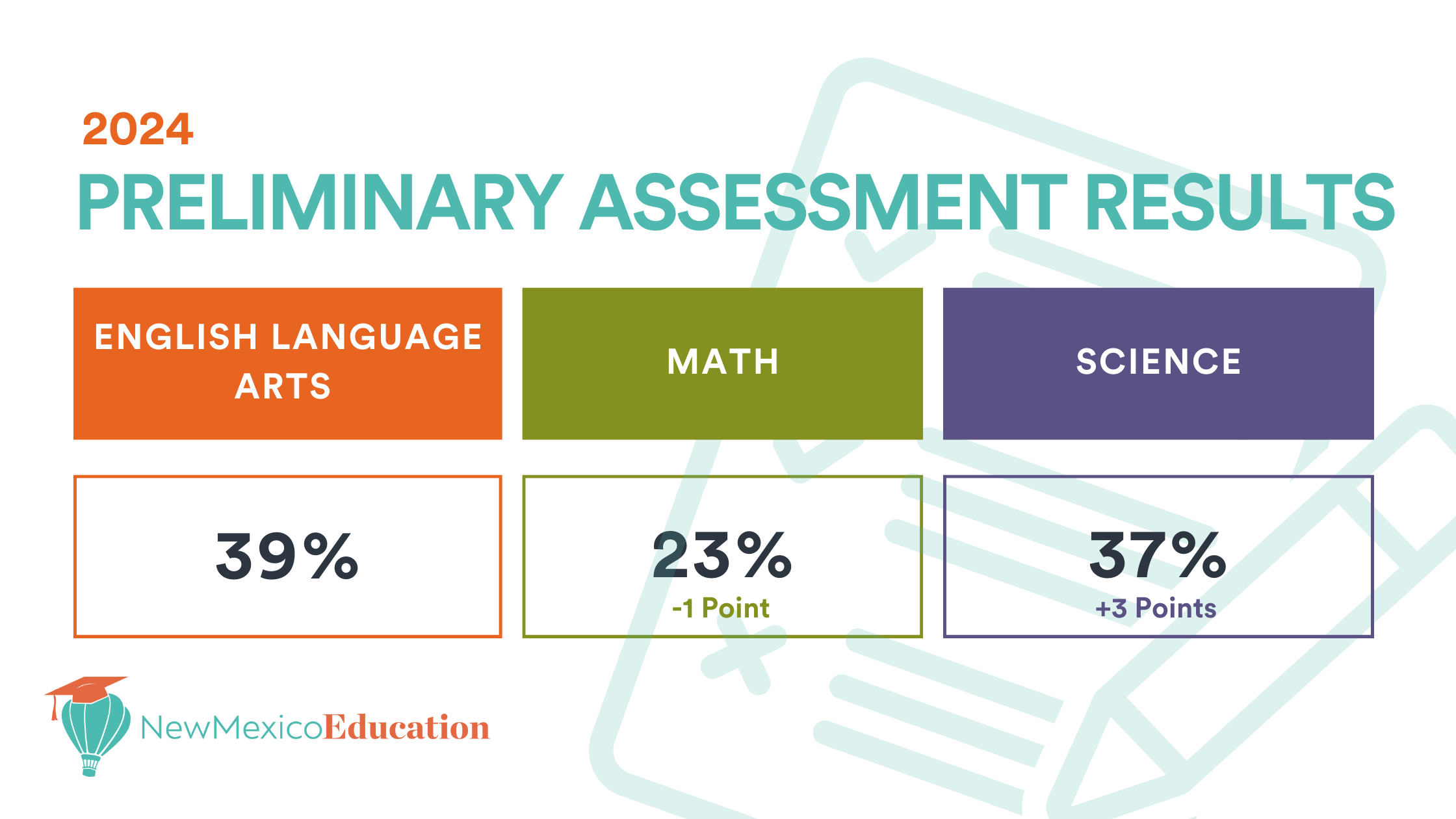
    New Mexico students made tiny gains in literacy and dipped slightly in math proficiency last school year, according to preliminary results released Sept. 19 by the Public Education Department.

    Notably, the results look slightly more favorable than those in data also released Sept.19 by the Legislative Education Study Committee, which showed 2023-24 scores flat. PED attributed the discrepancy to an error PED discovered on the data earlier this week.

    Regardless, the results show that a large majority of the state’s public education students continue to fall short of grade-level proficiency. This suggests that New Mexico will remain close to the bottom nationally in student achievement.

    The PED results do not include detailed demographic or grade-level breakdowns. Those results will be released on Oct. 4. 

    According to the PED, 39 percent of K-8 and 11th-grade students scored proficient or better on state literacy assessments, compared to 38 percent in 2023, and up from 34 percent in 2022. The LESC results showed that the literacy proficiency rate was flat at 38 percent.

    In math, PED data show 23 percent of students in grades 3-8 and 11 proficient. That’s down one percentage point from 2023 and two points down from 2022. LESC numbers showed 22 percent proficient in 2024.

    In grades 5, 8 and 11 science, scores were up three percentage points, from 34 percent proficient last year to 37 percent proficient in 2024.

    Source link