Tag: Floridas

  • Louisiana Seeks to Join Florida’s New Accreditor

    Louisiana Seeks to Join Florida’s New Accreditor

    Louisiana will join the new accrediting body Florida established earlier this month in conjunction with five other states, according to an executive order Gov. Jeff Landry signed Tuesday.

    Florida governor Ron DeSantis announced the formation of the new accreditor, the Commission for Public Higher Education (CHPE), last month, decrying higher education’s “woke ideology” and vowing to take down the “accreditation cartel.” CPHE’s business plan said the idea arose from “growing dissatisfaction with current practices among the existing institutional accreditors and the desire for a true system of peer review among public institutions.”

    In addition to the state university system of Florida, Louisiana now aims to join public university systems in Georgia, North Carolina, South Carolina, Tennessee and Texas in switching to the new accreditor.

    “Louisiana stands to benefit from early engagement with CPHE, both by diversifying accreditation options and by shaping the standards and procedures that align with the public mission of its institutions,” Landry’s executive order said. “CPHE will focus on student outcomes, streamline accreditation standards, focus on emerging educational models, modernize the accreditation process, maximize efficiency, and ensure no imposition of divisive ideological content on institutions.”

    The order establishes a task force “to lead statewide engagement on accreditation reform aligned with institutional autonomy, academic excellence, and federal requirements.”

    Landry will appoint the 13 members of the task force, which is required to reports its findings and recommendations no later than January 30, 2026.

    CPHE still needs to secure recognition from the Department of Education, a process that could take years. In the meantime, higher ed institutions can retain their current accreditors, according to the CPHE business plan.

    Louisiana’s public institutions are currently accredited by the Southern Association of Colleges and Schools Commission on Colleges (SACSCOC).

    Source link

  • Kenneth C. Griffin Donates $2 Million to Nonprofit Achieve Miami’s Teacher Accelerator Program to Strengthen South Florida’s Teacher Pipeline

    Kenneth C. Griffin Donates $2 Million to Nonprofit Achieve Miami’s Teacher Accelerator Program to Strengthen South Florida’s Teacher Pipeline

    Miami Achieve Miami, a nonprofit dedicated to equalizing educational opportunities for students throughout Miami-Dade County, has received $2.4 million from multiple philanthropic organizations and leaders, including a leadership gift of $2 million from Kenneth C. Griffin, founder and CEO of Citadel and founder of Griffin Catalyst. The funding, awarded over the past year, will further expand Achieve Miami’s transformative programs, reaching thousands of K-12 students through initiatives including Achieve Scholars, which prepares high schoolers for college success; Achieve Summer, a dynamic program combating learning loss through hands-on academics and enrichment; and the Teacher Accelerator Program (TAP), a groundbreaking effort to address Miami-Dade’s urgent teacher shortage.

    Kenneth C. Griffin’s $2 million leadership gift is specifically focused on supporting TAP in creating a pipeline of talent for the teaching profession through recruiting, preparing, and mentoring aspiring educators, including those who had not previously considered a career in education. This gift builds on Griffin’s $3.5 million gift to TAP in 2022, further strengthening Achieve Miami’s efforts to recruit and train qualified educators to teach in public, private and charter schools across Miami-Dade and close learning gaps in the city’s schools. Griffin has a longstanding commitment to improving education and has contributed more than $900 million to providing greater access to a high-quality education and pathways to success for students in Florida and across the country.

    Additional grants include:

    • $200,000 from the Bezos Family Foundation, which is a director’s gift supporting early and adolescent learning through grants and programs that advance the science of learning.
    • $100,000 from the Panera Bread Foundation, as part of its national initiative to support nonprofits that provide educational access to underserved youth.
    • $65,000 from Morgan Stanley, in support of Achieve Miami’s financial literacy and career readiness programs, which equip students in the organization’s Achieve Scholars program with essential money management skills for financial independence and future success. As part of its commitment, a team of Morgan Stanley employees guide students through financial literacy sessions across ten Miami-Dade County public schools, providing essential lessons on topics like budgeting, investing, entrepreneurship, savings, and credit.
    • $50,000 from City National Bank of Florida, as part of its long-term partnership with Achieve Miami in support of the Achieve Scholars program. City National Bank is planning financial literacy programming for students over the summer.

    “Every student deserves access to resources, mentors, and opportunities that can set them up for success,” said Leslie Miller Saiontz, Founder of Achieve Miami. “These generous grants, led by Ken Griffin, will enable us to expand our reach, empower more educators, and bridge opportunity gaps that are prevalent in Miami. By investing in students and teachers, we are building a stronger future for our community.”

    “Each of us has a story of how a teacher has changed our lives,” said Ken Griffin in February 2023 alongside his initial gift to Achieve Miami. “I care deeply about bringing more high-quality educators into Miami classrooms to help ensure the children of Miami will continue to enjoy the impact of life-changing teachers.”

    Despite being one of the fastest-growing states with the nation’s fourth-largest economy, Florida ranks #21 in per capita education funding. Achieve Miami’s initiatives aim to eliminate educational disparities by equipping students with the tools and support needed for success with a variety of diverse enrichment programs such as Achieve Scholars, Achieve Saturdays, and Achieve Music.

    Achieve Miami’s impact to-date includes support for over 10,000 Miami-Dade County students, college and career readiness programming for Achieve Scholars across ten high school sites, providing internet access to over 106,000 homes through Miami Connected, and the recruitment and training of nearly 200 new teachers through the Teacher Accelerator Program (TAP) since the initiative’s launch in 2023.

    ABOUT ACHIEVE MIAMI

    Achieve Miami is a nonprofit organization that is dedicated to fostering a transformational education ecosystem in Miami. Since its founding in 2015, the organization has supported over 10,000 K-12 students, bolstered programming for 60+ local schools, and engaged thousands of volunteers. Together with partners from the public and private sector, Achieve Miami designs and manages programs that bring together members from various parts of the community to extend learning opportunities for students, teachers, and community leaders. Learn more at www.achievemiami.org.

    ABOUT THE TEACHER ACCELERATOR PROGRAM

    Teacher Accelerator Program (TAP) is a non-profit organization creating a pipeline of talent for the teaching profession through recruiting, preparing, and mentoring aspiring educators. TAP’s comprehensive and streamlined program equips college students and career changers with the skills, knowledge, and certification necessary to excel in the classroom. TAP addresses the nationwide teacher shortage crisis by providing a built-in path to teaching, inspiring a new generation of educators.

    TAP participants take a one-semester course, followed by a six-week paid summer internship, earn a certificate to teach, and begin instructing in a Miami-Dade County public, private, or charter school classroom. TAP is an initiative of Achieve Miami, supported by Teach for America Miami-Dade, and is offered by the University of Miami, Florida International University and Miami-Dade College. Learn more at www.teacheraccelerator.org.

    eSchool News Staff
    Latest posts by eSchool News Staff (see all)

    Source link

  • Florida’s Own DOGE Is Reviewing Faculty Research, Grants

    Florida’s Own DOGE Is Reviewing Faculty Research, Grants

    Elon Musk’s days with DOGE appear numbered—the unelected billionaire bureaucrat said Tuesday that his time spent leading the agency-gutting U.S. Department of Government Efficiency will “drop significantly” next month. As Tesla’s profits plummet, the world’s richest man faces opposition from both Trump administration officials and voters.

    DOGE’s legacy remains unclear. Lawsuits are challenging its attempted cuts, including at the U.S. Education Department. Musk seems to have scaled back his planned overall budget savings from $1 or $2 trillion to $150 billion, and it’s unclear whether DOGE will achieve even that.

    But something may outlive Musk’s DOGE: all the state iterations it has inspired, with legislators and governors borrowing or riffing off the name. Iowa’s Republican governor created the Iowa DOGE Task Force. Missouri’s GOP-controlled Legislature launched Government Efficiency Committees, calling them MODOGE on Musk’s X social media platform. Kansas lost the reference to the original doge meme when it went with COGE, for its Senate Committee on Government Efficiency.

    But, as with the federal version, the jokey names for these state offshoots may belie the serious impact they could have on governments and public employees—including state higher education institutions and faculty.

    To take perhaps the most glaring example, the sweeping requests from the Florida DOGE team, which is led by a former federal Department of Transportation inspector general, have alarmed scholars.

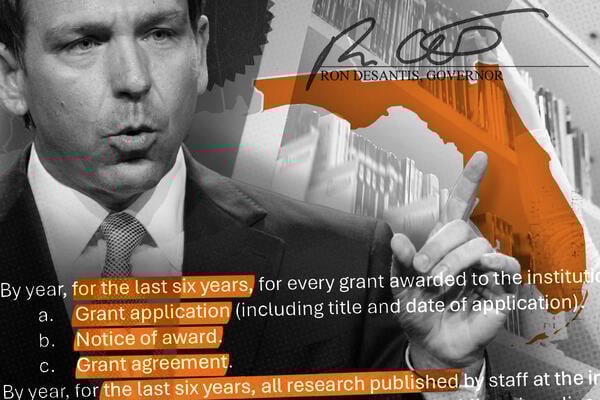
    Earlier this month, the Florida DOGE asked public college and university presidents to provide an account—by the end of last week—of “all research published by staff” over the last six years, including “Papers and drafts made available to the public or in online academic repositories for drafts, preprints, or similar materials.”

    “If not contained therein, author’s name, title, and position at the institution” must be provided, according to the letters the presidents received. The letters didn’t say what this and other requests were for.

    The Florida DOGE also requested information on all grants awarded to institutions over the last six years, asking for each institution’s policy on allocating grants “for purposes of indirect cost recovery, including procedures for calculation.” Further, it requested an account of “all filled and vacant positions held by any employee with a non-instructional role.”

    By the end of April, Florida’s public institutions must also provide the “Length of research associated” with each research publication, funding sources associated with the research and any “publications about the research” from the researcher or institution. In addition, the state DOGE is requesting funding sources for each institution’s noninstructional positions and the names of the nonstudent employees administering the grants.

    And that may not be the end of the DOGE demands. In a March 26 letter, the state DOGE team told college presidents that it will conduct site visits “to ensure full compliance” with the governor’s executive order that created it, “as well as existing Florida law.” It said it may in the future request various other information, including course descriptions, syllabi, “full detail” on campus centers and the required end of diversity, equity and inclusion activities.

    The requests so far from the Florida DOGE are the latest in a string of state actions that faculty say threaten to infringe on, or have already reduced, academic freedom. Dan Saunders, lead negotiator for the United Faculty of Florida union at Florida International University and a tenured associate professor of higher education, expressed concerns about what he called a “continuation of a chilling effect on faculty in terms of what we research and publish.”

    “The lack of any meaningful articulation as to why they’re looking for this data and what they’re going to do with it just adds to the suspicions that I think the state has earned from the faculty,” Saunders said. “It’s clear that this is part of a broader and multidimensional attack” on areas of scholarship such as women’s and gender studies—part of a “comprehensive assault” on the “independence of the university,” he said.

    “If Florida DOGE is following the patterns of the federal DOGE, then I think we can expect some radical oversimplifications of nuanced data and some cherry picking” of texts that an “unsophisticated AI will highlight,” he said. Noting how much research is published over six years, he questioned “how anyone is supposed to engage meaningfully” with that much information.

    David Simmons, president of the University of South Florida’s Faculty Senate and a tenured engineering professor, said many faculty are “reasonably” concerned that this request is part of an effort to target “certain ideas that are disfavored by certain politicians.” Simmons—who stressed that he’s not speaking on behalf of the Senate or his institution—said such targeting would be “fundamentally un-American and inconsistent with the mission of a public university.”

    “We hope that’s not happening. We hope this is just an inefficient effort to collect data,” Simmons said. He noted that much of the research information that the Florida DOGE is requesting is already publicly available on Google Scholar, an online database with profiles on faculty across the country.

    “Universities are being required to reproduce information that’s already freely available in some cases, and to do that they’re using considerable resources and manpower,” Simmons said. The initial two-week data request was “so large as to be nearly impossible” to fulfill, he added.

    A State University System of Florida spokesperson deferred comment to the DOGE team, which didn’t respond to Inside Higher Ed’s requests for an interview or provide answers to written questions Thursday. A spokesperson for the Florida Department of Education, which includes the Florida College System, deferred comment to Republican governor Ron DeSantis’s office, which responded via email but didn’t answer multiple written questions.

    “In alignment with previous announcements and correspondence with all 67 counties, 411 municipalities, and 40 academic institutions the Florida DOGE Task Force aims to eliminate wasteful spending and cut government bloat,” a DeSantis spokesperson wrote. “If waste or abuse is identified during our collaborative efforts with partnering agencies and institutions, each case will be handled accordingly.”

    ‘DOGE Before DOGE Was Cool’

    When Donald Trump returned to the White House in January and announced DOGE’s creation, he suggested it was an effort to cut the alleged waste his Democratic predecessor had allowed to fester. But DeSantis—who lost to Trump in the GOP presidential primary—launched his own DOGE in a state that he’s been leading for six years.

    “Florida was DOGE before DOGE was cool,” DeSantis posted on X Feb. 24. (His actions in higher education have, in many ways, presaged what Trump is now doing nationally.)

    So, perhaps not surprisingly, DeSantis’s executive order creating the Florida DOGE that day began by saying the state already has a “strong record of responsible fiscal management.” A list of rosy financial stats followed before DeSantis finally wrote, “Notwithstanding Florida’s history of prudent fiscal management relative to many states in the country, the State should nevertheless endeavor to explore opportunities for even better stewardship.”

    “The State of Florida should leverage cutting edge technology to identify further spending reductions and reforms in state agencies, university bureaucracies, and local governments,” DeSantis wrote, echoing, at least in language, the tech-focused approach of the federal DOGE.

    He established the DOGE team within the Executive Office of the Governor, tasking it in part to work with the statewide higher education agencies to “identify and eliminate unnecessary spending, programs, courses, staff, and any other inefficiencies,” including “identifying and returning unnecessary federal grant funding.” The executive order says state agencies must set up their own DOGE teams, which will identify grants “that are inconsistent with the policies of this State and should be returned to the American taxpayer in furtherance of the President’s DOGE efforts.”

    This executive order expires about a year from now. In an emailed statement, Teresa M. Hodge, the statewide United Faculty of Florida union president, said the request for faculty publication records “is not about transparency or accountability; it is about control.”

    “Our members should not be forced to defend their scholarship, or their silence, in a political witch hunt,” Hodge said. “We stand united in ensuring that Florida’s faculty are free to teach, conduct research, and to speak without fear of retaliation.”

    Source link