If you’ve ever organized faculty development, you know the usual routine: run workshops, get sign-in sheets, and maybe send a feedback survey. While useful, these activities don’t always tell us the real story—are faculty actually applying what they learn, and is it improving the student experience? At Amity University Dubai (AMUD), we decided to find out. In 2021, our Centre for Teaching and Learning (CTL) created something new: the Faculty Development Index (FDI). It’s a simple points-based system that encourages, tracks, and rewards professional growth, not just attendance at events. Over time, it’s transformed the way our faculty approach teaching.
Here’s how it works, and how you can adapt it for your institution.
Why We Needed a Change
Before the FDI, our professional development (PD) efforts were mostly measured by how many sessions we ran and how many people showed up. We had no easy way to know whether faculty applied what they learned, which activities had the most impact, or how to encourage consistent growth. We wanted a system that did three things: measured the right things, not just attendance, motivated faculty to go beyond the “minimum” in PD, and promoted a culture of sharing, collaboration, and innovation.
The Faculty Development Index at a Glance
The FDI rewards faculty for a variety of activities. While participation in or leading workshops is included, it earns the lowest points to encourage faculty to go beyond traditional PD. Completing online courses like MOOCs is valued more highly, as is applying new skills in the classroom and sharing examples with colleagues. We also award points for collaboration across disciplines, for partnering with industry to create authentic learning opportunities, and for completing advanced training such as our “Train the Trainer” program. Each year, points add up, and the highest scorers receive Teaching Innovation Awards.
Step-by-Step: How We Built It
In the first phase, we started small by tracking workshop participation. This provided a baseline and gave everyone time to get used to the idea of a points system. However, we were clear that attending workshops alone wouldn’t be enough to score well.
The second phase added a focus on applying skills. Faculty were encouraged to share evidence—such as photos or short write-ups—on a dedicated WhatsApp group called *Sharing Best Practices*. This real-time, peer-to-peer sharing helped spread good ideas quickly and made it easy for colleagues to adopt them.
The third phase introduced points for interdisciplinary and industry-linked projects. This encouraged faculty to co-teach modules, develop cross-program assignments, and partner with companies for real-world student projects. To make this practical, we provided examples of what counted as qualifying projects so faculty could see tangible ways to participate. Finally, in the fourth phase, we added MOOCs and our “Train the Trainer” program. We curated a list of high-quality MOOCs and developed a 12-hour blended learning course covering lesson planning, active learning, motivation, and assessment. To ensure relevance, we established a review process for MOOCs and scheduled “Train the Trainer” sessions during times that suited participants.
Practical Benefits for Teaching
The FDI isn’t just about points—it’s designed to improve everyday teaching. Faculty began to design courses with clearer learning outcomes, more authentic assessments, and stronger connections between theory and practice. In the classroom, active learning became more common, with examples ranging from case-based debates in business programs to hands-on prototype building in engineering courses. Class participation grew as faculty introduced strategies like “minute papers,” think-pair-share exercises, and role plays.
Assignments shifted towards more collaborative, project-based formats, often linked to industry input. Online teaching practices improved too; faculty became more confident in using breakout rooms, polls, and flipped classroom videos. Grading and feedback evolved with greater use of rubrics, audio comments, and peer review tools, making assessments more transparent and constructive. Teaching with technology expanded as faculty explored interactive whiteboards, quiz apps, and other digital tools.
Results We’ve Seen
The results have been encouraging. Student satisfaction with teaching quality increased notably in the past two years, which had a noticeable impact on student attrition and complaints. Faculty engagement in professional development grew, with more examples of sharing and collaboration visible in our community. We also noticed improved retention of faculty, suggesting higher job satisfaction and a stronger commitment to the institution.
Challenges and How We Solved Them
Of course, there were challenges. Some faculty were initially resistant, seeing the FDI as added administrative work. We addressed this by keeping reporting requirements light and highlighting early success stories. Industry engagement posed another hurdle; many faculty lacked local contacts, so we ran orientation sessions with our Job Placement Office to help them connect with potential partners. Scheduling conflicts were also a problem for the “Train the Trainer” program, which we resolved by building workshop time into participants’ timetables.
How You Can Adapt the FDI
If you want to create something similar, start by identifying the teaching behaviors you most want to encourage. Build a points system that rewards those activities more generously than routine ones. Provide a platform where faculty can easily share successes, whether that’s a chat group, internal blog, or quick video channel. Recognize and celebrate achievements publicly, and review your system regularly to keep it relevant and motivating.
Final Thoughts
The FDI has proven to be more than a tracking tool—it’s a shift in mindset. Faculty now view professional development as an ongoing, collaborative process that directly benefits their students. If you’re looking to refresh your approach to faculty development, start small, keep it practical, and make it rewarding. The results—both in faculty engagement and student learning—are well worth the effort.
References
Adams, S. R., and E. K. Mix. 2014. “Taking the Lead in Faculty Development: Teacher Educators Changing the Culture of University Faculty Development through Collaboration.” *AILACTE Journal*, 37–56.
Brouwer, N., G. Fleerackers, I. Maciejowska, C. McDonnell, and M. Mocerino. 2022. “The Impact of a Professional Development MOOC on the Teaching Beliefs of University Science Laboratory Teachers.” *Chemistry Teacher International*, 355–376.
Guskey, T. R. 1986. “Staff Development and the Process of Teacher Change.” *Educational Researcher*, 5–12.
McCrickerd, J. 2012. “Understanding and Reducing Faculty Reluctance to Improve Teaching.” *College Teaching*, 56–64.
Distance learning is here to stay. Both students and educators were required to quickly pivot to distance platforms during the COVID-19 pandemic without adequate preparation or training (Basilotta-Gomez-Pablos et al. 2022). Many programs elected to keep distance and hybrid learning options for students, with excellent reason. These platforms improve convenience, access, and inclusivity, gaining fast traction. Now, many institutions have an opportunity, or arguably a responsibility, to provide educators with the support needed to be successful while teaching in distance modalities; concurrently, educators are responsible for seeking resources and training to help them leverage technologies to thrive in this distance space (Crompton and Sykora 2021).
The use of technology in distance platforms is important; educators need to navigate a learning platform but don’t necessarily need to become digital technology experts (Crompton and Sykora 2021). So, what is possibly most important? Finding tools that are simple to use and have a high impact. Many educators still report that they do not feel equipped to apply new technologies, although today’s adult learners prefer novel and engaging technology tools (Borte, Nesje, and Lillejord 2023). Therefore, us educators should discuss, introduce, and share these technologies as we discover them to figure this out as a team.
In this article, we will explore how collaborative technologies, specifically collaborative whiteboards, can help bring life to adult learning theories in synchronous learning classrooms.
Students in distance learning platforms often have fewer opportunities to work collaboratively, outside of a break-out-room model, providing challenges for meaningfully applying adult learning theories. Theoretically speaking, collaboration and social engagement are essential components of adult learning, specifically to create a sense of community with learners, which can be more challenging in distance learning classes (Barbetta 2023; Shea, Richardson, and Swan 2022). Additionally, engaging students in more cognitively demanding ways, such as creating, analyzing, or developing information, is especially important to achieve higher-level learning outcomes (Vargas et al. 2024). Therefore, if we can strategically find ways to use digital technologies grounded in adult learning theory, we can strengthen the learning experience, enhance learning outcomes, and bridge the gap between theory and content delivery.
Many digital technologies and platforms exist and are met with opportunities and challenges. Time constraints and cost are common barriers (Borte, Nesje, and Lillejord 2023); therefore, free tools with relatively low preparation are prioritized. The Microsoft Collaborative Whiteboard app, which can be integrated within a Microsoft Teams Meeting space as a screen share, allows students to edit a document or template for more naturalistic collaborations simultaneously. Because it can be integrated into the meeting space, students do not need to download an app, leave the meeting, or switch to a new browser to participate. The form can be prepared before a lesson to allow instructors flexibility in their role and level of scaffolding.
Real-World Examples
A collaborative whiteboard can be applied to various programs, topic areas, or overall aims, and it may also be used as a formative assessment of content delivery. The examples included in this article were used in two separate synchronous occupational therapy courses, one focused on a neuroscience recap of the cranial nerves and one on adapting a therapeutic activity for different levels of traumatic brain injury rehabilitation. Pay special attention to the variance between the levels of learning targeted and how this is reflected in the collaborative efforts of the students.
Basic-level Whiteboard
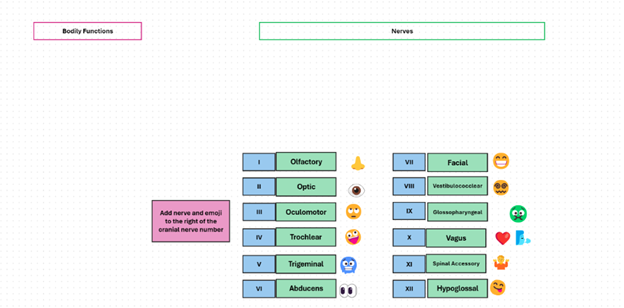
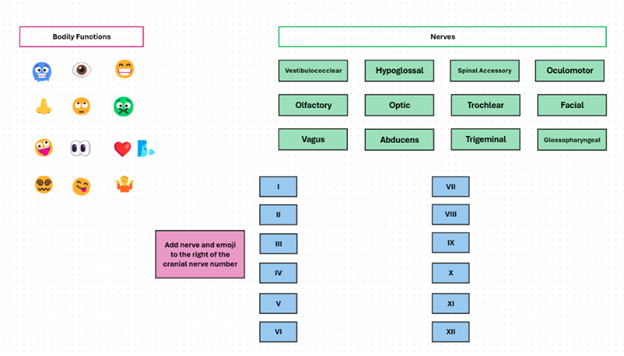
This synchronous whiteboard was used at the beginning of the class session to serve as a formative assessment of the understanding of basic concepts of content. The 24 students were asked to match the function’s cranial nerve name, number, and a representative emoji. This was a more simplistic board that allowed students to reorganize the information presented at a basic knowledge-attainment level collaboratively. It was helpful as a formative assessment to adapt the rest of the lesson according to the students’ level of understanding, and their pace and accuracy of completion. In this case, the students moved their pointers to arrange the information simultaneously, with only a few attempts to collaborate verbally. This activity provided a collaborative effort to complete a joint, goal-oriented task.
Before
After
Advanced-level Whiteboard
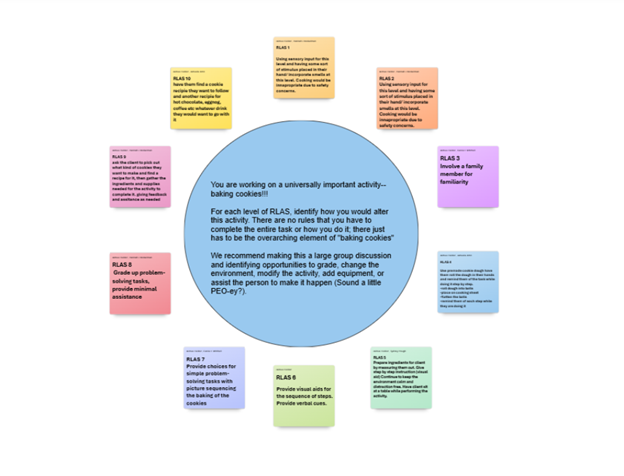
The synchronous whiteboard in this example was created for a higher level of application-based learning, where 11 students were asked to alter components of an occupation and treatment modality, baking cookies, to apply to each unique level of traumatic brain injury recovery. This activity demanded greater levels of problem-solving and, therefore, greater levels of collaboration within the class. Many discussions and opportunities for problem-solving and aims for collective approval arose. To close the learning activity, I led a group debrief to discuss each level, provided immediate feedback, and facilitated discussions transferable to other real-world applications. In this example, the directions are in the middle, and the students filled in the sticky notes around the perimeter.
Make it Meaningful
We need buy-in and motivation in higher education. This begins with identifying real-world challenges and ends with reflection. The strategic use of digital technologies, specifically when combined with theoretical reasoning and adult learning principles, can improve classroom experiences through a greater sense of community while targeting higher levels of learning. If we are intentional with this design, educators can increase student engagement and facilitate higher levels of learning in synchronous online classrooms. Sprinkle goal-oriented and real-world relevant material on top, and you have a recipe for a meaningful outcome.
Looking Ahead
With institutions more widely embracing long-term implementation of distance education programs, faculty require ongoing support, training, and access to resources for sustained confidence and success. Dissemination of practical examples of use by peer educators and texts outlining an approach to identify and develop materials will benefit ongoing efforts to increase competency. In other words, we must keep each other informed on educational tech-gems we find to collectively improve our system.
How to Whiteboard: Quick Start Guide
Open Microsoft Teams
Click on the Whiteboard tab in your meeting space
Upload an editable template or create a blank canvas
Once in your meeting, share your screen and select the whiteboard app
Scaffold your task with prompts and questions
Jaimee Fielder, OTD, OTR is an Assistant Professor of Occupational Therapy at the University of St. Augustine for Health Sciences. She earned her Master of Science in Occupational Therapy from Touro University Nevada, Post-Professional Doctorate in Occupational Therapy from Texas Woman’s University, and is now pursuing a Doctorate in Education from the University of St. Augustine for Health Sciences, with a dissertation focused on educational technology and active learning in higher education classrooms.
References
Barbetta, Patricia M. 2023. “Technologies as Tools to Increase Active Learning During Online Higher-Education Instruction.” Journal of Educational Technology Systems 51(3): 317–339.
Basilotta-Gomez-Pablos, Verónica, Matarranz, María, Casado-Aranda, Luis A., and Otto, Andreas. 2022. “Teachers’ Digital Competencies in Higher Education: A Systematic Literature Review.” International Journal of Educational Technology in Higher Education 19(8).
Børte, Kristi, Nesje, Kjersti, and Lillejord, Sølvi. 2023. “Barriers to Student Active Learning in Higher Education.” Teaching in Higher Education 28(3): 597–615.
Crompton, Helen, and Sykora, Christopher. 2021. “Developing Instructional Technology Standards for Educators: A Design-Based Research Study.” Computers and Education Open 2: 100044.
Shea, Peter, Richardson, Jennifer, and Swan, Karen. 2022. “Building Bridges to Advance the Community of Inquiry Framework for Online Learning.” Educational Psychologist 57(3): 148–161.
Vargas, Jesús H., Ojeda, Edison C. C., Zapata, Carlos A. C., Flores, Karen A. A., Vela, Juan A. H., and Espinoza, Yessenia E. D. 2024. “Analysis of Significant Learning in Higher Education: Usefulness of Fink’s Taxonomy: A Systematic Review.” Journal of International Crisis and Risk Communication Research 7(S7): 1341.
One of my quietest students once came up to me after class and said, “I’ve never felt comfortable speaking in English before this course.” That single sentence reminded me that what we build in the classroom goes far beyond lectures or grading. It’s the atmosphere we create that allows learning to happen. For this student, the turning point wasn’t grammar drills or vocabulary tests. It was trust.
As educators, we often focus on the what and how of teaching. But who the student in front of us matters just as much. In my experience, building genuine rapport is one of the most overlooked yet powerful strategies for helping students feel safe enough to participate, take risks, and grow.
What Rapport Really Means
Rapport is not about being the “fun” professor or trying to be everyone’s favorite. It’s about creating a space where students feel respected, seen, and supported not just academically, but as people.
In my classrooms, especially with my work with adult ESL learners in Kuwait, rapport means:
Greeting students by name and with warmth
Encouraging participation without pressure
Acknowledging their challenges as second-language users
Listening actively to their concerns and ideas
When students feel this kind of connection, they are far more willing to ask questions, attempt difficult tasks, and take ownership of their learning.
How I Build Rapport (and How You Can Too)
Here are five practical habits I’ve developed that have made a noticeable difference in student engagement and classroom climate.
1. Be Present Beyond the Podium
I make time before and after class for informal conversations, even brief ones. A simple, “How’s your week going?” can open doors. Students need to know we are not just grading machines. We are humans too.
2. Learn Names Quickly
It seems like a small detail, but using students’ names early in the semester changes everything. When I call on “Fatima” instead of “you in the third row,” I signal that her presence matters.
3. Use Encouragement Thoughtfully
When a student takes a risk, especially with speaking, I make sure to acknowledge the effort. Saying, “That was a great attempt,” helps build confidence and normalizes the learning process.
4. Normalize Mistakes
Learning is full of errors. I often point out my own slips and laugh with the class. This sets the tone that mistakes are part of the process, not something to fear.
5. Ask for Feedback and Act on It
I regularly ask students what’s helping and what’s not. If I change something based on their feedback, I let them know. This builds trust and shows them that their voices shape the learning experience too.
A Moment I’ll Never Forget
I remember one student, Yousef, who barely spoke during the first few weeks of class. He sat near the back, avoided eye contact, and never volunteered. I made a point to greet him by name each class, ask simple follow-up questions, and check in privately after group work. Slowly, he started opening up. First, he answered yes-no questions. Then, short phrases. By the end of the semester, he stood up and gave a short presentation in English. It wasn’t perfect, but it was powerful. Afterward, he told me, “You made me feel like I could do it.” That comment stays with me to this day.
How Rapport Transforms Feedback
One area where rapport makes a real difference is in how students receive feedback. Constructive feedback is essential for improvement, but it only works if students feel it comes from a place of support.
Once, I had to correct a student’s repeated grammatical mistake. It could have felt embarrassing, but because we had already built trust, she laughed and said, “I knew you would catch that.” She didn’t feel attacked. She knew the correction was about helping her grow.
This kind of response isn’t automatic. It comes from creating a consistent environment where feedback is expected, respected, and grounded in care.
The Ripple Effect of Strong Rapport
The impact of strong rapport is not limited to one assignment or one semester. I have seen students who once hesitated to speak now take initiative in group discussions, volunteer for peer mentoring, or continue English practice long after the course ends.
Rapport also builds community. When students see the teacher modeling kindness, encouragement, and open communication, they begin to do the same with each other. This shifts the classroom from a silent space to one that is collaborative and supportive.
What You Can Try This Week
If you’re looking to build rapport in your own classroom, here are three simple practices you can try immediately:
Learn and use student names within the first two weeks. Use name tents if needed. If you’re at mid-semester, consistent use of student names shows you care and value their presence which helps strengthen classroom connections.
Ask for anonymous feedback midway through the term. Just two questions: “What’s helping you learn?” and “What would you change?”
Set aside two minutes at the end of class to praise a risk taken, a great question asked, or a quiet win. This reinforces the kind of behavior you want to see more of.
These small actions compound over time. They send a clear message to students that they matter and that their growth is the shared goal of the classroom.
Final Thoughts: What They’ll Remember
As educators, we hope students walk away from our courses remembering the material. But what they often remember most is how we made them feel. Did they feel respected? Encouraged? Safe enough to take a risk?
If the answer is yes, then we have done more than teach. We have helped them build confidence, resilience, and the courage to use their voice.
That is the kind of learning that stays with them long after the final exam.
Fahad Ameen is a PhD researcher in Applied Linguistics at the University of Nottingham and an English language instructor at Kuwait University’s College of Education. His work focuses on student motivation, gamified learning, and building meaningful teacher–student relationships in Arab ESL contexts.
One of my quietest students once came up to me after class and said, “I’ve never felt comfortable speaking in English before this course.” That single sentence reminded me that what we build in the classroom goes far beyond lectures or grading. It’s the atmosphere we create that allows learning to happen. For this student, the turning point wasn’t grammar drills or vocabulary tests. It was trust.
As educators, we often focus on the what and how of teaching. But who the student in front of us matters just as much. In my experience, building genuine rapport is one of the most overlooked yet powerful strategies for helping students feel safe enough to participate, take risks, and grow.
What Rapport Really Means
Rapport is not about being the “fun” professor or trying to be everyone’s favorite. It’s about creating a space where students feel respected, seen, and supported not just academically, but as people.
In my classrooms, especially with my work with adult ESL learners in Kuwait, rapport means:
Greeting students by name and with warmth
Encouraging participation without pressure
Acknowledging their challenges as second-language users
Listening actively to their concerns and ideas
When students feel this kind of connection, they are far more willing to ask questions, attempt difficult tasks, and take ownership of their learning.
How I Build Rapport (and How You Can Too)
Here are five practical habits I’ve developed that have made a noticeable difference in student engagement and classroom climate.
1. Be Present Beyond the Podium
I make time before and after class for informal conversations, even brief ones. A simple, “How’s your week going?” can open doors. Students need to know we are not just grading machines. We are humans too.
2. Learn Names Quickly
It seems like a small detail, but using students’ names early in the semester changes everything. When I call on “Fatima” instead of “you in the third row,” I signal that her presence matters.
3. Use Encouragement Thoughtfully
When a student takes a risk, especially with speaking, I make sure to acknowledge the effort. Saying, “That was a great attempt,” helps build confidence and normalizes the learning process.
4. Normalize Mistakes
Learning is full of errors. I often point out my own slips and laugh with the class. This sets the tone that mistakes are part of the process, not something to fear.
5. Ask for Feedback and Act on It
I regularly ask students what’s helping and what’s not. If I change something based on their feedback, I let them know. This builds trust and shows them that their voices shape the learning experience too.
A Moment I’ll Never Forget
I remember one student, Yousef, who barely spoke during the first few weeks of class. He sat near the back, avoided eye contact, and never volunteered. I made a point to greet him by name each class, ask simple follow-up questions, and check in privately after group work. Slowly, he started opening up. First, he answered yes-no questions. Then, short phrases. By the end of the semester, he stood up and gave a short presentation in English. It wasn’t perfect, but it was powerful. Afterward, he told me, “You made me feel like I could do it.” That comment stays with me to this day.
How Rapport Transforms Feedback
One area where rapport makes a real difference is in how students receive feedback. Constructive feedback is essential for improvement, but it only works if students feel it comes from a place of support.
Once, I had to correct a student’s repeated grammatical mistake. It could have felt embarrassing, but because we had already built trust, she laughed and said, “I knew you would catch that.” She didn’t feel attacked. She knew the correction was about helping her grow.
This kind of response isn’t automatic. It comes from creating a consistent environment where feedback is expected, respected, and grounded in care.
The Ripple Effect of Strong Rapport
The impact of strong rapport is not limited to one assignment or one semester. I have seen students who once hesitated to speak now take initiative in group discussions, volunteer for peer mentoring, or continue English practice long after the course ends.
Rapport also builds community. When students see the teacher modeling kindness, encouragement, and open communication, they begin to do the same with each other. This shifts the classroom from a silent space to one that is collaborative and supportive.
What You Can Try This Week
If you’re looking to build rapport in your own classroom, here are three simple practices you can try immediately:
Learn and use student names within the first two weeks. Use name tents if needed. If you’re at mid-semester, consistent use of student names shows you care and value their presence which helps strengthen classroom connections.
Ask for anonymous feedback midway through the term. Just two questions: “What’s helping you learn?” and “What would you change?”
Set aside two minutes at the end of class to praise a risk taken, a great question asked, or a quiet win. This reinforces the kind of behavior you want to see more of.
These small actions compound over time. They send a clear message to students that they matter and that their growth is the shared goal of the classroom.
Final Thoughts: What They’ll Remember
As educators, we hope students walk away from our courses remembering the material. But what they often remember most is how we made them feel. Did they feel respected? Encouraged? Safe enough to take a risk?
If the answer is yes, then we have done more than teach. We have helped them build confidence, resilience, and the courage to use their voice.
That is the kind of learning that stays with them long after the final exam.
Fahad Ameen is a PhD researcher in Applied Linguistics at the University of Nottingham and an English language instructor at Kuwait University’s College of Education. His work focuses on student motivation, gamified learning, and building meaningful teacher–student relationships in Arab ESL contexts.
Wrapping up a recent course, one of my students approached and asked to talk. It turns out she wasn’t there to review an assignment or clarify a grade. Instead, she was seeking my advice on her future career: what were my thoughts on job prospects for her major; what professional pathways made sense, given our rapidly changing world.
As the conversation touched on search strategies, market forces, and even the shifting nature of work itself, I was struck by how the moment represented a growing phenomenon in higher education: helping students succeed beyond the academic setting is a shared responsibility, particularly as the call for post-academic success continues to grow.
Dedicated career centers lead the way for student success beyond campus, but when students seek guidance on their future professional roles, chances are it will be an instructor to whom they turn. That’s good news for those of us committed to academic success. When students reach out to faculty for career advice, it’s an opportunity to deepen trust and strengthen learner confidence–principles that correlate with learning success. It also allows us to link learning with purpose, while helping us more deeply understand the evolution of our disciplines.
Integrating career readiness into our courses benefits us all. Here are some simple steps to get started:
Instructors Are Career Influencers—Whether We Know It or Not
Classroom instructors are the most consistent professional mentors that students encounter throughout their college years. A passing comment about your own career trajectory, or a few minutes spent discussing potential paths in your field, can expand a student’s sense of what’s possible, particularly for those whose backgrounds lack the types of professional networks that can impact professional success. Inviting professionals into the classroom–whether through alumni networks, or local industry—is an opportunity to provide students with professional roadmaps. Sharing examples of the different ways your discipline shows up in the world can likewise orient students towards a meaningful future in which they will likely change careers multiple times. To help guide conversations, invite students to explore so-called “clusters” of careers using tools such as the U.S. Department of Labor’s Occupational Information Network which provides data on growing fields and industries.
Relevance Drives Engagement
When students understand how their academic work connects to real-world applications, their engagement deepens. They’re more likely to push through a complex assignment when they see how it builds toward the type of skills they can apply to future employment. Not every lesson needs to turn into a job training session but connecting the “what” of our teaching to the “why” that students are so often seeking strengthens outcomes and can also improve student satisfaction. Studies indicate that students gain motivation when they can see how the skills they’re developing serve a purpose beyond the classroom, so canvassing students about their future career goals and integrating conversations and activities that help them map content to careers can be highly effective.
Every Discipline Includes Transferable Skills
Supporting students with future career goals means guiding them to recognize key competencies that develop across disciplines and that are prioritized across professional fields. Key among these are the skills of critical thinking, communication, teamwork, cultural fluency, and ethical decision-making. Students won’t always recognize these as in-demand skills unless we name them, so consistently referencing their utility is an impactful step. That might mean pointing out that a history paper builds research skills; a biology lab fosters analytical reasoning; and a group project in any discipline develops collaboration and leadership skills that are prized in the workplaces of today. By drawing attention to these connections, we help students value the breadth of what they’re learning while helping them understand how to showcase these skills to future employers.
Hybrid Skills Define the Modern Workforce
Today’s employers seek graduates who bring both depth and versatility, meaning team members who know the specifics of their field, but can also communicate, adapt, and think creatively. These hybrid profiles are in demand across sectors and instructors can support their students by embedding assignments that mirror real-world demands. Case studies, presentations, simulations, along with reflective writing, all offer chances to practice skills that matter in professional life. When we give students opportunities to apply knowledge in dynamic ways, we prepare them not only for jobs, but for the type of lifelong learning these professional positions will demand.
Helping students prepare for their careers doesn’t dilute academic rigor; it strengthens it by affirming that education matters in the world beyond academics. That day in the classroom, as I listened to my student’s questions about her future, I realized she wasn’t looking for certainty, but rather the opportunity to engage in the very skills we’ve always valued in teaching: critical questioning, reflection, and the ability to envision new ways to advance. Faculty are in a unique position to offer this type of guidance. Embracing and integrating career readiness into our teaching supports the pedagogical goals of the classroom while helping students succeed well beyond them.
Juli S. Charkes, EdD, is a former Director of a Center for Teaching and Learning where she led faculty development across 100 academic programs. She has been a classroom instructor for the past 14 years, teaching organizational leadership, communications, and media studies at both the undergraduate and graduate levels.
Pleschová, G., Sutherland, K. A., Felten, P., Forsyth, R., & Wright, M. C. (2025). Trust-building as inherent to academic development practice. International Journal for Academic Development, 30(1), 1–13. https://doi.org/10.1080/1360144X.2025.2454704
Fish, N., Bertone, S., & van Gramberg, B. (2025). Improving student engagement in employability development: recognising and reducing affective and behavioural barriers. Studies in Higher Education, 1–16. https://doi.org/10.1080/03075079.2025.2461271
Wrapping up a recent course, one of my students approached and asked to talk. It turns out she wasn’t there to review an assignment or clarify a grade. Instead, she was seeking my advice on her future career: what were my thoughts on job prospects for her major; what professional pathways made sense, given our rapidly changing world.
As the conversation touched on search strategies, market forces, and even the shifting nature of work itself, I was struck by how the moment represented a growing phenomenon in higher education: helping students succeed beyond the academic setting is a shared responsibility, particularly as the call for post-academic success continues to grow.
Dedicated career centers lead the way for student success beyond campus, but when students seek guidance on their future professional roles, chances are it will be an instructor to whom they turn. That’s good news for those of us committed to academic success. When students reach out to faculty for career advice, it’s an opportunity to deepen trust and strengthen learner confidence–principles that correlate with learning success. It also allows us to link learning with purpose, while helping us more deeply understand the evolution of our disciplines.
Integrating career readiness into our courses benefits us all. Here are some simple steps to get started:
Instructors Are Career Influencers—Whether We Know It or Not
Classroom instructors are the most consistent professional mentors that students encounter throughout their college years. A passing comment about your own career trajectory, or a few minutes spent discussing potential paths in your field, can expand a student’s sense of what’s possible, particularly for those whose backgrounds lack the types of professional networks that can impact professional success. Inviting professionals into the classroom–whether through alumni networks, or local industry—is an opportunity to provide students with professional roadmaps. Sharing examples of the different ways your discipline shows up in the world can likewise orient students towards a meaningful future in which they will likely change careers multiple times. To help guide conversations, invite students to explore so-called “clusters” of careers using tools such as the U.S. Department of Labor’s Occupational Information Network which provides data on growing fields and industries.
Relevance Drives Engagement
When students understand how their academic work connects to real-world applications, their engagement deepens. They’re more likely to push through a complex assignment when they see how it builds toward the type of skills they can apply to future employment. Not every lesson needs to turn into a job training session but connecting the “what” of our teaching to the “why” that students are so often seeking strengthens outcomes and can also improve student satisfaction. Studies indicate that students gain motivation when they can see how the skills they’re developing serve a purpose beyond the classroom, so canvassing students about their future career goals and integrating conversations and activities that help them map content to careers can be highly effective.
Every Discipline Includes Transferable Skills
Supporting students with future career goals means guiding them to recognize key competencies that develop across disciplines and that are prioritized across professional fields. Key among these are the skills of critical thinking, communication, teamwork, cultural fluency, and ethical decision-making. Students won’t always recognize these as in-demand skills unless we name them, so consistently referencing their utility is an impactful step. That might mean pointing out that a history paper builds research skills; a biology lab fosters analytical reasoning; and a group project in any discipline develops collaboration and leadership skills that are prized in the workplaces of today. By drawing attention to these connections, we help students value the breadth of what they’re learning while helping them understand how to showcase these skills to future employers.
Hybrid Skills Define the Modern Workforce
Today’s employers seek graduates who bring both depth and versatility, meaning team members who know the specifics of their field, but can also communicate, adapt, and think creatively. These hybrid profiles are in demand across sectors and instructors can support their students by embedding assignments that mirror real-world demands. Case studies, presentations, simulations, along with reflective writing, all offer chances to practice skills that matter in professional life. When we give students opportunities to apply knowledge in dynamic ways, we prepare them not only for jobs, but for the type of lifelong learning these professional positions will demand.
Helping students prepare for their careers doesn’t dilute academic rigor; it strengthens it by affirming that education matters in the world beyond academics. That day in the classroom, as I listened to my student’s questions about her future, I realized she wasn’t looking for certainty, but rather the opportunity to engage in the very skills we’ve always valued in teaching: critical questioning, reflection, and the ability to envision new ways to advance. Faculty are in a unique position to offer this type of guidance. Embracing and integrating career readiness into our teaching supports the pedagogical goals of the classroom while helping students succeed well beyond them.
Juli S. Charkes, EdD, is a former Director of a Center for Teaching and Learning where she led faculty development across 100 academic programs. She has been a classroom instructor for the past 14 years, teaching organizational leadership, communications, and media studies at both the undergraduate and graduate levels.
Pleschová, G., Sutherland, K. A., Felten, P., Forsyth, R., & Wright, M. C. (2025). Trust-building as inherent to academic development practice. International Journal for Academic Development, 30(1), 1–13. https://doi.org/10.1080/1360144X.2025.2454704
Fish, N., Bertone, S., & van Gramberg, B. (2025). Improving student engagement in employability development: recognising and reducing affective and behavioural barriers. Studies in Higher Education, 1–16. https://doi.org/10.1080/03075079.2025.2461271
What if the AI tools we are trying to limit and caution against were actually essential (or beneficial) to enhancing the critical thinking skills we are afraid of losing? Since the 2023 proliferation of generative AI, faculty have been inundated with warnings that human intelligence is being eroded by AI. As a result, some faculty have adopted policies banning or severely limiting AI use driven by concerns of academic integrity and the fear of students bypassing essential learning.
However, banning AI will not prevent students from using it, whether for nefarious or appropriate purposes. Instead, it may deny students a chance to practice and engage with AI in an educational setting where they and faculty can explore its full potential collaboratively. This kind of restrictive thinking is based on two flawed assumptions: that AI cannot support student thinking and that students will only use AI to cheat. The challenge is not to police every use, but to reframe our approach from one of prohibition to one of collaborative partnership.
This shift in perspective allows faculty to systematically integrate AI into courses in a developmentally appropriate manner. By centering policies on learning, we can encourage students to take an active, self-regulated approach to their education. This reframes the focus from dishonesty to autonomous learning, emphasizing academic values while scaffolding meaningful assignments that challenge student thinking.
Integrating AI into the curriculum requires a developmental approach, much like teaching toddlers. Expecting a first-year student to rely on AI for essential skills development is like asking a toddler to color within the lines—it’s developmentally inappropriate. Instead, our policies should align with a student’s progression. In lower-level courses, the focus must be on foundational skill-building including learning how to use AI. For upper-level and graduate students, we can empower them to autonomously evaluate AI’s role in their learning and whether or not AI is developing or replacing learning. Meanwhile, mid-level courses can provide a scaffolded transition, with specific instructions on how and when to use AI.
It is important to consider students’ prior knowledge of AI as well. While many are comfortable using technology and AI, they may lack metacognitive awareness of how their use affects learning. Understanding students’ technology usage is crucial when designing courses. Ultimately, use your best judgment—some graduate courses may require a cautious approach, while entry-level courses might benefit from a more permissive policy, especially since students within the same course can have a wide range of AI abilities.
How to Integrate AI Developmentally into Your Courses
Lower-Level Courses: Focus on building foundational skills, which includes guided instruction on how to use AI responsibly. This moves the strategy beyond mere prohibition.
Mid-Level Courses: Use AI as a scaffold where faculty provide specific guidelines on when and how to use the tool, preparing students for greater independence.
Upper-Level/Graduate Courses: Empower students to evaluate AI’s role in their learning. This enables them to become self-regulated learners who make informed decisions about their tools.
Balanced Approach: Make decisions about AI use based on the content being learned and students’ developmental needs.
Now that you have a framework for how to conceptualize including AI into your courses here are a few ideas on scaffolding AI to allow students to practice using technology and develop cognitive skills.
To introduce AI into your course, create a prompt that asks students to have a conversation with an AI about a concept you will be discussing. This anticipatory set can prime student thinking and encourage them to use AI in a conversational manner, moving beyond simply asking for answers. You can then discuss the AI’s responses—exploring bias, hallucinations, and the depth of its answers—which naturally leads to a conversation about crafting better prompts. This simple, ungraded exercise allows all students to participate, provides valuable practice, and serves a clear learning purpose.
Another example of a nongraded, purposeful use of AI is for providing feedback on learning. When students are writing papers, you can create custom AI agents to provide feedback on different parts of the writing process, from idea development to final submission. These agents can be designed to follow assignment criteria without writing any portion of the work. If students choose to use the agent, you can ask them to share their feedback conversations to assess the quality of the feedback and to write about how they incorporated it to develop their ideas—adding a crucial element of metacognition.
This method is also ideal for reinforcing and mastering skill development. For example, in a counseling course, students can practice articulating confidentiality and its limits to a fictional client created by AI. Once this foundational skill is mastered, the agent can be instructed to demonstrate signs of self-harm, allowing the student to practice assessing client safety and deciding whether to break confidentiality. As with the other examples, you can ask students to share their conversations for your feedback, have them critique their own performance, and provide a rationale for their approach. The agent itself can even provide feedback at the end of the session.
Finally, a higher level of AI integration is to have students create their own custom learning AI agent. By this point, students will have had multiple chances to improve their prompt writing, practice using AI for learning (not bypassing skills), and evaluate how AI supports their development. Creating a personalized study agent would be an ideal way for students to be active in their learning and assess the areas they need to develop. Faculty could provide guidelines and ask students to share how they are using AI positively.
How to Scaffold AI into Your Courses
Start with low-stakes, ungraded activities.
Then use AI to provide meaningful, real-time feedback.
Create opportunities for skill reinforcement and mastery.
Finally, empower students to become creators, not just users.
To truly prepare students for life after graduation, institutions and faculty must be willing to provide training on new technologies with a lens of learning. Faculty must move beyond fear and prohibition and engage directly with these tools. By exploring AI’s potential faculty can transform their teaching from a place of restriction to one of collaborative partnership.
By taking a development and scaffolded approach to AI implementation students can benefit from its potential. If this approach is embraced, the question is no longer “Should we allow AI in the classroom?” The more productive question becomes “How can we teach our students to become discerning and effective creators of a world shaped by AI?”
Michael Kiener, PhD, CRC, is a professor at Maryville University of St. Louis in their Clinical Mental Health Counseling program. For the past 10 years he has coordinated their Scholarship of Teaching and Learning Program, where faculty participate in a yearlong program with a goal of improved student learning. In 2012 and 2024 he received the Outstanding Faculty Award for faculty who best demonstrate excellence in the integration of teaching, scholarship and/or service. He has over thirty publications including a co-authored book on strength-based counseling and journal articles on career decision making, action research, counseling pedagogy, and active and dynamic learning strategies.
When students of different years of study share a common class, their levels of experience and confidence differ. Students from lower years of study may hesitate to speak up in the presence of those in higher years, while more experienced students may contribute more freely. These dynamics are common and, if left unaddressed, can reinforce a power imbalance that discourages active learning.
The same challenge shows up at the start of a semester. When students meet a lecturer for the first time, the unfamiliarity often makes them cautious. Most hold back. It is not because they lack curiosity, but because they are unsure how their answers or questions will be received.
This hesitation can hold back meaningful participation. I have come to learn that all it takes is a simple, intentional tool to change the energy of a room and give every student the confidence to contribute.
One such tool that has had a lasting impact on my teaching is the “Parking Lot.”
Discovering the Parking Lot
The Parking Lot is a simple but powerful active-learning tool: a dedicated space, physical or digital, where students can “park” their questions, comments, or reflections for later discussion. This allows a session to keep its flow while assuring students that their contributions will be acknowledged.
I first encountered this tool during a two week professional development course on Competency-Based Education and Training (CBET) delivery organized by my university.
I left the training with many ideas for making my teaching more interactive, but the Parking Lot stayed with me as a practical, low-cost strategy I could implement immediately.
A few months later, in early September 2025, I have the privilege of leading an inaugural 40-Hour Mediation Training and Certification program, a capacity-building initiative for students and staff members.
As project lead, I handled admissions and could tell from the applications that we had a mix of students from different years and one staff member. I worried that students from lower years might hold back and that quieter voices might be lost. I wanted every participant to feel their questions, comments, and opinions mattered.
During the pre-training meeting, I asked the trainers if I could introduce the Parking Lot as a way to encourage engagement, and they graciously agreed.
Bringing the Parking Lot to Life
On the first day of the training, I wrote PARKING LOT on a manila sheet, taped it to the front wall near the exit, and placed sticky notes on each participant’s table. The trainers invited me to explain how it worked.
I explained the purpose of the parking lot and encouraged participants to write their questions on sticky notes at any point in the day, during sessions, breaks, or even early the next morning, if they were not ready to raise their hand.
The results were immediate and encouraging. By the end of the first day, the Parking Lot had several notes posted. The trainers reviewed and addressed them the following morning, and participants continued to engage with it throughout the week.
Some who started by writing anonymous notes eventually became confident enough to ask questions aloud. The trainers later confirmed that the Parking Lot had improved participation and enriched the discussions.
This success made me curious to see what would happen if I tried it in my regular semester classes, which were about to begin the following week.
Applying the Parking Lot in My Classes
It was my first class of the semester, and I wanted to set the tone for participation. I was teaching a fourth year second semester class on Alternative dispute Resolution.
This time, I didn’t use the Parking Lot just to collect questions — I used it to invite feedback and spark discussion.
The first question I asked was “What rules should govern our class this semester?” Students wrote their suggestions on sticky notes, and we created a “social contract” for the semester, another active learning technique I am experimenting with.
I read the suggestions aloud and asked students, “What does this rule mean for us as a class?” or “How might we apply this rule in practice?” Their answers led to rich discussion, and I saw the power of shared responsibility as play when we agreed on the class rules, their application and consequences for both the students and the teacher.
I then used the Parking Lot to ask questions to introduce the course I was teaching that semester: “What do you think is conflict?”, “What do you think is a dispute?”, “What is the difference?” Reading their answers helped me identify and gently correct misconceptions without putting anyone on the spot. The class became so interactive that students were surprised when time was up.
Motivated by the positive results, later that same day, I used the Parking Lot in my first-year, second-semester on Legal Research & Writing class.
I asked students to write down on the sticky notes why they chose to study law and what they hoped to do with their degree. I told them that their reasons could serve as a compass something to help them find direction, stay true to their path, and never lose sight of their reason for being in law school when the journey becomes challenging.
I read their answers aloud, offered encouragement, and connected their aspirations back to the course outcomes. For example, I reminded them that to become a defender of human rights, one must not only know how to find the correct law but also be capable of writing clearly and persuasively.
This exercise gave even the quietest students a voice and set a tone of openness and shared purpose for the rest of the semester.
Lessons Learned
In the three instances I have applied the Parking Lot with different groups of students, I have seen it:
Activate students’ thinking early as they process the material and reflect on what they are learning.
Open up discussion by creating a safe space where every student’s voice can be heard.
Reveal misconceptions and allow them to be addressed gently, without putting anyone on the spot.
Connect student contributions to learning outcomes, helping them see why what they wrote matters to the course.
Encourage students to take ownership of their learning, which builds confidence and keeps them engaged.
Create opportunities for mentorship, by affirming students’ ideas, encouraging them, and guiding them as they think about their future career paths.
Reflection
This experience brought me to the realization that innovation in teaching, even in public universities where resources are often limited, does not need complicated technology or big budgets.
A manila paper sheet, some sticky notes, and a willingness to listen can transform the classroom.
Most of all, this experience affirmed why I teach: to create spaces where every student, confident or quiet, can grow.
Seeing students engaged, sharing openly, and losing track of time because they are so absorbed in the conversation is one of the most rewarding experiences I can have as an educator.
What You Can Do Tomorrow
Bring a manila sheet and sticky notes to class, tape the sheet where students can see it as they leave, and invite them to post their questions, answers or reflections.
Review and address a few notes immediately or at the start of the next class. You may be surprised how quickly even the quietest students start to contribute.
J. Muthoni Mwangi, LL.B, PGDip Law, LL.M, is an Assistant Lecturer at JKUAT School of Law – Karen Campus, an Advocate of the High Court of Kenya, an Associate Member of CIArb, and an Accredited Mediator with SDRC. She served as Project Lead for the inaugural JKUAT 40-Hour Mediation Training & Certification and is passionate about learner-cantered legal education, mentoring the next generation of mediators, and promoting access to justice.
When students of different years of study share a common class, their levels of experience and confidence differ. Students from lower years of study may hesitate to speak up in the presence of those in higher years, while more experienced students may contribute more freely. These dynamics are common and, if left unaddressed, can reinforce a power imbalance that discourages active learning.
The same challenge shows up at the start of a semester. When students meet a lecturer for the first time, the unfamiliarity often makes them cautious. Most hold back. It is not because they lack curiosity, but because they are unsure how their answers or questions will be received.
This hesitation can hold back meaningful participation. I have come to learn that all it takes is a simple, intentional tool to change the energy of a room and give every student the confidence to contribute.
One such tool that has had a lasting impact on my teaching is the “Parking Lot.”
Discovering the Parking Lot
The Parking Lot is a simple but powerful active-learning tool: a dedicated space, physical or digital, where students can “park” their questions, comments, or reflections for later discussion. This allows a session to keep its flow while assuring students that their contributions will be acknowledged.
I first encountered this tool during a two week professional development course on Competency-Based Education and Training (CBET) delivery organized by my university.
I left the training with many ideas for making my teaching more interactive, but the Parking Lot stayed with me as a practical, low-cost strategy I could implement immediately.
A few months later, in early September 2025, I have the privilege of leading an inaugural 40-Hour Mediation Training and Certification program, a capacity-building initiative for students and staff members.
As project lead, I handled admissions and could tell from the applications that we had a mix of students from different years and one staff member. I worried that students from lower years might hold back and that quieter voices might be lost. I wanted every participant to feel their questions, comments, and opinions mattered.
During the pre-training meeting, I asked the trainers if I could introduce the Parking Lot as a way to encourage engagement, and they graciously agreed.
Bringing the Parking Lot to Life
On the first day of the training, I wrote PARKING LOT on a manila sheet, taped it to the front wall near the exit, and placed sticky notes on each participant’s table. The trainers invited me to explain how it worked.
I explained the purpose of the parking lot and encouraged participants to write their questions on sticky notes at any point in the day, during sessions, breaks, or even early the next morning, if they were not ready to raise their hand.
The results were immediate and encouraging. By the end of the first day, the Parking Lot had several notes posted. The trainers reviewed and addressed them the following morning, and participants continued to engage with it throughout the week.
Some who started by writing anonymous notes eventually became confident enough to ask questions aloud. The trainers later confirmed that the Parking Lot had improved participation and enriched the discussions.
This success made me curious to see what would happen if I tried it in my regular semester classes, which were about to begin the following week.
Applying the Parking Lot in My Classes
It was my first class of the semester, and I wanted to set the tone for participation. I was teaching a fourth year second semester class on Alternative dispute Resolution.
This time, I didn’t use the Parking Lot just to collect questions — I used it to invite feedback and spark discussion.
The first question I asked was “What rules should govern our class this semester?” Students wrote their suggestions on sticky notes, and we created a “social contract” for the semester, another active learning technique I am experimenting with.
I read the suggestions aloud and asked students, “What does this rule mean for us as a class?” or “How might we apply this rule in practice?” Their answers led to rich discussion, and I saw the power of shared responsibility as play when we agreed on the class rules, their application and consequences for both the students and the teacher.
I then used the Parking Lot to ask questions to introduce the course I was teaching that semester: “What do you think is conflict?”, “What do you think is a dispute?”, “What is the difference?” Reading their answers helped me identify and gently correct misconceptions without putting anyone on the spot. The class became so interactive that students were surprised when time was up.
Motivated by the positive results, later that same day, I used the Parking Lot in my first-year, second-semester on Legal Research & Writing class.
I asked students to write down on the sticky notes why they chose to study law and what they hoped to do with their degree. I told them that their reasons could serve as a compass something to help them find direction, stay true to their path, and never lose sight of their reason for being in law school when the journey becomes challenging.
I read their answers aloud, offered encouragement, and connected their aspirations back to the course outcomes. For example, I reminded them that to become a defender of human rights, one must not only know how to find the correct law but also be capable of writing clearly and persuasively.
This exercise gave even the quietest students a voice and set a tone of openness and shared purpose for the rest of the semester.
Lessons Learned
In the three instances I have applied the Parking Lot with different groups of students, I have seen it:
Activate students’ thinking early as they process the material and reflect on what they are learning.
Open up discussion by creating a safe space where every student’s voice can be heard.
Reveal misconceptions and allow them to be addressed gently, without putting anyone on the spot.
Connect student contributions to learning outcomes, helping them see why what they wrote matters to the course.
Encourage students to take ownership of their learning, which builds confidence and keeps them engaged.
Create opportunities for mentorship, by affirming students’ ideas, encouraging them, and guiding them as they think about their future career paths.
Reflection
This experience brought me to the realization that innovation in teaching, even in public universities where resources are often limited, does not need complicated technology or big budgets.
A manila paper sheet, some sticky notes, and a willingness to listen can transform the classroom.
Most of all, this experience affirmed why I teach: to create spaces where every student, confident or quiet, can grow.
Seeing students engaged, sharing openly, and losing track of time because they are so absorbed in the conversation is one of the most rewarding experiences I can have as an educator.
What You Can Do Tomorrow
Bring a manila sheet and sticky notes to class, tape the sheet where students can see it as they leave, and invite them to post their questions, answers or reflections.
Review and address a few notes immediately or at the start of the next class. You may be surprised how quickly even the quietest students start to contribute.
J. Muthoni Mwangi, LL.B, PGDip Law, LL.M, is an Assistant Lecturer at JKUAT School of Law – Karen Campus, an Advocate of the High Court of Kenya, an Associate Member of CIArb, and an Accredited Mediator with SDRC. She served as Project Lead for the inaugural JKUAT 40-Hour Mediation Training & Certification and is passionate about learner-cantered legal education, mentoring the next generation of mediators, and promoting access to justice.
Interpersonal communication theories not only help students navigate personal and professional relationships but also strengthen teacher-student connections. Drawing on Orón (2018) and Orón Semper & Blasco (2018), we encourage instructors to use this one-day activity to shift from a “student-centered” to an “interpersonal relationship-centered” pedagogy. This approach views instructor-student relationships as essential to learning and as a space for students to apply theory with relational intent. The activity promotes self-reflexivity, theory analysis, and collaborative dialogue, resulting in improved theory comprehension, stronger rapport, and communication practices that respect classroom diversity.
Student and instructor diversity in higher education has grown significantly in recent years (Li & Koedel, 2017), with over a million international students enrolled in U.S. universities (Urban, 2016). This diversity—across culture, gender, race, ability, and socioeconomic status—shapes classroom dynamics and presents unique challenges related to language, identity, and cultural differences (Jones et al., 2021). Instructors must respond by creating inclusive learning environments that support all students (Downing & Billotte Verhoff, 2023). Diversity also presents an opportunity to apply communication theories to foster intercultural empathy and improve collaboration. Students may initially struggle to understand and respect differing perspectives, affecting group work and engagement (Gray et al., 2020), but these challenges can become learning opportunities that deepen classroom inclusivity.
Communication scholars often apply interpersonal communication theories in the classroom to strengthen student–teacher relationships (Xie & Derakhshan, 2021). This single class activity integrates uncertainty management, self-disclosure, and communication accommodation theory (CAT) for undergraduate students to (a) to understand and (b) apply these theories to facilitate an inclusive and self-reflexive classroom. Teachers are the leading actors during everyday interaction and play a significant role in shaping communication and enhancing the teaching and learning process (Almas Rizkika Nabila, 2020). This activity encourages students to actively co-create a meaningful learning experience, highlighting the reciprocal nature of classroom interaction (Anyichie & Butler, 2023; Kong, 2021).
Self-disclosure: Communication Privacy Management
Self-disclosure is “any conversation about the self that a person communicates to others” (Ampong et al., 2018). Communication Privacy Management (CPM) theory helps students understand how they set and manage privacy boundaries with peers and instructors (Petronio et al., 2021). The intersection of privacy boundaries and the learning space is complicated as students and instructors navigate privacy. Instructors deliver the lecture and explain the course content, but they also intentionally and willingly share their personal stories (Liu & Zhu, 2021). For instance, the first author, an international graduate assistant, connects class discussions to experiences from his home country, helping students relate and engage. Such instructor self-disclosure encourages student participation and fosters more meaningful classroom communication (Goldstein, 1994) (Liu & Zhu, 2021).
However, instructors and students rarely critically examine the disclosure norms in the classroom and their role in learning and relationship building. For example, disclosure boundaries (i.e., how far instructors can go to share their experiences) (Cayanus, 2004). Additionally, while students may attend to how much information they share in the classroom, this activity challenges them to apply CPM theory to examine their disclosure practices, expectations, and privacy boundary negotiations.
Communication Accommodation Theory
Communication Accommodation Theory (CAT) explains how individuals adjust their communication such as speech, tone, pace, gestures, or body language—to interact effectively with others. Instructors can use CAT to enhance student understanding during lectures (Howard Giles, 2023).The theory outlines two key strategies: convergence, where a speaker adapts to another’s communication style (e.g., simplifying vocabulary, repeating phrases, pausing, smiling, nodding), and divergence, where a speaker maintains differences by avoiding shared cues (e.g., using complex words, changing topics, or not adjusting speaking pace) (Marko Dragojevic, 2016) (Pardo et al., 2022).
Drawing on this research, the goal of this activity is 1) to understand the theories and analyze how they facilitate the teaching process, 2) to explore the perceptions of students about these theories and their inclusion in the classroom, 3) to determine the expectations of students related to characteristics of these theories.
The Activity
This single-class activity applies to various undergraduate courses, such as public speaking, communication among cultures, communication in interpersonal relationships, argument analysis and advocacy, and persuasion. Instructors can do this activity during introduction week as they begin navigating disclosures about themselves and student expectations. Moreover, planning this activity at the beginning will challenge students to examine their positionalities, norms, and expectations critically.
Step 1: Personal Reflection
Before implementing the activity, instructors should familiarize themselves with relevant communication theories and reflect on how their own identities shape their teaching assumptions (Nabila, 2020, Downing & Billotte Verhoff, 2023). We recommend engaging in self-reflexive questions, such as: What disclosure boundaries do I set and why? What uncertainties do I face around privacy or accommodation in teaching? What expectations exist between me and my students regarding communication and flexibility? Instructors should identify what personal information they’re willing to share, why they’re sharing it, and how it might impact classroom relationships. For example, the first author reflected on cultural and linguistic differences and adjusted his teaching by using simpler language, acknowledging English is not his first language, and setting shared guidelines to support mutual understanding and accommodation. This reflective process helps align instructional practices with inclusive, theory-informed pedagogy.
Step 2: Students’ Perceptions About Components of Theories
This activity takes approximately 30 to 40 minutes and is best suited for a full class session. Instructors should introduce the key theories with examples and explain the activity’s purpose and timing. For advanced courses, assigning theory readings beforehand can deepen analysis, making it more effective to conduct the activity later in the semester rather than at the start. During the session, students should be divided into groups of four and asked to write their expectations for the course and the instructor. To guide discussion, instructors can pose prompts such as:
What expectations do you have for your instructor when it comes to using different communication accommodation strategies?
How do you manage your own self-disclosure in the classroom? Where do you draw the line on what you choose to share?
What are your thoughts on instructors’ self-disclosure? What types of disclosures have a positive or negative impact on your learning experience?
How comfortable are you with classroom communication? What strategies could reduce uncertainty or discomfort?
How do you plan to engage with and accommodate diversity in terms of culture, race, gender identity, and sexual orientation in your classroom interactions?
Can you connect your responses to the core ideas of the communication theories we’ve discussed? How do these theories help explain disclosure and accommodation in the classroom context?
These questions will provide space for students to reflect on their experiences. Moreover, during that time, the instructor will also answer these questions from the instructor’s perspective and enlist the convergence techniques they perceive to accommodate. Instructors can give 15 to 20 minutes to answer the provided questions briefly.
Step 3: Describing the Theories and Their Impact
Instructors will invite each group to share their responses, followed by the instructor’s own disclosure of planned strategies—such as accommodation, anticipated uncertainties, and boundaries around self-disclosure. A comparison table with two columns (students vs. instructor) can be used to visually display both perspectives. Instructors then lead a discussion with prompts like: Why do these expectations exist? What differences or overlaps emerge? How do these perspectives interact? This activity encourages students to (a) practice perspective-taking shaped by diverse identities, (b) apply key concepts like co-creating privacy boundaries (CPM), and (c) see how theory fosters a supportive learning environment. Since student familiarity with these theories may vary, instructors should first assess their basic understanding.
Debriefing
At the end of the activity on the same day. Instructors can initiate the debriefing by including the Q&A sessions such as:
How did this activity impact, how you view self-disclosure and accommodation?
What do you understand about embedding these theories in the classroom?
How can this activity help to build a good student-teacher relationship and create an inclusive environment in the classroom?
Appraisal
In the second week, I (the first author) compiled all responses into a table and presented it to the class. I briefly discussed both student and instructor perspectives, then posted reflection prompts on Blackboard for feedback. Students responded positively, noting that the activity was enjoyable and helped them get to know one another. Many emphasized the importance of communication accommodation, agreeing that in a diverse classroom, convergence strategies are essential for fostering inclusion and mutual respect. One student highlighted that accommodation is key to ensuring understanding and promoting respectful interaction (see Table 1).
Table 1: Responses of Students and Instructor
Communication Accommodation
Self-disclosure
Uncertainty
Students
-Speaking slower during a speech even when anxious** -Staying away from slang words to avoid language barriers -Clear annunciation -Respectful of each other’s speaking language** -Appropriate tone/voice -In class participation -Speaking clearly and loudly**** -Visual cue images if doing a speech. -Articulation -Be patient -Stay engaged -Ask him to repeat
-Disclose how comfortable you are speaking in front of a group, so the professor understands your anxiety or emotion towards speech presentation ** -Disclosing where you are from, what languages you, speak, and how much you understand a topic will be very important to critiquing your peers on their speeches -Safe space -No personal information**** -No social media -Should disclose important and relevant events that could affect quality -Establish boundaries
-Topics that peers choose to speak about throughout the semester may be understood less or more by others -How to write a speech -How we will be graded -How heavy the workload will be -Fear of asking questions -Ask for help when needed -Talking in front of people preparation -Speech topics (Range of issues) -Comfort -What is expected of us from the professor -Memorizing speeches -Deadlines -Clear instructions for assignments -Reminders of important dates -Remember to submit assignments -Nervous
Instructor
-Speak slowly -Use clear words -Allow students to ask questions -Repeat my words without asking -Take a break during lecture and ask students if they have any concern or not -Making good eye contact -Listen everyone carefully -Give everyone chance to speak
-If you are comfortable to share your personal information you can, we can make a rule that whatever you share in this class will stay in this class
-How do you feel when I show attendance sheet on BB -How do you feel about forgetting your name -What do you think when it takes time to respond to your email -How you think when you meet me outside of class at court street on weekends
One limitation of this activity is the time required to develop and implement it during the first week of the semester, making early planning essential. Second, the activity is best suited for small classes; in larger classrooms, it may be difficult to follow all steps without modification. Lastly, delayed feedback or response-sharing may reduce the activity’s impact, as students may forget key details over time.
Athar Memon, MBBS, MSPH, is a graduate student in the PhD program in the Scripps School of Communication Studies at Ohio University. Athar Memon research interest is related to health communication specifically health care access, behaviors to access healthcare services among marginalized population, barriers related to patient-provider interpersonal communication, health literacy and its relationship with health outcomes and healthy behaviors. His work has been published in various journals including Professional Medical Journal, Journal of Pakistan Medical Association, Pakistan Journal of Public Health, PEC Innovation, and Eastern Mediterranean Journal.
China C. Billotte Verhoff, PhD, (Purdue University) is an Assistant Professor in the School of Communication Studies at Ohio University. Dr. Billotte Verhoff’s research agenda lies at the intersections of interpersonal and organizational communication. Specifically, she explores how individuals with marginalized and stigmatized identities navigate self-disclosure and social support processes to identify the associated relational, career, and health outcomes. Dr. Billotte Verhoff’s work has been published in peer-reviewed journals such as Communication Monographs, the Journal of Language and Social Psychology, Communication Studies, Sex Roles, Women and Language, and Health Communication.
References
Almas Rizkika Nabila, A. M., Syafi’ul Anam. 2020. “TEACHER’S MOTIVES IN APPLYING COMMUNICATION ACCOMMODATION STRATEGIES IN SECONDARY ELT CLASS. Linguistic, English Education and Art (LEEA) Journal, 3(2), 373-384.”
Ampong, G. O. A., Mensah, A., Adu, A. S. Y, Addae, J. A., Omoregie, O. K., & Ofori, K. S. 2018. “Examining Self-Disclosure on Social Networking Sites: A Flow Theory and Privacy Perspective. Behav Sci (Basel), 8(6).”
Anyichie, A. C., & Butler, D. L.. 2023. Examining culturally diverse learners’ motivation and engagement processes as situated in the context of a complex task. Frontiers in Education,
Cayanus, J. L.. 2004. “Effective Instructional Practice: Using Teacher Self-Disclosure as an Instructional Tool. Communication Teacher, 18(1), 6-9.”
Downing, S. S., & Billotte Verhoff, C. C. 2023. “Incorporating mini lessons on the hidden curriculum in communication classrooms. Communication Teacher, 37(3), 246-253.”
Ewa Urban, L. B. P.. 2016. “International Students’ Perceptions of the Value of U.S. Higher Education Journal of International Students, 6(1), 153-174.”
Gray, D. L., McElveen, T. L., Green, B. P., & Bryant, L. H.. 2020. Engaging Black and Latinx students through communal learning opportunities: A relevance intervention for middle schoolers in STEM elective classrooms. Contemporary Educational Psychology, 60, 101833.
Howard Giles, A. L. E., Joseph B. Walther. 2023. Communication accommodation theory: Past accomplishments, current trends, and future prospects.
Jones, B. D., Krost, K., & Jones, M. W.. 2021. Relationships between students’ course perceptions, effort, and achievement in an online course. Computers and Education Open, 2, 100051.
Kong, Y. 2021. The Role of Experiential Learning on Students’ Motivation and Classroom Engagement. Front Psychol, 12, 771272.
Li, D., & Koedel, C. 2017. “Representation and salary gaps by race-ethnicity and gender at selective public universities. Educational researcher, 46(7), 343-354.”
Liu, X., & Zhu, L. 2021. The Role of EFL Teachers’ Self-Disclosure as Predictors of Student’s Willingness to Communicate and Their Engagement. Front Psychol, 12, 748744.
Marko Dragojevic, J. G., Howard Giles. 2016. Accommodative Strategies as Core of the Theory. Communication Accommodation Theory: Negotiating Personal Relationships and Social Identities across Contexts, 36-59.
Pardo, J. S., Pellegrino, E., Dellwo, V., & Möbius, B. 2022. Special issue: Vocal accommodation in speech communication. Journal of Phonetics, 95, 101196.
Petronio, S., Child, J. T., & Hall, R. D. 2021. Communication privacy management theory: Significance for interpersonal communication. In Engaging theories in interpersonal communication (pp. 314-327). Routledge.
Xie, F., & Derakhshan, A. 2021. A Conceptual Review of Positive Teacher Interpersonal Communication Behaviors in the Instructional Context. Front Psychol, 12, 708490.