It started with small talk at one of those laid-back faculty mixers—the kind designed for exchanging ideas and sparking new connections. As an online graduate psychology professor, I find these in-person moments to be, quite literally, grounding. During one conversation, a colleague chuckled and said, “Online teaching is almost too mild and peaceful sometimes. I feel like throwing in something controversial just to keep things lively!”
We all laughed, but beneath the humor was a plain truth: online learning, while valuable, convenient, and accessible, can sometimes lack the tension and spontaneity of in-person discussion and debate. My colleague’s observation wasn’t just about livening up the virtual classroom. It was also about cohesion and presence—something online classrooms most certainly lack when students keep their cameras off (Yoon & Leem, 2021; Xia et al., 2024).
Ghosts in the Machine
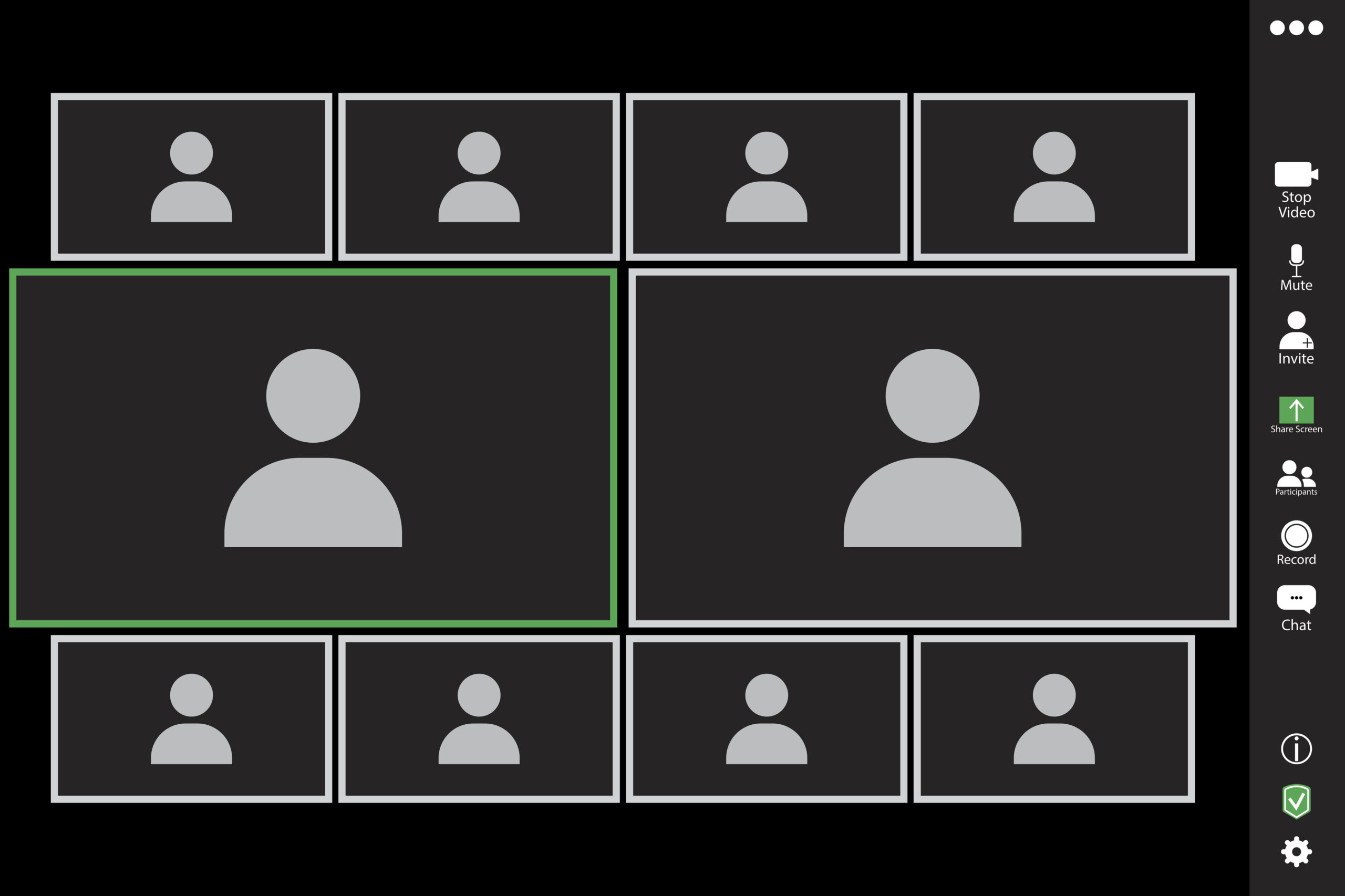
Faculty across various online institutions have noted the striking stillness of teaching to a grid of black boxes—no visible students, no expressions, only disembodied names suspended in silence. Research shows that when students choose to stay invisible, it’s not just the teacher who loses out—the entire class dynamic suffers (Pi et al., 2024). It’s well documented that visual presence in online learning increases engagement and social connection (Chen & Chen, 2015). The reality is that many online students are reluctant to speak up— there’s seemingly more at stake when your comment hangs in a recorded cloud that can be replayed and scrutinized. And without real-time facial feedback or the encouragement gleaned from someone else’s nod of agreement, students are more likely to retreat into passivity. In fact, more than 3 in 10 college students are less apt to participate in online discussions than their in-person peers (Chacon et al., 2023).
As I’ve learned both from teaching and parenting, the online space provides ample room for multitasking. One of my children, currently a college undergrad, “attended” a class recently while sautéing vegetables, chatting with a sibling, and tossing treats to our dog, Lemon. And no, I don’t fault her—she’s a bright, capable student. The responsibility, in this case, rests more with the instructor, who didn’t require cameras to be on and appeared resigned to teaching to what was basically an empty room.
Cameras On: A Case for Presence and Politeness
At the university where I teach online, students are expected to keep their cameras on, not because we’re attention-hungry control freaks, but because we understand how people actually learn. We know that attention is fragile, and focus is fleeting. Connection and concentration are bedrocks of meaningful and effective education (Chen & Chen, 2015).
Having cameras on isn’t just a matter of preference. It’s a matter of politeness. It’s about showing up for others, not just for yourself. Just as you’d make eye contact in a physical classroom (or anywhere, for that matter), nod in response, or lean in when someone shares a vulnerable insight, keeping your camera on says: I see you. I’m here. I’m listening.
For group discussions and breakouts, this becomes even more critical (Santacroce et al., 2025). The group dynamic depends on feedback loops—on tone, facial expression, and gestures (Santacroce et al, 2025). Without cameras, we strip these interactions of emotional nuance. Colleagues share that camera-off students are far less likely to challenge each other, less likely to support each other, and less likely to forge the kind of connections that make grad school so meaningful.
Teaching Professionals, Not Spectators
Let’s not forget—we’re teaching future professionals; in my field, that means guiding the next generation of psychotherapists and psychologists. These aren’t just students aiming to pass exams—they’re future professionals who’ll be supporting people, solving problems, and making decisions in complex, real-world situations. They must become experts at observing, interpreting, and responding thoughtfully to the world around them. For example, if they can’t learn to read a room, interpret subtle cues, or stay attentive during collaborative work, how will they respond effectively in their chosen field?
In fact, attunement— being aware of and responsive to subtle emotional cues—is fundamental to clinical work (Siegel, 1999) for my students and professional success for students in any discipline. Without practicing these skills in the classroom, students may enter the workforce without a full toolkit. It’s like learning to swim by watching videos—helpful in theory, but it doesn’t prepare you for the feel of the water.
Avalon and the Art of Connection
Recently, while playing the board game Avalon with my college-aged kids and their friends, I had a revelation. For those unfamiliar, Avalon is a game of secret identities, deception, and deduction. Players are secretly assigned roles—either loyal members of King Arthur’s court or villainous minions of Mordred. The “good” players must complete missions without being sabotaged, while the “evil” ones seek to stealthily undermine them.
It gets loud. It gets passionate. People argue, analyze, accuse, and defend. It’s part logic puzzle, part psychological combat. As I watched my kids animatedly playing this game, I imagined them trying to do so with their figurative cameras off. No gestures, no expression, no eye contact, no interaction. It would be confusing at best, and completely unenjoyable at worst.
Avalon, like the online classroom dynamics I’ve described, thrives on presence—on people being fully engaged and visible to one another in real time. Success in the game requires attention to subtle shifts in tone and confidence, keen observation of behavior, and collaboration. These skills mirror the very competencies we hope to cultivate in future clinicians.
What the Research Says: Nonverbal Speaks Volumes
The importance of nonverbal communication isn’t just anecdotal—it’s backed by research. In a seminal study, Mehrabian (1971) found that 93% of communication is nonverbal, with 55% attributed to body language and 38% to tone of voice, leaving only 7% to the actual words spoken. While these numbers have been debated, the consensus remains: nonverbal cues are crucial to understanding and connection. And more recent research highlights that body language conveys emotion, regulates interactions, and builds trust (Burgoon et al., 2021). These functions are central in the therapeutic alliance—and they begin in the classroom.
Nice Doesn’t Mean Neglect
Some instructors avoid requiring cameras because they want to be “nice.” They worry about students feeling judged, self-conscious, or overwhelmed. These concerns are real, and there are compassionate ways to address them. But we must not confuse niceness with neglect. There are many ways to support students: flexible deadlines, empathetic check-ins, diverse teaching and evaluation methods. But we can’t support what we can’t see. Connection begins with visibility. Eye contact. A wave. A smile. Greeting your student by name. These simple gestures remind students—and us—that we’re in this together.
Cameras On, Learning Up
The online classroom is not inherently sterile or mellow. It can be alive, dynamic, and even spirited. If we want to train thoughtful clinicians, if we want to foster meaningful dialogue, if we want to stir the pot in all the right ways, then let’s challenge the online black box. Let’s make the virtual space not just a platform for content, but a community, with cameras on and curiosity engaged. Connection doesn’t happen by accident—it’s built, moment by moment, face by face.
Beverly Wertheimer, PsyD, DMin, LCSW, is an adjunct professor of psychology at Pepperdine University, a child and adolescent psychotherapist specializing in cognitive and meaning-centered therapies, and a certified life coach. She was previously a TV news anchor, reporter, and bureau chief at ABC and NBC affiliates, and CNN’s Turner Entertainment.
References
Abargil, M., Schenkolewski, A., & Tishby, O. (2024). Therapists’ emotional responses and their relation to patients’ experience of attunement and responsiveness. Psychotherapy Research, 35(1), 54–66. https://doi.org/10.1080/10503307.2024.2403422
Burgoon, J. K., Wang, X., Chen, X., Pentland, S. J., & Dunbar, N. E. (2021). Nonverbal behaviors “speak” relational messages of dominance, trust, and composure. Frontiers in Psychology, 12, Article 624177. https://doi.org/10.3389/fpsyg.2021.624177
Chacon, M., Levine, R. S., & Bintliff, A. (2023). Student perceptions: How virtual student-led talking circles promote engagement, social connectedness, and academic benefit. Active Learning in Higher Education, 25(3), 569-587. https://doi.org/10.1177/14697874231179238
Chen, H.-R., & Chen, J.-H. (2015). Design of attention-based recommendation learning mechanism in the cloud computing environment. In 2015 IEEE 15th International Conference on Advanced Learning Technologies (ICALT) (pp. 456–457). IEEE. https://doi.org/10.1109/ICALT.2015.91
Halpern J. (2003), What is clinical empathy? J Gen Intern Med.18(8):670-4. https://doi:10.1046/j.1525-1497.2003.21017.x. PMID: 12911651
Mehrabian, A. (1971). Silent messages (1st ed.). Belmont, CA: Wadsworth.
Pi, Z., Zhang, L., Zhao, X., & Li, X. (2024). Peers turning on cameras promotes learning in video conferencing. Computers & Education, 212, 104986. doi:10.1016/j.compedu.2023.104986
Santacroce, L., Appiah, R., Sullivan, MD., Spaniol, J., (2025) Brief social presence improves delayed memory for online lecture content. doi:10.1371/journal.pone.0318149. PMID: 39879187
Siegel, D. J. (1999). The developing mind: Toward a neurobiology of interpersonal experience (1st ed., pp. 69–70). Guilford Press.
Xia, L., Wang, L., & Huang, C. (2024). Implementing a Social Presence-Based Teaching Strategy in Online Lecture Learning. European Journal of Investigation in Health, Psychology and Education, 14(9), 2580-2597. https://doi.org/10.3390/ejihpe14090170
Yoon, P., & Leem, J. (2021). The Influence of Social Presence in Online Classes Using Virtual Conferencing: Relationships between Group Cohesion, Group Efficacy, and Academic Performance. Sustainability, 13(4), 1988. https://doi.org/10.3390/su13041988