Working as a successful team member remains one of the most important skills that employers report that they want when hiring college graduates. This means that when professors create well-executed and high-quality team projects, they can help their students succeed in a challenging job market. However, there are times when professors fail to help students to develop the necessary teamwork skills that our students will need, such as helping them learn how to manage team conflict.
We surveyed college professors a few years ago to better understand the problems they face when running team projects, even learning about why some choose to avoid team projects altogether. Many reported that they struggle because of the issues that students face when working in a team, such as one student taking over the project, figuring out how to grade a team project, motivating social loafers, and including dealing with team conflict.
The reality is that conflict will inevitably occur during team projects. We can help our students work better in teams by teaching them how to manage the conflict that they will face.
Many students think that there is something wrong when conflict occurs on their team. However, conflict can be a positive force for team decision-making when it’s focused on the task, provides new perspectives on the issues, and shows how the team can improve. On the other hand, there are types of conflict that can be destructive, such as when it gets emotional and focuses on people and personal grievances, rather than the work that the team is doing.
In this article, we recommend six easy strategies to help your students try to avoid the destructive emotional conflict and better manage the substantive conflict in their team when it does occur.
1. Focus on Team Goals
It’s important to start your team project by emphasizing the importance of the team project to their work in your class. This requires more than discussing how the project paper or presentation relates to their grade. Instead, help your teams to understand the skills that they will gain from working on the project you’ve assigned. When team members see the value in your team project, they are more likely to work together on it.
2. Create a Team Charter
Start your teams off right by having them create a team charter. This should include at least three components: when and how long they will meet each week, how to contact one another, and a list of behavioral and attitudinal obligations that they have to one another. These obligations may include things like how soon to respond to messages, how responsibilities are assigned, and even how they will resolve disagreements as they work together.
3. Use Frequent Check-ins
Monitoring how well your teams are working together can help you to identify a minor conflict before it becomes a major problem. These check-ins can be accomplished through ongoing peer evaluations, when you attend their team meetings, and/or through team updates they can provide, often as an assignment on your LMS. Once you learn about a potential conflict, you can make some suggestions for how they might move forward. We have often made Google Drive folders for each team with instructor access, and we require students to write their contributions to the instructor each week as one way to keep an eye on potential issues that might derail their projects. We’ve even had these project updates impact a small portion of the final grade of the project.
4. Focus the Team on Their Task
Keep your teams focused on the team task. You can help them to accomplish this by breaking down your project into components and setting intermediary deadlines. Scaffolding a team project this way can help keep your teams moving forward rather than spiraling or stalling. You can also regularly remind them about the main goal of the assignment. Finally, make sure to explain how any conflict that occurs needs to focus on issues with substance (e.g., how to collect data, what recommendations should we give, etc.) because these are important parts of the discussions that will help their team to create a better project. Similarly, remind them that they should not be spending time hurling angry accusations at each other or talking to team members behind others’ backs. We like to use the following quote to help our students with this:
Conflict is inevitable. Anger is a choice. And almost always the wrong choice. — Seth R. Silver
This way, they begin to understand that their conflict is not a problem until it starts to boil over into frustration, anger, and even resentment that derails them.
5. Address Conflict Resolution Strategies in Class
There are many great conflict resolution strategies that you can use to help your students recover when they do in fact face some conflict. One of our favorites is a team-based Start-Stop-Continue exercise. In it, the team discusses what they should start doing (e.g., setting deadlines for completing action items), stop doing (e.g. showing up late to team meetings), and continue doing (e.g. keeping the other team members informed about their work) in order to be successful. Remind students that this is a team discussion, which means that they should use team talk (“we can start setting deadlines”) and it should not include any ‘naming or shaming’ that calls out any one team member by name.
6. Get Involved When Necessary
If you’re following the first five steps, your teams will usually work through most conflicts. But, there are times where you might need to get involved – this should be a last resort and often only when you are asked to intervene. When you get such a request, you should meet with the team outside of class time. Your main role will be listening to their issues and asking open-ended questions. This will help them to find (or maybe even gently guide them towards) a solution on their own, because your students will be more committed to a solution that they help to create. You want to avoid dictating a solution unless the team is ready to self-destruct and it is truly the only way forward.
By incorporating these six strategies into your team project, your students will be more likely to:
Have a better team experience in your class;
Learn important skills that will help them in future teams;
Be more likely to successfully work in teams in other classes; and
Have a compelling story that they can share with potential employers about how well they worked in a team.
In addition, it will improve your own experience with team projects (and make them easier for you to grade, too)!
Tim Franz is Professor of Psychology and Lauren Vicker is Communications Professor Emeritus, both at St. John Fisher University. We started working together to team-teach a course in group dynamics beginning in 2004, coming from the fields of psychology and communications. We have presented, written, and published on teamwork and team projects, with our latest effort being Making Team Projects Work: A College Instructor’s Guide to Successful Student Groupwork, published by Routledge/Taylor & Francis, 2025. Approaching the issue from two different perspectives and teaching beyond our own home disciplines in business, pharmacy, criminology, etc. has given us a broad perspective into the issue.
Are you one of the reported 61% of higher education faculty now using AI in your teaching (Weaver, 2025)? A recent survey by the Digital Education Council (2025) found that 88% of AI-using faculty report minimal to moderate use. Further, 83% of faculty question students’ ability to evaluate AI-generated content, and 82% worry about student overreliance on AI tools.
So, while a majority of faculty are incorporating AI, many of us remain cautious about how to use it effectively in our higher education classrooms. This tension is further echoed in a recent 2025 EDUCAUSE AI Landscape Study, which reports 57% of schools, up from 49% last year, now identify AI as a “strategic priority” as they continue to adapt to the expanding impact of AI across teaching and learning (Robert & McCormack, 2025).
Our institutions want us to use AI in our classrooms, but how can we do this well? Research by Zhou and Peng (2025) found that AI supported instruction can enhance both student engagement and creativity, especially in creating personalized and collaborative learning experiences. Similarly, Walter (2024) found that training educators and students in prompt engineering and critical evaluation is a key component necessary to maximize AI’s potential while reducing risks of misuse and over reliance. To enhance our content, we need to think about how to use AI purposefully, training both ourselves and our students to engage with AI tools critically, creatively, and ethically.
This article examines how faculty can incorporate AI tools effectively into their disciplines, while guiding students to use AI to foster critical thinking and creative application. Drawing on my own research, it offers strategies to support thoughtful integration of AI into higher education classrooms, with a focus on ethical awareness and responsive instruction design.
What I Learned From Using AI in My Teaching
Over the past school year, I used AI as a tool in my undergraduate courses and found that students were not as adept at using AI as I had suspected. In fact, when I introduced AI as a required component of the course framework at the start of the semester, many students were uncertain how to proceed. Some shyly offered that they had used AI in courses previously, but many were hesitant, having been repeatedly warned that using AI could jeopardize their academic careers. Without explicit, scaffolded instruction, both students and faculty risk using AI superficially, missing its potential to meaningfully transform teaching and learning.
When AI Becomes the Assignment
In Spring 2025, I led a research project in my classes exploring how university students used AI tools, such as ChatGPT, to support iterative writing and refining complex tasks like lesson planning. The study emphasized ethical AI use and focused on prompt engineering techniques, including the use of voice-to-text, targeted revision, and staged feedback loops to improve idea generation, structure, and differentiation. I wanted students to engage in a critical evaluation of AI outputs, developing greater precision and agency in applying AI suggestions across drafting stages.
What I found was that students did not initially know how to talk to AI, rather they talked at it. At first, students did not get useful results because they were not tailoring their prompts enough. One student offered “I had to ask the same question 50 billion different ways to get the right answer.” What I discovered over those first few weeks was that students needed to learn to dialogue with AI in the right ways. They had to be intentional in what they were asking it and tailor their prompts specifically.
Try this instead:
Begin broad, then refine. Encourage students to start with a general idea, then narrow their prompts based on assignment goals and relevance of the AI’s output.
Promote iterative prompting. Teach students to revise their prompts by engaging in an ongoing process of dialoguing with AI, aimed at narrowing down their ideas. Author WonLee Hee (2025) offers the following framework: prompt, generate output, analyze, refine prompt, and repeat.
Why Prompting Is Worth Teaching
Students are using AI, but often without the skills to do so effectively—and that is where we come in. Poor prompting reinforces the very over-reliance that faculty fear, training students to accept whatever results AI delivers, rather than critically questioning them. When prompts are vague or generic, the results are too.
Students need specific instruction on how to prompt AI effectively. In my classes I used a structured, multi-step process that students followed each week. However, after reviewing student feedback and surveys, I realized that the process involved too many steps. If I wanted my students to use AI meaningfully beyond my course, I would need to refine and simplify the approach.
Try this instead:
Incorporate guided practice. Use a consistent AI tool at the start of the semester (I used ChatGPT) and model effective prompting and revision to help students build foundational skills.
Gradually increase student choice. After the initial learning phase, allow students to mix and match AI tools to personalize the process and deepen their engagement.
Embed critical reflection. Encourage studentsto treat AI as a thinking partner, not an all-knowing source. Design assignments so that they require ongoing interaction with AI (Gonsalves, 2024), such as using AI to generate counterarguments to their own essays or applying math concepts to real-world problems to identify gaps or misunderstandings in their thinking.
A Simple Framework for Better Prompts
A simple, three-phased framework will be more user friendly.
Explore: Encourage students to begin by collecting and thinking through wide-ranging ideas. Start with speech-to-text to brainstorm. Then narrow the focus, identify gaps, and use AI to help fill them.
Refine: Have students evaluate the AI outputs and add specific details to further improve clarity, accuracy, and relevance.
Revise: Use AI to check if ideas have been clearly communicated. This type of editing involves more than fixing grammar, it is about making sure that their message is clear, focused, and appropriate for the audience.
What Changed for Students
When I incorporated these changes, I saw that my students became more strategic thinkers and were less likely to merely copy from AI. In fact, over 73% of my study participants noted that they stopped accepting AI’s first response and began asking better follow-up questions, indicating that they were dialoguing with AI rather than just copying from it. Repeated practice helped them yield more accurate AI generated support and emphasized their importance in the process. They came to view AI as a support tool not a substitute for their own ideas. At the end of the study, one student noted “You have to be very specific… I have learned how to tweak my prompt to get the result I want.” Another, stated that “I started editing ChatGPT instead of letting it write for me.” These responses indicated a key shift: better prompting had reframed AI as a collaborator, not a crutch.
Final Thoughts
Teaching students how to create effective prompts is not about using technology, it is about teaching them to craft better questions. This practice reinforces critical thinking skills so many of us aim to develop in our disciplines. When students learn how to guide AI, they are also learning how to refine their own thinking. Encouraging reflection throughout the process fosters metacognition; by regularly engaging in this type of analysis of their decisions and ideas, students become more thoughtful, independent learners. By intentionally incorporating AI tools into our coursework, we are reducing the temptation for misuse and overreliance, creating space for more ethical and transparent use in our higher education classrooms.
AI Disclosure: This article reflects collaboration between the human author and OpenAI’s ChatGPT-4 for light editing. All ideas, examples, and interpretations are the author’s own.
Lisa Delgado Brown, PhD, is a current Assistant Professor of Education at The University of Tampa and the former Middle/Secondary Program Administrator at Saint Leo University where she also served on the Academic Standards Committee. Dr. Delgado Brown teaches literacy courses with a focus on differentiation in the general education classroom.
References
Gonsalves, C. (2024). Generative AI’s Impact on Critical Thinking: Revisiting Bloom’s Taxonomy. Journal of Marketing Education, 0(0). https://doi.org/10.1177/02734753241305980
Walter, Y. (2024). Embracing the future of artificial intelligence in the classroom: The relevance of AI literacy, prompt engineering, and critical thinking in modern education. International Journal of Educational Technology in Higher Education, 21, 15. https://doi.org/10.1186/s41239-024-00448-3
Zhou, M., & Peng, S. (2025). The usage of AI in teaching and students’ creativity: The mediating role of learning engagement and the moderating role of AI literacy. Behavioral Sciences, 15(5), 587. https://doi.org/10.3390/bs15050587
A quick reminder that Focus Friday kicks off today (Sept 26) at 12:30-1:30pm Eastern on the Future of Higher Education. I’m being joined by Jackie Pichette from RBC and Sunny Chan from Business + Higher Education Roundtable. If you haven’t registered yet, it isn’t too late. Sign up here.
This is a new initiative from HESA but the session is simple: we’ll start with some questions to our invited guests, then open the floor for a coffee-chat style discussion. Bring your ideas, hang out, and learn something new.
Two weeks ago, we asked for what you want to chat about during Focus Friday and thank you to everyone who already submitted suggestions for future topics! Here’s what you told us you want to hear about most:
AI and Technology: by far the top theme (teaching, learning, admissions, student support, policy, and the future of work).
Internationalization: Canada’s future strategy and global comparisons.
Funding & Finance: enrolment pressures, revenue models, government funding.
Student Experience & Equity: belonging, value perception, well-being.
Politics & Governance: provincial/federal expectations, US political spillovers, policy changes as they happen.
Academic Programming & Curriculum: innovation in credentials, Quality Assurance reform (one of my favourite topics, so thanks for saying it).
Plus: a variety of topics we’ll touch on throughout the year.
Keep sharing your ideas in the Zoom Registration Form or reach out anytime at [email protected].
From here on, the Focus Friday emails will give a summary of the last discussion. Can’t make the session or simply one of our text-loving audience members? We got you.
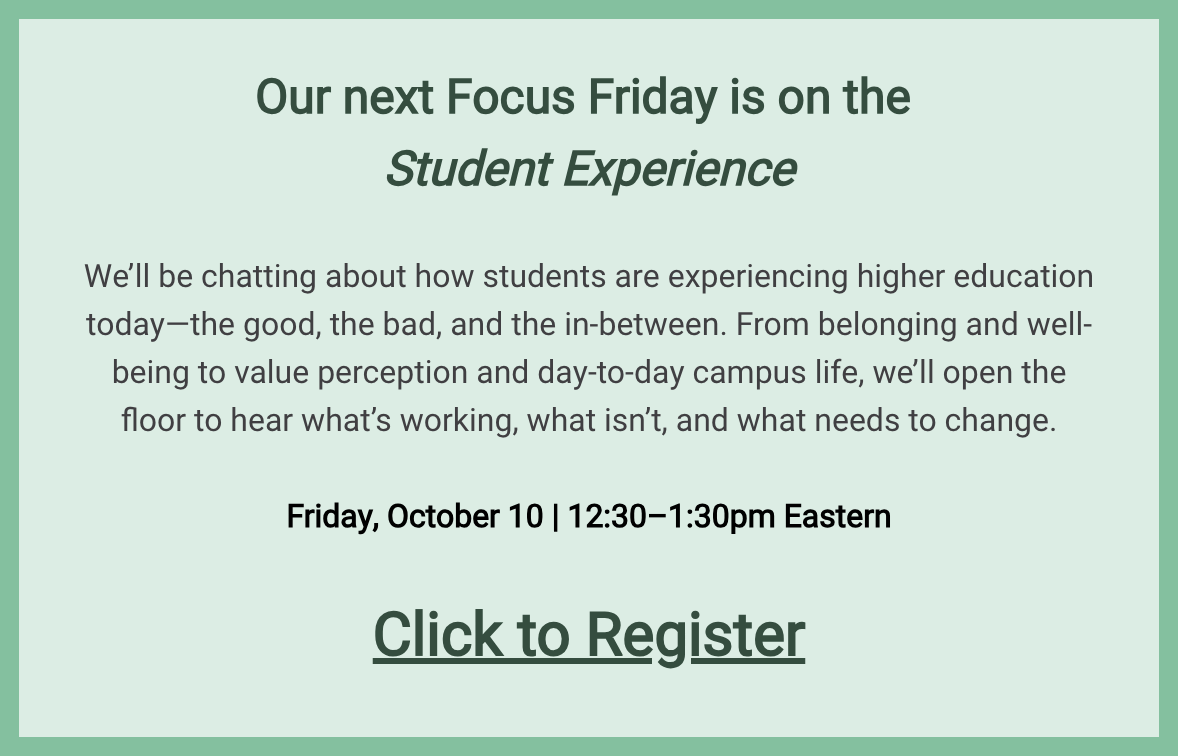
The next Focus Friday will be on October 10th focused onthe student experience and student life. I’ll be bringing you some folks directly from your own campuses to lead our discussion. Register via the big green box below.
Innovating new technologies in the classroom is not everyone’s jam. For some faculty, it can be a slog to keep up with the rapid emergence of new digital tools and their place in teaching. Yet others love discovering new tools that can enhance their teaching experience, support their students’ success, and are perhaps fun to use in the classroom. The tech-enthusiasts, or early-adopters (Rogers, 1962), however, can often feel isolated. There are few opportunities for them to exchange ideas with like-minded peers across campus and/or to engage in deeper professional growth in this area. These sentiments were often expressed by our UMass Amherst faculty.
To respond to these needs, we—the Instructional Design, Engagement, and Support (IDEAS) Team—embarked on creating a space where faculty could showcase their innovative approaches, inspire one another, refine their teaching practices through meaningful dialogue, and share teaching challenges honestly. In Fall 2022, we launched the Instructional Innovation Fellowship (IIF), adopting the Community of Practice (CoP) framework (Wenger, 1998; Wenger et al., 2002) as a guiding strategy. CoP is defined as “groups of people who share a concern, a set of problems, or a passion about a topic, and who deepen their knowledge and expertise in this area by interacting on an ongoing basis” (Wenger et al., 2002, p. 4). CoP’s three core elements— Community, Practice, and Domain—shaped the program’s design and implementation.
After completing the third iteration in the 2024-2025 academic year, and working with 30 instructors, we are excited to share the lessons we learned from designing and implementing the program. While IIF originated as a place to foster innovation in teaching, it also became a place for faculty to find strength through vulnerability—to learn with and from thought partners and supportive peers—and ultimately deepen their sense of belonging and community on campus.
As the name suggests, a Community of Practice should embody Community—a place where social interactions and relationships among members develop (Wenger et al., 2002). The IIF fosters a supportive space for meaningful discussion, knowledge sharing, and collaboration among instructors of record—full-time faculty, adjuncts, and graduate teaching associates—who shape higher education (Alhija & Fresko, 2018). Faculty from all disciplines are encouraged to join, promoting cross-disciplinary connections and breaking down academic silos (Perignat et al., 2023). Such engagement deepens self-awareness in teaching, enhances understanding of diverse student experiences, and builds instructor confidence (Harmon et al., 2024). The IDEAS team—comprising a faculty member, staff, and graduate assistant—plays a key role in organizing and facilitating sessions.
The Practice: How Do We Implement the Program?
The Practice element refers to activities, ideas, or tools that members share and maintain (Wenger et al., 2002). Faculty members and instructors apply to IIF from April to May. After a thorough selection process, 10 fellows are selected. We seek individuals who are eager to engage in a collaborative learning environment and who can commit to a year-long fellowship.
Throughout the year, fellows are expected to:
Present Twice – showcase two different innovative approaches to teaching
Attend Monthly Meetings – participate in eight in-person meetings, each lasting 1.5–2 hours
Collaborate with the IDEAS Team – work closely with our team to refine presentations and align with program expectations.
Share Resources – upload presentation slides and related instructional materials to a collaborative online platform
Contribute to Outreach – allow the IDEAS team to feature their teaching strategies in newsletters and online resources
Each session is designed to foster engagement and peer learning, typically following this format:
Community Building – Time to greet one another and check-in with one another.
Warm-Up Activity – Casual ice-breakers, thought-provoking questions, or interactive games.
Fellow Presentations – Two to three fellows share their innovative teaching practices (15-20 minutes each), followed by group discussions.
Community Building – Time to network and exchange ideas.
During our final meeting, typically held in May, we come together to reflect on the year’s learning journey and celebrate the fellows’ achievements. As a token of appreciation for their dedication and contributions, each fellow receives a $500 stipend.
The Domain: What Do We Talk About in the Program?
The Domain element is about a common interest or skill that brings people together (Wenger et al., 2002). Even though they teach different subjects, they come together to share creative and innovative teaching methods.
We ask faculty to prepare a presentation that addresses:
A teaching problem or challenge they were experiencing
Technologies/technology-mediated pedagogies to address it
Success and challenges they had in their approach
Future modifications to the approach
Over the years, faculty have shared their experiences and tips for using various technology-enhanced pedagogies that include digital storytelling practices, 3D printing, and video-production in the classroom. They also shared some lower-tech tricks that could be implemented immediately, such as using Google forms for absentee notifications or creating a ‘meme war’ to engage students in lively debate. You can read more about the strategies shared on our website.
Each year, the sessions organically became spaces where faculty started saying “here’s what worked, and here’s where I’m still struggling and can use some help.” Participants began openly discussing their challenges and seeking advice from their peers, an act that can be particularly difficult for faculty, who are often expected to be experts in their discipline. For example, some faculty members were challenged by attendance issues, while others bemoaned inappropriate use of Generative AI. Sessions transformed into collective brainstorming on how to use technologies and other strategies to address these challenges and became a safe space for faculty to get teaching advice.
The Outcomes: What is the Impact on Faculty? What Do We Recommend?
From our observations, surveys completed by participants, and faculty’s anecdotal feedback, we have learned that the IIF helped faculty feel less isolated in their teaching journey, realizing that others face similar struggles and moments of self-doubt. This sense of shared experience encourages participants to embrace vulnerability and to be more open and comfortable with the ups and downs of teaching.
The design and format of the presentations—which lends itself to presenting their innovations as ‘works-in-progress’—helps lead to lively discussion and group problem solving. The community acknowledges that, while we may be experts in some areas, there’s always room to grow. We hope this growth mindset is something that they can take back to their classrooms and students.
We also have a few key takeaways and recommendations for implementing a program, such as the IIF:
Selection & Commitment Matter: Although recruiting faculty members can be challenging due to their busy schedules, we found that offering a fellowship-style program helps overcome this obstacle. The selective application process allows for a more intentional and committed group of participants, ensuring that those who join are genuinely interested and able to engage fully. We also recommend that fellows sign a Memorandum of Understanding, outlining expectations
Presentation Drafting & Meeting: Meeting individually with faculty prior to the whole group presentation is beneficial in helping them shape their ideas and experiences into the format
Stipends: In line with the research in this area, even a modest stipend ($500) helps increase the prestige, commitment, and follow-through of participants (O’Meara, 2005; Jessani et al., 2020). Instructors prioritize these meetings, even when there are competing demands on their schedules
Clear Meeting Times & Format: Setting expectations on meetings dates and times, as well as format, during the application process enhances commitment and availability—though it inevitably restricts access for some folks who teach/have other commitments during those hours
Food & Refreshments: Modest refreshments, such as coffee and pastries, supports the creation a positive atmosphere and relaxes people in the space
The IIF program fosters an environment where interdisciplinary perspectives thrive, faculty find a supportive teaching community, and vulnerability is embraced as a path to growth. We are proud to be part of this transformative initiative.
Sharon Kearney, PhD, (Trinity College Dublin) is a member of the University of Massachusetts Amherst faculty, currently serving as a Lecturer in the Department of Teacher Education and Curriculum Studies (TECS) in the College of Education. Additionally, Kearney has held positions as a K–12 educator, supervisor and mentor for teacher-candidates, and educational developer supporting faculty development. Her teaching and research interests span new literacies & literature, multicultural education, community-based learning, and technology-mediated pedagogies.
Nanak Hikmatullah, MSc, is a graduate assistant within the Instructional Design, Engagement, and Support (IDEAS) team at the University of Massachusetts Amherst. He is also a PhD student in the UMass Amherst Teacher Education and Curriculum Studies (TECS) department in the College of Education, and his research focuses on humanizing online education.
Joan Giovannini, MEd, is an Educational Developer with Instructional Design, Engagement, and Support (IDEAS) at the University of Massachusetts Amherst. Prior to joining the UMass team, Giovanni worked as the Associate Director for the Center for Excellence in Teaching, Learning, and Scholarship at Springfield College, and as a Faculty Member and Department Chair of Education at Holyoke Community College.
Brad Wheeler, PhD, is the Director of Faculty Engagement within the Instructional Design, Engagement, and Support (IDEAS) team at the University of Massachusetts Amherst. Previously, Wheeler served as the Associate Director of Faculty Development at Brandeis University and the Assistant Director of Faculty Development at Boston University.
References
Harmon, J., Brown, A., Birbeck, D., Crockett, J., Panadgoo, S., Nawas, A., Stringer, A. & Costabile, M. (2024). Interdisciplinary reflection by higher education academics using teaching squares: A scoping review. Nurse Education Today, 106353. https://doi.org/10.1016/j.nedt.2024.106353
Jessani, N.S., Valmeekanathan, A., Babcock, C.M. et al. (2020). Academic incentives for enhancing faculty engagement with decision-makers—considerations and recommendations from one School of Public Health. Humanit Soc Sci Commun 7, 148. https://doi.org/10.1057/s41599-020-00629-1
Nasser-Abu Alhija, F., & Fresko, B. (2018). Graduate teaching assistants: how well do their students think they do? Assessment & Evaluation in Higher Education, 43(6), 943-954. https://doi.org/10.1080/02602938.2018.1423673
O’Meara, K. A. (2005). Encouraging Multiple Forms of Scholarship in Faculty Reward Systems: Does It Make a Difference? Research in Higher Education, 46(5), 479–510. http://www.jstor.org/stable/40197355
Perignat, E., Fleming, F. F., Nicholas, D., King, D., Katz-Buonincontro, J., & Gondek, P. (2023). Effective practices for high performing interdisciplinary faculty teams. College teaching, 71(1), 18-27. https://doi.org/10.1080/87567555.2022.2086525
Rogers, E. M. (1962). Diffusion of innovations. Free Press of Glencoe.
Wenger, E. (1998). Communities of practice: Learning, meaning, and identity. Cambridge University Press.
Wenger, E., McDermott, R. A., & Snyder, W. (2002). Cultivating communities of practice: A guide to managing knowledge. Harvard Business Press.
Wise, K. (2020). Educational mindfulness: Embracing vulnerability. Transformative Dialogues: Teaching and Learning Journal, 13(1).
If that question immediately makes your heart race, muscles tense, or your face do an unflattering cringe type of expression, you’re not alone. This question used to immediately spike my blood pressure too, until I realized I wasn’t actually frustrated with the question itself or even the student who asked it, but I was frustrated with the culture we have created in education that influences this type of behavior.
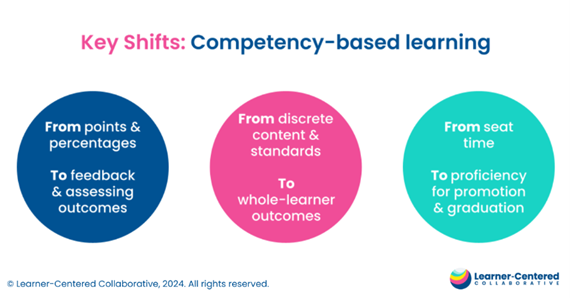
Many students approach their education with a narrow goal: study hard, ace the exam, and get an A in the class. It can feel disappointing when students seem to only care about what will be on the test or how they can bargain to bump up their grades, compared to learning and applying new knowledge to real-world experiences. Traditional grading systems tend to highlight performance above progress and prioritize short-term achievements over long-term growth. This approach not only confines deeper learning but also limits students’ understanding of what success in education truly means. Alternative grading methods that support critical thinking and meaningful reflection, like competency-based grading, can effectively promote student learning and enhance engagement.
Point-Chasing vs. Progress-Making: When Learning Takes the Lead
Traditional grading systems often:
Emphasize point accumulation rather than true comprehension
Include punitive consequences for errors without offering a chance to revisit/improve early coursework
Encourage a focus on “final” grades instead of continuous learning and growth
Traditional grading can also be inconsistent (“Traditional Grading Systems vs. Standards-Based Grading Systems” 2023). A student who only partially understands the content might pass with the application of extra credit or a grading curve, while another student who makes significant progress over time may still fail simply due to early struggles that cannot be counterbalanced. As educators in higher education, we recognize that learning isn’t always linear; so why do our grading practices assume it is?
Meeting Students Where They Are: What is Competency-Based Grading?
Competency-based grading promotes multiple opportunities for students to demonstrate proficiency in specific skills or learning outcomes instead of assigning a single score or high-stakes pass/fail grade to an assignment (Townsley and Schmid 2020). In addition to knowledge, this framework assesses expected student attitudes and skills in a progressive design that holds students accountable. It is important to define clear learning outcomes along with a constructive feedback process to guide future development toward mastery. Naturally, this approach shifts the focus from a final judgment to ongoing growth and improvement. If a student does not meet expectations for a certain skill, they aren’t faced with a permanent loss of points but instead could remediate and try again. (Hanson n.d.)
Putting Mastery into Motion: Strategies to Get Started
Transitioning from a traditional grading system can be a daunting task. Here are six helpful strategies to get started:
Start small. Unless the program is completing a comprehensive curriculum redesign, reworking your entire course all at once is not recommended and would likely overwhelm you and the students alike. Pilot competency-based grading by applying it to a single assignment or unit taught within the course.
Define clear learning outcomes. Identify the specific skills and competencies all students should be able to demonstrate. Ensure outcomes are specific, measurable, and student-centered. For example, “will demonstrate proper hand hygiene using aseptic technique” is preferable to “will understand proper hygiene practices”.
Use outcome-driven rubrics. Competency-based education closely aligns with backward design, so use the determined learning outcomes to build directly correlated rubrics. Focus on mastery, not points. Allow students to access the rubrics in advance. Describe what “competent” looks like by providing specific criteria with behavioral statements for different levels of achievement and provide routine formative feedback on how students can improve if they do not meet expectations. Some of the same assignments can be used, but the method of assessment changes.
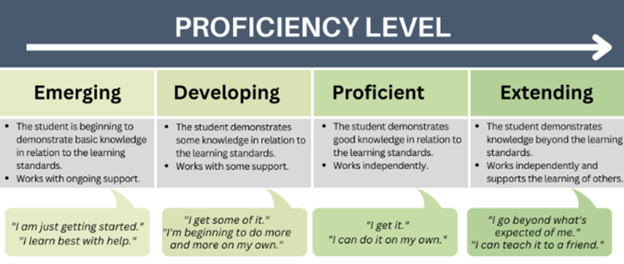
Use a 4-point scale (or similar) to assess student progress. Competency-based grading focuses on students demonstrating mastery of specific learning objectives rather than accumulating points. (“Extending Our View of Extending” 2022)
Plan for remediation activities. Incorporate opportunities for revision/resubmission attempts or re-demonstrations into the course schedule. For feasibility, set limits on the total number of resubmissions/re-demonstrations allowed or set a specific timeframe such as within one week of receiving faculty feedback.
Focus your feedback. Avoid commenting on everything and instead, try to highlight one or two priority areas to guide students toward targeted improvement and maintain a manageable workload. Offer timely individualized support and feedback based on each student’s needs. (Farah 2021; Townsley and Schmid 2020)
Troubleshooting the Transition
Challenges are expected to accompany any change but can usually be mitigated with some thoughtful planning. Although higher education seems to collectively be moving toward competency-based grading, some faculty may experience resistance from their faculty peers and learners. Being transparent by sharing the reason behind the change and how it will benefit students can help increase understanding and engagement from both parties. Providing real-world examples in this area and the powerful impact competency-based education has already had on learning is an influential bonus! Faculty may express valid concerns centered around the increased workload related to time and additional resource demands necessary for success. Since remediation takes time and effort from students and faculty alike, be sure to set clear limits on remediation assignments and the process for completion. Be the example you set for others by utilizing available resources and seeking out professional development opportunities to increase your knowledge. Several online tools, including assessment builders, feedback templates, and progress-tracking programs, can assist faculty in maintaining consistency and efficiency in competency-based grading implementation.
What You Gain When You Grade for Growth
After making the transition and offering a more personalized and reflective learning experience, students focus more attention on what they are learning as opposed to what grade they are getting. Their confidence and willingness to take academic risks increases while anxiety decreases without the fear of irreversible grade penalties taking up real estate in their mind. Instead of asking “How many points did I lose?”, students start asking “How can I improve or make that better?” – which is inspiring! Grading for growth isn’t about lowering academic standards. It’s about redefining meaningful learning and reshaping expectations. Minor changes can lead to major transformation. Take the first step and be prepared to marvel at what happens when students are empowered with the tools and encouragement to grow.
Lisa Pitzer, DNP, MSN, RN, CNE, CNE-cl, serves as an Assistant Professor of Nursing at Saint Francis Medical Center College of Nursing in Peoria, Illinois. In this role, she oversees the Nursing Resource Center Simulation Laboratory and provides instruction in fundamentals and medical-surgical nursing. Dr. Pitzer is a Certified Nurse Educator and Certified Academic Clinical Nurse Educator whose scholarly interests focus on simulation-based pedagogy, curricular innovation, and advancing student success in nursing education. She is an active member of the National League for Nursing, the American Association of Colleges of Nursing, and Sigma Theta Tau International Honor Society of Nursing.
Townsley, Matt and Deron Schmid. “Alternative Grading Practices: An Entry Point for Faculty in Competency-Based Education.” The Journal of Competency-Based Education 5, no. 3 (2020): 1–5. https://doi.org/10.1002/cbe2.1219.
The rapid adoption and development of AI has rocked higher education and thrown into doubt many students’ career plans and as many professors’ lesson plans. The best and only response is for students to develop capabilities that can never be authentically replicated by AI because they are uniquely human. Only humans have flesh and blood bodies. And these bodies are implicated in a wide range of Uniquely Human Capacities (UHCs), such as intuition, ethics, compassion, and storytelling. Students and educators should reallocate time and resources from AI-replaceable technical skills like coding and calculating to developing UHCs and AI skills.
Adoption of AI by employers is increasing while expectations for AI-savvy job candidates are rising. College students are getting nervous. 51% are second guessing their career choice and 39% worry that their job could be replaced by AI, according to Cengage Group’s 2024 Graduate Employability Report. Recently, I heard a student at an on-campus Literacy AI event ask an OpenAI representative if she should drop her efforts to be a web designer. (The representative’s response: spend less time learning the nuts and bolts of coding, and more time learning how to interpret and translate client goals into design plans.)
At the same time, AI capabilities are improving quickly. Recent frontier models have added “deep research” (web search and retrieval) and “reasoning” (multi-step thinking) capabilities. Both produce better, more comprehensive, accurate and thoughtful results, performing broader searches and developing responses step-by-step. Leading models are beginning to offer agentic features, which can do work for us, such as coding, independently. American AI companies are investing hundreds of billions in a race to develop Artificial General Intelligence (AGI). This is a poorly defined state of the technology where AI can perform at least as well as humans in virtually any economically valuable cognitive task. It can act autonomously, learn, plan, and adapt, and interact with the world in a general flexible way, much as humans do. Some experts suggest we may reach this point by 2030, although others have a longer timeline.
Hard skills that may be among the first to be replaced are those that AI can do better, cheaper, and faster. As a general-purpose tool, AI can already perform basic coding, data analysis, administrative, routine bookkeeping and accounting, and illustration tasks that previously required specialized tools and experience. I have my own mind-blowing “vibe-coding” experience, creating custom apps with limited syntactical coding understanding. AIs are capable of quantitative, statistical, and textual analysis that might have required Excel or R in the past. According to Deloitte, AI initiatives are touching virtually every aspect of a companies’ business, affecting IT, operations, marketing the most. AI can create presentations driven by natural language that make manual PowerPoint drafting skills less essential.
Humans’ Future-Proof Strategy
How should students, faculty and staff respond to the breathtaking pace of change and profound uncertainties about the future of labor markets? The OpenAI representative was right: reallocation of time and resources from easily automatable skills to those that only humans with bodies can do. Let us spend less time teaching and learning skills that are likely to be automated soon.
Technical Skills OUT
Uniquely Human Capacities IN
Basic coding
Mindfulness, empathy, and compassion
Data entry and bookkeeping
Ethical judgment, meaning making, and critical thinking
Mastery of single-purpose software (e.g., PowerPoint, Excel, accounting apps)
Authentic and ethical use of generative and other kinds of AI to augment UHCs
Instead, students (and everyone) should focus on developing Uniquely Human Capacities (UHCs). These are abilities that only humans can authentically perform because they need a human body. For example, intuition is our inarticulable and immediate knowledge that we know somatically, in our gut. It is how we empathize, show compassion, evaluate morality, listen and speak, love, appreciate and create beauty, play, collaborate, tell stories, find inspiration and insight, engage our curiosity, and emote. It is how we engage with the deep questions of life and ask the really important questions.
According to Gholdy Muhammad in Unearthing Joy, a reduced emphasis on skills can improve equity by creating space to focus on students’ individual needs. She argues that standards and pedagogies need to also reflect “identity, intellectualism, criticality, and joy.” These four dimensions help “contextualize skills and give students ways to connect them to the real world and their lives.”
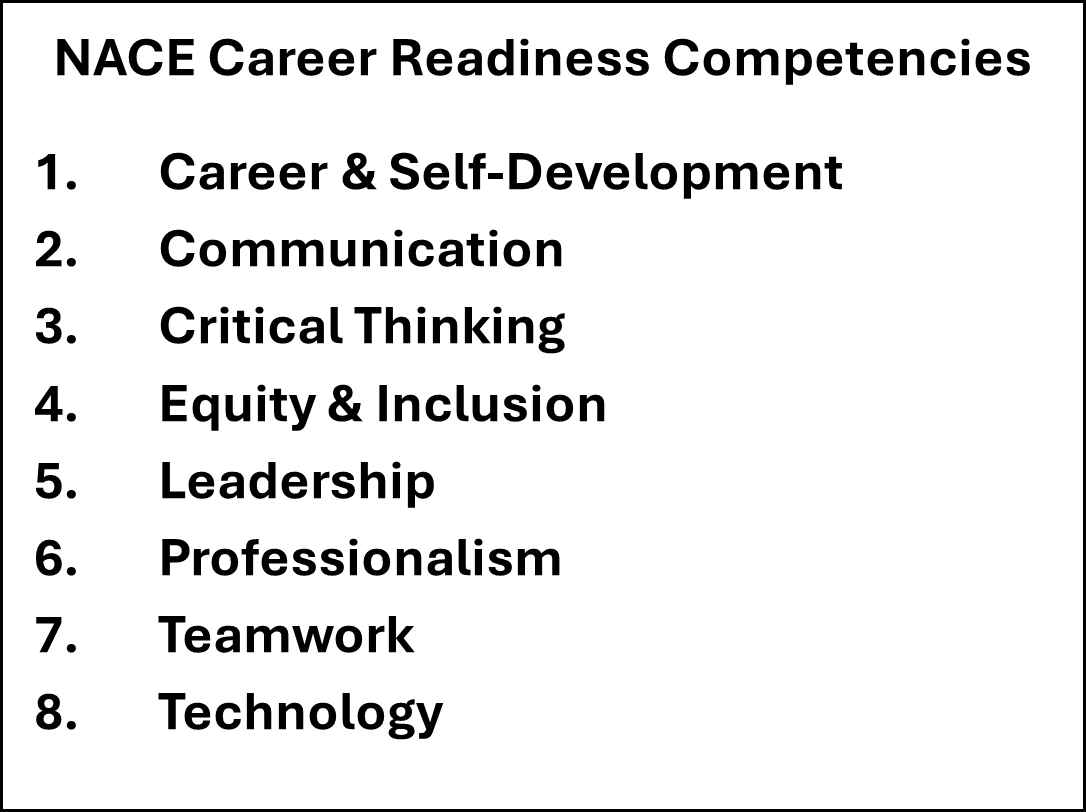
The National Association of Colleges and Employers has created a list of eight career readiness competencies that employers say are necessary for career success. Take a look at the list below and you will see that seven of the eight are UHCs. The eighth, technology, underlines the need for students and their educators to understand and use AI effectively and authentically.
For example, an entry-level finance employee who has developed their UHCs will be able to nimbly respond to changing market conditions, interpret the intentions of managers and clients, and translate these into effective analysis and creative solutions. They will use AI tools to augment their work, adding greater value with less training and oversight.
Widen Humans’ Comparative Advantage
As demonstrated in the example above, our UHCs are humans’ unfair advantage over AI. How do we develop them, ensuring the employability and self-actualization of students and all humans?
The foundation is mindfulness. Mindfulness is about being fully present with ourselves and others, and accepting, primarily via bodily sensations, without judgment and preference. It allows us to accurately perceive reality, including our natural intuitive connection with other humans, a connection AI cannot share. Mindfulness can be developed during and beyond meditation, moments of stillness devoted to mindfulness. Mindfulness practice has been shown to improve self-knowledge, set career goals, and improve creativity.
Mindfulness supports intuitive thinking and metacognition, our ability to think clearly about thinking. Non-conceptual thinking, using our whole bodies, entails developing our intuition and a growth mindset. The latter is about recognizing that we are all works in progress, where learning is the product of careful risk-taking, learning from errors, supported by other humans.
These practices support deep, honest, authentic engagement with other humans of all types. (These are not available over social media.) For students, this is about engaging with each other in class, study groups, clubs, and elsewhere on campus, as well as engaging with faculty in class and office hours. Such engagement with humans can feel unfamiliar and awkward as we emerge from a pandemic. However, these interactions are a critical way to practice and improve our UHCs.
Literature and cinema are ways to engage with and develop empathy and understanding of humans you do not know, may not even be alive or even exist at all. Fiction is maybe the only way to experience in the first person what a stranger is thinking and feeling.
Indeed, every interaction with the world is an opportunity to practice those Uniquely Human Capacities (UHCs):
Use your imagination and creativity to solve a math problem.
Format your spreadsheet or presentation or essay so that it is beautiful.
Get in touch with the feelings that arise when faced with a challenging task.
Many students tell me they are in college to better support and care for family. As you do the work, let yourself experience as an act of love for them.
AI Can Help Us Be Better Humans
AI usage can dull our UHCs or sharpen them. Use AI to challenge us to improve our work, not to provide short cuts that make our work average, boring, or worse. Ethan Mollick (2024) describes the familiar roles AIs can profitably play in our lives. Chief among these is as a patient, always available, if sometimes unreliable tutor. A tutor will give us helpful and critical feedback and hints but never the answers. A tutor will not do our work for us. A tutor will suggest alternative strategies and we can instruct them to nudge us to check on our emotions, physical sensations and moral dimensions of our work. When we prompt AI for help, we should explicitly give it the role of a tutor or editor (as I did with Claude for this article).
How do we assess whether we and our students are developing their UHCs? We can develop personal and work portfolios that tell the stories of connections, insights, and benefits to society we have made. We can get honest testimonials of trusted human partners and engage in critical yet self-compassionate introspection, and journalling. Deliberate practice with feedback in real life and role-playing scenarios can all be valuable. One thing that will not work as well: traditional grades and quantitative measures. After all, humanity cannot be measured.
In a future where AI or AGI assumes the more rote and mechanical aspects of work, we humans are freed to build their UHCs, to become more fully human. An optimistic scenario!
What Could Go Wrong?
The huge, profit-seeking transnational corporations that control AI may soon feel greater pressure to show a return on enormous investment to investors. This could cause costs for users to go up, widening the capabilities gap between those with means and the rest. It could also result in Balkanized AI, where each model is embedded with political, social, and other biases that appeal to different demographics. We see this beginning with Claude, prioritizing safety, and Grok, built to emphasize free expression.
In addition, AI could get good enough at faking empathy, morality, intuition, sense making, and other UHCs. In a competitive, winner-take-all economy with even less government regulation and leakier safety net, companies may aggressively reduce hiring at entry level and of (expensive) high performers. Many of the job functions of the former can be most easily replaced by AI. Mid-level professionals can use AI to perform at a higher level.
Finally, and this is not an exhaustive list: Students and all of us may succumb to the temptation of using AI short cut their work, slowing or reversing development of critical thinking, analytical skills, and subject matter expertise. The tech industry has perfected, over twenty years, the science of making our devices virtually impossible to put down, so that we are “hooked.”
Keeping Humans First
The best way to reduce the risks posed by AI-driven change is to develop our students’ Uniquely Human Capacities while actively engaging policymakers and administrators to ensure a just transition. This enhances the unique value of flesh-and-blood humans in the workforce and society. Educators across disciplines should identify lower value-added activities vulnerable to automation and reorient curricula toward nurturing UHCs. This will foster not only employability but also personal growth, meaningful connection, and equity.
Even in the most challenging scenarios, we are unlikely to regret investing in our humanity. Beyond being well-employed, what could be more rewarding than becoming more fully actualized, compassionate, and connected beings? By developing our intuitions, morality, and bonds with others and the natural world, we open lifelong pathways to growth, fulfillment, and purpose. In doing so, we build lives and communities resilient to change, rich in meaning, and true to what it means to be human.
The article represents my opinions only, not necessarily those of the Borough of Manhattan Community College or CUNY.
Brett Whysel is a lecturer in finance and decision-making at the Borough of Manhattan Community College, CUNY, where he integrates mindfulness, behavioral science, generative AI, and career readiness into his teaching. He has written for Faculty Focus, Forbes, and The Decision Lab. He is also the co-founder of Decision Fish LLC, where he develops tools to support financial wellness and housing counselors. He regularly presents on mindfulness and metacognition in the classroom and is the author of the Effortless Mindfulness Toolkit, an open resource for educators published on CUNY Academic Works. Prior to teaching, he spent nearly 30 years in investment banking. He holds an M.A. in Philosophy from Columbia University and a B.S. in Managerial Economics and French from Carnegie Mellon University.
In the fast-paced, demanding world of college education, joy might not be the first thing that comes to mind when we think about teaching. But bringing joy into the classroom can make a real difference; it boosts student engagement, sparks creativity, and supports academic success. Joyful learning is about building a space where curiosity can thrive, where students feel safe making connections, asking questions, and taking intellectual risks. When instructors intentionally weave joy into their teaching, they help students tap into their own motivation and foster a stronger sense of community and belonging. This article takes a closer look at how joyful pedagogy can turn the college classroom into a vibrant, supportive environment where students truly flourish.
What is Joyful Pedagogy?
Joyful pedagogy is an approach to teaching that fosters enthusiasm, engagement, and a deep sense of connection to learning. It cultivates the emotional and intellectual well-being of students by integrating curiosity, creativity, and meaningful collaboration into the learning process. According to Zull (2011), when students experience joy in learning, their brains are more receptive to new information, leading to deeper understanding and retention. This approach moves beyond traditional lecture-based instruction, incorporating active learning strategies and, yes, even some laughter along the way. Joyful pedagogy recognizes that students are more likely to succeed academically and personally when they feel a sense of ownership over their learning and when the classroom environment is supportive and stimulating.
By incorporating joyful teaching practices, educators create welcoming classrooms that inspire critical thinking and collaboration. Additionally, joyful pedagogy embraces flexibility and adaptability, allowing for various instructional methods that meet students’ individual needs.
The Power of Play
One powerful tool for cultivating joy in learning is play, something often overlooked in higher education. Play isn’t just for children; it’s an essential part of learning at all ages. Forbes and Thomas (2022) highlight that play supports overall well-being and serves as a meaningful pathway to learning, even for adult learners. In the classroom, play sparks joy, which can help reduce stress, boost optimism and resilience, and foster a more positive learning environment (Rylance-Graham, 2024).
Importantly, bringing joy into the learning process doesn’t mean sacrificing academic rigor. High expectations and challenging coursework can be upheld while making room for playful, joyful moments. In fact, play can offer much-needed balance, especially when tackling serious or emotionally heavy content (Forbes, 2021).
Research shows that enjoyment during learning increases blood flow to the brain, enhancing cognitive functioning (Purinton & Burke, 2019). When play and joy are intentionally woven into instruction, students often feel more connected to their professors and peers, relationships that can, in turn, motivate them to meet and exceed academic expectations (Forbes et al., 2022).
Play promotes flexible and creative thinking and increases productivity (Brown, 2009). It naturally draws students in, helping them engage more deeply and look forward to class. Because play is intrinsically motivating, it can shift how students relate to learning itself (Whitton & Moseley, 2019). Simply put, when students experience joy in learning, their engagement and their performance can thrive.
Practical Strategies for Infusing Joy
How can instructors bring joy into their day-to-day teaching? Below are two simple yet effective and easily adaptable strategies I’ve used in my courses.
On the first day of my Introduction to Special Education course, I arrive with a large sheet of poster paper and a collection of colorful paper scraps varied in shape, size, and color. As students enter the room, I invite each of them to choose a scrap of paper, any one they like. Before we begin introductions or any of the “usual” first-day business, I ask them to tape their chosen piece onto the poster, wherever they feel it belongs. Once everyone has placed their scrap of paper, I ask the following questions:
Why did you choose the piece you did?
Why did you place it where you did?
What do you notice about the overall design the group created?
Why do you think I started class this way?
What might this activity represent?
This simple yet engaging activity sparks curiosity and sets the tone for a semester rooted in exploration, connection, and reflection. While I can’t take full credit for the idea, it’s an activity shared by Marilyn P. Rice in the Professors at Play Playbook (2022), I’ve made it my own by adding a meaningful twist. I save the class poster and bring it back on the last day of the semester, hang it on the board, and ask the students if they remember creating it. Then I ask some reflective questions such as
How has your understanding of individual learners evolved since placing your scrap of paper on this poster?
How might this visual metaphor reflect the diversity you’ll encounter in your future classrooms?
What can you do to ensure every student feels like their “scrap of paper” belongs in your classroom?
The responses are always thoughtful, creative, and deeply personal. It’s a powerful way to bookend our learning journey and leave students with a lasting impression of the value of joy, inclusion, and connection in education.
To adapt the end-of-semester reflective questions to be relevant to a broader range of disciplines, the following could be posed:
How have you grown or changed since that first day?
What did you learn from your peers that has stayed with you?
Why do you think we’re revisiting this activity now, at the end of the course?
How might this visual metaphor of “many parts making a whole” guide you in your future classes, work, or life?
Alternatively, students could choose a second paper scrap to place on the poster, symbolizing their “after” self, creating a kind of before-and-after reflection.
Another example of joyful pedagogy involves using visual exploration to spark creativity and deepen understanding. While exploring the question “What is literacy?” I asked students to work in teams of two or three and head outside with their phones. Their task was simple: find and photograph something they believed represented literacy. They had 15 minutes to explore and return to class.
Once they returned, each group uploaded their photo to our online discussion platform. I projected the images for the whole class to see, and each team took a moment to explain why they chose their particular representation. The results were diverse, creative, and often surprising, ranging from street signs and murals to sculptures or even a menu spotted in an unexpected place.
This activity was not only fun and energizing, but it also prompted meaningful discussion about how literacy can take many forms in our everyday lives. It encouraged students to think beyond traditional definitions and consider how literacy shows up in the world around them.
Even better, this type of activity is easy to adapt to nearly any course topic. Whether you’re exploring themes like equity, identity, community, or content-specific concepts, inviting students to find and share visual representations brings movement, creativity, and fresh perspective into the learning experience.
If the aforementioned activities don’t quite fit your style, there are infinite ways to infuse joy into your teaching. For example, send students outside with chalk to solve a problem or equation on the sidewalk. Having students take a photo of their completed work to share with the class adds a collaborative element. Another example is to ask small groups of students to create and perform a short skit or role play to demonstrate a concept. This activity can add some fun along with a deeper layer of learning and engagement.
Bringing in board games or puzzles that connect to your course content is another engaging way to reinforce key concepts and spark curiosity. You can also flip the challenge by asking students to design their own games that relate to what they’re learning.
Even a quick three-minute brain break after 30 minutes of teaching can make a big difference. Ask students to stand up if possible and set aside all devices before the break begins. A brain break might include box breathing, stretching, structured movement, or a brainteaser. There are many resources available for brain break ideas, and they range from seated breathing exercises to dancing and everything in between. These quick pauses support focus and concentration, reduce stress, and contribute to a more positive learning experience (Tapp, 2020). Brain breaks can also help combat mental fatigue and give students a much-needed cognitive recharge.
Scaling Joy for Large Classes
Joy isn’t just for small seminar rooms; it is equally powerful in large lecture halls. In fact, joyful teaching may be even more important when students risk feeling lost in the crowd.
Here are a few scalable strategies:
Create a Class Playlist: Let students contribute songs and play them before class begins to set a positive tone.
Quick Icebreakers or Polls: Start class with a low-stakes question or prompt that encourages interaction.
Digital Scavenger Hunts: Use online tools for creative, content-linked challenges.
Infographic Partner Work: Students create visual summaries of key concepts together.
Pop Culture Connections: Use memes or relevant songs to reinforce course material and spark discussion.
These small touches can build community and make content feel more relevant without a full course redesign.
Key Takeaway
Joyful learning doesn’t have to involve elaborate plans or major changes to your teaching. In fact, it often emerges from small, intentional moments that make the classroom feel more human, more connected, and more alive. You don’t need to overhaul your entire lesson; just try one simple idea that adds a spark of joy to your students’ experience and see where it leads.
These joyful moments can increase engagement, deepen connection, and foster a more positive learning environment. Most importantly, by weaving joy into our teaching, we have the invaluable opportunity to inspire a lifelong love of learning, one that reaches far beyond the walls of the classroom.
AI Disclosure: ChatGPT was used for basic copyediting and general proofreading to check for redundancies and identify grammatical and word usage errors. It was also used to inspire ideas for the title of the article.
Robin Wolpinsky, EdD, is a clinical assistant professor in the Mary Lou Fulton College for Teaching and Learning Innovation at Arizona State University. Her background and expertise are in school psychology, human development, special education, and adult learning. Dr. Wolpinsky is deeply committed to cultivating student success.
References
Brown, S. (2009). Play: How it shapes the brain, opens the imagination, and invigorates the soul. New York: Penguin Group (USA) Inc.
Forbes, L. (2021). The process of play in learning in higher education: A phenomenological study. Journal of Teaching and Learning. 15(1), 57-73.
Forbes, L. & Thomas, D. (2022). Professors at Play Playbook. Pittsburgh, PA: Carnegie Mellon University: ETC Press.
Purinton, E. & Burke, M. (2019). Student engagement and fun: evidence from the field. Business Education Innovation Journal, 11(2), 133-140.
Rice, M. (2022). Human growth and learning: Setting the stage. In Forbes, L. & Thomas, D. Professors at Play Playbook (pp. 92-93). Pittsburgh, PA: Carnegie Mellon University: ETC Press.
Rylance-Graham, R. (2024). The lived experience of play and how it relates to psychological well-being: An interpretive phenomenological analysis (IPA) study amongst undergraduate students from medicine, nursing, and allied health professions’ programmes in the United Kingdom. Nursing Research and Practice. Apr 3;2024:7871499. doi: 10.1155/2024/7871499.
Whitton, N. & Moseley, A. (2019). Play and learning in adulthood. In Whitton, N. & Moseley, A. Playful Learning: Events and Activities to Engage Adults. (pp. 12-24). New York: Routledge.
Zull, J. E. (2011). From brain to mind: Using neuroscience to guide change in education. Stylus Publishing, LLC.
In the fast-paced, demanding world of college education, joy might not be the first thing that comes to mind when we think about teaching. But bringing joy into the classroom can make a real difference; it boosts student engagement, sparks creativity, and supports academic success. Joyful learning is about building a space where curiosity can thrive, where students feel safe making connections, asking questions, and taking intellectual risks. When instructors intentionally weave joy into their teaching, they help students tap into their own motivation and foster a stronger sense of community and belonging. This article takes a closer look at how joyful pedagogy can turn the college classroom into a vibrant, supportive environment where students truly flourish.
What is Joyful Pedagogy?
Joyful pedagogy is an approach to teaching that fosters enthusiasm, engagement, and a deep sense of connection to learning. It cultivates the emotional and intellectual well-being of students by integrating curiosity, creativity, and meaningful collaboration into the learning process. According to Zull (2011), when students experience joy in learning, their brains are more receptive to new information, leading to deeper understanding and retention. This approach moves beyond traditional lecture-based instruction, incorporating active learning strategies and, yes, even some laughter along the way. Joyful pedagogy recognizes that students are more likely to succeed academically and personally when they feel a sense of ownership over their learning and when the classroom environment is supportive and stimulating.
By incorporating joyful teaching practices, educators create welcoming classrooms that inspire critical thinking and collaboration. Additionally, joyful pedagogy embraces flexibility and adaptability, allowing for various instructional methods that meet students’ individual needs.
The Power of Play
One powerful tool for cultivating joy in learning is play, something often overlooked in higher education. Play isn’t just for children; it’s an essential part of learning at all ages. Forbes and Thomas (2022) highlight that play supports overall well-being and serves as a meaningful pathway to learning, even for adult learners. In the classroom, play sparks joy, which can help reduce stress, boost optimism and resilience, and foster a more positive learning environment (Rylance-Graham, 2024).
Importantly, bringing joy into the learning process doesn’t mean sacrificing academic rigor. High expectations and challenging coursework can be upheld while making room for playful, joyful moments. In fact, play can offer much-needed balance, especially when tackling serious or emotionally heavy content (Forbes, 2021).
Research shows that enjoyment during learning increases blood flow to the brain, enhancing cognitive functioning (Purinton & Burke, 2019). When play and joy are intentionally woven into instruction, students often feel more connected to their professors and peers, relationships that can, in turn, motivate them to meet and exceed academic expectations (Forbes et al., 2022).
Play promotes flexible and creative thinking and increases productivity (Brown, 2009). It naturally draws students in, helping them engage more deeply and look forward to class. Because play is intrinsically motivating, it can shift how students relate to learning itself (Whitton & Moseley, 2019). Simply put, when students experience joy in learning, their engagement and their performance can thrive.
Practical Strategies for Infusing Joy
How can instructors bring joy into their day-to-day teaching? Below are two simple yet effective and easily adaptable strategies I’ve used in my courses.
On the first day of my Introduction to Special Education course, I arrive with a large sheet of poster paper and a collection of colorful paper scraps varied in shape, size, and color. As students enter the room, I invite each of them to choose a scrap of paper, any one they like. Before we begin introductions or any of the “usual” first-day business, I ask them to tape their chosen piece onto the poster, wherever they feel it belongs. Once everyone has placed their scrap of paper, I ask the following questions:
Why did you choose the piece you did?
Why did you place it where you did?
What do you notice about the overall design the group created?
Why do you think I started class this way?
What might this activity represent?
This simple yet engaging activity sparks curiosity and sets the tone for a semester rooted in exploration, connection, and reflection. While I can’t take full credit for the idea, it’s an activity shared by Marilyn P. Rice in the Professors at Play Playbook (2022), I’ve made it my own by adding a meaningful twist. I save the class poster and bring it back on the last day of the semester, hang it on the board, and ask the students if they remember creating it. Then I ask some reflective questions such as
How has your understanding of individual learners evolved since placing your scrap of paper on this poster?
How might this visual metaphor reflect the diversity you’ll encounter in your future classrooms?
What can you do to ensure every student feels like their “scrap of paper” belongs in your classroom?
The responses are always thoughtful, creative, and deeply personal. It’s a powerful way to bookend our learning journey and leave students with a lasting impression of the value of joy, inclusion, and connection in education.
To adapt the end-of-semester reflective questions to be relevant to a broader range of disciplines, the following could be posed:
How have you grown or changed since that first day?
What did you learn from your peers that has stayed with you?
Why do you think we’re revisiting this activity now, at the end of the course?
How might this visual metaphor of “many parts making a whole” guide you in your future classes, work, or life?
Alternatively, students could choose a second paper scrap to place on the poster, symbolizing their “after” self, creating a kind of before-and-after reflection.
Another example of joyful pedagogy involves using visual exploration to spark creativity and deepen understanding. While exploring the question “What is literacy?” I asked students to work in teams of two or three and head outside with their phones. Their task was simple: find and photograph something they believed represented literacy. They had 15 minutes to explore and return to class.
Once they returned, each group uploaded their photo to our online discussion platform. I projected the images for the whole class to see, and each team took a moment to explain why they chose their particular representation. The results were diverse, creative, and often surprising, ranging from street signs and murals to sculptures or even a menu spotted in an unexpected place.
This activity was not only fun and energizing, but it also prompted meaningful discussion about how literacy can take many forms in our everyday lives. It encouraged students to think beyond traditional definitions and consider how literacy shows up in the world around them.
Even better, this type of activity is easy to adapt to nearly any course topic. Whether you’re exploring themes like equity, identity, community, or content-specific concepts, inviting students to find and share visual representations brings movement, creativity, and fresh perspective into the learning experience.
If the aforementioned activities don’t quite fit your style, there are infinite ways to infuse joy into your teaching. For example, send students outside with chalk to solve a problem or equation on the sidewalk. Having students take a photo of their completed work to share with the class adds a collaborative element. Another example is to ask small groups of students to create and perform a short skit or role play to demonstrate a concept. This activity can add some fun along with a deeper layer of learning and engagement.
Bringing in board games or puzzles that connect to your course content is another engaging way to reinforce key concepts and spark curiosity. You can also flip the challenge by asking students to design their own games that relate to what they’re learning.
Even a quick three-minute brain break after 30 minutes of teaching can make a big difference. Ask students to stand up if possible and set aside all devices before the break begins. A brain break might include box breathing, stretching, structured movement, or a brainteaser. There are many resources available for brain break ideas, and they range from seated breathing exercises to dancing and everything in between. These quick pauses support focus and concentration, reduce stress, and contribute to a more positive learning experience (Tapp, 2020). Brain breaks can also help combat mental fatigue and give students a much-needed cognitive recharge.
Scaling Joy for Large Classes
Joy isn’t just for small seminar rooms; it is equally powerful in large lecture halls. In fact, joyful teaching may be even more important when students risk feeling lost in the crowd.
Here are a few scalable strategies:
Create a Class Playlist: Let students contribute songs and play them before class begins to set a positive tone.
Quick Icebreakers or Polls: Start class with a low-stakes question or prompt that encourages interaction.
Digital Scavenger Hunts: Use online tools for creative, content-linked challenges.
Infographic Partner Work: Students create visual summaries of key concepts together.
Pop Culture Connections: Use memes or relevant songs to reinforce course material and spark discussion.
These small touches can build community and make content feel more relevant without a full course redesign.
Key Takeaway
Joyful learning doesn’t have to involve elaborate plans or major changes to your teaching. In fact, it often emerges from small, intentional moments that make the classroom feel more human, more connected, and more alive. You don’t need to overhaul your entire lesson; just try one simple idea that adds a spark of joy to your students’ experience and see where it leads.
These joyful moments can increase engagement, deepen connection, and foster a more positive learning environment. Most importantly, by weaving joy into our teaching, we have the invaluable opportunity to inspire a lifelong love of learning, one that reaches far beyond the walls of the classroom.
AI Disclosure: ChatGPT was used for basic copyediting and general proofreading to check for redundancies and identify grammatical and word usage errors. It was also used to inspire ideas for the title of the article.
Robin Wolpinsky, EdD, is a clinical assistant professor in the Mary Lou Fulton College for Teaching and Learning Innovation at Arizona State University. Her background and expertise are in school psychology, human development, special education, and adult learning. Dr. Wolpinsky is deeply committed to cultivating student success.
References
Brown, S. (2009). Play: How it shapes the brain, opens the imagination, and invigorates the soul. New York: Penguin Group (USA) Inc.
Forbes, L. (2021). The process of play in learning in higher education: A phenomenological study. Journal of Teaching and Learning. 15(1), 57-73.
Forbes, L. & Thomas, D. (2022). Professors at Play Playbook. Pittsburgh, PA: Carnegie Mellon University: ETC Press.
Purinton, E. & Burke, M. (2019). Student engagement and fun: evidence from the field. Business Education Innovation Journal, 11(2), 133-140.
Rice, M. (2022). Human growth and learning: Setting the stage. In Forbes, L. & Thomas, D. Professors at Play Playbook (pp. 92-93). Pittsburgh, PA: Carnegie Mellon University: ETC Press.
Rylance-Graham, R. (2024). The lived experience of play and how it relates to psychological well-being: An interpretive phenomenological analysis (IPA) study amongst undergraduate students from medicine, nursing, and allied health professions’ programmes in the United Kingdom. Nursing Research and Practice. Apr 3;2024:7871499. doi: 10.1155/2024/7871499.
Whitton, N. & Moseley, A. (2019). Play and learning in adulthood. In Whitton, N. & Moseley, A. Playful Learning: Events and Activities to Engage Adults. (pp. 12-24). New York: Routledge.
Zull, J. E. (2011). From brain to mind: Using neuroscience to guide change in education. Stylus Publishing, LLC.
Higher education provides students with the opportunity to participate in a diverse range of academic programs that facilitate further exploration beyond the classroom. Participating in a guided research project offers valuable exposure to discipline-specific inquiry. Under the mentorship of a faculty research advisor, students gain critical skills such as project management, research methods, and early professional development. While the roles and responsibilities of the research advisor can vary depending on the type of research (e.g., human subjects, qualitative, quantitative, mixed methods), there are commonalities in how to best support student researchers. These strategies highlight best practices along with other important considerations for research advisors.
Traditionally, a research advisor guides and oversees student-led research by providing pivotal insight and direction throughout the project (National Academy of Sciences, 2009). The advisor plays a vital role in ensuring that the student follows ethical standards and guidelines. Beyond its formal role, research advisors also serve as mentors who motivate, encourage, and support students as they develop intellectually and professionally. They also create a protected and affirming space for students to be vulnerable in instances of uncertainty as the research project progresses. This dual function as both advisor and mentor has a lasting impact on students’ academic success and career trajectories. Through intentional mentorship and guidance, research advisors help students cultivate scholarly excellence, professional competence, and life skills that extend beyond the academic environment into daily activities.
There are several considerations that may cause faculty members to feel apprehensive about serving as research advisors, especially since these responsibilities extend beyond classroom instruction. This includes increased teaching loads, required committee responsibilities, professional development, community service, and administrative duties (Springer et al., 2023). Balancing these institutional demands can be overwhelming. These expanding roles and expectations contribute significantly to faculty fatigue, often leading to demoralization and persistent stress. Additionally, a student’s aptitude, skills, level of independence, and overall capacity for college-level research can also add to the complexity of serving as a research advisor.
Teaching, Learning, and Engagement Strategies
The advisor role aligns with several teaching and educational philosophies. Notably, Behaviorism (stimuli, reinforcement, and environment) and Essentialism (back to the basics) are all useful. These conceptual and philosophical frameworks are demonstrated in each of the posited strategies through the intentional use of engaging activities and techniques. Also instructive is Jean Piaget’s philosophy, which emphasizes a hands-on approach that focuses on active learning and interaction, which leads to the student’s self-exploration and discovery (Uzun, 2024). Promoting engagement that fosters problem-solving and critical thinking is especially important in the student-researcher-advisor relationship. Serving as a research advisor also requires employing an eclectic approach in relation to teaching and educational philosophies. Throughout each of the following strategies, it is imperative that the student’s learning and each engagement opportunity are meaningful, productive, and place the student researcher at the center of the collaboration. Each of these strategies presents teachable moments not only for students but also for the research advisor. The implementation of each plan to support the student, specifically how and why it is addressed.
Assess Students’ Readiness for Research
Conducting a low-stakes, informal assessment of the students’ interests, strengths, and areas of opportunity is a good starting point. Prior involvement with the student, due to their having taken a course with the faculty, may have already allowed for a preliminary assessment of the student’s preparedness for college-level research. In the absence of experience working with the student, one quick assessment method is to explore the student’s understanding of the research project more deeply. Engage in active listening, ask insightful and probing questions, and allow the process to unfold naturally. This encourages the student to demonstrate what they know about producing a noteworthy project. Students have a wide range of learning styles, competencies, and abilities. The goal is not to judge but to assess through an objective lens. This strategy enables faculty to make informed decisions about the commitment level, existing competencies, and overall student needs when undertaking scholarly research (Sharp, 2002).
Model Behavior and Coach for Success
Engaging students outside of the classroom also allows faculty to demonstrate other skill sets. The research advisor should conduct themselves in a manner that shows students ways to interact with various research stakeholders and how soft skills can be applied across different contexts. Much of the advisor’s time is spent monitoring and supporting the student. It is also imperative that the student is empowered and given the space to work independently, which is vital to students’ metacognition (Howlett, 2021). Research can be daunting; therefore, a key part of the coaching process involves implementing activities and providing affirming feedback that keeps the student engaged and interested. This strategy is essential because it supports students in gaining the requisite proficiencies as a researcher and collaborating with others.
Introduce and Teach Project Management Skills
Prioritizing tasks and effective time management are valuable skills that can enhance a student’s academic, professional, and personal life. Monitoring and evaluating overall goals and objectives promote the success of the research project. A practical approach to this strategy is to assign the student small tasks with specific timelines and deliverables, then provide incremental feedback. Scheduling project meetings to identify immediate tasks and priorities helps students understand and appreciate how to manage projects effectively. Clearly defined due dates, which may sometimes be inflexible, must be communicated (Sharp, 2002). Students are empowered when given relevant information, as well as a clear understanding of each phase of the research project. Adopting this strategy is a value-added benefit for students, as it reduces the likelihood of missed deadlines and critical deliverables throughout the project cycle.
Create a Safe Space for New Experiences and Growth
Naturally, some students may feel intimidated or unsure about how the student-faculty research collaboration will proceed. Uncertainty is expected since this is a new role and experience. It is notably different from previous instructor-student interactions that existed in the classroom. While the faculty advisor anticipates various outcomes, the student also has expectations related to faculty expertise and creativity, as well as benefiting from their full support and constructive criticism (Abbas, 2020). The research advisor must ensure that a safe environment is created for the student to feel empowered to share alternative or completely different viewpoints on various aspects of the research project. Maintaining a safe environment also encourages collaboration, student growth, and overall development. Using this strategy creates an environment of trust, teamwork, and mutual respect.
Finally, regardless of the size or type of institution, service and student engagement activities are viewed positively in higher education. Serving as a research advisor gives faculty the chance to showcase what they do outside the classroom. A large part of their time is dedicated to meeting teaching and learning responsibilities, for which they are evaluated on annually. Great effort is also made to ensure that faculty adequately support students with academic challenges. Taking on the role of research advisor also allows high-achieving students to be engaged. Additionally, this role supports and addresses the needs of students with aspirations for graduate studies, those seeking more challenging opportunities, or who have a general interest in scholarly research. Ultimately, it is a win-win situation for both the student and the faculty member who takes on this important role.
Curtis L. Todd, PhD, is Professor of Social Work in the School of Arts and Sciences at Atlanta Metropolitan State College, where he also provides instruction in Criminal Justice. Quintero J. Moore, MD, is Assistant Professor of Biology in the School of Arts and Sciences at Atlanta Metropolitan State College.
References
Abbas, A., Arrona-Palacios, A., Haruna H., and Alvarez-Sosa, D. 2020. Elements of students’ expectation towards teacher-student research collaboration in higher education. Frontiers in Education Conference (FIE): IEEE.
Howlett, M.A., McWilliams, M.A., Rademacher, K. et al. 2021. Investigating the Effects of Academic Coaching on College Students’ Metacognition. Innovative Higher Education: Springer Nature.
National Academy of Sciences, National Academy of Engineering (US) and Institute of Medicine (US) Committee on Science, Engineering, and Public Policy. (2009). On Being a Scientist: A Guide to Responsible Conduct in Research – Advising and Mentoring. 3rd Edition. National Academies Press: National Academy of Sciences.
Sharp, J.A., Peters, J., & Howard, K. (2002). The Management of a Student Research Project. 3rd Edition. Routledge: Taylor & Frances Group.
Springer, A., Oleksa-Marewska, K., Basinska-Zych, A., Werner, I., and Bialowas, S. (2023). Occupational burnout and chronic fatigue in the work of academic teachers-moderating role of selected health behaviours. National Library of Medicine: PLoS One.
Uzun, Aylin. 2024. Education Based on Piaget’s Theory. Research In Educational Sciences-I: IKSAD.
Every new technology brings with it a moment of reckoning and a lot of noise. Higher education has always had its share of both. We’re good at asking questions, kicking the tires, holding things at arm’s length until we’re sure it’s worth leaning in. But AI hasn’t given us that luxury. It arrived fast, and it arrived everywhere. And so here we are: adapting syllabi, revisiting assessments, trying to imagine what teaching looks like when the work of thinking and writing and making can now be shared with a machine.
It’s easy to feel like we’re supposed to become AI experts overnight, or like our value is being called into question. But I don’t think either is true. The real challenge, the real opportunity, is to understand how this new partner might show up in the work we already do. The intellectual work. The teaching work. The deeply human work.
That starts by asking better questions – not just “What can AI do?” but “What kind of thinking does good teaching really require?” If we can name that, we can start to see where AI fits and where it doesn’t.
Jared Spataro, Microsoft’s Corporate Vice President for AI at Work, offered a helpful frame for understanding AI’s potential. He identifies five key cognitive tasks that define knowledge work:perceiving, understanding, reasoning, executing, and creating. I think this framework can be translated to the world of higher ed, and the work that faculty do. Because whether we’re designing curriculum, guiding discussion, mentoring students, or shaping institutional strategy, we’re doing some blend of those five things. And by looking closely at how they show up in our work, we can start to imagine how AI might support, not replace, the best of what we do.
1. Perceiving
Perceiving is about seeing what’s really there – what’s in front of us, and what might be hidden underneath. It’s the first move of any good teacher or designer: noticing. Noticing what students understand and what they don’t. Noticing patterns in discussion boards, in assignment uploads, in the quiet absence of a student who was once engaged. Perception is where reflection begins.
AI can help here by extending human observation. Imagine tools that model thousands of student submissions and flag potential misunderstandings. Or dashboards that surface patterns in feedback across multiple course sections. Or sentiment analysis that gives faculty a pulse on how students are responding to a unit in real time. These aren’t just speculative. Georgia State University’s implementation of predictive analytics has significantly improved student outcomes, especially for underrepresented groups (Dimeo, 2017).
And in my own work, I’ve seen how AI-powered tagging and clustering can help make sense of the digital exhaust students leave behind. During a review of some end of course survey responses, I used a language model to surface common themes in open-ended student responses. What might have taken hours of coding was compressed to minutes, giving me more time to focus on what really matters: how to respond, how to improve, how to connect.
When we talk about perceiving, we’re really talking about attention. AI can expand the reach of our attention—but it’s still up to us to decide where to look, and what to do with what we find.
2. Understanding
Understanding sits at the core of what faculty do. Whether we’re preparing to teach a new course or guiding a student through their first research project or writing up our own research, we’re spending time interpreting. This kind of work takes time and attention, a willingness to sit with uncertainty. And it’s where AI, when used carefully and with intention, can help.
In my own experience, I’ve used generative tools to scan large sets of institutional policy documents to better understand how decisions are communicated, and where inconsistencies emerge. What would have taken a full afternoon of toggling between tabs and highlighting paragraphs became a manageable, interpretable task, one that still needed my judgment, but got me there faster.
When AI can support us in making sense of large volumes of information, summarizing texts, comparing perspectives, identifying patterns, we free ourselves up for the more valuable intellectual work: asking better questions, and spending more time with the answers that matter. It’s about capacity.
Recent studies point to this as a growing area of impact. In a 2023 EDUCAUSE report, researchers note that AI’s ability to “curate and synthesize complex information” has emerged as a top priority for institutions looking to support both faculty productivity and student success (Pelletier et al., 2023). That doesn’t mean outsourcing the work of understanding, but it might mean sharing the load.
As Spataro puts it, these systems can “interpret, analyze, and generate vast amounts of text data,” but it’s up to us to bring interpretation, context, and care (2025). Used well, they don’t replace the act of understanding but they expand the space we have to do it well.
3. Reasoning
Tools that can break a complex task into parts, hold multiple threads in play, and adjust course as they go? That’s thinking and reasoning, and it can be put to work for us. Imagine planning a new course. You’re juggling student needs, institutional requirements, disciplinary content, pedagogical practices, assessment design, and accessibility considerations. AI can now meaningfully assist in that process by helping you reason your way through the options. I’ve used it to test weekly structures, re-sequence modules, generate alternate assessments keyed to different learning outcomes. It’s not always right. But it’s responsive.
This is what Spataro points to when he describes reasoning models’ capacity to navigate multistep challenges. And it’s what others are beginning to explore too. The 2024 Stanford Institute for Human-Centered AI report notes that models like GPT-4 are now outperforming the average human on tasks like LSAT logical reasoning questions, tasks that require inference, not recall (Stanford HAI, 2024). It’s not just that AI can make suggestions. It can anticipate consequences. It can debug your logic. It can help you think.
But it doesn’t replace the thinking. That means we need to stay in the loop. Because just like a teaching assistant who works fast but occasionally misses the nuance, these tools need supervision. The real value is in the collaboration. You bring the goals, the context, the judgment. The system brings the speed, the range, and the willingness to try again.
4. Executing
One of the most immediate shifts many faculty feel with these tools is in execution. Not in some futuristic, sci-fi sense, but in the simplest, most grounded way: things just get done faster. And not just routine things. Writing the first draft of an announcement. Reformatting a rubric. Creating a visual from a block of text. Summarizing student feedback across discussion boards. These are tasks that used to chip away at your time, that required a certain kind of attention and structure you didn’t always have at the end of the day. Now they can happen in seconds. Not perfect, but done. Or at least started, ready for you to refine, revise, and finalize.
In my own work, this means I don’t get stalled as easily. If a meeting runs long and I lose the hour I had planned to draft a guidance doc for a new course design initiative, I don’t start from zero later. I sketch the intent in a few lines, and the system scaffolds a first version. I get to come in as editor, refining and recentering. And yes, sometimes rejecting and starting over.
What’s changed isn’t just speed. It’s how close we can get from idea to action without needing to switch tools, start a new doc, find the right template. Execution becomes lighter. It gets folded into the flow. And for faculty navigating a day that might include grading, advising, committee work, and prepping for class, that lightness matters. But we should be careful here. The goal isn’t to turn every task into a race to the bottom. The speed is a gift only if we use the time it gives us well. Execution, in this new context, isn’t about doing more. It’s about clearing space to do what matters.
5. Creating
Creativity sits at the heart of so much work that faculty do. It’s how we see ourselves, not just as transmitters of knowledge, but as makers. We write, design, shape experiences. We revise courses to better fit the needs of a new cohort, craft discussion prompts that pull students deeper, build assignments that didn’t exist five years ago. Creativity is where our identities as scholars, teachers, and thinkers converge. So it’s no surprise that when people hear about AI “creating,” it sparks something between skepticism and alarm. And I get that.
But here’s where I land: this kind of creativity isn’t competition. These tools don’t originate like we do. They don’t generate ideas out of passion or lived experience. But they can be astonishingly good at offering sparks, those half-formed ideas, raw drafts, unexpected juxtapositions. In my own work, I’ve used them to draft module overviews that I later rewrite completely, but which help me see where I’m being too vague or too dense. I’ve used them to riff on potential assignment prompts, not to choose one blindly, but to scan for a new angle or a better tone. Sometimes, I reject it all. But I always walk away with more clarity about what I think.
That’s the shift: using the tools not to replace our voice, but to sharpen it. Not to outsource our thinking, but to reflect it back in new forms. Of course, this only works if we stay present in the process. If we hold fast to our criticality, our nuance, our sense of context. That’s the work. That’s the art. And as Spataro reminds us, the best ideas don’t care where they came from—they care what we do with them next (2024).
Why This Matters
I was working with a group of faculty from different disciplines demoing a few uses of generative tools in course development. We’d just finished a quick example, generating some low-stakes writing prompts for a discussion board. One person leaned back, arms crossed. “This is fine,” they said. “But the question is: what kind of teacher does this make me?”
It’s a great question. And I think the answer is: it makes you a teacher who’s choosing. Choosing how to spend your time and choosing where your expertise matters most. Choosing when to hand something off to the machine and, most importantly, choosing when to hold on tight because the human parts are the whole point.
That’s why I’ve stayed close to these five cognitive tasks. Because none of this matters unless we connect it to the real work we do. The knowledge work. The pedagogical labor. The thinking, the care, the creative decisions.
These five domains – perceiving, understanding, reasoning, executing, creating – aren’t abstract categories or corporate taxonomies. They’re a mirror of our everyday academic labor. They map how faculty prep a new course, evaluate student performance, write feedback, collaborate with colleagues, design new programs, interpret policy, serve on committees, apply for grants, rethink curriculum. This is what it means to work in higher ed. And these are the places where AI is entering.
So when we talk about adoption or training or integration, we’re not just talking about tools or workflows. We’re talking about how we think. How we value time. How we make meaning. And whether we can build systems, technological and human, that let us spend more of our energy on the parts of this job that matter most.
Dr. Nathan Pritts is Professor and Program Chair for First Year Writing at the University of Arizona Global Campus where he also serves as University Faculty Fellow for AI Strategy. He leads initiatives at the intersection of pedagogy, design, and emerging technologies and has spearheaded efforts in the strategic implementation of online learning tools, faculty training, and scalable interventions that support both educators and students. His work brings a humanistic lens to the integration of AI—balancing innovation with thoughtful pedagogy and student-centered design. As author and researcher, Dr. Pritts has published widely on topics including digital pedagogy, AI-enhanced curriculum design, assessment strategies, and the future of higher education.
Pelletier, K., Robert, J., Muscanell, N., McCormack, M., Reeves, J., Arbino, N., & Grajek, S., with Birdwell, T., Liu, D., Mandernach, J., Moore, A., Porcaro, A., Rutledge, R., & Zimmern, J. (2023). 2023 EDUCAUSE Horizon Report: Teaching and Learning Edition. EDUCAUSE.