Tag: Forgiveness

  • Education Department Rule Restricts Public Service Loan Forgiveness Eligibility

    Education Department Rule Restricts Public Service Loan Forgiveness Eligibility

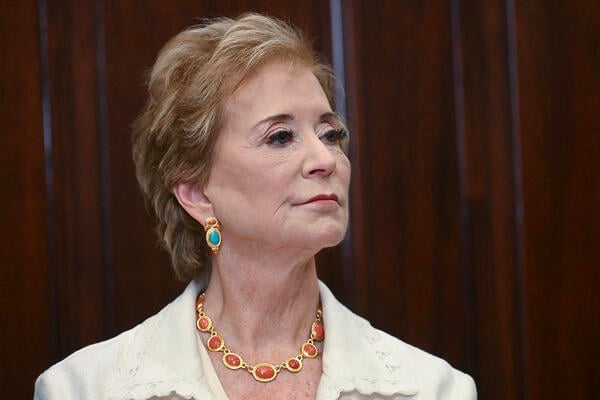
    File photoThe Department of Education announced a new rule that would allow the agency to exclude certain nonprofit and government employers from the Public Service Loan Forgiveness program, targeting organizations that “engage in specific enumerated illegal activities” or do not align with the current administration’s priorities.

    The rule, which was published Friday in the Federal Register, grants Education Secretary Linda McMahon unilateral authority to determine which organizations are ineligible for the program. It takes effect July 1, 2026.

    According to critics, the rule could disqualify employees of sanctuary jurisdictions and nonprofit organizations that provide immigrant family support, gender-affirming care, diversity and equity programs, or assistance to protesters exercising First Amendment rights.

    The Public Service Loan Forgiveness program was established by Congress in 2007 on a bipartisan basis. Under the program, federal, state, local and tribal government employees, as well as workers for 501(c)(3) nonprofit organizations, can have their remaining federal student loan debt forgiven after making 10 years of qualifying payments while working in public service. More than one million workers have received loan forgiveness through the program to date.

    Two advocacy organizations, Democracy Forward and Protect Borrowers, issued a joint statement committing to challenge the rule in federal court.

    “This is a direct and unlawful attack on nurses, teachers, first responders, and public service workers across the country,” the organizations said. “This new rule is a craven attempt to usurp the legislature’s authority in an unconstitutional power grab aimed at punishing people with political views different than the administration’s.”

    Alexander Lundrigan, Higher Education Policy and Advocacy Manager at Young Invincibles, called the changes “illegal” and “politically motivated.”

    “The administration cannot unilaterally rewrite a program that was passed into law by Congress,” Lundrigan said. “PSLF eligibility is defined by law, not political ideology.”

    Jaylon Herbin, director of federal policy at the Center for Responsible Lending, agrees, adding that the regulation “is the latest in a long list of cruel tricks imposed on workers and groups who hold views or serve people this administration doesn’t like.”

    He added that the restrictions “will consign millions of student borrowers to decades of unaffordable debt repayment and will worsen existing shortages of teachers, police and emergency services workers, and nonprofits who help local residents thrive and contribute to building vibrant, economically resilient communities.”


    Source link

  • ED Finalizes PSLF Rule Limiting Who Gets Forgiveness

    ED Finalizes PSLF Rule Limiting Who Gets Forgiveness

    Employees at any company the Trump administration deems as having “a substantial illegal purpose” will no longer qualify for Public Service Loan Forgiveness under a new set of regulations finalized Thursday by the Department of Education.

    The final rule is very similar to the first draft released in August—both of which have been heavily criticized. The policy change, in the works for months, stemmed from an executive order issued in March. Lawsuits challenging the new rule, which takes effect July 1 of next year, are expected as soon as next week.

    “My first reaction when reading the rule was that we will see them in court,” said Brian Galle, a law professor at the University of California, Berkeley, who submitted a comment along with at least a dozen other scholars of tax law.

    Collectively, the commenters called on department officials to conduct an extensive review and study over the rule, none of which were completed. So now, Galle said, the department will face the consequences.

    “I know that firsthand,” he explained. “A rule that I wrote for the Securities and Exchange Commission was sent back by the Fifth Circuit because there was one statistical study that the agency didn’t do.”

    Under the new rule, illegal activities will include: aiding and abetting violations of immigration or civil rights law, supporting terrorism, providing gender-affirming care, or “trafficking” children from one state to another for purposes of emancipation. The education secretary will decide whether an employer violates the rule based on a “preponderance of the evidence.”

    Many Democrats, industry leaders and student borrower advocates who have spoken out against the rule say it is vague and could allow Trump and future presidents to abuse executive power, essentially choosing which organizations qualify based on ideological preferences.

    Rep. Bobby Scott, a Virginia Democrat and ranking member of the House Education and Workforce Committee, told Inside Higher Ed that the rule “opens the door for all kinds of mischief.”

    “If you’re on the Trump side of the partisan political agenda on an issue, you get loan forgiveness. If you’re on the other side of the controversy, you don’t,” he explained. “A group promoting civil rights may be in jeopardy.”

    The National Council of Nonprofits went as far as declaring the new rule “unlawful” and saying it sets “a troubling precedent.”

    “Federal law makes clear that eligibility under PSLF applies to all charitable nonprofit organizations,” the organization wrote. “The Education Department does not have the authority to change eligibility. By unlawfully excluding certain nonprofits, the final rule opens the door to government overreach and abuse.”

    The Trump administration and fellow Republicans, however, say it has nothing to do with partisan politics and instead is focused on terminating unlawful actions that by their “very nature run contrary to the public good.”

    “As the name suggests, Public Service Loan Forgiveness was intended to help meet workforce needs for employers who serve the public good. Unfortunately, the open-ended nature of PSLF has forced taxpayers—many of whom never went to college, to foot the bill for employees at radical organizations that violate state and federal laws,” Rep. Tim Walberg, a Michigan Republican and chair of the Education and Workforce Committee, said in his statement about the rule.

    Education Under Secretary Nicholas Kent also chimed in, saying in a statement that “the Trump Administration is refocusing the PSLF program to ensure federal benefits go to our nation’s teachers, first responders, and civil servants who tirelessly serve their communities.”

    In addition to defining what activities are illegal, the rule outlines types of evidence that the secretary may consider in the decision process, establishes an appeals process and states that the department must provide “prompt notification” to both borrowers and employers when their eligibility is at risk. It also notes that, in general, employers with “minor compliance issues” and “no concerted practice of illegal activity” will be safe.

    The department estimates that fewer than 10 employers will be affected each year. But critics say that estimate is based on little research and worry the effect will be much broader.

    The National Council of Nonprofits said ultimately the rule could harm millions, as countless communities depend on their local nonprofits. By putting the nonprofit workforce at risk, they added, the rule jeopardizes nonprofits’ ability to meet those needs and provide essential services.

    A collection of half a dozen physicians’ groups echoed that point, arguing that if hospitals and the medical professionals they employ lose access to PSLF, it could jeopardize both physicians’ financial stability and patients’ access to care.

    “PSLF is not just a loan program; it is a lifeline that allows medical graduates to choose primary care or psychiatry careers in high-need areas without being weighed down by insurmountable debt,” the group wrote in a news release. “We strongly urge the Department of Education to preserve physicians’ access to the PSLF program and recognize that a healthy America depends on a strong physician workforce.”

    Galle from Berkeley believes that this lack of awareness regarding the scope of impact will become evident in court. He said that such a lack of evaluation, along with what he sees as the department’s executive overreach in issuing the rule, will give any plaintiffs a strong case in court.

    “The Supreme Court in the last eight years has really been at pains to say that Congress doesn’t give agencies … the authority to be way outside their lane,” he said. “And you couldn’t possibly be further outside your lane and your expertise than ED is with this rule.”

    Shortly after the department announced the final rule, multiple legal groups said they intend to sue over it.

    Democracy Forward, which has led a number of lawsuits against the Trump administration this year, and Protect Borrowers, a student loan advocacy group, described the new policy as “a craven attempt to usurp the legislature’s authority in an unconstitutional power grab.”

    Student Defense, a policy, litigation and advocacy organization, accused the president of “playing political football with the financial well-being of people who have dedicated their lives to public service.”

    All three said a lawsuit can be expected in a matter of days.

    “Congress created the Public Service Loan Forgiveness program because it is important for our democracy that we support the people who do the hard work to serve our communities,” Democracy Forward wrote in its release. “In our democracy, the president does not have the authority to overrule Congress.”

    Galle said the key question in the legal fight will be whether the Supreme Court will enforce those checks and balances.

    “Under any judge or justice who was applying the law as it is today, I don’t think this rule would have any hope of being upheld,” he said. “The only room for doubt is that it seems like the Supreme Court is willing to ignore most of what current law is.”

    Source link

  • Loan Forgiveness Becomes Tool for Authoritarianism (opinion)

    Loan Forgiveness Becomes Tool for Authoritarianism (opinion)

    By now, it’s obvious that the Trump administration’s efforts to expand Immigration and Customs Enforcement activities go far beyond enforcing federal immigration policy. The near-daily stories of inhumane detainment conditions, open violence against citizens and noncitizens alike, wanton civil rights violations, and purposeful shielding of these abuses from any form of public accountability lay bare that President Trump is now using ICE as a key component for advancing his administration’s hateful agenda.

    This context is essential to evaluate why the administration has sung such a different tune with the advertised $60,000 student loan forgiveness offers to new ICE recruits, compared to the normal song and dance about how higher education is evil incarnate. Trump and his political allies didn’t suddenly discover the societal benefits of affordable education, as evidenced by his simultaneous efforts to strip loan forgiveness pathways from those who are deemed obstructors to Trump’s political goals. What’s clear is that federal student loan forgiveness is now a poverty draft, coercing increased ICE and military enlistment from among those experiencing economic desperation.

    Weaponizing educational debt to fuel armed forces conscription from lower-income individuals is essentially socioeconomic hostage taking. It deprives people of their agency in choosing whether conscription is truly the career and life pathway they desire by forcing the decision as a survival tactic, especially when nearly half the country is approaching an economic recession deliberately caused by Trump’s policies.

    A History of Weaponizing College Affordability

    The easiest way for an authoritarian regime to maintain a highly militarized state is to make enlistment the only means of socioeconomic survival for the masses. This is exactly why the Trump administration is promoting student loan forgiveness for ICE recruits while curtailing eligibility for Public Service Loan Forgiveness. By passing the reconciliation bill that nearly tripled ICE’s budget while restricting Pell Grant eligibility for some students and cutting back basic needs programs like food stamps and Medicaid, congressional leaders have identified themselves as active participants in this strategy.

    Though Trump’s tactics are an unprecedentedly naked attempt to weaponize student loan relief in the service of authoritarianism, this is a foundational concept in federal higher education policy that he’s taking the opportunity to exploit. The Servicemen’s Readjustment Act of 1944, the first federal educational assistance program for veterans, and most follow-up educational assistance programs were more focused on rewarding military service in already-declared conflicts than using benefits as a recruitment draw.

    That shift came with the larger 1960s push to align higher education with the Cold War. California’s Master Plan of 1960 provided an opening for later attacks on college affordability, because it codified into public policy the idea that some types of institutions were worth attending more than others, mainly by segregating various types of educational experiences offered by different institutions. Later in the decade, then–California governor Ronald Reagan slashed public university budgets, in this way punishing students for antiwar protests. Reagan’s camouflaging of draconian education funding cuts as a necessary tool to combat the “filthy speech movement” became the groundwork for today’s deep inequality across all levels of the educational system.

    Over the next several decades, federal and state policymakers abandoned their responsibilities to fund public higher education, which has strengthened the ties between college (un)affordability and militarization. In 2022, 20 Republican House members—14 of whom are still in office—wrote a joint letter to then-president Biden expressing concern that his efforts to provide widespread student loan forgiveness would harm the ability of the military to use higher educational benefits as a recruitment tool.

    Last fall, 48 percent of 16- to 21-year-olds surveyed by the Department of Defense identified “to pay for future education” as a main reason they would consider joining the armed forces. This was the second-most common reason expressed in the survey, behind only “pay/money.”

    Student Loan Forgiveness Is Not Siloed Public Policy

    Public policy is rarely siloed into neat categories, and we are now experiencing the widespread consequences of allowing an inequitable and unaffordable higher education system to exist for so long in the United States. Trump isn’t the only federal policymaker endorsing this strategy, but he is the primary beneficiary. The more people willing to join ICE’s march toward martial law or forced to join ICE due to socioeconomic necessity, the easier it is for Trump to fully embrace authoritarianism and stay in power past January 2029.

    This is the framing that should be used in every policy conversation about student loan forgiveness moving forward, not just for the offers given to new ICE recruits. These actions are not distinct or separate from the administration’s federalizing of the National Guard, ICE’s vast increase in weapons spending or Trump’s public consideration of invoking the Insurrection Act to deploy more troops to U.S. cities; they’re a vital complement. Ransoming access to an affordable higher education, along with its associated socioeconomic benefits, based on how willing someone is to inflict terror on immigrant communities or any other population that the administration deems undesirable, is a deliberate tactic to build an authoritarian military state.

    Ideally, the current scenario facing higher education will end the usual hemming and hawing from policymakers about universal student loan forgiveness or tuition-free higher education being too expensive. Are the cost savings from not offering widespread forgiveness truly worth militarizing the country against the estimated 51.9 million immigrants living in the U.S., including more than 1.9 million immigrant and undocumented higher education students? Is appeasing Trump’s desire to play dictator dress-up so vital that policymakers feel compelled to willingly eradicate recent progress in national college affordability, discourage or outright bar international students from coming to learn in the United States, and shrink the economies of every state and congressional district due to the loss of international students?

    State Legislatures Are the Last Line of Defense

    The Trump administration is desperate to expand domestic militarization through ICE, as evidenced by advertisements on popular media streaming services and during nationally televised football games, public commitments to keep paying ICE agents as roughly 1.4 million federal workers go without pay during the government shutdown and the elimination or loosening of recruitment and training requirements for new ICE agents in relation to their age, physical fitness and ability to speak Spanish. As the Trump administration through ICE utilizes every available tool to further its authoritarian agenda, policymakers and institutions must use every available tool to combat said authoritarianism.

    State legislatures wield vast amounts of legal authority over education policy in comparison to the federal government. However, that authority is useless if states capitulate or are otherwise unwilling to use that authority to protect their education systems and their larger communities.

    Efforts like Connecticut’s new statewide student debt forgiveness program, California’s prohibition on campus police departments providing personal student information for immigration enforcement purposes and Colorado’s adoption of a new state law requiring public campuses to limit federal agents’ access to campus buildings are all welcome ways that state policymakers can fight back against ICE.

    These efforts must be expanded to more states as ICE continues to ramp up its domestic terrorism and congressional leadership remains content to abandon its constitutional responsibilities to hold the executive branch in check. For institutions, advocates and concerned community members, resources available through the Presidents’ Alliance on Higher Education and Immigration and its Higher Ed Immigration Portal, and from the Immigrant Legal Resource Center, provide essential guidance on how to act in protecting immigrants and their families.

    Student loan forgiveness, and the larger concept of an affordable and equitable higher education, could now be a matter of life and death for millions of people. The traditional willingness of policymakers to resist supporting higher education during times of economic surplus, while eagerly cutting educational funding at the first sign of economic distress, has now imperiled American democracy. Every image of ICE committing authoritarian violence is a stark call for policymakers to ask themselves what they value more: the fiscal savings of making no meaningful effort to address the more than $1.6 trillion owed in student debt, or American democracy itself.

    Christian Collins is a policy analyst with the education, labor and worker justice team at the Center for Law and Social Policy, a nonprofit organization focused on reducing poverty and advancing racial equity.

    Source link

  • Trump Administration Proposes Restricting Public Service Loan Forgiveness for Organizations with ‘Illegal Purpose’

    Trump Administration Proposes Restricting Public Service Loan Forgiveness for Organizations with ‘Illegal Purpose’

    The Trump administration on Friday released a proposed rule that would exclude organizations deemed to have a “substantial illegal purpose” from the Public Service Loan Forgiveness program, a move that could disqualify thousands of borrowers working for advocacy and legal aid organizations from having their student debt canceled.

    The Notice of Proposed Rulemaking, published in the Federal Register and scheduled to take effect July 1, 2026, follows President Trump’s March executive order directing the Department of Education to revise PSLF eligibility criteria. The proposed changes would give the Secretary of Education broad authority to determine which employers qualify for the program that has provided loan forgiveness to more than one million public servants.

    Under the proposed rule, organizations could lose PSLF eligibility for activities including “aiding or abetting violations of Federal immigration laws,” “engaging in a pattern of aiding and abetting illegal discrimination,” or “engaging in violence for the purpose of obstructing or influencing Federal Government policy.” The Department would use a “preponderance of evidence” standard to make determinations, and employers found ineligible would face a 10-year waiting period before they could regain qualifying status.

    The rule specifically targets several types of activities the administration considers problematic, including providing certain medical treatments to transgender minors, assisting with immigration cases, and various forms of protest activity that result in state law violations such as trespassing or disorderly conduct.

    Kristin McGuire, President and CEO of Young Invincibles, characterized the proposal as “continuing its attacks on education, deliberately targeting advocacy organizations whose work doesn’t align with its ideological agenda.”

    “By using a distorted and overly broad definition of ‘illegal activities,’ the Trump administration is exploiting the student loan system to attack political opponents,” McGuire said. “This is an illegal move by the administration; eligibility for Public Service Loan Forgiveness (PSLF) is defined by law, not political ideology.”

    The proposed rule emerged from a contentious negotiated rulemaking process that concluded in July without consensus. According to the Department’s documentation, the negotiator representing civil rights organizations dissented from the draft regulations, preventing the committee from reaching agreement.

    The Department of Education estimates the rule would result in budget savings of $1.537 billion over 10 years by reducing the number of borrowers who achieve loan forgiveness. Administrative documents suggest the changes could affect borrowers in multiple sectors, including legal services, healthcare, social work, and education.

    Organizations operating under shared federal tax identification numbers could see entire agencies lose eligibility if one component is found to engage in disqualifying activities. The rule includes provisions allowing the Secretary to separate organizations under shared identifiers, but grants ultimate authority to the Department to make such determinations.

    The proposed rule draws heavily on the Internal Revenue Service’s “illegality doctrine,” which denies tax-exempt status to organizations with substantial illegal purposes. The Department argues this approach ensures consistency across federal agencies and prevents taxpayer funds from subsidizing activities the government aims to prevent.

    Employers would be required to certify on PSLF application forms that they do not engage in activities with substantial illegal purpose. Those who fail to provide such certification would immediately lose qualifying status.

    The rule includes safeguards requiring notice and opportunity to respond before final determinations, and allows employers to maintain eligibility if they submit approved corrective action plans before losing qualification.

    According to the Department’s regulatory impact analysis, implementation would cost between $1.5 million and $3 million annually during the first two years. The analysis acknowledges that compliance costs for employers would vary significantly, with larger organizations potentially facing higher expenses for legal consultation and operational adjustments.

    The Department projects reduced confusion among borrowers due to clearer eligibility criteria, though it acknowledges potential disruptions during the transition period. The analysis notes that borrowers working for disqualified employers would need to find new positions with qualifying organizations to continue progress toward loan forgiveness.

    The proposed rule will undergo a 30-day public comment period following publication in the Federal Register on August 18. The Department must review all submitted comments before issuing a final rule.

    If implemented as proposed, the new eligibility requirements would apply only to activities occurring on or after July 1, 2026. Borrowers whose employers lose qualifying status would receive notification from the Department and would no longer earn qualifying payment credit while employed by those organizations.

    The Public Service Loan Forgiveness program, established in 2007, allows borrowers to have remaining federal student loan balances canceled after making 120 qualifying monthly payments while working full-time for eligible government agencies or qualified nonprofit organizations. The program has faced criticism and administrative challenges since its inception, with many borrowers initially denied forgiveness due to complex eligibility requirements.

    Young Invincibles and other advocacy organizations indicated they plan to submit detailed comments opposing the rule and may pursue legal challenges if the final version proceeds as proposed.

    Source link

  • BIG CHANGES to SNAP, Medicaid, Social Security & Student Loan Forgiveness – What You NEED to Know! (Low-Income Relief)

    BIG CHANGES to SNAP, Medicaid, Social Security & Student Loan Forgiveness – What You NEED to Know! (Low-Income Relief)

    If you’re worried about losing your benefits, you’re not alone. With new budget resolutions and lawsuits targeting SNAP, Medicaid, and student loan forgiveness, millions of Americans could be impacted.


    Source link

  • Public Service Loan Forgiveness: Help Employees Achieve Their Financial Goals

    Public Service Loan Forgiveness: Help Employees Achieve Their Financial Goals

    by Julie Burrell | September 17, 2024

    The Public Service Loan Forgiveness (PSLF) program can offer significant financial relief to higher ed employees, but many don’t know they qualify for this benefit. PSLF is open to most full-time higher ed employees of nonprofit colleges and universities who have direct federal student loans.

    HR can spread the word to current employees and use loan forgiveness as part of a retention and recruitment strategy. The average amount of individual loan forgiveness under the PSLF is $70,000, which makes the PSLF an especially attractive benefit to potential employees.

    Here’s what you need to know about who qualifies for PSLF, how to offer a free webinar on PSLF to your employees, and what steps you can take to ensure eligible employees enroll.

    What is PSLF?

    Public Service Loan Forgiveness forgives the balance of direct federal student loans after 120 qualifying payments made by the borrower if they work for a qualifying employer (after October 1, 2007) and are under a qualifying repayment plan. It’s intended to reward and incentivize public service, like teaching, nonprofit work and work in the public sector. PSLF eligibility isn’t about what job an employee does or what their job description is; it’s about where they work.

    Who qualifies for PSLF?

    Full-time employees of a nonprofit organization or a federal, state, tribal, or local government are eligible. Full-time work is defined as 30 hours or more per week. That means most full-time higher ed employees are eligible for PSLF, including those who may work part time at your institution but are also employed at other qualifying jobs (as is the case with many adjuncts). But the PSLF only applies to direct federal student loans. Borrowers with other federal student loans may be able to consolidate them into a direct federal student loan.

    How do I ensure my institution counts as an eligible employer?

    Use the PSLF Help Tool, which will search the federal employer database. The help tool is also useful to recommend to employees since it’s a step-by-step guide through the enrollment process.

    Six Tips for Getting the Word Out

    1. Partner with Public Service Promise, a nonprofit, nonpartisan organization that offers free webinars led by experts.
    2. Encourage HR staff to apply for PSLF. With firsthand experience, you and your team will be able to speak knowledgeably about the process.
    3. Publicize PSLF as a benefit to your employees, especially those who may not know they can take advantage of this program, including adjuncts and non-exempt and part-time employees.
    4. Include information about PSLF on your benefits websites or portal.
    5. Consider appointing a knowledgeable point person on campus, like a financial aid officer, to help answer employee questions.
    6. Involve non-exempt, adjunct and part-time employees in outreach campaigns. Employees can meet the 30 hours per week requirement with more than one job. So if they have multiple jobs at multiple qualifying employers, employees can add those hours up. And the PSLF instructions include how to calculate hours worked by adjunct faculty. Payments do not need to be consecutive, so even adjuncts without summer appointments can still take advantage of PSLF and start to chip away at the 120 payments.


    Source link