Tag: Form

  • 2025 DataOnDemand Order Form – CUPA-HR

    2025 DataOnDemand Order Form – CUPA-HR

    This form is for ordering 2025 DataOnDemand (DOD) subscriptions ONLY. 2025 DOD subscriptions feature data collected in fall of 2024.

    • Access Expiration: Access to 2025 DataOnDemand subscriptions will expire at 12:01 a.m. ET on February 9, 2026.
    • User Access: Once payment is received in full, your institution’s chief HR officer (CHRO) or Primary CUPA-HR Contact will be able to assign access to authorized subscription users at your institution. See Manage DOD Access for details.

    To pre-order 2026 DOD subscriptions — accessible February 12, 2026–February 8, 2027 — use our standard ordering system. 2026 DOD subscriptions feature data collected this fall.

    Participation discounts on DOD subscriptions apply to the specific surveys (and survey years) in which your institution participated.


    Source link

  • One Platform, Endless Possibilities: Meet ScaleFunder Giving Form

    One Platform, Endless Possibilities: Meet ScaleFunder Giving Form

    Did you know that beyond powering multi-million dollar Giving Days and dynamic crowdfunding initiatives, ScaleFunder also offers functionality for creating simple and easy to use giving forms?

    This versatility is why ScaleFunder Giving Forms are rapidly gaining momentum! If your institution is already a ScaleFunder Crowdfunding partner, you automatically have unlimited access to create as many Giving Forms as you need. Continue reading to explore how consolidating all your giving initiatives to the ScaleFunder platform can strengthen cross-campus collaboration, simplify the donor experience, and offer operational flexibility.

    Stay friends with your gift processing team

    Keep your gift processing team smiling, because fewer platforms mean fewer headaches. With every gift flowing through the same trusted payment processor (of your choice), your payment mapping fields stay consistent across all ScaleFunder Giving Day and crowdfunding campaigns. Plus, digital wallet options activated through your payment integration let donors give how they prefer without throwing your processing pals a curveball. In addition, you can now easily add opt-in questions for university-wide texts and emails, making it easier than ever to gather big-picture data while keeping your systems (and friendships) running smoothly.

    Build consistency with donors

    Familiarity builds confidence, and ScaleFunder keeps things beautifully consistent. Whether a donor is supporting your Giving Day, a crowdfunding project, or a giving form, the experience looks and feels consistent once they land on the donation form. After a few gifts, they’ll be pros at checkout…breezing through the form with ease. That comfort can translate to higher completion rates, faster transactions, and more donors exploring other opportunities on your platform.

    Plus, once they’ve landed on one Giving Form, connecting them to others is a snap. Link to additional forms—like athletics, annual fund, or individual colleges and schools—just like our partners at Michigan Tech do, making it effortless for donors to discover new ways to give.

    Pictured: The Michigan Technological University annual fund giving page.

    Enjoy the flexibility you know and love

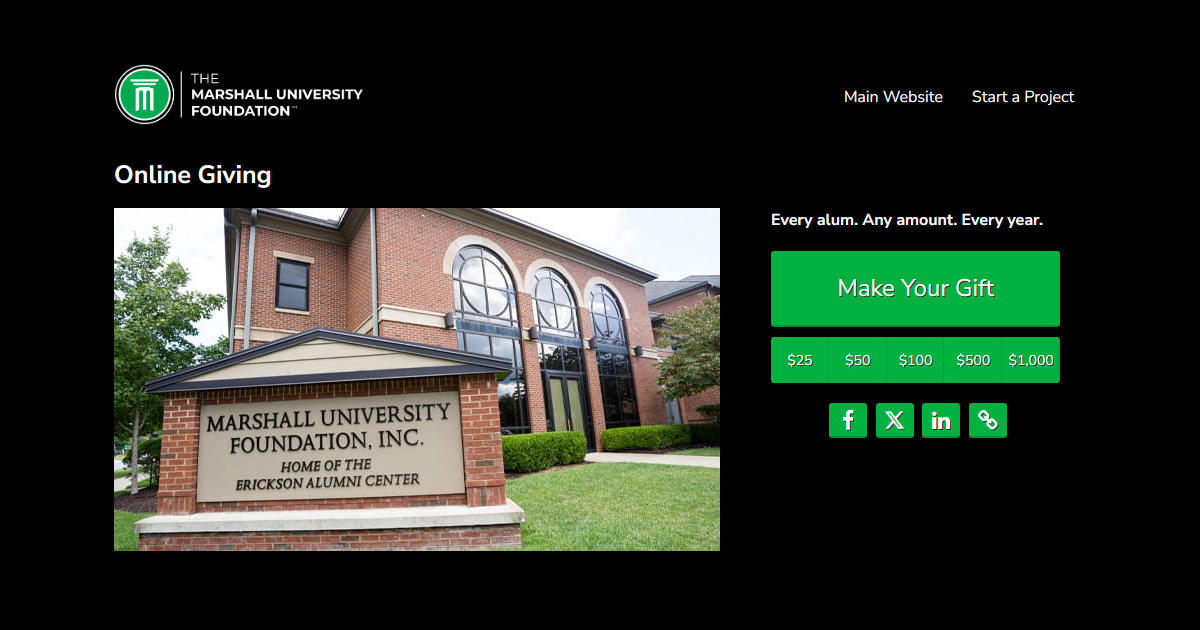
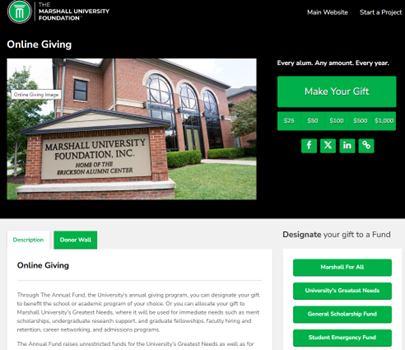
    Marshall University Foundation

    Creating a universal giving form has never been easier—you can do it in under five minutes! Need a simple form for one fund? Done. Want to showcase all 3,000 of your institution’s funds on a single page? Easy. The athletic director dreaming of a QR code in the banquet program that links to every athletic fund? Consider it handled.

    You can add unlimited custom questions to make your form as fun—or as functional—as you like. Ask for T-shirt sizes, invite donors to share their stories, or let them vote for their favorite residence hall. The options are limitless, and the setup is a breeze.

    Pictured: Our partners at Marshall University have identified nearly 20 priority funds on their Giving Form, which appear in two ways: visually appealing buttons on the project page and a searchable, scrollable list on the Giving Form.

    Maintain your identity

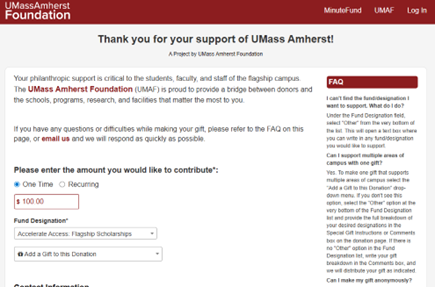
    UMass Amherst Foundation

    Your brand is uniquely yours and it should shine through every click, color, and contribution. When you join the ScaleFunder family, our team crafts a custom site design and background that aligns with your institution’s brand standards, colors, and tone. Every page carries that same cohesive look and feel, so donors always know they’re in your world.

    From your logo and language to your custom domain, everything says “you,” while Google reCAPTCHA quietly works behind the scenes to reassure them that every gift is safe and secure. This consistency of branding also means it’s easy to link to your Giving Forms from external pages, just like our partners at UMass Amherst have done from their main foundation website.

    Pictured: The UMass Amherst Foundation giving page.

    Ready to learn more?

    Whether you’re exploring digital fundraising platforms or already part of the ScaleFunder family, we’d love to help you get the most out of your tools. Connect with Courtney Pourciaux, senior consultant, to learn how Giving Forms and ScaleFunder can elevate your fundraising strategy. Reach out and we can schedule a demo as well as discuss how to make your giving experience easy and consistent for your donors.

    Talk with our digital giving experts

    RNL works with institutions on digital giving and donor engagement, including crowdfunding, giving days, and omnichannel fundraising. Set up a time to talk with our fundraising experts to find your optimal strategies.

    Request Consultation

    Source link

  • Education Department officially launches 2026-27 FAFSA form

    Education Department officially launches 2026-27 FAFSA form

    This audio is auto-generated. Please let us know if you have feedback.

    Dive Brief: 

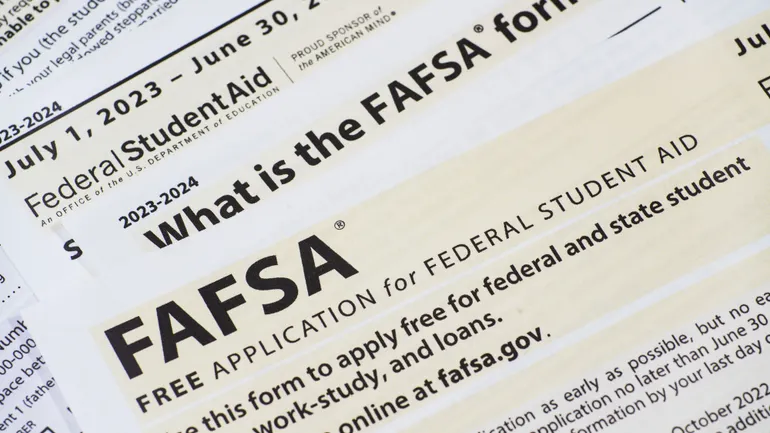
    • The U.S. Department of Education rolled out the 2026-27 Free Application for Federal Student Aid to all students Wednesday, about a week before the congressionally mandated deadline.  

    • Education Department officials billed the release as the “earliest launch in the program’s history.” The new form comes with several updates, including a redesigned process for inviting parents or other contributors to add information to the application and faster account verification for students and parents, according to the agency. 

    • The on-time FAFSA follows later than usual releases the past two years. In 2023, the Education Department didn’t roll out the FAFSA until the final days of December — nearly three months after students and their families usually can access the form. 

    Dive Insight: 

    Education Department officials praised the on-time release after two rocky financial aid cycles. 

    “No one would have thought this was possible after the Biden-Harris administration infamously botched FAFSA’s rollout two short years ago,” U.S. Education Secretary Linda McMahon said in a Wednesday statement. 

    In 2023, the Biden administration was responsible for carrying out the first major redesign of the FAFSA in over four decades, including by paring down the number of questions applicants must answer. However, even after the Education Department released the FAFSA in December that year, many students and families struggled to complete the form due to glitches and other technical issues. 

    Moreover, the Education Department didn’t begin sending FAFSA applicant data to colleges that financial aid cycle until March 2024, even though that information is typically available shortly after the form rolls out in October. Scores of colleges pushed back their traditional May 1 decision deadline as a result. 

    In response, congressional lawmakers passed a law in November 2024 mandating that the Education Department release the form by Oct. 1 each year. The statute also requires the U.S. education secretary to testify before Congress if the agency anticipates it will miss the deadline. 

    This year, the Education Department began beta testing the form in early August. During that period, students started nearly 44,000 FAFSA forms and submitted roughly 27,000 of them, according to the department. The agency has processed almost 24,000 FAFSA forms without rejection. 

    However, this financial aid cycle hasn’t come without criticism. A report earlier this month from the U.S. Government Accountability Office, a federal watchdog agency, raised questions about whether the Education Department was adequately overseeing contracted work on the new back-end system launched in 2023 for processing FAFSAs

    In September 2024, the Education Department told GAO officials that several functions required by a contract with a third-party vendor were not yet available, including the ability to make corrections to FAFSA applications and modify eligibility rules. At the time, the department said those functions would be available by 2026. 

    However, as of May 2025, the Education Department couldn’t provide an update on the system and said it was no longer tracking the contractual requirements, according to the GAO report. GAO recommended that Federal Student Aid’s chief operating officer take steps to improve contract monitoring. 

    The GAO’s report included a response from Aaron Lemon-Strauss, executive director of the FAFSA program, who pushed back on GAO’s framing. Lemon-Strauss wrote that some of its recommendations embrace a model that “assumes initial contracts can fully anticipate a system’s evolving needs.”

    Lemon-Strauss, who joined the department last year, said the agency has made changes to its FAFSA vendor contracts that allow it to adapt to user needs. For instance, after the 2024 FAFSA release, department officials identified that the FAFSA system still did not allow users to import their answers from the prior year to start their new forms — a contractually required feature. 

    “This is undoubtedly a helpful feature and one that should be included in the FAFSA,” Lemon-Strauss said to GAO. “Yet, rather than mechanically moving to implementing renewal capability, the team examined user data to determine where their next efforts would be maximally useful.”

    Internal data showed that some 5% of users were exiting the form and not returning once they needed to invite their parents or other contributors — such as a spouse or a parent’s spouse — to work on the application. In response, the Education Department decided to prioritize redesigning the process to invite outside contributors instead of focusing on the contractually required feature, Lemon-Strauss said.

    Source link

  • Job Description Form

    Job Description Form

    Job Descriptions

    Job Description Form

    If you have descriptions you are willing to share, please use this form to submit them for consideration. Thank you for helping us build this valuable resource.

    The post Job Description Form appeared first on CUPA-HR.

    Source link

  • Career Growth Series Cancellation Form

    Career Growth Series Cancellation Form

    Career Growth Series

    2025 Career Growth Series Cancellations

    Use this form to cancel your registration for one of more of the Career Growth Series virtual workshops.

    The post Career Growth Series Cancellation Form appeared first on CUPA-HR.

    Source link

  • USCIS Updates Form I-9 Language

    USCIS Updates Form I-9 Language

    by CUPA-HR | April 8, 2025

    On April 2, the U.S. Citizenship and Immigration Services (USCIS) announced minor changes to the Form I-9 to align with statutory language. The changes update language in the document that was included in previous editions of the Form I-9 released under the Biden administration.

    The new Form I-9 changes the language in Section 1, checkbox 4 from “A noncitizen authorized to work” to “an alien authorized to work” (italicized for emphasis). Additionally, USCIS announced that E-Verify and E-Verify+ have updated the Citizenship Status selection during case creation. Specifically, the selection “a noncitizen authorized to work” is updated to “an alien authorized to work.” In previous editions of the Form I-9 and in the E-Verify case creation process, the Biden administration’s USCIS changed the language from “alien” to “noncitizen” in this checkbox to align with an internal memo issued by the administration in April 2021 aiming to change the language used by agencies when talking about immigrants.

    The new Form I-9 from the Trump administration also updates the descriptions of the documents accepted under List B to say “sex” instead of “gender.” This change aligns with another April 2 announcement from USCIS about updates to its Policy Manual to clarify that the agency will only recognize two biological sexes, male and female, consistent with the Trump administration’s executive order, “Defending Women From Gender Ideology Extremism and Restoring Biological Truth to the Federal Government.” In the USCIS announcement on sex, the agency states that it would not deny benefits “solely because the benefit requestor did not properly indicate his or her sex” but that the agency would not issue documents with a blank sex field or with a sex different from the sex assigned at birth.

    The new Form I-9 from the Trump administration, known as the January 20, 2025, edition, is valid through May 31, 2027. Previous editions of the Form I-9 that include language from the Biden administration are still valid as well, including two editions from August 1, 2023, that have expiration dates on July 31, 2026, and May 31, 2027. Employers may continue to use the previous Form I-9 editions through their expiration dates; however, employers using the August 1, 2023, edition with the July 2026 expiration date in an electronic system are required to update their system with the Form I-9 expiring in May 2027 by July 31, 2026.

    CUPA-HR will continue to monitor for updates related to the Form I-9 and E-Verify.


    Source link

  • DHS Announces Final Rule Permitting Alternative Options for Form I-9 Document Examination – CUPA-HR

    DHS Announces Final Rule Permitting Alternative Options for Form I-9 Document Examination – CUPA-HR

    by CUPA-HR | July 24, 2023

    On July 21, the Department of Homeland Security (DHS) announced a final rule permitting the Secretary of Homeland Security to authorize optional alternative examination practices for employers when reviewing an individual’s identity and employment authorization documents required by the Form I-9, Employment Eligibility Verification. The rule creates a framework under which DHS may implement permanent flexibilities under specified conditions, start pilot procedures with respect to the examination of documents, or react to crises similar to the COVID-19 pandemic.

    Simultaneously, DHS published a notice in the Federal Register authorizing an alternative document examination procedure. This provides employers who are participants in good standing in E-Verify with the option to remotely examine their employees’ identity and employment authorization documents via a live video interaction.

    Background

    Under current law, employers are required to physically examine an individual’s identity and employment authorization documents within three business days after an individual’s first day of employment. In response to the COVID-19 pandemic, DHS introduced temporary flexibilities in March 2020, enabling employers to remotely review these documents. This virtual inspection was to be succeeded by a physical examination within three business days once normal operations resumed. These flexibilities, extended multiple times, are set to expire on July 31, 2023.

    Due to the success of temporary changes to document verification procedures implemented at the onset of the COVID-19 pandemic, DHS issued a Request for Public Input (RPI) on October 26, 2021, concerning remote document examination. This move initiated a discussion on whether these leniencies should be extended permanently. After examining the comments responding to the RPI, DHS proposed a framework on August 18, 2022, empowering the Secretary to extend these flexibilities. CUPA-HR submitted comments in response to the RPI (see here) and proposal (see here) encouraging DHS to move forward expediently and ensure that a remote review process remains available following the end of the COVID-19 Flexibilities.

    Details of the Alternative Procedure

    From August 1, 2023, eligible employers can start using the alternative procedure as outlined in the Federal Register notice. The conditions include: (1) restricting participation to E-Verify participants in good standing; (2) broadening document retention requirements to include clear and legible copies of all Form I-9 documents; (3) requiring E-Verify training on fraud awareness and antidiscrimination; and (4) holding a live video interaction after the employee transmits a copy of the document(s) to the employer.

    Employers participating in E-Verify, who created a case for employees whose documents were examined during the COVID-19 flexibility period (March 20, 2020 to July 31, 2023), can opt for the new alternative procedure from August 1, 2023 to satisfy the required physical examination of the employee’s documents for that Form I-9. Conversely, employers not enrolled in E-Verify during the flexibility period must complete a physical examination in-person by August 30, 2023 as outlined in the Agency’s May 4 announcement.

    What’s Next

    Looking ahead, DHS continues to expand its efforts to streamline employment verification procedures. As part of this endeavor, the department is gearing up to roll out a pilot program offering a remote examination option not just to E-Verify-enrolled employers but also to a broader category of businesses. This pilot program is expected to inform decisions about a comprehensive expansion of the remote examination option.

    Simultaneously, DHS is preparing to issue a new edition of Form I-9. Dated August 1, 2023, the new form will become the standard for all employers starting November 1, 2023. Until then, employers can still use the previous edition dated October 21, 2019, through October 31, 2023. It’s important to note, however, that if an employer chooses to utilize the 2019 edition in conjunction with the new alternative remote inspection procedure, they must mark “alternative procedure” in the Additional Information field in Section 2 of Form I-9.

    According to DHS, more details about the new Form I-9 and the pilot program will be disclosed in the near future. CUPA-HR will continue to monitor these developments and keep members apprised as they are announced.


    Source link

  • ICE Gives Employers Until August 30 for In-Person Form I-9 Verification After COVID Flexibilities Expire – CUPA-HR

    ICE Gives Employers Until August 30 for In-Person Form I-9 Verification After COVID Flexibilities Expire – CUPA-HR

    by CUPA-HR | May 10, 2023

    On May 4, 2023, U.S. Immigration and Customs Enforcement (ICE) announced it will provide employers with 30 days to reach compliance with Form I-9 requirements after the COVID-19 flexibilities sunset on July 31, 2023. Employers will now have until August 30, 2023, to complete all required physical inspections of identity and employment-eligibility documents. This extension aims to ease the transition for employers who have been using the temporary flexibilities throughout the pandemic.

    Background 

    In March 2020, ICE introduced the temporary flexibilities in response to the COVID-19 pandemic, allowing employers to review employees’ identity and employment authorization documents remotely, rather than in person. This virtual inspection was to be followed by a physical examination within three business days after normal operations resumed. The flexibilities were extended several times, with the most recent extension set to expire on July 31, 2023.

    During the pandemic, employers with employees taking physical-proximity precautions were allowed to temporarily defer physical examination of employees’ identity and employment authorization documents. Remote examination methods, such as video link, fax or email, were permitted, with “COVID-19” entered as the reason for the physical-examination delay in the Section 2 Additional Information field on the Form I-9. Once the employees’ documents were physically examined, employers would add “documents physically examined” with the date of examination to Section 2 or Section 3 of the Form I-9, as appropriate.

    The recent announcement clarifies that employers have until August 30, 2023, to perform all required physical examinations of identity and employment-eligibility documents for individuals hired on or after March 20, 2020, who have received only a virtual or remote examination under the flexibilities.

    What’s Next 

    On August 18, 2022, ICE issued a proposed rule to allow alternative procedures for examining identity and employment-eligibility documents. CUPA-HR submitted comments to ICE encouraging it to move forward expediently and ensure that a remote review process remains available for all employers. The public comment period closed on October 17, 2022, and DHS is currently reviewing the comments. While the Fall 2022 Regulatory Agenda had forecast a final rule to be issued in May 2023, ICE’s announcement indicates a final rule will be issued later this year.


    Source link

  • DHS Proposes Rule Permitting Alternative Options for Form I-9 Document Examination – CUPA-HR

    DHS Proposes Rule Permitting Alternative Options for Form I-9 Document Examination – CUPA-HR

    by CUPA-HR | August 23, 2022

    On August 18, the Department of Homeland Security (DHS) published in the Federal Register its anticipated Notice of Proposed Rulemaking (NPRM) on optional alternative examination practices for employers when reviewing an individual’s identity and employment authorization documents required by the Form I-9, Employment Eligibility Verification. Interested stakeholders can submit comments on the NPRM through October 17.

    Under current law, employers are required to physically examine an individual’s identity and employment authorization documents within three business days after an individual’s first day of employment. The proposed rulemaking, however, would create a framework under which the Secretary of Homeland Security could allow alternative options for verifying those documents, such as reviewing the documents via video, fax or email.

    As explained in the NPRM, the proposal does not directly allow employers or agents acting on the employer’s behalf to use such alternative examination options, but instead would create a framework under which the Secretary would be authorized to extend the flexibilities. The Secretary would be authorized to implement the alternative options in a pilot program if they determine such procedures would offer an equivalent level of security, as a temporary measure to address a public health emergency declared by the Secretary of Health and Human Services, or a national emergency declared by the President.

    The DHS is issuing this rulemaking following the success of temporary changes to document verification procedures implemented at the onset of the COVID-19 pandemic. In March 2020, the DHS’s Immigration and Customs Enforcement deferred its physical examination requirements for Form I-9 and relaxed its enforcement. Employers were allowed to review documents through video, fax or email so long as they also retained copies of the documents. The policy proved successful and was extended several times, but is currently set to expire October 31, 2022. It may still be extended as the agency pursues this rulemaking.

    In December 2021, CUPA-HR submitted comments to the DHS in response to the agency’s Request for Public Input on remote document examination. In its comments, CUPA-HR reported the results of the survey it conducted of member institutions’ experiences with the agency’s Form I-9 flexibilities. CUPA-HR members reported positive experiences with the changes and said they did not run into challenges with implementation. Respondents strongly supported a permanent option for remote document examination and said the policy provides numerous benefits for higher education institutions, including providing more flexibility for remote work, reducing the time needed to complete document verification and reducing institutions’ paperwork burden. Respondents also criticized physical document examination as overly burdensome.

    CUPA-HR plans to submit comments on the NPRM and will likely ask members for their input in the coming weeks.


    Source link

  • DHS Issues Request for Public Comment on Form I-9 Employment Verification – CUPA-HR

    DHS Issues Request for Public Comment on Form I-9 Employment Verification – CUPA-HR

    by CUPA-HR | October 27, 2021

    On October 26, 2021, the Department of Homeland Security (DHS) issued a Request for Public Input (RPI) “seeking comments from employers, employer organizations, employee groups, and other members of the public on document examination practices for Form I-9, Employment Eligibility Verification.” 

    The RPI is the agency’s next step in determining whether the remote document examination flexibilities that have been in place since the beginning of the COVID-19 pandemic should be continued on a permanent basis. Comments are due on or before December 27, 2021.

    Background

    On March 20, 2020, DHS announced employer flexibility guidance to defer the physical presence requirements associated with Form I-9 for 60 days. The guidance allows for remote inspection of Form I-9 documents in situations where employees work exclusively in a remote setting due to COVID-19-related precautions. For employees who physically report to work at a company location on any regular, consistent or predictable basis, employers are required to use standard I-9 procedures.

    The guidance has been extended continuously throughout the pandemic. Issued on August 31, the latest extension to the flexibility guidance was granted through December 31, 2021, following advocacy efforts from CUPA-HR and other stakeholders who expressed a dire need for DHS to maintain the flexibility in light of surging cases of the delta variant.

    Request for Public Input

    The RPI includes a list of questions grouped into two categories: “Experiences with Pandemic-Related Document Examination Flexibilities” and “Considerations for Future Remote Document Examination Procedures.” As DHS considers winding down the flexibility guidance, the RPI will provide the department with important feedback from employers who have conducted remote inspection and “inform and improve DHS policies and processes” regarding “alternative options to physical document examination that offer an equivalent or higher level of security for identity and employment eligibility verification purposes” moving forward.

    The flexibility guidance has been instrumental to institutions of higher education during the pandemic. As such, CUPA-HR intends to engage our members and submit robust comments in response to the RPI. ​Look for more details and your chance to contribute your feedback in the coming weeks.


    Source link