
Tag: Fort

  • Blending Culture and Safety at Fort Lewis

    Blending Culture and Safety at Fort Lewis

    After the death of a student at Fort Lewis College, Kendra Gallegos knew the institution’s response had to do more than make space for grief—it also had to honor the cultural traditions of the college’s largely Native student body.

    Fort Lewis, a public four-year college in Durango, Colo., invited an Indigenous healer to lead a traditional blessing of the residence hall where the student had lived.

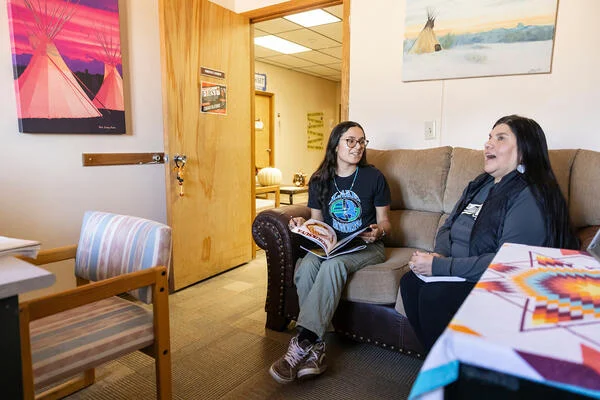
    That kind of healing ceremony reflects how campus leaders like Gallegos, the interim vice president of diversity affairs, approach student wellness programs: by grounding efforts in cultural practices that resonate with students.

    “We’re always asking students what they need and recognizing that there are many different tribes, each with its own traditions and ways of responding when someone passes away,” Gallegos said.

    With about 40 percent of its students identifying as Native, Fort Lewis offers a wide range of support services—from counseling rooted in Indigenous cultural identity to vending machines that provide anonymous access to Narcan, fentanyl test strips and emergency contraception—giving students multiple ways to seek help and protect themselves.

    “We’re looking at a lot of different approaches and building partnerships across the state,” Gallegos said. “We want to look beyond our campus and ask, ‘How can we best serve our students’ needs and help them get access to care?’”

    On the ground: Fort Lewis students have access to free, unlimited mental health and counseling services through the campus counseling center, including individual and group therapy, crisis support, and drop-in consultations.

    But Gallegos said counseling alone is not “one-size-fits-all.” Students can also tap into Indigenous ways of knowing and healing, including through connections to traditional healers.

    “We have a diverse group of students coming from all walks of life,” Gallegos said. “We get them connected with counselors who may be Indigenous, who may be from their tribe.”

    Gallegos said traditional counseling is not always the most appropriate way to meet students’ needs.

    “Maybe they need to go home and have a ceremony with their families, with their communities,” she said. “Or maybe they need a medicine man, or it’s herbal, like sage that we’re burning here in the campus community.”

    Beyond clinical and cultural support, Fort Lewis’s peer support office offers confidential, peer-led assistance and help navigating campus resources. 

    “We’re trying to be more specialized, knowing that [peer supporters] aren’t counselors and don’t have advanced degrees,” Gallegos said. “They’re not doing counseling—they’re saying, ‘I have some knowledge in this area or lived experience, and I’m willing to talk with you.’”

    Students rely on peer support for guidance on substance use, Indigenous identity, sexuality and gender, and student-athlete challenges, among other topics, she added.

    In 2024, the college also launched a harm-reduction vending machine that provides free, anonymous access to health and wellness supplies such as Narcan, fentanyl test strips, emergency contraception, menstrual products and condoms.

    So far, the vending machine has dispensed more than 2,600 items—including more than 100 boxes of Narcan and nearly 700 fentanyl test strips, Gallegos said—underscoring student engagement as well as need.

    Gallegos said the goal of the vending machine is to keep students in school by removing barriers to getting help.

    “We don’t actually get to know who they are or what their stories are,” she said. “But we know it’s making a difference.”

    Most recently, Fort Lewis began piloting a substance-free housing option for students in recovery or those who choose to live sober. The plan is to create an eight-resident living community designed to provide a supportive environment for students focused on sobriety.

    The college has hired two recent Fort Lewis graduates to help lead the initiative.

    “They’ll be part-time and really grow the community and the purpose in the sober living community and nurture those who are there,” Gallegos said.

    Signs of progress: For Gallegos, supporting students starts with making clear that conversations about substance use and mental health are welcome at Fort Lewis.

    “We don’t want there to be a wrong door for support,” she said. “We’ve seen that students are ready to talk to us about these things—they’re less willing to brush them under the rug until the last minute.”

    That openness doesn’t mean abandoning boundaries, Gallegos added.

    “We still follow our conduct code and policies,” she said. “But we’ve learned there can be a warmer handoff and an opportunity for growth and education.”

    Ultimately, Gallegos said, she’s proud to have helped build what she calls a “community of care” on campus.

    “Please don’t shut the door on a student who’s struggling,” she said. “Help them get the resources they need.”

    Get more content like this directly to your inbox. Subscribe here.

    Source link

  • FIRE demands Fort Worth police return artwork confiscated from museum

    FIRE demands Fort Worth police return artwork confiscated from museum

    FORT WORTH, Feb. 19, 2025 — A trio of civil liberty organizations are speaking up today to demand the Fort Worth Police Department end its unconstitutional censorship and seizure of several pieces of art that were on display at the Modern Art Museum of Fort Worth.

    The Foundation for Individual Rights and Expression, National Coalition Against Censorship, and the American Civil Liberties Union of Texas are joining forces to demand the return of several pieces of art by Sally Mann, a renowned photographer with accolades from the National Endowment for the Arts, the National Endowment for the Humanities, and the Guggenheim Foundation.

    In November 2024, the Modern Art Museum of Fort Worth began hosting an exhibition called “Diaries from Home,” featuring works that “explore the multilayered concepts of family, community, and home.” Included in the collection were some of the photos from Mann’s 1990 collection “Immediate Family.” Mann’s collection featured an intimate and candid look at her family’s rural life. As she describes it, “I photographed their triumphs, confusion, harmony and isolation, as well as the hardships that tend to befall children — bruises, vomit, bloody noses, wet beds — all of it.”

    Of the 65 photos in Mann’s “Immediate Family,” 13 depicted her children in the nude. The selection of nude photos displayed in the Modern reportedly included depictions of Mann’s daughter jumping onto a picnic table in a ballet pose, Mann’s daughter lying in bed with a stain from a nighttime accident, and Mann’s son with a melted popsicle running down his body.

    “Anyone who’s ever taken a photo of their child or grandchild taking a bath understands that not all photographs of child nudity are malicious, let alone child abuse,” said FIRE Director of Public Advocacy Aaron Terr. “The seizure of Mann’s works is an egregious abuse of power that dishonestly conflates artistic expression with sexual exploitation.”

    The works are not the product of child abuse, and they are neither intended nor designed to excite lust in the viewer. They do what much art does — convey ideas and invite viewers to reflect on the human experience.

    Nor do the works meet the legal definition of “obscenity,” an extremely narrow definition that does not apply to all depictions of child nudity. This should be common sense to anyone familiar with the iconic “Napalm Girl” photograph, National Geographic documentaries, or even major Hollywood films like the 1978 version of “Superman.”

    “Immediate Family” was controversial even at its debut decades ago, but has been showcased in more than a dozen art galleries across the world, including the National Gallery of Art. But its inclusion in the Fort Worth exhibition reignited the debate when local press and politicians denounced the photos as “child pornography.” Fort Worth police seized the artwork last month ostensibly as part of an investigation into “child abuse,” even though all of Mann’s children, as adults, continued to support the collection and their mother and have never once suggested they were abused.

    “Publicity stunts like this one — in which artworks that have been shown and discussed for over 30 years are suddenly the focus of an unfounded ‘investigation’ — do nothing to protect victims of child abuse, and serve only to chill the creative expressions of artists and cultural institutions by subjecting them to the threat of political prosecution and the unconstitutional seizure of artwork,” said Elizabeth Larison, Director of NCAC’s Arts and Culture Advocacy Program.

    “It’s shameful that government officials would use the criminal legal process to censor art and expression,” said Adriana Piñon, legal director of the ACLU of Texas. “This is a clear violation of the First Amendment and of the guardrails against abuse of the criminal justice system. Artistic expression should not be subject to the whim and punishment of government officials’ personal taste.”


    The Foundation for Individual Rights and Expression (FIRE) is a nonpartisan, nonprofit organization dedicated to defending and sustaining the individual rights of all Americans to free speech and free thought — the most essential qualities of liberty. FIRE educates Americans about the importance of these inalienable rights, promotes a culture of respect for these rights, and provides the means to preserve them.

    The ACLU of Texas is a nonpartisan nonprofit organization that works with communities, at the State Capitol, and in the courts to protect and advance civil rights and civil liberties for every Texan, no exceptions.

    Since its inception in 1974, the National Coalition Against Censorship (NCAC) has functioned as a first responder in protecting freedom of expression, a fundamental human right and a keystone of democracy. Representing 60 national education, publishing, and arts organizations, NCAC encourages and facilitates dialogue between diverse voices, perspectives, and audiences.

    CONTACT:

    Alex Griswold, Communications Campaign Manager, FIRE: 215-717-3473; [email protected]

    Kristi Gross, Press Strategist, ACLU of Texas, [email protected]

    Alex Finan, Communications Lead, NCAC, [email protected]

    Source link