Tag: Forum

  • Free Speech Forum empowers next generation of First Amendment heroes

    Free Speech Forum empowers next generation of First Amendment heroes

    By FIRE Summer Interns Eli Kronenberg, Suhani Mathur, and Matt Rigby.


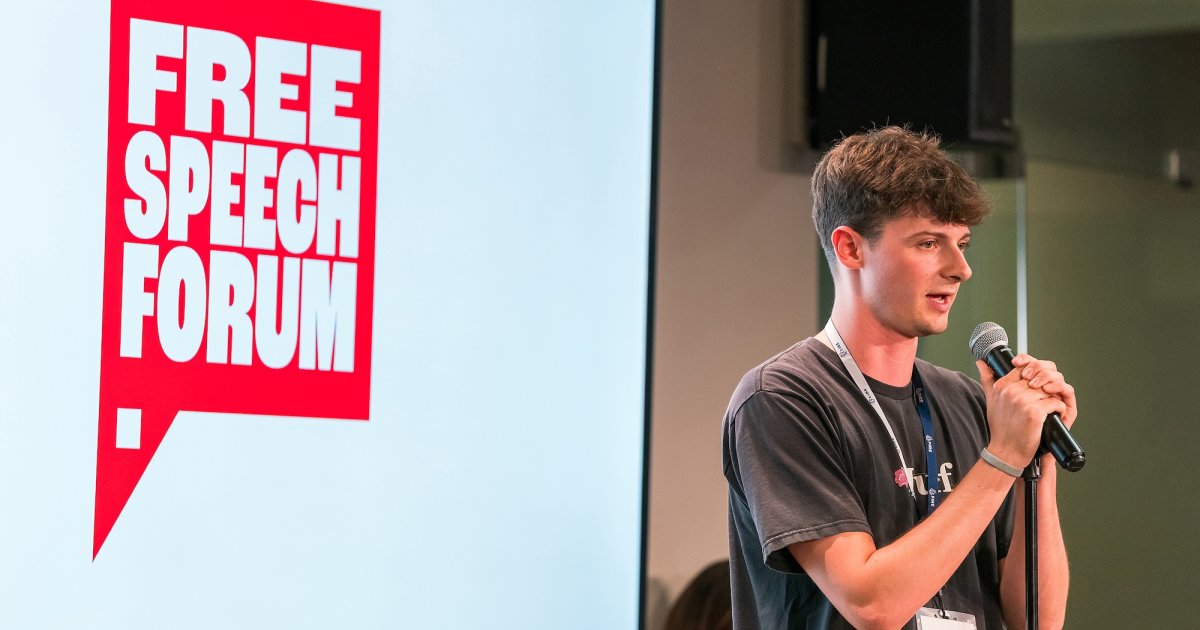
    This June, high school students from across the country assembled in our nation’s capital to offer a glimpse of one of the most important things in America — the future of the First Amendment.

    Held at American University in Washington, D.C., FIRE’s Free Speech Forum mixed big ideas with bigger conversations, bringing together 200 high schoolers to explore, deepen, and celebrate their interest in free speech. Thanks to the collaborative efforts of our generous donors, dedicated staff, enthusiastic counselors, and our incredible students, the forum was a resounding success, leaving us with a feeling of immense pride and a renewed belief in the power of young voices to shape the future of free expression.

    Throughout the week-long event, students had the opportunity to hear from world-renowned free speech advocates, engage in respectful discussions with their peers on pressing political issues, and explore the capital’s treasure trove of historic landmarks. But as one student remarked, the main highlight was simply “being around others who are also interested in civil discourse!”

    The conference kicked off in earnest with a keynote address by musician and activist Daryl Davis, who is known for convincing members of the Ku Klux Klan to renounce the group. Davis captivated the audience with his tales of attending KKK rallies as a black man, bringing Klan leaders inside his home for interviews, and even walking one Klansman’s wife down the aisle at her wedding. Through his commitment to civil dialogue, Davis has persuaded dozens of Klan officials to abandon their racist beliefs, and continues to inspire future generations of free speech advocates. 

    As one student reflected, “Opening with Daryl Davis made a big impact because it forced us to consider if this man can hear this hateful speech and still believe in free expression, then we should be able to do so as well.”


    WATCH VIDEO: An accomplished blues musician, Daryl Davis has dedicated decades of his life to a mission that defies conventional wisdom. Through the transformative power of conversation, Davis fearlessly takes on the challenging task of convincing members of the Ku Klux Klan and other extremist groups to renounce their deep-seated bigotry.

    Students also had the opportunity to meet former congressman and FIRE advisory councilmember Justin Amash during a live taping of FIRE Executive Vice President Nico Perrino’s So to Speak podcast. Campers thoughtfully engaged the former representative with questions about his time in office and his future political aspirations. 

    Capping off our keynote speakers for the week was Mary Beth Tinker, the plaintiff in the landmark Supreme Court decision Tinker v. Des Moines (1969). In 1965, Tinker and her brother wore black armbands in protest of the Vietnam War and were subsequently punished under the school’s code of conduct. Tinker’s victory in the Supreme Court paved the way for generations of students to enjoy greater First Amendment rights in the classroom. Tinker gave students an inspiring testimony about advocating for expression and taking an active role in defending causes you believe in. Her legendary story and lifelong dedication to public service was a striking reminder of students’ power to make an impact on a national scale.

    During the week, students learned the “dos and don’ts” of productive civil discourse, how to engage with opposing perspectives, the fundamentals of First Amendment case law, and how to connect and network with their peers in ways that foster lifelong personal and professional relationships. Breakout sessions like our model debate tournament gave students the chance to think on their feet and work together to form cohesive arguments about a variety of topics. In the session titled “Protected vs. Unprotected,” students tested their critical thinking skills by analyzing potential real-world speech scenarios and determining their protected status under the First Amendment.

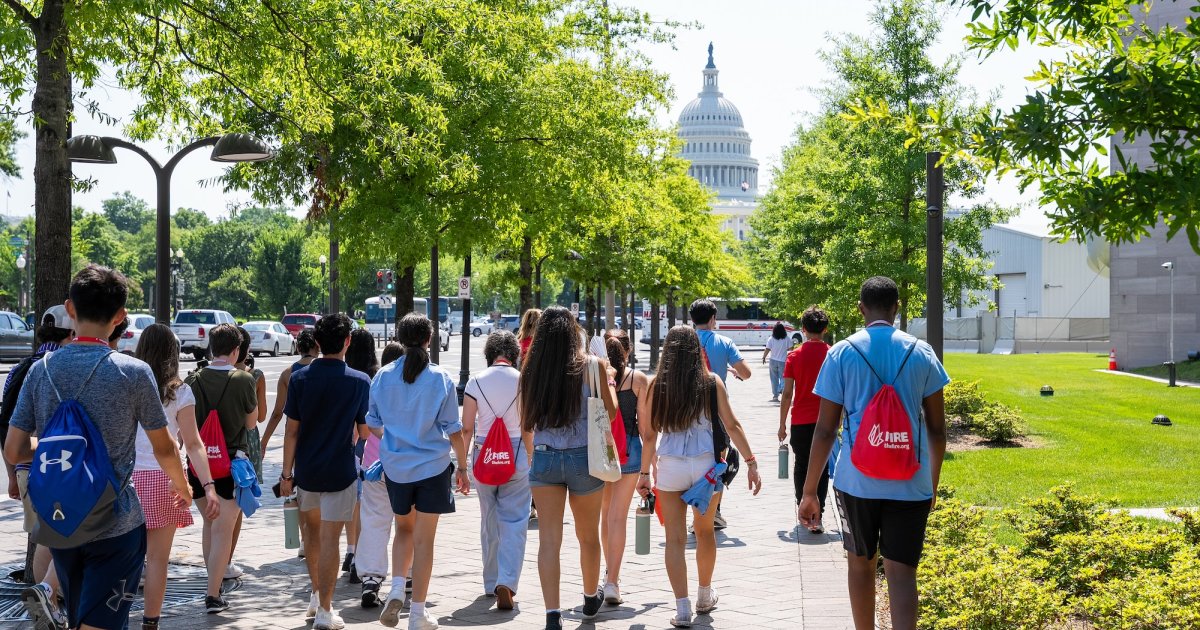
    Free Speech Forum students and counselors exploring the Supreme Court

    Free Speech Forum attendees and counselors explore the Supreme Court building in Washington, D.C.

    As the week progressed, it became clear that whether it was a lively discussion in the dining hall, a spirited debate on the walk to sessions, or the inquisitive questions posed to our speakers, students were engaged and used each opportunity to learn and mold their own perspectives, all while keeping an open mind and a curious attitude. One student said one of the things that most influenced their view on free speech was the “different debates and conversations we had amongst ourselves — on topics not everyone agreed with.”

    In addition, students had the chance to explore their nation’s capital beyond American’s campus, venturing to some of D.C.’s iconic museums and federal buildings. The National Archives, Library of Congress, Supreme Court, and Capitol Building each played host to scores of forum attendees, who supplemented their First Amendment education by standing at the sites where America’s enduring commitment to free speech has been cemented.

    And in true FIRE fashion, students who debated fervently in the classroom still managed to become friends outside of it. We would be remiss not to mention the impromptu piano sing-along during our game night when counselors and campers alike started belting out Ed Sheeran and Bruno Mars hits. The Free Speech Forum talent show was no snoozer either, featuring speed cubing, magic tricks, and cohort acapella. The show was capped off with a group of students presenting a new FIRE flag representing the forum’s transformative impact on our campers.

    “My daughter had an incredible experience,” one parent commented. “She particularly appreciated the chance to connect with other like-minded students from diverse backgrounds.” The parent added, “My daughter left the program feeling more confident in her ability to advocate for causes she cares about and to contribute to open, respectful dialogue.”

    It’s no surprise our Saturday dismissal was accompanied by teary goodbyes, the exchanges of contact information, and promises to stay in touch. We as interns hope students take what they learned at the conference to their communities and campuses, advocating for an America in which no one fears the censorious axe of the government, and in which political differences are resolved with mutually respectful discourse.

    Source link

  • This Thursday on the Future Trends Forum: an international enrollment scenario (Bryan Alexander)

    This Thursday on the Future Trends Forum: an international enrollment scenario (Bryan Alexander)


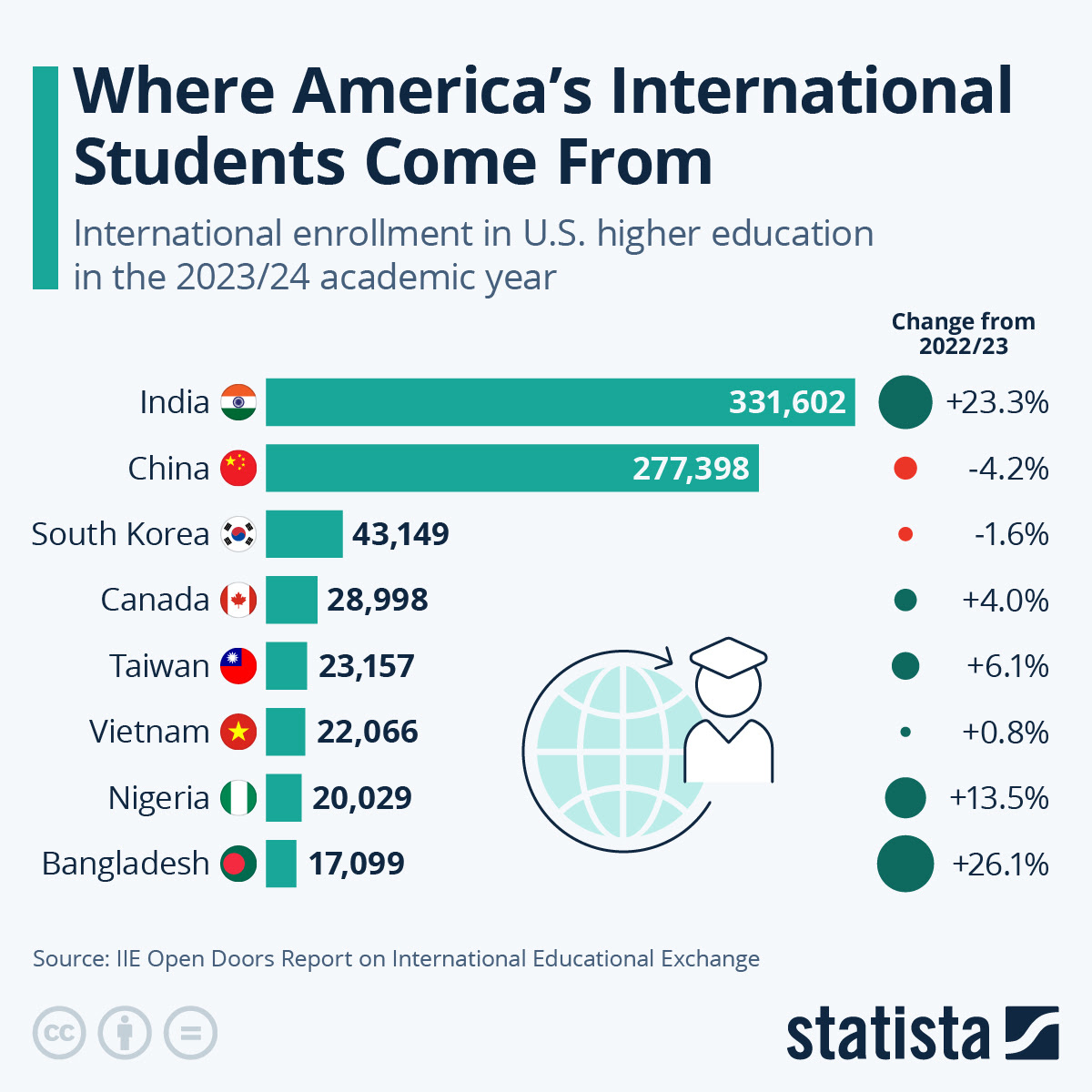
    How might international student enrollment changes impact colleges and universities? This Thursday, on June 5th, from 2-3 pm ET, the Future Trends Forum is holding an interactive exercise to work through an evidence-based scenario wherein fall 2025 numbers crash. Everyone will participate by representing themselves in the roles they currently have or would like to take up, and in those positions explore the scenario.

    We will develop responses to the situation in real time, which may help us think ahead for whatever form the crisis eventually takes. In this exercise, everyone gets to collaboratively explore how they might respond.   
     

    As with our first election simulation, not to mention our solarpunkgenerative AIblack swan, and digital twin workshops, this one will involve participants as cocreators and investigators, exploring and determining what might come next.  Consider it a trial run for a potential future.

    To RSVP ahead of time, or to jump straight in at 2 pm ET this Thursday, click here:

    To find more information about the Future Trends Forum, including notes and recordings of all previous sessions, click here: http://forum.futureofeducation.us/.

    (chart from Statista

    Source link

  • Collaboration in Action: The Third Sector Forum and the OfS Equality Agenda

    Collaboration in Action: The Third Sector Forum and the OfS Equality Agenda

    Last month, the Office for Students (OfS) confirmed the successful bids for their £2 million Equality of Opportunity Innovation Fund, launched to ‘support institutions to undertake new and innovative collaborative work or projects that will reduce risks to equality of opportunity’. 

    It is the culmination of three years of collaboration, beginning in February 2022 when Impetus hosted John Blake in his first external speaking event as the OfS’s Director for Fair Access and Participation.

    This seminal event gave rise to the Third Sector Forum – a quarterly dialogue between the Office for Students and third sector organisations working to support young people into higher education.   

    As an impact funder supporting the best attainment, engagement, and employment interventions for young people from disadvantaged backgrounds, we recognise the invaluable role of the third sector in addressing deep-seated barriers. We wanted to support this knowledge-sharing in the widening participation space.  

    Three years on, I spoke to some of the CEOs of Third Sector Forum organisations on what’s made the forum a success.

    Trust and openness  

    I was struck by the number of CEOs who cited the forum’s format as key to its success. While we fund widening participation organisations, Impetus itself is not a direct delivery organisation, meaning we can provide an independent middle ground. As a result, many emphasised the forum’s open and trusting nature and the uniqueness of this set-up. Anna Searle, CEO of The Access Project, reflected on how ‘you don’t often have the [governmental regulatory body] being as open with their constituent group’.  

    Another key factor in the success of the forum was the genuine engagement from the Office for Students, and particularly John Blake. Jayne Taylor, CEO of The Elephant Group, emphasised how John ‘genuinely listens to the voices around the table’, while Anna was quick to note how he went beyond discussing challenges for the OfS and what was next and provided his genuine views and reflections.  

    Collaborating and knowledge sharing

    Sam Holmes, CEO of Causeway Education, mentioned how participating in the sessions enabled him to form partnerships with other organisations in the space. Sitting next to Jayne when the Innovation Fund was announced, he says they were ‘immediately having conversations about […] potential collaboration’. 

    For organisations such as Causeway, which occupy a different space to programmatic organisations, it was also valuable to hear from colleagues across the sector. Forum members were able to share updates which, for Sam, demonstrated the wealth of collective knowledge and painted a picture of the higher education landscape.

    Shifting the narrative

    Action Tutoring is another member of the forum who wouldn’t ordinarily describe itself as a widening participation organisation. Susannah Hardyman, then-CEO, initially wondered if it was the right place for Action Tutoring, whose tutoring stops at age 16.  Organisations focusing on Level 2 outcomes have not always been seen as part of the widening participation space, but John Blake’s conscious decision to widen the focus of the equality of opportunity agenda brought them within scope. Over time, Susannah began to feel Action Tutoring had a place, helping to shift the narrative of what ‘widening participation’ means.

    At Impetus, we know that each step up the qualification ladder halves your chances of being NEET. We also know that early intervention is critical – before the barriers that young people face become acute – making the case for the importance of Level 2 pathways in achieving equality of opportunity. For Susannah, both the dialogue and John Blake’s emphasis on GCSE attainment, ‘[genuinely] did change the narrative of how we understand widening participation’. The implications of this reverberated beyond the four walls of the forum, opening up opportunities for organisations like Action Tutoring, which was later funded by the University of Brighton to work with two secondary schools on GCSE attainment.

    What next? 

    Policy professionals will know how rare it is to attribute policy change to their work. So, while Third Sector Forum members should undoubtedly shout about the fact that their expertise and dedication have helped to bring about £2 million of funding and a change to regulatory guidance, the work doesn’t end there. 

    Last year, the widening participation gap grew to 20.8 percentage points – its highest recorded level. The number is staggering, and even more bleak when coupled with a higher education sector on its knees and a ‘fiscal blackhole’ with seemingly no money to plug it up. It is clear that fighting to achieve equality of opportunity is more important than ever, but how?

    That a key pillar of the updated regulatory guidance is collaboration with the third sector is a testament to the success of the forum, but we can and must go further. 

    For Jayne Taylor, this looks like working groups or direct-action areas to facilitate collaboration, leveraging the collective knowledge and resources of the sector. With further investment, the forum could even evolve into an ecosystem, with opportunities for publishing research, bidding and running events together. 

    Collaboration also looks like an ever-evolving partnership between third sector organisations and the regulator. Anna Searle suggested implementing mechanisms for feedback loops, such as regular newsletters, to continue to foster a transmission of knowledge between forum members and the Office for Students. 

    For some, it feels like public policy is waiting for a return to pre-pandemic conditions. They believe that to truly move forward, we need to adapt to the present socio-economic landscape. One CEO pointed out the need for realistic conversations about the economic realities of the sector. With 40% of higher education institutions thought to be in deficit in 2023/24, providers and organisations are operating in an unprecedented funding landscape. For Sam Holmes, clearer messaging for charities that have relied on university contracts is increasingly necessary. He suggests there may even be benefits to involving funders in these discussions, alongside considering alternative partnerships, funding models and strategies.

    For others, such as Susannah Hardyman, we must continue to reevaluate our understanding of ‘equality of opportunity’.  With a record 56% of students now working part-time while studying, foodbank usage doubling since 2022, and 60% stating that money concerns affected their university choice, the landscape has undoubtedly changed. Where two decades ago the focus was relatively narrow – focused mostly around supporting high-achievers from deprived areas into high tariff institutions – this understanding has moved on. For Susannah, this needs to be taken into account, not to quash ambition but to broaden the definition of opportunity to reach as wide a group as possible. 

    When we hosted the Director for Fair Access and Participation three years ago, he said,

    ‘We are not short on people who will give up days, weeks, years of their time to pour into projects supporting the vulnerable and disadvantaged. We are not short on good suggestions, possible solutions, and rough ideas how things could be better. No, what we lack, still, is enough commitment for all those dedicated people to work together…’ 

    While the past few years have demonstrated the commitment that may have been missing previously, if we are to give every young person equal opportunity to succeed, our work is far from over. 

    Source link

  • Freedom of speech in higher education (Future Trends Forum)

    Freedom of speech in higher education (Future Trends Forum)

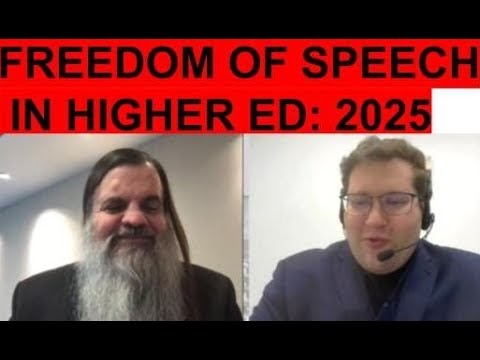
     What does academic freedom mean in 2025?

    We will explore this vital question with the help of Jeremy C. Young, the Freedom to Learn program director at PEN America (and excellent 2023 Forum guest).


    Source link

  • U.S. Secretary of State & U.S. Secretary of Education to Address 12th Annual EducationUSA Forum on July 26, 2021

    U.S. Secretary of State & U.S. Secretary of Education to Address 12th Annual EducationUSA Forum on July 26, 2021

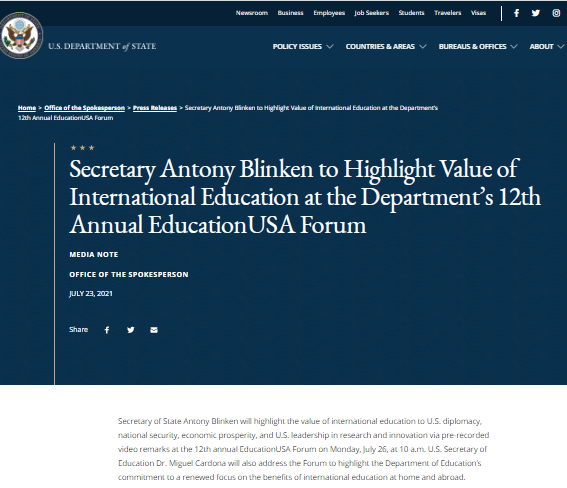
    U.S. Secretary of State Antony Blinken to highlight value of International Education at the Department’s 12th Annual EducationUSA Forum on July 26th. U.S. Secretary of Education Dr. Miguel Cardona will also address the Forum. Media Note via the Office of the Spokesperson [July 23, 2021] available at https://bit.ly/3kU7c1J

    Source link

  • Learn more about the Upcoming Forum on Education Abroad Annual Conference and Register #ForumEA21

    Learn more about the Upcoming Forum on Education Abroad Annual Conference and Register #ForumEA21

    Learn more about the upcoming Forum on Education Abroad annual conference and register at https://forumea.org/training-events/annual-conference/general-info-2/ #ForumEA21

    Note: I’ve been invited to attend the Forum on Education Abroad annual conference and will be tweeting and posting to IHEC Blog‘s Facebook page during the conference as well as doing an end of conference summary blog post.


    Source link