Six out of 10 parents hope their child will attend college, according to a new survey by Gallup and the Lumina Foundation.
The survey, conducted in June, comes out at a time when the value of a college degree is the subject of public debate.
“We hear all this skepticism of higher education,” said Courtney Brown, vice president of impact and planning for the Lumina Foundation, which advocates for opportunities for learning beyond high school available to all. “We hear the narrative that people don’t value it.”
Just last month, the results of a Gallup poll showed that confidence in higher education among Americans has been falling over the last decade.
But the results of actually asking what parents want for their own children, Brown said, are striking. This is the first survey that Gallup has specifically asked parents for their views on the topic.
“When it comes down to it, it’s pretty clear that parents hope their children get a college degree,” Brown said.
Brown has found that parents’ biggest concerns about higher education tend to be the cost, whether it leads to a job, or increasingly, whether it is political.
This may explain why community colleges were a popular option among parents who responded. Community colleges tend to have a much lower sticker price than four-year colleges, and there is a greater emphasis on job credentials. Roughly 1 out of 5 parents of varying backgrounds said that they would like to see their child enroll at a community college.
But there were some notable differences in the survey among parents, depending on their own level of education, but especially their political orientation.
The strongest narratives against higher education come from the Republican Party. That is reflected in the responses, Brown noted.
Greater differences emerged around whether students should enroll in a four-year college immediately after high school; 58% of college graduates and 53% of Democrats preferred sending their children straight to a four-year college, compared to 27% of Republicans and 30% of parents without a college degree.
Republicans are more likely to say that their children should go straight into the workforce or job training or certification, followed by independents and those without a college degree. Other options include taking time off or joining the military.
But overall, 4 out of 10 parents want to see their child attend a four-year college or university, making it the most popular option by far. This is something that comes up repeatedly in surveys about higher education.
“We see that people value four-year [degrees],” Brown said. “We see that people have trouble accessing it and have some concerns about the system, but they do greatly value it.”
The survey also measured the preferences of non-parents. It asked respondents to think about a child in their life, whether a nephew or niece, grandchild or family friend under 18 who has not graduated from high school. Responses were remarkably similar: 55% said they wanted this child to attend either a four-year or two-year college, compared to 59% of parents.
In the nearly two years since the U.S. Supreme Court struck down race-conscious admissions, there have been repeatedcalls for universities to address the resulting decline in diversity by recruiting from community colleges.
On the surface, encouraging students to transfer from two-year colleges sounds like a terrific idea. Community colleges enroll large numbers of students who are low-income or whose parents did not attend college. Black and Latino students disproportionately start college at these institutions, whose mission for more than 50 years has been to expand access to higher education.
But while community colleges should be an avenue into high-value STEM degrees for students from low-income backgrounds and minoritized students, the reality is sobering: Just 2 percent of students who begin at a community college earn a STEM bachelor’s degree within six years, our recent study of transfer experiences in California found.
There are too many roadblocks in their way, leaving the path to STEM degrees for community college students incredibly narrow. A key barrier is the complexity of the process of transferring from a community college to a four-year institution.
Related: Interested in innovations in higher education? Subscribe to our free biweekly higher education newsletter.
Many community college students who want to transfer and major in a STEM field must contend with three major obstacles in the transfer process:
1. A maze of inconsistent and often opaque math requirements. We found that a student considering three or four prospective university campuses might have to take three or four different math classes just to meet a single math requirement in a given major. One campus might expect a transfer student majoring in business to take calculus, while another might ask for business calculus. Still another might strongly recommend a “calculus for life sciences” course. And sometimes an institution’s website might list different requirements than a statewide transfer site. Such inconsistencies can lengthen students’ times to degrees — especially in STEM majors, which may require five- or six-course math sequences before transfer.
2. Underlying math anxiety. Many students interviewed for the study told us that they had internalized negative comments from teachers, advisers and peers about their academic ability, particularly in math. This uncertainty contributed to feelings of anxiety about completing their math courses. Their predicament is especially troubling given concerns that required courses may not contribute to success in specific fields.
3. Course scheduling conflicts that slow students’ progress. Two required courses may meet on the same day and time, for example, or a required course could be scheduled at a time that conflicts with a student’s work schedule. In interviews, we also heard that course enrollment caps and sequential pathways in which certain courses are offered only once a year too often lengthen the time to degree for students.
To help, rather than hinder, STEM students’ progress toward their college and professional goals, the transfer process needs to change significantly. First and foremost, universities need to send clear and consistent signals about what hoops community college students should be jumping through in order to transfer.
A student applying to three prospective campuses, for example, should not have to meet separate sets of requirements for each.
Community colleges and universities should also prioritize active learning strategies and proven supports to combat math anxiety. These may include providing professional learning for instructors to help them make math courses more engaging and to foster a sense of belonging. Training for counselors to advise students on requirements for STEM pathways is also important.
Community colleges must make their course schedules more student-centered, by offering evening and weekend courses and ensuring that courses required for specific degrees are not scheduled at overlapping times. They should also help students with unavoidable scheduling conflicts take comparable required courses at other colleges.
At the state level, it’s critical to adopt goals for transfer participation and completion (including STEM-specific goals) as well as comprehensive and transparent statewide agreements for math requirements by major.
States should also provide transfer planning tools that provide accurate and up-to-date information. For example, the AI Transfer and Articulation Infrastructure Network, led by University of California, Berkeley researchers, is using artificial intelligence technology to help institutions more efficiently identify which community college courses meet university requirements. More effective tools will increase transparency without requiring students and counselors to navigate complex and varied transfer requirements on their own. As it stands, complex, confusing and opaque math requirements limit transfer opportunities for community college students seeking STEM degrees, instead of expanding them.
We must untangle the transfer process, smooth pathways to high-value degrees and ensure that every student has a clear, unobstructed opportunity to pursue an education that will set them up for success.
Pamela Burdman is executive director of Just Equations, a California-based policy institute focused on reconceptualizing the role of math in education equity. Alexis Robin Hale is a research fellow at Just Equations and a graduate student at UCLA in Social Sciences and Comparative Education.
The Hechinger Report provides in-depth, fact-based, unbiased reporting on education that is free to all readers. But that doesn’t mean it’s free to produce. Our work keeps educators and the public informed about pressing issues at schools and on campuses throughout the country. We tell the whole story, even when the details are inconvenient. Help us keep doing that.
In a significant shift for higher education access, Illinois Governor JB Pritzker announced his support for new legislation that would allow the state’s community colleges to offer bachelor’s degrees in high-demand fields. The move aligns Illinois with a growing national trend that has seen dramatic expansion in community college baccalaureate (CCB) programs across the country.
“By allowing our community colleges to offer baccalaureate degrees for in-demand career paths, we are making it easier and more affordable for students to advance their careers while strengthening our state’s economy,” Pritzker said in his February announcement.
The proposed bills, SB2482 and HB3717, would make Illinois the 25th state to implement such programs, joining states like California, Washington, and Florida that have already embraced community college bachelor’s degrees as a way to meet workforce demands and increase educational access. The measure appears to be stalled in the state legislature.
The Illinois initiative addresses practical challenges faced by many community college students. According to State Representative Tracy Katz Muhl, 78% of community college students work while in school, making relocation to four-year institutions impractical.
“Community college students are deeply rooted in their local communities—they work here, raise families here, and contribute to the local economy,” says Dr. Keith Cornille, President of Heartland Community College. “By expanding community college baccalaureate programs, we’re meeting students where they are.”
The proposal has gained support from education leaders including Illinois Community College Board Executive Director Brian Durham, who highlighted the potential to increase access to affordable higher education without burdening students with excessive debt.
A recent survey revealed that 75% of Illinois community college students would pursue a bachelor’s degree if they could complete it at their current institution—a statistic that demonstrates significant untapped potential in the state’s third-largest community college system, which serves 600,000 residents annually.
Illinois’ move follows a remarkable expansion in community college baccalaureate programs nationwide. According to a recent report from The Community College Baccalaureate Association (CCBA) and higher education consulting firm Bragg & Associates Inc., 187 community colleges across the country were offering or authorized to offer bachelor’s degrees as of last year.
This represents a 32% increase from Fall 2021, when only 132 institutions had such authorization. Today, approximately one-fifth of the nation’s 932 community colleges offer bachelor’s degrees, with the number of CCB degree programs rising from 583 to 678—a 17% increase in just two years.
“It’s a big jump over the last two years,” says report author Dr. Debra Bragg, president of Bragg & Associates Inc. Bragg anticipates “tremendous growth” in coming years as more states recognize the potential of these programs.
The movement began in 1989 when West Virginia became the first state to authorize a community college to confer bachelor’s degrees. By 2010, several more states—including California, Michigan, Florida, Texas, and Georgia—had followed suit. Some states have embraced the model completely, with Florida, Delaware, and Nevada authorizing all their community colleges to confer bachelor’s degrees.
Geographic and demographic patterns Community colleges offering bachelor’s degrees are not distributed evenly across the country. According to the CCBA report, 62% of CCB colleges are located on the West Coast, where there is “less density” of higher education institutions and longer commutes to traditional four-year schools.
“Geographic access to college, measured through proximal distance from a student’s home to college, correlates with students deciding whether they will ever participate in higher education,” the report notes. “Research on ‘education deserts’ shows most students choose to attend college within 50 miles of their home.” Washington (32), California (29), and Florida (28) lead the nation in the number of community colleges offering bachelor’s degrees. These institutions tend to be concentrated in large city and suburban areas (36%) or rural and town settings (27%) rather than in small cities or midsize urban areas.
Perhaps most significantly, CCB programs appear to be effectively serving traditionally underrepresented student populations. Approximately half of all community colleges offering bachelor’s degrees qualify as minority-serving institutions (MSIs), with Hispanic-Serving Institutions (HSIs) comprising 71% of these MSIs.
Data from the 2021-22 academic year shows that about half of all CCB graduates come from racially minoritized groups. Hispanic or Latinx students made up the slight majority (52%) of these graduates, followed by those identifying as Black or African American (29%) or Asian (9%).
Women are also well-represented among CCB graduates, accounting for 64% of degree recipients. This aligns with broader trends in higher education, where women generally attain degrees at higher rates than men.
The gender distribution varies by field of study. While business programs attract the largest portion of both male and female students (around 40% for each), men are more likely to pursue STEM fields (34%), while women gravitate toward nursing programs (26%).
The CCBA report highlights that CCB degrees are primarily focused on workforce preparation. Business programs dominate the offerings, followed by health professions, education, and nursing—all areas that align with significant workforce needs.
This workforce alignment is a key selling point for Illinois’ proposed legislation. The initiative comes as Illinois employers report growing demand for workers with bachelor’s degrees in specialized fields, mirroring workforce gaps seen in other states with successful CCB programs.
CCBA President Dr. Angela Kersenbrock sees these workforce-focused degrees as central to the community college mission. “To me, this is the community college really embracing its missions,” says Kersenbrock. “I know some folks say this is community colleges stepping over their mission. But I think it’s a full embracing of what they should be doing… closing equity gaps, being the people’s college, setting people up for economic success and mobility, and being very responsive to what a community needs in terms of workers and employees.”
Despite the growth and apparent success of community college baccalaureate programs, they are not without controversy. Some traditional four-year institutions view them as mission creep or unwelcome competition.
Illinois’ proposal faces similar scrutiny. Critics question whether community colleges have the resources, faculty expertise, and infrastructure necessary to deliver quality bachelor’s degree programs. Others worry about potential duplication of existing programs at four-year institutions.
Supporters counter that CCB programs typically focus on applied fields with clear workforce connections rather than traditional academic disciplines. They also emphasize that these programs often serve students who would otherwise not pursue bachelor’s degrees at all, rather than pulling students away from existing institutions.
Looking Ahead If Illinois passes the proposed legislation, it will join a diverse group of states finding success with community college baccalaureate programs. States like Washington, California, and Florida report positive outcomes in terms of both degree attainment and workforce preparation.
For Illinois’ sprawling community college system—the third largest in the nation—the change could significantly reshape higher education access. Community colleges often serve as entry points to higher education for first-generation college students, working adults, and others who face barriers to traditional four-year institutions.
“This initiative isn’t about competing with our university partners,” notes one Illinois community college president. “It’s about creating additional pathways for students who might otherwise never earn a bachelor’s degree.”
As more states consider similar legislation, the community college bachelor’s degree appears poised to become an increasingly common feature of American higher education. With workforce demands continuing to evolve and traditional college enrollment patterns shifting, these programs offer a flexible approach to meeting both student and employer needs.
For Bragg, the trend represents a natural evolution of community colleges’ historical mission.
“Community colleges have always adapted to meet changing educational and workforce needs,” she observes. “Bachelor’s degrees are just the latest example of this responsiveness.”
As Illinois moves forward with its proposal and other states watch closely, the coming years will likely see further expansion of bachelor’s degree options at community colleges nationwide—continuing a transformation that is making higher education more accessible to students who need it most.
Graduation rates are always a hot topic in higher education, but often for the wrong reason. To demonstrate, I offer my parents. Here is a portrait of Agnes and Mark, married May 4, 1946.
One night while I was talking to my brother, he asked, “Do you think mom was the way she was because dad was the way he was, or do you think dad was the way he was because mom was the way she was?” To which I replied, “yes.” My point, of course, is that in complex relationships, it’s always difficult–impossible, actually–to detangle cause and effect.
And, despite the Student Affairs perspective that graduation rates are a treatment effect, I maintain that they are actually a selection effect. As I’ve written about before, it’s pretty easy to predict a college’s six-year graduation rate if you know one data point: The mean SAT score of the incoming class. That’s because the SAT rolls a lot of predictive factors into one index number. These include academic preparation, parental attainment, ethnicity, and wealth, on the student side, and selectivity, on the college side.
When a college doesn’t have to–or chooses not to–take many risks in the admissions process, they tend to select those students who are more likely to graduate. That skews the incoming class wealthier (Asian and Caucasian populations have the highest income levels in America), higher ability (the SAT is a good proxy for some measure of academic achievement, and often measures academic opportunity), and second generation. And when you combine all those things–or you select so few poor students you can afford to fund them fully–guess what? Graduation rates go up.
If this doesn’t make any sense, read the Blueberry Speech. Or ask yourself this question: If 100 MIT students enrolled at your local community college, what percentage would graduate?
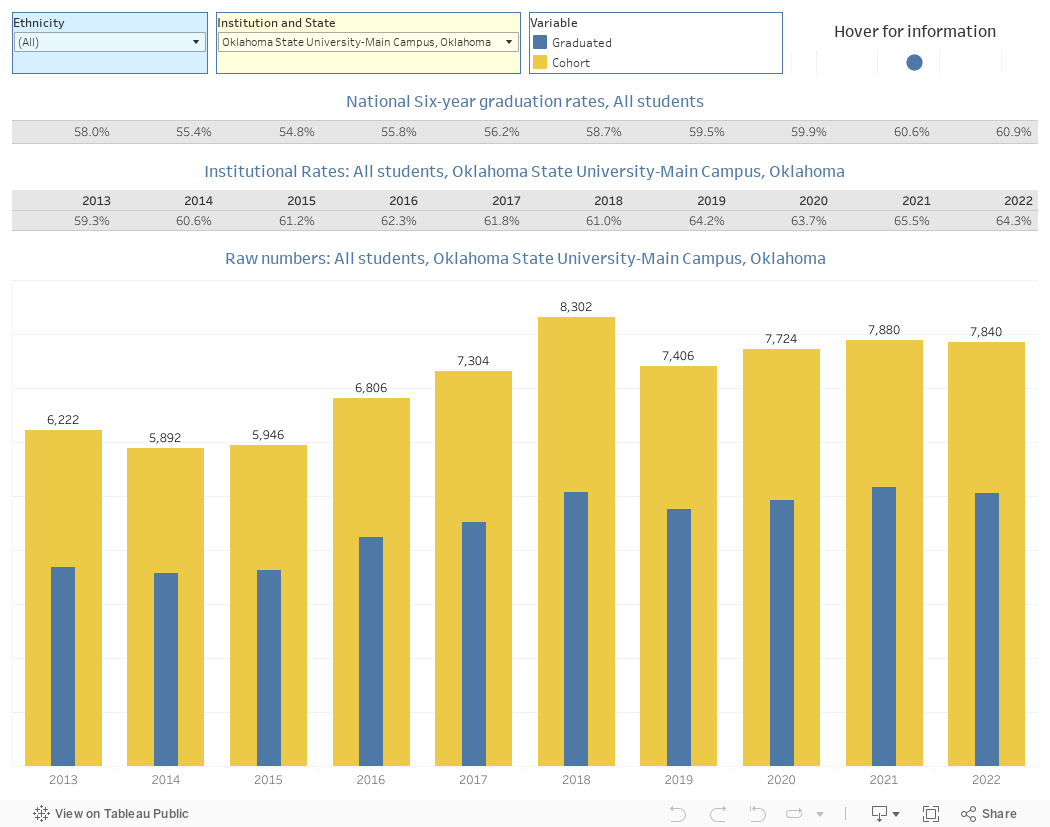
But graduation rates are still interesting to look at, once you have that context. The visualization below contains three views, using the tabs across the top. You’ll have to make a few clicks to get the information you need.
The first view (Single Group) starts with a randomly selected institution, Oklahoma State. Choose your institution of choice by clicking on the box and typing any part of the name, and selecting the institution.
On the yellow bars, you see the entering cohorts in yellow, and the number of graduating students on the blue bars. Note: The blue bars show graduates in the year shown (so, 4,755, which you can see by hovering over the bar) while the yellow bar shows the entering class from six years prior (7,406 in 2019, who entered in 2013).
The top row shows graduation rates at all institutions nationally, and the second row shows percentages for the selected institution. You can choose any single ethnicity at the top left, using the filter.
The second view (Single Institution) shows all ethnicities at a single institution. The randomly selected demonstration institution is Gustavus Adolphus College in Minnesota, but of course you can choose any institution in the data set. Highlight a single ethnic group using the highlight function (I know some people are frightened of interacting with these visualizations….you can’t break anything).
Note: I start with a minimum of 10 students in each year’s cohorts for the sake of clarity. Small schools in the Northeast, for instance, might enroll one Asian/Pacific Islander in their incoming class, each year, so the graduation rate could swing wildly from 0% to 100%. You can change this if you want to live dangerously, by pulling the slider downward.
The final view (Sectors) shows aggregates of institutional types. It starts with graduation rates for Hispanic/Latino students, but you can change it to any group you want.
Have fun learning about graduation rates. Just don’t assume they are mostly driven by what happens at the institution once the admissions office has its say.