Tag: fraud

  • Phoenix Education Partners, FAFSA Fraud, and the Familiar Dance of Blame

    Phoenix Education Partners, FAFSA Fraud, and the Familiar Dance of Blame

    When Phoenix Education Partners (PXED) CEO Chris Lynne publicly blamed the U.S. Department of Education for missing fraud in FAFSA applications—fraud that allowed the University of Phoenix to enroll individuals engaged in financial-aid misconduct—he likely hoped to redirect scrutiny away from his own shop. Instead, the maneuver sent up a flare. For many observers of the for-profit college sector, it felt like the return of a well-worn tactic: deflect, distract, and deny responsibility until the heat dies down.

    The pivot toward blaming the Department of Education does not merely look defensive; it echoes a pattern that helped bring down an entire generation of predatory schools. And it raises a simple question: why is PXED responding like institutions that have something to hide?


    The Old Script, Updated

    The University of Phoenix, under PXED’s ownership, carries not just a long memory of investigations and settlements but a structural DNA shaped by years of aggressive enrollment management, marketing overreach, and high-pressure tactics. When the industry was confronted with evidence of systemic abuses—lying about job placement, enrolling ineligible students, manipulating financial-aid rules—the typical industry defense was to claim that problems were caused by bad actors, by misinterpreted regulations, or by a sluggish and incompetent Department of Education.

    Those excuses were not convincing then, and they ring even more hollow now.

    If individuals involved in financial-aid fraud managed to slip into the system, an institution with PXED’s history should be the first to strengthen internal controls, not pass the buck. Schools are required under federal law to verify eligibility, prevent fraud, and monitor suspicious patterns. Pretending that ED is solely responsible ignores the compliance structure PXED is obligated—by statute—to maintain.

    Why Blame-Shifting Looks So Suspicious

    Instead of demonstrating transparency or releasing information about internal controls that failed, PXED’s leadership has opted for a public relations gambit: blame the regulator. This raises several concerns.

    First, shifting responsibility before releasing evidence suggests that PXED may be more focused on reputational management than on institutional accountability. If the organization’s processes were sound, those facts would speak louder—and more credibly—than an accusatory press statement.

    Second, the posture is déjà vu for people who have tracked the sector for decades. Corinthian Colleges, ITT Tech, Education Management Corp., and Career Education Corporation all blamed ED at various stages of their collapses. In each case, deflection became part of the pattern that preceded deeper revelations of systemic abuse.

    When PXED’s CEO adopts similar rhetoric, observers reasonably wonder whether history is repeating itself—again.

    Finally, PXED’s argument undermines trust at a moment when the University of Phoenix is already under skepticism from accreditors, policymakers, student-borrower advocates, and the public. Instead of strengthening compliance, PXED’s messaging signals defensiveness. Institutions with nothing to hide usually take a different approach.

    The Structural Issues PXED Doesn’t Want to Discuss

    PXED acquired the University of Phoenix with promises of modernization, stabilization, and responsible stewardship. But beneath the marketing, core challenges remain:

    A business model dependent on federal aid. The more a school relies on federal dollars, the stronger its responsibility to prevent fraud—not the weaker.

    A compliance culture shaped by profit pressure. For-profit education has repeatedly shown how financial incentives can distort admissions and oversight.

    A credibility deficit. PXED took over an institution known internationally for deceptive advertising and financial-aid abuses. Blaming ED only magnifies the perception that nothing has fundamentally changed.

    A fragile regulatory environment. With oversight tightening and student-protection rules returning, PXED cannot afford to gesture toward the old for-profit playbook. Doing so suggests they are trying to manage optics instead of outcomes.

    What Accountability Would Look Like

    If PXED wanted to demonstrate leadership rather than defensiveness, a different response was available:

    • Conduct and publish a full internal review of financial-aid intake processes
    • Outline steps to prevent enrollment of fraudulent actors
    • Acknowledge institutional lapses—and explain how they occurred
    • Invite independent audits rather than blaming federal partners
    • Demonstrate an understanding of fiduciary obligations to students and taxpayers

    This is the standard expected of Title IV institutions. It is also the standard PXED insists they meet.

    A Familiar Pattern at a Familiar Institution

    Every moment of pressure reveals something about institutional culture. PXED’s choice to immediately fault the Department of Education—without presenting evidence of its own vigilance—suggests that the company may still be operating according to the old Phoenix playbook: when in doubt, blame someone else.

    But in 2025, the public, regulators, and students have seen this movie before. And they know how it ends.

    Sources
    U.S. Department of Education, Federal Student Aid Handbook
    Senate HELP Committee, For-Profit Higher Education: The Failure to Safeguard the Federal Investment and Ensure Student Success
    Federal Trade Commission, University of Phoenix Settlement Documents
    U.S. Department of Education, Program Review and Compliance Requirements
    Higher Education Inquirer archives

    Source link

  • LAVC Media Arts Faculty Stripped of Administrative Roles Amid Fraud Scandal (LACCD Whistleblower)

    LAVC Media Arts Faculty Stripped of Administrative Roles Amid Fraud Scandal (LACCD Whistleblower)

    Faculty members in the Los Angeles Valley College (LAVC) Media Arts Department implicated in decades of fraud and misconduct have been removed from administrative positions, though they remain in teaching roles.

    Over the summer, longtime department head Eric Swelstad, who had led Media Arts since 2008, was replaced as chair by Chad Sustin, a full-time professor of Cinema and Media Arts. The change followed a notification from the LACCD Whistleblower Movement to new Chancellor Alberto J. Roman, alleging that Swelstad falsely claimed membership in the Writers Guild of America – West for more than 20 years and used this misrepresentation in official LACCD promotional materials.

    Sustin, a tenured faculty member since 2016 and a former Technicolor post-producer, now leads the department.

    The reshuffling comes amid years of internal turmoil. In 2022, full-time cinema professor Arantxa Rodriguez resigned and was replaced by Jonathan Burnett as assistant professor. Rodriguez had previously been implicated in department infighting and, alongside Swelstad, was named as a co-defendant in a 2008 case alleging failure to provide advertised technical training and education. Burnett’s hiring bypassed longtime adjunct and former grant director Dan Watanabe.

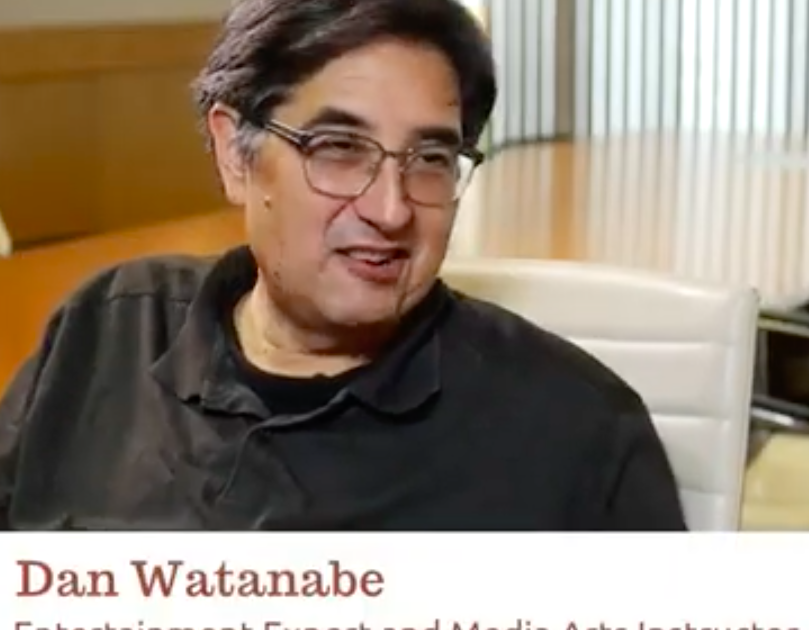
    Watanabe previously administered several Media Arts training grants, the last of which—ICT & Digital Media, LA RDSN—was reported as fraudulent in 2016. The 2013 grant proposal promised courses such as The Business of EntertainmentAdvanced Digital Editing, Photoshop, and After Effects. Yet once funding was approved, The Business of Entertainment and Advanced Digital Editing were archived by LAVC’s Academic Curriculum Committee and Senate. Photoshop and After Effects were offered only minimally, with After Effects disappearing after 2015 and Photoshop shifting to online-only by 2017.

    Students reported the suspected fraud to the State of California in 2016, prompting a review of the grant. Renewal applications submitted by Watanabe in 2018 and 2021 were both denied.

    Grant Record (Denied Renewal, 2018):

    • Project Title: ICT & Digital Media – LA RDSN (Renewal)

    • Funding Agency: CCCCO EWD

    • Grant Amount: $165,000

    • Funding Period: Oct. 1, 2018 – June 30, 2019

    • Project Director: Dan Watanabe

    • Description: Proposed renewal of the Deputy Sector Navigator grant under the California Community Colleges Chancellor’s Office, focused on curriculum development and alignment with universities and K–12 schools.

    https://services.laccd.edu/districtsite/Accreditation/lavc/Standard%20IVA/IVA1-02_Grants_History.pdf

    Despite this, Watanabe (who was also passed over for a full-time position at Los Angeles Pierce College) remains an adjunct faculty member slated to teach Cinema 111, Developing Movies – a field he reportedly last worked in twenty years ago. Arantxa Rodriguez and Eric Swelstad have both been scheduled to teach Fall 2025. Despite falsifying his credentials as a member of the Writer’s Guild of America – West, and implying he was a Primetime Emmy Winner (he in fact was the director of a movie that received a local Los Angeles Emmy in the 1990s), he is slated to teach Cinema 101 and screenwriting core class Media Arts 129. Rodriguez will a remote History of Film Class. 

    Reportedly the new full-time faculty in the department have started working to reverse the damage. Fall 2025 schedule includes Media Arts 112, Creative Sound Design Workshop. 

    Source link

  • AI-Fueled Fraud in Higher Education

    AI-Fueled Fraud in Higher Education

    Colleges across the United States are facing an alarming increase in “ghost students”—fraudulent applicants who infiltrate online enrollment systems, collect financial aid, and vanish before delivering any academic engagement. The problem, fueled by advances in artificial intelligence and weaknesses in identity verification processes, is undermining trust, misdirecting resources, and placing real students at risk.

    What Is a Ghost Student?

    A ghost student is not simply someone who drops out. These are fully fabricated identities—sometimes based on stolen personal information, sometimes entirely synthetic—created to fraudulently enroll in colleges. Fraudsters use AI tools to generate admissions essays, forge transcripts, and even produce deepfake images and videos for identity verification.

    Once enrolled, ghost students typically sign up for online courses, complete minimal coursework to stay active long enough to qualify for financial aid, and then disappear once funds are disbursed.

    Scope and Impact

    The scale of the problem is significant and growing:

    • California community colleges flagged approximately 460,000 suspicious applications in a single year—nearly 20% of the total—resulting in more than $11 million in fraudulent aid disbursements.

    • The College of Southern Nevada reported losing $7.4 million to ghost student fraud in one semester.

    • At Century College in Minnesota, instructors discovered that roughly 15% of students in a single course were fake enrollees.

    • California’s overall community college system reported over $13 million in financial aid losses in a single year due to such schemes—a 74% increase from the previous year.

    The consequences extend beyond financial loss. Course seats are blocked from legitimate students. Faculty spend hours identifying and reporting ghost students. Institutional data becomes unreliable. Most importantly, public trust in higher education systems is eroded.

    Why Now?

    Several developments have enabled this rise in fraud:

    1. The shift to online learning during the pandemic decreased opportunities for in-person identity verification.

    2. AI tools—such as large language models, AI voice generators, and synthetic video platforms—allow fraudsters to create highly convincing fake identities at scale.

    3. Open-access policies at many institutions, particularly community colleges, allow applications to be submitted with minimal verification.

    4. Budget cuts and staff shortages have left many colleges without the resources to identify and remove fake students in a timely manner.

    How Institutions Are Responding

    Colleges and universities are implementing multiple strategies to fight back:

    Identity Verification Tools

    Some institutions now require government-issued IDs matched with biometric verification—such as real-time selfies with liveness detection—to confirm applicants’ identities.

    Faculty-Led Screening

    Instructors are being encouraged to require early student engagement via Zoom, video introductions, or synchronous activities to confirm that enrolled students are real individuals.

    Policy and Federal Support

    The U.S. Department of Education will soon require live ID verification for flagged FAFSA applicants. Some states, such as California, are considering application fees or more robust identity checks at the enrollment stage.

    AI-Driven Pattern Detection

    Tools like LightLeap.AI and ID.me are helping institutions track unusual behaviors such as duplicate IP addresses, linguistic patterns, and inconsistent documentation to detect fraud attempts.

    Recommendations for HEIs

    To mitigate the risk of ghost student infiltration, higher education institutions should:

    • Implement digital identity verification systems before enrollment or aid disbursement.

    • Train faculty and staff to recognize and report suspicious activity early in the semester.

    • Deploy AI tools to detect patterns in application and login data.

    • Foster collaboration across institutions to share data on emerging fraud trends.

    • Communicate transparently with students about new verification procedures and the reasons behind them.

    Why It Matters

    Ghost student fraud is more than a financial threat—it is a systemic risk to educational access, operational efficiency, and institutional credibility. With AI-enabled fraud growing in sophistication, higher education must act decisively to safeguard the integrity of enrollment, instruction, and student support systems.


    Sources

    Source link

  • The Growing Problem of Scientific Research Fraud

    The Growing Problem of Scientific Research Fraud

    When a group of researchers at Northwestern University uncovered evidence of widespread—and growing—research fraud in scientific publishing, editors at some academic journals weren’t exactly rushing to publish the findings.

    “Some journals did not even want to send it for review because they didn’t want to call attention to these issues in science, especially in the U.S. right now with the Trump administration’s attacks on science,” said Luís A. Nunes Amaral, an engineering professor at Northwestern and one of the researchers on the project. “But if we don’t, we’ll end up with a corrupt system.”

    Last week Amaral and his colleagues published their findings in the Proceedings of the National Academy of Sciences of the United States of America. They estimate that they were able to detect anywhere between 1 and 10 percent of fraudulent papers circulating in the literature and that the actual rate of fraud may be 10 to 100 times more. Some subfields, such as those related to the study of microRNA in cancer, have particularly high rates of fraud.

    While dishonest scientists may be driven by pressure to publish, their actions have broad implications for the scientific research enterprise.

    “Scientists build on each other’s work. Other people are not going to repeat my study. They are going to believe that I was very responsible and careful and that my findings were verified,” Amaral said. “But If I cannot trust anything, I cannot build on others’ work. So, if this trend goes unchecked, science will be ruined and misinformation is going to dominate the literature.”

    Luís A. Nunes Amaral

    Numerous media outlets, including The New York Times, have already written about the study. And Amaral said he’s heard that some members of the scientific community have reacted by downplaying the findings, which is why he wants to draw as much public attention to the issue of research fraud as possible.

    “Sometimes it gets detected, but instead of the matter being publicized, these things can get hidden. The person involved in fraud at one journal may get kicked out of one journal but then goes to do the same thing on another journal,” he said. “We need to take a serious look at ourselves as scientists and the structures under which we work and avoid this kind of corruption. We need to face these problems and tackle them with the seriousness that they deserve.”

    Inside Higher Ed interviewed Amaral about how research fraud became such a big problem and what he believes the academic community can do to address it.

    (This interview has been edited for length and clarity.)

    Q: It’s no secret that research fraud has been happening to some degree for decades, but what inspired you and your colleagues to investigate the scale of it?

    A: The work started about three years ago, and it was something that a few of my co-authors who work in my lab started doing without me. One of them, Jennifer Byrne, had done a study that showed that in some papers there were reports of using chemical reagents that would have made the reported results impossible, so the information had to be incorrect. She recognized that there was fraud going on and it was likely the work of paper mills.

    So, she started working with other people in my lab to find other ways to identify fraud at scale that would make it easier to uncover these problematic papers. Then, I wanted to know how big this problem is. With all of the information that my colleagues had already gathered, it was relatively straightforward to plot it out and try to measure the rate at which problematic publications are growing over time.

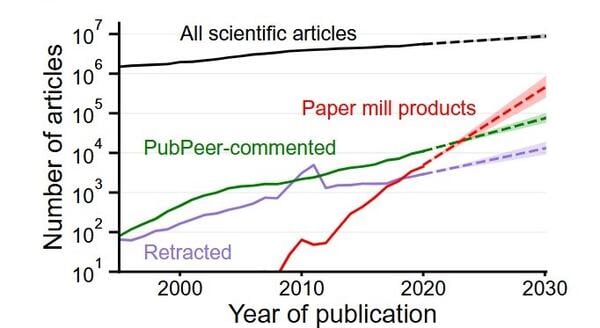
    It’s been an exponential increase. Every one and a half years, the number of paper mill products that have been discovered is doubling. And if you extrapolate these lines into the future, it shows that in the not-so-distant future these kinds of fraudulent papers would be the overwhelming majority within the scientific literature.

    A line graph showing all scientific articles, paper mill products, PubPeer-commented, and retracted papers. The Y axis is number of articles and the X axis is year of publication. All the lines are going up, but the red line for paper mill products is rising fastest.

    Proceedings of the National Academy of Sciences of the United States of America

    Q: What are the mechanisms that have allowed—and incentivized—such widespread research fraud?

    A: There are paper mills that produce large amounts of fake papers by reusing language and figures in different papers that then get published. There are people who act as brokers between those that create these fake papers, people who are putting their name on the paper and those who ensure that the paper gets published in some journal.

    Our paper showed that there are editors—even for legitimate scientific journals—that help to get fraudulent papers through the publishing process. A lot of papers that end up being retracted were handled and accepted by a small number of individuals responsible for allowing this fraud. It’s enough to have just a few editors—around 30 out of thousands—who accept fraudulent papers to create this widespread problem. A lot of those papers were being supplied to these editors by these corrupt paper mill networks. The editors were making money from it, receiving citations to their own papers and getting their own papers accepted by their collaborators. It’s a machine.

    Science has become a numbers game, where people are paying more attention to metrics than the actual work. So, if a researcher can appear to be this incredibly productive person that publishes 100 papers a year, edits 100 papers a year and reviews 100 papers a year, academia seems to accept this as natural as opposed to recognizing that there aren’t enough hours in the day to actually do all of these things properly.

    If these defectors don’t get detected, they have a huge advantage because they get the benefits of being productive scientists—tenure, prestige and grants—without putting in any of the effort. If the number of defectors starts growing, at some point everybody has to become a defector, because otherwise they are not going to survive.

    Q: [Your] paper found a surge in the number of fraudulent research papers produced by paper mills that started around 2010. What are the conditions of the past 15 years that have made this trend possible?

    A: There were two things that happened. One of them is that journals started worrying about their presence online. It used to be that people would read physical copies of a journal. But then, only looking at the paper online—and not printing it—became acceptable. The other thing that became acceptable is that instead of subscribing to a journal, researchers can pay to make their article accessible to everyone.

    These two trends enabled organizations that were already selling essays to college students or theses to Ph.D. students to start selling papers. They could create their own journals and just post the papers there; fraudulent scientists pay them and the organizations make nice money from that. But then these organizations realized that they could make more money by infiltrating legitimate journals, which is what’s happening now.

    It’s hard for legitimate publishers to put an end to it. On the one hand, they want to publish good research to maintain their reputation, but every paper they publish makes them money.

    Q: Could the rise of generative AI accelerate research fraud even more?

    A: Yes. Generative AI is going to make all of these problems worse. The data we analyzed was before generative AI became a concern. If we repeat this analysis in one year, I would imagine that we’ll see an even greater acceleration of these problematic papers.

    With generative AI in the picture, you don’t actually need another person to make fake papers—you can just ask ChatGPT or another large language model. And it will enable many more people to defect from doing actual science.

    Q: How can the academic community address this problem?

    A: We need collective action to resist this trend. We need to prevent these things from even getting into the system, and we need to punish the people that are contributing to it.

    We need to make people accountable for the papers that they claim to be authors of, and if someone is bound to engage in unethical behavior, they should be forbidden from publishing for a period of time commensurate with the seriousness of what they did. We need to enable detection, consequences and implementation of those consequences. Universities, funding agencies and journals should not hide, saying they can’t do anything about this.

    This is about demonstrating integrity and honesty and looking at how we are failing with clear eyes and deciding to take action. I’m hoping that the scientific enterprise and scientific stakeholders rise to that challenge.

    Source link

  • Los Angeles Community College District Claims to Be Facing State Takeover Amid Allegations of Fraud and Censorship in LAVC Media Arts Department (LACCD Whistleblower)

    Los Angeles Community College District Claims to Be Facing State Takeover Amid Allegations of Fraud and Censorship in LAVC Media Arts Department (LACCD Whistleblower)

    The Los Angeles Community College District (LACCD) may be facing state takeover within two years due to overextended hiring and budget mismanagement, as discussed during a May 2025 meeting of the Los Angeles Valley College (LAVC) Academic Senate. Faculty warned that the looming financial crisis could result in mass layoffs—including tenured staff—and sweeping program cuts.

    Start Minutes LAVC Academic Senate

    “R. Christian-Brougham: other campuses have brand new presidents doing strange things. If we don’t do things differently as a district, from the mouth of the president in two years we’ll be bankrupt and go into negative.
     Chancellor has responsibility
    C. Sustin  asks for confirmation that it is the Chancellor that can and should step in to curb campus budgets and hirings.
    R. Christian-Brougham: the Chancellor bears responsibility, but in the takeover scenario, the Board of Trustees – all of them – would get fired
    E. Perez: which happened in San Francisco
    C. Sustin: hiring is in the purview of campuses, so they can’t directly determine job positions that move forward?
    R. Christian-Brougham: Chancellor and BoT could step in and fire the Campus Presidents, though.
    E. Perez: in next consultation with Chancellor, bringing this up.
    C. Maddren: Gribbons is not sitting back; he’s acting laterally and going upward
    E. Thornton: looping back to the example of City College of San Francisco: when the takeover happened there the reductions in force extended to multiple long-since-tenured members of a number of disciplines, including English. For this and so many other reasons, it was a reign of terror sort of situation. So we really need to push the Chancellor.”

    End Minutes Academic Senate

    https://go.boarddocs.com/ca/laccd/Board.nsf/vpublic?open#

    The dire financial outlook comes as new scrutiny falls on LAVC’s Media Arts Department, already under fire for years of alleged fraud, resume fabrication, and manipulation of public perception. Central to these concerns is the department’s chair, Eric Swelstad, who also oversees a $40,000 Hollywood Foreign Press Association (Golden Globe) grant for LAVC students—a role now drawing sharp criticism in light of mounting questions about his credentials and conduct.

    Over the past two months, a troubling wave of digital censorship has quietly erased years of documented allegations. In May 2025, nearly two years’ worth of investigative reporting—comprising emails, legal filings, and accreditation complaints—were scrubbed from the independent news site IndyBay. The removed content accused Swelstad of deceiving students and the public for over two decades about the quality and viability of the Media Arts program, as well as about his own professional qualifications.

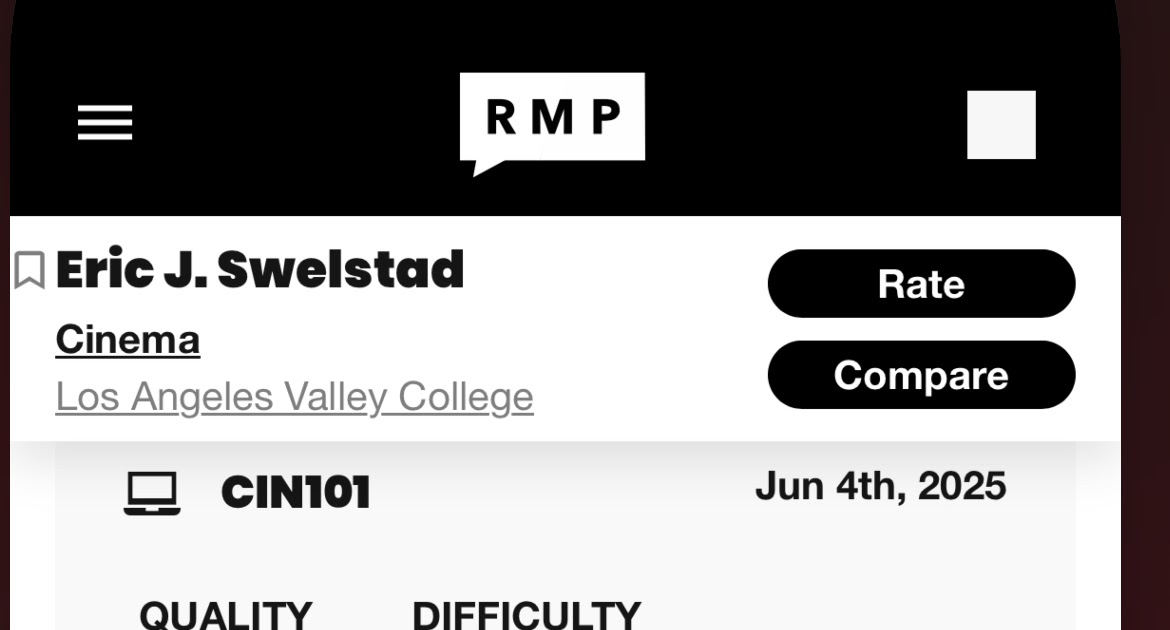
    In June 2025, a negative student review about Swelstad—posted by a disabled student—disappeared from Rate My Professor. These incidents form part of what appears to be a years-long campaign of online reputation management and public deception.

    An AI-driven analysis of Rate My Professor entries for long-serving Media Arts faculty—including Swelstad, Arantxa Rodriguez, Chad Sustin, Dan Watanabe, and Jason Beaton—suggests that the majority of positive reviews were written by a single individual or a small group. The analysis cited “Identical Phrasing Across Profiles,” “Unusually Consistent Tag Patterns,” and a “Homogeneous Tone and Style” as evidence:

    “It is very likely that many (possibly a majority) of the positive reviews across these faculty pages were written by one person or a small group using similar templates, tone, and strategy… The presence of clearly distinct voices, especially in the negative reviews, shows that not all content comes from the same source.”

    A now-deleted IndyBay article also revealed emails dating back to 2016 between LAVC students and Los Angeles Daily News journalist Dana Bartholomew, who reportedly received detailed complaints from at least a dozen students—but failed to publish the story. Instead, Bartholomew later authored two glowing articles featuring Swelstad and celebrating the approval of LAVC’s $78.5 million Valley Academic and Cultural Center:

    * *”L.A. Valley College’s new performing arts center may be put on hold as costs rise,”* Dana Bartholomew, August 28, 2017.

      [https://www.dailynews.com/2016/08/09/la-valley-colleges-new-performing-arts-center-may-be-put-on-hold-as-costs-rise/amp/](https://www.dailynews.com/2016/08/09/la-valley-colleges-new-performing-arts-center-may-be-put-on-hold-as-costs-rise/amp/)

    * *”L.A. Valley College’s $78.5-million arts complex approved in dramatic downtown vote,”* Dana Bartholomew, August 11, 2016.
      [https://www.dailynews.com/2016/08/11/la-valley-colleges-785-million-arts-complex-approved-in-dramatic-downtown-vote/](https://www.dailynews.com/2016/08/11/la-valley-colleges-785-million-arts-complex-approved-in-dramatic-downtown-vote/)

    Among the most explosive allegations is that Swelstad misrepresented himself as a member of the Writer’s Guild of America (WGA), a claim contradicted by official WGA-West membership records, according to another redacted IndyBay report.

    This appears to be the tip of the iceberg according to other also scrubbed IndyBay articles

    Other questionable appointments, payments, and student ‘success stories’ in the Los Angeles Valley College Media Arts Department include:

    * **Jo Ann Rivas**, a YouTube personality and former Building Oversight Committee member, was paid as a trainer and presenter despite reportedly only working as a casting assistant on the LAVC student-produced film *Canaan Land*.

    (https://transparentcalifornia.com/salaries/2018/los-angeles-district/jo-ann-rivas/)

    * **Robert Reber**, a student filmmaker, was paid as a cinematography expert.

    (https://transparentcalifornia.com/salaries/2017/los-angeles-district/robert-reber/)

    * **Diana Deville**, a radio host and LAVC alumna with media credits, served as Unit Production Manager on *Canaan Land*, but her resume claims high-profile studio affiliations including DreamWorks, MGM, and OWN.

    (https://www.tnentertainment.com/directory/view/diana-deville-13338)

    The film *Canaan Land*, made by LAVC Media Arts students, has itself raised eyebrows. Filmmaker Richard Rossi claimed that both it and his earlier student film *Clemente* had received personal endorsements from the late Pope Francis. These assertions were echoed on *Canaan Land*’s GoFundMe page, prompting public denials and clarifications from the Vatican in *The Washington Post* and *New York Post*:

    [https://www.washingtonpost.com/news/early-lead/wp/2017/08/17/after-july-miracle-pope-francis-reportedly-moves-roberto-clemente-closer-to-sainthood/]
    * [https://nypost.com/2017/08/17/the-complicated-battle-over-roberto-clementes-sainthood/]

    Censorship efforts appear to have intensified following the publication of a now-removed article advising students how to apply for student loan discharge based on misleading or fraudulent education at LAVC’s Media Arts Department. If successful, such filings could expose the department—and the district—to financial liability.

    But the highest-profile financial concern is the 2020 establishment of the **Hollywood Foreign Press Association’s $40,000 grant** for LAVC Media Arts students, administered by Swelstad:

    * [HFPA Endowed Scholarship Announcement (PDF)](https://www.lavc.edu/sites/lavc.edu/files/2022-08/lavc_press_release-hfpa-endowed-scholarship-for-lavc-film-tv-students.pdf)
    * [LAVC Grant History Document](https://services.laccd.edu/districtsite/Accreditation/lavc/Standard%20IVA/IVA1-02_Grants_History.pdf)

    As a disreputable academic administrator with a documented history of professional fraud spanning two decades and multiple student success stories that aren’t, future grant donors may reconsider supporting the Department programs – further pushing the Los Angeles Valley College and by extension the district as a whole towards financial insolvency. 

    Source link

  • Protecting Revenue and Reputation from Fraud  

    Protecting Revenue and Reputation from Fraud  

    A New Era of Risk and Responsibility  

    Higher Education is under intensifying scrutiny as federal regulations tighten, and public trust continues to waver. A growing threat to this is student aid fraud. Organized schemes are exploiting institutional systems to siphon millions in financial aid, particularly targeting Pell Grant disbursements and student aid refunds. The result is a direct hit to both institutional revenue and reputation. Institutions can no longer afford to operate passively. They must lead with transparency, accountability and systems built to withstand obstacles. In an era already marked by increasing skepticism surrounding higher education, this is a risk that institutions cannot afford to ignore 

    In June 2025, The US Department of Education announced identity verification measures for over 125,000 FAFSA applicants—a clear signal that proactive fraud prevention is no longer optional. Failure to act risks financial loss, audit exposure and reputational damage. Explore how your institution can recognize the warning signs, implement smart prevention strategies and build a strong foundation of trust that supports both reputational and revenue goals.  

    Understanding the Modern Fraudster’s Playbook  

    Today’s fraudsters are highly strategic. They understand how to game institutional processes—enrolling just long enough to trigger student aid refunds, then disappearing soon after. By carefully selecting enough credits to qualify for more aid, these fraudsters have fueled the rise of “ghost enrollments” — fraudulent student records created to claim federal aid without actual attendance.  

    This surge is fueled by gaps in infrastructure, less stringent verification procedures and siloed systems, all challenges that hit resource-limited institutions hardest. The rapid expansion of online learning has outpaced the sophistication of verification systems, reducing touchpoints to confirm student legitimacy. Adding to this challenge, outdated or isolated internal systems often lack real-time data sharing between critical departments such as admissions, financial aid and academic offices. 

    These deceptive tactics lead to more than just financial losses; they corrupt enrollment data, misguide long-term strategic planning and damage an institution’s reputation. Enrollment fraud is not just a compliance problem but a strategic issue that compromises the very accuracy of the data institutions depend on to create budgets, predict enrollment trends and allocate resources effectively.  

    Without real-time data sharing and alignment between systems, institutions remain vulnerable to fraud and flawed decision-making. EducationDynamics supports colleges and universities in closing these gaps through integrated data strategies that prioritize accuracy and system-wide consistency. 

    Identifying the Warning Signs 

    Early detection is an institution’s strongest defense against coordinated financial aid fraud. As schemes grow more sophisticated, so must the systems and vigilance required to stop them. Fraudsters are increasingly leveraging tools like AI to complete assignments, VPNs to hide their locations and fake identities to access financial aid. Even with these evolving tools, fraud leaves detectable patterns—and catching these patterns can become a valuable asset for institutions. 

    Red Flag Reports are among the most valuable tools institutions can use to identify fraudulent activity before financial aid is disbursed. These reports highlight anomalies in student data that may otherwise go unnoticed, offering a proactive mechanism to pause and review questionable activity. Implementing this type of reporting is a critical step toward closing system gaps and elevating your fraud prevention infrastructure. 

    To effectively intercept fraud, institutions should actively monitor for specific indicators across the enrollment and financial aid process, such as: 

    • Multiple students tied to the same bank account or IP address  
    • Invalid or recycled phone numbers tied to applicants  
    • Unusual enrollment or participation patterns, such as registering for the maximum credit load with no subsequent academic engagement 
    • Last-minute documentation or sudden changes to refund delivery preferences 
    • VPN usage that obscures geographic location, particularly when login or application behavior conflicts with submitted residence information 

    In response to these growing concerns,  The Department of Education has expanded identity verification requirements under V4/V5 processes, encouraging institutions to adopt similar protocols—including video-based ID confirmation and tighter front-end validation of applicant information.  

    By actively seeking out these red flags and embracing modern verification practices, institutions can significantly bolster their defense.

    Actionable Strategies for Institutional Defense 

    This is the era of proactive defense, demanding that institutions build workflows that not only accommodate scrutiny but leverage it to strengthen their practices. 

    To achieve this, institutions must: 

    Empower Staff for Early Detection 

    Use Red Flag Reports to monitor for suspicious indicators such as shared IP addresses, duplicate bank accounts and invalid phone numbers. These reports empower your staff to pause questionable disbursements and trigger manual reviews, catching issues that might otherwise slip through. 

    Build Verification Workflows to Withstand Volume  

    Build scalable, repeatable workflows to efficiently handle identity checks, document intake and federal verification requirements. Implement triage systems that ensure timely reviews, minimizing student disruption while maintaining operational efficiency and compliance.   

    Create Strategic Friction 

    Introduce intentional friction points that deter fraudsters without impeding legitimate students. Examples include phone verification for refund information or holding disbursements until after the add/drop period. These small process shifts significantly raise the barrier for fraudulent activity, preventing large-scale losses. 

    Require the Financial Responsibility Agreement  

    Make it standard practice to collect signed Financial Responsibility Agreements (FRAs) before disbursement. Doing so strengthens your paper trail and creates another point of identity verification, helping deter those attempting to abuse the system.  

    Modernize Refund Security  

    Require muti-factor authentication (MFA) when students update refund profiles, and default to e-refunds over checks. Limit paper disbursements and ensure funds are only returned to verified payment methods, significantly reducing fraud risk and maintaining transaction integrity. 

    Showcase Strong Digital Infrastructure 

    When institutions adopt secure, transparent payment systems, they project competence. Adopting strong digital infrastructure is more than an operational improvement; it’s a powerful brand message. A secure system builds public trust and reinforces your institution’s responsible stewardship of student funds. 

    Break Down Silos and Align Teams

    Financial Aid cannot combat fraud in isolation. Establish a collaborative task force with key stakeholders from IT, Registrar and Academic Affairs. Faculty, for instance, are often early observers of suspicious academic behavior. When departments share insights, vulnerabilities are closed far more swiftly. 

    Create Real-Time Communication Loops  

    Facilitate consistent touchpoints between Financial Aid, Accounts Receivable and IT to rapidly flag and act on anomalies. Integrated communication accelerates response times and minimizes oversight risks. 

    Strengthen Awareness Across Campus 

    Incorporate scam awareness into existing financial literacy programs. Students who understand phishing and fraud risks are less likely to fall victim and more likely to report suspicious behavior.  

    Develop a Crisis Communication Playbook 

    A public incident of financial aid fraud extends beyond headlines; it directly threatens an institution’s credibility. Build a comprehensive crisis communication playbook that ensures a fast, transparent, and coordinated response. Proactive planning is crucial, and institutions can significantly strengthen their efforts by partnering with trusted reputation management experts

    When institutions elevate fraud prevention to a core business function, they safeguard far more than their balance sheets, protecting their reputation, enrollment pipeline and overall standing. 

    Why This Matters for Institutional Leaders 

    Fraud prevention is a strategic responsibility that demands the attention of every institutional leader. The consequences of fraud aren’t limited to financial aid offices. Fraud compromises presidential planning, marketing performance and enrollment numbers—all while chipping away at public trust.  If institutional leaders want to chart a course for sustainable growth, defense against fraud must be built into the foundation of that strategy.  

    Presidents

     For presidents, fraud erodes the central pillars that define institutional stability—financial resilience and decision-making confidence. Ghost enrollments and fake students distort budget forecasts, inflate success metrics and mask areas of real vulnerability. 

    Fraud prevention supports long-term vision by ensuring that enrollment, funding and performance data reflect institutional realities, not manipulations. In an environment where every resource must be justified, clarity is a leadership requirement.  

    Marketing Leaders

    Marketing teams are measured by outcomes. Fraud makes those outcomes unreliable. Invalid inquiries and ghost enrollments inflate to the top of the funnel, while wasting precious budget. For leaders who rely on brand perception to drive engagement and attract prospects, fraud directly undermines their efforts, risking a loss of trust and diminished return on investment.  

    Enrollment Leaders

    Enrollment leaders face rising stakes driven by declining traditional student populations and heightened expectations for conversions. In this environment, fraud distorts the metrics that enrollment leaders depend on. It artificially inflates applicant numbers, conceals melt and obscures true student movement through the funnel.  

    More importantly, fraudulent applications divert the time and energy of enrollment coaches. Every moment spent chasing a ghost applicant is a moment stolen from a real applicant who may never get the support they need. Over time, this leads to higher melt, poorer service and declining performance. Strategic financial aid conversations can refocus coaching efforts on real prospects and improve yield through trust-building and transparency. 

    Fraud prevention empowers enrollment leaders to understand their true audience and make decisions rooted in authentic student behavior, not artificial patterns. Aligning enrollment management strategies with proactive fraud prevention creates a foundation that drives sustained success.  

    Building a Resilient Institution 

    Fraud prevention is an ongoing commitment to institutional resilience. As fraudsters evolve their tactics, institutions must continually refine their defenses with smarter workflows, updated red flag criteria and technology. The most resilient schools treat fraud prevention as core infrastructure, integrating it into strategic planning rather than siloing it within financial departments. More importantly, many fraud safeguards also enhance the experience of students and staff by eliminating confusion and freeing teams to focus on supporting real students. When institutions take a proactive approach to fraud, they’re not only protecting their operations—they’re actively preserving the credibility and brand reputation that define long-term success. 

    EducationDynamics is here to help you turn defense into momentum. By aligning revenue strategy with reputation stewardship, we empower institutions to lead with clarity, act with confidence and build a foundation for success in an increasingly high-stakes environment.    

    Source link

  • Corruption, Fraud and Scandal at Los Angeles Community College District, Part 2 (LACCD Whistleblower)

    Corruption, Fraud and Scandal at Los Angeles Community College District, Part 2 (LACCD Whistleblower)

    [Editor’s note: The first installment of Corruption, Fraud and Scandal at Los Angeles Community College District is here.]

    “HR has been weaponized against our faculty for speaking out and complaining about
    discrimination.” This was a public comment made by Los Angeles Community College District
    Academic Senate President Angela Echeverri at the March 2025 Meeting of the LACCD Board
    of Trustees.

    Echeverri’s remarks were not isolated either and were echoed by Deborah Harrington (California
    Community Colleges’ Success Network Executive Director), “Our HR leadership is not living up
    to the standards that we deserve. Our members remain quite frustrated.” More reporting can be
    read in Pierce College student newspaper ‘The RoundUp’ and LACCD Youtube Live-Streamed
    meetings.

    These accusations come three years after longtime administrator Annie G. Reed (Annie Goldman
    Reed) left her position as Omsbudsman/Associate Dean of Students at Los Angeles Valley
    College was promoted to Interim Dean of Employee and Labor Relations collecting an annual
    salary of $284,935.00 in pay and benefits in 2022 according to Transparent California last year of
    reporting.

    A survey of public records including news articles, lawsuits, accreditation complaints, and emails
    to show that Annie G. Reed has a long history of this sort of behavior across multiple LACCD
    campuses – going back to the 2000s. 

    In an October 27, 2010 article ‘Grade Grievances Give Students Voice’ by Lucas Thompson in
    ‘The Los Angeles Valley Star’ Annie G. Reed is quoted as cautioning students against using their
    rights to challenge unfair grades stating, “It’s worthwhile if a student really thinks they have the
    proof to forward with the process . . . It’s their right to, [but] we don’t encourage frivolous
    [cases], because that’s a waste of college resources.” 

    The article further quoted disgraced ex-College President Sue Carleo who left the institution in
    2013, with the College finances in the red and on Warning Status with the Accreditation
    Commission of Junior and Community Colleges. Carleo warned that students should simply
    view mis-grading as “Human Error.” (https://archive.org/details/cavgchm_002210/mode/2up?
    q=Annie+Reed+LAVC)

    When the ACJCC placed Los Angeles Valley College on Accreditation Warning it cited multiple
    standards violations and specifically;

    College Recommendation 5:

    To fully meet the Standards, the college should ensure that records of complaints are
    routinely maintained as required by the Policy on Student and Public Complaints Against
    Institutions
    (Standards II.B.2, II.B.2.c, II.B.3.a, II.B.4)

    This came after Annie G. Reed failed to have student records or complaints available for
    inspection to the visiting Accreditation Team.

     Three years later Reed was again in hot water when a student filed an Accreditation Complaint in
    June 2016, specifically documenting multiple faculty members in the Los Angeles Valley
    College Media Arts Department engaging in fraud and deceptive practices – supported by sixty
    pages of documentation.

    The complaint further stated that Reed refused to facilitate student complaints as was her role
    and threatened action for ‘disrupting the peace of the campus’ by making complaints. This was
    followed by a second accreditation complaint by another student regarding the same issues and a
    student Facebook Group discussing issues.

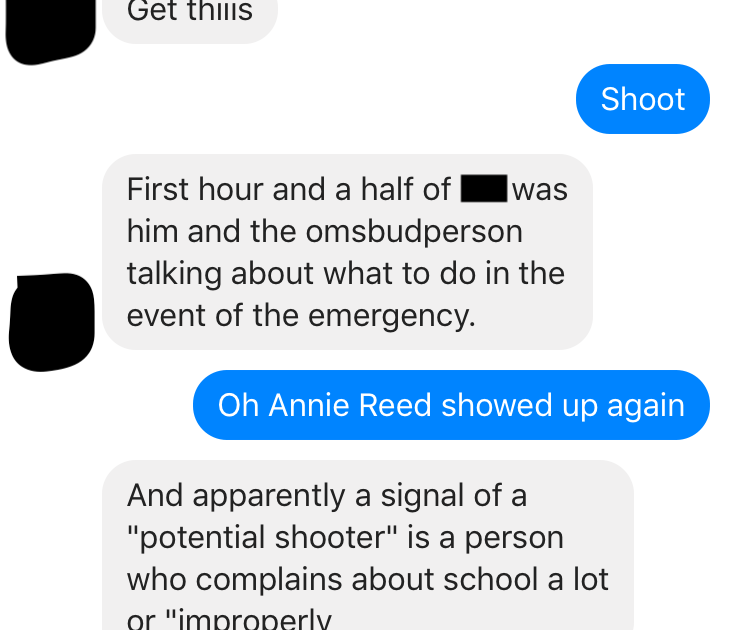
    Reed’s response was to suspend the first student running a smear campaign that he was potential
    active shooter citing the complaints he brought, suspend a thirty-year old single mother in the
    Facebook Group for Academic dishonesty after she forgot to have a college transcript from when
    she was eighteen-years old sent to LAVC, and then threatened the second student who brought an
    Accreditation Complaint for vandalizing school property.

    [Below: Text exchange between LACCD students alleging that administrator Annie Reed created a smear campaign against them.]

    Student 1 was suspended for a year (though not expelled by the Board of Trustees after
    investigation) a semester short of graduating. Student 1 would have earned six associate degrees
    and eight occupational certificates. Student 2, was ordered to pay a substantial amount of
    financial aid back to the college as “restitution.” Several months later, she was subjected to a
    reversal of hours by LAVC Grant Director Dan Watanabe in the Media Arts Department, for a
    campus job she worked and ordered to pay back several thousand dollars. Student 3 ended up
    going to Los Angeles City College to take final classes needed to graduate and was nearly
    refused graduation by Department Chair Eric Swelstad.

    These actions also happened right before and after LAVC Media Arts Faculty Eric Swelstad,
    Chad Sustin, Adrian Castillo, Dan Watanabe, and LAVC President Erika Endrijonas lobbied the
    LACCD Board of Trustees to approve construction of a new Media Arts Building that was later
    reported by The Los Angeles Times to be a massive racketeering scheme – Aug 4, 2022, Teresa
    Watanabe, ‘Corruption and fraud beset long-delayed L.A. Valley college theater project, lawsuit
    alleges.’ (https://www.latimes.com/california/story/2022-08-04/corruption-alleged-in-long
    delayed-la-valley-college-theater-project) 

    These actions mirrored the treatment of a student who sued LAVC’s Media Arts Department in
    2009, alleging the same type of fraud and misconduct by nearly all the same Department Faculty.

    Enrique Caraveo vs Los Angeles Valley College, Eric Swelstad, Joseph D’Accurso, Arantxia
    Rodriguez, Dennis J. Reed among others. Filing Date: 05/18/2009 (https://unicourt.com/case/ca
    la2-enrique-caraveo-vs-los-angeles-valley-college-et-al-621337)

    In that case, Caraveo stated:

    46. When plaintiff complained about the above referenced matters, Swelstad and other Valley
    College officials retaliated against plaintiff by refusing to grant him a Certificate and creating a
    hostile learning environment for him in class.

    47. On or around June 2007 plaintiff satisfied the requirements to get a Cinema Arts Production
    Certificate (“Certificate”) at Valley College.

    54. On or about October 2008, Swelstad denied plaintiff the certificate via a letter even though
    plaintiff has fulfilled the requirements to get the Certificate.

    55. On or about October 13, 2008, plaintiff notified Delahoussaye and Reed that plaintiff had
    fulfilled all requirements for the Certificate and that they should take care of the matter as soon
    as possible. On or about October 13, 2008, Yasmin Delahoussaye and Dennis Reed denied
    request.”

    Dennis Reed, was at the time the Dean over the Media Arts Department and the husband of
    Annie G. Reed. Dennis Reed was later profiled in LAist Magazine on April 27, 2016 article ‘Jerk
    Driver Who Ran Cyclists Off Glendale Road Charged With Assault, Lying To Police’ (https://
    laist.com/news/justice-delivered-almost)

     More to the point – Dennis Reed also oversaw a grant program at Los Angeles Valley College
    Media Arts Department known as IDEAS – Institute for Developing Entertainment Arts and
    Studies at LAVC. The Grant was run by Dan Watanabe. (https://archive.org/details/
    cavgchm_002241/mode/2up?q=Annie+Reed+LAVC)

     Watanabe was also named in the Accreditation Complaint for Wage Theft, Improper use of funds
    and fraud in the successor grant ICT Doing What Matters, due to the college receiving Grant
    Money but immediately eliminating the curriculum the grant application said they would provide
    and like Caraveo’s complaint not providing in class training or labs. The complaints to
    Accreditation and the LACCD Personnel Commission by students also questioned the legitimacy
    of a number of professional experts, including Robert Reber – who was listed as both a ‘student
    worker’ and ‘professional expert’ in 2008. Student 1 further provided evidence to both that Dan
    Watanabe had asked him to falsify his resume claiming fictitious jobs and cited an employee in
    the LAVC Payroll office as being behind it (that employee immediately denied it and Student 1
    refused).

    Dennis Reed had also spent years lobbying for the approval of the VACC building –
    unsuccessfully.

    In short, Annie G. Reed’s retaliation and cover-up in 2016, may have been to help realize her
    husband’s failed building project as well as preemptively shutdown any investigations or audits
    that might trigger further scrutiny regarding how the IDEAS Grant was administered under his
    time as area Dean.

    Reed’s behavior of covering up abusive behavior towards members of the LACCD Community
    was also not limited to retaliation against students.

    In 2017, then LACCD Board President Andra Hoffman accused former Board President Scott
    Svonkin of abusive behavior and demanded sanctions. According to an article in the Los Angeles
    Daily News, ‘LA Community College board postpones sanction hearing vote against former
    4
    president’ August 28, 2017, Annie G. Reed again inserted herself into the matter to cover-up for
    Svonkin.

    “The allegations do not strike me as related to governing and seem best suited for mediation,”
    said Annie Reed, a district employee for 22 years and a representative of Teamsters Local 911. “I
    don’t ever recall a time, or a place, where he has treated his colleagues poorly.”

    Others disagreed, including two former women board members who did not speak at the
    downtown meeting.

    They said Hoffman’s critics — who they said weren’t present during the abuse — had a tendency
    to blame the victim, while ignoring Svonkin’s allegedly brusque treatment of employees.”
    (https://www.dailynews.com/2017/07/13/la-community-college-board-postpones-sanction
    hearing-vote-against-former-president/)

    Her behavior is further documented in a series of lawsuits against the LACCD District. 

    Filed October 03, 2024 Dr. Christiana Baskaran (Plaintiff), Linda Silva; Dr. Ruth Dela Cruz,
    Dr. Adriana Portugal, vs LACCD (including defendant Annie Reed). (https://trellis.law/doc/
    219882998/complaint-filed-by-dr-christiana-baskaran-plaintiff-linda-silva-plaintiff-dr-ruth-dela
    cruz-plaintiff-et-al-as-to-los-angeles-community-college-district-defendant-board-trustees-los
    angeles-community-college-district-defendant-los-angeles-c)

    “[other defendants] Annie Reed to discriminate against female faculty and staff, refused to
    investigate immediately or to take preventative action. Then Defendants and EMPLOYER
    DEFENDANTS retaliated against PLAINTIFFS and others to try and prevent them from
    complaining to authorities. When PLAINTIFFS opposed these illegal practices, they continued
    to retaliate against them.”

    24. As set forth herein, ALL Defendants were officers, agents. Defendants and directly or
    indirectly used or attempt to use their official authority or influence for the purpose of
    intimidating, threatening, coercing, commanding, or attempting to intimidate, threaten, coerce, or
    command PLAINTIFF and others for the purpose of interfering with the right of that person to
    disclose to an official agent matters within the scope of this article. EMPLOYER
    DEFENDANTS aided and abetted MARY GALLAGHER, ARMANDO RIVERA-FIGUEROA,
    ANN HAMILTON, JAMES LANCASTER, JOCELYN SIMPSON, JIM LANCASTER, ANNIE
    REED and Victoria Friedman District Complaince Officer, Genie-Sarceda-Magruder Interim
    Director Office for Diversity, Equity and Inclusion, Rick Von Kolen to violate this statute.

    28. . . .Dr Hamilton admitted to other illegal activity such as planting drugs on employees to
    destroy their reputation and get them fired. Dr Silva filed a grievance against Dean Hamilton to
    try and get her to stop the illegal activity, the union did nothing. 

    32. Ms. Silva complained to Human Resources filed a title IX complaint, made a report to the
    police and was retaliated against.

    Filed October 19, 2023 Sara Adams, An Individual VS California Institute of Technology,
    California Corporation. (https://trellis.law/case/23stcv25556/sara-adams-an-individual-vs
    california-institute-technology-california-corporation)

    “21. On April 7, 2023, Mr. Wu continued to report the pay disparity to Annie Reed, Upon
    information and belief, Annie Reed is Caltech’s Employee and Organizational Development
    Consultant (Human Resources Department). 

    22. Annie Reed spoke about the report of pay disparity to Ofelia Velazquez-Perez, Caltech’s
    Senior Director, Total Rewards and Director of Employee and Organizational Development
    (Employee Relations).”

    Filed March 08, 2021, Mitra Hoshiar, an individual, Plaintiff, v. Los Angeles Community
    College District, (https://trellis.law/case/21stcv08950/mitra-hoshiar-vs-los-angeles-community
    college-district-an-unknown-entity)

    “28. On December 3, 2015, PLAINTIFF then filed a discrimination complaint against Sheri
    Berger (“Berger”), VP of Academic Affairs, and Fernando Oleas (“Oleas”), Pierce Union
    President. During PLAINTIFF meeting with Dean Barbara Anderson (“Anderson”) at
    Anderson’s office on June 10, 2015, Berger and Oleas stopped by and started making remarks of
    PLAINTIFF’s accent for reading the graduates’ names on the ceremony with a non-American
    accent.

    29. Thereafter, On December 11, 2015, in meeting with Dean Annie Reed in conjunction with the
    non-collegiality investigation Walsh, Union Grievance Rep and Oleas stopped by at
    PLAINTIFF’s office in order to prevent PLAINTIFF from Union Representation. They made
    PLAINTIFF to Barbara Anderson, whom was PLANTIFF’s chosen union rep and request for
    Anderson to not join the meeting because Walsh and Oleas had to choose who could be the union
    representation in the meeting.

    30. Based on what had transpired on December 11, 2015, on December 14, 2015, Plaintiff filed a
    Whistleblower/Retaliation Complaint at the District’s Complaint at the District’s Compliance
    Office against Walsh, Oleas, and McKeever (department and union delegate), and other members
    of her department. No action was taken by the Compliance Office.

    Annie G. Reed’s, current interim Dean of Labor and Employee Relations, has been involved in
    covering up wrongdoing in the Los Angeles Community College District for decades. Her targets
    have involved employees, students, faculty, and even a trustee. And so far has never been held
    accountable.

    Multiple stories were published on newswire IndyBay, the news outlet branch of the San
    Francisco Bay Area Independent Media Center between 2023 and 2024. They were then
    scrubbed (along with other stories) over the weekend of May 18, 2025.

    Recently, newly appointed Chancellor, Dr. Alberto J. Roman has been alerted to Ms. Reed’s
    disturbing history – it remains to be seen whether he will take corrective action, or continue to
    6
    keep around the same problematic individuals that resulted in his predecessor’s resignation after
    a vote of no-confidence by the LACCD Academic Senate.

    (To be continued…) 

    Source link

  • Corruption, Fraud and Scandal at Los Angeles Community College District (LACCD Whistleblower)

    Corruption, Fraud and Scandal at Los Angeles Community College District (LACCD Whistleblower)

    During the weekend of May 16-19, 2025, the San Francisco Bay Area Independent Media Center – IndyBay which operates as open platform news source against injustice, scrubbed two years of news articles ranging from May 2023 – May 2025.

    The focus of these articles was corruption, fraud and scandal in the Los Angeles Community College District, primarily at Los Angeles Valley College’s Media Arts Department.

    A few of these articles summarized.

    Erika Endrijonas faces new questions in LACCD fraud | May 2, 2023 |

    Pasadena City College President-Superintendent Erika Endrijonas being fired from the institution and trying to get a job at Santa Barbara City College, Mt. SAC, and Los Angeles City College. Endrijonas had been subjected to a vote of no confidence by the Pasadena Academic Senate, Pasadena Full-Time Faculty Union, protests by Part-Time Faculty, and finally the vote to reduce her contract by the newly elected board of trustees.

    The article dived into Endrijonas’s tenure at her previous institution – Los Angeles Valley College. Endrijonas was announced in her new role at PCC in December 2018, the same week that a jury in Van Nuys awarded a former LAVC employee $2.9 million jury award for illegal retaliation and abuse. A few months earlier, the Los Angeles Times published a major story about the Valley Academic and Cultural Center – a project meant to be Endrijonas’s crowning achievement – being an alleged massive racketeering scheme.

    Further it documented the Media Arts Department the VACC would house had a lengthy history of lawsuits and accreditation complaints against the faculty for not providing the education and training advertised – negating the need for the new building. The building’s approval vote happened in August 2016, the lawsuit happened in 2009, and the Accreditation Complaints happened in June 2016.

    Dozen LAVC Cinema Students Narratives challenge Erika Endrijonas’s LACCD Success Story | May 5, 2023 |

    This article covered a release of an email thread from a dozen students in 2016 that was ultimately sent to the Accreditation Commission for Junior and Community Colleges in 2016, substantiating that there was widespread fraud in the department. Classes were not scheduled by Department Chair Eric Swelstad, training was not provided, labs were not held, etc . . .

    Van Nuys/Los Angeles College Screenwriting Professor Faked Writer’s Guild Membership | May 17, 2023 |

    Revealed that LAVC Media Arts Department Chair Eric Swelstad faked his membership in the Writer’s Guild of America – West, and then used it in multiple professional bios.

    Los Angeles Valley College perpetuated wage theft against students on Julie Su’s watch | May 19, 2023 |

    Documented how Grant Director Dan Watanabe engaged in wage theft against students for two years from 2013 – 2016.

    Two Los Angeles Film Professors Bilked Taxpayers Over $3.5 Million Dollars | May 21, 2023 |

    Described how LAVC Media Arts Department Founder Joseph Dacursso’s retirement first as Department Chair, then as a full-time faculty in 2012, left Department Chair Eric Swelstad and Arantxa Rodriguez to engage in petty infighting and squabbling that spilled over into scheduling decisions. In short, two faculty members collected six-figure-salaries while putting students in the middle of department in-fighting.

    LAVC Omsbudsman Stalked Whistleblowers | August 8, 2023 |

    Described how LAVC’s Dean of Students, Annie G. Reed (Goldman) retaliated and stalked students that went to Accreditation, going as far as running a smear campaign that one of them was a potential school shooter. Worse, she began stalking him after he left school – including on social media.

    [Image: Annie G. Reed Goldman, Dean of Labor and HR at LACCD]

    Further articles questioned where Academic Degrees were given out to students who had not completed Academic classes and criteria, the role of Jo Ann Rivas turned YouTube Personality ‘AuditLA’ who was on the Los Angeles Valley College Citizen’s Building Oversight Committee, whether a number of students with falsified resumes received payments from a Grant as ‘Professional Experts’ etc . . .

    The scrubbing of these articles coincided with the formal appointment of Alberto J. Roman as the new Chancellor of the Los Angeles Community College District, following the retirement of disgraced administrator Francisco Rodriguez.

    It also came with the publication of two final articles. One about Annie G. Reed’s being named as a Defendant in a lawsuit by former faculty at Los Angeles City College, who came to her about an administrator engaging in illegal behavior – including planting drugs on employees to get them fired.

    The second article, probed Los Angeles Valley College Department Chair, Eric Swelstad’s professional bio again and provided evidence that he repeatedly lied and engaged in deceptive advertising and practices for two decades. It provided students who held loans with information about student borrower defenses.

    The censorship also came months after Jo Ann Rivas aka AuditLA, herself probed by the articles, launched a barrage of attacks for about a week in January about a former student who had grievance’s against the school. Rivas had previously engaged in a similar barrage in July 2020.

    This was not the first time that an attempt was made to censor this news stream.

    In 2020, an attempt was made to hack the community news feed account on Twitter/X.com @LACCDW. Then a week before the LACCD Board of Trustees election in November 2020, Twitter suspended the community newsfeed altogether. It was only restored two years later after Twitter’s sale and the re-evaluation of previous suspended accounts.

    In a final update – The Valley Academic and Cultural Center, despite having a 2018 completion date, remains unfinished. According to minutes of the LAVC Work Environment Committee Minutes from 2025-05-08;

    “The Valley Academic and Cultural Center (VACC) is as of Friday, May 8th, about 80% complete. They are still patching the roof. There are still some critical items like stage protection net.”

    Source link

  • What will happen when a university fails to prevent fraud?

    What will happen when a university fails to prevent fraud?

    The first day of September 2025 sees an important chunk of the Economic Crime and Corporate Transparency Act come into force.

    And if you are involved in academic partnerships or the use of agents, you might want to pay heed.

    Receiving Royal Assent in 2023, the Act was initially promoted as tidying up some of the very curious practices around submitting information to Companies House.

    Measures are very much focused on understanding and regulating who gets to become a company director, and ensuring the way a company is run is transparent and properly documented. If you are a fan of the Office for Students new condition of registration E7 you may find some of the new requirements there hauntingly familiar.

    The Act also introduces a range of new offences that can lead to fines, disqualification, and even imprisonment – and higher education providers are among those carefully considering the September start date for offence of “failure to prevent fraud”. And, almost inevitably – the issue comes down to franchising and academic partnership.

    Quick definitions

    Simply put, fraud is the act of gaining a dishonest advantage over another person. In most cases this is a financial advantage.

    To give some sector focused examples – we’ve recently seen cases where student maintenance loans and student fee loans have been paid out to students who have no intention of actually studying. We’ve seen evidence that some providers (and some higher education agents) may have been knowingly registering students for financial rather than educational benefit, and that franchise and partnership agreements – where incentives may be set around income maximisation rather than educational benefit – might have played a role in some of these instances.

    Fraud, obviously, is a criminal offence. Those who commit fraud face consequences, but before the Act it has been harder to ensure that the companies involved do.

    The “failure to prevent fraud” offence, in the words of the government’s guidance, means that:

    an organisation may be criminally liable where an employee, agent, subsidiary, or other “associated person”, commits a fraud intending to benefit the organisation and the organisation did not have reasonable fraud prevention procedures in place. In certain circumstances, the offence will also apply where the fraud offence is committed with the intention of benefitting a client of the organisation. It does not need to be demonstrated that directors or senior managers ordered or knew about the fraud.

    This applies specifically to “large incorporated organisations” (one of: more than 250 employees, more than £36m turnover, more than £18m in total assets). This can apply to an entire organisation, or “a subsidiary or franchise” of an organisation.

    Behind the sofa

    It’s not difficult to imagine that a cash-strapped provider of higher education may not always be motivated to check up on the activities carried out in its name by agents and partners. When dubious recruitment practices are revealed in the press, the usual response by “lead providers” is alarm followed by a decision to withdraw from the partnership. Neither the OfS, Department for Education, or Student Loans Company really has the regulatory tools to deal with stuff on anything other than a whack-a-mole basis – and every time the music stops it turns out nobody realised how bad things really are. Withdraw, regroup – and very often enter into a similar partnership with another organisation.

    The new “failure to prevent fraud” offence means that the onus will be on universities and other providers to prove that they had “reasonable prevention procedures” – and whether they did is a matter for the courts rather than a checklist.

    Things in scope include the public law offence of cheating the public revenue alongside expected parts of the Fraud Act and Theft Act in England and Wales. The law is slightly different in Scotland and Northern Ireland.

    As well as the person who committed the “base fraud” facing consequences, this new rule means that if they are a “person associated” with a relevant body – and are acting in the capacity of that body or providing services on behalf of that body as they commit the fraud – the body itself (the lead partner in our example) will also be on the hook. It is worth remembering that a small organisation can be an “associated person” for these purposes, and although there may be a formal contractual relationship there doesn’t need to be a contract in place.

    Higher education, specifically

    If you scroll through the guidance, you might start breathing normally when you spot that there is an exemption for some “franchisees” – these are seen as connected to the main company by contract only, rather than undertaking business for the parent company. If you think about models of franchising in other sectors, this makes sense – a franchisee basically pays for the rights to use a name and a set of products.

    However, this is not the meaning of the word “franchising” in higher education – and there are specifics in the guidance dealing with the sector.

    Academic franchises may be associated persons for the purposes of the offence depending on the details of the contract. Universities or other degree awarding bodies should take legal advice.

    There’s a line drawn between “validation” franchises (university accredits awards) and “delivery” franchises (university subcontracts delivery of a programme), but there’s no easy line to draw as to whether either is an “associated person” or not. It all comes down to the nature of the individual relationship and what is in the contact or agreement.

    Doing time

    If you are involved in academic partnerships, relationships with agents, or anything similar it feels very much like now should be the moment to get on top of what is in each agreement and what “reasonable preventative measures” might be. How are you monitoring what people are doing on your behalf? How much control do you genuinely have?

    In the main, franchising is done well by higher education institutions. But if corners are being cut, or inconvenient questions not being asked, for the less rigorous few the stakes just got even higher.

    Source link