The British Universities International Liaison Association (BUILA) has expressed concerns that the UKVI’s intention to introduce a new mandatory requirement to add agent details to the CAS will be undermined by inconsistency.
Representing 144 institutions, BUILA has insisted that the proposed listing of agents on the CAS evidence form should be done by selecting from a drop-down list or combo box.
A formal list of certified agents who have engaged with the national Agent Quality Framework training modules already exists and could be utilised to this effect.
In advance of this new CAS requirement, BUILA members are also preparing a sector-wide database of contracted agents, where information on vetting and compliance issues can be shared among international directors to improve standards.
The UKVI, however, has reportedly told stakeholders that a standardised list of agents in a drop-down box format will not possible due to technical system limitations.
The PIE News has contacted UKVI for clarification.
In the past, the government has been criticised for its poor data infrastructure relating to visa applicant data, with many universities turning to private sector solutions such as the Enroly platform to improve data quality.
The use of free-text form fields to capture information can greatly increase the variation of responses captured, making consistent reporting difficult. This issue already persists with naming protocols for international qualifications and language tests across the sector.
The use of free-text form fields to capture information can greatly increase the variation of responses captured
Recording agent names will be further complicated by variations in trading names for different global territories, along with the frequent use of subcontracted agents and franchises.
The current expectation from UKVI is that universities will manually write the name of the contracted agent in the new field as it appears on their official service agreements.
As such, this may be different to the name that a student might associate with having contracted application services from.
Andrew Bird, chair of BUILA, speaking to concerned agents at the QA Higher Education conference said that it was still “unclear” why the government is collecting agent data or what the information will be used for.
The news comes as the Labour government starts to release more information on policies relating to immigration. The use and monitoring of agents in the UK higher education was raised by the Migration Advisory Committee (MAC) in its review of the Graduate Route in 2024, with these new measures forming part of a direct response to those concerns.
Recording agent names on CAS evidence will be tested later in Spring 2025, before becoming a mandatory requirement in the summer during the peak visa application period.
Professor Brian Bell, chair of MAC, will be speaking at The PIE Live Europe, March 11-12 2025, alongside a town hall session from BUILA, where this issue will be discussed further. Tickets are still available for sector professionals wishing to participate.
The debate over whether higher education (HE) serves as a vehicle for social mobility that nurtures meritocracy or as a mechanism for social reproduction that reinforces and exacerbates inequalities in society has persisted for some time. The first perspective regards HE as a meritocratic, achievement-based system of stratification that selects and allocates individuals to societal roles based solely on their merit (in line with Émile Durkheim’s theories). Conversely, the second viewpoint sees education as a means that perpetuates social stratification and the cultural hegemony of the elite (reflecting Bourdieu’s perspective). This phenomenon occurs because students’ socio-economic backgrounds significantly influence their access to, decisions regarding, and success within HE.
To mitigate the impact of socioeconomic background on individuals’ educational opportunities, a movement of research and activism spans from South America to Africa and the Far East, advocating for free HE. To investigate this claim, I examined the situation in Syria, which has consistently asserted that it possesses a meritocratic HE system aimed at fostering societal equality through the provision of free public HE for all since the 1970s. I analysed the Ministry of Higher Education (MoHE) database for 15 academic years, from 2001 to 2015. This dataset encompassed information on student access and graduation rates, categorised by type of education (public, private, higher institutes, and technical institutes), education level (undergraduate and postgraduate), gender (male and female), city, faculty, and specialisations. This analysis revealed various forms of inequality, specifically class-based inequalities, city-based inequalities, and gender-based inequalities.
Class-based inequalities
Although every citizen in Syria who finishes school can access free public HE, many students from high socio-economic backgrounds choose private HE to obtain better education or to pursue specific courses unavailable in the free public tracks. An analysis of the data reveals that the graduation rate in private institutions is almost double that of public institutions. One of the reasons behind this discrepancy in graduation rates between free public HE and private HE is the lack of funding for free public HE. Public university students suffer from a high student-teacher ratio (in some cases, 140 students per teacher) and poor infrastructure compared to the low student-teacher ratio (around 20 students per teacher) and better infrastructure in private universities. Furthermore, inadequate funding for free public universities has led qualified lecturers to prefer teaching at private institutions. This has widened the inequality between public and private HE institutions, as students with the financial capacity to access private HE learn from the most qualified teachers in Syria and receive the best knowledge available.
City-based inequalities
Although Syria has 14 cities, during the analysis period (2008–2013), it had only 5 free public universities located in 5 different cities. These universities have small branches or centres in all Syrian cities, offering limited course options. This design of the HE system has neglected some cities in Syria, leaving them without a proper educational framework. Having only one large university in select cities advantages students who reside in those areas, as they do not endure the added financial and mental pressures that students from other cities face to access education, such as paying for accommodation, living away from home, and travelling to see their families. Consequently, many students from cities without a university may encounter additional barriers to accessing HE, negatively affecting their academic, professional, and personal opportunities and choices. This could explain why cities like Damascus, Homs, and Latakia (where universities are located) are consistently overrepresented in HE, while students from Hama, al-Hasakeh, and al-Rakka (which lack universities) are consistently underrepresented.
In addition to the inequality of access to HE, city-based inequalities also encompass disparities in accessing the various specialisations and faculties offered by HE. This is further exacerbated by the sector’s design as not all faculties or specialisations are available at every university or branch. For instance, undergraduate media studies are solely taught in Damascus. Although Damascus constitutes only 8.75% of the Syrian population, students from Damascus account for 23.9% of the total number of media students. This representation is nearly three times their percentage of the overall population. This significant overrepresentation of students in certain courses occurs at the expense of those from other cities who are unable to access these courses and faculties because they are not available in their localities. This trend of unequal access to specialisations applies to numerous disciplines (eg Pharmacy, Dentistry, Medicine, Arts, IT, Mechanical Engineering, and Architecture). In each of these specialisations, students in the cities where the courses are taught have a distinct advantage over students from other cities in terms of access.
Gender-based inequalities
Officials in the Syrian HE sector have consistently celebrated the progress they have made, asserting that free HE has eliminated gender-based inequality by achieving near parity in enrolment rates. Although noticeable progress has indeed occurred, this claim does not hold up under scrutiny as it obscures other gender inequalities affecting certain groups within the population.
An analysis of the database reveals that, while there is no overarching gender gap in the sector, apart from in undergraduate public universities, disparities exist across all other educational tracks. Moreover, the higher the level of education (Master’s, PhD, etc), the more pronounced the gap becomes. The analysis further indicates that gender-based inequalities extend beyond females’ access to specific tracks and impact female academic representation within the sector. A 14-year average shows that female teachers constitute less than 25% of the total teaching staff in the sector. However, in lower-paid and less prestigious roles, such as technical and administrative positions, females occupy more jobs than their male counterparts (57%).
Conclusion
Simply offering free HE does not address the broader socio-economic inequalities that limit people’s opportunities in HE. Assuming that free HE will foster equality in society presumes that everyone has an equal capacity to access education. This paper demonstrates that HE, if not paired with an inclusive sectoral design, increased funding, and a comprehensive strategy to alleviate socioeconomic inequalities, will persist as a site of social reproduction that creates and exacerbates disparities within societies, even if provided at no cost.
Dr Oudai Tozan recently finished his PhD at the University of Cambridge, researching the potential role of exiled Syrian academics and researchers in rebuilding the higher education sector of Syria. This blog is based on an article published in Policy Reviews in Higher Education: Tozan, O. (2024) ‘Peeling the multiple layers of inequalities in free higher education policies’ (online 12 July 2024).
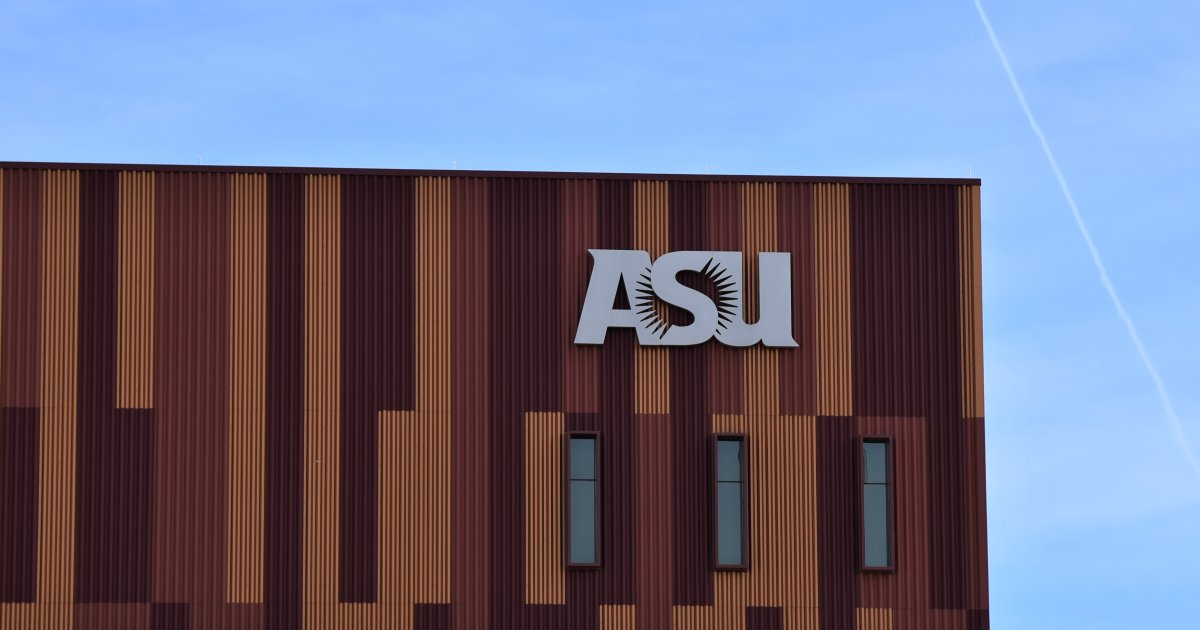
Late last year, a group of Arizona State University alumni gathered on the rooftop of the Canopy Hotel — high enough to see the headlights snake through the city of Tempe, but low enough to feel the pounding bass line of Mill Avenue’s nightlife.
Though the setting was casual, the conversation was anything but. A simple question had brought them together: What obligations do alumni have to their alma mater?
For most graduates, the answer is simple. Come back for Homecoming, buy the sweatshirt, scribble a check when the fundraising office calls. Thanks for your generosity!Click.
But for the assembled Sun Devils — spanning the classes of ’85 to ’24 — their connection to ASU is more than rah–rah nostalgia. They feel a duty to protect what made the university worth attending in the first place.
And so, that evening, they formed ASU Alumni for Free Speech. Their mission? “To promote and strengthen free expression, academic freedom, and viewpoint diversity, both on campus and throughout the global ASU community.”
The group’s inaugural chairman is Joe Pitts, ASU class of ’23 — whose beard, broad shoulders, and sage intellect belie his youth. For him, alumni should be more than mere spectators or “walking check books,” as he puts it, “endlessly giving and expecting little in return.” Instead, they should be invested stakeholders.
Pitts says it’s now fashionable to view a college diploma as little more than a fancy receipt. People think, I paid my tuition, endured the required courses, and behold: I’m credentialed! A neat little market transaction — no lingering ties, no ongoing investment.
But this mindset, Pitts argues, is both morally bankrupt and pragmatically wrong-headed. As a practical matter, he says, “the value of your degree is tied to the reputation of your school — if your alma mater improves over time, your degree becomes more prestigious. If it declines, so does the respect it commands.”
And in the cutthroat world of status-signaling and social capital that matters — a lot.
ASU alumni have already petitioned the Arizona Board of Regents, urging them to adopt a policy of institutional neutrality, which would prevent the university from taking positions on current political issues and weighing in on the cause-du-jour.
As a moral matter, “spending four years (or even more) at a university inevitably shapes you in some way,” Pitts says. “And in most cases, it’s for the better — even if we don’t exactly realize it at the time.” Think about it: how many unexpected friendships or serendipitous moments of clarity, insight, rebellion, and revelation do we owe our alma mater?
To discard that connection the moment you graduate — to treat it like an expired gym membership — isn’t just ungrateful. It’s a rejection of one’s own formation.
But beyond these considerations, Pitts insists that what united them on the Canopy Hotel rooftop last year was — love, actually. Not the saccharine, Hallmark kind or the fleeting thrill of a Tinder rendezvous, but the sort of love that drives men to build cathedrals and forge legacies.
Echoing St. Thomas Aquinas, Pitts says, “We love ASU, and to love is to will the good of the other — not to sit idly by.” And what is the good? It’s a campus where students unapologetically speak their minds; where professors dare to probe the perilous and the provocative; where administrators resist the temptation to do their best Big Brother impression!
Fortunately for ASU Alumni for Free Speech, their alma mater is already a national leader when it comes to free speech on campus — though, as Pitts notes, that’s “a damn low bar.”
ASU ranks 14 out of 251 schools in FIRE’s 2025 College Free Speech Rankings, and has maintained a “green light” rating from FIRE since 2011, meaning its official policies don’t seriously imperil free expression. In 2018, ASU adopted the Chicago principles, committing to the “free, robust, and uninhibited sharing of ideas” on campus.
The university didn’t stop there. This spring, ASU will launch a Center for Free Speech alongside an annual Free Speech Forum.
But despite these credentials, the specter of censorship still lingers at ASU, and the numbers tell the tale:
68% of ASU students believe shouting down a speaker is at least rarely acceptable.
35% believe violence can sometimes be justified to silence speech.
37% self-censor at least once or twice a month.
Over one-third of surveyed ASU faculty admit to self-censorship in their writing.
And so — like the cavalry cresting the hill — ASU Alumni for Free Speech arrives just in time.
“When controversy inevitably arises on a campus of 100,000 students,” Pitts argues, “the defense of free expression shouldn’t be left solely to outside organizations or political bodies. Instead, those speaking up should be people who genuinely care about ASU and have its best interests at heart.”
ASU Alumni for Free Speech aims to be that voice. “In the long run, we want to have a seat at the table,” Pitts explains. “We want to build relationships not just with the ASU administration but also with the Arizona Board of Regents.”
Along with FIRE, ASU alumni have already petitioned the Arizona Board of Regents, urging them to adopt a policy of institutional neutrality, which would prevent the university from taking positions on current political issues and weighing in on the cause-du-jour.
Pitts and the rest of ASU Alumni for Free Speech are tired of playing cheerleader. They’re here to ensure that ASU flourishes not just today, but for every Sun Devil yet to step onto Palm Walk for the first time.
“Sometimes that may look like applause,” Pitts says. “Other times, that may look like criticism.”
In either case, he insists, it’s an act of love.
If you’re ready to join ASU Alumni for Free Speech, or if you’re interested in forming a free speech alumni alliance at your alma mater, contact Bobby Ramkissoon at [email protected]. We’ll connect you with like-minded alumni and offer guidance on how to effectively protect free speech and academic freedom for all.
The Trump administration has cleared the way for immigration arrests at or near schools, ending a decades-old approach.
Republican and Democratic administrations alike have treated schools and child care centers, along with churches and hospitals, as “sensitive” or “protected” locations where immigration enforcement should only take place when there is an immediate danger to the public.
A copy of the Homeland Security memo was not immediately available for review.
But in a statement, a Homeland Security spokesperson said that Acting Secretary Benjamine Huffman issued a directive on Monday that rescinded the sensitive locations policy. The spokesperson said the action would help federal authorities enforce immigration law and catch criminals who entered the country illegally. Immigration agents will be asked to use “common sense” in enforcing the law.
“Criminals will no longer be able to hide in America’s schools and churches to avoid arrest,” the statement read.
Even before this policy existed, large-scale immigration raids weren’t conducted at schools. But Trump’s policy change paves the way for immigration agents to detain parents during dropoff or pickup, as has happened occasionally in the past.
Immigrant rights advocates worry that could lead to more absenteeism among children with immigrant parents, who may now fear being stopped by immigration agents while driving or walking their kids to school. That happened during the first Trump administration. Advocates also worry about the potential for routine interactions with school police to reveal a student or family’s immigration status, and lead to their deportation.
Some school districts have issued explicit instructions to educators and parents about how school staff should handle an immigration agent’s presence on campus. Some districts have also said they will not permit a federal agent on school premises without a judicial warrant, and that staff will be instructed to call the school system’s lawyer if these agents do show up.
Some of the nation’s largest districts, including Los Angeles and Chicago, have re-upped or expanded existing policies meant to protect immigrant students and families. New York City is scheduled to vote on a resolution this week that would reaffirm a policy preventing school safety agents from collaborating with federal immigration authorities in most cases.
Trump also signed an executive order that seeks to end the automatic right to citizenship for any child born in the U.S. On January 21, 18 states announced they were suing to block the policy change.
This story has been updated to include confirmation and comments from the Department of Homeland Security about the policy change.
Chalkbeat is a nonprofit news site covering educational change in public schools.
If progressive or even not-so-progressive Jewish students invited comedian Sacha Baron Cohen to their university to perform his riotous parody “In My Country There Is Problem,” with its call-and-pogrom chorus “throw the Jew down the well / so my country can be free,” would Cohen be allowed on campus? If the song were indeed sung, and a few humorless, unthinking listeners were distressed by the lyrics, or at least claimed to be, would the Jewish students face discrimination and harassment charges under the university’s disciplinary code?
Today, probably. Would they be found responsible for discrimination and harassment based on national origin? Again, probably. And what if a student band wished to parody the parody with a song titled something like, “Throw Chris Rufo Down the Well So My University Can Be Free”? Could the song be sung against the backdrop of students’ sensitivities and the reciprocated rage of today’s young conservative white men?
In her recently published opinion essay for Inside Higher Ed, Joan W. Scott skewered the Foundation for Individual Rights and Expression and its vice president for campus advocacy, Alex Morey, for condemning the American Association of University Professors. Scott’s criticism of Morey’s criticism goes like this: Morey lambasted AAUP president Todd Wolfson’s expression of “disappointment” over Donald Trump’s re-election, arguing that Wolfson’s explicit partisanship betrays the AAUP’s purported commitment to academic freedom. Scott countered that FIRE is a libertarian wolf donning academic freedom drag. FIRE, explains Scott, is “dedicated to the absolutist principle of individual free speech,” a principle that is “not,” Scott italicizes, synonymous with academic freedom. In turn, Scott elaborates on academic freedom as “individual and collective rights of faculty as they pursue the mission of higher education in a democracy.”
We agree with Scott that FIRE—with its many right-wing funding sources as Scott lists them—is unlikely to have our backs if and when the federal government comes to shut down diversity, equity and inclusion programs and cultural studies departments on campus (i.e., queer and Black studies). We respect, too, that Scott knows more about the history and purpose of academic freedom than we do.
And yet, we worry that the line she draws between free speech and academic freedom—the former ideological and libertarian, the latter true and good—cedes too much. Indeed, her distinction hands “free speech” over to the conservative groups championing their anti-educational causes under its banner, and her dismissal of free speech defenses as apologia for racism lets stand, unnuanced, the left-originating but now right-appropriated proposition that combative, controversial speech is necessarily harmful in an egalitarian university environment. It is the quick conversion of (at times highly provocative) political speech into hate speech that allows “from the river to the sea” to be branded as categorically harassing antisemitism—a conversion that would so quickly ban Jews from sending up antisemitism (“throw the Jew down the well”), ban musicians from joking about drowning Rufo or prohibit, for that matter, marginalized groups from reappropriating slurs to divest them of their injurious force.
In short, we think there is still good reason—several good reasons—for the academic left to defend speech, both as elemental to academic freedom and as a democratic value unto itself.
We and nearly every colleague we know have stories of students hastily claiming talk—talk of sex, Israel, Palestine and criticism of affirmative action—as intimidating, harassing or discriminating. It seems to us that a robust defense of academic freedom must include healthy skepticism, but not outright cynicism, of the proposition that words injure. Skepticism, not cynicism, because words may hurt people, further subordinate marginalized groups and erode democratic ideals. David Beaver’s and Jason Stanley’s recently published The Politics of Language draws on critical race and feminist theory to show how some speech acts—affective, nondeliberative and/or racist dog whistles—function to polarize and degrade.
But we also know, especially in the wake of spurious discrimination claims against campus activists and academics protesting Israel’s military campaigns, that conservative stakeholders are weaponizing the idea of words as weapons, alleging atmospheres of harassment to chill political speech—a project, we must concede, that the left paved the way for.
Indeed, around 2013, as trigger warnings gained traction on college campuses, the right repackaged “free speech” as the inalienable freedom of anyone to speak on any topic without consequence, especially if that consequence is the loss of a platform. Instead of drawing on the left’s history of free speech advocacy, scholars of “identity knowledges” centered attention on the moral wrongness of offensive speech and the intolerability of feeling unsafe. This shift left progressives defending feelings rather than ideas, collapsing political discord with dehumanization—or, as Sarah Schulman argues, conflict with abuse. Now, with free speech reduced to melodrama, even the Christian right claims to protect its constituents against “harm”—whether from critical race theory or drag shows—rendering the issue a conceit of the culture wars.
In his much-ridiculedop-ed for TheNew York Times published last year, linguist John McWhorter lamented that he and his students were unable to listen to John Cage’s silent “4:33” during class, as the silence would have been interrupted by the sound of student protests. The irony that McWhorter chided the protesters for impeding his students from appreciating Cage’s invitation to listen to “the surrounding noise” of the environs was not lost on McWhorter’s critics.
What was not commented on, though, was McWhorter’s contention that if a group of students had been shouting “DEI has got to die” with the same fervor with which they were shouting for Palestine’s self-determination, then the protests “would have lasted roughly five minutes before masses of students shouted them down and drove them off the campus. Chants like that would have been condemned as a grave rupture of civilized exchange, heralded as threatening resegregation and branded as a form of violence.”
Whether correct or not, McWhorter’s speculation is not baseless. We want to insist, though, that there are left, not just libertarian, grounds to defend, for example, a student protest against DEI initiatives. They include: respecting and celebrating the university as a space of open dialogue and debate; the possibility that you might learn something from someone with whom you disagree; the opportunity to lampoon, parody or otherwise countermand whatever worse-than-foolish statement the opposition is making; the opportunity, as John Stuart Mill taught us, to strengthen your own ideas and arguments alongside and against the ideas of others; and finally, avoiding the inevitable backlash of “the cancel,” whereby censored conservatives rebrand themselves as truth-telling victims of the “woke.”
Granted, some of these grounds for defending speech tilt more liberal or libertarian than pure left, whatever that means, but we nonetheless maintain that it is self-defeating for us to carry the banner for “academic freedom” while consigning “free speech” to the province of white grievance. This is especially true for those of us teaching queer and critical sexuality studies, where classrooms and related spaces of activism and dialogue are increasingly circumscribed, the harm principle ever more unprincipled. Consider the case of Aneil Rallin, who in 2022 was accused by Soka University of America of teaching “triggering” sexual materials to his students in a course called Writing the Body, and whose case—while taken up by FIRE—was met with little alarm from the academic left.
It also applies to those of us who still recognize satire, irony and social commentary in an age of breathtaking literalism. In 2011, the Dire Straits song “Money for Nothing” (1985) was temporarily banned from Canadian radio for its use of the f-slur, even though the term was intended as a commentary on working-class homophobia. The drive to censor and demonize without regard for social context has arguably gotten stronger in the years since.
From the recent historical record, it seems to us that the enforcement of bureaucratic speech restrictions often damages campus culture and democratic norms more than the speech acts themselves. Indeed, the better question than is X speech act harmful is, to crib from Wendy Brown, when—if ever and at what costs—are speech restrictions the remedy for injury?
Debating DEI programs, myths of meritocracy and so on is the stuff of academic freedom. A speech act like “DEI must die” is provocative, abrasive and worth publicly disparaging, but it is not the same as hate speech. Song parodies will not save us from the dark years ahead for public education, academic freedom and egalitarian pedagogies of all kinds. But our battle preparations demand standing up for, not surrendering, free speech.
Joseph J. Fischel is an associate professor of women’s, gender and sexuality studies at Yale University.
Kyler Chittick is a Ph.D. candidate in the Department of Political Science at the University of Alberta.
To lift a line from the songwriter extraordinaire of our era, “the times they are a- changin’.” Indeed, they are — and this is certainly true in our own corner of the world, the world of free speech.
For better and worse, Donald Trump and his agents are rearranging the structure of free expression in America. Only a few weeks into his presidency, things are proceeding at a breakneck speed, with a flurry of executive orders flying out the windows of the White House. Even early on, there is a sense that what will follow may well mark one of those pinpoints in our history when that “experiment” of which Holmes spoke is tested. Whatever else happens, it is important that there is some record of these times and what happened in them. To that end, we will soon launch a new segment within FAN called “Executive Watch” to track it all: the President’s orders, the executive agencies’ actions, the activities of the President’s affiliates, and Mr. Trump’s personal undertakings.
Enter Professor Timothy Zick, the William and Mary Law School Robert & Elizabeth Scott Research Professor and John Marshall Professor of Government and Citizenship.
WATCH VIDEO: Trump Calls For Changes To First Amendment, Demands “Mandatory One-Year In Jail” For U.S. Flag Burning.
By chronicling such information and then analyzing it, the hope is that our readers will have a more informed sense of the state of free speech at a time when so much is in flux. There is the hope that “Executive Watch” will prompt further discussion of that vital freedom that is at the core of constitutional government in America.
FBI agents file First Amendment class action
While FBI agents may be at-will employees who can, generally speaking, be fired for “any reason or no reason,” they can’t be fired for an unconstitutional reason, or as punishment for the exercise of their constitutional rights (e.g. he can’t fire all the African-American agents, or all the agents registered as Democrats).
The Complaint, filed in DC District Court, is posted here. Plaintiffs are “employees of the FBI who worked on Jan. 6 and/or Mar-a-Lago cases, and who have been informed that they are likely to be terminated in the very near future for such activity.” They “intend to represent a class of at least 6,000 current and former FBI agents and employees who participated in some manner in the investigation and prosecution of crimes and abuses of power by Donald Trump, or by those acting at his behest.”
Knight Institute on need for fact-checking platform
[Recently] Meta announced changes . . . to its content moderation policies, including that it’s replacing third-party fact checking with a Community Notes model that allows users to publicly flag content they believe to be incorrect or misleading.
The following can be attributed to Katherine Glenn Bass, the Knight Institute’s research director:
Katy Glenn Bass
“Mark Zuckerberg’s announcement today is a stark reminder that many of the biggest platforms we use to communicate about issues of public importance are owned by billionaires who are not accountable to us. Apart from the obvious effort to signal political allegiance, the impact of the announced changes will not be clear for some time. But if we have any hope of measuring or understanding what is happening on these platforms, we need strong protections for the independent researchers and journalists who study them, and better mechanisms for ensuring they can access platform data.”
In 2019, more than 200 researchers signed an open letter in support of the Knight Institute’s efforts to persuade Facebook to amend its terms of service to establish a “safe harbor” for public-interest journalism and research on the platform. Read more about that effort here.
Shibley on Harvard’s anti-Semitism settlement
Robert Shibley
Just one day after President Trump took office, Harvard agreed to settle two lawsuits brought against it by Jewish students that alleged the university ignored “severe and pervasive anti-Semitism on campus” and created “an unbearable educational environment” in the wake of the October 7, 2023, Hamas attack on Israel and the ongoing war in Gaza.
While the settlement language itself does not appear to be public, a press release filed on the official docket of The Louis D. Brandeis Center for Human Rights Under Law v. President and Fellows of Harvard College included some details. Most notably, Harvard agreed to adopt the International Holocaust Remembrance Alliance’s (IHRA’s) definition of anti-Semitism. FIRE’s worry, shared by many others — including the definition’s primary author — is that, when added to policies used to punish discriminatory harassment on American campuses, the definition is too likely to be used to punish speech that is critical of Israel or its government but that is not motivated in animus against Jews or Israelis.
FIRE has repeatedly proposed steps to address anti-Semitic discrimination on campus that would safeguard students from harassment while protecting freedom of speech, most recently in our inauguration-day letter to President Trump. Getting this right is important; any proposal that chills or censors protected speech on campus won’t pass constitutional muster at public universities, won’t square with free speech promises at private universities (like Harvard), and won’t effectively address anti-Semitism.
Nevertheless, attempts to codify the IHRA definition of anti-Semitism into laws or regulations are nothingnew. FIRE posted a roundup of the widespread civil libertarian opposition to its codification last year, when Congress considered adopting it as federal law. Among those opponents is the definition’s primary author, Kenneth Stern, who spoke at length with FIRE’s Nico Perrino on our So to Speak podcast about why it’s not the right tool for the job of regulating speech. As Stern wrote back in 2016 for The New York Times: “The definition was intended for data collectors writing reports about anti-Semitism in Europe. It was never supposed to curtail speech on campus. . . . And Jewish students are protected under the law as it now stands.” (Perhaps “as it is now written” would have been more precise; whether colleges follow the law is a different issue.)
As Stern predicted in that piece:
If this bill becomes law it is easy to imagine calls for university administrators to stop pro-Palestinian speech. Even if lawsuits alleging Title VI violations fail, students and faculty members will be scared into silence, and administrators will err on the side of suppressing or censuring speech.
Stern’s prediction is about to receive ground testing at Harvard, and likely at other universities that may follow its lead.
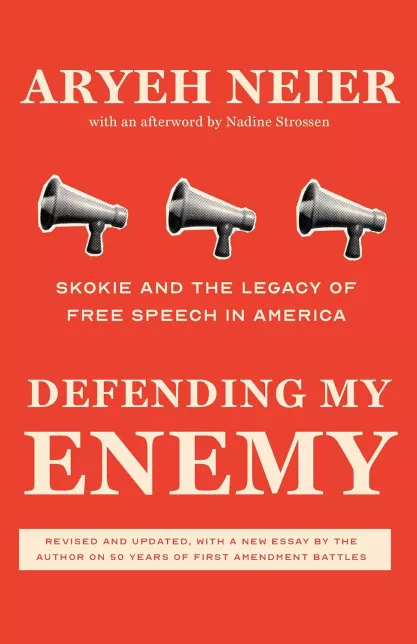
Forthcoming book: New edition of Neier’s ‘Defending My Enemy’
A new edition of the most important free speech book of the past half-century, with a new essay by the author on the ensuing fifty years of First Amendment controversies.
When Nazis wanted to express their right to free speech in 1977 by marching through Skokie, Illinois — a town with a large population of Holocaust survivors — Aryeh Neier, then the national director of the ACLU and himself a Holocaust survivor — came to the Nazis’ defense. Explaining what many saw as a despicable bridge too far for the First Amendment, Neier spelled out his thoughts about free speech in his 1977 book Defending My Enemy.
Now, nearly fifty years later, Neier revisits the topic of free speech in a volume that includes his original essay along with an extended new piece addressing some of the most controversial free speech issues of the past half-century. Touching on hot-button First Amendment topics currently in play, the second half of the book includes First Amendment analysis of the “Unite the Right” march in Charlotteville, campus protest over the Israel/Gaza war, book banning, trigger warnings, right-wing hate speech, the heckler’s veto, and the recent attempts by public figures including Donald Trump to overturn the long-standing Sullivan v. The New York Times precedent shielding the media from libel claims.
Including an afterword by longtime free speech champion Nadine Strossen, Defending My Enemy offers razor-sharp analysis from the man Muck Rack describes as having “a glittering civil liberties résumé.”
Praise for Defending My Enemy
“Aryeh Neier’s Defending My Enemy is as relevant today as it was when it was first published. The book is a powerful reminder of why free speech matters—not just for the voices we agree with, but for the voices we abhor. Neier’s story of defending Nazis’ rights to speak in Skokie underscores a timeless truth: If we want to preserve freedom for ourselves, we must be willing to defend it for others, no matter how deeply we disagree. At a time when censorship is on the rise globally, Defending My Enemy stands as a bold and principled call to action. Every advocate of free expression needs to read this book—and more importantly, live its lessons.” — Greg Lukianoff
Forthcoming scholarly article: ‘Output of machine learning algorithms isn’t entitled to First Amendment protection’
Machine learning algorithms increasingly mediate our public discourse – from search engines to social media platforms to artificial intelligence companies. And as their influence on online speech swells, so do questions of whether and how the First Amendment may apply to their output. A growing chorus of scholars has expressed doubt over whether the output of machine learning algorithms is truly speech within the meaning of the First Amendment, but none have suggested a workable way to cleanly draw the line between speech and non-speech.
This Article proposes a way to successfully draw that line based on a principle that we call “speech certainty” – the basic idea that speech is only speech if the speaker knows what he said when he said it. This idea is rooted in the text, history, and purpose of the First Amendment, and built into modern speech doctrines of editorial discretion and expressive conduct. If this bedrock principle has been overlooked, it is because, until now, all speech has been imbued with speech certainty. Articulating its existence was never necessary. But machine learning has changed that. Unlike traditional code, a close look at how machine learning algorithms work reveals that the programmers who create them can never be certain of their output. Because that output lacks speech certainty, it’s not the programmer’s speech.
Accordingly, this Article contends that the output of machine learning algorithms isn’t entitled to First Amendment protection. With the Supreme Court signaling its intent to address unresolved questions of online speech, we are poised to enter a new era of First Amendment jurisprudence in the coming years. As we do, scholars, practicing attorneys, and judges can no longer ignore how the algorithms underlying online speech actually work – and how they have changed with the advent of machine learning.
Without recognizing this paradigm shift in algorithmic speech, we risk sleepwalking into a radical departure from centuries of First Amendment jurisprudence. By failing to distinguish between traditional and machine learning algorithms, current consensus about algorithmic speech suggests that the Constitution should, for the first time in its history, protect speech that a speaker does not know he has said. Speech certainty provides a novel and principled approach to conceptualizing machine learning algorithms under existing First Amendment jurisprudence.
2024-2025 SCOTUS term: Free expression and related cases
Cases decided
Villarreal v. Alaniz(Petition granted. Judgment vacated and case remanded for further consideration in light of Gonzalez v. Trevino, 602 U. S. ___ (2024) (per curiam))
Murphy v. Schmitt (“The petition for a writ of certiorari is granted. The judgment is vacated, and the case is remanded to the United States Court of Appeals for the Eighth Circuit for further consideration in light of Gonzalez v. Trevino, 602 U. S. ___ (2024) (per curiam).”)
TikTok Inc. and ByteDance Ltd v. Garland (The challenged provisions of the Protecting Americans from Foreign Adversary Controlled Applications Act do not violate petitioners’ First Amendment rights.)
This article is part of First Amendment News, an editorially independent publication edited by Ronald K. L. Collins and hosted by FIRE as part of our mission to educate the public about First Amendment issues. The opinions expressed are those of the article’s author(s) and may not reflect the opinions of FIRE or Mr. Collins.
On Wednesday, Trump signed an executive order on antisemitism that directs leaders of agencies, including the secretary of homeland security, to familiarize universities with grounds for inadmissibility for foreign nationals “so that such institutions may monitor for and report activities by alien students and staff relevant to those grounds.” Those reports will then lead “to investigations and, if warranted, actions to remove such aliens.”
This development should worry all Americans, regardless of their position on the Israel-Hamas war.
The order implies that universities should be monitoring and reporting students for scrutiny by immigration officials, including for speech that is protected by the First Amendment. It follows last week’s executive order threatening denial of entry to foreign nationals, or even deportation of those currently in the country, who “espouse hateful ideology.”
Free Speech Dispatch
Page
The Free Speech Dispatch is a new regular series covering new and continuing censorship trends and challenges around the world. Our goal is to help readers better understand the global context of free expression.
Student visa holders in the U.S. already risk deportation by engaging in criminal activity, and did so long before the enactment of this order. Students who commit crimes — including vandalism, threats or violence — must face consequences, including potential revocation of visas when appropriate.
The First Amendment does not protect violence, for visitors and citizens alike, and an executive order narrowly confined to targeting illegal acts would not implicate First Amendment rights.
But a fact sheet released by the White House alongside the executive order goes well beyond criminal grounds for removal of foreign nationals to instead threaten viewpoint-motivated deportations. “To all the resident aliens who joined in the pro-jihadist protests, we put you on notice: come 2025, we will find you, and we will deport you,” Trump said. “I will also quickly cancel the student visas of all Hamas sympathizers on college campuses, which have been infested with radicalism like never before.”
If that’s what the Trump White House expects agencies to read into its formal orders, this development should worry all Americans, regardless of their position on the Israel-Hamas war.
Advocates of ideological deportation today should not be surprised to see it used against ideas they support in the future.
Our nation’s campuses are intended to be places of learning and debate that facilitate a wide range of views, even ones that some consider hateful or offensive.
This openness, albeit unpleasant or controversial at times, is a defining strength of American higher education. It’s one of the features attractive to students traveling from abroad who may hope to take part in the speech protections Americans have worked so hard to preserve. These are protections that they may very well be denied in their home countries.
We won’t protect freedom on campus by making it inaccessible to the international students who study there. But, given the warning accompanying the order, international students will now be rightfully afraid that their words — not just their conduct — are under a microscope.
There are already signs that critics of campus demonstrations expect the administration will expel protesters from the country. In the lead-up to the signing of this latest order, pro-Israel advocates claimed to be in contact with officials in the incoming Trump administration concerning lists of student protesters they hope to see deported. One group, Betar, told the New York Post it’s “using a combination of facial recognition software and ‘relationship database technology’” to identify protest attendees who are foreign nationals.
Freedom of speech was never meant to be easy.
At the Foundation for Individual Rights and Expression (FIRE), where I work, we have seen firsthand the many speech-related controversies that have plagued higher education over the decades. In every case, adhering to viewpoint-neutral principles, rather than censorship, has been the proper solution.
If we open the door to expelling foreign students who peacefully express ideas out of step with the current administration about the Israeli-Palestinian conflict, we should expect it to swing wider to encompass other viewpoints too. Today it may be alleged “Hamas sympathizers” facing threats of deportation for their political expression. Who could it be in four years? In eight?
Advocates of ideological deportation today should not be surprised to see it used against ideas they support in the future.
Why (most) calls for genocide are protected speech
News
Creating a “genocide” exception to free speech only opens the door to more speech restrictions and selective enforcement.
In Bridges v. Wixon, the Supreme Court’s 1945 decision rejecting the deportation of Australian immigrant Harry Bridges over alleged Communist Party connections, Justice William Douglas wrote, “Freedom of speech and of press is accorded aliens residing in this country.”
Later decisions from the court complicate the question. The federal government retains significant authority over those who may enter and stay in the country. But the court’s reasoning in Wixon should provide lasting guidance.
In his concurring opinion, Justice Frank Murphy stated that he “cannot agree that the framers of the Constitution meant to make such an empty mockery of human freedom” by allowing the government to deport an alien over speech for which it could not imprison him.
Freedom of speech was never meant to be easy. But it allows us the space we need to work through thorny social and political challenges, even when it’s fraught with friction and discomfort. The United States should preserve this freedom on our campuses — spaces for free learning that set us apart from more authoritarian nations around the world — not make an “empty mockery” of it.
Since taking office for his second term on Jan. 20, President Trump has issued a flurry of executive orders, including several implicating the First Amendment and freedom of expression. Below, we highlight some of these orders and evaluate the potential ramifications for free speech.
Executive order on protecting freedom of speech is a good start — but more must be done
One of the first executive orders the president signed was titled “Restoring Freedom of Speech and Ending Federal Censorship.” This order aims to “secure the right of the American people to engage in constitutionally protected speech” and “ensure that no Federal Government officer, employee, or agent engages in or facilitates any conduct that would unconstitutionally abridge the free speech of any American citizen.” Specifically, the order notes the government has “trampled free speech rights by censoring Americans’ speech on online platforms, often by exerting substantial coercive pressure on third parties, such as social media companies, to moderate, deplatform, or otherwise suppress speech that the Federal Government did not approve.”
FIRE welcomes this order’s call to end federal government censorship, including that which is hidden from public view. Leaks, court documents, and other disclosures have revealed instances of federal officials pressuring social media companies to limit controversial but constitutionally protected speech on vigorously disputed topics like the origins of Covid-19, the Hunter Biden laptop story, and election integrity.
We have writtenrepeatedly about the dangers of such government coercion, commonly referred to as “jawboning,” highlighting how this sneaky form of government censorship threatens freedom of expression.
A pledge by the executive branch to respect the free speech of all Americans is a good first step. But any executive order can be modified or reversed on the say-so of one person — the president. It will take actual legislation — such as FIRE’s model transparency bill — to create mechanisms that statutorily require disclosure and bring to light governmental efforts to strong-arm private social media companies into censoring protected speech.
In the meantime, FIRE will monitor the administration’s actions, just as we did during the Biden administration, and hold federal agencies to the standards set forth in the executive order.
Executive orders targeting DEI programs appear to avoid First Amendment pitfalls — but FIRE will be watching their implementation
President Trump also signed two executive orders with the aim of dismantling diversity, equity, inclusion, and accessibility programs. The first, signed on Jan. 20 and titled “Ending Radical and Wasteful Government DEI Programs and Preferencing,” calls for “termination of all discriminatory programs, including illegal DEI and ‘diversity, equity, inclusion, and accessibility’ (DEIA) mandates, policies, programs, preferences, and activities in the Federal Government, under whatever name they appear.”
DEI/DEIA programs and initiatives take many forms. FIRE has no position on the values DEI programs may seek to advance. But our experience defending student and faculty rights on campus demonstrates that DEI administrators and offices haveregularlybeen involved in threats to academic freedom and speech policing, functioning as a way to enforce preferred orthodoxy or ideology. And some DEI initiatives — such as mandatory DEI statements in faculty hiring or student admissions — flatly threaten free expression and academic freedom and should be prohibited. We have previously introduced model legislation designed to eliminate such use of political litmus tests in faculty hiring and student admission decisions.
FIRE has also seen legislation in which overbroad attempts to curtail DEI mandates threaten the very same speech rights of faculty and students they aim to protect. Overbroad restrictions can improperly limit classroom discussions — as we saw in West Virginia’s recent executive order prohibiting faculty from sharing any material that promotes or encourages certain DEI-related views, while at the same time permitting criticism of those views. This allows institutions to continue ideological litmus tests as long as such tests oppose DEI — which just recreates the same problem.
Overzealous enforcement could threaten free speech by, for example, indirectly chilling a professor from sharing their positive views of affirmative action policies or leading to investigation of a government grantee for a social media post expressing personal support for DEI initiatives.
The president’s executive order appears to avoid these issues by targeting only the government’s own speech and initiatives, which it can constitutionally control. For instance, the Office of Management and Budget must provide a list of “Federal grantees who received Federal funding to provide or advance DEI, DEIA, or ‘environmental justice’ programs, services, or activities since January 20, 2021.” This is different from prohibiting any federal grantees from promoting DEI, which would threaten speech. Instead, the order specifically targets federal grants made specifically for the purpose of advancing DEI, and the federal government is free to shut off that funding if it no longer wishes to advance those ideals or views.
A second DEI-related order, signed on January 21, “Ending Illegal Discrimination and Restoring Merit-Based Opportunity,” aims to eliminate “affirmative action” and “illegal discrimination and illegal preferences” in line with the Supreme Court’s decision in Students for Fair Admissions v. Harvard, which held race-based affirmative action programs in college admissions violated the Fourteenth Amendment. (FIRE takes no position on affirmative action.)
FIRE releases statement on the use of ‘diversity, equity, and inclusion’ criteria in faculty hiring and evaluation
News
FIRE’s statement provides guidance to universities to ensure they respect faculty members’ expressive freedom when seeking to advance DEI.
The order helpfully includes two provisions that make clear it does not reach into the college classroom or infringe upon academic freedom:
(b) This order does not prevent State or local governments, Federal contractors, or Federally-funded State and local educational agencies or institutions of higher education from engaging in First Amendment-protected speech.
(c) This order does not prohibit persons teaching at a Federally funded institution of higher education as part of a larger course of academic instruction from advocating for, endorsing, or promoting the unlawful employment or contracting practices prohibited by this order.
While these orders avoid constitutional pitfalls on their face, implementation should proceed carefully. Overzealous enforcement could threaten free speech by, for example, indirectly chilling a professor from sharing their positive views of affirmative action policies or leading to investigation of a government grantee for a social media post expressing personal support for DEI initiatives.
Executive order on “gender ideology” invites possible abuse
This executive order focuses on “[defending] women’s rights and [protecting] freedom of conscience by using clear and accurate language and policies that recognize women are biologically female, and men are biologically male.” The order requires federal government agencies to:
remove all statements, policies, regulations, forms, communications, or other internal and external messages that promote or otherwise inculcate gender ideology, and shall cease issuing such statements, policies, regulations, forms, communications or other messages. Agency forms that require an individual’s sex shall list male or female, and shall not request gender identity. Agencies shall take all necessary steps, as permitted by law, to end the Federal funding of gender ideology.
This aspect of the order is limited to the federal government’s own speech. However, there is a risk, similar to that presented by imprecise anti-DEI legislation, that the breadth of such an order could lead to direct or indirect censorship of private actors. The government has the power to control its speech when it is the speaker, such as in a training given to its employees. But its power is much more limited when the speaker is a private citizen.
Of particular concern is this clause: “Federal funds shall not be used to promote gender ideology. Each agency shall assess grant conditions and grantee preferences and ensure grant funds do not promote gender ideology.”
While the government can choose to change its own messaging on gender issues, it cannot deny funds to grantees for exercising their own First Amendment rights. Further, the imprecise language could encourage government actors to withhold otherwise available grants from those with opinions that do not align with the views expressed in this executive order — chilling constitutionally protected speech. Grantees who would otherwise espouse views agreeing with “gender ideology” may refrain for fear of losing their government grant, even if they do not use the grant itself to promote “gender ideology.”
Executive order intended to “protect” Americans from noncitizens who “espouse hateful ideology” is at odds with our culture of free speech
This executive order makes it federal policy to “protect [American] citizens from aliens who intend to commit terrorist attacks, threaten our national security, espouse hateful ideology, or otherwise exploit the immigration laws for malevolent purposes.” In addition to requiring agencies to ensure their policies for screening aliens align with the executive order, it requires the secretary of state to:
Recommend any actions necessary to protect the American people from the actions of foreign nationals who have undermined or seek to undermine the fundamental constitutional rights of the American people, including, but not limited to, our Citizens’ rights to freedom of speech and the free exercise of religion protected by the First Amendment, who preach or call for sectarian violence, the overthrow or replacement of the culture on which our constitutional Republic stands, or who provide aid, advocacy, or support for foreign terrorists.
The federal government has the authority to refuse entry to or deport people who genuinely present a national security threat. But the broad language of this order implies it may also be used to target people already in the U.S. for engaging in speech that is otherwise constitutionally protected. FIRE haspreviously expressed concern about denials of entry in cases where students and speakers were seemingly barred based on their speech. The ambiguous language of the order, including references to a “replacement of the culture,” suggests an intent to review and potentially punish foreign nationals for speech that would typically be protected.
To be clear, speech that calls for violence is generally protected by the First Amendment. As we have previously written, calls for genocide or chanting “From the river to the sea,” though listeners may be offended or deeply upset, are generally constitutionally protected. Denying visas or deporting anyone who engages in such speech will create a chilling effect, deterring foreign nationals from participating in lawful protests and demonstrations.
But just because the government may have the power to deport people for expressing their views, as it does in at least some circumstances, that does not make such deportations a good idea.
While the driving force behind this executive order is the current Israel-Hamas conflict, there is no reason other than political whim that efforts to punish foreign nationals for their speech would stay confined to one side of that issue, or to the Israeli-Palestinian issue at all. If those targeted for “espousing hateful ideology” are today likely to be those supporting Hamas, a new government could aim such efforts at supporters of Israel’s military efforts in the coming years. Those from other nations experiencing ethnic or religious conflict, from Ukraine to Myanmar to Burkina Faso, could also face adverse immigration decisions for expressing their views.
Why (most) calls for genocide are protected speech
News
Creating a “genocide” exception to free speech only opens the door to more speech restrictions and selective enforcement.
Because this executive order is directed at foreign nationals, the legal First Amendment issues (as distinct from the cultural free speech questions) are complicated. The Supreme Court noted in Bridges v. Wixon that the freedom of speech is accorded to resident aliens, but other precedent upholds immigration consequences based on viewpoint, and immigration officials have targeted foreign nationals for deportation for otherwise-protected speech.
In the 1904 caseUnited States Ex. Rel. John Turner v. Williams, the Court upheld a law that allowed the deportation of “anarchists.” In the 1954 case Galvan v. Press, the Court upheld a law that allowed the deportation of non-citizens for belonging to the Communist Party. (Interestingly, statutory prohibitions on the naturalization of anarchists and members of the Communist Party still exist.)
But just because the government may have the power to deport people for expressing their views, as it does in at least some circumstances, that does not make such deportations a good idea. Establishing a system that allows for the routine deportation of foreign nationals based solely on their otherwise protected speech would erode our national commitment to freedom of expression as a uniquely American cultural value.
A new poll from the Foundation for Individual Rights and Expression finds that conservative and very conservative Americans have more confidence that President Trump will protect their First Amendment rights than Gov. Gavin Newsom or the Supreme Court. Liberal and very liberal Americans are skeptical that any of them will protect their first amendment rights, though they are most confident in Newsom.
The fifth installment of FIRE’s National Free Speech Index further reveals that there is a partisan disagreement about the security of free speech in America and whether or not it is headed in the right direction. When it comes to whether people are able to freely express their views, conservatives are more likely to think that things in America are heading in the right direction and are likely to think that the right to freedom of speech is secure in America today, compared to liberals.
This was not the case three months ago.
Overall, when it comes to whether people are able to freely express their views, 41% of Americans think things in America are heading in the right direction, up 5% from October when 36% of Americans felt this way. Yet, compared to last year, liberals and conservatives have swapped their perspectives on the direction freedom of speech is headed in America in this month’s survey. In July of last year, 31% of very liberal and 45% of liberal Americans reported that freedom of speech in America is headed in the right direction while just 16% of conservative and 20% of very conservative Americans reported the same. Then, in October, 46% of very liberal and 49% of liberal Americans reported the same while just 18% of conservative and 30% of conservative Americans did.
This month however, more conservative (52%) and very conservative (49%) Americans reported thinking things in America are heading in the right direction when it comes to freedom of speech compared to moderate (42%), liberal (34%) or very liberal (31%) Americans. After October last year, a drastic shift in ideological perspective on the state of free speech occurred between liberals and conservatives. While liberal and very liberal Americans were more likely to think that things in America were heading in the right direction in October, in January, conservative and very conservative Americans are now the ones most likely to report the same.
In addition, last year, very liberal and liberal Americans reported much more confidence than conservative and very conservative Americans in the security of free speech in America. In July, 41% of very liberal and 30% of liberal Americans reported that the right of freedom of speech in America was “not at all” or “not very” secure while 49% of conservative and 61% of very conservative Americans reported the same.
In October, the partisan divide grew larger, with 32% of very liberal and 27% of liberal Americans reporting that the right of freedom of speech in America was “not at all” or “not very secure” while 55% of conservative and 60% of very conservative Americans reported the same.
The large partisan divide between the liberals and conservatives and the swap in their political viewpoints on free speech this month may be startling but a clear indication of how Americans are reacting to the outcome of the presidential election.
Yet, this month, liberals and conservatives have swapped their perspectives on the security of free speech in America, with 46% of very liberal and 36% of liberal Americans reporting “not at all” or “not very secure” and 29% of conservative and 41% of very conservative Americans reporting the same, showcasing conservatives’ growing trust that their free speech rights are secure.
Moderates, on the other hand, have remained consistent in their views over the last six months, with approximately 40% of moderates reporting that the freedom of speech in America was “not at all” or “not very secure”.
This quarter’s survey makes evident the ideological trends among Americans and their perspectives on the security and condition of their free speech rights. The large partisan divide between the liberals and conservatives and the swap in their political viewpoints on free speech this month may be startling but a clear indication of how Americans are reacting to the outcome of the presidential election.
FIRE’s poll found confidence in the future of free speech is still low (41%), but jumped 10 points compared to a July poll.
Conservatives went from the most pessimistic subgroup to the most optimistic following Donald Trump’s election, while liberals’ optimism fell.
PHILADELPHIA, Jan. 30, 2025 —A new poll finds that confidence in the future of free speech in America and belief in Donald Trump’s commitment to the First Amendment both saw an uptick, at least among conservatives. (Liberals are not so sure.)
The newest edition of the National Speech Index — a quarterly barometer of free speech from the Foundation for Individual Rights and Expression — found that Americans are still mostly pessimistic about the state of free expression in America, with only 41% saying the country is headed in the right direction.
But those numbers represent an all-time high since FIRE began asking the question last year, and a 10-point jump from the 31% who said the country was headed in the right direction in July.
The increase in confidence is driven in large part by a substantial surge in free speech optimism from self-described conservatives. The October edition of the National Speech Index found that less than a third (30%) of very conservative Americans and less than a fifth (18%) of conservative Americans said that people’s ability to freely express their views was headed in the right direction, while now roughly half of very conservative (49%) and conservative (52%) Americans now say it is headed in the right direction.
“Unsurprisingly, the sudden shift suggests that for many Americans’ their feelings about the future of free speech depend in large part on whether they trust whomever occupies the White House,” said FIRE Research Fellow and Manager of Polling and Analytics Nathan Honeycutt. “Of course, we at FIRE have long recognized that no party has a monopoly on censorship.”
Liberals, on the other hand, saw a drop in free speech optimism. In October, 46% of very liberal Americans and 49% of liberal Americans said people’s ability to freely express their views was headed in the right direction, compared to about a third now (34% and 32% respectively). That fall wasn’t large enough to outweigh the large jump from conservatives.
When asked about Trump’s commitment to the First Amendment, opinions were mixed. While 39% said they had “quite a lot” or “full” confidence he would protect their First Amendment rights, 41% said they had “very little” or “no confidence at all.” But that’s still a seven-point increase from when FIRE asked the same question about then-candidate Trump in October, when 32% said they had “quite a lot” or “full confidence” in Trump’s protection of the First Amendment.
For comparison, FIRE also asked about the Supreme Court and a high-profile elected official on the other side of the political aisle, California Gov. Gavin Newsom. Opinions on Newsom were split neatly into thirds: 34% said they had high confidence, 34% said they had some confidence, and 32% expressed low confidence. Meanwhile, only 23% of Americans said they had high confidence in the Supreme Court to protect their First Amendment rights, compared to 44% who said they had low confidence.
“Though declining levels of trust in institutions is concerning, skepticism that politicians or the courts will protect your free speech is always a healthy instinct,” said Honeycutt. “The best defense against censorship isn’t a particular public official. It’s the American people themselves cultivating a free speech culture, defending others’ right to disagree, and holding leaders accountable.”
As censorship attempts tend to target controversial and unpopular opinions, FIRE asked respondents to judge several political statements on how offensive they found them. The results showed that wide swathes of Americans identified statements on both sides of certain divisive topics as offensive. While 45% of respondents found it “very” or “extremely” offensive to say “Black Lives Matter is a hate group,” for example, 51% said “The police are just as racist as the Ku Klux Klan” was an offensive statement as well.
In another example, 40% of Americans believe that “transgender people have a mental disorder” — a sentiment banned on Facebook and Instagram until earlier this month — is an extremely or very offensive statement. But 59% also said the idea that “children should be able to transition without parental consent” was offensive.
“The problem with policing offensive speech is that there will always be disagreement on what is and isn’t offensive,” said FIRE’s Chief Research Advisor Sean Stevens. “Many people who want to ban offensive speech imagine they could never end up on the receiving end, but often what people find offensive changes rapidly.”
The National Speech Index is a quarterly poll designed by FIRE and conducted by the Dartmouth Polarization Research Lab to capture Americans’ views on freedom of speech and the First Amendment, and to track how Americans’ views change over time. The January 2025 National Speech Index sampled 1,000 Americans and was conducted between January 3 and January 9, 2025. The survey’s margin of error of +/- 3%.
The Foundation for Individual Rights and Expression (FIRE) is a nonpartisan, nonprofit organization dedicated to defending and sustaining the individual rights of all Americans to free speech and free thought — the most essential qualities of liberty. FIRE educates Americans about the importance of these inalienable rights, promotes a culture of respect for these rights, and provides the means to preserve them.
The Polarization Research Lab (PRL) is a nonpartisan collaboration between faculty at Dartmouth College, Stanford University and the University of Pennsylvania. Its mission is to monitor and understand the causes and consequences of partisan animosity, support for democratic norm violations, and support for partisan violence in the American Public. With open and transparent data, it provides an objective assessment of the health of American democracy.
CONTACT:
Alex Griswold, Communications Campaign Manager, FIRE: 215-717-3473; [email protected]