Tag: free

  • The global free speech recession

    The global free speech recession

    This essay was originally published in The Dispatch on Oct. 28, 2025.


    Since Charlie Kirk’s murder, the Trump administration has launched a blitzkrieg against Americans’ free speech rights. The scale and speed are dizzying — and they jeopardize the United States’ credibility as the world’s leading defender of free expression as other democracies continue to falter.

    The administration’s most alarming actions blur the distinction between protected and unprotected speech as well as words and violence. Right after the Kirk tragedy, Attorney General Pam Bondi said: “We will absolutely target you, go after you, if you are targeting anyone with hate speech.” Bondi later walked this statement back, saying that “Hate speech that crosses the line into threats of violence is NOT protected by the First Amendment.” But since then, the administration has only continued to conflate protected speech with violence.

    Why everything Pam Bondi said about ‘hate speech’ is wrong

    The nation’s top law enforcement officer doesn’t understand there is no hate-speech exception to the First Amendment — and that’s scary.


    Read More

    On Sept. 25, the White House released a national security memo on “Countering Domestic Terrorism and Organized Political Violence.” Inside it lies this passage:

    Common threads animating this violent conduct include anti-Americanism, anti-capitalism, and anti-Christianity; support for the overthrow of the United States Government; extremism on migration, race, and gender; and hostility towards those who hold traditional American views on family, religion, and morality.

    There’s little subtlety here. The White House has flagged Americans it considers anti-American, anti-capitalist, or anti-Christian — none of which the memo defines — as potential national security threats. The president’s memo asserts a vast left-wing conspiracy to incite political violence and then directs the National Joint Terrorism Task Force and its local offices to “investigate all participants in these criminal and terroristic conspiracies.”

    This guilt-by-association tactic is absolutely chilling in a free society. Being critical of America, capitalism, and Christianity shouldn’t put you on the feds’ radar because all those viewpoints are protected speech. A federal investigation should only occur when there’s reasonable evidence that some person or group — regardless of their constitutionally protected beliefs and opinions — has crossed the line into criminality. By the memo’s logic, the president’s own Make America Great Again movement could have been investigated after the political violence that erupted on Jan. 6. The message conveyed here is simple: Watch what you say. Or else.

    And if you’re a noncitizen legally in the country, that message goes doubly for you. Two weeks ago, the State Department revoked six foreigners’ visas for their social media posts about Kirk’s murder. According to the State Department on X, it will “continue to identify visa holders who celebrated the heinous assassination of Charlie Kirk.” This continues the administration’s crusade against noncitizens who engage in expression that the government doesn’t like. But the First Amendment protects the free speech rights of anyone on American soil, as the Supreme Court made clear in 1945’s Bridges v. Wixon. (Full disclosure: the Foundation for Individual Rights and Expression, my employer, is currently suing Secretary of State Marco Rubio to challenge two federal provisions that give the secretary the power to deport noncitizens for their protected speech.)

    Why FIRE is suing Secretary of State Rubio — and what our critics get wrong about noncitizens’ rights

    FIRE is suing Secretary of State Rubio to defend the First Amendment rights of legal immigrants threatened with deportation simply for speaking their minds.


    Read More

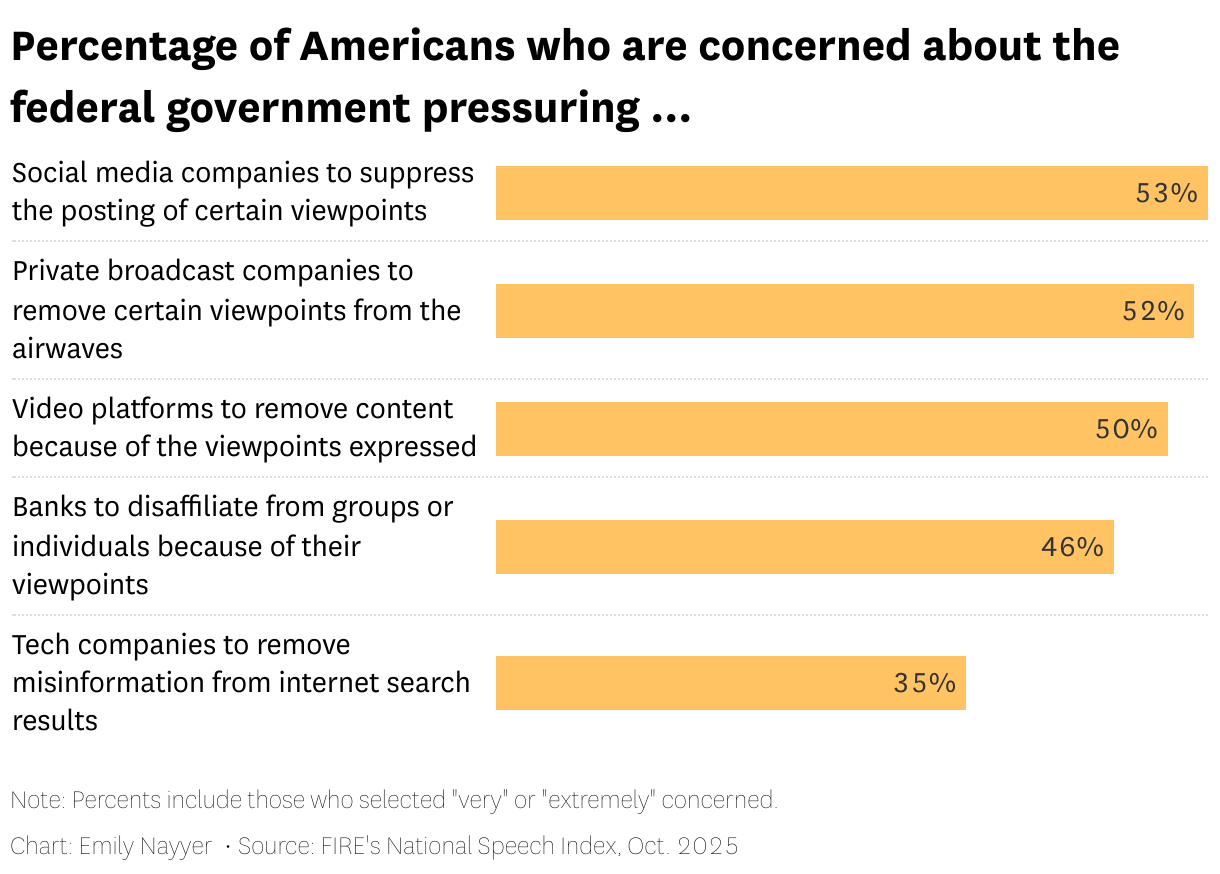
    The administration has intensified its prolific jawboning, too, turning the screws on the private sector, particularly the media, to achieve what it does not have the constitutional power to do itself. The most infamous example of this occurred when Federal Communications Commission Chairman Brendan Carr pressured Disney and ABC to cancel Jimmy Kimmel Live. Soon after, ABC indefinitely suspended Kimmel, though he was back on air after a week. Then in mid-October, Bondi leaned on Facebook to remove a group page that allowed users to track where ICE agents were in Chicago, much like Waze alerts you to speed traps. Like it or not, this is constitutionally protected speech. Telling folks the location of law enforcement isn’t a crime, and the creators and users of the page are registering their dissent to the government’s immigration policies.

    During the Biden administration, President Trump and conservative Americans understood the perniciousness of jawboning. They rightly pointed to the behind-the-scenes pressure the Biden administration exerted on social media companies to suppress stories they deemed as mis- or disinformation. This included Hunter Biden’s laptop, the efficacy of the COVID-19 vaccines, or the lab-leak theory of COVID-19’s origins. Yet now that Trump is back in power, the feeling is that “the left” is getting their just deserts. Politics is triumphing over principle — remember Trump’s promise to “bring back” free speech and his executive order restoring free speech and ending federal censorship once and for all — as America’s culture of free expression deteriorates more and more.

    But the Trump administration’s deliberate and focused attacks on free expression don’t just impact America, they reverberate globally. Across the democratic world, a free speech recession continues to worsen. Rather than defend this foundational human right at home and abroad, the U.S. government is abdicating that responsibility and undermining the legitimacy of free speech in an increasingly illiberal and authoritarian world.


    Two years ago, The Future of Free Speech, a nonpartisan think tank at Vanderbilt University, released a report, “The Free Speech Recession Hits Home.” The report analyzed free speech developments in 22 democracies between 2015 and 2022. It found something alarming: “Over 75 percent of the developments discussed are speech restrictive.”

    Recent examples from the United States’ closest allies are illustrative of these societies’ splintering belief in free speech as a critical right in a democracy.

    This fall, Canada’s Quebec province will consider a bill to ban prayer in public. Secularism Minister Jean-François Roberge said the bill would be introduced as part of his mandate “to strengthen secularism.” Religious expression, of course, is a form of free expression, but Roberge believes it shouldn’t be public. “Seeing people praying in the streets, in public parks, is not something we want in Quebec,” he said. He added: “When we want to pray, we go to a church, we go to a mosque, but not in public places. And, yes, we will look at the means where we can act legally or otherwise.”

    In Germany last year, a 64-year-old man had his flat searched and tablet seized because of alleged “antisemitic” posts as well as one calling a German politician a “professional idiot.” Under German law, it’s not only a crime to insult a politician, the penalties are more severe than criticizing a German pleb, in perfect Animal Farm style. Also in 2024, American expat C.J. Hopkins was charged with disseminating propaganda for criticizing Germany’s COVID-19 response on X by superimposing a barely visible white swastika on top of a white medical mask.

    So to Speak Podcast Transcript: CJ Hopkins compared modern Germany to Nazi Germany. Now he’s standing trial.

    J Hopkins is an American playwright, novelist, and political satirist. He moved to Germany in 2004.


    Read More

    This is a feature, not a bug, of Germany’s repressive speech climate. During a 60 Minutes story from last February, when correspondent Sharyn Alfonsi asked three prosecutors if it was a crime in Germany to insult someone, they confirmed it was. The punishment could even be worse when posted online “because in internet, it stays there,” said one prosecutor. Germany’s federal police, the BKA, also organize “action days” — including investigations, raids, interrogations, and seizures — to crack down on hate speech and insulting politicians online. In June, the BKA launched its 12th day of action, which included a total of 180 “police measures.” Herbert Reul, an interior minister for the German state of North Rhine-Westphalia, summed it up best, telling a German news agency, “Digital arsonists must not be allowed to hide behind their phones or computers.”

    In France, President Emmanuel Macron took thin-skinned to extraordinary heights when he sued a billboard owner in 2021 for using some of his inventory to depict the French president dressed up like Adolf Hitler to protest France’s pandemic policies. The business owner, Michel-Ange Flori, told Reuters: “I caricature. People may or may not like it but it is all the same, caricature will remain caricature.” A French court disagreed, slapping Flori with a fine of 10,000 euros. In response, Flori’s lawyer said “the right to caricature has been violated” in France, adding, “The president, so quick to defend freedom of expression … considers that it stops at his own august person.”

    But the most depressing accomplice in the West’s retreat from free speech is, without a doubt, our neighbor across the pond. In April, the Times of London reported a shocking statistic. Analyzing custody data, the newspaper reported that police in the United Kingdom arrested more than 24,000 people from 2022 through 2023 for sending “grossly offensive” messages or sharing posts considered “indecent,” “obscene,” or of a “menacing character” on social media.

    The most recent and infamous case of this is Irish comedy writer Graham Linehan. In early September, five armed police officers arrested the writer after he disembarked a flight from the United States to Heathrow. Linehan’s offense: mean tweets about transgender people, which the Metropolitan Police said incited violence. Linehan posted the tweets in April — four and a half months before his arrest — demonstrating the absurdity of the inciting-violence rationale. Last week, both Linehan and Londoners received good news: The Metropolitan Police announced they dropped the investigation into Linehan and said it would no longer investigate “non-crime hate incidents.” That’s the right approach, of course, but that’s only one police force across the entire kingdom. It also doesn’t undo the ordeal Linehan went through, which is why he intends to sue the Metropolitan police for wrongful arrest.

    The U.K.’s crackdown on speech, however, isn’t contained to online discourse. Since July, more than 2,000 people have been arrested for expressing support for Palestine Action, a pro-Palestinian direct action network. In July, Parliament deemed the group a terrorist organization and banned it after two members broke into a military base and damaged two planes.

    In early September, London’s Metropolitan Police arrested nearly 900 protesters for peacefully protesting the ban. A month later, police arrested nearly 500 more people for demonstrating in support of Palestine Action in Trafalgar Square. The reason for their arrest is eye-widening: They held up a sign that read, “I oppose genocide, I support Palestine Action.” Police even took in a man who held up a magazine cover about these arrests.

    Diane Afhim, a 69-year-old protester, said it best during the September arrests: “I feel that justice is not working if people are being arrested for holding a sign. This is not my Britain.”

    Late last month, another disconcerting story came out of the U.K., when a judge handed down a suspended sentence to Moussa Kadri, sparing him jail. Back in February, Kadri attacked a protester, Hamit Coskun, with a knife for burning the Quran outside of the Turkish consulate in London.

    “The court is effectively saying that if you attack a blasphemer with a knife, … you won’t have to spend a day behind bars,” said Lord Young of Acton, general secretary of the Free Speech Union, in reaction to Kadri’s suspended sentence.

    In Quran burning conviction, UK judge uses violence against defendant as evidence of his guilt

    UK judge cites violence against Quran-burning protester as proof of his guilt, Brazil sentences comedian to over eight years for telling jokes, and France targets porn.


    Read More

    But things get worse. Back in June, a court found Coskun, the victim of Kadri’s knife attack, guilty of a religiously aggravated public order offense and ordered him to pay a fine. “Your actions in burning the Quran where you did were highly provocative,” the judge said, “and your actions were accompanied by bad language in some cases directed toward the religion and were motivated at least in part by hatred of followers of the religion.” Most alarming was the judge’s finding that the violent attack on Coskun was evidence of Coskun’s guilt. You read that right.

    Fortunately, Coskun won his appeal this month. On Oct. 10, Coskun’s conviction was overturned by a judge who reminded Britons that they have no blasphemy law on the books.

    “Burning a Koran may be an act that many Muslims find desperately upsetting and offensive,” Justice Joel Bennathan said. “The criminal law, however, is not a mechanism that seeks to avoid people being upset, even grievously upset. The right to freedom of expression, if it is a right worth having, must include the right to express views that offend, shock or disturb.”

    While the courts finally got it right, Coskun never should have had to go through this nightmare in the first place.


    The despots of the world must relish the propaganda value of this Western backsliding on free expression.

    If they attack the press, they can point to what Trump is doing in the United States as justification. Throw a critic in jail? They can bring up Macron’s lawsuit for caricaturing him in France. Punish a religious dissenter? Well, there’s the curious case of Hamit Coskun in London. Repress the supporters of a disfavored group? They can point to the UK arrests of Palestine Action protesters. These illiberal actions are gifts to the world’s dictators — the Putins, the Erdogans, the Xis of the world — demonstrating that when push comes to shove, the world’s democracies will crack down on speech they don’t like, too.

    Just look at the unjust trial of media mogul Jimmy Lai in Hong Kong, where a judge in the case cited censorship in the U.S. and UK to justify the proceedings against Lai. “People who were freely expressing their views on Palestine, they were arrested in England … [and] in the U.S.,” Judge Esther Toh said in August. “It’s easy to say ‘la-di-da, it’s not illegal,’ but it’s not an absolute. Each country’s government has a different limit on freedom of expression.”

    But it doesn’t need to be this way.

    It’s a cruel irony that America’s dedication to free speech is slipping as we prepare to celebrate this nation’s 250th birthday. But it’s an opportunity, too. An opportunity to recommit to what makes the American experiment so special: our ability to settle our differences through dialogue and the ballot box, rather than dehumanization and the bullet. America is still the last best hope of earth, that shining city upon the hill, if we’ll fight for it.

    Even as America’s culture of free speech withers, the First Amendment fortunately still gives this country the world’s strongest constitutional protection for speech. But culture matters. Woe to us if we indulge our worst impulses and welcome in the ravenous, all-consuming spirits of censorship and violence and turn our back on what truly makes America exceptional.

    As Judge Learned Hand wrote back in 1944: “Liberty lies in the hearts of men and women; when it dies there, no constitution, no law, no court can even do much to help it. While it lies there it needs no constitution, no law, no court to save it.”

    There would be no greater tragedy than if free speech dies here by our own hands, to the delight of despots everywhere.

    Source link

  • Clear and Present Danger – A history of free speech

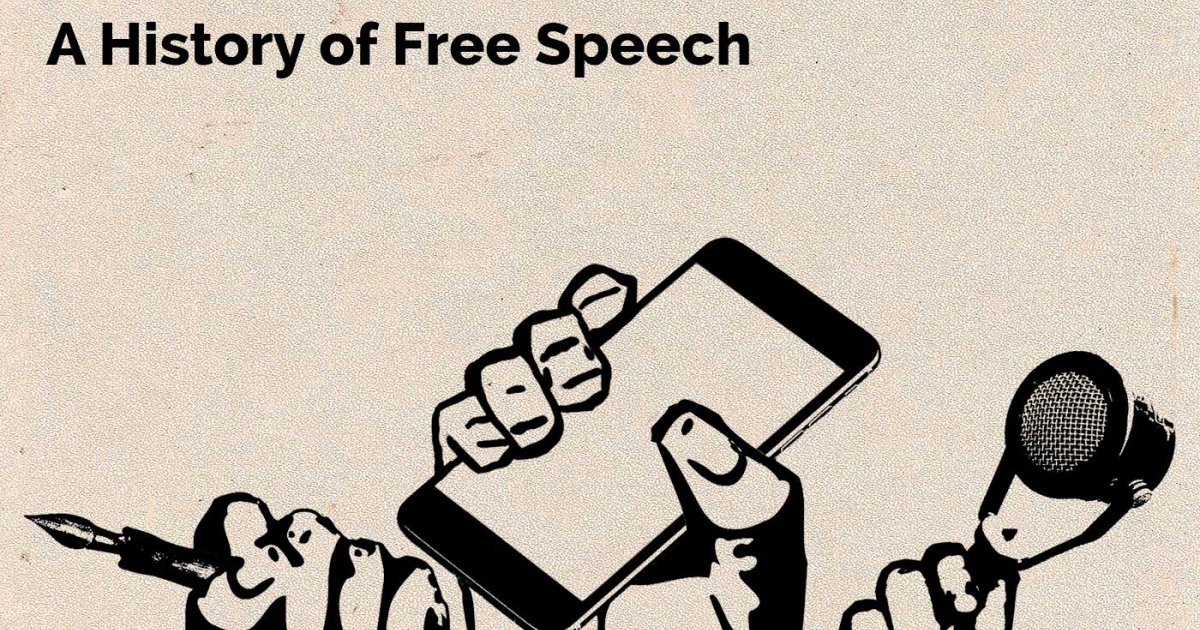
    Clear and Present Danger – A history of free speech

    Why have kings, emperors, and governments killed and imprisoned people to shut them up? And why have countless people risked death and imprisonment to express their beliefs? Jacob Mchangama guides you through the history of free speech from the trial of Socrates to the Great Firewall.
    Stay up to date with Clear and Present Danger on the show’s website at freespeechhistory.com

    Source link

  • Smart strategies to help students find the perfect college

    Smart strategies to help students find the perfect college

    Key points:

    You’ll often hear two words come up in advising sessions as students look ahead to college: match and fit. They sound interchangeable, but they’re not.

    Match refers to what colleges are looking for from students. It’s mostly determined by admissions requirements such as GPA and test scores, and in some cases, other criteria like auditions, portfolios, or athletic ability. Fit is more of an art than a science; it refers to what the student is looking for in a college, including personal preferences, social and cultural environment, financial factors, and academic offerings. When we talk to students about college fit, it’s an opportunity for them to ask themselves whether they like what a certain institution offers beyond being admitted.

    In the college admissions process, both terms matter. A strong match without a good fit can leave a student disengaged and negatively affect their chances of graduating from college. Nearly a quarter of undergraduate freshmen drop out before their second year, and it seems likely to me that a lot of these cases boil down to bad fits. On the other hand, a great fit that isn’t a match could be difficult for admission in the first place, and if a student is admitted anyway, the rigorous coursework they encounter might be more than they’re ready for. To maximize postsecondary success, advisors, families, and students alike should fully understand the difference between match and fit and know how to approach conversations about each of them.

    Match: Reach, target, and solid

    As I’ve worked with advisors over the years, one of the best ways we’ve found to guide students on match is using the categories of “Reach,” “Target,” and “Solid” schools. We can determine which schools belong to what category using the data that colleges share about the average incoming GPAs and test scores of admitted classes. Typically, they report weighted GPAs and composite test scores from the middle 50 percent of accepted applicants, i.e., from the students who fall anywhere from the 25th to 75th percentile of those admitted.

    • Reach: These are schools where admission is less likely, either because a student’s test scores and GPA are below the middle 50 percent or because the school traditionally admits only a small percentage of eligible applicants.
    • Target: These are schools where either GPA or test scores fall in the middle 50 percent of admitted students.
    • Solid: These are schools where students are well within the middle 50 percent for both GPA and test scores.

    Building a balanced college list across these categories is essential in the college planning process. Often, I see high-achieving students over-index on too many Reach schools, which may make it hard for them to get accepted anywhere on their list, simply because their preferred schools are ultra-selective. Meanwhile, parents and guardians may focus heavily on fit and overlook whether the student actually meets the college’s admission criteria. Advisors play a key role in keeping these data-informed conversations grounded with the goal of a balanced list of college options for students to pursue.

    The importance of early planning

    Timing matters. In general, if you meet with students early enough, conversations about fit are productive, but if you’re meeting with students for the first time in their senior year, the utmost priority should be helping them build a balanced list. Ideally, we want to avoid a situation where a student thinks they’re going to get into the most competitive colleges in the country on the strength of their GPA and test scores, only to find out that it’s not that easy. If advisors wait until senior year to address match, students and families may already have unrealistic expectations, leading to difficult conversations when options are limited.

    On the other hand, we would stress that although GPA is the factor given the most weight by admissions offices, there are ways to overcome match deficits with other elements of a college application. For instance, if a student worked part-time to support their family or participated in co-curricular activities, colleges using holistic review may see this as part of the student’s story, helping to balance a GPA that falls outside the typical range. These experiences highlight a student’s passions and potential contributions to their chosen major and campus community. We don’t want students to have unrealistic expectations, but we also shouldn’t limit them based on numbers alone.

    In any case, advisors should introduce both match and fit concepts as early as 9th grade. If students have a specific college in mind, they need to be aware of the match requirements from the first day of freshman year of high school. This allows students to plan and track academic progress against requirements and lets families begin exploring what kind of environment, resources, and financial realities would make for the right fit.

    Fit: A personal process

    Once match is established, the next step is making sure students ask: “What do I want in my college experience?” The answers will involve a wide range of factors:

    • Institutional type: Public or private? Small liberal arts college or large research university?
    • Academic considerations: What majors are offered? Are there study abroad programs? Internship opportunities?
    • Student life: What is the student body like? What kind of extracurriculars, sports, and support services are offered? Are there fraternities and sororities? What is the campus culture?
    • Affordability: What financial aid or scholarships can I expect? What is the true net cost of attendance?
    • Outcomes: What a student hopes to gain from their postsecondary experience, including specific degrees or credentials, career preparation, financial benefits, personal growth, and skill development.

    Fit also requires conversations within families. I’ve found that open communication can reveal misunderstandings that would otherwise falsely limit students’ options. Sometimes students assume their parents want them close to home, when in fact, parents just want them to find the right environment. Other times, families discover affordability looks very different once they use tools like free cost calculators. Ongoing dialogue about these topics between advisors, students, and families during the high school years helps prepare for better decisions in the end.

    Bringing it all together

    With more than 4,000 colleges and universities in the U.S. alone, every student can find a college or university that aligns with their goals and abilities. Doing so, however, is both an art and a science. Advisors who help families focus on both dimensions, and start the conversation early, set students up to receive those treasured acceptance letters and to thrive once they arrive on campus.

    For school districts developing their proficiency in postsecondary readiness factors, like advising, there is an increasing amount of support available. For one, TexasCCMR.org, has free guidance resources to strengthen advising programs and other aspects of college and career readiness. While Texas-focused, many of the insights and tools on the site can be helpful for districts across the country in building their teams’ capabilities.

    Latest posts by eSchool Media Contributors (see all)

    Source link

  • University of Rochester student expelled after speaking out about harassment will lead orchestra in concert to affirm free expression

    University of Rochester student expelled after speaking out about harassment will lead orchestra in concert to affirm free expression

    ROCHESTER, N.Y., Oct. 20, 2025 — A former doctoral conducting student at the Eastman School of Music who was silenced after reporting harassment by a faculty member is standing up for herself in the way she knows best — by conducting a classical music concert in support of free expression. 

    Rebecca Bryant Novak will conduct a volunteer orchestra at the Hochstein School of Music Performance Hall in Rochester, N.Y., on Thursday, Nov. 20, in a concert sponsored by the Foundation for Individual Rights and Expression, our first-ever classical music concert in support of free speech. The evening will feature Beethoven’s Fidelio Overture and selections from Shostakovich’s Symphony No. 5 — two works that faced censorial pressure in their own time and which emphasize the timeless connection between civil liberties and artistic expression. 

    The event will also feature internationally acclaimed violinist Lara St. John, praised by The New York Times as “a high-powered soloist.” 

    For Bryant Novak, who was expelled from the University of Rochester earlier this year after filing a complaint against one of her professors at Eastman, the evening will provide her not only with an opportunity to create wonderful music but to send a message to the school that she will not be intimidated into silence.

    “All I’ve wanted since I came to Eastman was to become a conductor and share my appreciation for great music with others,” Bryant Novak said. “I’m looking forward to doing so this evening — while reminding Eastman that I’m not going away.”

    Shortly into her first semester as a doctoral student in fall 2023, Bryant Novak complained about behavior by a professor who she said made sexist comments.

    After a yearlong investigation, a panel of faculty and administrators agreed that the professor had indeed violated Rochester’s harassment policy and that Eastman’s Title IX coordinator had mishandled her complaint.

    Despite all this, Eastman allowed the same school authorities to retain oversight of Bryant Novak’s academic trajectory — with one official telling her that the school restricted her performance times because of her complaint against the professor. 

    When Bryant Novak complained, Eastman did nothing. As a result of the alleged retaliation, Rochester opened a second investigation into Eastman’s mishandling of the situation in December 2024, and Bryant Novak publicly disclosed the university’s new investigation in a Substack article on Feb. 10.

    Two weeks later, Eastman abruptly expelled Bryant Novak, citing a failure to make academic progress, even though the school never showed that she met that criteria. In doing so, the school ignored its written policy that calls for students to be given ample notice if they are in danger of falling short of academic standards.

    FIRE is calling on Rochester President Sarah C. Mangelsdorf to immediately reinstate Bryant Novak and ensure that she is able to complete her doctorate under the oversight of Eastman faculty and officials who are not already subject to investigation for misconduct in her case. And we’re not alone. Over 800 members of the public have signed on to our Take Action campaign telling Mangelsdorf to heed the call.

    In any case, Bryant Novak won’t be banished from the conductor’s podium. We hope to have you join us for “Outspoken: Music for Free Speech,” an evening championing the right to free expression — hers and yours.

    The concert is free and open to the public. To attend, RSVP here to reserve your spot.

    The Foundation for Individual Rights and Expression (FIRE) is a nonpartisan, nonprofit organization dedicated to defending and sustaining the individual rights of all Americans to free speech and free thought—the most essential qualities of liberty. FIRE educates Americans about the importance of these inalienable rights, promotes a culture of respect for these rights, and provides the means to preserve them.

    CONTACT
    Karl de Vries, Director of Media Relations, FIRE: 215-717-3473; [email protected]

    Source link

  • Learn SPSS Online for MBA Projects: Free Resources Inside

    Learn SPSS Online for MBA Projects: Free Resources Inside

    How to do regression analysis in spss

    Regression Analysis is a analysis process where the relationship between one dependent variable is evaluated with one or more independent variables. Regression Analysis are mainly used for prediction and forecasting. To define as an example, a doctor can quantify how much each factor will contribute to the overall risk of patients.

    Regression Analysis is a analysis process where the relationship between one dependent variable is evaluated with one or more independent variables. 

    Types of Regression Analysis

    1. Simple Linear Regression: Used for evaluating the relationship of one dependent variable with one independent variable.

    Formula: Y=a+bX+

    Where:

    Y=Dependent Variable (Outcome)

    X=Independent variable (Predictor)

    a= Intercept (Value of Y when X=0)

    b=Slope (how much Y changes for a one unit increase in X)

    = Error Term.

    1. Multiple Linear Regression: It is used for evaluating two or more independent variable to predict a dependent variable.

    Formula:Y=a+b_1 X_1+b_2 X_2+⋯+b_n X_n+ϵ

    Performing Regression Analysis in SPSS

    In SPSS performing regression analysis is extremely easy as it used a menu driven interface which allows user to perform the analysis in a few clicks. Once the dataset is imported in the system the user has to select the dependent and independent variables. The software will immediately calculate regression coefficient, R-squared values and the model fit statistics.

    Source link

  • Introducing the SPFI Sentinel: Free speech stories by — and for — student journalists

    Introducing the SPFI Sentinel: Free speech stories by — and for — student journalists

    Thirteen hundred student newsrooms across the country prove each day that the news doesn’t wait until graduation to break. And no one’s closer to the ground where free speech debates are blazing on college campuses than student journalists. 

    So far this year, FIRE’s Student Press Freedom Initiative has received 84 calls for help from student journalists. In 2024, there were 140. As they cover the battle for free speech on campus, they face their own fights for press freedoms, often combating censorship without the recognition they deserve. 

    That’s why we created the SPFI Sentinel. With the Sentinel, we’re celebrating the student journalists on the front lines of the First Amendment by recognizing their unflinching reporting and sharing their stories with 1,300 other student newsrooms in the U.S.

    The following are the featured journalists for the 2025 edition of the Sentinel.

    Nikita Osadchiy, The Heights, Boston College:

    I’m Nikita Osadchiy, an assistant news editor at The Heights. With nearly a year on our editorial board and amid a presidential administration intent on battering higher education nationwide, the need for accountability journalism has never felt more urgent. Newspapers serve as watchdogs, holding institutions — academic or otherwise — to the principles from which journalism itself springs. When those institutions fail, it is the press’s mission to confront them, expose wrongdoing, and reaffirm the public’s right to truth. Student journalism has been the chance to preserve integrity where it falters and to give voice where silence would otherwise prevail.

    Dylan Hembrough, The Alestle, Southern Illinois University Edwardsville:

    I’m Dylan Hembrough, editor-in-chief of The Alestle at Southern Illinois University Edwardsville. I’m a second-year pharmacy student and in my third year as editor-in-chief. I got into journalism because I love to write, and that has blossomed into a passion for disseminating information and giving people the unfiltered truth they deserve.

    Glenn Hedin, The Michigan Daily, University of Michigan:

    My name is Glenn Hedin, and I am a student journalist. I report on university governance and campus activism, and I like to tell myself that if powerful people aren’t mad at me then I’m doing something wrong. Free speech in America is eroding fast, with even major media institutions preemptively capitulating to censorship. Journalists need to rise to this occasion by intensely scrutinizing powerful institutions and seeking out silenced voices to listen to. Student journalists play a part there, and I hope that when I’m old I’ll be able to look back and say that I did mine well.

    Barrett Dolata, The Michigan Daily, University of Michigan:

    My name is Barrett Dolata and I am a student journalist pursuing my final year of a BA in English, with a minor in art and design at the University of Michigan. Student journalism holds a special place for me because it gives voice to the students and community members I pass every day in Ann Arbor. What makes it particularly unique is the immersion, as we’re not distant observers writing about issues from the outside. We’re experiencing many of these same challenges and moments right alongside the people we’re covering, which brings a depth to our reporting that wouldn’t be possible otherwise.

    Chloe Platt, The Spectator, Seattle University:

    I’m Chloe Platt (she/her), a Seattle-based journalist, poet, and writer whose work is rooted in empathy and poetic connectivity. As editor-in-chief of The Spectator, Seattle University’s student newspaper, I held fast to the belief that journalism is both a vessel for amplifying vulnerable voices and a force for challenging oppressive systems. I carry this conviction into my professional work, viewing student journalism as essential in shaping critically minded, outspoken storytellers who see narrative as a tool for social change.

    To these and all of the other talented journalists across the nation, SPFI has one message: We have your back. 

    As the 2025 academic year begins, we encourage any journalists facing censorship on campus to contact our 24-hour hotline at  717-734-SPFI (7734) for guidance, resources, and answers to your legal questions. For information on topics like defamation and privacy law, visit SPFI’s clickable guide to common media law and First Amendment Questions: Can I Publish This?

    Source link

  • OfS rebalances the free speech/harassment see-saw on antisemitism

    OfS rebalances the free speech/harassment see-saw on antisemitism

    The Union of Jewish Students (UJS) has published a fascinating new episode of “Yalla”, its podcast for Jewish students.

    Hosted by Louis Danka, who is the new President of UJS, the September 2025 episode features an extensive interview with Arif Ahmed, OfS’ Director for Freedom of Speech and Academic Freedom.

    The conversation comes weeks after the regulator’s new higher education free speech guidance came into force on August 1, 2025, alongside enhanced harassment protections.

    What makes the interview especially interesting is what it doesn’t mention – Ahmed’s reversal on the IHRA definition of antisemitism.

    In February 2021, Ahmed wrote in a HEPI blog that he was strongly against Gavin Williamson’s requirement that universities adopt the IHRA definition of anti-Semitism, arguing it obstructs perfectly legitimate defence of Palestinian rights and chills free speech:

    I hope the Secretary of State reconsiders the need for it; but these new free speech duties ought to rule it out in any case.

    We’re all allowed to change our minds on things. The issue is the extent to which the law, or the regulation he’s now in charge of, offers clarity on the volte-face.

    And while there’s plenty of helpful material in there on how OfS might approach casework and complaints, it does raise all sorts of questions about expectations – and OfS’ strategy for communicating what in some cases amounts to significant additions and clarifications to its guidance.

    What the podcast says

    The interview centres on what I’ve previously described as the twin sandbags on the regulatory see-saw – the Higher Education (Freedom of Speech) Act 2023 and the E6 condition on harassment and sexual misconduct.

    A central theme throughout is UJS’ contention of a deteriorating campus environment for Jewish students. Ahmed acknowledges there has been “a big rise in antisemitic incidents in recent years, on campus, in the country more generally” and describes this as a source of “grave concern” for OfS.

    The discussion then considers how this manifests practically on campuses. Ahmed describes, for example, scenarios where Jewish students may feel unable to attend lectures due to protest activity, or where “protests outside Jewish accommodation” create hostile environments.

    He first emphasises that while “political ideas expressed in the protests may be perfectly awful and expressible,” universities can still regulate their “time, place and manner” – such that core functions can keep going.

    Hence on protest regulation, Ahmed says:

    …if you have protests that take place in such a way that Jewish students don’t feel able to attend lectures … it may also be right for the university say, well, you can’t do it here, and you can’t do it in this place, and you can’t have it every day outside a lecture theatre.

    He also points to protests outside Jewish accommodation as another context where restrictions could be justified.

    Ahmed’s contemporary position on IHRA is explained as follows:

    …we ourselves have adopted the IHRA definition, and we do think it can be a very useful tool for understanding modern antisemitism.

    He adds that there is “no obstacle, in principle” for universities adopting a particular definition, and “certainly not” the IHRA working definition.

    He clarifies that it is “absolutely compatible” with the guidance, provided it’s being used properly as a way to understand antisemitism rather than to suppress lawful and legitimate debate. That latter caveat may represent the only vestige of his previous concerns about IHRA chilling Palestinian rights advocacy.

    The published guidance takes an uncompromising stance on Holocaust denial, where Ahmed explains this was made explicit after consultation feedback seeking clarity:

    …we will not under any circumstances protect Holocaust denial, so nothing that we do in our complaint scheme or otherwise will protect that speech.

    With the more obvious stuff out of the way, the subsequent nuanced discussion involves distinguishing between legitimate political discourse and antisemitic harassment, particularly around coded language.

    Ahmed addresses scenarios like “Zionists off our campus” signs, explaining that context is crucial. On coded antisemitism, Ahmed explains:

    …very often when people use the expression “Zionist”, for instance, it can actually be used as a kind of euphemistic expression meaning Jewish people, and in the circumstances where that’s so it seems very much more likely to be something that’s targeted at individuals because of their race, because of their religion.

    He then distinguishes between attacking ideas versus targeting individuals, noting that speech “directed at ideas” differs from speech that makes individuals feel excluded because of their protected characteristic.

    Ahmed is at pains to point out that freedom of speech encompasses religious expression, making Jewish students’ ability to practice their faith a free speech issue. He also describes scenarios where Jewish students might hide religious symbols like Stars of David due to campus hostility. He then explains the religious expression dimension:

    …if you have an atmosphere on campus which is allowed to grow, which grew, Jewish students are intimidated out of expressing their own religion, that’s that’s an affront to their freedom of speech.

    The interview also explores “chilling effects” – where students self-censor rather than face consequences. Ahmed describes situations where students with pro-Israel views or Jewish religious expression might “decide not to say it in the first place” due to fears about academic consequences or social ostracism.

    Nevertheless, he repeatedly stresses that harassment determinations require objective analysis, not just subjective feelings. He explains that the legal test involves whether:

    …a reasonable person would think that was… creating an intimidating atmosphere for people because of their race, because of their religion.

    And on that point:

    …it’s not enough, for speech to count as harassment, that the person at the receiving end feels offended; what’s important is that a reasonable person would think that was so.

    He concludes by stressing that freedom of speech “historically… most protects minorities and those… for whom their voice and their words are the only things that they have.”

    What the papers say

    The Jewish News coverage of Ahmed’s podcast exemplifies how the reassuring rhetoric translates into heightened community expectations.

    The headline itself – “Free speech tsar tells universities: stop intimidation of Jewish students” – frames Ahmed’s nuanced legal discussion as a clear directive for immediate action.

    The article’s language amplifies Ahmed’s confidence, presenting his tentative statements (“it may also be right for the university to say”) as firm commitments (“universities must take firm steps”) and his regulatory expectations (“we would expect universities to take action”) as binding obligations.

    The coverage also amps up specific protections – Jewish students’ ability to attend lectures, enter accommodation, and express their religion – without conveying the complex legal determinations universities might need to navigate to provide that protection.

    Ahmed’s discussion of “coded language” becomes a promise that universities can identify and restrict antisemitic euphemisms, while his IHRA compatibility statements are presented as resolving rather than acknowledging ongoing tensions between free speech and antisemitism prevention.

    Most tellingly, UJS President Louis Danker’s response reveals both the raised expectations and their fragility. While expressing satisfaction that “the Office for Students shares our concerns,” he acknowledges that “the ambiguity of the guidance will be challenged by crucial test cases in the coming months.”

    This tension, between reassurance about shared concerns and worry about guidance ambiguity, captures the potential problem that OfS has created – confident promises built on uncertain legal foundations that will inevitably face testing in precisely the complex scenarios that the framework struggles to address.

    What the podcast doesn’t say

    The central question is whether the reassuring statements to Jewish students align with what universities can actually deliver under existing legal frameworks.

    If we take holocaust denial, for example, Ahmed demonstrates clear understanding:

    Article 17 says that none of these rights can be used, essentially to destroy other people’s rights. So speech that aims to destroy others rights… the courts have found, for instance, that many instances of Holocaust denial they’ve looked at, fall under it.

    That explanation appears to be legally accurate. Article 17 is sometimes called the “abuse clause” of the European Convention – it strips protection from speech that aims to destroy the rights of others, such as Holocaust denial.

    But the guidance leaves the explanation out, simply declaring Holocaust denial unprotected without explaining why – or when. That omission matters, because Article 17 normally operates alongside Article 10(2) – another part of the Convention that allows restrictions on speech if they are necessary and proportionate to protect others.

    As a reminder, the OfS guidance’s three-step framework treats human rights considerations as sequential rather than integrated:

    Step 1 asks simply whether speech is “within the law” – defined as speech not prohibited by primary legislation, legal precedent, or secondary legislation. Crucially, university regulations and contracts don’t count as “law” here. If not, don’t allow it. If it is, move to Step 2.

    Step 2 considers whether there are “reasonably practicable steps” to enable the speech. Universities should consider factors like legal requirements (including any formal duties), maintaining essential functions, and physical safety – but explicitly cannot consider the viewpoint expressed, whether it’s controversial, or reputational impact. If steps can be taken, take them. If not, move to Step 3.

    Step 3 – which is only reached if no reasonably practicable steps exist – then asks whether any restrictions are “prescribed by law” and proportionate under the European Convention. This involves checking if there’s a specific legal rule authorising the restriction, and runs through a four-part proportionality test weighing the importance of the objective against the severity of limiting the right.

    That proportionality test looks something like this:

    • Is the objective important enough? – The reason for restricting speech must be sufficiently weighty to justify limiting a fundamental right.
    • Is the restriction rationally connected? – The measure must actually help achieve the objective, not just be vaguely related to it.
    • Is this the least restrictive option? – Could you achieve the same goal with less impact on free speech? If yes, you must use the less intrusive approach.
    • Does the benefit outweigh the harm? – Even if the first three tests are met, you must still balance the severity of restricting speech against how much the restriction actually helps achieve your objective. The restriction fails if the damage to free expression outweighs the benefit gained.

    As I’ve noted before on here, the published approach seems to conflict with Minasyan v Armenia (2019), where the European Court of Human Rights struck down Armenia’s handling of a protest case. The Armenian courts had first checked whether protesters broke domestic criminal law, and only afterwards asked whether their free speech rights were engaged.

    Strasbourg was clear – you can’t separate those steps. The balancing of rights under Article 10(2) has to be done at the outset. So when the guidance asks universities to check domestic criminal law first and only consider broader human rights implications as an afterthought, the sequential framework seems to repeat the flaw that Strasbourg condemned.

    Meanwhile, Ahmed seems to correctly state the objective harassment test:

    …it’s not enough. Speech to count as harassment, that the person at the receiving end feels offended… what’s important is that a reasonable person would think that was so.

    But his practical applications consistently reference subjective experiences without clear frameworks for objective assessment. He discusses Jewish students feeling “unable to attend lectures” or “intimidated out of expressing their own religion” – but then offers up little on how universities should distinguish between justified concerns and unfounded complaints.

    The “reasonable person” test sounds simple, but in practice it is one of the hardest questions courts face. Would an average observer see this as harassment, taking into account context, repetition, and effect?

    Judges often split over the answer, even with days of evidence. Expecting university or SU staff to make that call in real time, during a protest or at a room-booking stage, is asking staff to perform complex human rights analyses on the fly. Clarity on what he might expect is reasonable in those scenarios would help.

    Ahmed’s discussion of antisemitic language also illustrates the analytical burden placed on those enforcing or explaining rules day to day:

    …very often when people use the expression Zionist, for instance, they can actually, can actually be used as a kind of euphemistic expression meaning Jewish people.

    Determining when “Zionist” functions as coded antisemitism requires careful analysis of speaker intent, contextual factors, and impact on targeted individuals. These are determinations that typically require evidence about speaker’s background and previous statements, analysis of the specific context and setting, an assessment of audience understanding and reaction, and an evaluation of the targeting effects on specific individuals.

    Day to day, staff may well lack both the investigative capacity and legal expertise to perform those sorts of analyses reliably. Ahmed acknowledges the complexity – “it might depend on context” – but doesn’t offer anything like a practical methodology for making the determinations.

    The UK Supreme Court in Elan-Cane (2021) stressed that domestic bodies should not push human rights analysis beyond what the European Court of Human Rights has already recognised. Lord Reed warned against overstepping into areas Strasbourg had not yet endorsed.

    Ahmed’s framework arguably asks universities to do exactly that – making human rights calls (on protests, coded language, or harassment) that even the courts approach with extreme caution.

    If legally trained judges with full procedural protections must be cautious about extending human rights analysis, how can staff be expected to perform similar determinations through internal processes? Is OfS fit to do so when it gets a complaint in? And what are the penalties for getting it wrong?

    Rights collision

    Another silence in the interview is how to handle the collision of rights. He clearly anchors harassment to protected characteristics like race and religion, and he treats Zionism as an idea that can be lawfully discussed – while warning it is sometimes used as a euphemism for “Jew” in context. He doesn’t quite say “Zionism is a protected belief” in terms, though that would be the likely legal position under Equality Act case law. The same goes for anti-Zionism.

    Under UK equality law, political and philosophical beliefs qualify for protection if they meet what’s known as the Grainger criteria – that is, the belief must be genuinely held, relate to a weighty aspect of human life, attain a certain level of seriousness and cogency, and be worthy of respect in a democratic society.

    Courts have already recognised beliefs such as environmentalism, gender-critical feminism, and ethical veganism under this test. Anti-Zionism looks like it would qualify on the same basis, provided it is expressed as a coherent political or philosophical position rather than as a proxy for antisemitism.

    What he does not explain is what universities should do when the protections appear to come into direct conflict or quite how a university is supposed to differentiate between the political or philosophical position and the proxy.

    Let’s imagine a student holding a placard reading “Zionism is racism” and another responding that “anti-Zionism is antisemitism.” Both statements can amount to the expression of protected beliefs under the Equality Act. Both students might also claim they are being harassed by the other.

    Courts take weeks to sift through context, intent, and impact in such cases – weighing not just Article 10 free speech but also Article 9 (religion), Article 8 (private life) and Article 11 (assembly).

    On balance, “Zionists off campus” feels like it targets a group of people. Those banned from painting it on a banner may feel their speech is being chilled. “Zionism off campus” feels more like a protected piece of political expression. Some reading that may feel harassed. Complaints in either event are likely.

    Recent cases show how fraught these clashes can be. In Forstater v CGD Europe, the tribunal upheld that gender-critical beliefs were protected, even though many found them offensive – but also emphasised that protection for a belief does not mean protection for every manifestation of it.

    In Mackereth v DWP, the tribunal held that a doctor’s refusal to use trans patients’ pronouns could lawfully be limited, despite his Christian beliefs being protected. The principle is clear – both Zionism and anti-Zionism can be protected, but the way they are expressed may still lawfully be restricted if it harasses others.

    What’s missing from Ahmed’s account is the extent to which universities are expected to perform that fine distinction in real time, and at which stage of a process they’re expected to do so.

    What now?

    The danger in all of this is a form of regulatory false advertising – promising protection through frameworks that universities cannot properly execute without risking legal challenge or practical failure.

    The focus on context is welcome, but it doesn’t solve the core problem – the absence of a practical framework for when and how to balance competing rights. Without it, institutions risk inconsistency, overreach, or paralysis – either censoring lawful political expression or failing to protect students from harassment.

    The reassuring tone also suggests clearer legal boundaries than actually exist. When he says that universities “would expect to take action” about intimidatory speech, he presents complex, fact-specific determinations as straightforward administrative decisions.

    It’s a false certainty that may mislead universities into thinking they have clear authority to restrict speech, and could simultaneously raise student expectations about protection that may prove impossible to deliver.

    Then the style compounds the problem. In the podcast and coverage of it, Jewish students hear confident reassurances; in the consultation response annex, Article 17 is quietly acknowledged; in public guidance, proportionality is all but absent from the “within the law” test.

    The impression is of a regulator telling each audience what it wants to hear by pointing at one end of the see-saw, rather than grappling with the hard edges of the case law in ways that may temper expectations rather than raise them.

    And given both the free speech guidance and the E6 guidance drives home the need to get these messages into the heads of students themselves, there’s certainly nothing in there on how universities are supposed to explain all of this to students.

    It leaves universities (and by proxy their SUs) stuck in the impossible position that they have been for months.

    They remain caught between those heavy sandbags without mechanisms to resolve them, having expectations raised on both ends in ways that may not be as simple in practice, and offering little confidence that a good stab at making the calls, carried out in good faith, will result in anything other than Kafka’s regulator appearing with a fine either way.

    Source link

  • Trump’s tinseltown tariffs threaten free speech

    Trump’s tinseltown tariffs threaten free speech

    “The Movie Industry in America is DYING a very fast death,” declared the 47th president in a post earlier this year on Truth Social. To lure more film productions back to America, Trump ordered the Department of Commerce and the U.S. Trade Representative to place a 100% tariff on foreign films.

    Hollywood went into panic mode. But the summer months passed without any update from the White House. Then, on Monday, Trump renewed his calls for a foreign-film tariff.

    Much has been made about the financial implications of Trump’s shocking movie mandate. But beyond the economic concerns, both the industry and elected officials alike have failed to consider the broader constitutional implications of the president’s chaotic posts, should the tariffs actually be implemented.

    Nestled in his posts, declaring offshore film productions a “National Security threat,” Trump further justified the tariffs this year by labeling foreign films as “propaganda.” For any American who cares about free speech, that should be the cue to jump up and holler, “Cut!”

    “Propaganda” carries an ominous connotation, one that those in power have often used to censor speech they dislike. But no matter what the president declares to be propaganda, whether movies or any other medium, it is still protected speech. That protection extends to both making and watching films, regardless of where they were produced, as the First Amendment safeguards not only the right to speak, but also the right to receive information and ideas.

    Artists have the right to express their ideas, even when such ideas irk those in power.

    Details are incredibly murky, and the White House clarified in May that “no final decisions” have been made on what the policy would look like. But Trump’s threats to use the government’s might to financially punish Hollywood for working with foreign filmmakers, while limiting Americans’ access to those films, are deeply worrying. 

    Any directive that aims to suppress movies based on their content or filmmakers’ creative choices would violate both the letter and the spirit of the First Amendment. The president claims these tariffs would strengthen American industry, but doing so by targeting filmmakers and their art, based on their place of origin or viewpoint, is as un-American as it gets. It’s less Mr. Smith Goes to Washington and more The Manchurian Candidate.

    America’s proud free speech tradition is built on protecting speech critical of those in power. Because of this, the arts have historically been a potent force for social and political change in this country. One just has to look at the history of cinema to see that.

    ‘So to Speak’ Podcast: ‘The Trials of Lenny Bruce’

    His trials began with a police bust at the Jazz Workshop in San Francisco in 1961, and ended with an obscenity conviction in New York in 1964.


    Read More

    Since the medium’s advent over a century ago, movies have been a dominant form of artistic expression in the United States. Not only that, but it’s historically been used to push back against the status quo. 

    During the studio system’s heyday, Meet John Doe shone a spotlight on the rising threat of fascism on domestic soil. Later, Casablanca tackled the dangers of isolationism. At the height of the Cold War, the Gary Cooper western High Noon challenged the Red Scare. Heralding the start of New Hollywood, Easy Rider rebelled against the prudish, white-picket-fence America of Eisenhower and Kennedy, while They Live! condemned the Reagan-era capitalism of the late 80s and early 90s. During the War on Terror, The Dark Knight questioned the morality of the Patriot Act surveillance state.

    Not only that, but courts have consistently repelled government efforts to suppress artistic expression, reaffirming that artists have the right to express their ideas, even when such ideas irk those in power. 

    In a free society, the government, regardless of who is in power, cannot dictate what films we can watch or what books we can read. 

    In the 1948 Supreme Court case Winters v. New York, a 6-3 majority explained that “one man’s amusement teaches another’s doctrine.” The First Amendment protects everything from highbrow political commentary to sensational entertainment. Artistically, the line between high- and low-value expression is too subjective, too paper-thin to entrust the government with policing it. This free speech principle still rings true today, but the president seems willing to cast it aside to exert greater control over the film industry. 

    The nation’s highest court also has much to say on why taxing speech is unconstitutional because, let’s be clear, Trump’s tinseltown tariffs are just another tax. The Supreme Court has repeatedly ruled that the First Amendment protects us against government taxing expression it dislikes.

    Like all art, movies both provoke and inspire. They are, in the words of the late film critic Roger Ebert, “empathy machines.” In the darkness of a movie theater, we sit with strangers from different backgrounds. We gravitate to those cathedral-like spaces to share in one singular experience that is more than likely foreign to our own. We watch movies to be swept up in something different. At the very least, movies can challenge our ideas, much like a thriving free speech culture. At their best, movies change us. 

    In a free society, the government, regardless of who is in power, cannot dictate what films we can watch or what books we can read. And when we encounter a film that we may disagree with, the way we respond is our own speech, our own art, our own expression. As the nation’s chief executive, Trump cannot use the force of the presidency to target filmmakers and their artistic expression in the name of “national security” or “propaganda.” That’s unconstitutional. And that’s to say nothing of the other legal roadblocks to his plan.

    The president’s vague, broad call for speech-retaliatory tariffs against foreign films has the potential to silence storytellers, chill the efforts of studios, and prevent American audiences from participating in the international exchange of ideas movies provide. 

    That doesn’t “Make Hollywood Great Again.” It makes it worse.

    Source link

  • Charlie Kirk was a free speech advocate. His death shouldn’t lead to suppression.

    Charlie Kirk was a free speech advocate. His death shouldn’t lead to suppression.

    This article originally appeared in USA Today on Sept. 21, 2025.


    If you’re a believer in free speech, the past two weeks have been one of the longest years of your life. In fact, this might have been the worst fortnight for free expression in recent memory.

    It started Sept. 9, when the Foundation for Individual Rights and Expression (FIRE), where I work, released its sixth annual College Free Speech Rankings. The rankings revealed that a record 1 out of 3 students is open to the idea of using violence to stop campus speech.

    This sentiment was then frighteningly made flesh the next day, when conservative commentator Charlie Kirk was assassinated at Utah Valley University. 

    The fact that Kirk was killed while engaging in open debate on a college campus is a cruel irony. If the first person to hurl an insult rather than a spear birthed civilization, then anyone resorting to violence in response to speech is attempting to abort it.

    The free speech principles that are foundational to our democracy have been a candle in the dark – not just here at home, but across a world in the grip of a terrifying resurgence of authoritarianism.

    The difference between words and violence – and the civilizational importance of free speech – couldn’t have been more stark in that moment. No matter how hurtful, hateful or wrong, there is no comparing words to a bullet.

    To preserve that distinction, we must have the highest possible tolerance for even the ugliest speech. But that notion has landed on largely deaf ears, because what followed was a cacophony of cancellations.

    Charlie Kirk was a free speech advocate. His death led to stifled speech.

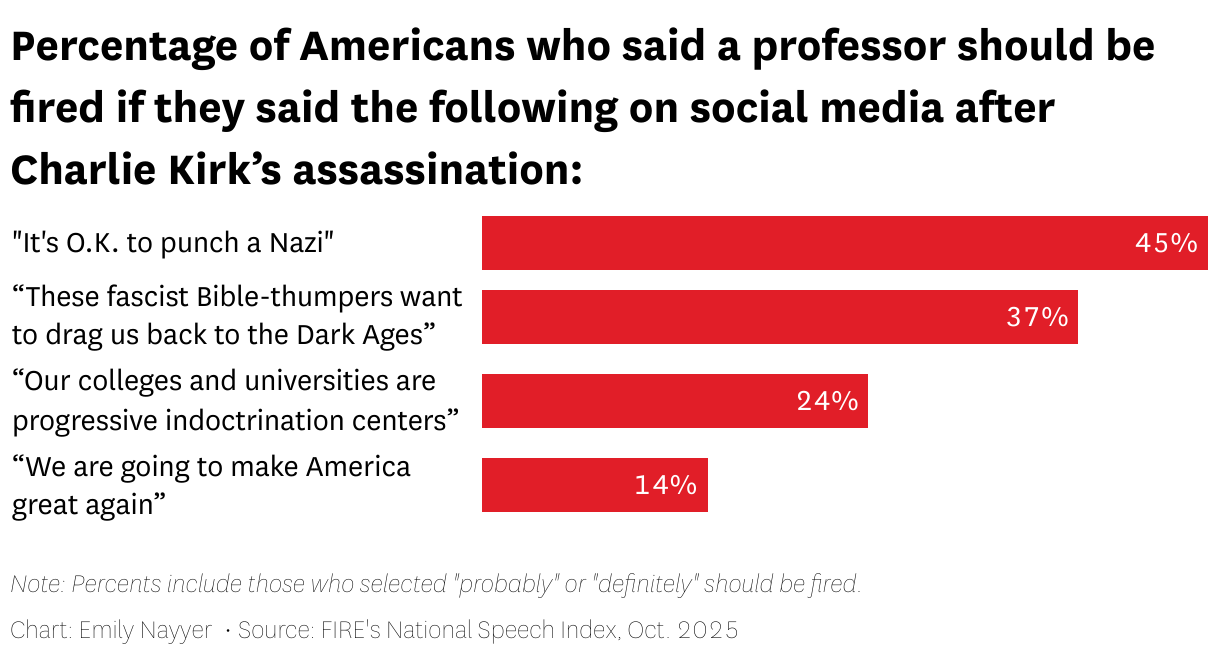
    Scores of college professors, for example, have either been investigated, suspended or fired for comments they made regarding Kirk’s assassination. Even wildlife conservationistscomic book writers, retail workers and restaurant employees have been targeted for their speech.

    There are many more, and Vice President JD Vance, while stepping in to guest-host “The Charlie Kirk Show,” endorsed these efforts

    In some cases, the targeted speech was a criticism of Kirk and his views. In others, it was a celebration of his fate. In all cases, however, it has been First Amendment-protected speech – and far from violence.

    The government pressure didn’t end there, either. Secretary of Agriculture Brooke Rollins called for “a legal and rational crackdown on the forces that are desperately trying to annihilate our nation.”

    Carr’s threats to ABC are jawboning any way you slice it

    ABC suspended Jimmy Kimmel hours after FCC Chair Brendan Carr suggested they could face consequences for remarks Kimmel made in the aftermath of Charlie Kirk’s murder.


    Read More

    On Sept. 15, U.S. Attorney General Pam Bondi went on “The Katie Miller Podcast” and threatened, “There’s free speech, and then there’s hate speech. . . . We will absolutely target you, go after you, if you are targeting anyone with hate speech.”

    Given that there is no First Amendment exception or legal definition for “hate speech,” this can mean just about anything Bondi and President Donald Trump‘s administration consider “hateful.” Bondi walked back her comments after public outcry, notably from conservatives.

    The president, however, ran with it, threatening an ABC News reporter for having covered him “unfairly.” “You have a lot of hate in your heart,” Trump said Sept. 16. “Your company paid me $16 million for a form of hate speech. So maybe they’ll have to go after you.”

    Then Federal Communications Commission Chairman Brendan Carr publicly threatened action against host Jimmy Kimmel and ABC for “really sick” comments Kimmel made during his opening monologue. “We can do this the easy way or the hard way,” Carr said.

    Hours later, ABC suspended Kimmel’s show indefinitely, prompting celebration from TrumpCarr and others – and driving us from a free speech nightmare into a full-on hellscape.

    Social discourse needs a reset in America

    This is unsustainable.

    In the past two weeks alone, the state of free speech in our country has been battered almost beyond recognition.

    For years now, we have had a cultural climate where growing numbers of people are so intolerant of opposing viewpoints that they will resort to violence, threats and cancellation against their adversaries. Now we’re seeing the Trump administration flagrantly abusing its power and authority to punish criticism and enforce ideological conformity. 

    Yes, plenty of previous administrations have violated the First Amendment. But rather than repudiating those violations, the Trump administration’s actions over the past week have dramatically escalated how openly and aggressively that constitutional line is crossed.

    The core American belief that power is achieved through persuasion and the ballot box, and that bad ideas are beaten by better ones – not by bullets or bullying – is in serious danger.

    As former federal Judge Learned Hand once put it: “Liberty lies in the hearts of men and women; when it dies there, no constitution, no law, no court can even do much to help it.”

    That’s what’s at stake here: The free speech principles that are foundational to our democracy have been a candle in the dark – not just here at home, but across a world in the grip of a terrifying resurgence of authoritarianism.

    The ultimate tragedy would be if we extinguished them in our own hearts and by our own hands.

    Source link

  • Texas State Prof Sues, Claiming Free Speech, Contract Violations

    Texas State Prof Sues, Claiming Free Speech, Contract Violations

    Mikala Compton/Austin American-Statesman/Getty Images

    A tenured Texas State University professor who was terminated earlier this month after allegedly inciting violence during a speech has sued the university, CBS Austin reported. In the lawsuit filed in district court, Thomas Alter, the former associate professor of history, claims that university leadership violated his free speech and due process rights and breached his employment contract. 

    At a Sept. 7 conference organized by Socialist Horizon, Alter said in part that “without organization, how can anyone expect to overthrow the most bloodthirsty, profit-driven mad organization in the history of the world—that of the U.S. government.” His speech was recorded and circulated by a right-wing YouTuber who had infiltrated the event. Alter was terminated three days later.

    In a statement announcing his termination, Texas State president Kelly Damphousse said Alter’s “actions are incompatible with their responsibilities as a faculty member at Texas State University.” Alter told CBS Austin that he did not associate himself with Texas State during the conference. 

    “The reasons Provost Aswrath provided for Dr. Alter’s termination are false and give every appearance of politically-motivated discrimination,” the lawsuit states. “In truth, Dr. Alter was terminated because he espoused views that are politically unpopular in today’s politically-charged climate, in violation of his First Amendment right to free speech.”

    Alter told CBS Austin that his dismissal “turned my world upside down and my family’s world upside down.”

    “Anyone should be able to express their views no matter how unpopular they are without facing the repercussions that many people are seeing,” he added. (Alter had earned tenure just 10 days before he was removed, The Chronicle of Higher Education reported.)

    Texas State did not respond to Inside Higher Ed’s request for comment, but a spokesperson told CBS Austin the university declined to comment on pending litigation.

    Source link