Tag: free

  • Free speech in an age of fear: The new system loyalty oaths – First Amendment News 464

    Free speech in an age of fear: The new system loyalty oaths – First Amendment News 464

    “Whoever would overthrow the liberty of a nation must begin by subduing the freeness of speech.” — Benjamin Franklin

    If you look beneath the veneer of it all, what surfaces from the chaos of the last eight weeks is a demand for unyielding loyalty to a man and his personal and political whims. 

    His demands, followed in fear, are cravenly honored by political figures, media corporations, university presidents, law firms, Justice Department lawyers, and all others who surrender on bended knee to an authoritarian figure who holds the title of the 47th president of the United States. 

    Few stand up to him; many kowtow to him. Silence and sycophancy surround him. Meanwhile, his agency hitman exercises power with unconstitutional zeal. 

    When persuasion fails, when logic departs, when toleration ceases to be tolerated, and when the very pillars of freedom of expression are battered with ruinous consistency, then the promise of the First Amendment is breached with abandon — this while so many fiddle. 

    Given what has gone on in the first quarter of 2025 alone, this much is true: We are witnessing frontal attacks on freedom, especially our First Amendment freedoms (e.g., FANs 463462461, and 460). 

    Government by executive order is his calling card — his “trump” card. Shakedowns are his tactic. “Administrative error” is the justification given by his confederates for egregious due process violations. 

    No matter how personal, punitive, or partisan, this power (often unconstitutional in principle and authoritarian in practice) has become this administration’s default position. His will is effected by his lieutenants, implemented by his attorney general, executed by his DOGE goons, fulfilled by his FBI director and other cabinet officials, orchestrated by his deputy of policy, and defended by his press secretary. 

    In such ways, as professor Timothy Zick’s “Executive Watch” posts have revealed and will continue to reveal, the First Amendment is also under siege.

    Fear is the engine that drives so much of this aggrandizement of power, and the submission to it. As in the McCarthy era, robotic loyalty fuels that engine. What we are seeing in Washington is a new era in compelled allegiance. Executive order “negotiations” are premised on mandatory loyalty.

    To get a sense of the nature of this problem, simply consider some of what Thomas I. Emerson (a revered civil liberties and free speech scholar) wrote 55 years ago in his seminal “The System of Freedom of Expression.” When liberty is contingent on one’s “beliefs, opinions, or associations,” there is a “grossly inhibiting effect upon the free exercise of expression.” 

    The inevitable result, Emerson added, is to silence “the more conscientious and invite the less scrupulous to pass. ‘Self-executing’ by its nature, it places the burden upon the person…to interpret [the loyalty oaths’] purpose, recall all past events in his life, and decide what current or future [orders might affect him] at his peril.” The net effect is to leave citizens “at the continuing mercy” of the government. 

    Put bluntly: “It is inherently demeaning to a free people.” (emphasis added) 

    It is that fear, born of direct or veiled demands for loyalty, that has seized power in the control rooms of our government. Time and again, day in and day out, yet another executive order, followed by servile enforcement, abridges our First Amendment freedoms. When will it end? When will enough men and women of courage join together and say “enough”? One answer was tendered in 1776 in a work titled “The American Crisis.” To quote its author, Thomas Paine:

    These are the times that try men’s souls. The summer soldier and the sunshine patriot will, in this crisis, shrink from the service of their country; but he that stands by it now, deserves the love and thanks of man and woman.

    Related 

    To preserve America’s tradition as a home for fearless writing, the Foundation for Individual Rights and Expression and Substack are partnering to support writers residing lawfully in this country targeted by the government for the content of their writing — those who, as Hitchens once put it, “committed no crime except that of thought in writing.”

    If you fit this category, whether or not you publish on Substack, we urge you to get in touch immediately at thefire.org/alarm or pages.substack.com/defender.


    Coming Soon

    A Question and Answer interview with Janie Nitze, co-author with Justice Neil Gorsuch of “Over Ruled: The Human Toll of Too Much Law.”

    See “An open invitation to Justice Neil Gorsuch and Janie Nitze to reply to their new book’s critics,” FAN 444 (Oct. 23)


    Voice of America court victory in journalists’ firing case

    The Voice of America can’t be silenced just yet. A federal judge on March 28 halted the Trump administration’s efforts to dismantle the eight-decade-old U.S. government-funded international news service, calling the move a “classic case of arbitrary and capricious decision making.”

    Judge James Paul Oetken blocked the U.S. Agency for Global Media, which runs Voice of America, from firing more than 1,200 journalists, engineers and other staff that it sidelined two weeks ago in the wake of President Donald Trump’s ordering its funding slashed.

    Seth Stern on DOGE and related free speech issues

    First Amendment Watch spoke with director of advocacy at Freedom of the Press Foundation, Seth Stern, about the First Amendment issues baked into the online exchange. Stern described Martin’s letter as intentionally ambiguous, argued that confusion over DOGE as a quasi-government agency brings its transparency responsibilities into question, and described the free speech issues that may arise from Musk’s roles as a social media platform owner and advisor to the president.

    Yale Law School ‘Free Speech in Crisis’ conference

    Agenda

    Friday, March 28

    9:15 a.m. | Welcome/Opening Remarks 

    • Organizers: Jack Balkin, Genevieve Lakier, Mikey McGovern

    9:30 a.m. | Panel 1: Media Environment 

    • Chair: Paul Starr, Princeton University
    • Yochai Benkler, Harvard Law School
    • Mary Anne Franks, George Washington University School of Law
    • Eugene Volokh, Hoover Institution

    11:15 a.m. | Panel 2: Polarization 

    • Chair: Robert Post, Yale Law School
    • Nicole Hemmer, Vanderbilt University
    • Liliana Mason, SNF Agora Institute, Johns Hopkins University
    • Ganesh Sitaraman, Vanderbilt Law School

    2:15 p.m. | Panel 3: Political Marketplace 

    • Chair: Rick Hasen, University of California, Los Angeles School of Law
    • Rick Pildes, NYU Law School
    • Bradley A. Smith, Capital University Law School
    • Ann Southworth, University of California, Irvine School of Law

    4:00 p.m. | Panel 4: Workplace 

    • Chair: Amanda Shanor, University of Pennsylvania
    • Helen Norton, University of Colorado School of Law
    • Benjamin Sachs, Harvard Law School
    • Liz Sepper, University of Texas Law School

    Saturday, March 29

    9:30 a.m. | Panel 5: Knowledge Production 

    • Chair: Amy Kapczynski, Yale Law School
    • E.J. Fagan, University of Illinois Chicago
    • Vicki Jackson, Harvard Law School
    • Naomi Oreskes, Harvard

    11:15 a.m. | Panel 6: Campus Politics 

    Chair: Genevieve Lakier, University of Chicago Law School

    • Judith Butler, University of California, Berkeley
    • Athena Mutua, University at Buffalo School of Law
    • Keith Whittington, Yale Law School

    1:00 p.m. | Wrap-Up Conversation 

    • Organizers: Jack Balkin, Genevieve Lakier, Mikey McGover

    Forthcoming book on free speech and incitement 

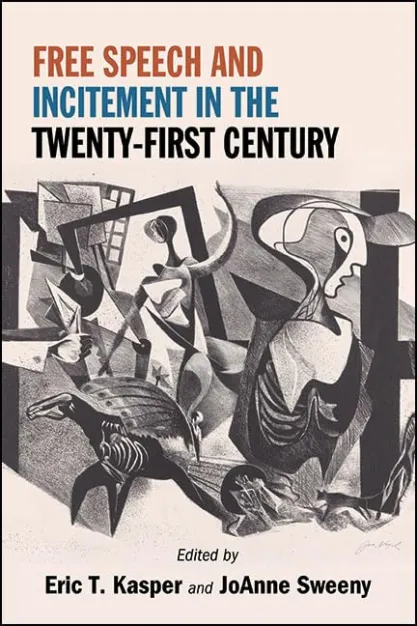
    Cover of the book "Free Speech and Incitement in the Twenty-First Century" by Eric Kasper and JoAnne Sweeny

    Free Speech and Incitement in the Twenty-First Century explores the line between free speech and incitement, which is a form of expression not protected by the First Amendment. Incitement occurs when a person intentionally provokes their audience to engage in illegal or violent action that is likely to, or will, occur imminently. 

    This doctrine evolved from World War I through the Cold War and the civil rights movement era, culminating in a test announced by the U.S. Supreme Court in Brandenburg v. Ohio (1969). Since the 1970s, this doctrine has remained largely unchanged by the Supreme Court and, as such, has received relatively little academic or media attention. 

    Since the late 2010s, however, violence at political rallies, armed protests around Confederate statues, social unrest associated with demonstrations against police, and an attack on the U.S. Capitol have led to new incitement cases in the lower courts and an opportunity to examine how incitement is defined and applied. Authors from different perspectives in Free Speech and Incitement in the Twenty-First Century help the reader understand the difference between free speech and incitement.

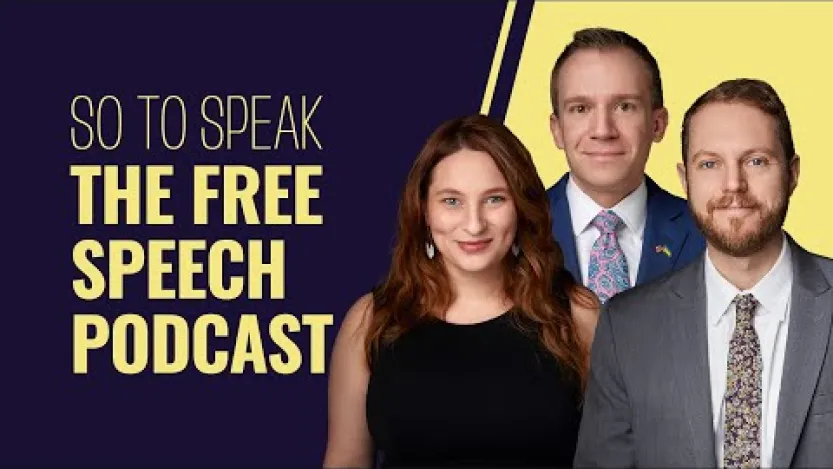
    ‘So to Speak’ podcast on Columbia University, DEI, and law firms

    We explore how censorship is impacting institutions — from universities to law firms to the Maine House of Representatives.


    More in the news

    2024-2025 SCOTUS term: Free expression and related cases

    Cases decided 

    • Villarreal v. Alaniz (Petition granted. Judgment vacated and case remanded for further consideration in light of Gonzalez v. Trevino, 602 U. S. ___ (2024) (per curiam))
    • Murphy v. Schmitt (“The petition for a writ of certiorari is granted. The judgment is vacated, and the case is remanded to the United States Court of Appeals for the Eighth Circuit for further consideration in light of Gonzalez v. Trevino, 602 U. S. ___ (2024) (per curiam).”)
    • TikTok Inc. and ByteDance Ltd v. Garland (The challenged provisions of the Protecting Americans from Foreign Adversary Controlled Applications Act do not violate petitioners’ First Amendment rights.)

    Review granted

    Pending petitions 

    Petitions denied

    Free speech related

    Thompson v. United States (Decided: 3-21-25/ 9-0 with special concurrences by Alito and Jackson) (Interpretation of 18 U. S. C. §1014 re “false statements”)

    Last scheduled FAN

    FAN 463: ‘We simply could not practice law . . . if we were still subject to the executive order’

    This article is part of First Amendment News, an editorially independent publication edited by Ronald K. L. Collins and hosted by FIRE as part of our mission to educate the public about First Amendment issues. The opinions expressed are those of the article’s author(s) and may not reflect the opinions of FIRE or Mr. Collins.

    Source link

  • Free speech and the University of Sussex 

    Free speech and the University of Sussex 

    • Naimat Zafary is a PhD researcher at the University of Sussex and a former Afghan Chevening Scholar.

    There are times, as a scholar from another country, that events in your adopted home catch you off guard. The fears of those around you are so far removed from your own experience that you are baffled by them. Sometimes, this simply demands that you learn more about the society and culture around you or chalk up different perspectives to the rich experience of a global education. 

    At other times, though, there is a desire to share with your colleagues your own thoughts about an issue, especially when you think others are at risk of undervaluing the freedoms and advantages they have. This week was one of those times. 

    First a bit about me. I came to this country at a moment of deep crisis. An Afghan accepted for a prestigious Chevening Scholarship, I had been excited by the opportunity to study at the top university in the world for international development and to gain knowledge that I could put to use in my home country. 

    But even as I packed my cases, the unimaginable happened. The US withdrew its forces and the Taliban entered Kabul. As fearful Cheveners worried whether they would or would not be granted a place on the last flights from the chaotic airport, I gathered my family. I was permitted a small rucksack as I turned my back on my family home and car, my library where local children had studied, and gathered my loved ones for the two-day journey through hell to the airport perimeter fence. When a British soldier finally recognised us and saw my name on the list, he lifted us over the wall and to safety. I kissed his shoulder and wept. 

    From there, we sat on the floor of a military cargo ship and flew to an asylum hotel in London, safe at last from the Taliban, who would see us as a threat for our academic links to the UK and deep commitment to education for all, including women and girls. And so, it was I travelled by train for my first class at my academic home and inspiration, University of Sussex. 

    What I found in Sussex could not have contrasted more profoundly with what I left behind. Sussex has been ranked 1st in the world for Development Studies for seven consecutive years in the QS World University Rankings. And here was a global community of men and women dedicated to the highest standards of education and using academic rigour and debate to acquire knowledge which would benefit not only the immediate community of Brighton but the wider world. 

    My wife Saima and my daughters were also inspired by the women leaders who surrounded me. While former female colleagues and family members in Afghanistan were being barred from education and being driven behind burqas and closed doors, their voices silent, I was at an institution led by a courageous and principled woman committed to supporting diverse perspectives from across the world. I expressed my views in the classroom, at conferences and seminars, and in print without fear of brutal consequences. Sussex has given a platform to voiceless Afghan girls, whereas, in Afghanistan, asking a question about girls’ education is banned; Sussex made sure to value our voices and let us speak with wider audiences.

    This was truly free speech. I was gifted the ability to challenge the accepted norms of government and aid agencies, and in turn, my own ideas were challenged daily by my fellow students, my supervisor, my community. I learned and grew to appreciate the diversity of thought and background which typified the world I had entered. 

    So how do I respond to the idea that a place that has been to me and many hundreds of Chevening scholars from across the globe has been such a haven for free enquiry and open expression has been fined for a breach of free speech? 

    I understand that the issues and debate that led to this circumstance predate the leadership of the institution I have entered. I appreciate that there are deeply held views and profound concerns at play and that the ability to speak without fear of harassment or intimidation is core to educational exchange. 

    But I also know that the commonly held stereotype of my institution in some parts of the media is very wide of the mark. Those who have, like me, known the cost of true tyranny understand that places like Sussex are the very antithesis of that and an antidote to it. And so, I offer my voice and support to the university and community that not only welcomed me but encouraged me to challenge and be challenged in the pursuit of truth and global justice. It is a proud tradition and we undervalue it at our cost. 

    Source link

  • DfE and OfS are running out of road on regulating a “free market” effectively

    DfE and OfS are running out of road on regulating a “free market” effectively

    On The Wonkhe Show, Public First’s Jonathan Simons offers up a critique of the way the higher education sector has been organised in recent years.

    He says that despite being more pro-market than most, he’s increasingly come to the view that the sector needs greater stewardship.

    He says that the theory of change embedded in the Higher Education and Research Act 2017 – that we should have more providers, and that greater choice and contestability and composition will raise standards – has worked in some instances.

    But he adds that it is now “reasonably clear” that the deleterious side effects of it, particularly at a time of fiscal stringency, are “now not worth a candle”:

    If we as a sector don’t start to take action on this, then the risk is that somebody who is less informed, just makes a judgment? And at the stroke of a ministerial pen, we have no franchising, or we have a profit cap, or we have student number controls. Like that is a really, really bad outcome here, but that is also the outcome we are hurtling towards, because at some point government is going to say we don’t like this and we’re just going to stop it overnight.

    Some critiques of marketisation are really just critiques of massification – and some assume that we don’t have to worry about whether students actually want to study something at all. I don’t think those are helpful.

    But it does seem to be true that the dominant civil service mindset defaults to regulated markets with light stewardship as the only way to organise things.

    Civil servants often assume that new regulatory mechanisms and contractual models can be fine-tuned to deliver better outcomes over time. But the constant tweaking of market structures leads to instability and policy churn – and bad actors nip around the complexity.

    Much of Simons’ critique was about the Sunday Times and the franchising scandal. But meanwhile, across the sector, something else is happening.

    Another one

    Underneath daily announcements on redundancies, senior managers and governing bodies are increasingly turning to data analytics firms to inform their academic portfolios.

    The advice is relatively consistent – close courses with low market share and poor demand projections, maintain and grow those showing high share or significant growth potential.

    But when every university independently follows that supposedly rational strategy, there’s a risk of stumbling into a classic economic trap – a prisoner’s dilemma where individual optimisation leads to collective failure.

    The prisoner’s dilemma, a staple of economic game theory, runs like this. Two prisoners, unable to communicate, have to decide whether to cooperate with each other or defect. Each makes the decision that seems best for their individual circumstance – but the outcome is worse for both than if they had cooperated.

    I witnessed it unfold a couple of weeks ago. On a Zoom call, I watched four SU officers (under the Chatham House rule, obvs) from the same region simultaneously share that their university was planning to expand their computer science provision while quietly admitting they were “reviewing the viability” of their modern languages departments.

    It did sound like, on probing, that their universities were all responding to the same market intelligence, provided by the same consultancies, using the same metrics.

    Each university, acting independently and rationally to maximise its own market position, makes decisions that seem optimal when viewed in isolation. Close the underperforming philosophy department. Expand the business school. Withdraw from modern languages. Double down on computer science.

    But when every university follows the same market-share playbook, the collective result risks the sector becoming a monoculture, with some subjects vanishing from entire regions or parts of the tariff tables – despite their broader societal value.

    The implications of coordination failure aren’t just theoretical – they are reshaping the physical and intellectual geography of education in real time.

    Let’s imagine three post-92 universities in the North East and Yorkshire each offered degrees in East Asian languages, all with modest enrolment. Each institution, following market share analysis, determines that the subject falls below their viability threshold of 40 students per cohort. Acting independently, all three close their departments, creating a subject desert that now forces students in the region to relocate hundreds of miles to pursue their interest.

    The spatial mismatch of Hotelling’s Location Model means students having to travel further or relocate entirely – disproportionately affecting those from lower-income backgrounds.

    And once a subject disappears from a region, bringing it back becomes extraordinarily difficult. Unlike a coffee shop that can quickly return to a high street when demand reappears, universities face significant barriers to re-entry. The sunk costs of hiring specialist staff, establishing facilities, securing accreditation, and rebuilding reputation create path dependencies that lock in those decisions for generations.

    The Matthew effect and blind spots

    Market-driven restructuring doesn’t affect all providers equally. Higher education in the UK operates as a form of monopolistic competition, with stratified tiers of universities differentiated by reputation, research intensity, and selectivity.

    The Matthew effect – where advantages accumulate to those already advantaged – means that elite universities with strong brands and secure finances can maintain niche subjects even with smaller cohorts.

    Meanwhile universities lower in the prestige hierarchy – often serving more diverse and less privileged student populations – find themselves disproportionately pressured to cut anything deemed financially marginal.

    Elite concentration means higher-ranking universities are likely to become regional monopolists in certain subjects – reducing accessibility for students who can’t meet their entry requirements.

    Are we really comfortable with a system where studying philosophy becomes the preserve of those with the highest A-level results, while those with more modest prior attainment are funnelled exclusively toward subjects deemed to have immediate market value?

    Markets are remarkable mechanisms for allocating resources efficiently in many contexts. But higher education generates significant positive externalities – benefits that extend beyond the individual student to society at large. Knowledge spillovers, regional economic development, civic engagement, and cultural enrichment represent value that market signals alone fail to capture.

    Market failure is especially acute for subjects with high social utility but lower immediate market demand. Philosophy develops critical thinking capabilities essential for a functioning democracy. Modern languages facilitate international cooperation. Area studies provide crucial cultural competence for diplomacy and global business. And so on.

    When market share becomes a dominant decision criterion, broader societal benefits remain invisible on the balance sheet. The market doesn’t price in what we collectively lose when the last medieval history department in a region closes, or when the study of non-European languages becomes accessible only to those in London and Oxbridge.

    And market analysis often assumes static demand curves – failing to account for latent demand – students who might have applied had a subject remained available in their region.

    Demand for higher education isn’t exogenous – it’s endogenously shaped by availability itself. You can’t desire what you don’t know exists. Hence the huge growth in franchised Business Degrees pushed by domestic agents.

    Collective irrationality

    What’s rational for an individual university becomes irrational for the system as a whole. Demand and share advice makes perfect sense for a single institution seeking to optimise its portfolio. But when universally applied, it creates what economists call aggregate coordination failure – local optimisations generating system-wide inefficiencies.

    The long-term consequences extend beyond subject availability. Regional labour markets may face skill shortages in key areas. Cultural and intellectual diversity diminishes. Social mobility narrows as subject access becomes increasingly determined by prior academic advantage. The public good function of universities – to serve society broadly, not just commercially viable market segments – erodes.

    But the consequences of market-driven strategies extend beyond immediate subject availability. If we look at long-term societal impacts, we end up with a diminished talent pool in crucial but less popular fields – from rare languages to theoretical physics – creating intellectual gaps that can take generations to refill.

    An innovative economy – which thrives on unexpected connections between diverse knowledge domains – suffers when some disciplines disappear from regions or become accessible only to the most privileged students.

    Imagine your small but vibrant Slavic studies department closes following the kind of market share analysis I’ve explained – you lose not just courses but cross-disciplinary collaborations that generate innovative research projects. Your political science colleagues suddenly lacked crucial language expertise during the Ukraine crisis. Your business school’s Eastern European initiatives withered. A national “Languages and Security” project will boot you out as a partner.

    Universities don’t compete on price but on quality, reputation, and differentiation. It creates a market structure where elite institutions can maintain prestige by offering subjects regardless of immediate profitability, while less prestigious universities face intense pressure to focus only on high-demand areas.

    In the past decade, some cross-subsidy and assumptions that the Russell Group wouldn’t expand disproportionately helped. But efficiency has done what efficiency always does.

    Both of the assumptions are now gone – the RG returning to the sort of home student numbers it was forced to take when the mutant algorithm inflated A-Levels in 2020.

    Efficiency in market terms – optimising resources to meet measurable demand – conflicts directly with EDI and A&P goals like fair access and diverse provision. A system that efficiently “produces” large numbers of business graduates in large urban areas while eliminating classics, philosophy, and modern languages might satisfy immediate market metrics while failing dramatically at broader social missions.

    And that’s all made harder when, to save money, providers are reducing elective and pathway choice rather than enhancing it.

    Choice and voice

    When we visited Maynooth University last year we found structures that allow students to “combine subjects across arts and sciences to meet the challenges of tomorrow.” It responds to what we know about Gen Z demands for interdisciplinary opportunities and application – and allows research-active academics to exist where demands for full, “headline” degrees in their field are low.

    In Latvia recently, the minister demanded, and will now create the conditions to require, that all students be able to accrue some credit in different subjects in different institutions – partly facilitated by a kind of domestic Erasmus (responding in part to a concern about the emigration caused by actual Erasmus).

    Over in Denmark, one university structures its degrees around broad disciplinary areas rather than narrowly defined subjects. Roskilde maintains intellectual diversity while achieving operational efficiency – interdisciplinary foundation years, project-based learning that integrates multiple disciplines, and a streamlined portfolio of just five undergraduate degrees.

    As one student said when we were there:

    The professors teaching the classes at other universities feel a need to make their little modules this or that, practical or applied as well as grounded in theory. Here they don’t have that pressure.

    And if it’s true that we’re trapped in a reductive binary between lumbering, statist public services on the one hand, and lean, mean private innovative operators on the other, the false dichotomy paralyses our ability to imagine alternative approaches.

    As I note here, in the Netherlands there’s an alternative via its “(semi)public sector” framework, which integrates public interest accountability with institutional autonomy. Dutch universities operate with clear governance standards that empower stakeholders, mandate transparency, enforce quality improvement, and cap senior staff pay – all while receiving substantial public investment. It recognises that universities are neither purely market actors nor government departments, but entities with distinct public service obligations.

    When Belgian student services operate through distinct governance routes with direct student engagement, or when Norwegian student welfare is delivered through regional cooperative organisations, we see alternatives to both market competition and centralised planning.

    They suggest that universities could maintain subject diversity and geographical access not through either unfettered market choice or central planning mandates, but through governance structures that systematically integrate the voices of students, staff, and regional stakeholders into portfolio decisions. The prisoner’s dilemma is solved not by altering individual incentives alone, but by fundamentally reimagining how decisions are made.

    Other alternatives include better-targeted funding initiatives for strategically important subjects regardless of market demand, proper cross-institutional collaboration where universities collectively maintain subject breadth, regulatory frameworks that actually incentivise (rather than just warn against extremes in removing) geographical distribution of specialist provision, new metrics for university performance beyond enrolment and immediate graduate employment and better information for prospective students about long-term career pathways and societal value when multiple subject areas are on the degree transcript.

    Another game to play

    Game theory suggests that communication, coordination, and changing the incentive structure can transform the outcome.

    First, we need policy interventions that incentivise the public good nature of higher education, rather than just demand minimums in it. Strategic funding for subjects – and crucially, minor pathways or modules – that are deemed nationally important, regardless of their current market demand, can maintain intellectual infrastructure. Incentives for regional subject provision might ensure geographical diversity.

    Universities will need to stop using CMA as an excuse, and develop cooperative rather than competitive strategies. Regional consortia planning, subject-sharing agreements, and collaborative provision models are in the public interest, and will maintain breadth while allowing individual institutions to develop distinctive strengths.

    Flexible pathways, shared core skills, interdisciplinary integration – all may prove more resilient against market pressures than narrowly defined single-subject degrees. They allow universities to maintain intellectual diversity while achieving operational efficiency. And they’re what Gen Z say they want. Some countries’ equivalents of QAA subject benchmarking statements have 10, or 15, with no less choice of pathways across and within them. In the UK we somehow maintain 59.

    At the sector level, collaborative governance structures that overcome the coordination failure means resource-sharing for smaller subjects, and student mobility within and between regions even for those we might consider as “commuter students”.

    OfS’ regulatory framework could be reformed to incentivise and reward collaboration rather than focusing primarily on institutional competition and financial sustainability. Funding could reintroduce targeted support for strategically important subjects, informed by decent mapping of subject (at module level) deserts and cold spots.

    Most importantly, universities’ governing instruments should be reformed to explicitly recognise their status as “(semi)public sector bodies” with obligations beyond institutional self-interest – redefining success not as market share growth but as contributing to an accessible, diverse, and high-quality higher education system that serves both individual aspirations and collective needs.

    Almost every scandal other than free speech – from VC pay to gifts inducements, from franchising fraud to campus closures, from grade inflation to international agents – is arguably one of the Simons’ deleterious side effects, which are collectively rapidly starting to look overwhelming. Even free speech is said by those who think there’s a problem to be caused by “pandering” to student consumers.

    Universities survive because they serve purposes beyond market demands. They preserve and transmit knowledge across generations, challenge orthodoxies, generate unanticipated innovations, and prepare citizens for futures we can’t yet imagine.

    If they respond solely to market signals, the is risk losing what makes them distinctive and valuable. That requires bravery – seeing beyond the apparent rationality of individual market optimisation to recognise the collective value of a diverse, accessible, and geographically distributed higher education sector.

    It doesn’t mean running provision that students don’t want to study – but it does mean actively promoting valuable subjects to them if they matter, the government intervening to signal that quality can (and does) exist outside of the Russell Group, and it means structuring degrees such that some subjects and specialisms can be studied as components if not the title on the transcript.

    It also very much requires civil servants and their ministers to wean themselves off the dominant orthodoxy of regulated markets as being the best or only way to do stuff.

    Source link

  • Defending free speech: FIRE and Substack partner to protect writers in America

    Defending free speech: FIRE and Substack partner to protect writers in America

    In his farewell address to the nation, President Ronald Reagan remarked that “America is freedom,” and it’s this freedom that makes the country “a magnet” for those from around the world.

    In recent weeks, America has sent a very different message to foreigners residing in America lawfully: You can stay here — but only if you give up your freedom of speech.

    Earlier this week, federal immigration officials arrested a Tufts University student off the street, allegedly for an op-ed she wrote in a student newspaper calling for the university to divest from Israel. If true, this represents a chilling escalation in the government’s effort to target critics of American foreign policy.

    Since our founding, America has long welcomed writers and thinkers from across the globe who come to this country and contribute to the richness of our political and cultural life. Christopher Hitchens was one of President Bill Clinton’s sharpest critics, Alexander Cockburn punched in all directions, and Ayn Rand minced no words in her condemnation of socialism.

    To preserve America’s tradition as a home for fearless writing, the Foundation for Individual Rights and Expression and Substack are partnering to support writers residing lawfully in this country targeted by the government for the content of their writing — those who, as Hitchens once put it, “committed no crime except that of thought in writing.” If you fit this category, whether or not you publish on Substack, we urge you to get in touch immediately at thefire.org/alarm or pages.substack.com/defender.

    President Reagan recognized that freedom is “fragile, it needs protection” — and that’s exactly what FIRE and Substack intend to provide.

    Source link

  • Sussex fined almost £600k over free speech

    Sussex fined almost £600k over free speech

    The University of Sussex is to be fined a record £585,000 over a failure to uphold free speech and academic freedom.

    The Office for Students (OfS) has found “significant and serious breaches” of free speech and governance issues at the University of Sussex.

    The regulator’s investigation, which followed the departure of academic Kathleen Stock from the university, says that said policies intended to prevent abuse or harassment of certain groups on campus had created “a chilling effect” that might cause staff and students to “self-censor.”

    OfS found that Sussex’s policy statement on “trans and non-binary equality” failed to uphold the principles of freedom of speech and academic freedom governance – and had created a “chilling effect” on campus.

    It also said the university failed to have “effective and adequate management and governance arrangements in place” to uphold those principles.

    Officially, OfS’ inquiry focused on the university’s general compliance with the regulatory framework, rather than the departure of Kathleen Stock specifically – but also found “no evidence to suggest that Professor Stock’s speech during her employment at the university was unlawful.”

    Sussex has come out fighting. Vice chancellor Sasha Roseneil told the Financial Times that universities are now exposed to regulatory risk if they have policies that protect staff and students from racist, homophobic, antisemitic, anti-Muslim or other abuse, and said the regulator had decreed “free speech absolutism as the fundamental principle” for universities.

    She also claims the regulator had “refused to speak to us,” and that the fine imposed was “wholly disproportionate” – arguing the university had defended Stock’s right to pursue her academic work and express her “lawful beliefs.”

    The report – some 1,224 days since OfS says it opened the investigation – comes at a tricky time for the government. Its decision first to pause, and then announce an intention to partially repeal the Higher Education (Freedom of Speech) Act, has to some extent been centred on concerns that the Act as passed represented a “hate speech charter” preventing universities from taking steps to protect marginalised groups on campus.

    OfS’ decision – notwithstanding that it is one taken in the context of a previous and pre-existing legal framework – will therefore be widely seen as rebuttal of the idea that protection of that sort conflicts with free speech and academic freedom.

    But on the other side of that argument is Sussex itself – experiencing OfS’ fifth ever fine, and arguing that OfS’ decision will itself have a chilling effect on efforts to:

    …prevent abuse, harassment or bullying, to protect groups subject to harmful propaganda, or to determine that stereotyped assumptions should not be relied upon in the university curriculum.

    Kathleen Stock left her post as Professor of Philosophy at the University of Sussex in October 2021, shortly after which the Office for Students (OfS) announced that it had opened an investigation focused on whether or not the university had met its obligations for academic freedom and freedom of speech within the law for all students and staff, whatever their views.

    Although Stock and her departure from Sussex has become easily the most-referenced example used to illustrate the need for the Higher Education (Freedom of Speech) Act, it had at that stage only recently completed its run in the Commons – so the investigation opened by OfS was over whether the university had complied with general ongoing conditions E1 and E2 – which, in the original Jo Johnson design, were designed to give regulatory force to the “public interest governance principles” for academic freedom and freedom of speech.

    This report outlines how OfS determined breaches of conditions E1 and E2, how penalties were calculated, and raises concerns that the university may have breached broader legal duties on free speech and academic freedom. Here there’s a short background, a look in detail at the report itself, and what it might mean for the campus culture wars in coming years.

    Background

    In late 2021 at the University of Sussex – a campus with a long history of radical politics – a group of students describing themselves as queer, trans, and non-binary had mounted a campaign calling for Stock’s dismissal.

    Responding both to her teaching and books, they claimed she was espousing a “bastardised version of radical feminism that excludes and endangers trans people.” Posters and protests ensued, Stock reported receiving death threats and was advised by police to take safety precautions, and the university’s vice chancellor, Adam Tickell (now at Birmingham) defended Stock’s academic freedom and announced an investigation into the protests.

    More than 200 academic philosophers from across the UK went on to sign an open letter supporting Stock’s right to “engage in open and scholarly debate without fear of harassment,” but notably the Sussex branch of the University and College Union (UCU) criticized Tickell’s stance, expressing solidarity with the protesting students and calling for an investigation into “institutional transphobia” at the university.

    Stock resigned on 28 October, and in a subsequent radio interview on Woman’s Hour, she denied being transphobic, and explained that her resignation followed attacks from colleagues who opposed her views and who, according to Stock, encouraged an “extreme” response from their students. Stock also said that it was the UCU statement that had “effectively ended” her career at Sussex.

    What was novel about the affair is that while there had been quoted incidents of “mobbing,” “cancellation,” and “no platforming,” these had tended to be focused on figures outside of universities, visiting as speakers.

    Since the Education Act 1986 had started to require to universities to “take reasonably practicable steps to ensure that freedom of speech within the law is secured for members, students and employees of the establishment and for visiting speakers,” it had been the last of that list that had caused that legislation – and the last of that list that had largely generated skirmishes since.

    But when Arif Ahmed – now OfS’ Director for Academic Freedom and Freedom of Speech, then a fellow philosopher at the University of Cambridge – wrote for Index on Censorship in early 2022, he noted a new character to conflict on campus. Ahmed picked up other cases – the 500 students that had petitioned Oxford University to force two professors to include trans women in their research into women’s equality, and the academics that had had talks cancelled at Essex University after they were accused of transphobia.

    Not wanting to “anticipate what that inquiry finds,” the article also argued that in principle, there may be academic freedom issues on both sides, including “the right of students (or anyone else) to protest against her” – albeit that:

    …we must distinguish peaceful protest in favour of a principle like rights for trans people… harassment and victimisation of an individual aimed at blocking their speech.

    That often fraught line – between freedom to speak (and research), and freedom from harm – is both as old as John Stuart Mill’s On Liberty (1859), and one that has dogged the debate about campus culture generally and the Higher Education (Freedom of Speech) Act specifically ever since. Where a regulator might draw the line has been an open question – and the report now illustrates it clearly.

    An inspector calls

    On 7 October 2021, OfS contacted the university seeking information on what steps it had taken to protect free speech and academic freedom for Kathleen Stock and others with similar views, and how it had assessed whether the incident amounted to harassment based on her gender critical beliefs. After reviewing this and examining relevant policies, it formally launched an investigation on 22 October.

    The investigation focused on whether the university had taken reasonably practicable steps to uphold lawful free speech and academic freedom, whether its governance documents complied with OfS public interest principles and legal duties (including under the Equality Act 2010), and whether its policies – particularly those on academic freedom, HR, and EDI – had negatively impacted free expression.

    It imposed “cooperation requirements,” reviewed multiple rounds of documentation, and considered policy changes made during the process. Provisional findings were shared in March 2024, and final decisions were made on 14 February 2025 after considering the university’s response.

    The first breach – of Condition E1 – concerns the university’s governing documents, and the way in which OfS says they restricted lawful speech – including “gender critical” views, which are protected under the Equality Act 2010.

    OfS says this created a chilling effect – discouraging staff and students from expressing certain views. Though not officially about Stock’s case per se, it’s cited as a real-world example – OfS taking the opportunity to remind readers of its role in safeguarding lawful free speech through a viewpoint-neutral, “impartial” approach.

    The university first adopted a Trans and Non-Binary Equality Policy Statement in November 2018. On 12 November, a proposal was made to publish it on 20 November – Trans Day of Remembrance. The draft was reviewed by the University Executive Group (UEG) on 13 November, which supported its general direction, but called for further discussion after review by the Equality, Diversity and Inclusion Committee.

    Despite this, the UEG held an unscheduled meeting on 14 November 2018, during which it approved the statement for publication on 20 November. No separate minutes were recorded for this meeting. That 2018 version remained in effect when OfS began its investigation in October, and is the main source of the compliance problem.

    Some tricky timeline issues ensue which relate to later revisions, and OfS has not yet determined whether one of its identified breaches has extended beyond March of last year.

    But essentially, the judgement centres on four aspects of different versions of the university’s policy – which it’s counting here for E1 purposes as one of the university’s governing documents:

    • A requirement for “any materials within relevant courses and modules [to] positively represent trans people and trans lives.” OfS refers to this as the Positive Representation Statement throughout its report;
    • A statement that “the curriculum shall not rely on or reinforce stereotypical assumptions about trans people”. It refers to this as the Stereotyping Statement;
    • A statement that “transphobic propaganda … will not be tolerated.” It refers to this as the Transphobic Propaganda Statement;
    • A statement that “transphobic abuse, harassment or bullying (name-calling/derogatory jokes, unacceptable or unwanted behaviour, intrusive questions) are serious disciplinary offences for staff and students and will be dealt with under the appropriate University procedures.” It refers to this as the Disciplinary Statement.

    OfS’ conclusion is that the university breached E1 because the four statements breached the academic freedom and freedom of speech principles.

    That’s partly because the statements were capable of restricting lawful speech – including in-course content – and signalled that some views weren’t welcome. This, says OfS, produced a chilling effect – Stock self-censored, and others likely did too. She removed lawful material from her curriculum, narrowing academic debate and reducing students’ exposure to diverse views. Other staff may have followed suit or felt pressured to.

    Its argument is that the policy lacked safeguards for legally protected beliefs like “gender critical” views and that its other governing documents didn’t fill that gap. The university’s wider “Statute VII” offered some protection for free speech and academic freedom, but in OfS’ view was insufficient.

    Partly because the investigation has been on for a long time – and partly because the university has been making changes to policies throughout – there’s also some complex evaluation of what’s happened since the initial investigation opened, all of which is of a similar nature.

    See-saw

    Much of the material on wider legal duty breaches is focussed on gender critical views as a protected belief – anyone searching for the ways in which OfS might have evaluated efforts to protect trans students just won’t find it.

    Hence OfS found no “credible evidence” that the university assessed whether its restrictions on expression under the Trans and Non-Binary Equality Policy Statement were proportionate – a key requirement under Article 10 of the European Convention on Human Rights – that it says raised the risk that the policy’s interferences with freedom of expression were disproportionate and therefore unlawful.

    Similarly, OfS was concerned the university may have breached equality law under section 19 of the Equality Act 2010 by indirectly discriminating against individuals with gender critical beliefs – a protected characteristic. The Trans and Non-Binary Equality Policy Statement included provisions (e.g. the Positive Representation, Stereotyping, Transphobic Propaganda, and Disciplinary Statements) that it says restricted lawful speech, including gender critical views. Again, OfS found no credible evidence that the university conducted an objective justification assessment for the restrictions when adopting the policy.

    OfS was also concerned that the university may have failed to comply with the Public Sector Equality Duty (PSED). It found no credible evidence that the university properly considered the equality implications of the policy, as required under the PSED, and while the university claimed to have conducted an Equality Impact Assessment for the 2023 version, this appeared limited to the removal of the Positive Representation Statement and did not assess the remaining content.

    Taken as a whole, this is a pretty extensive illustration of the principle both in the Higher Education (Freedom of Speech) Act 2023 and OfS’ draft guidance on it – both on “particular regard” to the importance of freedom of speech, and these two notable paras in the draft:

    Freedom of speech within the law is protected. Unlawful speech is not protected. However, there is no need to point to a specific legal basis for speech. Instead, the starting point is that speech is permitted unless restricted by law.

    Free speech includes lawful speech that may be offensive or hurtful to some. Speech that amounts to unlawful harassment or unlawful incitement to hatred or violence (for instance) does not constitute free speech within the law and is not protected.

    There are likely to be debates about the extent to which that was clear to providers in the old regime, and whether the new regime is merely an enforcement wrapper around pre-existing legal duties – but that’s the framing in use in this decision.

    A record (reduced) fine

    The fining decision is then explained in in line with Regulation 4 of the 2019 Monetary Penalties Regulations, where OfS considered several factors – the nature, seriousness, duration, and impact of the breach; any financial or other benefit the university may have gained or losses it avoided; and whether the breach had been repeated.

    OfS assessed that the breach was “serious, prolonged, and had a chilling effect on lawful speech and academic freedom” – and while no direct financial gain was identified, the regulatory failure was significant enough to warrant a monetary penalty to reflect the severity and ensure accountability.

    In setting the penalty, OfS also considered steps the university took to prevent future breaches and the likely impact of a monetary penalty on students. A “baseline penalty” was established as per Regulation 4, then adjusted based on aggravating and mitigating factors, including the university’s compliance history. The maximum penalty allowable was either 2 per cent of qualifying income or £500,000, whichever was higher.

    For 2023–24, Sussex’s qualifying income was £232,358,874, making the cap £4,647,177. OfS applied its published framework (Regulatory Advice 19) to determine the final penalty, ensuring it was “proportionate, targeted, and justified” in light of the breach’s seriousness and the steps taken by the university since.

    The university’s financial position was relevant – with (at the time) substantial income and reserves, OfS concluded that a penalty would not materially harm students. Instead, it would promote future compliance, both at Sussex and, notably, across the sector. The baseline penalty was set at 0.9 per cent of qualifying income: £2,091,230.

    Mitigating factors included steps taken by the university to reduce the restrictive effect of its policy like removing the “positive representation” requirement, adding an objective definition of “transphobic abuse,” and including a safeguard for academic freedom in the 2023 policy.

    Aggravating factors included the length of the breach (over four years) and the failure to self-report. After applying both sets of factors – each justifying a 0.2 per cent adjustment in opposite directions – the penalty remained unchanged at 0.9 per cent.

    The university’s compliance history did not warrant any further adjustment. It cooperated with the investigation and there was no evidence of dishonesty, recklessness, or concealment. Accordingly, after the first three steps of the process, the final penalty for the breach remained £2,091,230.

    Governance and delegation

    The second breach (Condition E2) was a process one – key policies were adopted by groups lacking the delegated authority to do so. The Prevent Steering Group approved the 2021 Freedom of Speech Code of Practice, the University Executive Group approved the 2023 External Speakers’ Procedure, and also approved the 2022 and 2023 versions of the Trans and Non-Binary Equality Policy Statement – each time acting outside its remit.

    These governance failures were deemed significant. Decisions were made by bodies not authorised to take them, raising the risk of insufficient scrutiny or expertise and potentially compromising compliance with legal and regulatory duties. Those failures, found OfS, could result in decisions not in the best interests of staff or students. The breach was not an isolated incident, but part of a pattern suggesting “systemic weaknesses rather than a one-off lapse.”

    The university didn’t report the breach to OfS (the old Kafka-esque rules around the reportable events regime), nor has it taken clear steps to address or rectify its governance failures. As such, OfS concluded that its intervention factors supported a breach of condition E2(i), and that regulatory action was necessary to address the university’s ongoing non-compliance with its own governance framework.

    This time the baseline penalty was 0.5 per cent of the university’s qualifying income (£1,161,794) for the E2 breach, reflecting its seriousness as a governance failure. While the decisions made without proper authority risked poor quality outcomes, the direct impact on students was assessed as less severe than the E1 breach, and the penalty was also viewed as a means to incentivise future compliance, both at Sussex and across the sector.

    Because of aggravating factors – like the longstanding nature of the breach, failure to report it, and lack of remedial steps – the penalty was increased by 0.2 percentage points, bringing it to 0.7 per cent (£1,626,512). No mitigating factors were identified.

    As with the E1 breach, the university’s compliance history didn’t affect the penalty, and it had cooperated with the investigation – but OfS ultimately concluded that penalties at the calculated levels would be disproportionately high. And so balancing all considerations – the seriousness of the breaches, financial capacity, cumulative penalty size, and the novelty of regulatory enforcement in this area – OfS reduced the final penalties and imposed £360,000 for the E1 breach and £225,000 for the E2 breach, totalling £585,000.

    This was deemed “sufficient” to deter future non-compliance while maintaining financial sustainability. Sussex says the fine is “wholly disproportionate.”

    Fallout and next steps

    There will doubtless be some fallout from the decision – not least because Sussex is (at least in principle) very publicly criticising the process, the fine, and the judgement made on the EDI/freedom of speech see saw.

    In some ways what’s surprising – although on reflection inevitable – is that this wasn’t really an investigation about the Stock affair at all. She and others calling for full implementation of the Higher Education (Freedom of Speech) Act may well argue that the investigation ought to have handled how she was treated, how she was protected (or otherwise) by the university, and drawn conclusions about the handling of events leading to her departure. OfS may well argue – campaigners almost certainly will – that that would only have been possible under the Higher Education (Freedom of Speech) Act.

    There are real questions over how long the process has taken, that are not substantially addressed or answered in the report – and the huge fine imposed. That OfS is able to follow the logic of its own documents is one thing, but when compared against some of the teaching and learning investigations it’s done so far, either those providers are in for huge fines, or inevitable comparisons are going to be drawn about relative impact.

    There will also be questions about Arif Ahmed himself. The report dots the Is and crosses the Ts as we would expect it to – and includes the “neutrality” defence we’ve come to recognise. But even though he’s unlikely to have been personally involved in this process, we should be reminded of the OIA’s advice that providers need to take steps to avoid “actual bias and the reasonable perception of bias” when handling complaints. Given in a previous role that Index on Censorship blog was entitled “We academics must fight the mob – now”, it’s not hard to see why some might at least perceive an agenda.

    The other questions surround the jurisprudence. It remains the case that in the cases we’ve seen, different levels of protection for freedom of speech apply in different contexts – there’s no doubt that in a lecture hall or seminar room, the way the Human Rights Act is applied is different to during someone’s personal life, free time, and so on. There’s nothing in here on the different contexts of conduct that a “university” encompasses – and it remains a hole in what OfS has published so far, and arguably in the way it has evaluated the policies for the breaches.

    The practical compatibility of the decision with impending heavy duties on harassment will also be a concern – with frantic rewrites of policies similar in nature and tone to that adopted by Sussex likely to face pushback from those who fear a wider retreat from equality-focussed work.

    It’s the government, though, that faces the trickiest set of decisions from here on in. Its decision to pause and intent to soften somewhat the Act has all been about a perception that it was to result in free speech absolutism at the expense of the protection of minorities.

    It may be a reflection of the law or a very particular (and contestable) interpretation of it – and legal challenges may ensue – but if nothing else, it’s hard to see how the version of “absolutism” deployed here is compatible with (for example) the IHRA definition of antisemitism – something successive governments have consistently supported, and which Ahmed himself only changed position on when taking up his role.

    Notwithstanding that Labour has disappointed trans campaigners since taking office, it will now have to decide whether Sussex is right that universities are now “exposed to regulatory risk if they have policies that protect staff and students from racist, homophobic, antisemitic, anti-Muslim or other abuse.” And if they are, whether the problem is the Higher Education (Freedom of Speech) Act, the Human Rights Act, or Arif Ahmed himself.

    Source link

  • Victory in Virginia! Gov. Youngkin defends free speech by vetoing bill on ‘altered’ political media

    Victory in Virginia! Gov. Youngkin defends free speech by vetoing bill on ‘altered’ political media

    If you were planning to post an edited photo online of a Virginia political candidate during the next election, you might’ve been in trouble. 

    After FIRE’s opposition and outreach on this bill, Gov. Glenn Youngkin just prevented that from happening by vetoing HB 2479. 

    The Virginia General Assembly passed HB 2479 to suppress “altered” and AI-generated depictions of candidates — enforced with threats of fines and even jail time — unless a conspicuous disclaimer was added. Instead of trusting the public to decide what’s true, false, or credible, HB 2479 would have violated the free speech rights of Virginians to make the government into the arbiter of truth. 

    This bill would’ve made it illegal for virtually any Virginian to sponsor an “electioneering communication” that contains “altered” or AI-generated images or audio recordings of identifiable candidates running for elected office. This included messages appearing in print, TV, radio, or online platforms within 60 days of an election. 

    Not only would it have included traditional paid campaign ads, but anyone’s speech expressing support for or against a candidate that involves the exchange of something of value and appears in a paper, a broadcast, or is promoted online for a fee. This could include using an AI tool that requires a paid license or even posting on a social media platform using a paid premium account that many platforms offer to extend the content’s visibility and reach.

    What “altered” means is anyone’s guess — but the government would be the decider.  Any edit that created a “fundamentally different impression” of the photo or video could count, meaning it could have covered even simple edits like cropping a photo. If an image of a candidate was cropped to fit onto a page, an aggrieved candidate could sue and argue that the crop created a “fundamentally different impression” from the original if the portion cropped out removed some kind of context — such as part of the background or another person.

    And every speaker was covered, not just mud-slinging political opponents. Suppose a small business owner buys space in a newspaper to highlight how a mayor running for reelection failed to address public safety concerns outside her shop. If she includes a slightly edited and unflattering image of the mayor, she could have been sued — even if the content is not misleading (or even relevant).

    The disclaimer requirement wouldn’t have solved the bill’s problems, and in fact created new ones. The First Amendment protects both your right to speak your mind and to hold your tongue, but disclaimers force you to utter government-mandated speech.   Even worse, the disclaimer here could have actually misled voters into thinking that someone is spreading falsehoods — even if the ad was factually accurate — simply because edited or AI-generated material was included. 

    Lawmakers certainly need to protect the electoral process, but this bill would have done the opposite, and it restricted far more speech than necessary to prevent true voter deception. It therefore was unlikely to withstand judicial scrutiny. 

    The better, constitutional way to fight falsehoods that arise during campaigns is to let candidates fight speech with more speech. If an ad is misleading or outright wrong, candidates can and should point it out. Should any depictions of candidates rise to the level of being actually defamatory, Virginia already has laws to address it. Otherwise, the First Amendment protects our right to use expressive tools like AI to enhance political communication.

    Our system of government hinges on the freedom to freely express our opinions about candidates for public office. We commend Youngkin for his veto, which will help preserve the First Amendment rights of Virginians and ensure a vibrant, open political discourse.

    Source link

  • American Jews must not give an inch on free speech — even when words hurt us

    American Jews must not give an inch on free speech — even when words hurt us

    This essay was originally published in Jewish Telegraphic Agency on March 14, 2025.


    We can’t make antisemitism go away by censoring antisemites.

    Nevertheless, the Trump administration has said it is combating antisemitism at Columbia University by canceling $400 million in funding and detaining a former student over what the president has vexingly called “illegal protests” against Israel. It is also making a host of additional demands of the university.

    Some Jewish groups are applauding the effort. But as an American Jew and free speech lawyer, I can tell you that protest alone isn’t illegal — and that giving the government the power to punish hateful speech will only erode our own right to speak out against hate.

    In the wake of the Oct. 7, 2023, attack led by Hamas on Israeli civilians and Israel’s military response, protests erupted on campuses nationwide. Some of the activities by student protesters were unlawful, like blocking fellow students from entering parts of campus or occupying buildings. But many students engaged in pure speech by marching, displaying signs, or shouting slogans. These are protected and celebrated forms of protest in our country. Whether in support of Israel, Palestine, or even Hamas, the First Amendment prevents the government from punishing or censoring them.

    As a historically persecuted population, Jews have a vested interest in ensuring American civil rights protections remain in full force. The First Amendment guarantees not only the freedom to practice our religion in this country, but our ability to speak out when our rights and lives are in danger.

    Our institutions of higher education are supposed to be a marketplace of ideas. Even if you think those ideas are bad, protecting all speech means your speech is protected, too.

    In 1943, 400 rabbis marched on Washington to draw attention to the mass murder of European Jews, helping lead to the creation of an American War Refugee Board that saved thousands of Jewish lives. In 1963, American Jewish leaders like German-born Rabbi Joachim Prinz marched again, this time with Martin Luther King Jr. Speaking just before Dr. King’s “I Have a Dream” speech, Rabbi Prinz lamented that his former countrymen “remained silent in the face of hate” and pleaded that “America must not become a nation of onlookers. America must not remain silent.”

    But we endanger the ability to speak out when we allow the government to erode our First Amendment protections. That’s why White House statements this week threatening punishment for anti-Israel speech should have all Americans concerned — even those of us who would appear, at first blush, to benefit.

    Regarding the arrest of Palestinian protester Mahmoud Kahlil by U.S. Immigration and Customs Enforcement, President Trump said, “We will find, apprehend, and deport these terrorist sympathizers from our country — never to return again.” Secretary of State Marco Rubio posted an advisory from the Department of Homeland Security saying that Khalil had “led activities aligned to Hamas,” and has also claimed the power to deport a legal resident whose activities “would have potentially serious adverse foreign policy consequences for the United States.” But those justifications could merely describe Khalil’s on-campus protests, including his protected speech.

    Threatening to deport Khalil without accusing him of any crimes chills speech. And that threat extends to everyone, no matter what side of the Israeli-Palestinian debate you are on, or whether you are promoting or combatting antisemitism. Would a green-card-holding Jew feel free to criticize special government employee Elon Musk for publicly supporting the far-right, German-nationalist AfD party, knowing our government could deem such criticism creates “adverse foreign policy consequences”? That standard is just too vague to risk deportation, and it permits the government to punish speech it just doesn’t like.

    The Trump administration’s pledge to remove “pro-Hamas” students, coupled with Khalil’s arrest, make it hard to see the administration’s actions this week against Columbia and other institutions of higher education as anything other than attempts to police and punish campus speech.

    To be sure, it has been a difficult year for Jewish college students, and there have been documented instances of bad actors preventing them from getting to class, or even assaulting them. Title VI requires colleges and universities that receive federal funding to ensure discriminatory harassment does not deprive Jewish students of an education, and it is possible Columbia has failed that obligation.

    But protest alone is not grounds by itself for a Title VI violation. And the government did not make sure it was punishing only actionable misconduct before canceling Columbia’s funding, like it is supposed to. The Supreme Court rightly set a high bar for conduct that amounts to discriminatory harassment that is supposed to ensure pure speech rarely rises to that level.

    And with good reason: Our institutions of higher education are supposed to be a marketplace of ideas. Even if you think those ideas are bad, protecting all speech means your speech is protected, too.

    I’m no stranger to fear of the recent public increase in antisemitism. Last year, given online antisemitism approaching the anniversary of Oct. 7, my wife and I chose to keep our daughter home from her Chabad preschool that day. The current political moment terrifies me. Antisemitism is coming from both sides of the political spectrum, and it feels like there is nowhere to run. So instead, I think we should fight.

    But allowing the government to ignore our rights to free speech would only deprive us of our most powerful weapon.

    Source link

  • No Free Lunch? But for Some, Harvard is Now Free

    No Free Lunch? But for Some, Harvard is Now Free

    Emil GuillermoAre  you or your kids ready for Harvard?

    It’s free.

    As in F-R-E-E, free. At least for most families where the household income is $200,000 or below.

    Of course, you still have to pass the standards of the school’s admissions board.  But don’t assume that means straight-A’s and perfect scores.

    You can just be you. If you feel you are truly special and worthy.

    But now money, or class, shouldn’t get in the way.

    And no one has to mention that bad word these days: Race.

    So, if you’ve been shooting for two years at your local JUCO, followed by two years at the big state school, in order to save money, aim higher. Harvard has had alumni like Supreme Court Justice Ketanji Brown Jackson, the first African American woman to the high court. There’s Alvin Bragg, the District Attorney of New York who successfully prosecuted Donald Trump in the Stormy Daniels/Hush Money case.

    In the arts, there’s Courtney B. Vance, the actor, who played a lawyer, the O.J. Simpson defense attorney Johnnie Cochran, in FX’s “American Crime story.”  Vance is now running to be an overseer at the Harvard.

    And now after what Harvard did this week, you or your kids could be the next Ketanji Brown Jackson, Alvin Bragg, or Courtney B. Vance.

    Harvard’s decision follows the path of other schools that have come to the conclusion, that elite schools like Stanford and MIT,  can afford to be more magnanimous to more people, especially those potential students and families who aren’t wealthy. 

    These days, a household income of $200,000 a year is unfortunately just a decent middle class income. It’s a family of a nurse and mid-level manager. An administrator and a fire fighter. Maybe some overtime involved.

    Previously, the income number for Harvard was set at around $85,000 which is fairly modest, but more like households of two fast food managers. It’s also not as realistic in terms of attracting the most people who might give Harvard a second look. Some of course will,  but at that income level, the pool is relatively small. There are more first-time college admits.

    By lifting the income level, the number of people broadens to include more college educated households, and helps the school lose the tag of being elitist. There’s also likely to be a more diverse racial pool.

    And that may be the prime motivator of going free. It overcomes the hurdle placed by the Supreme Court that bars the use of race in admissions through the process often called “affirmative action.”

    Subsequent to that ruling, diversity at Harvard had taken a hit. Indeed, the school has been so gun-shy about using or talking about race in order not to violate the SCOTUS ruling.  But with an expanded pool, maybe the numbers of Black and Latino students improve.

    It’s a workaround to get by the legal roadblocks put up by those against race and diversity. And it gets past the biggest obstacle about a school like Harvard.

    It’s always been, “can I afford the $80-90,000 it costs to go there?”

    Harvard isn’t the first to reach out in this way. In many ways, Harvard was forced to. But why did it take so long?

    Harvard is well-endowed. Harvard could always afford it. They could call it a scholarship, but it just makes better marketing sense to say Harvard is Free. Still, we all know there’s no free lunch, will Harvard really be free? Will there be a stigma attached to getting in free?

    If people know, will that impact one’s status among those who want to preserve the school’s elitist tag? As an alumnus, I like the idea. But then when I applied, my family relied exclusively on  Social Security and SSI. An income of $200,000 is middle-class in America. There will be more diversity in this group, without trying to appeal to race.

    If this is the way to overcome the legal attacks on race-based admissions, and a bad  SCOTUS decision, that’s great. It’s premeditated accidental social justice. It also shows there’s a way to fight all the present anti-DEI, anti-higher ed decisions, if colleges can be ever more creative with costs and accounting.

     But the upside is worth it. Schools that may have seemed distant and unreachable can act more for the public good than they ever have. Removing the cost factor makes sense. Harvard isn’t a public school. But at least now to a segment, it’s free.

    Emil Guillermo is a journalist, commentator, and former adjunct professor. You can reach him at www.amok.com


    Source link

  • CASEL Becomes New Home for Engaging Schools Resources

    CASEL Becomes New Home for Engaging Schools Resources

    The Collaborative for Academic, Social, and Emotional Learning (CASEL) recently announced that it has become the new steward of Engaging Schools’ extensive body of educational resources. With Engaging Schools set to close in early 2025 after more than four decades of impact, CASEL will ensure the organization’s valuable tools, books, and frameworks remain available to educators worldwide.

    As part of this transition, CASEL is making these resources freely accessible to the public. Over time, CASEL will integrate elements of Engaging Schools’ work into several areas including the free Guide for Schoolwide SEL to further advance high-quality, evidence-based SEL implementation in schools and districts.

    “For more than 40 years, Engaging Schools has helped educators create safe and supportive learning environments where students thrive,” said Aaliyah A. Samuel, president and CEO of CASEL. “We are honored to carry forward their legacy by making these resources widely available and embedding them into our work to create school communities that prioritize academic, social, and emotional development.”

    Engaging Schools has long been recognized for its contributions to fostering inclusive school climates, strengthening restorative and equitable  discipline, and advancing engaging  teaching practices. 

    “We take immense pride in the lasting impact of Engaging Schools’ work,” said Larry Dieringer, Executive Director of Engaging Schools. “Though our organization’s chapter is closing, we are deeply grateful to CASEL for ensuring our resources continue to benefit educators and students for years to come.”

    For more than 30 years, CASEL has been a trusted leader in advancing SEL through research, practice, and policy. By integrating Engaging Schools’ resources into its offerings, CASEL reaffirms its commitment to supporting educators with the tools they need to create engaging, inclusive, and academically rich learning environments.

    To access Engaging Schools’ resources now available through CASEL, visit casel.org/engagingschools.

    Kevin Hogan
    Latest posts by Kevin Hogan (see all)

    Source link

  • How a Republican Plan to Cut Universal Free School Meals Could Affect 12 Million Students – The 74

    How a Republican Plan to Cut Universal Free School Meals Could Affect 12 Million Students – The 74


    Get stories like this delivered straight to your inbox. Sign up for The 74 Newsletter

    Every school in Kentucky’s LaRue County provides free breakfast and lunch to any student who wants it.

    It’s been that way for a decade, ever since the federal government launched a program allowing LaRue County Schools, and thousands of other districts nationwide, to skip the paperwork asking how much families earn.

    In these communities, lots of kids already receive other kinds of assistance for low-income families. Federal officials saw a way to make the subsidized meals program more efficient: Cover meal costs based on how many children are in similar assistance programs, rather than verify every family’s income.

    But LaRue County Schools won’t be able to do that anymore if sweeping changes to social programs proposed by congressional Republicans become law. GOP lawmakers say they want to ensure only eligible families get help and that taxpayer dollars are reserved for the neediest students, so that federal subsidies for school meals remain sustainable. But by one estimate, the Republicans’ plan would affect nearly a quarter of the students in the nation’s public schools.

    Research has found that universal free school meals can boost school attendance, increase test scores, and decrease suspensions, likely because it eliminates the stigma students often associate with the free meals. Taking them away from students on a large scale could also have downstream effects on everything from families’ household budgets to local unemployment.

    Stephanie Utley, the LaRue County district’s director of child nutrition, said that inevitably, fewer kids would eat school meals, either because their families no longer qualify for free breakfast and lunch or because they cannot produce documents to verify their income.

    When fewer kids eat school meals, it’s harder for districts to cover their costs. To save money, Utley would likely swap higher-quality foods for cheaper ones, she said.

    Apples and beef from local farms would go. The high school would serve fewer salads — they’d be too labor-intensive to prep. And a popular chicken breast sandwich would become a ground chicken patty.

    Utley may have to lay off staff, too, she said, which would hurt the rural community’s economy.

    “We’re the biggest restaurant in town,” she said. “It would be a nightmare.”

    GOP school meals proposals would impact states

    Republican lawmakers are considering a trio of proposals to help offset tax cuts sought by President Donald Trump that would be “devastating” to children and schools, said Erin Hysom, the senior child nutrition policy analyst for the nonprofit Food Research & Action Center.

    One proposal would dramatically increase the share of students who need to be enrolled in aid programs — such as the Supplemental Nutrition Assistance Program and Temporary Assistance for Needy Families — for schools to be eligible to serve free meals to all kids through the Community Eligibility Provision.

    Right now, schools need to show 25% of students are enrolled in those kinds of assistance programs to participate in community eligibility. The House Republican proposal would raise the share to 60% — higher than the threshold has ever been. That would kick more than 24,000 schools off of community eligibility, and some 12 million students would no longer automatically qualify for free meals, Hysom’s organization estimated.

    Essentially, only communities where nearly every child qualifies for free or reduced-price lunch could serve free meals to all kids.

    “They’ve really moved the needle to the upper echelon of poverty,” Hysom said. “You couldn’t get any higher than that.”

    Another proposal would require all families who don’t automatically qualify for free school meals through programs like SNAP to submit documents to verify their income with their application. That would burden families and schools with time-consuming added paperwork. Schools could end up cutting staff who serve food and work on school menus to hire more people to process applications.

    Together, those changes would save $12 billion over 10 years, according to the list of proposals circulated by U.S. Rep. Jodey Arrington, the Republican chair of the House budget committee.

    A third proposal would change how families qualify for SNAP and likely make over 1 million students no longer automatically eligible for free school meals. That would increase the paperwork burden even more.

    All of that would make it more costly for states with universal free school meals to run their programs, because they rely heavily on federal reimbursement. Some states were already weighing whether they could afford to keep up free meals for all.

    These three proposals are part of a process known as budget reconciliation that GOP lawmakers are using to make long-term changes to federal spending and revenue. As of Wednesday, Congress was considering a separate, stopgap budget that would keep funding essentially flat for the Agriculture Department, which pays for the school meal program, through the end of September.

    School staff and child nutrition advocates are taking the House’s budget reconciliation proposals seriously. The Trump administration has already cut a $1 billion Agriculture Department program that helped schools buy food from local producers.

    Free school meal cutbacks would have ripple effects

    If fewer kids have access to free meals at school, more families would likely struggle to afford groceries at home. Many families who don’t qualify for free meals struggle to pay for food. This school year, a family of four qualified for free school meals if they made under $40,560 a year.

    When schools eliminated free school meals for all following the pandemic, there was a surge in unpaid school meal debt, an issue school staff say will only intensify if these proposals go through.

    Right now, schools typically have to verify the family’s income for 3% of their applications. If schools had to check income for every application, the burden would be enormous, school staff and child nutrition advocates said.

    Many families who eke out a living working multiple jobs would have a hard time gathering up all the required documents to show how much they earn. Though children can participate in the school meals program regardless of their immigration status, undocumented parents may be afraid to hand over personal documents when Trump is threatening mass deportations.

    “Eligible children are going to fall through the cracks,” Hysom said.

    Many schools are already facing financial pressures from higher-than-usual food and labor costs, a 2024 survey of nearly 1,400 school nutrition directors showed. On top of that, schools are navigating new and stricter requirements for how much salt and sugar can be in food served by schools.

    Schools have to buy most of their food from American sources, but if Trump puts certain tariffs in place for the long term, that could create new financial constraints.

    “Cost is absolutely a concern,” said Diane Pratt-Heavner, a spokesperson for the School Nutrition Association, which represents school nutrition directors and conducted the survey. “When avocados or tomatoes from Mexico become much more expensive, that will cause an increase in demand for domestic produce, and an increase in price, as well.”

    Shannon Gleave, the president of the School Nutrition Association, understands the need to make sure the school meal program runs as it should.

    In Arizona’s Glendale Elementary School District, where Gleave is the director of food and nutrition, kids can speed through the lunch line because everyone qualifies for free meals. But staff scan student ID badges to make sure each kid only takes one meal, and that children with dietary restrictions get the right food.

    Upping the verification requirements a little could work, she said. But verifying 100% of applications “is not an efficient use of time.”

    “There is no way my existing staff could do that now,” she said. “You have to figure out a way to be good stewards of resources, but also look at the amount of administrative burden that it’s going to entail.”

    This story was originally published by Chalkbeat. Chalkbeat is a nonprofit news site covering educational change in public schools. Sign up for their newsletters at ckbe.at/newsletters.


    Get stories like these delivered straight to your inbox. Sign up for The 74 Newsletter

    Source link