Tag: freedom

  • University of Wisconsin academic freedom panel back on after effort to disinvite speaker

    University of Wisconsin academic freedom panel back on after effort to disinvite speaker

    Disinviting a professor from a panel on academic freedom for exercising her academic freedom is, to put it mildly, a bad look. That’s why FIRE is glad to report the Universities of Wisconsin system backed off such an ill-advised course of action. 

    The Wisconsin Institute for Citizenship and Civil Dialogue will host a discussion on academic freedom at a faculty retreat next month with UW-Milwaukee professor Rachel Buff, the former head of the UW-Milwaukee chapter of the American Association of University Professors, and FIRE’s Director of Campus Rights Advocacy Lindsie Rank. 

    But last week, UW officials privately demanded that Buff be disinvited. Their reason? Buff’s criticisms of Israel and advocacy for the Palestinian cause, as well as her involvement in the encampment protest on campus last May. 

    On Friday, FIRE wrote UW system President Jay O. Rothman to demand that the UW system reverse its decision. As we told the university: 

    While the University of Wisconsin system does exercise some authority over WICCD’s activities, it should wield that authority in ways that maximize the atmosphere for academic freedom for its faculty and may not do so in ways that compromise that freedom. By demanding Buff’s disinvitation because of her political speech, UW sends a deeply chilling message to WICCD’s leadership and to UW faculty as a whole.

    On Monday, UW responded by affirming its commitment to academic freedom and confirming that the retreat will proceed as originally planned, clearing the way for Buff to speak at the panel. 

    “It is appropriate to review an individual’s adherence to both the First Amendment and time, place and manner restrictions when determining who to contract and pay to speak at a private professional development conference,” wrote UW Vice President for University Relations Chris Patton. “It was this type of review that I requested be performed.”

    WICCD is a subunit of the Universities of Wisconsin system intended to promote viewpoint diversity, free inquiry, and academic freedom, both within UW schools and society at large. In its public releases, UW has crowed that WICCD “seeks to enhance democracy through civil dialogue in a robust marketplace of ideas.”

    We give the system credit for backing off and getting its priorities straight, allowing WICCD to fulfill its commendable mission. 

    Source link

  • FAN Special Dispatch: Photos of Freedom

    FAN Special Dispatch: Photos of Freedom

    The First Amendment is far more than what lawyers and judges do.

    It is what We the People do with our freedom. 

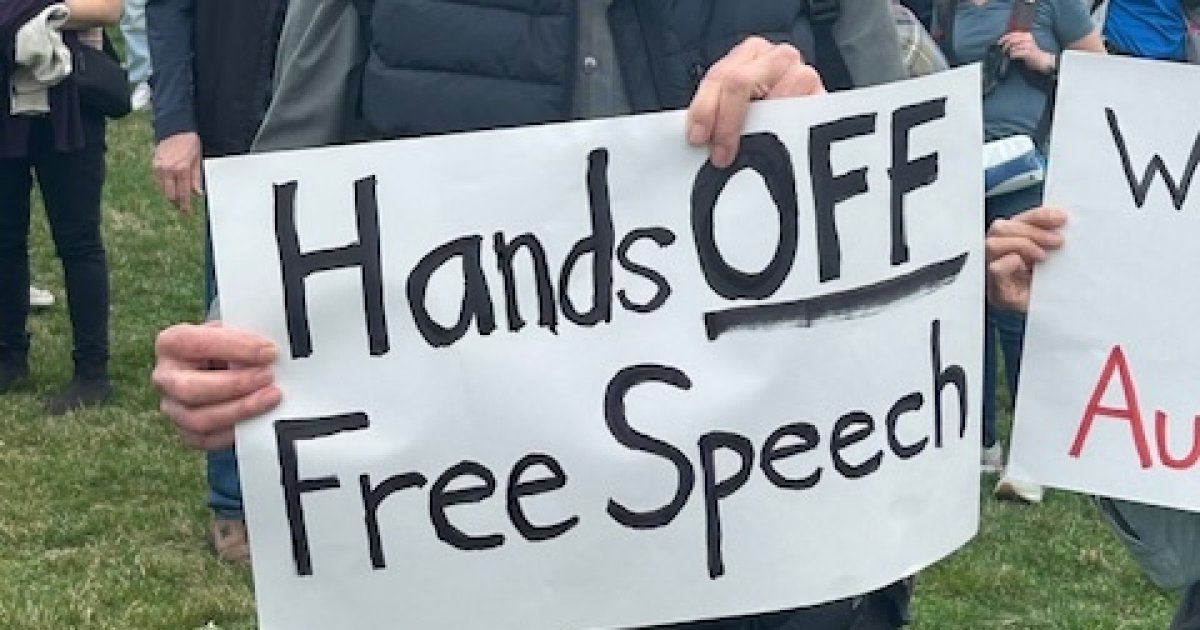
    Whatever the peaceful cause, whenever people speak and assemble to exercise their rights, it is always a healthy sign in a constitutional democracy. To that end, and to underscore yet again the value of dissent, the photos below were taken in Washington, D.C. on Saturday, April 5 in the areas surrounding the Washington Monument, as part of the “Hands Off” campaign.

    — rklc

    Source link

  • Religious Freedom as a Defense for DEI?

    Religious Freedom as a Defense for DEI?

    Last month, amid a Trump administration broadside against diversity, equity and inclusion initiatives, government officials took aim at Georgetown University’s law school.

    “It has come to my attention reliably that Georgetown Law School continues to teach DEI. This is unacceptable,” interim U.S. attorney for the District of Columbia Ed Martin wrote in a letter.

    Martin announced he had launched “an inquiry into this” and asked Georgetown law school officials, “If DEI is found in your courses or teaching in anyway [sic], will you move swiftly to remove it?” He added that students and others “affiliated with a law school or university” that “continues to teach and utilize DEI” would not be hired “for our fellows program, our summer internship” or other jobs.

    Martin’s letter, which was sent on Feb. 17 and quickly became public, prompted shock and outrage, with many observers noting that it was a clear affront to First Amendment rights at Georgetown. It also drew a quick—and pointed—response from the law school.

    Georgetown Law dean William Treanor invoked both the First Amendment and the tenets of Catholic faith in his March 6 response to Martin, noting that the government cannot control curriculum.

    “As a Catholic and Jesuit institution, Georgetown University was founded on the principle that serious and sustained discourse among people of different faiths, cultures, and beliefs promotes intellectual, ethical, and spiritual understanding,” Treanor wrote in a response that soon spread online. “For us at Georgetown, this principle is a moral and educational imperative. It is a principle that defines our mission as a Catholic and Jesuit institution.”

    Given that multiple institutions have already complied with Trump directives to unwind DEI initiatives, despite numerous outstanding legal questions, Treanor’s response stood out as an uncommon example of a university holding its ground. It also raised a unique question for religiously affiliated institutions: Does religious freedom offer a defense against Trump’s attacks on DEI efforts?

    A Faith-Based Defense for DEI

    It might. For decades, faith-based colleges and universities have cited religious freedom in decrying federal meddling in their policies and practices.

    Some institutions have argued in drawn-out legal battles that they’re exempt from federal rules that chafe against tenets of their faith, such as strictures related to gender and sexual orientation. They’ve similarly asserted in court that whom they hire or fire is within their theological purview. Such legal cases often revolve around the concept of church autonomy doctrine, a legal principle protecting the rights of religious institutions to govern themselves—including their internal operations.

    Now, as Treanor’s letter suggests, the same argument could prove a powerful tool for pushing back against the onslaught of anti-DEI directives coming out of the Trump administration. Religious institutions that view diversity, equity and inclusion as core to their faith missions arguably have a layer of legal protection to defend DEI initiatives that their secular peers do not. They could also ostensibly challenge anti-DEI orders in court on religious freedom grounds at a time when the U.S. Supreme Court has displayed a warm disposition toward religious issues.

    “It’s not an unreasonable argument,” said Charles Russo, Joseph Panzer Chair in Education and research professor of law at the University of Dayton, a Catholic—but not Jesuit—institution in Ohio. He emphasized that he was speaking on his own behalf, not the university’s.

    Church autonomy doctrine is based on the idea that “we have the right to run our institutions consistent with what our beliefs are, and we don’t need people from the outside coming out telling us what we believe,” he added. Most DEI efforts are “certainly consistent with Christian values … to help the underprivileged, the downtrodden, the most in need.”

    Jesuit colleges and universities, such as Georgetown, seem the most likely to consider venturing into this legal battleground, given the religious order’s emphasis on social causes. Many Catholic colleges—and Jesuit institutions in particular—were founded to serve burgeoning Catholic immigrant populations. In recent years, Jesuits founded several new institutions designed explicitly to support low-income students; those colleges, like Arrupe College in Chicago, have emphasized efforts to enroll and retain students from underrepresented groups.

    But even if some Jesuit institutions do view DEI as central to their faith, it remains to be seen whether they’re willing to call on their religious identities to fight for it.

    What Religious Colleges Said

    They’re certainly not keen to do so publicly.

    Of the 27 Jesuit universities that Inside Higher Ed contacted for this story, only two responded by deadline. Fordham University declined to comment, while Seattle University sent a link to a past statement from President Eduardo M. Peñalver that noted the institution “does not plan to make any immediate operational changes in response to [a Feb. 14 Dear Colleague letter] and will await new regulations or formal administrative guidance.” He added that resulting guidance will be studied carefully and the university will “either comply in a manner consistent with our Jesuit Catholic values … or—if that proves impossible—consider other legal avenues.”

    The Association of Jesuit Colleges and Universities is also treading carefully.

    “The member institutions of the Association of Jesuit Colleges and Universities share a mission based on long-standing Catholic religious beliefs and values in the Jesuit traditions, which affirm the equal dignity of every human being and of the human family in all its diversity. As noted by the dean of Georgetown Law, we are all ‘founded on the principle that serious and sustained discourse among people of different faiths, cultures and beliefs promotes intellectual, ethical and spiritual understanding,’” an AJCU spokesperson told Inside Higher Ed by email.

    AJCU did not answer specific questions sent by Inside Higher Ed.

    Raymond Plaza, director of Santa Clara University’s Office for Diversity and Inclusion and chair of AJCU’s Diversity and Equity Network, offered a defense of DEI initiatives. Speaking in his personal capacity, Plaza argued that DEI work has been deliberately misconstrued by its critics.

    “DEI is not about divisions or separation, it’s about how can I create a space where people can be their authentic selves and thrive?” Plaza said. “It’s not that this group thrives while the other one doesn’t.”

    He emphasized the need to create an environment where all students feel welcome. “At the end of the day, it’s really about how we build community on our campuses,” Plaza said.

    A review of university DEI pages shows that many Jesuit institutions cite their religious beliefs in support of such initiatives. Some emphasize social justice and inclusion as tenets of their faith.

    “Inspired by the Catholic and Jesuit tradition, our community believes that every human being is a profound gift of God, deserving of both dignity and opportunity,” Creighton University’s website reads. “We thus strive to acknowledge and celebrate diversity at Creighton—building equitable, inclusive, welcoming spaces and relationships that are required for every person to thrive.”

    Some institutions even note their antiracism efforts.

    “At LMU, the goal of diversity, equity, and inclusion is to actively cultivate an anti-racist institutional climate that supports inclusive excellence and fights systemic oppression,” Loyola Marymount University’s website reads, adding that such values are “intrinsic” to their mission.

    But other Jesuit universities appear to have backtracked in the face of Trump’s attacks on DEI.

    The University of Scranton, for example, overhauled its DEI page in recent weeks, removing references to systemic racism and the “historically unfair and unjust treatment of Black, Indigenous, and People of Color,” according to an archived page available on the Wayback Machine.

    Le Moyne University also removed BIPOC references, identity-based resources and an “oath of diversity and inclusion” from its DEI page, an archive on the Wayback Machine shows. Le Moyne officials also told the student newspaper that the university is considering changing the name of its Equity, Diversity, Inclusion and Belonging office due to federal attacks on DEI efforts.

    An Untested Strategy

    Just because Jesuit institutions aren’t openly using religious freedom as a rationale for preserving DEI, it doesn’t mean the idea is without merit, legal and Catholic higher ed scholars say.

    Russo hasn’t seen any religious college call on its faith mission to defend DEI in court—at least not yet. While the idea is “floating around out there, it has not yet made much of a judicial splash,” he said.

    Still, he believes it’s a plausible legal argument that could receive a “strong reception” in the Supreme Court, provided colleges aren’t defending practices that directly butt up against the court’s ruling on race-conscious admissions. He believes the overall message of Treanor’s letter to Martin is “on the mark.”

    “I don’t think anybody would disagree that helping those most in need, however we describe that, is consistent with Christian values,” Russo said.

    Donna Carroll, president of the Association of Catholic Colleges and Universities, agreed equity is a “mission-critical commitment” for most Catholic higher ed institutions.

    “For Catholic colleges and universities, DEI work is a long-held expression of mission and of the Catholic social teaching that anchors it—including a commitment to the dignity of each person, a solidarity with the vulnerable and less advantaged, and a care for the common good,” Carroll wrote to Inside Higher Ed. “All this is foundational to who we are, what and how we teach, and the services that we provide.”

    She sees Martin’s inquiry into Georgetown Law School as a disturbing challenge to academic freedom but isn’t sure if there’s a “threshold that might trigger concern about religious freedom” for Catholic institutions.

    “With so much uncertainty, it is hard to say,” she said. “And such a determination would require sectorwide discussion.”

    Source link

  • Govs. DeSantis, Hochul threaten academic freedom with political interference

    Govs. DeSantis, Hochul threaten academic freedom with political interference

    It’s no secret that politicians are getting more involved in higher education. And while some level of involvement with how colleges and universities operate is appropriate given the amount of taxpayer money spent on campuses, nobody should be surprised to learn that greater political involvement can pose academic freedom risks.

    Last Monday, for example, Florida Gov. Ron DeSantis announced the creation of Florida’s own Department of Governmental Efficiency (DOGE), named after the Trump Administration’s Elon Musk-led initiative to cut federal spending. The Florida task force is to conduct “a deep dive into all facets of college and university operations and spending and make recommendations to the Board of Governors and State Board of Education to eliminate any wasteful spending.”

    There are viewpoint-based decisions that governors and legislatures have to make about colleges as part of the political and appropriations process. But the more granular those decisions, the more they threaten to substitute academic judgment with political judgment.

    During his live announcement, DeSantis expanded on what he called “the DOGE-ing of our state university system,” saying it would include “examining courses, programming, and staff” with an aim towards helping students gain “meaningful employment.” But the governor also, troublingly, made clear that he’s continuing to take aim at a particular set of viewpoints:

    [S]ome of the ideological studies stuff, we just want to prune that and get that out, and we want to make sure that these universities are really serving the classical mission of what a university should be. And that’s not to impose ideology.

    Politicians have long complained about taxpayer money spent on what they see as frivolous academic pursuits — the proverbial degree in “underwater basket weaving” — but what DeSantis posits goes further. This task force won’t simply be focused on (say) eliminating majors that offer no real job prospects. Rather, it will seek out courses involving “ideological studies stuff,” presumably by reviewing course descriptions or syllabi, that in the task force’s view is not worth teaching. 

    That’s not just an invitation to viewpoint discrimination — it’s an explicit mandate.

    It’s not hard to see how this could threaten academic freedom by pressuring faculty members to substitute state-level politics for their academic judgment. 

    For example, let’s say the University of Florida’s Chinese Studies department decides that, to understand contemporary China, students need to take a class on Marxist-Leninist political thought. It’s easy to see how this could be relevant given that China is a Communist country. It’s also easy to see how an outside agency like Florida DOGE might view this as an effort to propagandize students into Marxism.

    What’s the likely result?

    • Most obviously, the department might decide to avoid conflict with the government by eliminating the class altogether despite believing it was needed, therefore impoverishing students’ education.
    • Even if it did decide to require the class, the department is likely to pressure its instructor not to include things that look pro-Marxist, regardless of whether the professor thinks it would be the best material for the course. That poorly serves students and limits a professor’s ability to engage in the intellectual pursuit of teaching, to boot.
    • Finally, even if the department were to offer the class without compromising on content, its instructor will most certainly feel “in the crosshairs,” restricted from following his or her academic conscience lest he or she get the class eliminated through an incautious word.

    Colleges should not be immune from investigations into waste and abuse. And there are viewpoint-based decisions that governors and legislatures have to make about colleges as part of the political and appropriations process. But the more granular those decisions, the more they threaten to substitute academic judgment with political judgment. It remains to be seen whether this is how Florida DOGE will actually operate, but the governor’s remarks create plenty of cause for concern.

    Lest there be any doubt that governors of any party are capable of interfering in isolated academic decisions if given the opportunity, New York Gov. Kathy Hochul (no friend of DeSantis) last Tuesday ordered the immediate removal of a CUNY-Hunter College job posting for a professor of Palestinian Studies. Hochul also ordered “a thorough review of the position to ensure that antisemitic theories are not promoted in the classroom.”

    The job listing certainly listed plenty of controversial topics, calling for a “historically grounded scholar who takes a critical lens to issues pertaining to Palestine including but not limited to: settler colonialism, genocide, human rights, apartheid, migration, climate and infrastructure devastation, health, race, gender, and sexuality.” Yet the very next sentence stated, “We are open to diverse theoretical and methodological approaches.”

    Critics are unlikely to believe that the job was really open to scholars with diverse approaches to whether, say, Israel is an “apartheid” state. Maybe it was, maybe not. But one can’t make that determination simply based on the language of the listing, and there is no reason to believe that the governor of New York is (or should be expected to be) the best-qualified person to make that call.

    Faculty members are supposed to be hired because they are subject-matter experts who have the ability and knowledge in the field to make informed academic judgments. Readers may recall that Winston Churchill famously opined that democracy is “the worst form of government except for all those other forms that have been tried.” That’s just as true when it comes to academic faculty making academic decisions — like it or not, there are no better alternatives. Even if one believes a particular group of public college faculty is, itself, making decisions that harm higher education, as DeSantis and Hochul both seem to believe, there’s one thing we can know for sure: transferring that job to politicians will only make it worse.

    Source link

  • Lawsuit slaps heart of academic freedom (opinion)

    Lawsuit slaps heart of academic freedom (opinion)

    A lawsuit filed in July against the Columbia University chapter of the American Association of University Professors, along with 20 other organizations and individuals, alleged that our public statements in support of antiwar and pro-Palestinian student protests last spring harmed other students by contributing to the campus shutdown that followed. Unraveling the cynical logic of this claim is for the courts. But what is clear from this lawsuit is that the purpose of such recourse to legal theater is not to ameliorate harm. It is to silence public and academic speech.

    This effort is part and parcel of a broader attack on higher education, one characterized by legislative attacks on diversity, equity and inclusion; instruction; and tenure; and an epidemic of jawboning by public officials meddling into curricula, campus programming and even the careers of individual faculty members. Following a series of executive orders from President Donald Trump, colleges and universities across the country now find themselves in the crosshairs.

    The tactic used against us is what is known as a strategic lawsuit against public participation (SLAPP). These suits are brought principally not to win in court but to harass and intimidate individuals or groups into curtailing speech. By entangling defendants in costly and invasive litigation—or even just threatening to do so—plaintiffs can frighten those with whom they disagree into silence. In the context of higher education, this comes at an incalculable cost.

    On its own, this lawsuit certainly threatens the speech of Columbia-AAUP. But in the current climate, it also opens a front in the widespread attack on universities as sanctuaries of critical inquiry and reasoned debate. In their mere filing, lawsuits like this one aim especially to chill dissenting speech, including speech that takes place at the intersection of the classroom and the public square. Such legal instruments are a dangerous cudgel that could be used to threaten broad swaths of political and academic speech on American campuses.

    Our chapter has precisely sought to combat this hostile environment in the speech over which we are being sued. In multiple public statements made during the height of the campus protests last spring, we condemned partisan congressional meddling in Columbia’s affairs, arguing that this “undermine[s] the traditions of shared governance and academic freedom.” We called for a vote of no confidence in university leadership, who we believe “failed utterly to defend faculty and students” and “colluded in political interference.” And we affirmed the Columbia Faculty of Arts and Sciences’ subsequent vote of no confidence in our then-president for her “failure to resist politically motivated attacks on higher education,” whereby she endangered students and undermined our rights as faculty.

    In challenging our statements in support of faculty and students, this particular SLAPP targets both our constitutionally protected public speech and our academic freedom. We are fortunate enough to be represented by the American Civil Liberties Union and civil rights firm Wang Hecker LLP, who have filed a motion to dismiss on our behalf that utilizes New York State’s anti-SLAPP law, one of the 35 state-level anti-SLAPP laws on the books across the United States. But the outcome of a SLAPP shouldn’t depend on your counsel, or the state in which you live. Unfortunately, for many faculty and students faced with a SLAPP, the only available option may well be to self-censor.

    Interests committed to the mainstream political consensus have found pro-Palestinian political advocacy on American campuses to be unacceptable. To silence dissent, they have shown themselves willing to use every instrument at their disposal in a manner that recalls the red scares of the early and mid-20th century, when character assassination and blacklists were employed in industry and civil society, including academia. This SLAPP revives such measures, as do the theatrical congressional grillings of college presidents, including our own, and the wave of censorship that has swept over higher education during the course of the past year. In this context, attacks on public speech are also attacks on academic freedom.

    Academic freedom depends essentially upon a social contract that remains under perpetual debate both inside and outside the academy. SLAPPs like this one aim at the very heart of that contract, which accords to academics relative autonomy to explore difficult and often uncomfortable truths on the assumption that those truths will ultimately benefit society. Although the classroom, the laboratory and the library are classic sites for the practice and protection of this freedom, the truths pursued there translate to worlds outside the campus gates. Bullying faculty and students into self-censorship in the public square, SLAPPs seek to further silence and constrain the pursuit of uncomfortable truths in the classroom.

    Scholarly knowledge consists of truth claims, not dicta. Whether exercised in the classroom or in the public square, academic freedom is therefore the freedom to make and to contest such claims. This goes for all sides in a debate, including the debates still quietly raging on our campuses. However, a stark reality disclosed by SLAPPs is that political force is now poised to govern the contest over truth in place of enlightened reason and democratic deliberation.

    If such high-minded concepts as truth claims, enlightened reason and democratic debate seem too lofty for the dirty realism of the day, it is important to remember that these still lie at the core of any academic freedom worthy of the name. Academic freedom is not a narrowly academic matter; it is a matter of determining whether something is or is not true. SLAPPs are designed to decide such questions in advance, in favor of those who can afford the attorneys, or on whose behalf politically motivated law firms work. It is time for us to exercise our freedoms and responsibilities as academics, in defense of our right and that of our students to speak.

    Reinhold Martin is president of the American Association of University Professors chapter at Columbia University, on whose behalf he wrote this piece, and a professor of architecture.

    Source link

  • Effect of Institutional Autonomy on Academic Freedom in Higher Education Institutions in Ghana

    Effect of Institutional Autonomy on Academic Freedom in Higher Education Institutions in Ghana

    By Mohammed Bashiru and Professor Cai Yonghong

    Introduction

    The idea of institutional autonomy in higher education institutions (HEIs) naturally comes up when discussing academic freedom. These two ideas are connected, and the simplest way to define how they relate to one another is that they are intertwined through several procedures and agreements that link people, institutions, the state, and civil society. Academic freedom and institutional autonomy cannot be compared, but they also cannot be separated and the loss of one diminishes the other. Protecting academic freedom and institutional autonomy is viewed by academics as a crucial requirement for a successful HEI. For instance, institutional autonomy and academic freedom are widely acknowledged as essential for the optimization of university operations in most African nations.

    How does institutional autonomy influence academic freedom in higher education institutions in Ghana?

    In some countries, universities have been subject to government control, with appointments and administrative positions influenced by political interests, leading to violations of academic autonomy and freedom. Autonomy is a crucial element in safeguarding academic freedom, which requires universities to uphold the academic freedom of their community and for the state to respect the right to science of the broader community. Universities offer the necessary space for the exercise of academic freedom, and thus, institutional autonomy is necessary for its preservation. The violation of institutional autonomy undermines not only academic freedom but also the pillars of self-governance, tenure, and individual rights and freedoms of academics and students. Universities should be self-governed by an academic community to uphold academic freedom, which allows for unrestricted advancement of scientific knowledge through critical thinking, without external limitations.

    How does corporate governance affect the relationship between institutional autonomy and academic freedom?

    Corporate governance mechanisms, such as board diversity, board independence, transparency, and accountability, can ensure that the interests of various stakeholders, including students, faculty, and the government, are represented and balanced. The incorporation of corporate governance into academia introduces a set of values and priorities that can restrict the traditional autonomy and academic freedom that define a self-governing profession. This growing tension has led to concerns about the erosion of academia’s self-governance, with calls for policies that safeguard academic independence and uphold the values of intellectual freedom and collaboration that are foundational to higher education institutions. Nonetheless, promoting efficient corporate governance, higher education institutions can help safeguard academic freedom and institutional autonomy, despite external pressures.

    Is there a significant difference between the perceptions of males and females regarding institutional autonomy, academic freedom, and their relationship?

    The appointment process for university staff varies across countries, but it is essential that non-academic factors such as gender, ethnicity, or interests do not influence the selection of qualified individuals who are necessary for the institution’s quality. Unfortunately, studies indicate that women are often underrepresented in leadership positions and decision-making processes related to academic freedom and institutional autonomy. This underrepresentation can perpetuate biases and lead to a lack of diversity in decision-making. One solution to address these disparities is to examine gender as a factor of difference to identify areas for improvement and promote gender equality in decision-making processes. By promoting diversity and inclusivity, academic institutions can create a more equitable environment that protects institutional autonomy and promotes academic freedom for everyone, regardless of their gender.

    Methodology and Conceptual framework

    The quantitative and predictive nature of the investigation necessitated the use of an explanatory research design. Because it enabled the us to establish a clear causal relationship between the exogenous and endogenous latent variables, the explanatory study design was chosen. The simple random sample technique was utilised to collect data from an online survey administered to 128 academicians from chosen Ghanaian universities.

    The conceptual framework, explaining the interrelationships among the constructs in the context of the study is presented. The formulation of the conceptual model was influenced by the nature of proposed research questions backed by the supporting theories purported in the context of the study.

    Conclusions and Implications

    Institutional autonomy significantly predicts academic freedom at a strong level within higher education institutions in Ghana. Corporate governance can restrict academic freedom when its directed to yield immediate financial or marketable benefits but in this study it plays a key role in transmitting the effect of institutional autonomy. Additionally, there is a significant difference in perception between females and males concerning the institutional autonomy – academic freedom predictive relationship. Practically, higher education institutions, particularly in Ghana, should strive to maintain a level of autonomy while also ensuring that academic freedom is respected and protected. This can be achieved through decentralized governance structures that allow for greater participation of academics in decision-making processes. Institutions should actively engage stakeholders, including academics, in discussions and decisions related to institutional autonomy and academic freedom. This will ensure that diverse perspectives are considered in policy development.

    This blog is based on an article published in Policy Reviews in Higher Education (online 02 January 2025) https://www.tandfonline.com/doi/full/10.1080/23322969.2024.2444609

    Bashiru Mohammed is a final year PhD student at the faculty of Education, Beijing Normal University. He also holds Masters in Higher education and students’ affairs from the same university. His research interest includes School management and administration, TVET education and skills development.

    Professor Cai Yonghong is a professor at Faculty of Education, Beijing Normal University. She has published many articles and presided over several domestic and international educational projects and written several government consultant reports. Her research interest includes teacher innovation, teacher expertise, teacher’s salary, and school management.

    References

    AAU, (2001). ‘Declaration on the African University in the Third Millennium’.

    Akpan, K. P., & Amadi, G. (2017). University autonomy and academic freedom in Nigeria: A theoretical overview. International Journal of Academic Research and Development,

    Altbach, P. G. (2001). Academic freedom: International realities and challenges. Higher Education,

    Aslam, S., & Joshith, V. (2019). Higher Education Commission of India Act 2018: A Critical Analysis of the Policy in the Context of Institutional Autonomy.

    Becker, J. M., Cheah, J. H., Gholamzade, R., Ringle, C. M., & Sarstedt, M. (2023). PLS-SEM’s most wanted guidance.

    Hair, J., Hollingsworth, C. L., Randolph, A. B., & Chong, A. Y. L. (2017). An updated and expanded
    assessment of PLS-SEM in information systems research. Industrial management & data
    systems,

    Lippa, R. A. (2005). Gender, nature, and nurture. Routledge.

    Lock, I., & Seele, P. (2016). CSR governance and departmental organization: A typology of best practices. Corporate Governance: The International Journal of Business in Society.

    Neave, G. (2005). The supermarketed university: Reform, vision and ambiguity in British higher education. Perspectives:.

    Nicol, D. (1972) Academic Freedom and Social Responsibility: The Tasks of Universities in a Changing World, Stephen Kertesz (Ed), Notre Dame, University of Notre Dame Press.

    Nokkala, T., & Bacevic, J. (2014). University autonomy, agenda setting and the construction of agency: The case of the European university association in the European higher education area..

    Olsen, J. P. (2007). The institutional dynamics of the European university Springer Netherlands.

    Tricker, R. I. (2015). Corporate governance: Principles, policies, and practices. Oxford University Press, USA.

    Zikmund, W.G., Babin, B.J., Carr, J.C. & Griffin, M. (2012). Business Research Methods. Boston: Cengage Learning.

    Zulu, C (2016) ‘Gender equity and equality in higher education leadership: What’s social justice and substantive equality got to do with it?’ A paper presented at the inaugural lecture, North West University, South Africa

    Author: SRHE News Blog

    An international learned society, concerned with supporting research and researchers into Higher Education

    Source link

  • Academic freedom doesn’t require college neutrality

    Academic freedom doesn’t require college neutrality

    Amid public campaigns urging universities to commit to “institutional neutrality,” the American Association of University Professors released a lengthy statement Wednesday saying that the term “conceals more than it reveals.”

    The statement, approved by the AAUP’s elected national council last month, says it continues the national scholarly group’s long commitment to emphasizing “the complexity of the issues involved” in the neutrality debate. “Institutional neutrality is neither a necessary condition for academic freedom nor categorically incompatible with it,” it says.

    The push for universities to adopt institutional neutrality policies ramped up as administrators struggled over what, if anything, to say about Hamas’s Oct. 7, 2023, attack on Israelis and Israel’s swift retaliation in the Gaza Strip.

    The AAUP statement notes that “institutional neutrality” has varied meanings and that actions—not just words—convey a point of view. For instance, some argue that to be neutral, institutions shouldn’t adjust their financial investments for anything other than maximizing returns. But the AAUP says that “no decision concerning a university’s investment strategy counts as neutral.”

    The AAUP asserts that by taking any position on divestment—which many campus protesters have asked for—a university “makes a substantive decision little different from its decision to issue a statement that reflects its values.”

    “A university’s decision to speak, or not; to limit its departments or other units from speaking; to divest from investments that conflict with its mission; or to limit protest in order to promote other forms of speech are all choices that might either promote or inhibit academic freedom and thus must be made with an eye to those practical results, not to some empty conception of neutrality,” the AAUP statement says. “The defense of academic freedom has never been a neutral act.”

    Steven McGuire, Paul and Karen Levy Fellow in Campus Freedom at the conservative American Council of Trustees and Alumni, called the statement “another unhelpful document from the AAUP.”

    “Institutional neutrality is a long-standing principle that can both protect academic freedom and help colleges and universities to stick to their academic missions,” McGuire told Inside Higher Ed. “It’s critical that institutional neutrality be enforced not only to protect individual faculty members on campus, but also to help to depoliticize American colleges and universities at a time when they have become overpoliticized” and are viewed as biased.

    Source link

  • Freedom is the bedrock for learning

    Freedom is the bedrock for learning

    Two big things, personally, happened this week, and I want to explain how while they may seem different on the surface, they’re sort of inextricable from each other.

    One thing that happened was the release of my book More Than Words: How to Think About Writing in the Age of AI. Regular readers of this space will be well familiar with the subjects and themes of the book, but of course a book is a different thing than a blog or column.

    I do my best to always make what I share here worth reading, but often the ideas I explore in this forum are in a much earlier stage of gestation. Writing is thinking, and while sufficient thinking has to occur for me to get a post onto the page, posting a column does not end the thinking.

    A book is a chance to hone that thinking into an extended argument and experience, seeing those initial individual thoughts join together, and in this joining shift in important ways as I seek greater clarity and more impactful presentation. One of the reasons I don’t really understand people’s enthusiasm for turning their writing over to large language models is that the process of working through my own thoughts is 100 percent necessary to delivering the final product.

    There is no shortcut if I want the book to be as good as possible.

    Anyway, as I wrote at my personal newsletter in a post celebrating the book’s release, I’m proud of it. It’s good! Or the best I can do at this time, anyway, which is its own form of good. If you’re at all concerned about how tools powered by generative AI are encroaching on our spaces of working, learning and thinking, you might find some value in it.

    Kirkus Reviews had this to say:

    The other thing that happened this week is the launch of a new newsletter, Academic Freedom on the Line, that I’ll be helping oversee as part of my fellowship for the Center for the Defense of Academic Freedom (CDAF).

    CDAF has been organized around a vision statement and a mission statement.

    Vision Statement

    We believe that teaching, learning, and the pursuit of knowledge are essential to creating and sustaining multi-racial and plurinational societies. For those of us working and studying within institutions of higher education, this means pursuing knowledge wherever it leads, free from intimidation and retaliation. Such freedoms serve as the foundation upon which we educate students, produce and disseminate credible research, nurture artistic expression and foster critical inquiry.

    Mission Statement

    The Center for the Defense of Academic Freedom is committed to preserving and expanding conditions that make it possible to work, teach, learn, create, and share knowledge in ways that promote the common good. The center serves as a resource and knowledge hub for all people—including faculty, students, campus workers, alumni, administrators, trustees, parents, journalists, policymakers, and business leaders—seeking to build a flourishing higher education system, rooted in institutional autonomy, workplace democracy, and freedom from coercion and external interference.

    To work towards these goals we:

    • create practical resources and build strategic partnerships for those engaged in defending academic freedom,
    • produce original research that can serve as the evidentiary basis for this work, and
    • communicate the value of academic freedom and institutional autonomy to wide audiences.

    The first newsletter post is an annotated version of these statements, where some of the other fellows comment on different parts of each, and I encourage you to check it out for yourself to see how important individual perspectives are even inside of communication that is meant to reflect group consensus.

    I also encourage you to sign up for the newsletter ,since we’ll be sharing more information and research all the time.

    A couple of weekends ago, we had an in-person gathering of CDAF, along with some other folks concerned about the attacks on academic freedom (PEN, AAUP, et al. …), and I was struck by how important it is to have all these different perspectives when considering complex and important problems.

    Even though it was a gathering of people with a broad base of shared values, there were many different perspectives, and I lost track of the number of times I experienced a moment of, I hadn’t thought of it that way.

    Here’s how I see these two different strains of my work as intimately related. At the heart of More Than Words is my belief that humans have a right to their own minds, that part of exercising our freedom is being given the chance to interpret the world and then impress ourselves onto the world around us through communication rooted in our unique intelligences. Writing is a great way to achieve this, as I’ve experienced firsthand, not just because I have some public platforms for my writing, but because the act of writing allows me to know what I think and believe.

    The boosters of the syntax-generating technology speak of it in liberatory terms, that the technology frees one up to not have to do difficult and maybe even unrewarding work. But in my view, giving over the work of writing to a probability machine is anti-freedom. The process matters.

    The process of academic freedom matters, too, which is why we sometimes (often) have disputes about what academic freedom means or how it can be supported in institutions. As a baseline, we need people to believe that academic freedom matters, that it is more than an abstract idea and it is, in fact, a way to make possible the work we want our institutions to do. This is what is being threatened at this time.

    One of the consistent themes of the weekend gathering was that deep down, we’re not just defending academic freedom, a term that we all acknowledge comes with some baggage, but we are trying to preserve important parts of our democracy.

    I don’t want to overinflate the importance of this work, either my own with my writing about writing or the efforts of the fellows of CDAF. There are clearly more urgent threats at this moment.

    But at the same time, I don’t want to shy away from the fact that there’s a lot at stake, and that what’s being threatened is our ability to self-govern.

    It matters. It all matters.

    Source link

  • Freedom of speech in higher education (Future Trends Forum)

    Freedom of speech in higher education (Future Trends Forum)

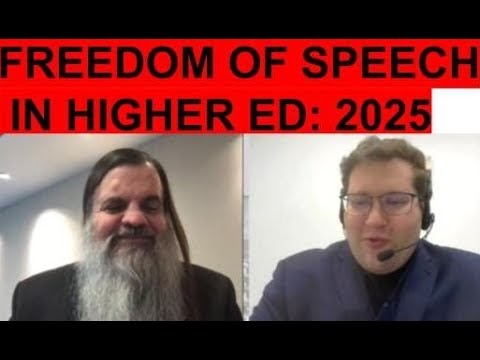
     What does academic freedom mean in 2025?

    We will explore this vital question with the help of Jeremy C. Young, the Freedom to Learn program director at PEN America (and excellent 2023 Forum guest).


    Source link

  • We need new ways to protect academic freedom (opinion)

    We need new ways to protect academic freedom (opinion)

    Katherine Franke, formerly a law professor at Columbia University, is just the latest of many academics who have found themselves in hot water because of something they said outside the classroom. Others have been fired or resigned under pressure for what they posted online or said in other off-campus venues.

    In each of those cases, the “offending party” invoked academic freedom or freedom of speech as a defense to pressures brought on them, or procedures initiated against them, by university administrators. The traditional discourse of academic freedom or free speech on campus has focused on threats from inside the academy of the kind that led Franke and others to leave their positions.

    Today, threats to academic freedom and free speech are being mounted from the outside by governments or advocacy groups intent on policing colleges and universities and exposing what they see as a suffocating orthodoxy. As Darrell M. West wrote in 2022, “In recent years, we have seen a number of cases where political leaders upset about criticism have challenged professors and sought to intimidate them into silence.”

    We have seen this act before, and the record of universities is not pretty.

    During the 1940s and 1950s, an anticommunist crusade swept the nation, and universities were prime targets. In that period, “faculty and staff at institutions of higher learning across the country experienced increased scrutiny from college administrators and trustees, as well as Congress and the FBI, for their speech, their academic work, and their political activities.”

    And many universities put up no resistance.

    Today, some believe, as Nina Jankowicz puts it, that we are entering “an era of real censorship the likes of which the United States has never seen. How will universities respond?”

    If academic freedom and freedom of expression are to be meaningful, colleges and universities must not only resist the temptation to punish or purge people whose speech they and others may find offensive; they must provide new protections against external threats, especially when it comes to extramural speech by members of their faculties.

    They must become active protectors and allies of faculty who are targeted.

    As has long been recognized, academic freedom and free speech are not identical. In 2007, Rachel Levinson, then the AAUP senior counsel, wrote, “It can … be difficult to explain the distinction between ‘academic freedom’ and ‘free speech rights under the First Amendment’—two related but analytically distinct legal concepts.”

    Levinson explained, “Academic freedom … addresses rights within the educational contexts of teaching, learning, and research both in and outside the classroom.” Free speech requires that there be no regulation of expression on “all sorts of topics and in all sorts of settings.”

    Ten years after Levinson, Stanley Fish made a splash when he argued, “Freedom of speech is not an academic value.” As Fish explained, “Accuracy of speech is an academic value … [because of] the goal of academic inquiry: getting a matter of fact right.” Free speech, in contrast, means “something like a Hyde Park corner or a town-hall meeting where people take turns offering their opinions on pressing social matters.”

    But as Keith Whittington observes, the boundaries that Levinson and Fish think can be drawn between academic freedom and free speech are not always recognized, even by organizations like the AAUP. “In its foundational 1915 Declaration of Principles on Academic Freedom and Academic Tenure,” Whittington writes, “the AAUP asserted that academic freedom consists of three elements: freedom of research, freedom of teaching, and ‘freedom of extramural utterance and action.’”

    In 1940, Whittington explains, “the organization reemphasized its position that ‘when they speak or write as citizens,’ professors ‘should be free from institutional censorship or discipline.’”

    Like the AAUP, Whittington opposes “institutional censorship” for extramural speech. That is crucially important.

    But in the era in which academics now live and work, is it enough?

    We know that academics report a decrease in their sense of academic freedom. A fall 2024 survey by Inside Higher Ed found that 49 percent of professors experienced a decline over the prior year in their sense of academic freedom as it pertains to extramural speech.

    To foster academic freedom and free speech on campus or in the world beyond the campus, colleges and universities need to move from merely tolerating the expression of unpopular ideas to a more affirmative stance in which they take responsibility for fostering it. It is not enough to tell faculty that the university will respect academic freedom and free expression if they are afraid to exercise those very rights.

    Faculty may be fearful that saying the “wrong” thing will result in being ostracized or shunned. John Stuart Mill, one of the great advocates for free expression, warned about what he called “the tyranny of the prevailing opinion and feeling.” That tyranny could chill the expression of unpopular ideas.

    In 1952, during the McCarthy era, Supreme Court justice Felix Frankfurter also worried about efforts to intimidate academics that had “an unmistakable tendency to chill that free play of the spirit which all teachers ought especially to cultivate and practice.”

    Beyond the campus, faculty may rightly fear that if they say things that offend powerful people or government officials, they will be quickly caught up in an online frenzy or will be targeted. If they think their academic institutions will not have their back, they may choose the safety of silence over the risk of saying what they think.

    Whittington gets it right when he argues that “Colleges and universities should encourage faculty to bring their expertise to bear on matters of public concern and express their informed judgments to public audiences when doing so might be relevant to ongoing public debates.” The public interest is served when we “design institutions and practices that facilitate the diffusion of that knowledge.”

    Those institutions and practices need to be adapted to the political environment in which we live. That is why it is so important that colleges and universities examine their policies and practices and develop new ways of supporting their faculty if extramural speech gets them in trouble. This may mean providing financial resources as well as making public statements in defense of those faculty members.

    Colleges and universities should also consider making their legal counsel available to offer advice and representation and using whatever political influence they wield on behalf of a faculty member who is under attack.

    Without those things, academics may be “free from” the kind of university action that led Franke to leave Columbia but still not be “free to” use their academic freedom and right of free expression for the benefit of their students, their professions and the society at large.

    Austin Sarat is the William Nelson Cromwell Professor of Jurisprudence and Political Science at Amherst College.

    Source link