Friday Fragments
Sara Brady
Fri, 12/12/2025 – 03:00 AM
Sans-serif fonts, passing along great literature, Middle States.


Friday Fragments
Sara Brady
Fri, 12/12/2025 – 03:00 AM
Sans-serif fonts, passing along great literature, Middle States.
Members of the American Association of University Professors, the affiliated American Federation of Teachers and student groups are planning protests in more than 50 cities Friday against “the Trump administration’s broad assault” on higher ed, the AAUP announced in a news release.
The AAUP said demonstrators will urge institutions to continue rejecting Trump’s “Compact for Academic Excellence in Higher Education” and instead “commit to the freedom to teach, learn, research, and speak out without government coercion or censorship.”
“From attacks on academic freedom in the classroom to the defunding of life-saving scientific research to surveilling and arresting peaceful student protesters, Trump’s higher education policies have been catastrophic for our communities and our democracy,” AAUP president Todd Wolfson said in the release. “We’re excited to help build a coalition of students and workers united in fighting back for a higher education system that is accessible and affordable for all and serves the common good.”
The protests are part of a progressive movement called Students Rise Up, or Project Rise Up. The Action Network website says there will be “walkouts and protests at hundreds of schools” Friday—the start of a buildup “to a mass student strike on May 1st, 2026, when we’ll join workers in the streets to disrupt business as usual.”
“We’re demanding free college, a fair wage for workers, and schools where everyone is safe to learn and protest—regardless of their gender or race or immigration status,” the website says.
Other groups listed as organizing or supporting the protests include the Campus Climate Network, College Democrats of America, Florida Youth Action Fund, Frontline for Freedom, Higher Ed Labor United, Ohio Student Association, Sunrise Movement, Dissenters, Feminist Generation, Gen-Z for Change, Generation Vote (GenVote), March for Our Lives, Oil and Gas Action Network, Socialist Alternative, Together Across America, Voters of Tomorrow, Blue Future, Get Free, and NOW Young Feminists.
Asked for a comment from the Education Department, Madi Biedermann, deputy assistant secretary for communications, repeated statements the department previously made, saying, “The Trump Administration is achieving reforms on higher education campuses that conservatives have dreamed about for 50 years.”
“Institutions are once again committed to enforcing federal civil rights laws consistently, they are rooting out DEI and unconstitutional race preferences, and they are acknowledging sex as a biological reality in sports and intimate spaces,” she wrote.
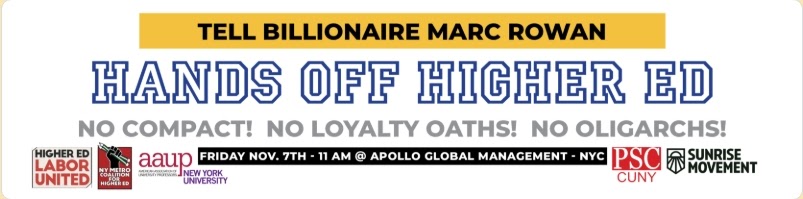
Higher Ed Unions, Student Unions, and For-Profit College Borrowers Unite Against Trump’s “Higher Education Compact”
Several higher education unions, student unions, and former students of for-profit colleges are organizing in opposition to the Trump administration’s proposed “higher education compact”—a plan heavily shaped and promoted by private-equity billionaire Marc Rowan.
Rowan, the CEO of Apollo Global Management, has played a central role in advancing this proposal. Apollo owns several predatory for-profit institutions, including the University of Phoenix, one of the most notorious offenders in the industry.
In a recent New York Times op-ed, Rowan took public credit for the compact, writing:
“The evidence is overwhelming: outrageous costs and prolonged indebtedness for students; poor outcomes, with too many students left unable to find meaningful work after graduating…”
Yet, under Rowan’s leadership, the University of Phoenix has become the largest source of Borrower Defense claims of any for-profit school, with more than 100,000 pending applications as of July 2025. Borrower Defense is a federal protection that allows students to seek loan forgiveness if their school misled them or violated state or federal law.
The University of Phoenix has faced multiple law enforcement investigations for deceptive recruiting tactics that targeted veterans, service members, and working adults nationwide. The school’s misconduct led to a $191 million settlement with the Federal Trade Commission for falsely claiming partnerships with major employers. More recently, the university attempted to portray itself as a public institution while seeking to sell to two states—both of which ultimately rejected the deal after public backlash.
While Rowan’s personal fortune exceeds $7 billion, borrowers continue to shoulder crushing debt from degrees that delivered little to no value. His leadership has fueled a system that profits from student harm—and now, through this compact, he is setting his sights on reshaping major public universities.
We refuse to stay silent. Borrowers, students, and educators are standing together to demand accountability and defend higher education from predatory perpetrators.

Hi everyone,
Tiffany here.
A quick reminder that there is a Focus Friday session today (October 24) from 12:30-1:30pm Eastern on International Student Enrolment.
I’ll be joined by Victor Tomiczek (Director of International Recruitment and Global Partnerships at Cape Breton University) and Eric Simard (Director of Fanshawe International and former Director of International Recruitment and Market Development at Fanshawe College). We’ll be discussing past, current, and expected future trends in international student recruitment, enrolment, and engagement.
If you haven’t registered yet, it’s not too late. Register here.
Two weeks ago, we gathered for a conversation that hit close to home: What does the student experience look and feel like today?
I was joined by three people who live and breathe these questions every day: Wasiimah Joomun (Canadian Alliance of Student Associations, a federal student advocacy organization for college, university and polytechnic students), Brendan Roberts (Students Nova Scotia), a provincial level student advocacy organization for university and college students), and Olamipo Ogunnote (Ontario Student Voices, a provincial advocacy organization for college students). Together, they painted a vivid picture of how students are navigating post-secondary life in 2025. What we heard was both sobering and hopeful.
Wasiimah reminded us that the purpose of post-secondary has shifted. Students aren’t coming to explore anymore; they’re coming to survive. “We’ve turned education from a space of discovery into a checklist for employability,” she said. Costs are rising, pressures are mounting, and the system is asking students to thrive in conditions it wasn’t built to support. “Students are no longer exploring their interests; they’re trying to match what the labour market needs” she said.
Brendan spoke about the ripple effects of affordability on mental health and belonging. From housing, food, transportation, all of it weighs heavily. “You can’t build a community for someone,” he said, “but you can give them the tools to foster it themselves.” Students need the chance, and support, to create their own networks, not just attend the ones we design for them.
Olami brought the conversation to Ontario’s college sector, where students are juggling work, caregiving, and coursework, often all in the same day. He shared the story of one student finishing an eight-hour shift, racing home to her kids, and starting her assignment at midnight. “Resilience,” Olami said, “shouldn’t be about surviving hardship. It should be about thriving with opportunity.” Olami added to the piece on community with a great comment that has stuck with me since our conversation, “real community doesn’t come from infographics, it comes from matching the reality of students’ lives.”
Across all three perspectives, the thread was clear: affordability touches everything. Forty percent of students skip meals. One in four struggle to pay rent. One in five use food banks. Four percent have experienced homelessness. Students are still choosing education, but they’re not sure if their institutions and their governments through investment are choosing them back.
And yet, there’s optimism. Students still believe in the value of learning. They want to help shape institutions that see them not only as learners, but as people with families, jobs, and ambitions that stretch far beyond the classroom.
You can catch the full conversation here: https://www.youtube.com/watch?v=ywcHrBEwA-M.
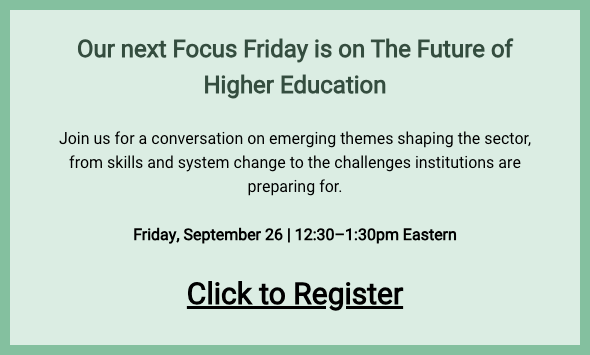
On the next Focus Friday, we will be covering the hottest topic of that week: the Federal Budget. What happens, what it means, and what the early reactions to it are. That conversation happens on November 7th, and registration is already open (see below, in a big green box).
In the meantime, keep sharing your ideas in the registration form or reach out anytime at [email protected].
I’m looking forward to seeing many of you this afternoon, and again in two weeks.
Cheers,
Tiff
Hi everyone,
Tiffany here.
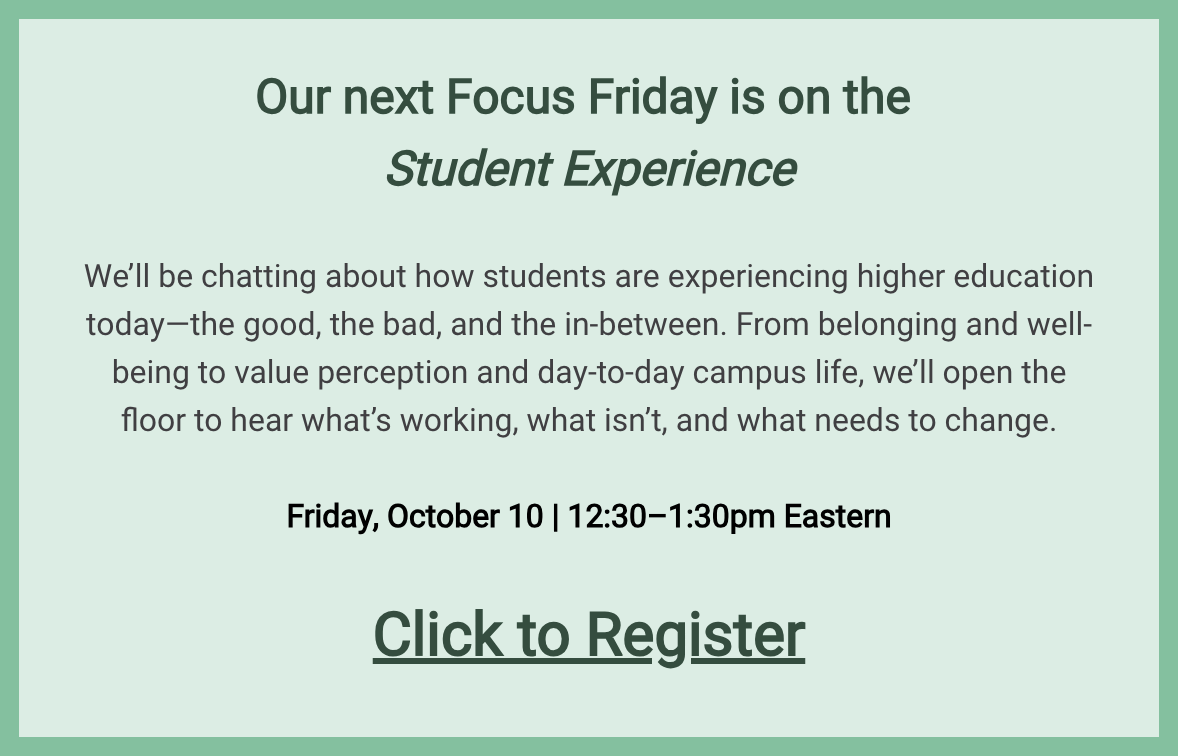
A quick reminder that there is a Focus Friday session today (October 10) from 12:30–1:30pm Eastern on the Student Experience.
I’ll be joined by Wasiimah Joomun (Executive Director, Canadian Alliance of Student Associations), Brendan Roberts (Executive Director, Students Nova Scotia), and Olamipo Ogunnote (Director of Advocacy and Strategic Partnerships, Ontario Student Voices) for a conversation on student experience—from campus culture and communication to what feels most different about being a student today.
If you haven’t registered yet, it’s not too late. Register here.
The format is simple: we’ll start with a few questions to our invited guests, then open the floor for a coffee-chat style discussion. Bring your ideas, hang out, and learn something new.
Two weeks ago, we launched our first Focus Friday with a big question: What will Canada’s post-secondary system need to look like to thrive by 2035?
I was joined by Jackie Pichette from RBC Thought Leadership and Sunny Chan from the Business + Higher Education Roundtable (BHER), two people who’ve spent the past few months travelling the country with us, listening to hundreds of ideas about the future of higher ed. Together, we tried to pull those threads into a single conversation about where we go next.
A few themes stood out:
Both Jackie and Sunny agreed that Canada’s post-secondary system has to get much more comfortable with change. As Sunny put it, we’re still “a little scared of big changes.” From funding models to internal governance, we need more room, and more courage, to experiment. Jackie imagined a future where the morning news is full of stories about new programs and partnerships instead of program cuts. “I hope ten years from now I hear stories about innovation, not layoffs,” she said.
That optimism came with some realism, too. Jackie talked about how Canada’s national priorities such as defence, AI, and energy, depend on colleges and universities producing the talent to match. Right now, she said, the gap between what’s needed and what’s being trained is wider than it should be.
Sunny offered the employer perspective. Work-integrated learning has gone from a nice-to-have to an expectation, but the challenge now is building lasting partnerships instead of one-off placements. “The most successful collaborations,” she said, “aren’t projects with an end date—they’re embedded relationships.”
Another topic that kept coming up was AI. Jackie argued that AI literacy should be treated like critical thinking—something every student gains, regardless of discipline. Some institutions, like Ohio State University, have already made AI fluency mandatory for all students. Canadian institutions can’t afford to wait too long to follow suit.
Of course, none of this happens without money and trust. Jackie pointed out that institutions need both more flexible funding and stronger financial aid if they’re going to modernize responsibly. And both speakers reflected on the erosion of public confidence in higher education. Sunny framed it simply: “If institutions can better tell their impact stories, it makes it easier for employers to champion them.”
Looking ahead to 2035, both ended on a hopeful note. Jackie hopes that by then, lifelong learning will finally be the default where people can stack, pivot, and return to education without starting from scratch. Sunny envisions institutions that serve whole communities, not just students aged 18 to 22, acting as anchors of both economic and civic life.
Want to listen or watch this discussion? You can find it on YouTube.
We’ll be turning next to enrolment. How it’s changing, what’s staying the same, and what institutions are learning along the way. That conversation happens on October 24, and registration is already open (see below, in a big green box).
In the meantime, keep sharing your ideas in the registration form or reach out anytime at [email protected].
I’m looking forward to seeing many of you this afternoon, and again in two weeks.
Cheers,
Tiff
Hi everyone,
Tiffany here.
A quick reminder that Focus Friday kicks off today (Sept 26) at 12:30-1:30pm Eastern on the Future of Higher Education. I’m being joined by Jackie Pichette from RBC and Sunny Chan from Business + Higher Education Roundtable. If you haven’t registered yet, it isn’t too late. Sign up here.
This is a new initiative from HESA but the session is simple: we’ll start with some questions to our invited guests, then open the floor for a coffee-chat style discussion. Bring your ideas, hang out, and learn something new.
Two weeks ago, we asked for what you want to chat about during Focus Friday and thank you to everyone who already submitted suggestions for future topics! Here’s what you told us you want to hear about most:
Keep sharing your ideas in the Zoom Registration Form or reach out anytime at [email protected].
From here on, the Focus Friday emails will give a summary of the last discussion. Can’t make the session or simply one of our text-loving audience members? We got you.
The next Focus Friday will be on October 10th focused on the student experience and student life. I’ll be bringing you some folks directly from your own campuses to lead our discussion. Register via the big green box below.
Looking forward to these conversations with you!
Cheers,
Tiff
Hi everyone,
I’m excited to share a new initiative we’re launching this fall: Focus Friday.
Focus Friday is a biweekly webinar series that brings people together around some of the most pressing issues in higher education. Each session runs for an hour and features a few short conversations with invited guests, followed by an open, coffee-chat style discussion where everyone can join in.
The goal is simple: create space to share ideas, meet new people across the sector, and learn from one another. We especially encourage you to join sessions on topics that may be outside your usual focus as sometimes that’s where the most interesting insights emerge.
Over the course of this initiative, we’ll be diving into themes like current enrolment trends, student experience, the future of research, and even integrating elements of our AI-CADEMY programming into the series. If you’re doing something exciting in any of these areas, I’d love to hear from you. There’s a suggestion box built directly into the Zoom registration form, and you can always drop me a line at [email protected].
In each Focus Friday, you’ll receive the Zoom registration link for the next session. For example, below you will find the link to register for our first full session on September 26 from 12:30–1:30pm Eastern.
I’m excited to chat with you!
Cheers,
Tiff