This audio is auto-generated. Please let us know if you have feedback.
Dive Brief:
Carnegie Mellon University has laid off 75 employeesin its Software Engineering Institute as it wrestles with disruptions to federal funding,according to a community message Wednesday from Vice President for Research Theresa Mayer.
Mayer tied the cuts — which amount to 10% of SEI’s workforce — to the engineering institute’s “unique financial structure as a federally funded research and development center as well as the shifting federal funding priorities that are shaping the research landscape.”
Carnegie Mellonas a whole is in a “strong financial position” for fiscal 2026, university President Farnam Jahanian said in August, noting that the Pittsburgh institution cut its expenses by $33 million.
Dive Insight:
Jahanian said in an August community message that Carnegie Mellon is poised to get through the current fiscal year without a deficit, which is more than some of its peer institutions can say.
But the university faces stiff financial headwinds — and what its president described as “existential challenges” —from the Trump administration’s disinvestment in scientific and academic research.
To tighten its budget, Carnegie Mellon has paused merit raises, reduced nonessential expenditures, limited new staff and faculty hiring, and has reduced staff in certain units through voluntary retirements and employee reductions.
In the August message, Jahanian described “signs of a marked decline in the pipeline of new federal research awards nationally and at Carnegie Mellon.”He added that university officials expect more cutbacks in federal agencies’ research budgets under a Republican-led Congress.
The university’s Software Engineering Institute, which Mayer described as integral to Carnegie Mellon’s overall research enterprise, is one of the institution’s biggest recipients of federal research funding. Sponsored by the U.S. Department of Defense, SEI develops new technologies and studies complex software engineering, cybersecurity and AI engineering problems, in large part to advance the strategic goals of federal agencies.
The institute took in $148.8 million in grants and contracts revenue in fiscal 2024.
Prior to this month’s job cuts, officials at the institute took “extensive steps to avoid this outcome, including implementing cost-saving measures in recent months,” Mayer said Wednesday. “Despite these efforts, SEI was unable to reallocate or absorb costs, so staff reductions were unavoidable.”
Along with a slackening grant pipeline, Jahanian’s August message pointed to the possibility of reduced funding for research overhead costs.
The Trump administration has sought to unilaterally cap reimbursement rates for indirect research costs at 15% across multiple agencies, though these policies have been blocked by courts.
Carnegie Mellonis a plaintiff in one of the lawsuits that led to the 15% cap being permanently blocked at the National Institutes of Health, though the Trump administration has appealed the ruling. The university is also represented in lawsuits against other agencies through its membership in the Association of American Universities.
If a 15% cap were implemented on research overhead, that would create an additional $40 million annual shortfall for Carnegie Mellon, according to Jahanian. Indirect research costs include overhead expenses such as laboratories and support staff.
Beyond federal funding woes, Jahanian also noted in August that Carnegie Mellon’s projected $365 million in graduate tuition revenue for the current fiscal year is about $20 million short of initial estimates due to “lower-than-expected enrollment.”
While Jahanian didn’t offer reasons for the shortfall, he did note that going forward Carnegie Mellon was examining its balance of undergraduate to graduate and international to domestic students to “ensure long-term stability.”
Other universities have experienced major declines in their international enrollment amid the Trump administration’s disruptions to the visa approval process and aggressive immigration policies.
Officials at DePaul University, in Chicago, said recently that new international graduate student enrollment fell by 62% year over year this fall, contributing heavily to a budget crunch at the institution.
One group has predicted that international enrollment could drop by as much as 150,000 students this fall.
In recent years, Carnegie Mellon’s enrollment has grown, as has its graduate student ranks. Between 2018 and 2023, overall enrollment increased 11.2% to 15,596 studentsand graduate enrollment grew 11.7% to 8,307 students.
in recognition of the explosion in demand for higher education in India – with 70 million places needed by 2035, which has created a huge opportunity for UK universities seeking new funding streams.
The last couple of years have seen a loosening of restrictions on overseas campuses in India and a corresponding piling in from universities in the UK, US, Australia and elsewhere, in particular within the new Edu City development in Navi Mumbai. On the UK side, Southampton, Surrey, York, Aberdeen, Bristol and Liverpool have either opened a new campus or received the go-ahead from India’s University Grants Commission to move forward with plans for one, whether in the new education hub area or elsewhere.
The government seems keen to trumpet UK higher education’s growing overseas presence as an economic win for the country and the institutions involved. It has also shrewdly observed that some UK universities are indeed “seeking new funding streams.” The future looks bright for TNE then – right?
Overdue refreshments
There’s a school of thought which says the government’s long-delayed international education strategy refresh will lean into transnational education, although exactly what this would entail is unclear – probably more trade delegations and better intertwining of the sector’s efforts with wider diplomatic work, rather than anything as flashy as a student number target.
If we look, for example, at the value of transnational education, where UK universities have sites in or relationships with other countries, we see a growing sector, and these are all areas that we will want to look at in the international education strategy.
This way of thinking is perhaps stimulated by the unlikelihood of Labour’s vision for the strategy being particularly bullish in any other area. A new international student number target is surely off the cards, and while there may be aspirations around overall education export totals, such a large slice of this comes from international students’ fees and living expenses that it’s tricky to be realistic about increases if numbers don’t return to growth.
About the only thing we do know at this point about the new strategy is that it will be co-led by the Foreign Office as well as DfE and the Department for Business and Trade (the Home Office still doesn’t seem to be closely involved with the strategy – history suggests that it will suddenly have thoughts at a later date).
And while the UK trade strategy, launched just before the summer, made only passing reference to education, more recently the business department has continued funding for the QAA to address “regulatory barriers to the growth of UK higher education in priority nations.”
Doing things leanly
The future regulatory environment has begun to look more promising too, with new Office for Students chair Edward Peck telling the education committee back in March that increased scrutiny of TNE would not be a priority:
I think there may be ways of doing things more leanly, which is why I want to explore the legal framework, as I noted. There may be some things that at the moment just are not a priority. The one that has been raised with me by the sector is the interest in more regulatory activity around transnational education. I would want to explore with the OfS why that was thought to be a priority at this moment, given everything else that is going on.
The regulator’s draft free speech guidance had left the territorial extent of the new requirements somewhat vague, leading to some pointed consultation responses from sector representatives as to why they should very much not apply elsewhere in the world. But the finalised guidance in June 2025 put it bluntly:
HERA does not require providers or constituent institutions to take steps to secure freedom of speech in respect of their activities outside England.
Plus earlier this year OfS (and Medr) announced that providers would not be required to submit individualised TNE learner data to the HESA student record “until further notice”, backtracking on earlier plans intended to provide a better understanding of the quality and standards of TNE provision and thus assist the regulator to “more effectively protect the interests of these students.” The regulatory outlook for TNE looks light-touch for the foreseeable future.
The Industry and Regulators Committee inquiry into OfS was told that the regulator’s falling-out with the QAA was putting at risk future transnational education partnerships involving English providers. But the recent glut of new campuses and programmes seems to bely these fears.
Sovereign glut
To pick out a few recent examples, the last year or so has seen new overseas campuses (opening or announced) involving Exeter in Egypt, Lancaster in Indonesia, Keele and York in Greece, and all the ones in India mentioned above. There is plenty more action besides – and plenty of TNE which doesn’t follow the more eye-catching branch campus model.
Around 20 per cent of UG and PGT students registered for a higher education award are now based overseas in one form or another of TNE. We’re rapidly approaching the inflection point where there are more TNE students in UK higher education than there are international students travelling over here (in fact we may have already passed this important moment, we just don’t have timely enough data to tell us).
Despite the occasional fears that there are reputational skeletons lurking in the overseas activities of UK universities, the media spotlight is rarely turned their way. We get the occasional scare story when the Telegraph is told the student numbers involved, or occasional deeper digging when an overseas partner becomes too involved in geopolitics – but these are relatively few and far between, as opposed to the incessant drumbeat of negative coverage for many other higher education issues.
At the risk of breaking the unwritten Wonkhe rule of not writing up imagined HE futures for the second time in a week, you can see a world 20 years hence in which transnational higher education has gone from strength to strength, with UK universities having continued to grow their overseas offer, and the proportion of higher education students whose awards come from institutions outside their country of study ticking ever upwards.
The UK can benefit from its huge pool of expertise in getting programmes off the ground – and plenty of experience in what can go wrong, if it’s able to learn from it. If the government leans in, the regulators stay largely unengaged, and the press generally continues to ignore the detail of what happens elsewhere in the world – it feels plausible.
Rescue me
But there are clearly challenges. Jisc’s new survey of staff and student digital experiences in TNE is a rare window into actual teaching and learning environments at a decent scale (more than 5,000 responses from a wide variety of countries and provision types).
Staff and students alike reported fairly widespread problems logging into university systems, accessing e-books, journals and software, and restrictions to certain apps or websites. One-third of teaching staff said that unreliable wifi negatively affects student learning – a “significant proportion” of TNE students were found to be paying cellular data costs to access learning resources via smartphones. Of the teaching staff surveyed, only 32 per cent said that most or all students had an understanding of acceptable use of generative AI.
It’s not all directly about tech either. Students highlighted unclear marking criteria, especially for those learning online, and some mentioned a lack of feedback. The report has two examples (both in China) of students being placed in “potential danger” from the government due to political content of their past or present assignments. There’s an example of synchronous content from the UK being packaged up as an asynchronous programme for learners abroad in a way that hardly screams high quality.
Some of the issues that emerge are simply around the challenges of delivering university study which is ever more designed around access to tech in places which suffer from moderate to high digital poverty. But others – and it’s these you’d be interested in if prognosticating about future trends in TNE – revolve more around the extent to which the world is becoming more or less technologically, and intellectually, open. You wouldn’t want to bet the farm on models of learning which suppose that internet access internationally is going to become more open, or that the same countries’ companies will continue to enjoy the same access to developing markets that they have over the last decade or so.
The problems aren’t all insurmountable – the Jisc report emphasises the opportunities of transnational licensing agreements and the importance of the sector setting up publisher agreements in a way that doesn’t forget that it has thousands of students in different domiciles.
If regulators began to take a closer interest in TNE student experience (and other topics such as assessment and feedback, or academic freedom), the report spells out some areas where there would be a greater impetus for action. Though many of these issues have not really been effectively tackled for UK-based students either.
Travelling long haul
Practicalities of staff and student experiences aside, there are plenty of sensible reasons why TNE isn’t a policy solution to the UK higher education sector’s wider funding challenges, a claim the government seems to be flirting with in its trade deal boosterism.
The chance to relitigate the question of how much it costs to deliver higher education, and at what fee, to students studying in their home country is an enticing one, given how the various UK governments have boxed universities in from doing so here. There may be more margin available in some instances – but there are certainly plenty of examples of institutions losing more than they put in, even if they are not public-spirited enough to fess up and enhance everyone else’s understanding of what not to do.
The long-term stability of programmes is unclear too. The risk of big geopolitical upheaval changing the landscape in one fell swoop is fairly well-trodden ground at this point (even if it still gets ignored in planning) but smaller policy changes – take Malaysia’s recently instituted tax on international students as but one example – can also make the difference between viability and non-viability. Another clear direction of travel in global TNE is competition: countries who have typically been hosts pivoting into setting up their own initiatives. Transnational education might be ubiquitous in global HE in 2050, but this doesn’t translate to UK institutions necessarily enjoying an ever-upward trajectory.
The other point that gets largely overlooked is what this hypothetical boom in TNE looks like across the sector – it’s surely unrealistic to see all, or even most, universities with mature transnational offers a couple of decades hence, in the same way that other export industries don’t have a plethora of successful UK actors on the world stage. A more compelling prediction would be a relatively modest number of institutions getting TNE “right” for the longer-term, leaving the others to focus on all that stuff the government wants but doesn’t fund: more civic and local focus, the (re)building of links to local economies and businesses, an ever more ambitious role in enabling opportunity in the UK on a shoestring.
So TNE might well be an enormous part of UK higher education’s future – but you’d have to predict that for many individual universities it will certainly not be, however much the government might want to trumpet its potential role as a new funding stream. This complicates any efforts to use it as a policy plug for a sector taking on water.
The nine universities that were sent the Trump administration’s new deal for higher ed are under increasing pressure to reject the compact.
Multiple major associations representing institutions and faculty have urged them not to sign it. California governor Gavin Newsom has said the University of Southern California and any other university in his state that signs will “instantly” lose billions of state dollars. Faculty groups at the University of Virginia, another institution presented with the compact, overwhelmingly urged university leaders to reject it. A group of progressive student and higher ed worker organizations is circulating a petition that calls on university presidents and boards to “reject the Trump administration’s attempt to cajole universities into compliance through explicit bribery.”
So far, the universities at the center of the fight are remaining mostly mum, saying they’ll review the proposal. Some leaders are hinting they have reservations about signing. But other higher ed leaders and observers say that beyond what those institutions do, the nine-page document represents another escalation in the White House’s precedent-shattering crusade to overhaul postsecondary ed—one that could restrict freedoms at colleges across the nation. They expect the compact will likely serve as a blueprint for the administration’s dealings with other colleges.
“It’s making it really clear that the dominoes are being set up … they’re going to expand this to the rest of higher ed,” said Amy Reid, interim director of PEN America’s Freedom to Learn program.
A White House official told Inside Higher Ed in an email that “other schools have affirmatively reached out and may be given the opportunity to be part of the initial tranche.” The New York Times cited May Mailman, a White House adviser, as saying the compact could be extended to all institutions.
The administration has dangled the compact before universities with promises of extra benefits it hasn’t revealed. It’s an evolution in the White House’s quest to upend higher ed using the blunt instrument of federal funding access. The federal government earlier slashed billions of dollars from Harvard and Columbia Universities and other selective institutions to pressure them to change their internal policies and practices.
But now, the administration has written a boilerplate contract asking colleges to voluntarily agree to overhaul or abolish departments “that purposefully punish, belittle, and even spark violence against conservative ideas,” without further defining what those terms mean. It also asks universities to, among other things, commit to not considering transgender women to be women and to reject foreign applicants “who demonstrate hostility to the United States, its allies, or its values.”
In addition to a murky promise of additional money, the compact can be read as threatening colleges’ current federal funding. Higher ed groups say those that sign are taking a big gamble. The compact says failure to adhere to the terms of the agreement, which are vague, can lead to a loss of all federal funding. But it’s also unclear whether the universities have the freedom to refuse. A line at the end of the compact’s introduction says, “Institutions of higher education are free to develop models and values other than those below, if the institution elects to forego [sic] federal benefits.”
The nine institutions sent the Compact for Academic Excellence in Higher Education aren’t necessarily being asked to sign it. The letter sent to the University of Virginia requested “limited, targeted feedback” on the compact by Oct. 20—before the White House sends invitations to finalize language and sign to universities showing “a strong readiness to champion this effort.”
Lynn Pasquerella, president of the American Association of Colleges and Universities, said many campus leaders worry that, if any institutions do sign the compact, it will start a ripple effect in which other university leaders feel pressured to sign so they don’t lose out on funding.
Joy Connolly—president of the American Council of Learned Societies, a federation of 81 groups including the American Academy of Arts and Sciences and the American Historical Association—added that with this compact, the White House “is using nine months of intimidation tests to take its divide-and-conquer strategy to the next level.”
“If one by one institutions give in and sign, hoping to mitigate the damage later, it will set a truly problematic precedent,” Connolly said. “Some of the most powerful and wealthy institutions on the planet will have agreed to subject their faculty and research and teaching to state approval, and academia will be visibly divided into an insider group and an outsider group.”
Unclear Carrots, Clearer Sticks
According to the letter to UVA—signed by Mailman, Education Secretary Linda McMahon and Vincent Haley, director of the White House’s Domestic Policy Council—universities that sign will reap “multiple positive benefits … including allowance for increased overhead payments where feasible, substantial and meaningful federal grants, and other federal partnerships.” The White House didn’t provide Inside Higher Ed further information on how much extra money signatories would be able to receive.
The compact itself makes no mention about the potential financial benefits of signing.
For this unclear gain, a signatory university would risk all of their federal funding: The compact says “all monies advanced by the U.S. government during the year of any violation shall be returned to the U.S. government.”
Asked to clarify whether a university that refuses to sign could lose all federal funding, White House spokeswoman Abigail Jackson replied in an email simply that “the Administration does not plan to limit federal funding to schools that sign the compact.”
Jackson said universities that do sign “would be given [funding] priority when possible as well as invitations to collaborate with the White House. This is an opportunity for collaboration that all institutions of learning should be excited about.” The White House didn’t grant Inside Higher Ed an interview or answer written requests for more information about the compact’s benefits and how some of its requirements should be interpreted.
Pasquerella, of AAC&U, said the compact is “meant to be vague as a way of fomenting confusion.”
“Part of the strategy, I believe, of this administration is to engage in overly broad, overly vague language that is confusing so it’s not clear when institutions are complying,” Pasquerella said—a form of jawboning that pressures universities to overcomply. She said the compact’s promise of federal funds for signatories and apparent threat of cuts for those who refuse is “not a real choice.”
“It is the continued weaponization of federal funding,” she said. The compact isn’t “reforming higher education but dismantling it and replacing it with institutions that have a conservative ideology.” It disadvantages those institutions that are unwilling to relinquish their academic freedom and other freedoms, such as transgender people’s rights, she said.
Jon Fansmith, senior vice president for government relations at the American Council on Education, expressed concern that institutions that don’t sign could face the same “harassment” Harvard has suffered for refusing the administration’s earlier demands on that university. The administration cut off Harvard’s access to billions of dollars in research funding, placed it on heightened cash monitoring and tried to prevent it from enrolling international students, among other efforts in a growing pressure campaign against the institution.
“Now they’re essentially saying we’re going to create two classes of institutions,” Fansmith said: those “swearing fealty to the administration” and getting extra benefits, and those that are punished.
“That’s a massive step in the wrong direction in the history of American higher education,” he said. He said prioritizing less merit-worthy candidates for federal funding just because they signed the compact is “harmful to the goal of getting the best science performed on behalf of the American people.”
Standing Up
Fansmith noted the compact’s ideas aren’t necessarily new for the administration, but they would add up to “very specific intrusions into institutional policies.” For instance, the compact would mandate that all “undergraduate applicants take a widely-used standardized test … or program-specific measures of accomplishment.” Signatories must also agree that no more than 15 percent of their undergraduates be in the “Student Visa Exchange Program [sic], and no more than 5 percent shall be from any one country.” (The Student and Exchange Visitor Program, not the Student Visa Exchange Program, collects information on international students.)
Reid, of PEN America, said, “The administration has gone from picking off individual schools to selecting a group—a group of well-respected universities, but that for different reasons are seen as perhaps likely to comply—and putting everyone on notice that this is coming for everyone.”
Some of the nine institutions, however, have hinted at reservations about signing. On Friday, Dartmouth College president Sian Leah Beilock noted in a statement that “you have often heard me say that higher education is not perfect and that we can do better. At the same time, we will never compromise our academic freedom and our ability to govern ourselves.”
On Sunday, University of Pennsylvania president J. Larry Jameson said Penn’s “long-standing partnership with the federal government in both education and research has yielded tremendous benefits for our nation,” but also that “Penn seeks no special consideration.” On Monday evening, University of Virginia Board of Visitors chair Rachel Sheridan and interim president Paul Mahoney wrote in a message to the campus community that “it would be difficult for the University to agree to certain provisions in the Compact.”
Reid told Inside Higher Ed that “for those of us who are not at those nine targeted institutions, the question is how do we all respond in a way that bolsters the resolve of any institution to stand up.”
“It is wrong to call this a compact, because there’s nothing mutual about it,” Reid said. “It is a one-sided coercive proposition that has a bow of commonality stuck onto it that it doesn’t deserve. We need to call this what it is, which is an attempt to extort universities, to shut down free expression on campuses, to impose ideological restrictions under another name.”
This HEPI blog was kindly authored by Professor Julie Mennell, Vice-Chancellor of the University of Cumbria, and Martin Williams, Chair of the University of Cumbria.
Barrow-in-Furness, now in the county of Westmorland and Furness, exemplifies the Government’s approach to stimulating regeneration and growth. Considerable public money is being committed, and the University of Cumbria, as the local university, is deeply involved. We are proud of what we and others are trying to do and confidently expect that many benefits will result. But our involvement also reminds us how national systems, such as student financial support, cannot currently flex to support a nationally-mandated priority – and makes us wonder whether it is time for a little experimentation.
The Government’s reasons for focusing on Barrow are clear. Undoubtedly the town is in need of regeneration; its current health and education outcomes make depressing reading. However, Barrow is also the only place in the country where BAE Systems manufactures the nuclear-powered submarines, which are crucial to Britain’s national and global defence strategy. With a volatile international situation, these craft are in demand, and the order books at the Barrow shipyard are full for decades to come. Constructing nuclear submarines is a highly technical, labour-intensive business, and the company and its suppliers urgently need to grow and upskill their workforces. However, the local Furness population is ageing, and for decades, employers there have struggled to attract and retain skilled workers. To grow, Barrow has to improve its ‘liveability’ – in other words, a big regeneration effort.
Because the submarine programme is a national priority, Government has been prepared to intervene directly to support this goal. It has invested £220 million, coordinated by a Board chaired by a former Cabinet Secretary. Their recently published 10 Year Plan recognises the interconnectedness of what needs to happen, covering health, transport, education, skills, housing, environment and leisure. It is ambitious, but not unrealistic, given the underpinning demand from a large, profitable company and its associated supply chains. The Government’s recent Defence Industrial Strategy document quotes Team Barrow as a model on which to build.
The University of Cumbria has been deeply involved in the development of this Plan. We sit on the Team Barrow Delivery Board and will contribute to everything the Plan seeks to achieve. We are already BAE Systems’ main supplier of project managers, via degree apprenticeships. We train the nurses and healthcare workers that the town will need, and from this year, our new Medical School means we can provide a wider range of practitioners. We can produce the teachers to improve the schools, and the artists and environmental scientists to enhance Furness’s natural and cultural landscapes.
We can and will do more. This month the University opens a new campus, supported by Town Deal money, right next to the shipyard on Barrow Island. With BAE Systems, we are now creating new courses based there in mechanical engineering and computer science. There will be a new Doctoral Training Centre and Innovation Hub to develop and test potentially viable new products and processes and to attract more PhD-level skills into Furness. There is potential for even closer working with the local FE Colleges. We are investing, and we want to invest, and the public purse is supporting that investment.
But this is the supply side. Will it be enough to attract students and researchers at the speed and in the numbers that are wanted?
In a demand-led higher education system, this is primarily a matter for universities. We have to convince students to enrol. If they don’t come, our income will be directly affected. The onus is on us to sell our offerings, and on potential employers to give extra support to students if they think that is worthwhile.
Fair enough, but should that be the whole story in this case? The courses are being created in response to a Government goal. The faster the recruitment to these courses, the quicker the effect on the supply of local skills. We know there are barriers to overcome. It isn’t accidental that Barrow is currently a higher education cold spot. A lot of Barrovians come from families that believe university courses are not for them. BAE Systems are offering generous scholarships and paid placements for local students, but mindsets don’t change quickly. And how many people from outside the region will instinctively encourage their children or friends to consider a course in Barrow in Furness, offered by the University of Cumbria? Barrow is a remote and superficially not very attractive town. The University of Cumbria isn’t in ‘the Russell Group’. A new course, by definition, won’t appear in the Times league tables and won’t yet have employment outcomes (although as a university, we rank top in Northwest England on this measure). We believe they will be good quality courses, offering excellent prospects in the jobs market, but it will take time to establish their reputation.
The whole rationale behind the Barrow Rising programme is that Government intervention is needed if Barrow is to become what the country needs it to be. However, the Government’s Higher Education funding system offers no incentives for students to overcome their possible preconceptions. There is a ‘level playing field’ of student choice; any course, anywhere, attracts the same support. 12 years of this model has demonstrated its results. Students tend to play safe and favour longer-established, higher-prestige institutions. A perfectly sensible approach for them to take. But might the public interest right now be better served by a playing field that could be tilted slightly in favour of, for example, engineering courses in Barrow?
Fiddling with funding systems is tricky and prone to unintended consequences. Nevertheless, Barrow is a small place, of particular interest to Government and facing some particular challenges. It would surely be useful to the Government to know whether targeted financial incentives, nudging students towards strategically important courses in particular places, made a difference to behaviours. If successful, the approach could be applied to a few other selected priority areas or courses.
This would be a new step, but this Government has signalled it wants to think imaginatively in support of growth. With a higher education policy document expected in the autumn, is there space to experiment with a more strategic use of a tiny piece of the huge student finance budget?
This audio is auto-generated. Please let us know if you have feedback.
Dive Brief:
California Gov. Gavin Newsom on Thursday threatened to pull state funding from colleges that signed a proposed compact from the Trump administration seeking to impose sweeping policy changes in return for priority in research funding.
“If any California university signs this radical agreement, they’ll lose billions in state funding,” Newsom said in a statement. “California will not bankroll schools that sell out their students, professors, researchers, and surrender academic freedom.”
First reported by the Wall Street Journal, federal officials offered the compact to the University of Southern California and eight other high-profile research universities this week.
Dive Insight:
Since taking office, President Donald Trump and his administration have waged a legal and financial campaign against colleges in an effort to transform them ideologically. It comes after Trump on the campaign trail described colleges as “dominated by Marxist maniacs and lunatics” and full of academics “obsessed with indoctrinating America’s youth.”
With the compact, the administration has gone from using mainly sticks — typically in the form of civil rights investigations and canceled research grants — to using carrots as a means of pushing institutions to make reforms.
The Trump administration offered to prioritize colleges for research grants and other funding if they agree to give the government unprecedented control over internal institutional decisions and governance.
That includes:
Taking a position of institutional neutrality on events that don’t directly impact the college.
Committing not to consider race, gender, religion and other characteristics “explicitly or implicitly” in admissions. (The compact would grant exceptions for religious and single-sex institutions to limit admissions based on religious belief and gender, respectively.)
Conducting broad, public assessments of the viewpoints of employees and students.
Changing governance structures and potentially dissolving or taking over departments that “purposefully punish, belittle, and even spark violence against conservative ideas.”
Adopting policies that recognize “academic freedom is not absolute” and prevent “discriminatory, threatening, harassing, or other behaviors that abridge the rights of other members of the university community.”
Capping international undergraduate enrollment at 15% of the broader student body while screening out “students who demonstrate hostility to the United States, its allies, or its values.”
Freezing tuition for five years.
Requiring applicants to take standardized tests such as the SAT.
Committing to using “lawful force” and “swift, serious, and consistent sanctions” to handle protests that “delay or disrupt class instruction or disrupt libraries or other traditional study locations.”
The compact would also require colleges with endowments worth $2 million or more per student to waive tuition for students studying hard sciences, though the memo didn’t define the field.
Along with USC, eight other colleges received the administration’s memo detailing the compact: the University of Arizona, Brown University, Dartmouth College, Massachusetts Institute of Technology, the University of Pennsylvania, the University of Texas, Vanderbilt University and the University of Virginia.
The compact has drawn alarm and stern rebukes throughout the higher education world.
“College and university presidents cannot bargain with the essential freedom of colleges and universities to determine, on academic grounds, whom to admit and what is taught, how, and by whom,” the American Association of Colleges and Universities said in a statement Friday.
Denise Forte, president and CEO of the policy analysis and advocacy organization EdTrust, described the compact in a statement as an “existential threat to all institutions of higher learning and the latest example of the federal government overexerting its power to intimidate colleges and universities viewed as ideological enemies.”
In a joint statement Thursday, top leaders of the American Association of University Professors and the American Federation of Teachers described the compact as offering preferential treatment “in exchange for allegiance to a partisan ideological agenda” and said that it “stinks of favoritism, patronage, and bribery.” They urged all governing boards and administrators to reject the agreement.
American Council on Education President Ted Mitchell in an interview with The New York Times described the compact as a power play “designed to divide the higher education community.”
And then there is Newsom, who has been among the most vocal Democrats opposing Trump, especially since the president sent the National Guard into Los Angeles this summer, a move that a judge later ruled illegal.
In a press release, Newsom’s office described the compact as tying access to federal research funding to “radical conservative ideological restrictions on colleges and universities.” The governor also specifically threatened to “instantly” pull colleges’ eligibility for Cal Grants, a form of state aid for students from low- and middle-income families.
USC on Friday confirmed it had received and was reviewing the administration’s letter, but the university did not offer further comment.
Most of those institutions have remained quiet about their plans, if any, to sign or reject the agreement. A leader from one, however, voiced enthusiastic openness to the compact.
In a widely shared statement, Kevin Eltife, chair of the University of Texas Board of Regents, said that the system was “honored” that its flagship in Austin was selected among the nine to receive the compact.
“We enthusiastically look forward to engaging with university officials and reviewing the compact immediately,” said Eltife, a former Republican state senator.
This audio is auto-generated. Please let us know if you have feedback.
Dive Brief:
Kean University is set to receive an additional $10 million to support its acquisition of New Jersey City University, as part of New Jersey’s fiscal 2026 budget.
Kean would have to return the money to the state if the merger is not completed as detailed in the two public universities’ May letter of intent. Kean and NJCU are expected to finalize their merger by June 2026, pending regulatory and accreditor approvals.
Further reshaping Kean finances, its board on Monday approved in-state tuition rates for all students beginning in 2026-27 — the first academic year the university is set to fully control NJCU post-merger.
Dive Insight:
Following years of financial challenges, NJCU found a lifeline in Kean after a state-appointed monitor ordered the university to find a financial partner.
The $10 million state allocation — a small fraction of the $3.1 billion New Jersey is set to spend on higher education in fiscal 2026 — will go toward “feasibility studies, planning and legal work tied to the merger” between NJCU and Kean. But it’s unlikely to cover the full cost of the process.
In 2020, a University System of Georgia regent estimated that just changing the name of an institution — updating everything from signage to stationery — cost over $3 million.
Under Kean and NJCU’s letter of intent, the former would assume the latter’s assets and liabilities and NJCU’s campus would be renamed Kean Jersey City.
As the two universities go through the merger process, Kean is also to receive state funding for over 1,100 NJCU jobs in the form of a loan, per the state’s budget. If the merger falls through, the funded positions will return to NJCU.
A 2019 working paper found that, on average, a merger between two nonprofit colleges raised tuition prices by students between 5% and 7%.
But Kean appears to be poised to buck that trend with its elimination of out-of-state tuition. Under the new plan, the university will drop out-of-state tuition for current and new undergraduate and graduate students.
“Kean’s outstanding academics, proximity to New York City and growing research programs make the University appealing to students outside of New Jersey,” Michael Salvatore, Kean’s executive vice president for academic and administrative operations, said in a Tuesday statement. “This will enable us to tap into expanded markets while bringing students into the state.”
In the 2025-26 academic year, full-time students from New Jersey paid $7,649.80 per semester in tuition and fees, while their out-of-state counterparts paid $12,008.58. In-state and out-of-state graduate students paid $1,019.54 and $1,206.64 per credit, respectively.
When the U.S. Department of Education abruptly ended grants for most minority-serving institutions last week, it raised questions about what the department would do with the hundreds of millions of dollars already slated for these programs. The department offered an answer Monday, announcing plans to repurpose funds from programs “not in the best interest of students and families” to historically Black colleges and universities, tribal colleges, charter schools, and civics education.
“The department has carefully scrutinized our federal grants, ensuring that taxpayers are not funding racially discriminatory programs but those programs which promote merit and excellence in education,” Education Secretary Linda McMahon said in a statement. “The Trump Administration will use every available tool to meaningfully advance educational outcomes and ensure every American has the opportunity to succeed in life.”
The department promised to direct an extra $495 million to HBCUs and tribal colleges, on top of the funds already anticipated for fiscal year 2025—increases of 48.4 percent and 109.3 percent, respectively. In total, HBCUs are slated to receive over $1.34 billion and tribal colleges expect to receive $108 million this fiscal year, which ends Sept. 30. The department is also giving an additional $60 million to charter schools and putting $137 million toward civics education grants. The department didn’t share more specifics on how it would allocate the funds to institutions.
The move has been met with mixed reactions. Some HBCU advocates are celebrating the one-time influx as a game-changer for cash-starved institutions. Others’ joy is tempered by concern that the Trump administration is uplifting some MSIs at the expense of others, sowing tensions between them.
The new funds come less than a week after the Education Department quashed grant programs for Hispanic-serving institutions and other MSIs, deeming them “unconstitutional” because they require colleges to serve a certain percentage of students from a particular racial or ethnic background to qualify. (HBCUs and tribal colleges don’t have enrollment thresholds.) This blow to MSI grants, as well as cuts to teacher prep and gifted and talented programs, is paying for the department’s recent largess, The New York Times reported, citing several anonymous sources familiar with the department’s plans.
Lodriguez Murray, vice president of public policy and government affairs at the United Negro College Fund, which represents private HBCUs, said the funds are “nothing short of a godsend” for institutions operating on lean budgets.
“Now, all of a sudden, [HBCUs] have much more wherewithal to do the things, not just that take you from year to year, but can make an impact on your campus,” he said. He foresees HBCUs using the funds to buy property, improve their campus infrastructure and invest in student and faculty supports in new ways.
Murray said he doesn’t have qualms about the money coming from the slashed MSI programs.
He claimed many of these institutions are predominantly white, tend to have higher endowments than HBCUs and serve lower shares of Pell-eligible students. (Most enrollment-based MSIs are required to serve at least 50 percent low-income students. HBCUs have no such requirement but tend to enroll at least 70 percent Pell-eligible students.)
As far as he’s concerned, the Trump administration is channeling “resources toward the institutions that seem to need it the most—and the institutions that have a better track record at taking students from underserved backgrounds and … changing the economic outlook of their lives,” Murray said. “That is the reason why we have no pause about receiving the funds this morning.”
Harry Williams, president and CEO of the Thurgood Marshall College Fund, which represents public HBCUs, said he wants to see other types of MSIs thrive, and at the same time, he’s excited about how the new support could help HBCU students.
He didn’t know the Trump administration planned to drop millions on the institutions, he said. And while TMCF regularly lobbies for HBCU funding, “candidly, we have never made any recommendations about where the money should come from to the administration, because that’s their decision in terms of how they operate.”
He said he’s “sensitive” to the challenges facing MSIs, noting that TMCF has three predominantly Black institutions among its members. TMCF put out a statement last week in support of them when the department said it was ending MSI grant programs, including PBIs.
“We do support MSIs and PBIs and all the groups in that category and recognize the importance of them having resources, too,” he said, “but our primary focus has always been working with HBCUs.”
Pitting MSIs Against Each Other
Marybeth Gasman, executive director of the Rutgers Center for Minority Serving Institutions, said HBCUs and tribal colleges deserve the money.
These institutions have “always been underfunded” and “the federal government should always be thinking about ways to enhance them, especially based on our country’s history of racism and inequities,” she said.
But Gasman believes other types of MSIs are also deserving of these resources. She pointed out that many Hispanic-serving institutions are community colleges, and they serve about a third of the country’s students over all, not just Latino students.
The Education Department is “trying to pit different types of minority-serving institutions against each other,” even though MSI leaders and advocacy groups have worked together for years toward similar policy goals, she said. “And that is really, really troubling … I hope people don’t fall for that.”
Gasman noted that department officials made a “purposeful” decision to share that new funds for HBCUs and tribal colleges came from defunded programs. She called the framing of the announcement “spiteful” and said she worries for the future of the MSI community.
“There is enough pie for all of these institutions,” she said. “It’s not like you need to take from one to feed the others.”
Dominique Baker, associate professor of education and public policy at the University of Delaware, said the funding for HBCUs and tribal colleges, while necessary, doesn’t lead her to believe the Trump administration has their best interests at heart.
The funds are “a nice way” for the administration to claim “they hold no racial animus, because look at all the money that they’ve given to HBCUs,” Baker said, at the same time as they crack down on diversity, equity and inclusion at predominantly white institutions.
“It can both be true that you are providing funding to institutions that deserve funding—and you are working to ensure that the institutions that you hold in high prestige resegregate,” she added.
Executive Branch Overreach?
The legality of the department’s move—cutting funding for some programs to be showered on others—is also a little murky. Department officials say they are relying on “existing flexibilities in discretionary grant programs” to move the money around.
Amanda Fuchs Miller, former deputy assistant secretary for higher education programs under the Biden administration and now president of the higher ed consultancy Seventh Street Strategies, said under statute, the department legally has the right to “reprogram” funds within an account.
But even if department officials are following the law, she said the “intent” of reprogramming was never to end programs authorized and continually funded by Congress, like the MSI programs. And the executive branch claiming it has the authority to declare anything unconstitutional is “the real problem.” So, as far as she’s concerned, the department went out of bounds by eliminating the MSI programs and regifting their money to other institutions.
“It’s great that the HBCUs and TCUs will get more money—they need it,” Miller said. “Those students will benefit from it. But to take away funds from one group of students to help another group of students, that’s not beneficial to anybody. We should be pushing back to help all students succeed and have these resources.”
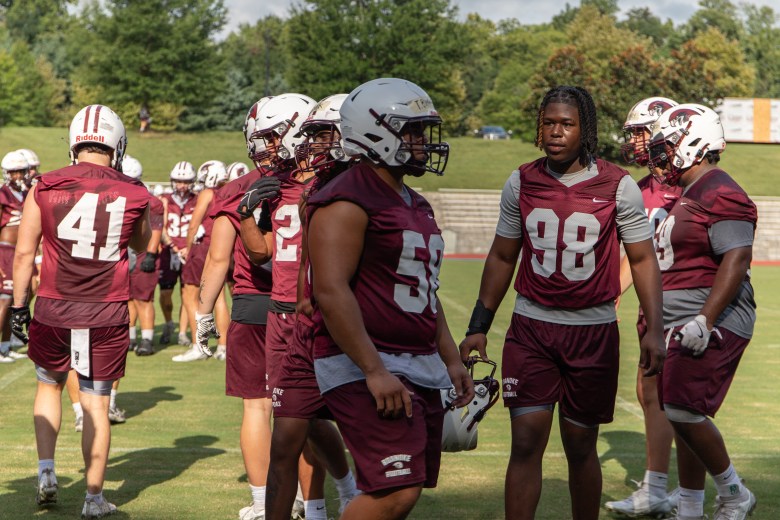
SALEM, Va. — On a hot and humid August morning in this southwestern Virginia town, football training camp is in full swing at Roanoke College. Players cheer as a receiver makes a leaping one-handed catch, and linemen sweat through blocking drills. Practice hums along like a well-oiled machine — yet this is the first day this team has practiced, ever.
In fact, it’s the first day of practice for a Roanoke College varsity football team since 1942, when the college dropped football in the midst of World War II.
Roanoke is one of about a dozen schools that have added football programs in the last two years, with several more set to do so in 2026. They hope that having a team will increase enrollment, especially of men, whose ranks in college have been falling. Yet research consistently finds that while enrollment may spike initially, adding football does not produce long-term enrollment gains, or if it does, it is only for a few years.
Roanoke’s president, Frank Shushok Jr., nonetheless believes that bringing back football – and the various spirit-raising activities that go with it — will attract more students, especially men. The small liberal arts college lost nearly 300 students between 2019 and 2022, and things were likely to get worse; the country’s population of 18-year-olds is about to decline and colleges everywhere are competing for students from a smaller pool.
“Do I think adding sports strategically is helping the college maintain its enrollment base? It absolutely has for us,” said Shushok. “And it has in a time when men in particular aren’t going to college.”
Women outnumber men by about 60 percent to 40 percent at four-year colleges nationwide. Roanoke is a part of this trend. In 2019, the college had 1,125 women students and 817 men.
This fall, Roanoke will have 1,738 students altogether, about half men and half women. But the incoming freshman class is more than 55 percent male.
Sophomore linebacker Ethan Mapstone (26) jogs to the sideline at the end of a drill. Mapstone said he hadn’t planned to play college football until Roanoke head coach Bryan Stinespring recruited him. Credit: Miles MacClure for The Hechinger Report
“The goal was that football would, in a couple of years, bring in at least an additional hundred students to the college,” said Curtis Campbell, Roanoke’s athletic director, as he observed the first day of practice. “We’ve got 97 kids out there on the field. So we’re already at the goal.”
That number was 91 players as the season began, on Sept. 6 — and the Maroons won their first game, 23-7, over Virginia University of Lynchburg, on what Shushok called “a brilliant day full of community spirit and pride.”
“Our students were out in force, side by side with community members spanning the generations,” he said via email. “In a time when we all need more to celebrate and opportunities to gather, it is easy to say our first football game since 1942 was both historic and invigorating.”
Related: Interested in more news about colleges and universities? Subscribe to our free biweekly higher education newsletter.
In the NCAA’s Division III, where Roanoke teams compete, athletic scholarships are not permitted. Athletes pay tuition or receive financial aid in the same way as other students, so adding football players will add revenue. For a small college, this can be significant.
Shushok said it’s not just about enrollment, though: He wants a livelier campus with more school spirit. Along with football, he started a marching band and a competitive cheerleading team.
“It plays to something that’s really important to 18- to 22-year-olds right now, which is a sense of belonging and spirit and excitement,” said Shushok, who came to Roanoke after being vice president of student affairs at Virginia Tech. Its Division I football team plays in a 65,000-seat stadium where fans jump up and down in unison to Metallica’s “Enter Sandman” as the players take the field.
The Maroons play in the local high school stadium — it seats 7,157 — and pay the city of Salem $2,850 per game in rent. The college raised $1.3 million from alumni and corporate sponsors to get the team up and running.
Roanoke College players gather on the sidelines during practice. Credit: Miles MacClure for The Hechinger Report
Despite the research showing limited enrollment gains from adding football, colleges keep doing it. About a dozen have added or relaunched football programs in the last two years, including New England College in New Hampshire and the University of Texas Rio Grande Valley. Several more plan to add football in 2026, including Chicago State University and Azusa Pacific University in California.
Calvin University in Michigan recently added football even though the student body was already half men, half women. The school wanted to broaden its overall appeal, Calvin Provost Noah Toly said, citing “school spirit, tradition, leadership development,” as well as the increased enrollment and “strengthened pipelines with feeder schools.”
“What you see is basically a one-year spike in male enrollment around guys who come to that school to help be part of starting up a team, but then that effect fades out over the next couple of years,” said Welch Suggs, an associate professor there and the lead author of that study. It found early modest enrollment spikes at colleges that added football compared to peers that didn’t and “statistically indistinguishable” differences after the first two years.
”What happens is that you have a substitution effect going on,” Suggs said. “There’s a population of students that really want to go to a football school; the football culture and everything with it really attracts some students. And there are others who really do not care one way or the other. And so I think what happens is that you are simply recruiting from different pools.”
Today, college leaders value any pool that includes men. Most prefer the campus population to be balanced between the sexes, and, considering the low number of male high school graduates going to college at all (39 percent in the last Pew survey), many worry about too few men being prepared for the future workforce.
“ I don’t know that we have done a good job of articulating the value, and of programming to the particular needs that some of our young men are bringing in this moment,” Shushok said. “I think it’s pretty obvious, if you read the literature out there, that a lot of men are feeling undervalued and perhaps unseen in our culture.”
Roanoke College President Frank Shushok Jr. in his office. Shushok said he brought football back to Roanoke to boost enrollment and create a livelier campus. Credit: Miles MacClure for The Hechinger Report
Shushok said that Roanoke’s enrollment-building strategy was not centered on athletics. The college has also forged partnerships with local community colleges, guaranteeing students admission after they complete their associate degree, and has added nine new majors in 2024, including cannabis studies. Shushok pointed out that while freshman enrollment is down slightly this year, the community college program has produced a big increase in transfer students, from 65 in fall of 2024 to 91 this fall.
About 55 percent of Roanoke’s students come from Virginia, but 75 of the football team’s 91 players are Virginians. The head coach, Bryan Stinespring, a 61-year-old Virginia native, knows that recruiting territory, having worked on the coaching staffs at several Virginia universities in his career.
When Stinespring took over as head coach in 2023, hoping to inspire existing students and potential applicants to join his new team, there was no locker room, no shoulder pads or tackling dummies, no uniforms.
“The first set of recruits that came on campus, we ran down to Dick’s, got a football, went to the bookstore, got a sweatshirt,” said Stinespring, referring to a local Dick’s Sporting Goods store. “These kids came on campus and they had to believe in the vision that we had.”
Students bought into that vision; 61 of them joined a club team last fall, which played four exhibition games in preparation for this year. The community bought in, too; 9,200 fans showed up to the first club game, about 2,000 of them perched on a grassy hill overlooking the end zone.
Linebackers Connor Cox (40) and Austin Fisher (20) look on from the sidelines. Credit: Miles MacClure for The Hechinger Report
Before Ethan Mapstone, a sophomore, committed to Roanoke, he was on the verge of giving up football, having sustained several injuries in high school. Then Stinespring called.
“I could hear by the tone of his voice how serious he meant everything he was saying,” said Mapstone, a 6-foot-1-inch linebacker from Virginia Beach. “I was on a visit a week later, committed two weeks later.”
To him, the football leaders at Roanoke seemed to be “a bunch of people on a mission ready to make something happen, and I think that’s what drove me in.”
KJ Bratton, a junior wide receiver and transfer student from the University of Virginia, said he was drawn to Roanoke not because of football but because of the focus on individual attention in small classes. “You definitely get that one-on-one attention with your teacher, that definitely helps you in the long run,” said Bratton.
Jaden Davis, a sophomore wide receiver who was an honor roll student in high school, said, “ The staff, they care about all the students. They’ll pull you aside, they know you personally, they’ll send you emails, invite you to office hours, and they just work with you to do the best you can.”
Not everyone was on board with football returning to the college when the plan was first announced. Some faculty and administrators were concerned football would change the campus culture, said Campbell, the athletic director.
Sophomore wide receiver Jaden Davis poses for a photograph before the first practice of the season. Davis said the individual attention he could get from professors is what attracted him to Roanoke. Credit: Miles MacClure for The Hechinger Report
“There were just stereotypes about football players,” he said. “You know, they’re not smart, they’re troublemakers. They’re gonna do this and they’re gonna do that, be disruptive.”
But the stereotypes turned out to be unwarranted,he said.When the club team started, he said, “I got so many compliments last year from faculty and staff and campus security about how respectful and polite and nice our students were, how they behaved in the classroom, sitting in the front row and just being role models.”
Payton Rigney, a junior who helps out with the football team, concurred. “All the professors like them because they say ‘yes, sir’ and ‘no, ma’am,’” she said.
Like most Division III athletes, the Roanoke players know that they have little chance of making football a professional career. Mapstone said there are other reasons to embrace the sport.
“It’s a great blessing to be able to do what we do,” he said. “There’s many people that I speak to who are older and, and they reminisce about the times that they had to play football, and it’s very limited time.
“And even though there’s not a future for it, I love it. It’s a Thursday, my only problem in the world is that there’s dew on my shoes.”
Contact editor Lawrie Mifflin at (212) 678-4078 or [email protected].
The Hechinger Report provides in-depth, fact-based, unbiased reporting on education that is free to all readers. But that doesn’t mean it’s free to produce. Our work keeps educators and the public informed about pressing issues at schools and on campuses throughout the country. We tell the whole story, even when the details are inconvenient. Help us keep doing that.
This audio is auto-generated. Please let us know if you have feedback.
Dive Brief:
The University of California system’s president warned state lawmakers Wednesday that it would need at least $4 billion to $5 billion to minimize harm in the event of a major loss of federal funding.
In a letter to state Sen. Scott Wiener, chair of California’s joint legislative budget committee, UC President James Milliken said the Trump administration’s actions “place the entire University of California system at risk,” noting there is a“distinct possibility of more to come.”
The federal government in August suspended $584 million in grants to the University of California, Los Angeles over antisemitism-related allegations. Milliken responded at the time that cuts “do nothing to address antisemitism.”
Dive Insight:
In his letter to Wiener, Milliken detailed the many ways the University of California depends on federal funding. That includes $5.7 billion in research funding and $1.9 billion in student financial aid per year. UCLA alone received over $875 million in federal grants and contracts in fiscal 2024, according to the latest system financials.
He also described the potential impacts of losing this funding in dire terms.
“Classes and student services would be reduced, patients would be turned away, tens of thousands of jobs would be lost, and we would see UC’s world-renowned researchers leaving our state for other more seemingly stable opportunities in the US or abroad,” he wrote.
Cutting off research funding, largely for scientific studies, has been the primary tool of the Trump administration when targeting colleges. Federal officials often link the cuts to allegations that colleges aren’t doing enough to respond to campus antisemitism that the administration ties to protests over Israel’s war against Hamas.
In some cases, the tactic has paid off for the federal government. Columbia University agreed to settle allegations by paying $221 million to the federal government in return for having most of its $400 million in suspended research grants restored.
The administration is also seeking $500 million from Harvard University, which has been navigating a multi-agency attack from the federal government.
However, a federal judge on Wednesday ruled that the Trump administration’s suspension of $2.2 billion of Harvard’s funding was unlawful. The judge in the case concluded that the evidence does not “reflect that fighting antisemitism was Defendants’ true aim in acting against Harvard.”
On the West Coast, the U.S. Department of Justice announced in June it was investigating the UC system over “potential race- and sex-based discrimination in university employment practices.”
Meanwhile, the administration has also demanded $1 billion from UCLA specifically. While the UC system and UCLA have negotiated with the administration, Milliken in August said the sum “would completely devastate our country’s greatest public university system as well as inflict great harm on our students and all Californians.”
State officials have panned the administration’s demand in fiercer terms, with both Gov. Gavin Newsom and Wiener describing it as extortion.
In an August statement, Wiener likened the $1 billion demand to “classic mob boss behavior,” describing the administration as “threatening to illegally revoke funding — here, science funding — or take other punitive steps unless the university submits to his control, pays him off, and submits to his racist, transphobic, xenophobic dictates.”
As it navigates the numerous financial risks at the federal level, as well as other structural financial pressures, UCLA has paused faculty hiring and is moving to consolidate its IT operations to save costs on top of past budget moves.
In his letter to Wiener, Milliken described the current moment as “one of the gravestthreats in UC’s 157-year history,” and suggested further actions from the Trump administration could be in store later.
In outlining the amounts the UC system would need to survive a blow to federal funding, he said that the UC system “will need the resolve and partnership of our state’s leaders.
The Trump administration has already frozen $500 million in grant funding at UCLA.
The University of California system is warning state lawmakers that federal funding cuts could extend well beyond UCLA as tensions between the Trump administration and American colleges continue to rise.
UC president James B. Milliken wrote a letter to dozens of local elected officials Tuesday explaining that “the stakes are high and the risks are very real.” The system’s 10 institutions could lose billions of dollars in aid, forcing its leaders to make tough calls about staffing, the continuation of certain academic programs and more, he said.
President Trump has already frozen more than $500 million in grants at UCLA, allegedly because the Justice Department accused the university of violating Jewish students’ civil rights. The president demanded the university pay a $1.2 billion fine to unlock the funds,and system officials are worried that more funding cuts are likely. California lawmakers have repeatedly urged the UC system not to capitulate.
In an August letter, State Sen. Scott Wiener, a Democrat and chair of the Joint Legislative Budget Committee, and 33 other lawmakers told Milliken that Trump’s actions were “an extortion attempt and a page out of the authoritarian playbook,” the Los Angeles Times reported.
Milliken wrote in Tuesday’s letter that a loss in funding would “devastate” the system and harm students, among other groups.
“Classes and student services would be reduced, patients would be turned away, tens of thousands of jobs would be lost, and we would see UC’s world-renowned researchers leaving our state for other more seemingly stable opportunities in the US or abroad,” he wrote.
If the UC system loses federal funding, it would need about $4 to $5 billion a year to make up the difference, Milliken added. “That is what fighting for the people of California will take.”