Tag: Funding

  • Abrupt Pause, Unpause of Grants Doesn’t End NIH Funding Woe

    Abrupt Pause, Unpause of Grants Doesn’t End NIH Funding Woe

    The Tuesday night news quickly sowed alarm among researchers: Media outlets reported that the Trump administration had stopped the National Institutes of Health from funding any new grants. The Wall Street Journal wrote that “certain grants that are up for renewal” were also cut off, and STAT, along with other outlets, later confirmed that reporting.

    The newspaper reported that the Office of Management and Budget was blocking these billions of dollars in research funding for the rest of the fiscal year, which ends Sept. 30. After that, the dollars would return, unspent, to the Treasury. This nationwide halt to grants stemmed from an OMB footnote in a budget document, the Journal reported, adding that “the fourth quarter of the fiscal year is typically the busiest for grant-giving institutes at the NIH.”

    Inside Higher Ed reviewed screenshots of an email from an NIH employee saying, “Research grant, R&D contract, or training awards cannot be issued during this pause.” The funding halt would’ve meant an end to new research to help find and improve cures and treatments for diseases as well as stanched the flow of federal dollars to already financially beleaguered universities and labs nationwide.

    “This is undeniably an unforced error, since this will not only harm current and future American patients, but the disruptive and chilling effect of this sudden holding back of promised funds will further jeopardize the future of the American medical research enterprise,” Association of American Universities president Barbara R. Snyder said a statement Tuesday.

    But before the night was over, the Trump administration appeared to reverse course. In an updated article citing unnamed sources, the Journal reported that unnamed “senior White House officials intervened.” (OMB is part of the executive branch.) The Journal said officials at the Health and Human Services Department, which includes NIH, fought the pause for days, but OMB only relented after the newspaper published its initial story Tuesday.

    In response to Inside Higher Ed’s written questions and interview requests about the situation Wednesday, the White House and HHS both sent the same statement from an HHS spokesperson: “The programmatic review is over. The funds are out.”

    One OMB spokesperson posted on X that OMB had been “waiting for more information from NIH” before releasing the funds.

    The NIH is one of the largest sources of funding for research at colleges and universities, and it touts itself as the “largest single public funder of biomedical and behavioral research in the world.” Tuesday night’s controversy wasn’t the first—and likely won’t be the last—upheaval that this crucial agency has faced under the Trump administration.

    From grant cancellations to the White House proposal to slash the agency’s budget by 40 percent for the next fiscal year, institutions and researchers have seen the flow of NIH grant money stymied. Atop all this, the reportedly now-abandoned move by OMB to stop grant awards highlights continuing concerns about the fate of the grant dollars that the NIH still hasn’t given out this current fiscal year.

    Since Trump took office, the NIH has awarded fewer grants compared to previous years, multiple analyses have found. A former NIH official estimated to Science that at least $6 billion of the agency’s $48 billion budget could be sent back. In a higher estimate, Sen. Patty Murray, the top Democrat on the Senate Appropriations Committee, said in a statement that what OMB reportedly tried to do before reversing course Tuesday “would choke off approximately $15 billion in funding that would otherwise go to institutions across the country.”

    A nongovernment official familiar with the NIH appropriations process told Inside Higher Ed that, within a sample of major universities surveyed, institutions are down 20 to 48 percent in NIH award and renewal funds compared to the same time last year.

    The official, who requested anonymity to maintain relationships with people within the administration, said Wednesday that there’s been “a very, very slow spend at NIH, even prior to last night’s fire drill.” The official said they don’t think NIH has ever had to push out so much remaining money in such a short time, and there’s “a very small amount of NIH staff left to allocate those funds.”

    Heather Pierce, senior director for science policy at the Association of American Medical Colleges, told Inside Higher Ed that Tuesday’s news “caused a real concern across the research enterprise very quickly. This is a community that has seen not just threats but actual damaging changes to the typically stable federally funded research grants take place overnight, or even faster.

    “By any measure, the pace of grant funding is a fraction of what it has been in any other year, and that includes grant renewals, that includes new funding opportunities,“ Pierce added. “And the pace with which grant applications are reviewed and awarded is far below what we’ve seen in the past, and that includes applications that were submitted a long time ago that have already been scored and gotten very competitive scores that would be expected to be funded.”

    Joanne Padrón Carney, chief government relations officer for the American Association for the Advancement of Science, said the reported freeze “just reinforced the current mood among researchers that the future of scientific research at NIH is still in question and could change at a moment’s notice, but also that this isn’t just about NIH. This cloud of uncertainty hovers over other agencies as well, such as the National Science Foundation.”

    Carney added that “the head of the Office of Management and Budget has made public his interest in reducing spending and reducing the size of government and using what tools that he is able to use to do that.”

    Russell Vought, head of OMB, hasn’t sworn off using rescission legislation, which can be passed with a simple majority in both chambers of Congress, to take back already appropriated funds during a fiscal year. NPR also reported that he’s called Congress’s spending bills “a ceiling … not a floor.”

    Murray, who represents Washington State, previously warned that the Trump administration’s use of such legislation to claw back funds already appropriated for this fiscal year—like it recently did for public broadcasting money—could scuttle consensus on the budget for next fiscal year.

    Carney attributed the slowdown in NIH grants to multiple factors, including the regular change in presidential administrations, Congress adopting a continuing resolution instead of a budget for this fiscal year and the Trump administration’s executive orders and other actions.

    “It’s like throwing sand into the machine,” Carney said. She said her association is pleased “that the funding will continue to flow, but it’s still unknown whether that flow of funds will be in drips or will be full stream, and we only have two months left until the end of the fiscal year.”

    Some Senate Republicans recently called on NIH and OMB to send more money out the door, as directed in the continuing resolution Congress passed in March.

    “We are concerned by the slow disbursement rate of [fiscal year 2025] NIH funds, as it risks undermining critical research and the thousands of American jobs it supports,” the senators wrote in a letter to OMB. “Suspension of these appropriated funds—whether formally withheld or functionally delayed—could threaten Americans’ ability to access better treatments and limit our nation’s leadership in biomedical science. It also risks inadvertently severing ongoing NIH-funded research prior to actionable results.”

    Tuesday night’s controversy came as some Republican members of Congress have joined Democrats in opposing the president’s proposal to gut the NIH’s funding for fiscal 2026. The Senate Appropriations Committee is meeting today, and it’s set to unveil how much it plans to send NIH next fiscal year.

    Carney said, “The U.S. is considered a global leader in biomedical research and medical discoveries, and we can’t afford to lose opportunities for advancing new discoveries and therapies and treatments for diseases that affect millions all over the world.

    “So when it comes to Alzheimer’s or cancer or infectious diseases, this is about hope,” she said. “It shouldn’t be about politics.”

    Source link

  • Northwestern University cuts 425 jobs in face of federal funding pressure

    Northwestern University cuts 425 jobs in face of federal funding pressure

    Dive Brief:

    • Northwestern University plans to cut about 425 staff jobs— amounting to roughly 5% of the private nonprofit’s staffing budget — senior leaders said Tuesday in a community message. 
    • Nearly half of the jobs are vacant, while others will be cut through layoffs, which administrators are working to complete within 48 hours of the announcement. 
    • The Illinois university is navigating a host of financial challenges, including federal research funding cuts and a potentially higher endowment tax under the Republicans’ new spending law.

    Dive Insight:

    In their message Tuesday, Northwestern President Michael Schill, Provost Kathleen Hagerty and Chief Financial Officer Amanda Distel described recent months as “among the most difficult in our institution’s 174-year history.”

    About a month and a half ago, the same group of officials said the university faced “an increasing strain” on its finances from both looming federal policy changes and increasing expenses.

    At the time, they rolled out a series of austerity measures, including a pause on employee raises, a hiring freeze for faculty and staff, health insurance changes, reduced capital spending, and lowered budgets for academic and administrative units. 

    While the university has cut nonpersonnel budgets by 10%, employee costs make up 56% of Northwestern’s total annual spending. “We still are left with a budgetary gap that cannot be bridged without cutting personnel costs,” the officials said. 

    The layoffs announced this week represent “a drastic step that causes pain and anxiety both for the individuals whose lives are affected, but also for our entire community, and we do not take it lightly,” they said. They also noted that schools and units were given discretion in making cuts and asked to “think strategically”  to minimize the impact to units, workers, students and the university.

    Northwestern is among the prominent universities targeted by the Trump administration through probes into their responses to antisemitism on campus by the U.S. departments of Education and Health and Human Services

    The university, however, has reported an 88% year-over-year decline in complaints of antisemitic discrimination or harassment as of November 2024.

    Nonetheless, the Trump administration in April reportedly froze $790 million funds to Northwestern. Although the university at the time hadn’t received official notification of a targeted freeze from the government, it saw around 150 stop-work orders and grant terminations from federal agencies by May 1.

    Last week, The Wall Street Journal reported via an anonymous source that the Trump administration was in talks with Northwestern and other universities about possible deals that would involve a hefty fine to resolve the investigations. The news followed Columbia University’s controversial settlement with the government requiring a $221 million payment in return for the government restoring most of its research funding.

    In an op-ed published in The Daily Northwestern on Tuesday, a group of Northwestern faculty described such fines as a “ransom” and called on university leadership to “resist the administration’s attack on fundamental democratic principles by refusing to ‘make a deal’ with the administration.” 

    Source link

  • Duke Faces $108M Funding Freeze, Multiple Investigations

    Duke Faces $108M Funding Freeze, Multiple Investigations

    Duke University file photo

    The Departments of Education and Health and Human Services are investigating Duke University and the Duke Law Journal for allegedly violating Title VI of the Civil Rights Act of 1964, which bars discrimination based on race and national origin, the agencies announced Monday.

    The New York Times reported Tuesday night that the Trump administration froze $108 million in federal grants and contracts at Duke’s medical school and health system.

    On Monday, ED and HHS sent a letter detailing their concerns about potentially discriminatory practices at Duke Health and threatening the medical school’s federal funding.

    “These practices allegedly include illegal and wrongful racial preferences and discriminatory activity in recruitment, student admissions, scholarships and financial aid, mentoring and enrichment programs, hiring, promotion, and more,” the letter states, though officials didn’t offer specifics.

    The departments want Duke to “review all policies and practices at Duke Health for the illegal use of race preferences, take immediate action to reform all of those that unlawfully take account of race or ethnicity to bestow benefits or advantages, and provide clear and verifiable assurances to the government that Duke’s new policies will be implemented faithfully going forward—including by making all necessary organizational, leadership, and personnel changes to ensure the necessary reforms will be durable.”

    Additionally, the agencies want Duke to convene a “Merit and Civil Rights Committee” that can negotiate with the federal government on behalf of university leaders and “avoid invasive federal engagement,” according to the letter. This request appears to be a new ask for the Trump administration as officials work to expand their scrutiny of higher education, based on what’s publicly known about investigations at other colleges.

    “We hope this arrangement will enable the parties to move quickly toward a mutually agreeable resolution of outstanding concerns and complaints,” officials wrote in the letter. “If the alleged offending policies, practices, and programs are found to exist and remain unrectified after six months, or if at any time the Merit and Civil Rights Committee and federal government reach an impasse, the federal government will commence enforcement proceedings as appropriate.”

    Duke has 10 days to respond to the request to form the committee.

    Meanwhile, the Duke Law Journal investigation, led by the Education Department’s Office for Civil Rights, centers on allegations that the journal uses factors such as race or national origin to select editors. The department opened a similar investigation into the Harvard Law Review

    The Washington Free Beacon, a conservative news outlet, reported last month that the Duke Law Journal prepared a special application packet for affinity groups that noted applicants could get a three- to five-point bump if they have “meaningfully advanced the interests of communities with diverse perspectives and experiences either at school or in their community.” 

    Source link

  • Federal cuts to AmeriCorps could make it harder for recent graduates to find jobs

    Federal cuts to AmeriCorps could make it harder for recent graduates to find jobs

    This story about AmeriCorps jobs was produced by The Hechinger Report, a nonprofit, independent news organization focused on inequality and innovation in education. Sign up for the Hechinger newsletter.

    Lily Tegner didn’t know what she wanted to do when she graduated from Oregon State University with a chemical engineering degree five years ago. She entered the workforce at a point when unemployment briefly skyrocketed and companies were freezing hiring because of the Covid pandemic. “I didn’t have a very clear direction as far as where I was going in life,” she said. 

    Like hundreds of thousands of other young adults, Tegner kick-started her career through AmeriCorps, a federal agency that sends its members to communities across the country to tutor students, help after disasters strike and restore wildlife habitats, among other activities. She took a position at the Alaska Afterschool Network, where her job was to help find ways to expand science, technology, engineering and math access in its programs. Four years later, she’s still there — now, as a full-time employee managing the nonprofit’s AmeriCorps program. 

    “This state became my home,” Tegner said, adding that her year in AmeriCorps “completely changed the trajectory of my career.” 

    An AmeriCorps member poses with a student in one of the Alaska Afterschool Network’s funded programs. The organization lost its AmeriCorps funding last spring. Credit: Courtesy of Alaska Afterschool Network

    This spring, Alaska Afterschool Network was one of hundreds of organizations abruptly notified that its AmeriCorps funding had been terminated. Federal funding cuts forced the nonprofit to eliminate three full-time positions and cancel 19 internships scheduled for this summer. Tegner’s job is also at risk, though the organization is trying to find a way to keep her on. 

    In late April, the Trump administration slashed 41 percent of AmeriCorps’ funding, cutting about $400 million in grants and letting go of more than 32,000 members serving in hundreds of programs across the United States. In June and also this month, judges ordered the government to restore some funding, but the ruling does not reinstate all the money that was taken away. Shrinking AmeriCorps is among the many steps the Trump administration has taken to curb what he has called “waste, fraud and abuse” of federal funds. More action is expected in the months ahead. 

    Related: Become a lifelong learner. Subscribe to our free weekly newsletter featuring the most important stories in education. 

    Over the years, the program former President Bill Clinton created has deployed more than a million people. On top of gutting AmeriCorps, the cuts have diminished the reach of an agency that has been a critical path to a career for recent high school and college graduates at a time when entry-level jobs can be difficult to find.

    AmeriCorps was created more than three decades ago to oversee expanded federal volunteer programs, incorporating existing projects including Volunteers in Service to America and the National Civilian Community Corps. Its members take on community service positions across the country that can last for up to two years. They receive a small living stipend, and full-time members are eligible for health insurance. At the end of their terms, members are awarded a grant that can be used to pay college tuition or student loans.

    “AmeriCorps dollars have a powerful ripple effect, for both the AmeriCorps members and the students that they serve,” said Leslie Cornfeld, founder and CEO of the National Education Equity Lab, a nonprofit that brings college courses to high-poverty schools. “In many instances, it helps them define their careers.” 

    About half of the AmeriCorps funding for the Philadelphia Higher Education Network for Neighborhood Development was cut this spring. Credit: Courtesy of PHENND

    Federal surveys of AmeriCorps members from 2019, 2021 and 2023 show that 90 percent of members joined the national program in part to gain skills that would help them in school and work, and well over 80 percent said their experience in AmeriCorps helped further their “professional goals and endeavors.”

    The Trump administration cited fraud as part of its reason for nearly halving the AmeriCorps budget. Audits of the agency have raised questions about its financial management. 

    Related: Hundreds of thousands of students are entitled to training and help finding jobs. They don’t get it

    Peter Fleckenstein, 23, joined Aspire Afterschool in Arlington, Virginia, through AmeriCorps last year after graduating from the University of Delaware with a degree in psychology. He saw AmeriCorps as a way to build out his resume; even the entry-level positions he encountered during his job search required experience in the field. 

    In his position at the after-school program, Fleckenstein leads daily activities for a group of about two dozen fourth grade students. The experience has helped him crystallize his career aspirations: Before AmeriCorps, he was considering clinical social work or teaching. Now, he wants to become a counselor.

    “Working with the kids here is a lot of behavior management: problem solving, helping them regulate themselves,” Fleckenstein said. “Doing one-on-one work with them, building habits and routines with them — that is something that I could focus on more if I was in a counseling job.”

    Fleckenstein’s position was cut in April before he could complete his one-year term set to end in August, but Aspire Afterschool was able to raise money through donations to hire him and some of the nonprofit’s other AmeriCorps members part-time to finish out their grant year. 

    The Philadelphia Higher Education Network for Neighborhood Development lost half of its AmeriCorps funding this past spring when the federal agency was slashed. Credit: Courtesy of PHENND

    While some members have joined Americorps after graduating, student Deja Johnson, 24, joined as a way to help pay for college. Her term at The Scholarship Academy — a nonprofit in Atlanta helping low-income high school students navigate financial aid applications — was supposed to end with a $7,400 education grant. Because the terms were cut short, members have been told they’ll get only a prorated portion of the money.

    “It’s a little bit of a shame,” said Johnson, who is using the education grant to pursue a bachelor’s degree in nonprofit leadership. 

    “That’s what a lot of us look forward to with this work that we’re doing, because we know how much of a sacrifice it can be at times. It’s that ‘pouring into our community’ — and that’s how our community pours into us,” Johnson said.

    The AmeriCorps termination letters told grantees that their programs no longer met agency priorities, but the nonprofits were not told what those priorities are. Programs with different missions, in both Democratic- and Republican-led communities, were cut.

    Sira Coulibaly, a member with the Philadelphia Higher Education Network for Neighborhood Development’s Next Steps AmeriCorps program, packs bags of food for the Metropolitan Area Neighborhood Nutrition Alliance. Credit: Courtesy of PHENND

    The Hindman Settlement School, a nonprofit in rural Kentucky, was one victim of the cuts. The organization receives about $1 million a year from AmeriCorps for its program tutoring students with math and reading learning disabilities in more than two dozen schools. Losing that funding means drastically scaling back services, said Josh Mullins, senior director of operations at the Hindman Settlement School. He said he does not know why Hindman’s grants were terminated: The nonprofit regularly passes its audits, and its last annual report showed an average gain of seven months in reading levels among students in its dyslexia intervention program.

    A statement published in January on an AmeriCorps webpage says the agency is in the process of “conducting a full review” to comply with President Donald Trump’s executive order banning diversity, equity and inclusion in federal programs. But Mullins and other AmeriCorps grantees said diversity, equity and inclusion efforts were not listed anywhere as part of their operations.

    “That’s what’s devastating,” Mullins said. “It was completely out of our control. There was nothing you could do.”

    Related: Tracking Trump: His actions to dismantle the Education Department, and more

    The administration also gutted 85 percent of the agency’s federal staff, which has caused problems even for programs that are still receiving AmeriCorps funding. 

    The federal government terminated about half of the AmeriCorps grants for the Philadelphia Higher Education Network for Neighborhood Development. The group uses the funding to place members in local nonprofits and to help develop community partnerships in high-poverty schools. Director Hillary Kane said she’s been experiencing delays from the national AmeriCorps office in getting members approved for the programs that are still operating.

    “We need the humans in D.C. to do the stuff that they do, so we can do the stuff that we do,” Kane said. “The person we communicate with isn’t there.”

    About half of the AmeriCorps funding for the Philadelphia Higher Education Network for Neighborhood Development was cut this spring. Credit: Courtesy of PHENND

    On June 5, a federal judge granted a temporary injunction ordering the Trump administration to restore AmeriCorps funding in states that had sued over the budget cuts. The lawsuit, which was filed by two dozen Democratic-led states in May, challenges the administration’s authority to cancel the funding without Congressional approval. But the judge’s injunction does not require the Trump administration to reinstate AmeriCorps’ federal employees, and funding is not being restored to programs in states that did not sign on to the lawsuit, including Alaska, home of the Alaska Afterschool Network, or Virginia, where Aspire Afterschool is based.

    The Hindman Settlement School in Kentucky was one organization whose funding was restored this summer because of the lawsuit. Mullins said he’s hopeful the nonprofit will continue to receive AmeriCorps funding for the upcoming grant cycle in the fall.

    For Kane, the injunction does not undo the chaos caused by the abrupt cancellation of half of her Philadelphia organization’s funding. Many terminated members that were with Kane’s organization have already moved on. 

    “It’s too late for us,” she said.

    Related: Schools push career ed classes ‘for all,’ even kids heading to college

    Programs whose grants were cut can apply again in the next grant cycle, but the president’s 2026 budget calls for shutting down AmeriCorps entirely. 

    While the debate in Washington rages, current and former volunteers mourn the potential loss of a program they said gave their lives meaning and led to employment. The avenue AmeriCorps provided for Tegner to start a career at the Alaska Afterschool Network gave her purpose in life, she said. She’s worried if the program ends, there won’t be another pathway on the same scale for young idealists who aren’t sure what they want to do with their lives.

    “It helps young people of all ages grow and try new things,” Tegner said. “That’s very much what it was for me.”

    Contact staff writer Ariel Gilreath on Signal at arielgilreath.46 or at [email protected].   

    This story about AmeriCorps jobs was produced by The Hechinger Report, a nonprofit, independent news organization focused on inequality and innovation in education. Sign up for the Hechinger newsletter.

    The Hechinger Report provides in-depth, fact-based, unbiased reporting on education that is free to all readers. But that doesn’t mean it’s free to produce. Our work keeps educators and the public informed about pressing issues at schools and on campuses throughout the country. We tell the whole story, even when the details are inconvenient. Help us keep doing that.

    Join us today.

    Source link

  • Brown University Takes Out $500M Loan After Funding Freeze

    Brown University Takes Out $500M Loan After Funding Freeze

    Brown University is taking out a $500 million loan as it faces a prolonged federal funding freeze and braces for other changes to federal policy, Bloomberg reported.

    The university previously borrowed $300 million in April after the Trump administration said it was freezing about $510 million in federal grants and contracts at the Ivy League institution. 

    “Given recent volatility in capital markets and uncertainty related to evolving federal policy related to higher education, research and other important priorities of Brown, the university is fortunate to have a number of sources of liquidity,” a Brown spokesperson told Bloomberg.

    Other universities have turned to loans or bonds to get immediate cash amid federal funding freezes.

    In a June message that warned of the potential for “significant cost-cutting” measures, Brown administrators pointed to numerous challenges such as federal research grant cuts, the increasing tax on university endowments and threats to international students. Administrators were considering, among other measures, service reductions as well as changes to staffing levels and graduate student admissions. Brown was already grappling with a $46 million deficit before President Trump took office in January, and the university implemented a hiring freeze in March.

    “All these losses represent an ongoing threat to Brown’s financial sustainability and, consequently, our ability to fulfill our mission,” university officials wrote of the federal policy changes. “We are doing everything possible to minimize the impact, and we are proud of the response of this community in making important changes to operations to reduce expenses over the past year. Unfortunately, the level of savings to date is not enough to counter the deep financial losses Brown is experiencing and must prepare for in the coming year.”

    Source link

  • Lawsuit Over NIH Grant Funding Heads to Supreme Court

    Lawsuit Over NIH Grant Funding Heads to Supreme Court

    Photo illustration by Justin Morrison/Inside Higher Ed | Adam Bartosik and Jacob Wackerhausen/iStock/Getty Images

    The Trump administration has taken its fight over grants awarded by the National Institutes of Health to the Supreme Court, requesting permission Thursday to finalize millions of dollars in award cuts, CBS News reported.

    President Trump began slashing research funding shortly after he took office in January, targeting projects that allegedly defied his executive orders against issues such as gender identity and DEI. By early April, 16 states and multiple academic associations and advocacy groups had sued, arguing the funding cuts were an unjustified executive overreach and bypassed statutory procedures.

    Since then, a federal district court ordered a preliminary injunction requiring all grants to be reinstated, and a court of appeals denied the Trump administration’s request to halt the decision. Now, executive branch legal officials are taking the case to the highest court.

    In an emergency appeal, Solicitor General John Sauer wrote that the NIH is attempting to “stop errant district courts from continuing to disregard” presidential orders.

    The solicitor also pointed to an April ruling from the Supreme Court allowing the Department of Education to terminate some of its own grants for similar reasons. In that case, the justices said the Trump administration would likely be able to prove that the lower court lacked jurisdiction to mandate the payment of a federal award.

    The court system does not allow a “lower-court free-for-all where individual district judges feel free to elevate their own policy judgments over those of the Executive Branch, and their own legal judgments over those of this Court,” Sauer wrote.

    Source link

  • Why should we care about cuts to funding for science education?

    Why should we care about cuts to funding for science education?

    Key points:

    The Trump administration is slashing the funding for new projects focused on STEM education and has terminated hundreds of grants focused on equitable STEM education. This will have enormous effects on education and science for decades to come.

    Meaningful science education is crucial for improving all of our lives, including the lives of children and youth. Who doesn’t want their child or grandchild or neighbor to experience curiosity and the joy of learning about the world around them? Who wouldn’t enjoy seeing their child making careful observations of the plants, animals, landforms, and water in their neighborhood or community? Who wouldn’t want a class of kindergartners to understand germ transmission and that washing their hands will help them keep their baby siblings and grandparents healthy? Who doesn’t want their daughters to believe that science is “for them,” just as it is for the boys in their classroom?

    Or, if those goals aren’t compelling for you, then who doesn’t want their child or grandchild or neighbor to be able to get a well-paying job in a STEM field when they grow up? Who doesn’t want science itself to advance in more creative and expansive ways?

    More equitable science teaching allows us to work toward all these goals and more.

    And yet, the Department of Government Efficiency has terminated hundreds of grants from the National Science Foundation that focused squarely on equity in STEM education. My team’s project was one of them.  

    At the same time, NSF’s funding of new projects and the budget for NSF’s Education directorate are also being slashed.

    These terminations and drastic reductions in new funding are decimating the work of science education.

    Why should you care?

    You might care because the termination of these projects wastes taxpayers’ hard-earned money. My project, for example, was 20 months into what was intended to be a 4-year project, following elementary teachers from their teacher education program into their third year of teaching in classrooms in my state of Michigan and across the country. With the termination, we barely got into the teachers’ first year–making it impossible to develop a model of what development looks like over time as teachers learn to engage in equitable science teaching.

    You might care because not funding new projects means we’ll be less able to improve education moving forward. We’re losing the evidence on which we can make sound educational decisions–what works, for whom, and under what circumstances. Earlier NSF-funded projects that I’ve been involved with have, for example, informed the design of curriculum materials and helped district leaders. Educators of future teachers like me build on findings of research to teach evidence-based approaches to facilitating science investigations and leading sense-making discussions. I help teachers learn how they can help children be change-makers who use science to work toward a more just and sustainable world.  Benefits like these will be eliminated.

    Finally, you might care because many of the terminated and unfunded projects are what’s called NSF Early Career Awards, and CAREER program funding is completely eliminated in the current proposed budget. CAREER grants provide crucial funding and mentoring for new researchers. A few of the terminated CAREER projects focus on Black girls and STEM identity, mathematics education in rural communities, and the experiences of LGBTQ+ STEM majors. Without these and other NSF CAREER grants, education within these fields–science, engineering, mathematics, data science, artificial intelligence, and more, from preschool through graduate school–will regress to what works best for white boys and men.

    To be sure, universities have some funds to support research internally. For the most part, though, those funds are minimal. And, it’s true that terminating existing projects like mine and not funding new ones will “save” the government some money. But toward what end? We’re losing crucial evidence and expertise.

    To support all children in experiencing the wonder and joy of understanding the natural world–or to help youth move into high-paying STEM jobs–we need to fight hard to reinstate federal funding for science and science education. We need to use every lever available to us–including contacting our representatives in Washington, D.C.–to make this happen. If we aren’t successful, we lose more than children’s enjoyment of and engagement with science. Ultimately we lose scientific advancement itself.

    Latest posts by eSchool Media Contributors (see all)

    Source link

  • The Numbers Don’t Lie: HSI Funding Delivers Results

    The Numbers Don’t Lie: HSI Funding Delivers Results

     Dr. William Casey Boland A lawsuit challenging Hispanic-Serving Institution (HSI) federal funding represents another figurative bomb lobbed in the current war on U.S. higher education. Galvanized by the President’s blitzkrieg on social funding and education, this assault on the alleged reverse racism of HSI funding reflects the ugly political tenor of the times in the U.S. It also conveniently ignores the evidence of the positive impact of such governmental support. 

    l’ll acknowledge my bias: I teach at a large urban college that recently received an HSI grant. Nearly all my students are students of color, with roughly half being Hispanic. Many are the first in their families to enroll in college. Most of their parents were not born in the U.S.  We are amongst the 20% of all colleges in the U.S. that are eligible to apply for an HSI grant, which are made available through the Higher Education Act of 1965 (Title III and Title V). 

    Why did we apply for this grant? State funding per student to public HSIs is $6,396.59 compared to $15,526.13 for non-HSIs. The ongoing disparities in postsecondary educational attainment based on race and ethnicity reveal more about a deficit in public policy to address the equitable distribution of resources and less about the ability of students of color to obtain a college degree. Despite modest gains over time, gaps in attainment continue. 28% of the Hispanic population in the U.S. received an associate degree or higher compared to 48% of the white population. The average graduation rate in four-year postsecondary institutions was 52% for Hispanic students compared to 65% for white students. HSI grants are made available in part to narrow this gap in college outcomes amongst Hispanic students.

    What is my college doing with its HSI grant? To advance retention, persistence, and specific course completion, the grant will improve the First Year Seminar, provide professional develop with a focus on culturally responsive pedagogy, integrate tutoring, peer mentoring, academic and career coaching, and target intervention in gateway courses.

    Many HSI-eligible colleges look like mine, but not all. They are two and four-year public and private non-profit institutions that are under-resourced, become eligible to apply when their undergraduate enrollment reaches 25% Hispanic and at minimum 50% receive some form of financial aid. The rising number of colleges eligible for HSI grants reflects the growth of the Hispanic population in the U.S. Between 2010 and 2022, the Hispanic population accounted for 34 percent of the overall increase in the U.S. population. Hispanic participation in colleges and universities rose from 14 percent in 2010 to 20 percent in 2022.

    Several characteristics are common across institutions designated as HSIs. First, Hispanics tend to enroll in HSI-designated colleges more than non-HSIs. This is largely due to Hispanic students wanting to enroll in a college close to their community. Second, Hispanic students attending HSIs are often the first in their family to seek a college degree. Third, Hispanic students enrolled in HSIs on average graduated from high schools with large classroom sizes, disproportionate levels of racially minoritized student populations, and lower standardized test scores. Many argue that HSIs offer such students an opportunity to participate in postsecondary education that they would not otherwise have.

    Evidence-based research demonstrates the ROI on the federal government’s investment in HSIs. When colleges receive HSI grants, there is a positive effect on Hispanic students. I found that grant receipt increases Hispanic bachelor’s degree completion by nearly 30 percent and associate degrees by almost 25 percent. In another study, we found a 10% increase in Hispanic students obtaining STEM associate’s degrees. We also found benefits for non-Hispanic students, with an 11% increase in the number of those students receiving STEM associate’s degrees. This echoes another study focusing on the initial year HSI STEM grants were awarded with the authors finding HSI STEM grant receipt directly led to an 8% increase in Hispanic students receiving such degrees in community colleges. 

    I doubt the architects of this recent lawsuit challenging HSI funding have ever spoken to someone who graduated from an HSI. I teach a graduate course on minority serving institutions (MSIs). Nearly all my students are students of color from the New York City metropolitan area. Most attended different MSIs as undergraduates. While experiences vary, most extol the virtues of having attended an MSI. They speak to the level of support they received, the power of being surrounded my others who shared their background, the willingness of HSIs and other MSIs to welcome students’ families and community to campus, amongst many other characteristics that made them glad they chose an HSI or MSI over a PWI.

    It is important to evaluate the effectiveness of postsecondary programs funded through tax-payer dollars. Yet recent political antagonism directed towards higher education looks more like red meat being tossed to appease the red base as opposed to thoughtful, evidence-based decision-making. Acknowledging the effectiveness of HSI funding and similar efforts would weaken the core animating principle of the current Republican mission to decimate political support for such programs and reduce the existence of government more broadly.

    Dr. William Casey Boland is an assistant professor in the Marxe School of Public and International Affairs at Baruch College-City University of New York.

    Source link

  • How the FY25 funding freeze impacts students across America

    How the FY25 funding freeze impacts students across America

    This press release originally appeared online.

    Key points:

    Communities across the nation began the budget process for the 2025-2026 school year after Congress passed the FY25 Continuing Resolution on March 14, 2025. Historically, states receive these funds on July 1, enabling them to allocate resources to local districts at the start of the fiscal year. 

    Even though these funds were approved by Congress, the Administration froze the distribution on June 30. Since that time, AASA, The School Superintendents Association, has advocated for their release, including organizing hundreds of superintendents to meet with offices on the Hill to share information about its impact, the week of July 7.  

    On July 16, the Office of Management and Budget (OMB) announced that Title IV-B or 21st Century funds (afterschool funds) would be released. AASA’s Executive Director issued a statement about the billions of dollars that remain frozen

    To gather more information about the real-world effects on students across America, AASA conducted a survey with its members. 

    From July 11th to July 18th, AASA received responses from 628 superintendents in 43 states.

    Eighty-five percent of respondents said they have existing contracts paid with federal funds that are currently being withheld, and now have to cover those costs with local dollars.

    Respondents shared what will be cut to cover this forced cost shift: 

    • Nearly three out of four respondents said they will have to eliminate academic services for students. The programs include targeted literacy and math coaches, before and after school programming, tutoring, credit recovery, CTE and dual enrollment opportunities.
    • Half of respondents reported they will have to lay off teachers and personnel. These personnel include those who work specifically with English-language learners and special education students, as well as staff who provide targeted reading and math interventions to struggling students.
    • Half of respondents said they will have to reduce afterschool and extracurricular offerings for students. These programs provide STEM/STEAM opportunities, performing arts and music programs, and AP coursework. 
    • Four out of five respondents indicated they will be forced to reduce or eliminate professional development offerings for educators. These funds are used to build teachers’ expertise such as training in the science of reading, teaching math, and the use of AI in the classroom. They are also used to ensure new teachers have the mentors and coaching they need to be successful.  

    As federal funding is still being withheld, 23 percent of respondents have been forced to make tough choices about how to reallocate funding, and many districts are rapidly approaching similar inflection points.  

    Notably, 29 percent of districts indicated that they must have access to these funds by August 1 to avoid cutting critical programs and services for students. Twenty-one percent of districts will have to notify parents and educators about the loss of programs and services by August 15.  

    Without timely disbursement of funding, the risk of disruption to essential educational supports for children grows significantly.

    As one superintendent who completed the survey said, “This isn’t a future problem; it’s happening now. Our budget was set with these funds in mind. Their sudden withholding has thrown us into chaos, forcing drastic measures that will negatively impact every student, classroom, and school in our district. We urgently need these funds released to prevent irreparable harm to our educational programs and ensure our students get the quality education they deserve.” 

    Latest posts by staff and wire services reports (see all)

    Source link

  • Policy and funding in the USA

    Policy and funding in the USA

    by Rob Cuthbert

    Abolishing the Education Department may be illegal

    It seems that many Education Department functions are codified in federal law, so may need Congressional approval or new legislation before they can be abolished, as Jessica Blake reported for insidehighered.com on 31 March 2025.

    The ignorance of Linda McMahon

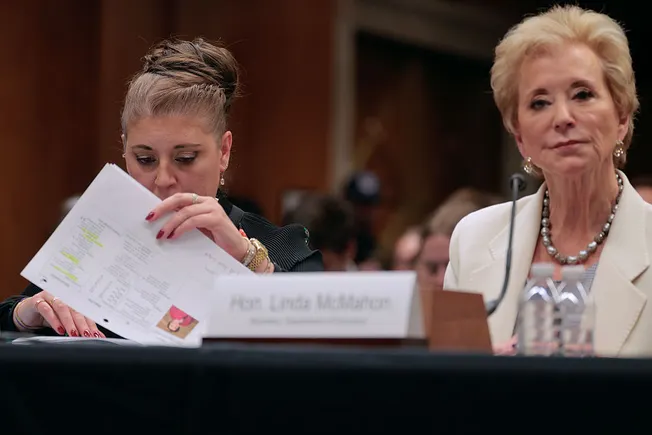
    Shaun Harper reported for insidehighered.com on 9 June 2025 on the way US Education Secretary Linda McMahon had been unprepared and unbriefed on so many questions in a US Senate subcommittee hearing in the previous week, probably because of the massive staff cuts she had made in her department.

    Trump promised ‘gold standard science’; Make America Healthy Again uses fake citations

    Shaun Harper (Southern California) blogged for insidehighered.com on 2 June 2025 in disgust and despair about the US Department of Health and Human Services Make America Healthy Again (MAHA) report. And then they did it again with a report on chronic diseases in child health, as Kathryn Palmer reported for insidehighered.com on 2 June 2025. This was the climate change-denying, anti-DEI Executive Order, 23 May 2025.

    Will Columbia get its $400million back?

    Columbia University folded under Trump’s objections to its alleged anti-semitism, and acceded to multiple demands in the face of cuts to $400million of public funding. Discussions started about how to restore the cuts, but in internal discussions interim President Katrina Armstrong seemed to deny that some of the demands would ever be implemented. Now Armstrong has stepped down, replaced by a new interim President, Claire Shipman, the co-chair of Columbia’s board of trustees. Johanna Alonso reported for insidehighered.com on 29 March 2025.

    Steven Mintz (Texas at Austin), a former Columbia academic, blogged for insidehighered.com on 31 March 2025 arguing that the roots of current campus disputes go right to the heart of the university’s mission and purpose:The Gaza-Israel conflict became a flashpoint not simply because of its geopolitics, but because it sits at the crossroads of the deepest fissures in campus life: between liberalism and radicalism, identity and ideology, tradition and transformation.” The story of Columbia University in New York and its alleged failure to resist then depredations of the Trump administration was told by Andrew Gumbel for The Observer on 28 April 2025 in his article “Destroying higher education with the veneer of going after antisemitism”. Max Matza reported for the BBC on 4 June 2025 that: “The Trump administration is looking to strip Columbia University of its accreditation over claims it violated the rights of its Jewish students.” A letter from Linda McMahon, US Education Secretary, told accreditor the Middle States Commission on Higher Education that “Columbia “no longer appears to meet the Commission’s accreditation standards” by its alleged violation of anti-discrimination laws.

    The appeasement strategy didn’t work, then.

    Trump goes after Harvard

    Brock Read reported for The Chronicle of Higher Education on 31 March 2025 that the Trump administration would review $255million of current federal contracts and $8.7billion of multi-year contracts as part of its moveto reprove colleges it portrays as hotbeds of antisemitism.” A Trump official said the 18 April letter making extensive demands of Harvard about hiring, admissions and curriculum had been sent by mistake, according to Michael S Schmidt and Michael C Bender in their report for the New York Times on 18 April 2025. Jessica Blake reported for insidehighered.com on 18 April 2025 that “… Trump has made it clear that he’ll use billions of dollars in federal grants and contracts, primarily for research, as a lever to force colleges and universities to bow to his agenda and increase the representation of conservative ideology on their campuses.”

    US Education Secretary Linda McMahon sent a badly-written Trump-style threatening letter to Harvard, purporting to freeze all future federal grants, as Gram Slattery and Jarrett Renshaw reported for Reuters on 6 May 2025. Nathan M Greenfield wrote for University World News on 9 May 2025: “In a robust statement in response, Harvard University accused the United States government of making “new threats to illegally withhold funding for lifesaving research and innovation in retaliation against Harvard for filing its lawsuit on April 21”.”

    The next round of bullying of Harvard in an effort to make it do what Donald Trump decrees came in the move by the Department of Homeland Security under the notorious Kristi Noem to revoke Harvard’s ability to enrol international students, as Karin Fischer reported for the Chronicle of Higher Education on 22 May 2025.

    Then Trump interfered in Fulbright scholar selection, by vetoing about 20% of Fulbright nominations for 2025-2026 on “clearly political” grounds, ruling out applicants with proposals on diversity or climate change, as Liam Knox reported for insidehighered.com on 29 May 2025. Liam Knox reported for insidehighered.com on 11 June 2025 that 11 of 12 members of the Fulbright Scholarship Board resigned on 11 June 2025 “… in protest of the Trump administration’s intervention in the selection process, which they say was politically motivated and illegal.”

    The Harvard experience: could it happen here? by GR Evans

    On 1 May 2025 The Guardian headline read: ‘Trump administration exploits landmark civil rights act to fight universities’ diversity initiatives‘. What prevents a British King or Prime Minister from attempting to impose sanctions on universities?

    US higher education is exposed both to presidential and to state interference. Government powers to intervene in US HE reside in presidential control of federal funding, which may come with conditions. Trump cannot simply shut down the Department of Education by executive order but it seems he can direct that the Department’s grant- and loan-giving functions are taken on by another government department. … read the full blog here.

    Politicians rule in Florida

    Two weeks after the Florida Board of Governors rejected Santa Ono they approved three new presidents, none having led a university before. On 18 June 2025 they confirmed Jeanette Nuñez as president of Florida International University, Marva Johnson at Florida A&M University, and Manny Diaz Jr at the University of West Florida. Nuñez had been interim President after leaving her job as state lieutenant governor; Diaz is currently Florida commissioner of education; Johnson is a lobbyist whom State Governor Ron DeSantis appointed to the Florida State Board of Education. Josh Moody reported for insidehighered.com on 23 June 2025.

    Indiana wants to take over HE

    JD Vance said in 2021 that “universities are the enemy” and Iris Sentner for Politico said that in March 2025 ” “… the White House declared war against them”. Ryan Quinn reported for insidehighered.com on 30 April 2025 that Indiana’s state budget bill would “… require faculty at public colleges and universities to post their syllabi online and undergo “productivity” reviews … prohibit faculty emeriti from voting in faculty governance organizations, place low-enrolled degree programs at risk of elimination by the Indiana Commission for Higher Education and end alumni elections for three Indiana University Board of Trustees seats by filling them with gubernatorial appointees. In addition, it has a provision that would let [State Governor] Braun remove the currently elected board members before their terms expire. “I think overreach doesn’t begin to describe the actions of the Legislature,” said Russ Skiba, a professor emeritus of education at IU Bloomington. “This is really a sweeping takeover of higher education in Indiana.”

    Why aren’t students protesting against Trump’s university attacks?

    Patrick Jack posed the question for Times Higher Education on 1 May 2025. Why indeed?

    Endowment tax will penalise rich US universities

    A bill which passed the House of Representatives in late May proposes to increase the tax on endowments from 1.4% to 21% for private colleges with an endowment of $2 million or more per student, as Patrick Jack reported for Times Higher Education on 2 June 2025. It would affect only the 35 or so richest institutions in the USA.

    Is college worth it?

    Yes, according to the Federal Reserve Bank of New York (the NY Fed), as reported by Phil Hill of OnEdTech on 3 June 2025.

    A graph showing the return to college remains significant

AI-generated content may be incorrect.

    But not for everyone: Jaison R Abel and Richard Deitz blogged for the NY Fed’s Liberty Street Economics on 16 April 2025: “In our last post, we showed that the economic benefits of a college degree still far outweigh the costs for the typical graduate, with a healthy and consistent return of 12 to 13 percent over the past few decades. But there are many circumstances under which college graduates do not earn such a high return. Some colleges are much more expensive than average, and financial aid is not guaranteed no matter which college a student attends. In addition, the potentially high cost of living on campus was not factored into our estimates. Some students also may take five or six years to finish their degrees, which can significantly increase costs. Further, our calculations were based on median wages over a working life, but half of college graduates earn less than the median. Indeed, even when paying average costs, we find that a college degree does not appear to have paid off for at least a quarter of college graduates in recent decades.”

    Santa Ono not for Florida

    After the embarrassment of Ben Sasse, the not-very-well-known Republican politician with little HE experience but with a large spending habit, the University of Florida seemed to be playing safe by naming Santa Ono as the only preferred candidate to replace Sasse. Ono was President at Michigan and previously headed the universities of British Columbia and Cincinnatti. He might have become the highest paid university leader in the US, as Chris Havergal reported for Times Higher Education on 6 May 2025. One of his current colleagues, Silke-Maria Weineck, thought after his controversial Michigan tenure he might be better suited to red-state (Republican) politics, in her opinion piece on 5 May 2025 for the Chronicle of Higher Education. Ono’s salary would have been $3million a year: he was unanimously approved by the University of Florida Board, but on 3 June 2025 in an anti-DEI move the State University System of Florida Board of Governors voted not to approve his appointment, as David Jesse reported for the Chronicle of Higher Education. There was more detail from Josh Moody of insidehighered.com on 3 June 2025: “That process included a no vote from Paul Renner, a former Republican lawmaker in the state who had previously angled for the UF presidency …”. Patrick Jack reported for Times Higher Education on 9 June 2025 that after the Santa Ono brouhaha many commentators had said the only people willing to lead Florida institutions would be right wing ideologues.

    Rob Cuthbert is editor of SRHE News and the SRHE Blog, Emeritus Professor of Higher Education Management, University of the West of England and Joint Managing Partner, Practical Academics. Email [email protected]. Twitter/X @RobCuthbert. Bluesky @robcuthbert22.bsky.social.

    Author: SRHE News Blog

    An international learned society, concerned with supporting research and researchers into Higher Education

    Source link