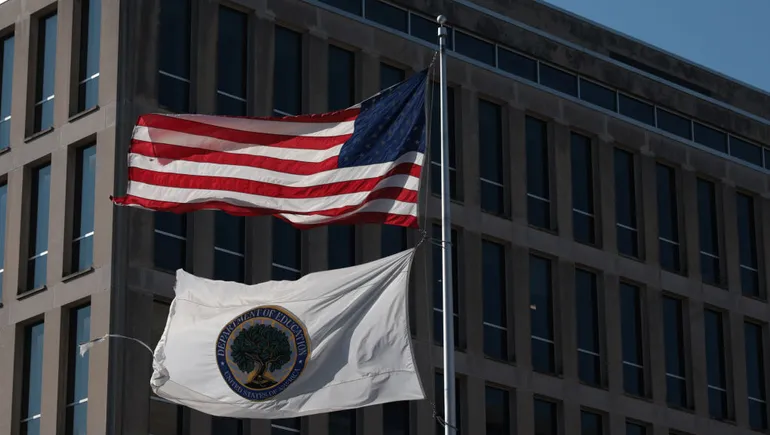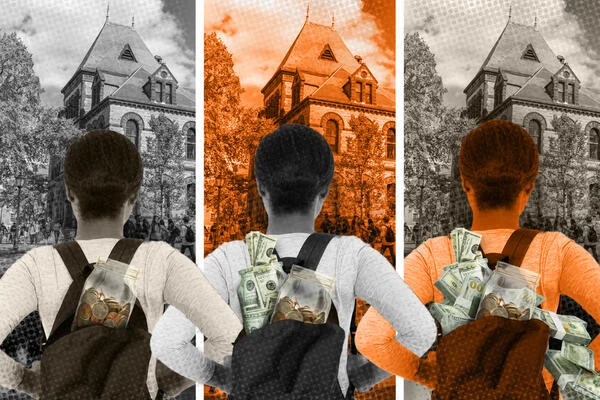
Starting next July, colleges and universities’ access to federal student loans will hinge on how much their graduates make after Congress’s new earnings test, known as the Do No Harm standard, takes effect.
This monumental shift in how the federal government holds degree programs accountable is one that’s years in the making. But when Congress passed the law, one key type of degree program was left out—undergraduate certificates.
Lawmakers from both parties have long said holding colleges accountable for cost is critical in order to drive down borrower-default rates and protect students from paying high tuition without a guaranteed return on investment. Yet, the very students and programs Republicans left out of the earnings test are expected to face the worst return on investment, studies show.
Under the so-called Do No Harm test, a program would lose access to federal loans if its average graduate doesn’t earn more than someone with a high school diploma for two out of three consecutive years. And while students enrolled in undergraduate certificate programs only make up about 10 percent of all those receiving federal aid, they account for about half of those who attend programs projected to fail the earnings test, according to research from American University’s Postsecondary Education & Economics Research Center.
For now, a different rule, known as gainful employment, holds certificate programs with a poor return on investment accountable using a similar earnings test and a metric related to a student’s debt. But unlike Do No Harm, the Biden-era gainful-employment rule only applies to certificate programs and for-profit colleges.
According to the Federal Register rule-making notice, the Department of Education and an advisory committee are set to both iron out the details of Do No Harm and rehash the gainful-employment rule during a months-long process known as negotiated rule making. But while the process begins Monday, the initial meeting agenda doesn’t include any discussion about either issue. Instead, the first week of rule making will focus specifically on regulations that expand the Pell Grant to short-term job training programs, and then the committee will break for the holidays.
In the meantime, education experts are left to wonder what the fate of accountability for certificate programs will be—and tensions remain. For-profit institutions remain critical of gainful employment, calling it an uneven playing field. Colleges and universities of all types worry that both metrics are holding them accountable for factors outside of their control. And student and taxpayer advocates stress that it’s important to ensure federal dollars are being put toward programs that pay off.
But when conversations about the accountability measures do kick off, policy experts from all sides agree that the regulations regarding gainful employment, which are not as restricted by the new law, will be the most contentious topic of debate.
“The thing that will take up a lot of oxygen in the room is gainful employment,” said Clare McCann, a former Education Department official who is now the PEER Center’s managing director of policy and operations. “Republicans have come a long way in believing accountability is important. So the desire to settle accountability issues as much as possible, for once and for all, runs pretty deep.”
A Perennial Political Football
Since the Obama administration first established a gainful-employment rule in 2010, Republicans and Democrats have fought over how to hold career education programs accountable.
The first Trump administration made rescinding the Obama-era rule a priority, and then the Biden administration put a stronger iteration in place. This back-and-forth raised speculation that the second Trump administration would once again roll back gainful employment.
However, officials have sent some mixed signals. The administration has pursued deregulation while also opting to defend the Biden rule in court. (A federal judge upheld it earlier this fall.) Further, the Trump administration’s push for greater federal involvement in higher education runs counter to many of its actions in the first term. The Education Department has yet to release its plans for the accountability provisions, fueling uncertainty about the fate of gainful employment.
Key Republican lawmakers, including Sen. Bill Cassidy, chair of the education committee, have said undergraduate certificates were only exempted from the new Do No Harm standard because of the gainful-employment rule. (The senator’s response implies that holding certificates accountable under both standards would be duplicative.)
As it currently stands, gainful employment requires certificate programs at any institution and degree programs at for-profit colleges to pass two tests. The first is similar to the Do No Harm earnings test. The second one, known as the debt-to-earnings ratio, gauges whether the average student earns enough to reasonably pay off their loans. Programs that fail either test are at risk of losing access to all federal student aid, including both loans and the need-based Pell Grant.
About 1.4 million students annually use federal aid to attend undergraduate certificate programs, and without gainful employment, advocates worry they are at risk of enrolling in programs that fail to provide a positive return on investment.
New data from the Century Foundation, a left-leaning think tank, showed that while two out of every three programs projected to fail the gainful-employment tests would also fail Do No Harm, about 400 programs could squeeze by, passing the new earnings test while failing the gainful-employment debt-to-earnings ratio. Those programs represent about $528 million in annual Pell Grant disbursements.
“Someone who wanted to take a lot of Pell money by setting up a bad program … could set up a program, which may not require students to take out loans but still is not worth their time or that Pell Grant money,” said Peter Granville, a Century Foundation fellow and author of the report. “That’s a crack which we’re concerned bad actors could go in and use to game the system.”
Advocates like Granville urge the department to not touch gainful employment. Meanwhile, most institutional representatives Inside Higher Ed spoke with said they’d like to see more clarity in the policy proposals about how the Do No Harm test will work and are advocating for at least some changes to make gainful employment more fair. During public comment, the trade association Career Education Colleges and Universities, which represents for-profits, called on ED to “take the opportunity to fully rescind” the gainful-employment rule.
But one institutional representative who will serve as a member of the negotiating committee said that while institutions may want to see changes made to the gainful-employment rule, it seems highly unlikely that it will be fully rescinded the way it was during Trump’s first term.
“Whether it’s the department or negotiators, I think anyone coming in and trying to say, ‘There should just be nothing that applies to nondegree programs,’ seems pretty inconsistent with the language coming out of Congress,” the representative said, speaking on the condition of anonymity to protect his good faith in negotiations. “It also just seems like it would be a really challenging position to defend.”
Some Potential Changes
So if the department doesn’t try to roll gainful employment back entirely, could they change the regulations in other ways? Experts, advocates and institutions have several ideas if they do.
Advocates for for-profit institutions have argued for years that all programs should be subject to the gainful-employment rule. But one policy expert, who asked to speak anonymously since the department has yet to release its proposals, said that stripping gainful employment down to the bare bones to directly mirror the Do No Harm test seems unlikely.
“Congress left out undergraduate certs, and that’s the only fair reading of the law. So … presumably you can’t do the exact same thing as the Do No Harm measure for undergraduate certs,” the source said.
Instead, the expert hopes that the department will do what it can to better level the playing field while maintaining accountability for certificate programs. One way of doing that, the source suggested, is to lower the ages of adults with high school diplomas that are used in comparison and extend the time before earnings are measured.
Currently under gainful employment, the earnings premium test compares the income of certificate and degree holders three years after graduation to adults ages 25 to 34. That means a 21-year-old with a certificate in phlebotomy could be compared to a 34-year-old flight attendant.
The Do No Harm test is expected to use data for the same age group and compare it to students four years after they graduate, but since the gainful-employment rule has other stipulations like the debt-to-earnings ratio and the higher penalty of losing Pell Grants, the expert said they would “like to see a better, more reasonable comparison group.”
Other potential changes on the table could include eliminating the debt-to-earnings test but keeping the Pell-eligibility penalty for both certificate and for-profit programs or opting to maintain gainful employment for certificate programs while for-profit programs would only be subjected to the Do No Harm test. But, for each policy expert that proposed one of these ideas, another suggested that it could lead to legal challenges.
In general, policy experts said, until the issue papers are published, it will be difficult to predict what the Trump administration plans to do.
Preston Cooper, a senior fellow at the American Enterprise Institute, a right-leaning think tank, will be serving on the negotiating committee. He said he understands the argument that it’s not fair to hold for-profit institutions to a higher standard, but he wants to ensure “the strongest accountability that we can possibly get.”
“As the taxpayer representative, I certainly find it compelling … because if we have weaker accountability, then we’re losing more money on Pell Grants and student loans,” he said. “But ultimately, it will come down to what they decide to propose in the issue papers.”