Tag: Gaza

  • Gaza, higher education, and the ethics of institutional neutrality

    Gaza, higher education, and the ethics of institutional neutrality

    When I published my academic article Witnessing Silence: The Palestinian Genocide, Institutional Complicity, and the Politics of Knowledge in June this year, I shared it on LinkedIn expecting it might quietly circulate among those already engaging with Palestine and decolonial education.

    Instead, what followed was an unexpectedly wide response – emails, messages, and private conversations from academics and professional services staff across the sector, expressing that the piece gave language to something they had been living with but unable to name.

    Where the original piece offered a theoretically grounded, autoethnographic account of institutional complicity and epistemic violence in UK higher education, this is a direct reflection on what that silence means in practice: for those of us who work within universities, support students, write policy, and try to teach with integrity in times of crisis.

    This is not a neutral topic. Nor, I believe, should it be. But it is one that demands clarity, care, and honesty about what our sector chooses to say – or not say – when faced with the mass killing of civilians, including thousands of children. It also demands that we reckon with how our silences function, who they serve, and who they leave behind.

    What is the silence we’re talking about?

    Since October 2023, higher education institutions in the UK have issued few, if any, direct statements on the situation in Gaza. Where communications have been made, they have been strikingly general: references to “ongoing events in the Middle East,” or “the situation in Israel and Gaza.” In many cases, even the word “Palestine” is omitted altogether.

    This is not simply a matter of tone. Language signals recognition, and its absence is felt. In the same period, UK universities have published clear and immediate statements on the war in Ukraine, the Christchurch mosque attacks, and the murder of George Floyd. These responses were swift and specific, naming both the nature of the violence and the communities affected.

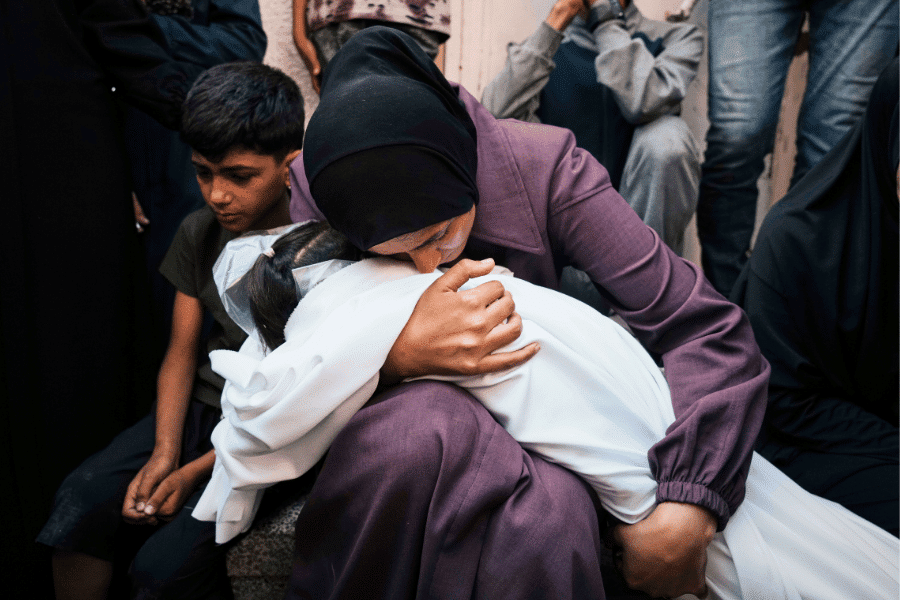
    By contrast, when it comes to Gaza, where, as of April 2025, the Palestinian Central Bureau of Statistics reported that 17,954 children killed, 39,384 children orphaned, and 7,065 children injured, many with life-changing disabilities most institutions have chosen vagueness or silence.

    The use of the term “genocide” is not a personal flourish. It has been raised by international human rights organisations such as Amnesty International, by UN experts, and by legal scholars. It is also under formal consideration at the International Court of Justice, which in January 2024 issued provisional measures recognising a plausible risk of genocide in Gaza. To avoid naming this, or to replace it with neutral euphemisms, is not caution. It is abandonment.

    I do not assume that this silence stems from indifference. In many cases, it reflects complex pressures: reputational risk, external scrutiny, internal disagreement, legal advice. But intention does not cancel out impact. And the cumulative impact of this silence is a deepening sense that Palestinian suffering is institutionally unrecognisable: too controversial to name, too politically fraught to mourn, too inconvenient to address.

    How silence affects minoritised staff and students

    The consequences of silence are not theoretical; they are lived. For many Muslim, Arab, and pro-Palestinian staff and students, the ongoing refusal to acknowledge what is happening in Gaza has created a climate of anxiety, exhaustion, and quiet despair. What I describe in my research as “moral injury” – the psychological toll of witnessing profound injustice while being expected to remain silent – has become, for many, a defining feature of daily academic life.

    I’ve heard this from colleagues across roles and disciplines: early career researchers who self-censor in lectures and grant proposals, students too afraid to name Palestine in their dissertations, and professional services staff torn between personal conviction and institutional messaging. Some have received formal warnings; others speak only in private, fearful of reputational damage or being labelled as disruptive. The burden of caution is not equally distributed.

    These are not isolated feelings. For many colleagues and friends, this silence also carries an unbearable weight: the knowledge that our lives are treated as less valuable and more easily dispensable. Conflicts in Iraq, Afghanistan, Yemen, Gaza, and Syria have taken millions of lives, yet they rarely provoke the same sustained outrage or mobilisation that far smaller losses elsewhere receive – a phenomenon documented by Kearns et al. (2019). To live with that awareness is haunting. And when universities, too, remain vague or silent, the omission feels less like caution and more like confirmation, that even here, in institutions that speak of justice and care, some lives – our lives – and losses are considered harder to name.

    I want to be clear: I am not accusing individuals of deliberate harm. But when institutions fail to name atrocities, when they issue statements that sidestep historical context, and when they offer wellbeing support without acknowledging what that support is for, they deepen a sense of abandonment that many minoritised staff already carry. It becomes harder to feel safe, heard, or morally aligned with the institutions we work in.

    Silence becomes censorship

    Silence in our universities is not just absence. It often comes with a cost for anyone who dares to speak. What looks like neutral restraint can be revealed, in practice, as institutional censorship.

    Since October 2023, disciplinary investigations have spread across UK campuses. A joint investigation found that at least 28 universities launched formal proceedings against students and staff over pro-Palestinian activism, involving more than a hundred people. Other reporting suggests that as many as 250 to 300 employees across the sector have been investigated or threatened with dismissal simply for expressing pro-Palestinian views.

    A HEPI report documents how encampments across UK universities, including many Russell Group members, were met with heavy institutional responses. Emails obtained by journalists also show that university security teams adopted “US-style” surveillance tactics during protests, often under pressure from their own professional networks.

    These are not isolated anecdotes. The pattern is clear. Silence is not neutral. It is often enforced. When colleagues or students raise their voices, they risk being investigated, disciplined, or even expelled. That cost is real and immediate, and it must be named.

    Ethical contradictions

    What makes the silence so disorienting is not just the absence of language, it’s the dissonance between that silence and the values our sector claims to uphold. We talk about decolonisation, inclusive pedagogy, and trauma-informed practice. We encourage students to “critically engage with systems of power,” and we celebrate academic freedom as foundational to our purpose. Yet when faced with a case of genocide – documented by international bodies, witnessed daily in the media, and devastating in its scale – many universities fall silent.

    This is not simply a question of public statements. It is a deeper ethical contradiction that permeates the day-to-day environment of higher education institutions. When staff are encouraged to design anti-racist curricula but discouraged from naming colonial violence in Palestine, the message is clear: some histories are welcome, others are not. When mental health services are promoted but cannot address the context of collective grief, the care offered feels hollow.

    None of this is new. As my article argues, the logic of institutional silence is historically patterned. Higher education has long been selective in its expressions of solidarity – often willing to speak when the political stakes are low, but cautious when they risk reputational or legal exposure. What we are seeing now is the cumulative effect of that selectivity: a moral framework that is uneven, inconsistent, and, for many, increasingly untenable.

    What can institutions do?

    If silence has consequences, then breaking it must be an intentional act. This doesn’t mean rushing to issue statements for every global tragedy. But it does require universities to reflect on the ethical frameworks guiding their public responses, especially when those responses (or omissions) disproportionately impact already marginalised groups.

    First, naming matters. Even if a university does not take a political position, it can acknowledge the reality of civilian death and collective grief. It can refer explicitly to Palestinians as a people, not just as part of a geography. It can recognise that some communities in our institutions are disproportionately affected by what is unfolding, and that they are looking to us not just for pastoral care, but for moral clarity.

    Second, policy protections must catch up with practice. Staff who speak out within the bounds of academic freedom should not face disproportionate scrutiny or reputational risk. Nor should students be penalised for engaging critically with the politics of occupation, war, or settler colonialism. Institutional support must be consistent, not selectively applied based on the political palatability of the cause.

    Finally, universities must reckon with the unequal distribution of emotional labour. Many of us who are called upon to “lead conversations” on inclusion or belonging are also the ones absorbing the silence around Palestine. That dissonance is unsustainable – and addressing it requires more than a line in a strategy document. It requires courage, consistency, and care.

    There is no perfect statement, no risk-free position. But neither is neutrality ever neutral. If we expect students and staff to bring their whole selves into our classrooms, then we must be prepared to name the losses and injustices that shape those selves—and to respond with more than silence.

    Silence is not safety

    The idea that universities must remain neutral in the face of political crisis may feel institutionally safe, but it is ethically brittle. Neutrality, when applied unevenly, is not neutrality at all. It becomes complicity, dressed up as caution.

    What makes this moment so painful for many in the sector is not just the lack of solidarity, but the sense that even the language of care has become selective. If we are truly committed to fostering inclusive, trauma-informed institutions, then we cannot exclude entire communities from the scope of our empathy. We cannot preach justice in our classrooms while avoiding it in our corridors.

    In the weeks following the article’s publication, I received messages from colleagues across the country – many from minoritised backgrounds – who described feeling both moved and afraid: seen, perhaps for the first time, but still unsure whether it was safe to speak.

    There is still time for institutions to act, not by offering perfect words, but by showing they are listening. By naming what is happening. By protecting those who speak. And by recognising that silence is not safety. For many of us, it is precisely the thing we are trying to survive.

    Source link

  • GAZA, GENOCIDE, AND THE GLOBAL MEDICAL RESPONSE (Saint Cecilia Parish, Boston)

    GAZA, GENOCIDE, AND THE GLOBAL MEDICAL RESPONSE (Saint Cecilia Parish, Boston)

    WEDNESDAY, JULY 30 | 6:30PM | PARISH HALL (Boston)

    Join us for a special presentation by Dr. Kuemmerle, a neurologist at Children’s Hospital and the co-founder of Doctors Against Genocide. Founded in 2023, Doctors Against Genocide is a coalition of healthcare professionals who seek to unite their voices in uproar against the genocide in Gaza. This presentation will be livestreamed on our Youtube channel

    Doctors Against Genocide is currently raising $737,000 to fund the construction of a 140-bed field hospital with 4 operating rooms on the grounds of Al-Shifa hosptial. Gaza’s largest hospital has been bombed, burned, and pushed past its limits. After the forced shutdown of the Indonesian, Al-Awda, and Kamal Adwan hospitals, Al-Shifa is the last major hospital left standing in North Gaza. 

    Right now, occupancy is at 200–300%. Patients are being treated on floors, in hallways, and tents. There are no more beds. No more space. But there is a way forward with your help. If you would like donate, please visit: https://doctorsagainstgenocide.org/donate.

    Source link

  • Gaza Encampments “Made University Leaders Lose Their Minds”

    Gaza Encampments “Made University Leaders Lose Their Minds”

    The war in Gaza and the adverse reaction of U.S. colleges to the pro-Palestinian movement have completely changed students’ relationship to higher education, according to the maker of a new film about last year’s protests.

    A new documentary, The Encampments, follows the movement from Columbia University, where the first tents were erected in April 2024, as protests spread to hundreds of campuses worldwide, including the University of Tokyo and Copenhagen University.

    Not just isolated to Ivy League institutions in the U.S., the movement spread to many traditionally Republican-dominated states as well, Michael Workman, co-director of the film, told Times Higher Education.

    “These are not just places where the coastal elite are,” he said. “This movement touched and reached into the middle of America. In places like [Idaho], there were protests every day in solidarity and support.”

    He hopes that the film, which he sees as a “counternarrative” to the media’s negative portrayal of the encampments, will “haunt” higher education leaders for being on the wrong side of history.

    Although the conflict in Gaza continues, the student movement has had a much smaller impact this year, with many students facing severe repercussions from both their universities and the White House.

    “For some reason camping out on the lawn demanding an end to a genocide made all these administrators around the world, and especially in the U.S., lose their minds,” said Workman.

    He said the encampments arrived at a time of “heightened” organization and engagement among the student body. These movements are not sustainable but always “ebb and flow,” he added.

    Along with demanding that universities lend their voices to Gaza, students have called on institutions to divest from companies that they believe are funding a genocide.

    Workman said the “twin demands” of many of the students were to support Palestinians and to take universities, which they were paying lots of money, back to being educational institutions.

    “Students have seen their educations get turned into moneymaking machines, [instead of institutions] that are primarily there to teach students,” he said.

    “This has completely changed this generation’s relationship to higher education, and I think their relationship to the U.S. and U.S. foreign policy.”

    He said the war in Gaza has “woken up this generation,” which is why colleges reacted with such force.

    “It’s why they responded in the way that they did, because they felt they couldn’t do anything else. The cat was out of the bag,” he said.

    “These students are not going to go back to thinking what Israel is doing in Gaza was justified … and they’re going to continue to grow their movement to raise awareness around what’s happening and to fight against it.”

    Workman, who also teaches documentary film production at the University of San Francisco, said the response by faculty in the U.S. is “not a monolith” but that it is becoming increasingly supportive of the students.

    This has been particularly evident since the detention of activist and green card–holder Mahmoud Khalil, who features in the documentary, he said. Khalil, an international student who moved to the U.S. in 2022, was arrested in March following a crackdown on student protesters by President Donald Trump’s administration.

    “The more they repress the movement, in a lot of ways, the stronger it gets, because people aren’t backing down,” Workman said.

    “That doesn’t mean that we have this huge moment like the encampment moment, but we’re building a sustained foundation that is continuing to grow with really committed organizers.”

    Source link

  • The war in Gaza is a test for humanity

    The war in Gaza is a test for humanity

    “There will be no electricity, no food, no water, no fuel,” Gallant said. “Everything is closed. We are fighting human animals and we are acting accordingly.”

    President Isaac Herzog said militants and civilians in Gaza would be treated alike. “It’s an entire nation out there that is responsible,” Herzog said. “This rhetoric about civilians not aware, not involved — it’s absolutely not true … and we will fight until we break their backbone.”

    Netanyahu has been equally explicit, comparing Hamas to “Amalek”, a tribe in the Bible which the Israelites were told to eradicate. He blames Hamas for all civilian casualties.

    Other ministers have urged Gaza’s total destruction — one proposed dropping a nuclear bomb — and expulsion of its people, as in the 1948 “Nakba” when several hundred thousand Palestinians were ethnically cleansed as part of Israel’s independence war.

    International justice

    Whether Israel’s Gaza onslaught amounts to genocide, war crimes or crimes against humanity, or very possibly all three, is for international courts to decide.

    What matters now is stopping the killing in a ruined land that has lost its schools, homes, hospitals, roads, power and water plants, farms, places of worship and historical heritage. That is a moral issue for all of us, and most pertinently for Israel and its Western allies, principally the United States, which supplies most of the weapons used against Gaza.

    U.S. complicity is beyond doubt. Many European and other countries, by their silence in face of the carnage, or their failure to take action, are also to blame.

    Leaders in some of these nations are only now chiding Israel more strongly. Spain’s prime minister has called it a genocidal state. There is talk in European and other capitals of sanctions targeting Israeli leaders, a ban on arms shipments or trade penalties.

    But no measures likely to push Netanyahu to alter course have been adopted. His eyes are fixed on the United States, the only nation that could swiftly halt the Gaza debacle — by halting or suspending the $3.8 billion it gives Israel each year in mostly military aid, along with extra arms shipments worth billions of dollars since the current war began.

    Quantifying the horror

    Cold statistics mask the individual suffering of Gazans, but tell part of the story.

    More than 54,000 people, including more than 16,000 children, have been killed since the war began, according to Gaza Health Ministry figures considered reliable by the United Nations, or 2.5% of the population — equivalent to 8.5 million Americans.

    This number does not count many thousands whose bodies may still lie under the rubble, or who died weakened by hunger, preventable diseases and failing health care. It includes more than 1,400 health workers and more than 200 journalists and media workers.

    United Nations officials say more than 90% of homes have been destroyed or damaged, along with 94% of Gaza’s 36 hospitals, with only some still struggling to function. Gaza has the world’s highest number of child amputees per capita.

    According to Hans Laerke, spokesman for the U.N. Office for the Coordination of Humanitarian Affairs, Gaza is also the only territory in the world where “100% of the population is threatened with famine” despite Israel’s denial of any humanitarian blockade.

    Abetting a genocide

    The horrors endured by Palestinians have been documented by local journalists (Israel has banned all international reporters from Gaza), U.N. officials, Palestinian and foreign doctors and aid workers, as well as locally shot videos and photos.

    Foreign physicians with long experience of many countries ravaged by war say conditions they witnessed in Gaza are worse than anything they have ever encountered.

    “I have worked in conflict zones from Afghanistan to Ukraine,” said U.S. paediatrician Seema Jilani, after an assignment in the southern city of Rafah for the International Rescue Committee. “But nothing could have prepared me for a Gaza emergency room.”

    No one can plausibly claim “we did not know” what was, and is, going on.

    Yet world powers have largely stood by as massacres unfold in Gaza. They have kept equally silent as Israel batters parts of Lebanon at will despite a ceasefire with Hezbollah militants agreed in November. Israel has also grabbed more land in Syria and bombed hundreds of targets there since Bashar al-Assad’s regime fell in December.

    A diplomatic debacle

    U.S. President Donald Trump, like President Joe Biden before him, has backed Israel to the hilt. Not even images of emaciated children in Gaza have prompted a change of heart.

    Trump’s own contempt for international law and his plan for the removal of Gazans to allow for a fantasy reconstruction on the toxic ruins of their land has only emboldened far-right Israeli leaders with ambitions to “purify”, annex and resettle Gaza, and to do likewise in the West Bank, where half a million Israeli settlers already live.

    Israel’s actions, under permissive Western eyes, are shredding a longstanding international consensus on a two-state solution to the Israeli-Palestinian conflict – an idea incompatible with an ever-expanding Israeli grip on the West Bank and Gaza.

    After French President Emmanuel Macron called for recognition of a Palestinian state, Defence Minister Israel Katz responded with brutal clarity.

    “They will recognise a Palestinian state on paper — and we will build the Jewish-Israeli state on the ground,” he said in the West Bank on May 29 at one of 22 new settlements just approved by the Israeli government.

    Can peace be given a chance?

    Western outrage at Russia’s invasion of Ukraine has no echo when it comes to Israel which for decades has defied U.N. resolutions and violated international law.

    The fate of Gaza may prove a final blow to the rules of international conduct and treatment of civilians agreed after the Second World War — a system already frayed by the Cold War and more recently the illegal U.S.-British invasion of Iraq in 2003.

    Crushing the Palestinian people will not make Israel any safer in the long run. Only a true peace settlement on a basis of mutual respect and equality can do that.

    If Western nations ever get around to imposing sanctions on Israel and its leaders, they should do so to promote the Jewish state’s real interests which they claim to have at heart — as a stepping stone to such a peace between human beings.

    The German-born Jewish-American philosopher and political scientist Hannah Arendt foretold the consequences for a society unable to perceive others as human.

    “The death of human empathy is one of the earliest and most telling signs of a culture about to fall into barbarism,” she wrote.


    Questions to consider:

    1. Is it justified, or wise, for a state to take revenge on its enemies?

    2. Do people everywhere have the right to resist occupation?

    3. How should we react when a possible genocide is taking place?


    Source link

  • Trump’s idea of peace in Gaza? Hotels and yacht clubs.

    Trump’s idea of peace in Gaza? Hotels and yacht clubs.

    U.S. President Donald Trump views Israel’s war on Gaza through the eyes of the real estate developer he was before he entered politics. 

    “We have an opportunity to do something that could be phenomenal,” he said at a joint news conference with Israeli Prime Minister Benjamin Netanyahu on 4 February. “And I don’t want to be cute. I don’t want to be a wise guy. But the Riviera of the Middle East.”

    He was talking about the possibility of forcing 2.2 million Palestinians from Gaza to make place for “the Riviera of the Middle East.”

    Elaborating the idea in social media posts and interviews, the U.S. president left no doubt that he saw one of the world’s most complex problems — the Israeli-Palestinian conflict — as a real estate deal.

    Trump explained that the United States could take over Gaza, a place where tens of thousands of people have been killed by Israeli air strikes and ground troops over the past 16 months. 

    Taking ownership of the conflict

    Israel has pummelled Gaza ever since 7 October 2024 when gunmen from the militant Hamas group stormed across the border, killed 1,200 Israelis and took more than 250 people hostage. 

     “I do see a long-term ownership position and I see it bringing great stability to that part of the Middle East and maybe the entire Middle East,” Trump said. “We’re going to take over that piece and we’re going to develop it, create thousands and thousands of jobs. And it will be something that the entire Middle East can be very proud of.”

    To make that possible, the people now living in the future Riviera must leave, possibly to neighbouring Jordan or Egypt, he said. 

    Leaders of both countries have rejected that idea, as has the Arab League, the Secretary General of the United Nations, Antonio Guterres and a host of human rights groups.

    Conspicuously absent from statements by Trump and officials of his administration was the matter of international law.

    The thorny issue of international law

    The forced deportation of civilians is prohibited by an array of provisions of the Geneva Conventions which the United States has ratified. 

    Forced deportation has been considered a war crime ever since the Nuremberg Trial of Nazi officials.

    The International Criminal Court lists the kind of forcible population transfer visualized by Trump’s Riviera of the Middle East plan as both a war crime and a crime against humanity. (The United States is not a member of the court because it never ratified the Rome Statute on the court’s establishment).

    The legal and geo-political arguments triggered by Trump’s controversial proposal often leave out the collective trauma that shapes the Palestinians’ national identity and political aspirations.

    That trauma dates back to the violence preceding the establishment of the state of Israel in 1948, more than 50 years after an Austrian Jew, Theodor Herzl, published a book (Der Judenstaat) that inspired the Zionist movement.

    A history of forced expulsion

    An estimated 700,000 Palestinians fled or were expelled from what is now Israel during the war between Zionist paramilitary fighters of the Haganah, the forerunners of today’s Israeli Defence Force, and regular soldiers of six Arab countries. 

    Palestinians call that forced exodus the Naqba (the catastrophe). At the time, many expected to return to their homes once the fighting was over.

    A resolution by the U.N. General Assembly seven months after the formal establishment of Israel provided for a right of return for those who fled. A General Assembly resolution in 1974 declared the right to return an “inalienable right.” 

    Like all General Assembly resolutions, the 1948 vote was not binding, but it was explicit: “Refugees wishing to return to their homes and live at peace with their neighbours should be permitted to do so at the earliest possible date and that compensation should be paid for the property of those choosing not to return…”

    Neither happened but the concept that those who left had a right to return has lived on for four generations, with hopes fading gradually but not entirely. There are still families who keep as heirlooms keys to the houses they fled in the turmoil of the Naqba.

    How history plays out today

    This history helps explain why today’s Palestinians in Gaza take seriously Trump’s proposal to resettle them all and their fear that any resettlement would result in permanent exile. 

    Trump’s “Riviera” proposal came as a surprise, apparently even to Netanyahu who stood next to him at the press conference. But it appears to have been a subject of discussion inside the Trump family for some time.

    At an event at Harvard university in February 2024, Trump’s son-in-law, Jared Kushner, mused about the untapped value of the Gaza strip and its beautiful beaches. “Gaza’s waterfront property, it could be very valuable, if people would focus on building up livelihoods,” Kushner said. 

    He did not specify which people would do the building but his father-in-law appears to be determined that it would not be the people now living there. 

    Who, then? It’s one of many questions yet to be answered in the era of Trump 2.0.


    Questions to consider:

    • What is one problem Trump will have if he wants the United States to take over Gaza?

    • Why do many Palestinians take Trump’s threat of relocation seriously?

    • What makes the idea that people have the right to return to homes their ancestors were force out of complicated?


    Source link

  • UK universities and the war in Gaza

    UK universities and the war in Gaza

    2024 was a difficult year for UK higher education, particularly in the international arena.

    Universities from all parts of the sector struggled to meet their overseas student recruitment targets in an increasingly competitive global market. Some international research collaborations – once encouraged by governments and funding councils – came under tighter scrutiny.

    And many campuses were rocked by protests over the conflict in the Middle East. I have touched on the last of these issues in a previous Wonkhe article – but it is worth revisiting in the light of ongoing tensions.

    Campus protests

    There are wars underway in diverse parts of the world – last year saw serious loss of life in Ukraine, Sudan, Myanmar and Yemen, to name only a few. However, nowhere attracts the attention of staff and students like the invasion of the Gaza Strip which followed the 7 October attack on Israel and the abduction of hundreds of civilian hostages.

    Some argue that this is unfair or, at least, disproportionate – why has Israel faced so much criticism when other regimes have committed atrocities against civilian populations with no demonstrations on British campuses? While that is undeniable, it is also true that the Palestinian people in Gaza are enduring a horrendous situation; despite the recent ceasefire, tens of thousands of innocent lives have been lost and hundreds of thousands are still denied access to basic essentials. The anguish and concern expressed by staff and students in response to their plight are surely justified.

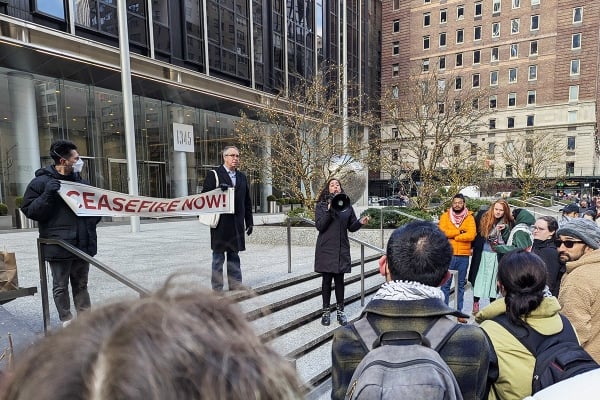
    During 2024, that concern manifested itself in encampments across 30 or so universities. There were numerous marches, often organised in combination with civic gatherings. The public events tended to focus on demands that the government condemn the Israeli military action and use its influence to stop the war.

    On campus, the centre of attention was slightly different, with pressure on university administrations not only to provide financial support for Palestinian scholars but also to disinvest in companies which supplied arms to Israel. This drew on a longer running campaign which argued that any investment in the arms trade is fundamentally immoral. The incoming Labour government’s withdrawal of some export licences has not changed the situation – the issue has become a rallying point for those who feel powerless to alleviate the suffering of innocent people in the war zone.

    Formulating a response

    The protests have put university managers under considerable pressure. Initially, administrators were reluctant to say anything, being anxious to avoid alienating different groups or to make individuals who had an affiliation with Israel feel under attack. UK senior managers were also aware of the deep divisions on some American campuses – several heads of institutions resigned after making infelicitous statements while navigating between radical student opinion and aggrieved benefactors.

    Even so, quite quickly senior managers in British universities began to share ideas and formulate a common position. This generally involved voicing support for academic freedom and freedom of expression while calling on protestors to respect the position of others. There were nuances – some institutions banned flags or outlawed certain contentious slogans; several announced that they would not talk to activists until camps were disbanded. In the face of prolonged disruption, a few resorted to legal interventions to remove tented villages.

    For the most part, though, UK universities engaged with all shades of opinion, facilitated peaceful protest and sought to foster rather than stifle debate. The monthly colloquies at meetings organised by Universities UK were supplemented by occasional reflective discussions at events elsewhere.

    Like others, the University of Glasgow’s senior management and university court (the governing body) considered the ethical position as well as the politics of the situation. We communicated regularly with the wider community, reached out to activists and met with faith groups, student representatives, civic leaders and national bodies.

    A key concern was to ensure that students (especially, in this instance, Jewish and Muslim students and staff) always felt welcome and safe on campus. We were one of the first institutions to call for the release of the hostages and a humanitarian ceasefire. The university issued regular reminders about good conduct but did not rush to take disciplinary action against individuals. When students occupied a building, senior managers met with the leaders; we permitted a peaceful demonstration outside the door of the governing body meeting. In response to Students’ Representative Council (SRC) and trade union demands, we undertook a widespread consultation on disinvestment in the arms trade.

    Despite vociferous calls from students and trade unions, Glasgow’s Court voted two-to-one against disinvestment; following a thoughtful discussion, a majority agreed with senior managers that it was morally right for the UK to have a defence sector and that this should be distinguished both from the conflict in the Middle East and from the question of which countries the UK sold arms to. In essence, the Court’s position was unchanged from 2020, when officers were instructed to write to government ministers calling for tighter restrictions on sales to countries which breached international law, or which had poor human rights records.

    Towards reconstruction

    The decision on disinvestment does not constitute the sum of our response to the situation in the Middle East. Alongside this, we have sought to build on Glasgow’s status as a University of Sanctuary through practical action in support of those suffering in Gaza and other conflict zones.

    A key aspect of this was the conference we organised in December, in conjunction with Professor Sultan Barakat of Hamad Bin Khalifa University, on the post-war reconstruction of higher education in Gaza.  With most university campuses in the area reduced to rubble, reconstruction might seem like a momentous task, but the event attracted nearly 200 registrations. It drew strong support from UK universities and significant engagement from colleagues based in the Middle East.

    The conference delegates heard directly from victims of the conflict. They learned of its disastrous impact and considered academic analyses of aid interventions (often meagre and inadequate) as well as efforts to support students and academics to continue their studies. The attendees engaged in the difficult task of identifying how UK higher education can best support universities in the region to rebuild.

    Key messages included the undying hunger of Palestinians in Gaza for higher education, their determination to create a better future and the belief that, with international support, all obstacles to reconstruction can be overcome. Scotland’s former First Minister Humza Yousaf (who gave a moving address in the main Glasgow synagogue following the 7 October attack on Israel) told the conference: “this is not about taking sides – it’s about being pro-humanity.”

    The conversation will not cease – we intend to reconvene in Qatar and online in the spring, and to strengthen links with colleagues in key agencies, such as the Council for At-Risk Academics (CARA), who attended the conference. We will continue to draw support from a coalition of interests, including the UCU, whose local representatives actively supported the event.

    In the coming semester, we anticipate further protest and vigorous debate at Glasgow over the correct response to the war in Gaza and its aftermath.  The situation there remains desperate and the prospects for a lasting peace – for Palestinians, Israelis and Lebanese alike – are still very uncertain. But the events of the past few days should give us hope, and we in the higher education sector should do everything we can to advance the cause of peace and reconstruction. By identifying solutions to age-old problems, sharing our resources and giving practical assistance to colleagues in need, we can help make hope a reality.

    The author is writing in a personal capacity.

    Source link

  • Historians’ council vetoes Gaza scholasticide condemnation

    Historians’ council vetoes Gaza scholasticide condemnation

    The American Historical Association’s top elected body has shot down a resolution opposing scholasticide in Gaza, after members who attended its annual convention approved the statement early this month by a 428-to-88 margin.

    The association’s elected council, which has 16 voting members, could have accepted the resolution or sent it to the organization’s roughly 10,450 members for a vote. Instead, the council rejected it as the official position of the association.

    Jim Grossman, the association’s executive director and a nonvoting member of the council, said the Thursday afternoon vote was 11 to 4, with one abstention. He said the meeting was over Zoom.

    The rejected resolution had condemned the U.S. government’s funding of Israel, saying it “has supplied Israel with the weapons being used to commit this scholasticide” and that Israel “has effectively obliterated Gaza’s education system.” Scholasticide is defined as the intentional eradication of an education system.

    The resolution also called for a permanent ceasefire and for the association to form a committee to help rebuild Gaza’s “educational infrastructure.”

    In a written explanation of the veto, the council said it “deplores any intentional destruction of Palestinian educational institutions, libraries, universities and archives in Gaza.”

    However, it considers the resolution to be a contravention of AHA’s “constitution and bylaws because it lies outside the scope of the association’s mission and purpose.” The constitution, the council noted, defines that mission and purpose as “the promotion of historical studies through the encouragement of research, teaching and publication; the collection and preservation of historical documents and artifacts; the dissemination of historical records and information; the broadening of historical knowledge among the general public; and the pursuit of kindred activities in the interest of history.”

    Grossman said the vote to approve that explanation was 10 to zero with three abstentions, after some members left the meeting following the veto vote. He said he couldn’t reveal who voted which way in either tally because the discussion was confidential.

    “We consider it imperative that council members be able to speak freely and candidly during the meeting, and that’s why they’re not recorded and that’s why we do not quote any individual council members,” Grossman said. “And they did speak freely and candidly.”

    Van Gosse, a co-chair and founder of Historians for Peace and Democracy, which wrote the resolution, said “we are extremely shocked by this decision, and disappointed.” He said, “It overturns the democratic decision at that huge [conference] business meeting and the landslide vote.”

    Anne Hyde, a council member and a University of Oklahoma history professor, said she voted to veto “to protect the AHA’s reputation as an unbiased historical actor,” noting that the organization does congressional briefings. She also said the current war in Gaza “is not settled history, so we’re not clear what happened or who to blame or when it began even, so it isn’t something that a professional organization should be commenting on yet.”

    Asked why she didn’t support sending the resolution to the full membership for a vote, Hyde said, “As a council member, you really are thinking about the full 10,000 people, and it includes high school teachers, people who teach in really difficult circumstances and who don’t agree about this issue.” She said, “You could imagine all kinds of scenarios” where a full membership vote “still wasn’t representative.”

    This marks the second time this academic year that the top body of a major scholarly organization has shot down a pro-Palestinian resolution before the group’s full membership could vote on it. In the fall, the Modern Language Association’s executive council rejected a resolution that would’ve also accused Israel of scholasticide—and would’ve gone further by endorsing the international boycott, divestment and sanctions movement against Israeli policy.

    Unlike the American Historical Association, the Modern Language Association Executive Council, which has different bylaws, axed that resolution before its convention this month even began.

    In February 2022, the AHA council did approve a statement on another current war. It condemned “in the strongest possible terms Russia’s recent invasion of Ukraine” and said, “This act of overt military aggression violates the sovereignty of an independent Ukraine, threatening stability in the broader region and across the world.”

    The statement rebutted Russian president Vladimir Putin’s historical justifications for the invasion, saying, “Putin grossly simplifies and distorts Ukraine’s history, essentially erasing its distinct past and rendering it indistinguishable from Russia.” The statement ended with this: “We vigorously support the Ukrainian nation and its people in their resistance to Russian military aggression and the twisted mythology that President Putin has invented to justify his violation of international norms.”

    Grossman told Inside Higher Ed Friday that “the Ukraine statement was purely historical. It was well within our scope.” He said, “No serious professional historian in the United States considers Putin’s historical explanation to be anything close to accurate history, so the war itself was based on an abuse of history, and that’s what our statement addressed.” There’s “no such consensus” among U.S. historians on the situation in Gaza, he said.

    Two pro-Israel organizations, the American Jewish Committee and the Academic Engagement Network, said they sent a joint letter to the council Thursday urging the veto. The letter calls the scholasticide accusation “preposterous.”

    “There is no evidence to suggest that Israel is deliberately and systematically targeting the Palestinian educational system for destruction,” the letter said. “The resolution blatantly ignores the fact that Hamas routinely launches rockets from, and houses its weapons and fighters in, civilian structures and facilities.”

    The organizations wrote that “as an institution, the AHA should steer clear of weighing in on contentious political conflicts, particularly when so many members vehemently disagree.” They said such resolutions can “create a hostile and unwelcoming environment for scholars and students who identify as Zionists and those with strong personal, academic and professional ties to Israel.” They further argued that “the association would be better served by adopting a stance of political neutrality on geopolitical issues.”

    This story has been updated.

    Source link