
by Jon Marcus, The Hechinger Report
November 18, 2025
PLEASANTVILLE, N.Y. — As she approached her senior year in high school, the thought of moving on to college was “scary and intimidating” to Milianys Santiago — especially since she would be the first in her family to earn a degree.
Once she began working on her applications this fall, however, she was surprised. “It hasn’t been as stressful as I thought it would be,” she said.
It’s not that Santiago’s anxiety was misplaced: The college admissions process has been so notoriously anxiety inducing that students and their parents plan for it for years and — if social media is any indication — seem to consider an acceptance as among the greatest moments of their lives.
It’s that getting into college is in fact becoming easier, with admissions offices trying to lure more applicants from a declining pool of 18-year-olds. They’re creating one-click applications, waiving application fees, offering admission to high school seniors who haven’t even applied and recruiting students after the traditional May 1 cutoff.
The most dramatic change is in the odds of being admitted. Elite universities such as Harvard and CalTech take as few as 1 applicant in 33, but they are the exception. Colleges overall now accept about 6 in 10 students who apply, federal data show. That’s up from about 5 out of 10 a decade ago, the American Enterprise Institute calculates.
“The reality is, the overwhelming majority of universities are struggling to put butts in seats. And they need to do everything that they can to make it easier for students and their families,” said Kevin Krebs, founder of the college admission consulting firm HelloCollege.
This has never been as true as now, when the number of high school graduates entering higher education is about to begin a projected 15-year drop, starting with the class now being recruited. That’s on top of a 13 percent decline over the last 15 years.
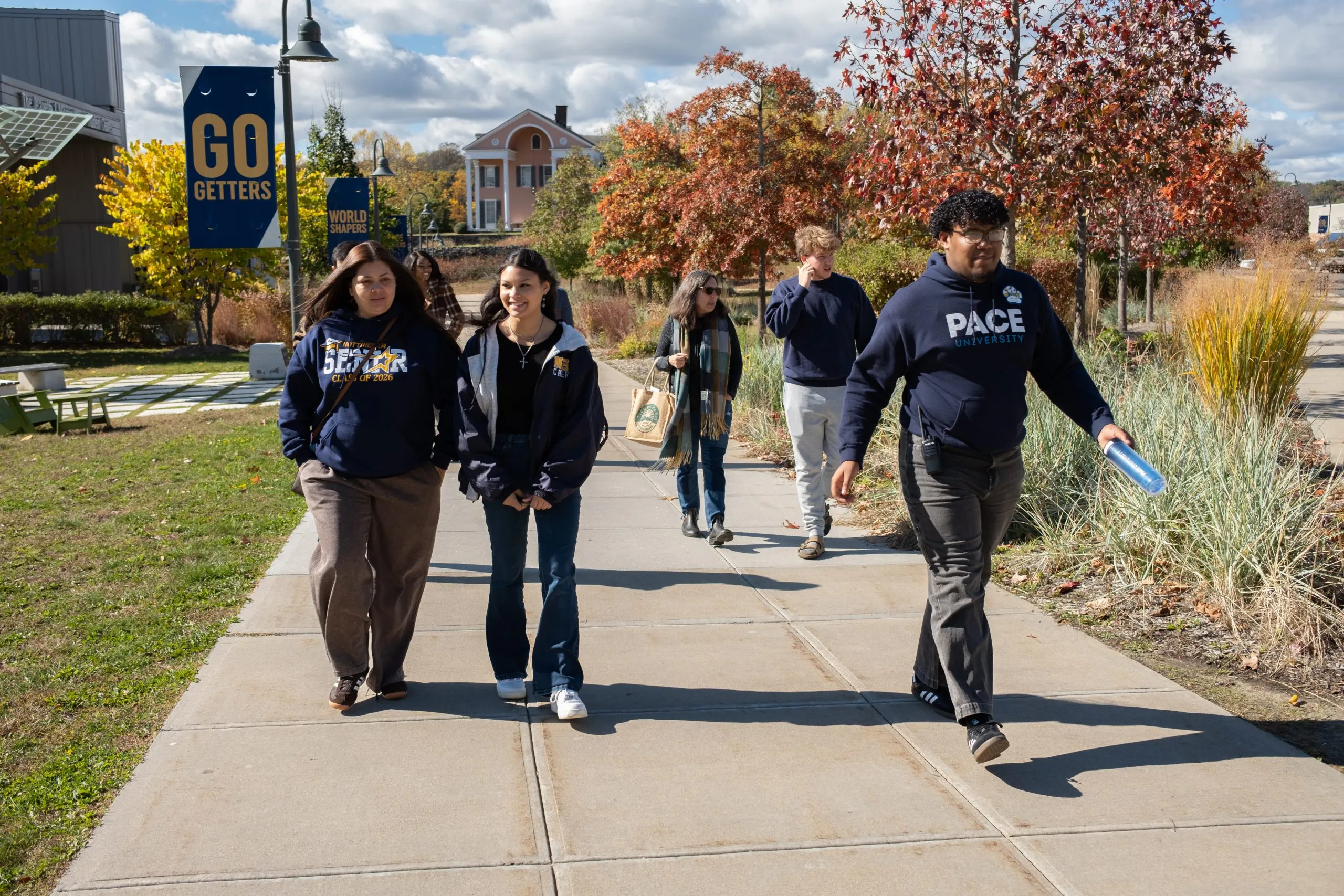
Santiago, who lives in Hamilton, New Jersey, was waiting for a tour to start at Pace University as a video on repeat showed exuberant students and drone footage of the leafy, 200-acre grounds about 30 miles north of New York City, where the university also has a campus.
Related: Interested in more news about colleges and universities? Subscribe to our free biweekly higher education newsletter.
Pace was one of 130 New York state colleges and universities that during October waived their application fees of from $50 to $90 per student, per school. That’s just one of the ways it’s trying to make admissions easier.
“That was a little eye-opening, when we received that letter,” Sueane Goodreau of Ithaca, New York, said about the free application offer as she waited for a tour of Pace’s campus with her high school senior son, Will. Compared to when her older daughter applied to college just three years ago, said Goodreau, “it does feel a little more receptive.”
There was an even bigger incentive offered by Pace: Prospects such as Santiago and Goodreau who visit are promised an additional $1,000 a year of financial aid if they enroll. Applicants who come to visit a campus are twice as likely to enroll as those who don’t, research has found.
The students’ names awaited them on a welcome sign at the reception desk in the office where tours depart. “You Belong Here,” pronounced another placard, on an easel in the waiting area. There was a QR code they could scan if they wanted to chat one-on-one with an admissions officer — who, in earlier times at many schools, were often unapproachable.
“I feel like I’m already a student here,” Santiago quipped.
The reason the university encourages that feeling? It’s simple, said Andre Cordon, dean of admission, in the distinctive pink Choate House at the center of the campus: “We want more students to apply. We don’t want to put up hurdles.”
So many hurdles previously stood along the route to college admission, it’s become a part of popular culture. “Everyone thinks we’re sadists — that we like saying no,” noted Tina Fey in her role as a Princeton admissions officer in the 2013 movie “Admission.”
Related: The number of 18-year-olds is about to drop sharply, packing a wallop for colleges — and the economy
Perceptions such as those are hard to change. Not only do young Americans aged 18 to 29 believe it isn’t any easier to get into college than it was for people in their parents’ generation, 45 percent of them think it’s harder, a Pew Research Center survey found. More than three-quarters say the admissions process is complex, and more than half that it’s more stressful than anything else they’ve done during their time in elementary, middle or high school, according to a separate survey, by the National Association for College Admission Counseling, or NACAC.
“People have that notion that all campuses are in the same category as MIT, Harvard, Stanford” with their impossibly low acceptance rates, said Cordon. (Pace took 76 percent of its applicants last year, university statistics show.) And “teenagers are still teenagers. There’s anxiety no matter what. They overthink things, and they overthink the admissions process.”
There’s also still a lot of genuine emotion in the process, he said. For many parents, “It’s a pride thing. It’s a status thing. It’s showing off. Or from the student’s side, it’s, ‘I want to make my parents proud.’ ”
In the new world of university admissions, however, that no longer necessarily even requires filling out an application.
“Congratulations! You’ve been admitted,” a new California State University website tells prospective students, before they enter a single piece of information about themselves.
Cal State is the latest system to deploy so-called direct admission: They will automatically accept any student who earns at least a C in a list of required high school courses, starting in January for students in some and expanding the following year to every high school in the state.
Related: To fill seats, more colleges offer credit for life experience
Public universities or systems in Alabama, Arizona, Connecticut, Georgia, Hawai’i, Idaho, Illinois, Indiana, Minnesota, New York, North Carolina, Tennessee, Texas, Utah, Washington and Wisconsin also now offer various forms of direct admission — some beginning this fall — accepting students automatically if they meet certain high school benchmarks.
Several systems now allow students to apply to several public universities and colleges with a single application, avoiding the time-consuming process of completing different forms, writing essays, collecting letters of recommendation or paying fees.
Through Illinois’s new One Click College Admit, for instance, high school students can have their transcripts provided instantly to 10 of the state’s 12 four-year public universities and all of its community colleges and get back a guaranteed offer of admission to at least one, depending on their grades.
“Especially first-generation students, they don’t have that knowledge of how to apply to college,” said José Garcia, spokesman for the Illinois Board of Higher Education. “That’s among the people we’re trying to reach — those who might be intimidated by the name of an institution or not feel confident in their academic abilities or their grades.”
Several of these programs have been advocated for public institutions by governors and legislatures worried about a continued supply of college-educated workers in their states as the proportion of high school graduates going on to get degrees declines.
“Basically we need to have a bigger pipeline,” said David Troutman, deputy commissioner for academic affairs at the Texas Higher Education Coordinating Board. “We have to do everything we can to open that door to all students, not just a few. So we have to make sure we’re making the process as painless as we can.”
Now private colleges are jumping aboard the direct-admission bandwagon. More than 210 have arranged through the Common App — an online application used by about 1,100 institutions nationwide — to extend offers of direct admission for the coming academic year to students who filed the Common App but have not applied. That’s almost twice as many as signed on last year, when Common App says 119 institutions in 35 states made more than 733,000 unsolicited offers.
It’s still early to definitively know the effect of this on whether students ultimately enroll. In Idaho, which in 2015 became the first state to try direct admission, enrollment of first-time undergraduates at participating public universities rose 11 percent.
Direct admission by itself does not resolve the other reasons students forgo college, however, said James Murphy, director of postsecondary policy at the nonprofit Education Reform Now, which advocates for more access to and diversity in higher education.
“It’s the furthest thing from a panacea,” Murphy said. “How do we know? Because colleges embraced it so quickly. Any reform taken up so quickly by colleges is likely to have more benefit to colleges than to students.”
While direct admission might help colleges get closer to enrollment targets, for example, he said, “it works best when it’s paired with financial aid and other resources that actually make it easier” to pay.
Waiving application fees has driven increases in applications, some research has shown. During the month that fees were waived last fall in New York state, a quarter of a million students applied to the public State University of New York, up 41 percent from the same period the year before, according to the state’s Higher Education Services Corporation, or HESC.
Related: After years of quietly falling, college tuition is on the rise again
While college applications may not seem expensive, at around $50 each, many students “aren’t just paying one application fee. They can be paying multiple fees,” which add up, said Angela Liotta, HESC’s director of communication.
Universities and colleges are trying other ways to ease the process. More than 2,000 continue to make submitting the results of SAT and ACT scores optional, for instance, something many started doing during the pandemic. More have extended their deadlines or recruited after the traditional May 1 cutoff, when incoming classes were previously considered locked in.
Students are noticing. One way is through the massive amount of marketing materials they’re getting, begging them to apply. The median high school student gets more than 100 letters and emails from colleges and universities each month, a survey by the education technology company CollegeVine found — an old-style approach that CollegeVine found turns out for this generation to be generally ineffective.
Will Goodreau, who was visiting Pace, for instance, got “so many emails and texts,” he said, laughing. “I must have given somebody my number for something.”
All of these things appear to be slowly changing students’ perception of admission. In that NACAC survey, fewer of those who had already gone through the process — while they still found it challenging — considered it as challenging as students who hadn’t started yet.
There could be more changes ahead. A lawsuit was filed in August against 32 colleges and universities that practice so-called early decision, under which students who apply before the usual admission period are more likely to get in, but are obligated to enroll. The practice, which the lawsuit seeks to end, helps colleges fill their classes, but prevents students from shopping around for better offers of financial aid.
Whatever happens, students and their parents should know that “they’re actually the ones in control of this process,” said Krebs, of HelloCollege. “The reality is that at a lot of schools, if you have the grades, you’re going to get in.”
Contact writer Jon Marcus at 212-678-7556, [email protected] or jpm.82 on Signal.
This story about applying to college was produced by The Hechinger Report, a nonprofit, independent news organization focused on inequality and innovation in education. Sign up for our higher education newsletter. Listen to our higher education podcast.
This <a target=”_blank” href=”https://hechingerreport.org/colleges-ease-the-dreaded-admissions-process-as-the-supply-of-applicants-declines/”>article</a> first appeared on <a target=”_blank” href=”https://hechingerreport.org”>The Hechinger Report</a> and is republished here under a <a target=”_blank” href=”https://creativecommons.org/licenses/by-nc-nd/4.0/”>Creative Commons Attribution-NonCommercial-NoDerivatives 4.0 International License</a>.<img src=”https://i0.wp.com/hechingerreport.org/wp-content/uploads/2018/06/cropped-favicon.jpg?fit=150%2C150&ssl=1″ style=”width:1em;height:1em;margin-left:10px;”>
<img id=”republication-tracker-tool-source” src=”https://hechingerreport.org/?republication-pixel=true&post=113378&ga4=G-03KPHXDF3H” style=”width:1px;height:1px;”><script> PARSELY = { autotrack: false, onload: function() { PARSELY.beacon.trackPageView({ url: “https://hechingerreport.org/colleges-ease-the-dreaded-admissions-process-as-the-supply-of-applicants-declines/”, urlref: window.location.href }); } } </script> <script id=”parsely-cfg” src=”//cdn.parsely.com/keys/hechingerreport.org/p.js”></script>