Tag: Georgetown

  • Georgetown Fellow Detained by ICE May Resume Work for Now

    Georgetown Fellow Detained by ICE May Resume Work for Now

    Andrew Thomas/AFP via Getty Images

    A Georgetown University researcher who was detained by immigration agents in March will be allowed to resume his work, at least for now, according to a court settlement released Tuesday. Politico first reported the development.

    The agreement does not guarantee that the postdoctoral fellow, Badar Khan Suri, will be able to stay in U.S. long term, and it doesn’t resolve his claim that the government violated his First Amendment rights by detaining him because of his pro-Palestinian comments and what the government claims are ties to Hamas. Those aspects of the case will be determined by a later ruling.

    That said, as litigation continues, Suri will be protected, maintain his status as a student and remain employed.

    Suri was first released from detention in May. His wife is a citizen, but her father has been identified as a former Hamas adviser, which likely was a key factor that influenced Suri’s arrest, Politico reported.

    Both parties in the case agreed the settlement was a result of “good faith” negotiations, Politico noted, though the State Department and Department of Homeland Security declined to comment.

    “We are encouraged that the government agreed to restore Dr. Suri and his children’s status and records,” Eden Heilman, an ACLU lawyer representing Suri, told Politico. “We know Dr. Suri is eager to rejoin the academic community at Georgetown and this will give him the opportunity to do that this fall.”

    Source link

  • Republicans Denounce Georgetown Professor for Post on Iran

    Republicans Denounce Georgetown Professor for Post on Iran

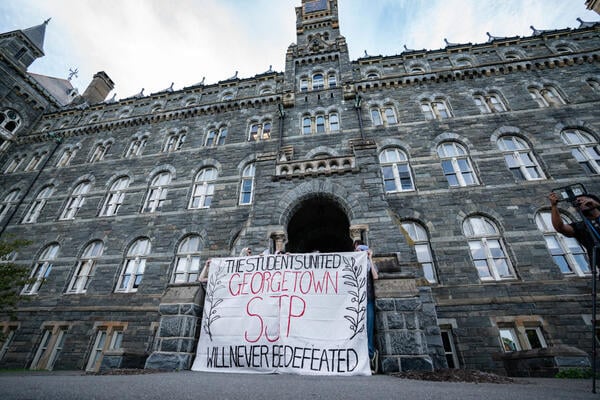
    On June 22, the United States bombed Iranian nuclear enrichment facilities. Observers wondered whether it was the start of another lengthy, destructive American war in the Middle East.

    Hours later, a conservative social media account with more than 4.3 million followers highlighted one response—allegedly from a Georgetown University professor. According to a screenshot the Libs of TikTok X account posted, Jonathan Brown, the Alwaleed bin Talal Chair of Islamic Civilization, had written on X, “I hope Iran does some symbolic strike on a base, then everyone stops.”

    Tagging the university’s X account, Libs of TikTok summarized it this way: “Professor at Georgetown University @Georgetown says he hopes Iran strikes a US base.”

    What transpired is becoming a familiar story in U.S. higher education: Conservatives denounce a faculty member’s speech, members of Congress join in and eventually pressure a prestigious university’s president to publicly denounce and punish the scholar.

    In his own June 22 X post, Congressman Randy Fine, a Florida Republican whom Gov. Ron DeSantis previously wanted to lead Florida Atlantic University, noted that Georgetown interim president Robert M. Groves was scheduled to testify before the House Education and Workforce Committee, which he did on Tuesday.

    “This demon had better be gone by then,” Fine wrote of Brown. “We have a Muslim problem in America.”

    A June 23 Iranian strike that appeared symbolic did mark the end of the conflict. President Trump said Iran had forewarned the U.S. about the coming attack on a U.S. base in Qatar, allowing Americans to avoid any casualties. But, unlike that fight’s swift end, the battle over Brown’s social media post has dragged on.

    At the House committee’s hearing this week, former committee chair Virginia Foxx, a North Carolina Republican, asked Groves about Brown, who works in Georgetown’s respected School of Foreign Service. “Is this person really suited to be educating the next generation of American diplomats?” she said.

    Groves didn’t respond that this was a personnel matter he couldn’t discuss. Like former Columbia University president Minouche Shafik did in front of the same committee last year, he discussed actions the university was taking regarding his employee.

    “Within minutes of our learning of that tweet, the dean contacted Professor Brown, the tweet was removed, we issued a statement condemning the tweet, Professor Brown is no longer chair of his department and he’s on leave, and we’re beginning a process of reviewing the case,” Groves said.

    “You are now investigating and disciplining him?” Foxx asked.

    “Y-yes, Congresswoman,” Groves said.

    He responded differently to a question from another Republican about Georgetown employee Mobashra Tazamal, an associate director of an Islamophobia research project who allegedly reposted a statement that said, “Israel has been recreating Auschwitz in Gaza for two years.” In that case, Groves said he rejected the statement but added, “That’s behavior covered under the First Amendment on social media that we don’t intervene on.”

    ‘Willful Misreading’

    Greg Afinogenov, an associate history professor and president of Georgetown’s chapter of the American Association of University Professors, said Brown has received “death threats, his family has come under attack and members of the university administration have also criticized him and disavowed him.”

    Afinogenov said the university should clarify that Brown’s post was “protected speech.”

    The university didn’t provide Inside Higher Ed an interview or answer most written questions Thursday. In an email, a university spokesperson said Brown is no longer chair of the Arabic and Islamic Studies Department. But the spokesperson didn’t say why or whether he violated any policy.

    “He retains his faculty appointment,” including his named chair position, the spokesperson wrote.

    In a statement the day after Brown’s alleged post, the university said, “We are appalled that a faculty member would call for a ‘symbolic strike’ on a military base in a social media post.”

    “The faculty member has since deleted the post and stated that he would not want any harm to befall American servicemembers,” the statement said. “We are reviewing this matter to see if further action is warranted. We take our community’s concerns seriously and condemn language which is deeply inconsistent with Georgetown University’s values.”

    In response to a request for an interview and written questions, Brown told Inside Higher Ed in an email, “I am unable to make any public comments at this time.” He previously told Fox News Digital he was “calling for de-escalation” in his post, likening it to the strikes Iran ordered after an American drone strike killed Gen. Qassim Suleimani during Trump’s first term, “with telegraphed warning and no American casualties and no one felt any further need for attacks.”

    In a statement, the Council on American-Islamic Relations said that “to frame Dr. Brown’s comment as unpatriotic or violent, as some have done, requires a willful misreading of his intent and of the broader context of the brief U.S.-Iran war.”

    “Hoping for a swift end to the war was the clear intent of his message, it was a sentiment shared by many Americans, and it is what ultimately happened: Iran launched a telegraphed strike on a U.S. military base that harmed no one, President Trump declined to respond, and the war ended,” the statement said.

    For Afinogenov, the incident bodes ill for faculty rights.

    “This procedure of hauling members of university administrations before” a “congressional kangaroo court” harms academic freedom, he said. Administrators should push back against these “smear campaigns,” and Georgetown should articulate a policy to protect faculty and other members of the university community from retaliation for their “extramural speech,” such as on social media, he said.

    Over all, Afinogenov said, Brown’s situation is part of an “attack on academic freedom and the independence of universities in general, which we’re seeing across the country.”

    Source link

  • Detained Georgetown Professor Released From ICE Custody

    Detained Georgetown Professor Released From ICE Custody

    Badar Khan Suri, a postdoctoral fellow and professor at Georgetown University, was released from a federal detention center in Texas on Wednesday after being held for two months.

    Suri, an Indian national, was arrested in March under government claims that he was a threat to U.S. interests and had close connections to a known or suspected terrorist. This week a federal judge in Virginia ordered Suri’s immediate release due to a lack of evidence to support such claims.

    Suri is one of about a dozen foreign nationals in the U.S. targeted by the Trump administration for pro-Palestinian activism, including Mahmoud Khalil, Mohsen Mahdawi, Rümeysa Öztürk and Momodou Taal. While Khalil remains in custody, Mahdawi was released on bail on April 30 and Öztürk was released from federal custody last week. Taal chose to leave the U.S. in April.

    Prior to his arrest, Suri had been in the U.S. for three years on a student visa and was teaching a course on minority rights in South Asia at Georgetown, according to The New York Times. Suri’s lawyers believe he was targeted because his father-in-law served as a political adviser to the Hamas-led government in Gaza in the early 2000s.

    Suri was apprehended outside his home in Rosslyn, Va., on March 15 and was moved among detention centers in Virginia, Louisiana and Texas. Suri described his treatment in the Prairieland Detention Center in Texas as subhuman, saying he was chained at the ankles, wrists and body.

    Other international academics are locked in legal battles with the federal government over challenges to their standing in the U.S.

    A University of Minnesota student, Dogukan Gunaydin, has been in ICE custody since March despite having his case overturned. Alireza Doroudi, who was a doctoral student at the University of Alabama, requested voluntary departure to avoid prolonged detention, according to his attorney. Columbia student Leqaa Kordia was arrested in March and remains in an immigration detention center in Texas.

    Source link

  • Georgetown University Honors Xavier University of Louisiana’s Centennial and Black Catholic Studies Legacy

    Georgetown University Honors Xavier University of Louisiana’s Centennial and Black Catholic Studies Legacy

    Georgetown UniversityAs Xavier University of Louisiana enters its centennial year, the nation’s oldest Catholic institution—Georgetown University—celebrated the institution’s 100-year legacy and the 45th anniversary of its Institute for Black Catholic Studies (IBCS).

    Last Thursday’s event, titled “Reflecting on the Significance of the Institute for Black Catholic Studies and the Journey Toward Reconciliation,” included a discussion among leaders from Xavier’s IBCS, the Descendants Truth & Reconciliation Foundation, and Georgetown University. It also showcased an exhibition co-created by the Georgetown University Library, highlighting the impact of the IBCS—a graduate program dedicated to fostering Black Catholic theology, ministry, and leadership.

    Founded in 1925 by Saint Katharine Drexel and the Sisters of the Blessed Sacrament, Xavier University of Louisiana remains the only historically Black Catholic university in the United States. The Georgetown event not only honored Xavier’s continued contributions but also reflected on the role of Black Catholic scholarship in shaping faith and social justice initiatives.

    Dr. Kathleen Dorsey Bellow, director of IBCS, acknowledged the deep collaboration between Xavier and Georgetown.

    Reflecting on her journey, Bellow shared how she initially hesitated to attend the IBCS in 1989 but was transformed by the experience.

    “I immediately appreciated that I was on holy ground,” said Bellow. “After my very first class, I knew I would complete the program and try to come back every summer after that. I needed to be refreshed, challenged, and affirmed in my mission as a Black Catholic woman in church and society,” she said. She said that the Institute was created to form strong Catholics who can express and explain their faith in ways that resonate with their communities.

    IBCS offers two tracks: a graduate theology program for future church leaders and a continuing education track for lay people seeking deeper faith formation. The program takes a well-rounded approach by including challenging coursework, combined with cultural experiences, prayer, and opportunities to build strong communities.

    “We study together, we pray together, we have African dance and drumming in the evenings,” Bellow said. “We are Black and Catholic Sunday through Saturday, and our mission is to share the gift of Blackness in the life of the Church.”

    The legacy of resistance, persistence, and transcendence was also central to the event’s discussion, a theme introduced by Father Joseph Brown, S.J., a leading scholar and former head of IBCS.

    Monique Trusclair Maddox, CEO of the Descendants Truth & Reconciliation Foundation discussed her family’s history of enslavement by the Jesuit order and the impact of learning about Georgetown University’s role in the sale of enslaved persons to save the institution.

    In 1838, Georgetown University, facing financial hardship, approved the sale of 272 enslaved men, women, and children to plantations in Louisiana to secure its financial future. The sale brought in about $115,000, which would be worth millions today, and helped pay off the university’s debts. The decision not only tore apart families but also reinforced the systemic exploitation of Black people for institutional survival.

    For years, the story remained buried until 2004, when Patricia Bayonne-Johnson uncovered it while tracing her family history. Since then, researchers along with the Jesuits, have worked to trace the lineage of those enslaved by the Society of Jesus and the Catholic Church. Their efforts have identified over 10,000 descendants, a number that continues to grow.

    Trusclair Maddox detailed her spiritual journey, including prayers for peace and understanding, and the establishment of the Descendants Truth and Reconciliation Foundation. The foundation, supported by JP Morgan Chase, has issued over $166,000 in scholarships and launched programs for home modifications and racial healing. Maddox emphasized the need for systemic change and called for broader awareness and participation in restorative justice efforts.

    “We knew that reconciliation required more than an acknowledgment, but demanded action,” Trusclair Maddox said.  “Restorative justice isn’t just about the past, it’s about what we do today to shape a more just future,” she added, and called on institutions and individuals to engage in meaningful change toward racial healing.

    As part of an effort to support the Descendants Truth & Reconciliation Foundation, Maddox highlighted a series of grassroots initiatives to raise awareness through media and marketing. He also announced the Jesuit order’s commitment of $100 million over the first five years to fund the foundation’s operations.

    “Now that we have operational dollars and we’re starting to give our grants to not just descendants, but also into transformation programs and truth-telling, we’re going to continue to build our programs,” Trusclair Maddox said.

    Dr. Joseph Ferrara, senior vice president and chief of staff at Georgetown University, said that he is excited about the school’s continued partnership with Xavier University.

    “We’re grateful for this opportunity to celebrate alongside Xavier and to recognize their importance to Catholic higher education,” Ferrara said. “We have an opportunity to reflect on the legacy at Xavier and the process toward reconciliation. Georgetown is very happy to be a part of the process, and that’s a journey we’re still on.”


    Source link