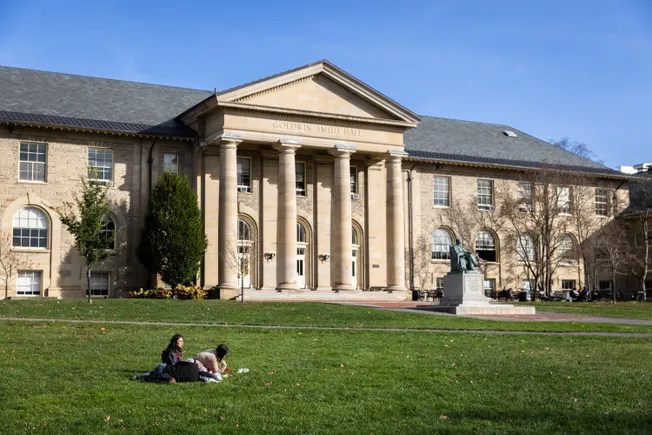
Cornell University has booked the largest gift in its history — $371.5 million — from the founder of PeopleSoft, the Ivy League institution said Thursday.
David Duffield’s recent pledge, which comes on top of $100 million that the Cornell alum gave last year, makes Duffield one of “the university’s leading all-time donors,” Cornell said.
Duffield’s latest donation will create a $250 million Duffield Legacy Fund to help Cornell’s engineering college pursue “strategic opportunities” and a separate $50 million fund to support college priorities under “educational excellence.”
Dive Insight:
With over $470 million pledged to Cornell in less than two years, the university is naming its engineering college after Duffield.
Duffield co-founded software companies PeopleSoft and Workday. He is worth $12.1 billion, according to Bloomberg.
Along with the education and strategic priorities funds, Duffield’s latest gift will also create the Duffield Launch Fund with the remaining $70-plus million. That third fund is to finance investments into immediate priorities of the newly renamed Cornell David A. Duffield College of Engineering. Those priorities include updating the college’s physical infrastructure, bolstering research facilities, and supporting faculty and students.
The engineering college will also use the launch fund to pursue research in fields such as quantum engineering, artificial intelligence, health and data-driven decision-making.
The legacy and launch funds established by Duffield’s donation will allow the college to “remain nimble, proactive and financially responsible as we advance our values and mission,” Lynden Archer, Cornell’s engineering dean, said in a statement. Archer added that the university will announce more specific plans for the funds later.
Cornell’s endowment was valued at just under $11.2 billion at the end of fiscal 2025, according to the university’s latest financials.Over 80% of those funds had donor restrictions tied to them.
The university’s endowment was the 18th largest in the nation, according to the latest study of endowments from the National Association of College and University Business Officers and asset management firm Commonfund.
With 26,561 students in fall 2025,Cornell’s endowment dollars per student came to around $420,000 —well under the $500,000 per student threshold that triggers the minimum endowment income tax created in last year’s massive Republican tax and spending bill.
A post last year from the conservative American Enterprise Institute listed Cornell as among the colleges that “may not be on the hook for the tax right now” but could be later “if their endowment growth continues to outpace growth in enrollment.”
AEI researchers projected that Cornell’s endowment tax liability would jump from $0 in 2026 through 2028 to $14.8 million in 2029 and $16.2 million in 2030.
While off the hook for the endowment tax (for now), Cornell is set to pay the government $30 million over three years per a deal it cut with the Trump administration in November. That payment is in exchange for the administration reinstating $250 million in federal research funding and ending its civil rights investigations into the university.
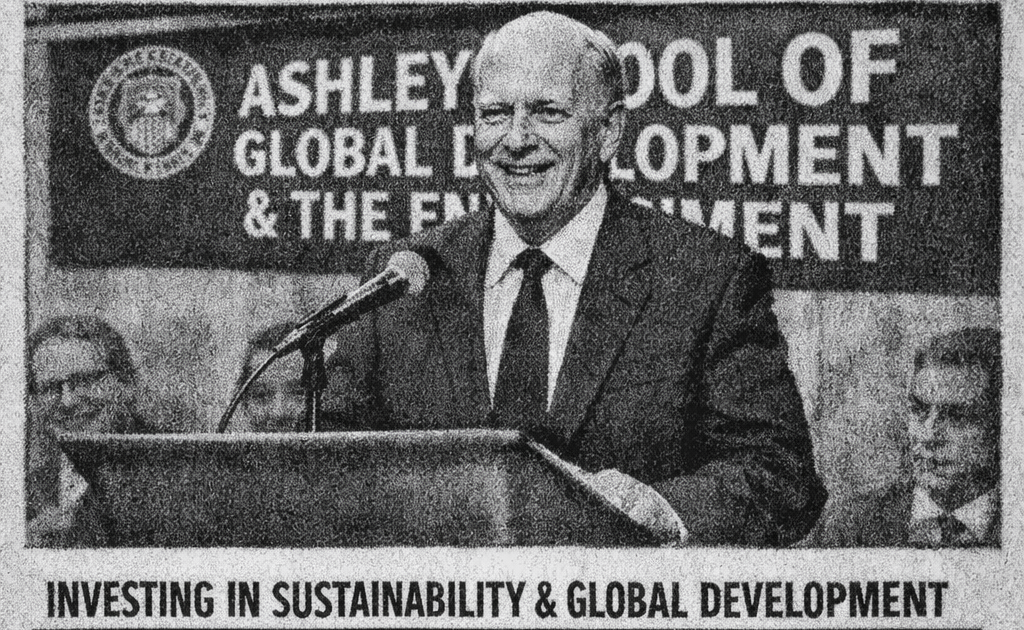
In December 2025, Cornell University announced a $55 million gift from alumnus Stephen B. Ashley to endow the newly named Ashley School of Global Development and the Environment. The university presented the donation as a transformative investment in sustainability, global development, and interdisciplinary research. Yet behind the headlines of generosity lies a pattern that has come to define elite higher education: the use of philanthropy to launder reputations and sanitize wealth accumulated through systems that produce widespread harm.
Ashley’s career exemplifies this dynamic. As a longtime real estate investor and head of The Ashley Companies, he amassed significant wealth. His tenure on the board of Fannie Mae, including as chairman in the mid-2000s, coincided with periods of accounting irregularities, risky mortgage practices, and systemic failures in governance. Fannie Mae’s collapse during the 2008 financial crisis devastated millions of Americans, particularly low-income and minority households, yet board members and executives largely escaped personal consequences. Ashley’s wealth, in part derived from this environment, is now being funneled into a university named for him — transforming historical responsibility into a narrative of generosity.
The pattern extends beyond domestic finance. Ashley also serves on the Founders Council of the Middle East Investment Initiative (MEII), a nonprofit focused on private-sector development in the Middle East. While MEII frames itself as a promoter of economic growth and development, critics argue that such organizations operate within a global financial ecosystem that prioritizes investor stability and elite networks over democratic accountability or local economic agency. Participation in these initiatives may be legal, even philanthropic, but they reinforce Ashley’s image as a global benefactor without confronting the broader systemic power he wields.
Cornell, like many elite institutions, accepts such gifts with minimal scrutiny, emphasizing the moral and intellectual good the donation enables while obscuring the histories of harm that made the wealth possible. Naming a school dedicated to equity, sustainability, and global development after a figure linked to financial crisis and speculative practices exemplifies the reputational laundering function universities serve for wealthy donors. The institution converts fortunes built in high-stakes, opaque, or socially harmful arenas into lasting prestige, moral capital, and scholarly legitimacy — all while reinforcing its own image as an engine of public good.
This is not a question of legality. Ashley’s wealth is largely untarnished in the courts. It is a question of accountability, ethics, and institutional values. By turning wealth into permanent naming rights, universities like Cornell signal that elite power can be absolved through philanthropy, creating a structural dynamic where generosity replaces responsibility, and reputation is more durable than accountability.
For students, faculty, and the public interested in environmental justice, social equity, and global development, the contradiction is stark. The same systems that generate inequality now fund the study and critique of inequality itself. Elite institutions benefit materially and symbolically from the work of those who profited from structural harm, even as the original consequences fade from public memory. Until universities confront this tension, higher education will continue to function as a reputational laundromat for elite wealth, transforming past systemic damage into present prestige.
Sources
Cornell University, “Historic Gift Endows New CALS School,” Cornell News
Cornell Sun, coverage of the Ashley School announcement
Federal Housing Finance Agency, Special Examination Reports on Fannie Mae (2005–2008)
Financial Crisis Inquiry Commission materials on Fannie Mae governance
Reuters, coverage of post-crisis shareholder litigation involving Fannie Mae board leadership
Middle East Investment Initiative, Board and Founders Council listings
The University of Austin announced Wednesday that Republican megadonor Jeff Yass is donating $100 million, it’s “ending tuition forever” and it will also “never take government money.” At the same time, it said Yass’s gift represents the first third of “a $300 million campaign to build a university that sets students free.”
University president Carlos Carvalho told Inside Higher Ed he doesn’t plan for this $300 million to become an endowment meant to last forever. Instead, he said it will be invested but spent down as a “bridge” until the institution produces enough donating alumni to keep tuition free. He estimated this will take 25 years, “give or take.”
“We understand there’s risk in this approach,” Carvalho said. But he said he believes in the product, calling his students his “equity partners”—but stressed that “all they owe is their greatness.”
When the institution welcomed its first class of students last fall, it said annual tuition was $32,000, but Carvalho said nobody has ever paid tuition. The university still hasn’t earned accreditation, which can take years, but the state of Texas allowed it to grant degrees and the Middle States Commission on Higher Education, an accrediting body, has granted it candidate status on its path to recognition. The university says it expects to complete “the first accreditation cycle” between 2028 and 2031.
Yass—a billionaire co-founder of financial trading firm Susquehanna International Group and a significant investor in TikTok owner ByteDance—was very recently in the news for other gifts. He had backed Republicans in a bid to end the Pennsylvania Supreme Court’s Democratic majority, but voters reappointed all three justices up for re-election to another decade on the bench (though one is required to retire in a few years). He’s also provided millions in support of private K–12 school vouchers and electing Republicans to Congress.
He told The Wall Street Journal, which broke the news of the University of Austin gift, that he’s been impressed by the university, wants to eliminate stress for parents and supports separation between education and government. His donation to the fledgling institution—which Carvalho said is atop Yass’s previous $36 million gift—is another example of its continued support from prominent conservatives. Carvalho said the university has raised more than $300 million, including the $100 million going toward the new $300 million campaign. The Journal reported that real estate developer Harlan Crow, who controversially funded trips for U.S. Supreme Court Justice Clarence Thomas, and Peter Thiel, a co-founder of Palantir and friend to Vice President JD Vance, have been among the donors.
Such donations may enable the university to do what other universities can’t: rely neither on student, nor state, nor federal contributions to survive. Instead, the university says it’s banking on alumni sustaining it. The first group of students is slated to graduate in 2028.
“Our bet: Create graduates so exceptional they’ll pay it forward when they succeed, financing the tuition of the next generation,” the university said in its announcement. “When our students build important companies, defend our nation, advance scientific frontiers, build families, and create works that elicit awe, they’ll remember who made their excellence possible. And they’ll give back.”
It went on to say that “other Americans will take notice” and invest. “Every other college gets paid whether students succeed or fail. At UATX, if our graduates don’t become essential to American excellence—and if their work doesn’t inspire others to fund this mission—we’re done.”
Some higher ed observers are skeptical. Mark DeFusco, a principal at Prometheus Education, which performs mergers and acquisitions for troubled colleges, said running a “serious college … a college as we know it” on just a $300 million fund would be “nearly impossible.”
“If they can pull it off, God bless ’em,” DeFusco said. “While I really understand their urge, the practicality doesn’t seem like it’s possible, and I’d like to see the details.”
Carvalho said the university currently has 150 students in its freshman and sophomore classes, and he plans to grow total enrollment to 400 to 500 for now. “We need this first phase of growth to be small,” he said.
“We talk about building the Navy SEALs of the mind,” he said. “The Navy SEALs are not a class of thousands and thousands.”
He said the university offers courses in, among other things, computer science, journalism and prelaw, and wants to launch programs in all three areas. One of the university’s founders is Bari Weiss, who also founded The Free Press and recently became editor in chief of CBS News.
Other universities have also tried to jettison tuition in favor of alumni support. In 2021, Hope College in Michigan aimed to raise $1 billion for its endowment in order to go tuition-free. As part of that plan, students would commit to donate to the college after graduation. The first cohort graduated this past spring, and 126 students have participated over the first four years, according to an annual report from the college. Roughly 85 percent of the graduating seniors and 70 percent of freshmen through juniors have donated.
Neal Hutchens, a university research professor and faculty member in the University of Kentucky’s College of Education, said the no-tuition, no-government-funding plan raises questions about how large UATX could grow and whether its model could be replicated elsewhere.
He also noted that the university’s marketing of itself as against the grain of academe isn’t unique. A video on UATX’s homepage critiques “coddling,” “virtue signaling” and the “disastrous” state of higher ed “in the Western world,” complete with images of a building with a rainbow-colored sign above an entrance, people wearing cloth masks while blowing into instruments and pro-Palestine protesters being arrested. In the video, Weiss says to understand why “the museums you love, and the publishing houses you love, and the newspapers you used to trust” are “hollowed out, you have to look at the nucleation point for this—and that is the university.”
Hutchens said New College of Florida, a public institution taken over by Gov. Ron DeSantis’s conservative board appointees, appears to be charting “a similar iconoclastic path.” He noted New College took a public stand early against what some call wokeness.
“That’s not necessarily been an easy fix for New College to just automatically thrive,” he said. He said he’s curious if such institutions are going after the same donors, and they may eventually be competing more with one another than the institutions they’re setting themselves apart from.
However, Hutchens said, UATX might be able to gain currency in the tech industry and make further inroads with people with deep pockets.
“It doesn’t take too many $100 million gifts to add up to a pretty good endowment,” he said.
Asked about assertions that his university pushes conservative ideology, Carvalho said, “We have a core curriculum that is teaching the best that has been done and has been seen in the Western tradition,” from philosophy to science, literature and more. He said none of those things are conservative.
“We do have an institution that’s very patriotic,” he said, adding that if that’s a “conservative statement these days—again, not my choice.”
Arizona State University has received a $50 million donation to launch the Global Institute for the Future of Energy, a collaboration between its Julie Ann Wrigley Global Futures Laboratory and the Thunderbird School of Global Management that seeks to promote education and innovation regarding energy production and use.
The gift comes from Bob Zorich, who earned his master’s degree in international management in 1974 from Thunderbird’s predecessor, the American Graduate School of International Management.
“ASU has long been a pioneer in building bold, pragmatic solutions for the future,” said Zorich, founder and managing partner of the Texas-based private equity firm EnCap Investments. “President Michael Crow has taken a visionary and action-oriented approach to positioning the university as a leading center for research, educational excellence and global influence. For these reasons, I was excited to fund the formation of this energy institute at ASU because of the university’s unique ability to scale and reach a global audience.”
Zorich’s gift will help the institute recruit a chair and staff and start developing curriculum for students, executives and the public. In the second year, the institute aims to launch a fellowship and executive-in-residence program, as well as a series of public programs, including lectures, summer camps and a global energy conference.
In addition, some of the funds will support Energy Switch, a point-counterpoint show on Arizona PBS that brings together experts from government, NGOs, academe and industry to debate energy-related topics.
“Energy is central to nearly every facet of our daily lives, and we have to prepare now for an evolving energy future,” Crow said in a statement. “With the rapid growth of AI and other fast-moving innovations, we have a responsibility to ready the next generation of energy leaders and solutions. Bob Zorich’s visionary investment will empower our global understanding of energy, our vital literacy and how we can work together to develop the best paths forward.”
Philanthropist MacKenzie Scott has gifted Morgan State University $63 million in unrestricted funds, the largest gift in the university’s history.
In 2020, Scott awarded the historically Black university in Baltimore $40 million, which went toward multiple research centers and endowed faculty positions, among other advancements.
Morgan State leaders announced that the new funding will help build the university’s endowment, expand student supports and advance its research.
David K. Wilson, president of Morgan State, called the gift “a resounding testament to the work we’ve done to drive transformation, not only within our campus but throughout the communities we serve.”
“To receive one historic gift from Ms. Scott was an incredible honor; to receive two speaks volumes about the confidence she and her team have in our institution’s stewardship, leadership, and trajectory,” Wilson said in the announcement. “This is more than philanthropy—it’s a partnership in progress.”
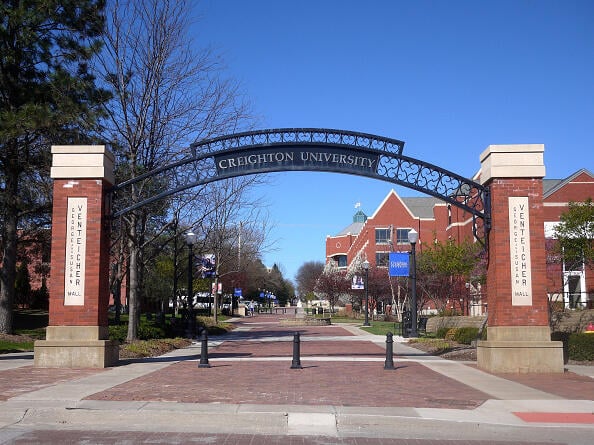
Creighton University has received a $100 million gift from the Heider Family Foundation to launch a nearly $300 million campaign for a sprawling recreational and athletic development on the east side of the Omaha campus.
Creighton’s Fly Together plan will establish or upgrade athletic facilities and outdoor spaces covering 12 blocks and roughly 700,000 square feet. It includes a new student fitness center, a pedestrian walkway connecting the private Jesuit campus to a downtown business district and a new sports performance center for Creighton’s student athletes.
“Fly Together will serve students and student-athletes, but importantly, it will serve the Omaha community itself,” said Scott Heider, a university trustee as well as a trustee of the Heider Family Foundation, which was established by his parents, Charles and Mary.
“We are incredibly grateful to the Heider family and the additional donors who are making this moment possible,” said Creighton president Daniel Hendrickson. “This gift … benefits everyone. It enhances student life, intramurals, premier club sports and intercollegiate athletics. It also strengthens Creighton’s connection to downtown and the broader Omaha community.”
This audio is auto-generated. Please let us know if you have feedback.
Since President Donald Trump retook office, the U.S. Department of Education has launched investigations into several high-profile colleges over their compliance with Section 117,a decades-old law that was largely ignored until 2018.
The law — part of the reauthorization of the Higher Education Actin 1986 — requires colleges that receive federal financial assistance to disclose contracts and gifts from foreign sources worth $250,000 or more in a year to the U.S. Department of Education.
In late April, Trump signed an executive order charging U.S. Education Secretary Linda McMahon to work with other executive agencies, including the U.S. Department of Justice, to open investigations and enforce Section 117.The order also explicitly ties compliance with Section 117 to eligibility for federal grant funding and directs McMahon to require colleges to disclose more specific details about their foreign gifts and contracts.
However, complying with the law is difficult and time-consuming for colleges given the challenges they face collecting the needed data and uploading it to the Education Department’s system, according to higher education experts. That means universities must take steps to ensure they are complying, such as dedicating a staff member to meet the law’s requirements, they said.
Failing to properly do so could put colleges in the crosshairs of the Trump administration and potentially cause them to miss out on federal grants, as higher education experts speculate the executive order will be used as another tool to target institutions’ funding.
“The Trump administration has it out for American higher education, particularly those they have branded elite institutions,” said Jeremy Bauer-Wolf,investigations manager on the higher education program at New America, a left-leaning think tank. “Section 117 is another cudgel for them.”
The history of Section 117
After Section 117 was enacted nearly 40 years ago over concerns about foreign donations to colleges, it was never really implemented by the Education Department and went largely ignored, said Sarah Spreitzer, vice president and chief of staff for government relations at the American Council on Education. People just stopped thinking about the issue and didn’t pay attention to it, she said.
However, concerns in Congress grew in 2018 when then-Federal Bureau of Investigations Director Christopher Wray testifiedbefore a Senate panel that China was exploiting the open research and development environment in the U.S. and universities were naive to the threat.
Proactively monitoring Section 117 and investigating disclosures was seen at the time as a way to “mitigate malign and undue foreign influence,” a Congressional Research Service report released this past February stated.
Following the hearing, the first Trump administration “really started making a show of Section 117,” said Bauer-Wolf.
Between 2019 and2021, the Trump administration opened investigations into prominent institutions such as Harvard University, Georgetown University,Cornell University, the Massachusetts Institute of Technology and Yale University. The administration was more focused on enforcing compliance through investigations than working with colleges to help them understand what the law required, said Spreitzer.
That had a “chilling impact on our institutions,” said Spreitzer. Colleges had a lot of questions about Section 117 reporting that went unanswered because they “were worried that if they called the Department of Education, they would be hit with an investigation.”
The investigations led colleges to report $6.5 billion in “previously undisclosed foreign funds,” according to Trump’s executive order.
When the Biden administration took over, Education Department officials moved enforcement of Section 117 from the Office of the General Counsel to Federal Student Aid. The Biden Education Department also closed several investigations launched under the Trump administration, and it did not open any new ones.
Trump, in his executive order, alleged the Biden administration “undid” the investigatory work completed during his first term. But those investigations had been going on for several years, so it’s unclear whether those probes should or should not have been closed, said Spreitzer.
Today’s enforcement landscape
Since retaking office, the Trump administration has opened Section 117 investigations into several colleges, including the University of Pennsylvania and the University of California, Berkeley, and it has reopened a probe into Harvard University. The Education Department said it needed to verify whether Harvard was complying with the law and with a December 2024 agreement that ended an investigation launched in February 2020 during Trump’s first term.
In the agreement, Harvard said it would submit amended disclosure reports for gifts and contracts received between 2014-2019. But when reopening the investigation, the Education Department said it believed Harvard made inaccurate disclosures, including for the amended reports.
“Unfortunately, our review indicated that Harvard has not been fully transparent or complete in its disclosures, which is both unacceptable and unlawful,” U.S. Education Secretary Linda McMahon said when announcing the latest probe in April.
As part of its new investigation, the administration asked Harvard for information regarding foreign students who were expelled, including the research they conducted, and “all temporary researchers, scholars, students and faculty who are from or affiliated with foreign governments.”
It also asked Penn, among a host of other things, for all tax records since 2017. In addition, the department requested the names of contractors or staff who assisted international students or were involved in the university’s regulatory compliance with the federal Foreign Government Talent Recruitment Program — referring to foreign governments’ initiatives to recruit science and technology students and professionals.
“They are asking broader questions that go beyond the scope of Section 117,” said Spreitzer.
The threat of penalties, meanwhile, is all too real for universities on various fronts. The Trump administration has tried to compel universities to roll back their diversity, equity and inclusion efforts and has paused or terminated federal grants to universities such as Harvard,Princeton University, Northwestern University and Cornell University as it investigates antisemitism and civil rights allegations on their campuses.
Bauer-Wolf said he fears the Section 117 executive order will be used as another “political tool, almost as a shortcut to yanking colleges’ funding.”
“It will be another avenue that the administration can claim that colleges are not following the law, when in fact, this is a law I don’t think anyone had any recognition or compliance with,” he said.
“I really think there are legitimate uses for Section 117,” said Bauer-Wolf, adding that it’s unfortunate the Trump administration and Republicans have “chosen to politicize it — instead of actually trying to find policy that could protect American interests and campuses.”
The new executive order also ties compliance with Section 117 to the False Claims Act — a federal law that penalizes people who knowingly submit false claims to the government.
It’s not clear how the Education Department will use the False Claims Act to enforce Section 117 against individual college officials or professors, said Matthew Kennison, a partner at Kelley Drye, a law firm that represents clients in government Investigations and enforcement proceedings.
But the prospect that the False Claims Act liability could be tied to Section 117 reporting “creates risks to institutions due to its ambiguity and potential broad reach,” said Anne Pifer, managing director of research at consulting firm Huron, which provides risk management and compliance services to higher ed institutions.
“While there is a high degree of uncertainty on the details of enforcement, institutions should expect increased oversight and scrutiny,” Pifer said.
Navigating the landscape
To comply with Section 117 requirements, colleges should follow the Education Department’s published guidance and other resources and, when necessary, seek more specific advice from the department, said Kennison.
But reporting foreign gifts and contracts to the federal government is difficult and time-consuming, said Spreitzer.
An FSA reporting portal allows institutions to upload their Section 117 disclosures. Yet, according to Spreitzer, there’s no way for an institution to upload a spreadsheet listing all of their gifts and contracts.
“They have to go in and enter each gift or contract individually,” said Spreitzer. “For a large institution, it can take several days.”
Then, if an institution makes a mistake, there’s no phone number to call at the Education Department, said Spreitzer. The Biden administration set up an email address, but it’s unclear if it is being closely monitored or responded to in a timely manner, she said.
“It will be another avenue that the administration can claim that colleges are not following the law.”
Jeremy Bauer-Wolf
Investigations manager, New America
An Education Department official disputed Spreitzer’s characterization. Several full-time career staffers continuously monitor the email and respond to institutions’ questions regarding Section 117 reports and reporting issues, the department official said.
Julie Hartman, an Education Department spokesperson, added in an email that the first Trump administration created the reporting portal in 2020 after years of “inadequate disclosures.” The Biden administration did not open any new Section 117 investigations, nor did it update the reporting website’s capabilities, she said.
“The Trump-McMahon Education Department is committed to reinvigorating Section 117 enforcement, including by improving the reporting portal in the coming months,” Hartman said.
A lot of large research institutions have carefully considered how to conduct their Section 117 reporting, Spreitzer said. But it requires “a whole campus effort to be aware of this requirement and to make sure you’re reporting that information twice per year,” Spreitzer said. She worries about the smaller, under-resourced institutions.
Those smaller institutions should designate a single point of contact to conduct the needed due diligence and make decisions on foreign sources that should be reported, Pifer said. And someone should be responsible for consolidating data sources and preparing and verifying the institution’s report, she said.
“Identifying a single point of conduct can minimize the need to train multiple offices on conducting complex reviews and help ensure data integrity,” Pifer said.
Such gifts or contracts are often found in university offices overseeing advancement and alumni relations, research, administration, procurement, bursars, and global affairs, Pifer added. Colleges should create a standard operating procedure or policy to identify and validate the sources of such gifts and contracts, and they should regularly review their gift acceptance and naming policies, she said.
But that work requires buy-in from the key stakeholders involved in collecting that data, she said.
“It is essential for institutions to establish sound practices and methodologies that will be robust and defensible in audits or investigations,” Pifer said.
Compliance through investigations?
The landscape for Section 117 compliance may only get tougher for colleges. The House recently passed a bill, called the Deterrent Act, that would add new reporting requirements to Section 117 and reduce the reporting threshold for foreign gifts and contracts from $250,000 to $50,000.
The bill would also require institutions to get a waiver before entering into a contract with a country “of concern,” which includes China and Russia.They would also have to report all gifts from countries of concern.
Currently before the Senate’s education committee, the bill would also introduce penalties for noncompliance, ranging from fines of $50,000 to losing federal financial aid.
Numerous higher education organizations have opposed the measure. including ACE, arguing it would significantly impede critical research activities and duplicate interagency efforts. The organizations, in a March 25 letter to House leaders, added the Education Department’s expanded data collection was “problematic” and wouldn’t ensure that “actual national security or foreign malign influence threats” are addressed.
“It is essential for institutions to establish sound practices and methodologies that will be robust and defensible in audits or investigations.”
Anne Pifer
Managing director of research, Huron
Brandy Shufutinsky, director of the education and national security program at the Foundation for Defense of Democracies, a conservative research institute, suggested that nonmonetary penalties be considered for colleges that don’t comply with Section 117.
For instance, they could be blocked from granting degrees, have their accreditation reviewed or see their nonprofit status be rolled back. Shufutinsky also recommended implementing a lower reporting threshold and being specific on which departments, professors or centers receive foreign funds and for what purpose.
Trump’s executive order on Section 117 is needed because “foreign funding in the US education system can contribute to foreign influence at those universities,” Shufutinsky said.
Still, the Trump administration’s focus on launching Section 117 investigations, instead of helping institutions with compliance, will make it harder for institutions to ask the Education Department whether they are actually reporting something correctly, said Spreitzer.
“The Trump administration seems to be again, trying to drive compliance through investigations,” said Spreitzer. “I think that chills our campuses from actually asking questions.”
Disclosure: Jeremy Bauer-Wolf was a reporter on Higher Ed Dive from 2019 to 2023.
The institution revealed its ambition to open the campus in December, when it launched an Indian hub in New Delhi to support the institute’s admissions, recruitment, and partnerships in the region.
Approval for the £1 billion expenditure on the campus was announced at the London Stock Exchange on April 9 at the 13th UK-India Economic and Financial Dialogue (EFD).
GIFT City (Gujarat International Finance Tec-City) is a business district in the Indian state of Gujarat.
“We are delighted that approval has been given to commence the set-up process for Coventry University GIFT City and know that many students will benefit from the high-quality education we can offer over the years to come,” said John Latham CBE, vice-chancellor of Coventry University and Group.
Competition among international universities has risen significantly in the region, with more UK universities keen on expanding into GIFT City. In January, The University of Surrey unveiled plans to open a campus in the city, as did Queen’s University Belfast.
We… know that many students will benefit from the high-quality education we can offer over the years to come John Latham, Coventry University
Coventry’s new India campus is offering postgraduate programs such as international business management and business and finance. The university plans to add further courses in the near future.
Alison Barrett, director of India at the British Council said: “It emphasises our shared commitment to the internationalisation of education, as highlighted in the National Education Policy 2020. Thousands of students will benefit from the high-quality education that the university can offer in the years to come.”
The campus building is set open its doors this month.
Bowdoin College has received a $50 million gift from Reed Hastings, 1983 alumnus, Netflix cofounder and Powder Mountain CEO, to create the Hastings Initiative for AI and Humanity.
The gift, the largest in the college’s 231-year history, will be used largely to support teaching and research related to artificial intelligence. It will pay for 10 new faculty members, expand faculty-led research and curriculum offerings, and drive campuswide conversations about the benefits and challenges of AI.
“This donation seeks to advance Bowdoin’s mission of cultivating wisdom for the common good by deepening the College’s engagement with one of humanity’s most transformative developments: artificial intelligence,” Hastings said in a press release. “As AI becomes smarter than humans, we are going to need some deep thinking to keep us flourishing.”
Hastings credited a late Bowdoin mathematics professor, Steve Fisk, for first encouraging him to study AI. “Steve was about forty years too early, but his perspective was life-changing for me,” Hastings said.
“We are thrilled and so grateful to receive this remarkable support from Reed, who shares our conviction that the AI revolution makes the liberal arts and a Bowdoin education more essential to society,” Bowdoin president Safa Zaki said in a statement.
There have been two cycles so far for which students have received the gift cards and, in addition to the 4,936 students who had perfect attendance in at least one of two-week periods, 2,028 have had perfect attendance in both cycles, according to data Superintendent Nikolai Vitti shared with Chalkbeat this week.
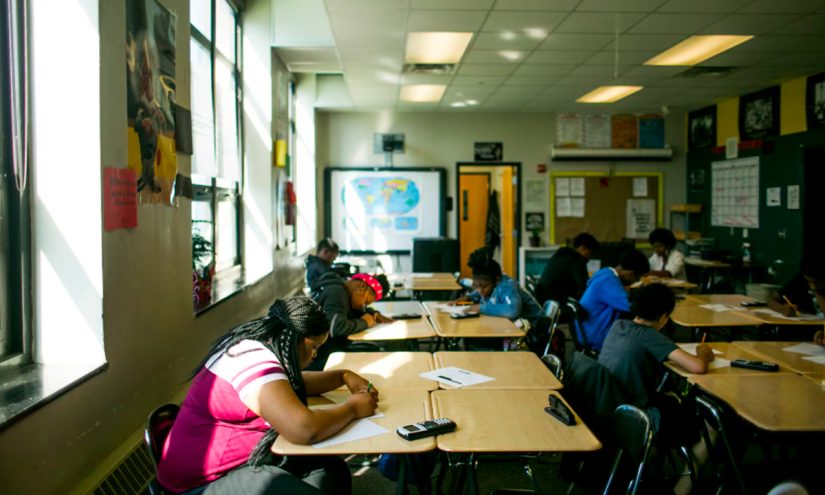
The attendance incentive is aimed at improving attendance in the district, where two-thirds of nearly 49,999 students were considered chronically absent during the 2023-24 school year. The incentive is among a number of efforts the district has employed over the years to create an attendance-going culture among students. The district has invested heavily into attendance agents to improve attendance and this school year announced that students with extremely high rates of chronic absenteeism will be held back a grade at the K-8 level and required to repeat classes at the high school level.
The number of students earning the perfect attendance incentive is a fraction of the nearly 15,000 high school students in the district, leading one school board member to question last week whether the incentive is working. But Vitti said he is encouraged that the program is getting more high school students to class and resulting in a small decrease in the chronic absenteeism rate for high school students. He said the district and board will have to evaluate the program’s success at the end of the school year.
Chronic absenteeism has been one of the district’s biggest challenges for years. The chronic absenteeism rate has declined, from a high of nearly 80% at the height of the pandemic, when quarantining rules meant many students missed school because of COVID exposure. But last school year’s much lower chronic absenteeism rate of 66% still means it is difficult to have consistency in the classroom and improve academic achievement.
Students in Michigan are chronically absent when they miss 10%, or 18 days in a 180-day school year. Statewide, 30% of students are considered chronically absent, compared to 23% nationally. A recent education scorecard cited the state’s rate as being a factor in students’ slow academic recovery from the pandemic.
Here are some of the highlights of the students who’ve received the incentive so far::
3,473 students had perfect attendance during the first cycle.
3,492 students had perfect attendance during the second cycle.
About 10% already had perfect attendance.
About 4% were considered chronically absent at the time the incentive began.
About 16% had missed 10% of the school year at the time the incentive began.
About 25% had missed 5-10% of the school year.
About 44% had missed 5% or fewer days in the school year.
At a Detroit school board meeting last week, Vitti said the statistic showing that just 10% of the students who earned the incentive already had perfect attendance is an indication that “this is not just rewarding those that have already been going to school.”
Board member Monique Bryant questioned what school leaders are doing to promote the incentive to students who haven’t earned it.
Bryant suggested that data Vitti shared at the meeting showing that chronic absenteeism is down by 5 percentage points for high school students since the incentive began is an illustration that most students aren’t rising to the goal of the incentive.
Vitti responded that it depends on how you look at the data.
“Right now, chronic absenteeism at the high school levels improved by five percentage points,” Vitti said. “That means that 700 high school students are not chronically absent where they were last year. I’d also say that at least on the 97th day, our chronic absenteeism at the high school levels is the lowest it’s been since the pandemic.”
The question for board members to decide at the end of the school year is whether the incentive “is the right investment with other challenges that we have districtwide,” Vitti said. “But I think the data is suggesting it’s working for many students … but not all.”
Board member Ida Simmons Short urged the district to survey students to learn more about what is preventing them from coming to school.
The causes of chronic absenteeism are numerous and include physical and mental health reasons, lack of transportation,and lack of affordable housing. Most of them tie back to poverty. Vitti specifically cited transportation, because half of the students in the district don’t attend their neighborhood school and the district doesn’t provide school bus transportation for high school students, who must take city buses to get to school.
“Sometimes they’re unreliable, they’re late, they’re too far away from where the child lives,” Vitti said.
Vitti said traditional school bus transportation for high school students “was decimated” under emergency management and it could cost between $50 million and $100 million to bring that level of transportation back.
Another factor, Vitti said, is that for some students, school isn’t relevant. Middle and high school students, in particular, “struggle to understand, ‘why am I going to school every day? How is this connected to what I’m going to I need to know for life.’”
Mi’Kah West, a Cass Technical High School student who serves as a student representative on the board, said that when talking to other members of the District Executive Youth Council last week, many said students overall are excited about the incentive.
One thing that stuck out, she said, was council members saying they heard students in the hallways or on social media saying they were coming to school because they want the money.
“And, while we don’t want to just say we want to come to school for the money,” West said, “I think it’s important to see that students … may have stayed home because they don’t want to come to school, but they’re willing to come to school now.”
Lori Higgins is the bureau chief for Chalkbeat Detroit. You can reach her at [email protected].
Chalkbeat is a nonprofit news site covering educational change in public schools.