Tag: girls

  • Teen Girls, Marriage, and Social Inequality

    Teen Girls, Marriage, and Social Inequality

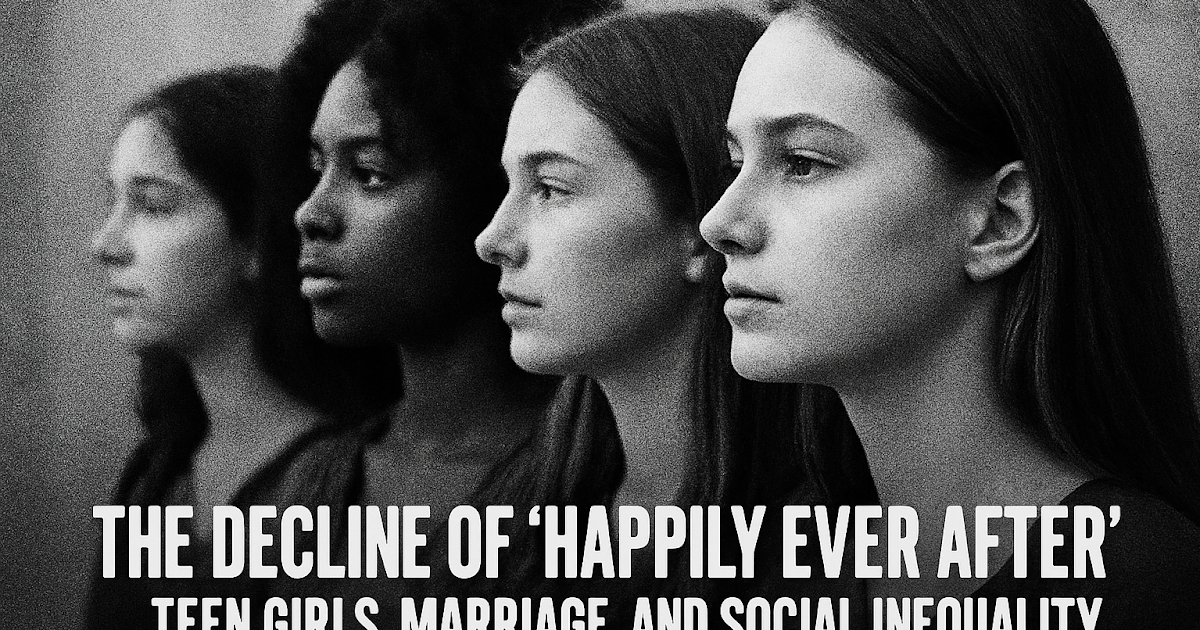
    A profound shift is taking place in the aspirations of American teenagers. In a Pew Research analysis of 2023 University of Michigan survey data, only 61 percent of 12th-grade girls expected to marry someday, down sharply from 83 percent in 1993. Boys, in contrast, reported a stable 74 percent, surpassing girls for the first time. Alongside this, fewer teens anticipated having children or staying married for life. Only 48 percent of 12th-graders said they were “very likely” to want children, and belief in lifelong marriage dropped from 59 percent to 51 percent over three decades.

    These figures are more than statistical curiosities; they reflect structural changes in the lives of young women and reveal how cultural, economic, and social inequality shape personal expectations. Access to education and professional opportunity has expanded dramatically for women, allowing them to envision futures independent of traditional marriage and family structures. Yet these gains exist alongside persistent barriers: economic instability, student debt, and unequal labor markets make long-term commitments like marriage and homeownership fraught and uncertain. For many girls, the choice to delay or reject marriage is not merely personal—it is pragmatic.

    Cultural shifts amplify this trend. For decades, mainstream media promoted the narrative of “happily ever after,” equating personal fulfillment with marriage and motherhood. Today, stories about self-discovery, financial independence, and flexibility dominate the imagination of young women. In this context, marriage is no longer the default marker of adulthood or success; it is one of many possible pathways, often weighed against educational ambitions, career goals, and economic realities.

    This evolution of expectations is deeply intertwined with inequality. Historically, marriage has often reinforced gendered hierarchies, particularly among working-class and minority women, for whom early marriage frequently constrained educational and career opportunities. Delaying marriage, or choosing to forgo it altogether, can represent a form of empowerment—but it also exposes young women to the structural vulnerabilities of a society where social support and economic stability are unevenly distributed. For those without family wealth or safety nets, the decision to prioritize education or autonomy over marriage is often a negotiation with risk rather than pure choice.

    The broader social implications are significant. Declining enthusiasm for marriage may influence fertility patterns, reshape household structures, and challenge institutions built around traditional family models. For policymakers, educators, and social institutions, the question becomes whether systems will adapt to support diverse life paths or continue to privilege outdated models that assume early marriage and childbearing. For young women navigating these choices, the cultural shift represents both liberation and uncertainty, an opportunity to define adulthood on their own terms amid economic and social pressures.

    As these teenagers mature, their choices may redefine what adulthood looks like in the United States. The decline in the “happily ever after” fantasy signals not a rejection of commitment, but a recalibration of priorities under the weight of opportunity, constraint, and inequality. It is a moment that reveals how deeply personal aspirations—love, marriage, family—are shaped by the structures, inequities, and possibilities of the world they inherit.


    Sources:

    Ms. Magazine. “Actually It’s Good That Fewer High Schoolers Want to Get Married.” 2025. https://msmagazine.com/2025/11/20/high-school-girls-marriage

    New York Post. “High school girls are shifting away from marriage and ‘happily ever after,’ expert says.” 2025. https://nypost.com/2025/11/25/media/high-school-girls-are-shifting-away-from-marriage-and-happily-ever-after-expert-says

    The Times. “Jobs, porn and manfluencers: the real reasons girls don’t want to get married.” 2025. https://www.thetimes.com/us/news-today/article/why-dont-girls-plan-to-get-married-f7hr8jgp0

    Source link

  • A track meet that pushes girls to greatness

    A track meet that pushes girls to greatness

    The crowd is electric. The starting gun goes off to begin a race, and you can hear and feel the passion of the crowd as they cheer. The announcer feeds the excitement, commentating every stride over the sound system, urging athletes to “pump those arms” and “keep moving.” It’s difficult not to get swept.

    These are the Colgate Women’s Games, the largest amateur track and field series in the United States, which kick off its 50th iteration this year with preliminary meets 28 December. 

    Watching the youngest athletes compete is witnessing sports in its purest form. There’s no pretense, calculated strategies or alternative agendas. It’s just grit, unbridled joy and the thrill of pushing their bodies to the limit. 

    Some triumph and some falter, but they all cross the finish line giving it their all, and that authenticity is what makes the Games special.

    The venue is packed wall-to-wall. Not an empty seat in sight. The athletes fill in every inch of space — so many that you can hardly see the floor beneath them. The girls wrap around what’s known at Colgate as “The Wall,” lining every side of the facility. 

    More than just a track meet

    The line of competitors is so long, it will snake around the entire facility in a sea of athletes waiting for their moment to shine.

    The fierce competitive spirit of the competitors and the crowd’s near proximity to the action combine to generate an almost tangible atmosphere. The energy doesn’t just fuel the competition, it elevates it, pushing performances to another level.

    The Colgate Women’s Games are more than just track meets. They are a gateway to opportunity that transforms lives, with more than 5,000 scholarships awarded, lifelong friendships cultivated and the start of Olympic and professional dreams, athletic and non-athletic.

    “It was some of the best memories I had at that time,” said Dalilah Muhammad, Olympic gold medalist and former 400-meter hurdles world record holder. “Just being a kid, nervous and excited at the same time, while being able to do it with your friends. For me, that was the most important aspect of it. It made me feel like I had a place that I belonged to with friends, that all wanted to be there and do the same thing.”

    The goal is to foster a robust sense of personal accomplishment and self-worth while supporting the coaches who serve as role models and mentors for the girls.

    Ideas sketched out on a napkin

    Alumni include 29 Olympians, countless national champions and current and former world and national record holders at the senior, junior and youth levels. Former competitors now work as teachers, judges, lawyers, executives and ESPN anchors. One of the most recognizable is ESPN SportsCenter anchor Amina Smith.

    The Colgate Women’s Games were the brainchild of Fred Thompson, a New York attorney and founder of a Brooklyn girls’ track club who was frustrated with the state of women’s athletics in the mid-1970s.

    Thompson was an ABC network sportscaster, and was invited to an event hosted by the Colgate-Palmolive Company — a corporate giant known for soap and toothpaste — for the unveiling of a video presentation titled “Colgate’s Women in Sports,” to air on ABC’s telecast of the newly-launched Dinah Shore golf tournament. 

    The video included a segment on Thompson’s Atoms Track Club, where girl athletes trained. In the video they talked about training as well as school, why they enjoyed running and their aspirations on and off the track. It caught the eye of Colgate President David Foster. He saw that Thompson had found a way to instill in women a drive for excellence that would carry over to college and careers. 

    Foster wanted his company to replicate in communities around the country what Thompson had done in his community. 

    “[They were talking] for a long time, scribbling some stuff on a napkin and I’m sitting there wondering what is going on?” said Cheryl Toussaint, an alum of the Atoms Track Club. Toussaint had won a silver medal in the women’s 4 × 400 meters relay at the 1972 Olympics. She is now the Meet Director of the Colgate Women’s Games, having taken over the position from Thompson.

    Getting girls to plan for their future

    But back then, the Games were just rough ideas. Thompson and the Colgate execs wanted to bolster the sport for women, give them more opportunities and provide scholarships that could be applied to any level of education.

    A pilot program at a local college gym drew a massive turnout. Colgate-Palmolive saw that with awards and scholarship opportunities, it could be something that would resonate.

    Now, the Games consist of eight events — six track distances plus shot put and high jump — in six divisions for the women to compete in.

    Competitors collect points for results in preliminary rounds, and those with the highest numbers move on to the semi-finals and the grand finale on 7 February 2026, which will be available livestream on ArmoryTrack.org

    The top six finishers in each event will receive a trophy and the top three finishers will be rewarded an additional educational scholarship in denominations of $2,000, $1,000 and $500. Special awards are also given for most outstanding and improved performances as well as most promising performance from a newcomer.

    From local to national

    All girls and women from elementary school grades 1 and up are eligible to participate in the Colgate Women’s Games. No prior experience in track and field is necessary, but all girls of school-age must be enrolled and attending school in order to participate.

    As the years continued, the Games began to grow from a local meet, to a regional meet and even a national meet where girls from states such as Georgia, Arizona and Texas would travel to New York to compete.

    But it’s the finals that set the Games apart. The finals aren’t just the last series of races; it’s a celebration, a ceremony marking the culmination of the preliminary and semifinal rounds.

    Muhammad and many other Olympians such as Nia Ali, Ajee Wilson, Natasha Hastings, Kim Thomas Barnes (Carter), Diane Dixon and Athing Mu got their start here. The Olympians produced by the Games would represent multiple nations, demonstrating their international reach.

    The Games’ impact extends beyond the track; the skills and confidence built from competing has led to careers in education, medicine, business, law, media and beyond. Some Games alumni, like basketball star Lorin Dixon, went on to excel in other sports.

    Scholarships get girls thinking about college.

    Colgate Women’s Games gives the competitors the chance to earn scholarships to college as early as Grade 1, around the age of 6 or 7, which gets parents and guardians planning that early for a college path for their daughters. If they continue competing, the scholarships accumulate.  

    If the scholarship earners opt out of college, they can apply that scholarship to career training.

    For the women who would go on to run track at the high school and collegiate level, the Games introduced them to the scoring system. The girls learn at an early age how their performance affects their score and overall placement in the meet, along with race strategies to earn the maximum number of points possible. 

    This knowledge helps when competing at the next level where point scoring is a crucial aspect to high school and collegiate track.

    Empowering women through sports

    Numerous alumni have embraced the Colgate Women’s Games’ mission of empowering young girls and women.

    Consider Olicia Williams, Games’ alum and three-time All-American at Baylor University, who after years of mentoring youth and serving the community through The Armory Foundation, along with coaching her high school and college alma mater, created Lili’s Lionesses Track Club, a program focused on enabling young women to thrive in academics, sports and personal development.

    Impact alone doesn’t ensure survival. The Games continue to thrive after 50 years because their model is built on values that extend beyond any single season or generation.

    Foremost, it’s a developmental series. Because it’s not a one-off competition, girls with no experience can come to each competition and learn as they compete. They learn they don’t need expensive equipment to participate in the sport.

    Toussaint pointed out that the series not only develops competitors from a physical standpoint; it develops them mentally. 

    “When younger girls fall down, come in last or get bumped out of competition and feel dejected, we help them understand that it’s just one day,” Toussaint said. “We tell them and their parents, this is a place to learn what you’re made of, develop your skills and improve on what you did before.”

    Eliminating barriers

    The Games are free for the competitors. This makes it different from the many track meets and running events that are surprisingly expensive

    Muhammad said that everyone is there for the right reasons. “No one’s there doing it for any type of money and that’s what makes Colgate so great,” she said. “You have great people doing it for a cause that’s bigger than themselves and it’s inspiring.”

    Thompson died in 2019 from complications of Alzheimer’s disease. But his legacy lives on through all the lives he’s helped, and he would be thrilled to see the Games’ 50th anniversary, says Toussaint. “He would cry tears of joy,” she said. 

    Women’s sports have finally surged into the mainstream. There’s WNBA stars A’ja Wilson and Sabrina Ionescu launching signature shoes that are high performing in sales, and women headlining Ultimate Fighting Championship events and selling out arenas. There’s Serena Williams transcending sport to become a global icon. But it’s important to remember that this success didn’t emerge spontaneously. It was built by pioneers who invested in women athletes long before it was profitable or popular.

    The Colgate Women’s Games belong in that conversation as a cornerstone of women’s sports.


    Questions to consider:

    1. What is one thing about the Colgate Women’s Games that makes it different from other track and field competitions for women?

    2. How can sports help girls off the field?

    3. In what ways can competition be both good and bad?



    Source link

  • When young girls pay the cost of climate change

    When young girls pay the cost of climate change

    Jaffarabad, Balochistan: When floodwaters swept through Shaista’s village in 2022, they didn’t just take her family’s home and farmland, they also took away her childhood. Just 14 years old, Shaista was married off to a man twice her age in exchange for a small dowry. 

    Her father, a daily wage laborer, said it was the most painful decision he has ever made.

    “I didn’t want to do it,” he said, his eyes fixed on the cracked earth where his fields used to be. “But I have four other children to feed and no land to farm. We lost everything.”

    Stories like Shaista’s are becoming increasingly common across Balochistan, Pakistan’s poorest province. In 2022, devastating floods there driven by record-breaking monsoon rains and accelerated glacial melt linked to climate change, displaced over 1.5 million people.

    There is worldwide recognition that extreme weather events — not just floods, but drought, heatwaves, tornados and hurricanes — are becoming more frequent and less predictable as the planet warms. These events have devastating and long-term consequences for people in poor regions. 

    Young girls as assets 

    In districts like Jaffarabad and Chowki Jamali, the aftermath of the disaster has left families grappling with deepening poverty, food insecurity and crushing debt. For many, marrying off their young daughters is no longer just a tradition, it’s a form of survival.

    A 2023 survey by the Provincial Disaster Management Authority reported a 15% spike in underage marriages in flood-affected regions. Child rights activists warn that these numbers likely underestimate the scale of the crisis, as most cases go unreported.

    “In flood-hit areas, families are exchanging their daughters to repay loans, buy food or simply reduce the number of mouths to feed,” said Maryam Jamali, a social worker with the Madad Community organization. “We’ve documented girls as young as 12 being married to men in their forties or fifties. This isn’t about tradition anymore, it’s desperation.”

    Bride prices, once a source of negotiation and family prestige, have plummeted due to the economic collapse. Activists report instances where girls are married for as little as 100,000 Pakistani rupees (roughly US$360), or in some cases, simply traded for livestock or debt forgiveness.

    “There are villages where girls are married off like assets being liquidated,” said Sikander Bizenjo, a co-founder of the Balochistan Youth Action Committee. “It’s not just a violation of rights, it’s a systemic failure rooted in climate vulnerability, poverty and legal gaps.”

    Marriage as debt payment

    In Usta Muhammad, another flood-ravaged district, 13-year-old Sumaira (name changed) was married off just weeks after her family’s mud house collapsed. Her parents received 300,000 rupees (a little over $1,000) from the groom’s family, which they used to rebuild their shelter and repay moneylenders. 

    Now pregnant, Sumaira, has dropped out of school and rarely leaves her husband’s house.

    “I miss my friends and school,” she told us softly. “I wanted to become a teacher. But my parents said there was no other way.”

    Child marriages like Shaista’s and Sumaira’s carry lasting consequences: early pregnancies that endanger both mother and child, disrupted education, psychological trauma and lifetime economic dependence. 

    A study following the 2010 floods found maternal mortality rates in some affected regions were as high as 381 per 100,000 live births, one of the highest in the world.

    “These girls are thrust into adult roles before they’re ready,” said Dr. Sameena Khan, a gynecologist in Quetta. “They face dangerous pregnancies, and many have no access to medical care. Their childhood ends the moment they say ‘yes’ or are forced to.”

    Giving girls an alternative to marriage

    The crisis unfolding in Balochistan is not unique. Across the world, climate shocks and civil strife are causing displacement that intensifies the risk of child marriage. 

    In 2024, News Decoder correspondent Katherine Lake Berz interviewed 14-year-old Ola, who nearly became a child bride after her Syrian family, displaced by war and facing severe poverty, began arranging her marriage to an older man. But before that coil happen, Ola was able to enroll in Alsama, a non-governmental organization that provides secondary education to refugee girls. In less than a year, she was reading English at A2 level.

    Alsama, which has more than 900 students across four schools and a waiting list of hundreds, has been able to show girls and their parents that education can offer an alternative path to security and dignity.

    In Balochistan, the absence of legal safeguards compounds the crisis. The Sindh province banned child marriage in 2013 under the Sindh Child Marriage Restraint Act which set the legal age at 18 for both girls and boys. But Balochistan has yet to enact a comparable law. 

    Nationally, Pakistan remains bound by the UN Convention on the Rights of the Child, which requires nations to end child marriage but enforcement remains patchy. And Pakistan is not one of the 16 countries that have also signed onto the Convention on Consent to Marriage, Minimum Age for Marriage and Registration of Marriages, which forbids marriage before a girl reaches puberty and requires complete freedom in the choice of a spouse. 

    Pakistan needs to reform its laws, said human rights lawyer Ali Dayan Hasan. “Without a clear provincial law and mechanisms to enforce it, girls are at the mercy of social pressure and economic collapse,” Hasan said. “We need legal reform that matches the urgency of the climate and humanitarian crises we are facing.”

    Attempts to introduce child marriage laws in Balochistan have repeatedly stalled amid political resistance and lack of awareness. Religious and tribal leaders argue that such laws interfere with cultural norms, while government officials cite limited administrative capacity in rural areas.

    Bringing an end to child marriages

    The solution, experts agree, is multi-pronged: legal reform, economic recovery and access to education.

    “We can’t end child marriage without rebuilding livelihoods,” said Bizenjo. “Families need food, land, healthcare and hope. If they can’t survive, they’ll continue to sacrifice their daughters.”

    Grassroots organizations like Madad and Sujag Sansar provide vocational training, safe shelters and legal awareness sessions in flood-affected areas. In one case, Sujag Sansar intervened to stop the marriage of 10-year-old Mehtab in Sindh, enrolling her in a sewing workshop instead.

    UNICEF estimates that child marriages could increase by 18% in Pakistan due to the 2022 floods, potentially reversing years of progress. The agency is urging governments to integrate child protection into climate adaptation and disaster relief programs.

    “Girls must not be forgotten in climate response plans,” said UNICEF Pakistan’s representative Abdullah Fadil. “Their future cannot be the cost of every flood, every drought, every crisis.”

    Back in Jaffarabad, Shaista now lives with her husband’s family in a two-room house. Her dreams of becoming a doctor have faded, replaced by household chores and looming motherhood. “I wanted to study more,” she said. “But now I have to take care of others.”


    Questions to consider:

    1. How does the marriage of young girls connect to climate change?

    2. How can societies end the practice of child marriage?

    3. Why do you think only 16 countries have signed the UN treaty that requires consent for marriages?


    Source link

  • Strategies to help girls stay engaged in STEM learning

    Strategies to help girls stay engaged in STEM learning

    Key points:

    • When girls participate in STEM learning, the future is more inclusive
    • 5 practical ways to integrate AI into high school science
    • Linking STEM lessons to real-world applications
    • For more news on STEM learning, visit eSN’s STEM & STEAM hub

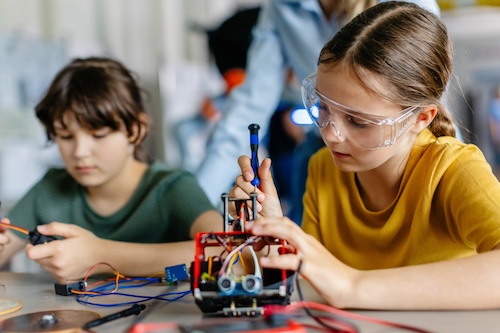
    Encouraging girls to engage in STEM is vital for fostering diversity, innovation, and equal opportunities in these fields. Women remain underrepresented in STEM degrees and in careers, often due to societal stereotypes, lack of representation, and limited access to resources.

    More News from eSchool News

    HVAC projects to improve indoor air quality. Tutoring programs for struggling students. Tuition support for young people who want to become teachers in their home communities.

    Almost 3 in 5 K-12 educators (55 percent) have positive perceptions about GenAI, despite concerns and perceived risks in its adoption, according to updated data from Cengage Group’s “AI in Education” research series.

    Our school has built up its course offerings without having to add headcount. Along the way, we’ve also gained a reputation for having a wide selection of general and advanced courses for our growing student body.

    When it comes to visual creativity, AI tools let students design posters, presentations, and digital artwork effortlessly. Students can turn their ideas into professional-quality visuals, sparking creativity and innovation.

    In my work with middle school students, I’ve seen how critical that period of development is to students’ future success. One area of focus in a middle schooler’s development is vocabulary acquisition.

    For students, the mid-year stretch is a chance to assess their learning, refine their decision-making skills, and build momentum for the opportunities ahead.

    Middle school marks the transition from late childhood to early adolescence. Developmental psychologist Erik Erikson describes the transition as a shift from the Industry vs. Inferiority stage into the Identity vs. Role Confusion stage.

    Art has a unique power in the ESL classroom–a magic that bridges cultures, ignites imagination, and breathes life into language. For English Language Learners (ELLs), it’s more than an expressive outlet.

    In the year 2025, no one should have to be convinced that protecting data privacy matters. For education institutions, it’s really that simple of a priority–and that complicated.

    Teachers are superheroes. Every day, they rise to the challenge, pouring their hearts into shaping the future. They stay late to grade papers and show up early to tutor struggling students.

    Want to share a great resource? Let us know at [email protected].

    Source link

  • GIRLS IN STEM (SCIENCE, TECHNOLOGY, ENGINEERING AND MATH) UPDATE

    GIRLS IN STEM (SCIENCE, TECHNOLOGY, ENGINEERING AND MATH) UPDATE

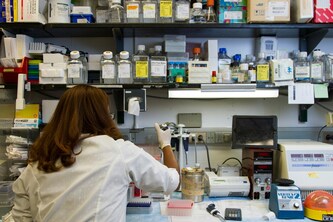
    According to The American Association of University Women(AAUW), throughout their education, girls and women are systematically tracked away from science and math. This limits their access, preparation and opportunities to enter these fields for their careers as adults. By the time students reach college, women are significantly underrepresented in STEM majors.

    Women make up only 34% of the workforce in science, technology, engineering and math (STEM). While this is up from 28% two years ago, it is still significantly less than the existing overall percentage of women, and men vastly outnumber women majoring in most STEM fields in college. The gender gaps are particularly high in some of the fastest-growing and highest-paid jobs of the future, like computer science and engineering.

    Women in STEM Occupations
    Biological Scientists
    46%

    Chemists & Materials Scientists 40.4%
    Computer & Mathematical Occupations 25.2%
    Engineers & Architects 16.5%
    SOURCE: U.S. Bureau of Labor Statistics, “Employed persons by detailed occupation, sex, race, and Hispanic or Latino ethnicity,”
    ​Labor Force Statistics from the Current Population Survey, Table 11, 2020.

    A typical STEM worker earns two-thirds more than those employed in other fields, according to Pew Research Center. And some of the highest-earning STEM occupations, such as computer science and engineering, have the lowest percentages of women workers. Giving women equal opportunities to pursue and succeed in STEM careers helps narrow the gender pay gap, enhances women’s economic security, ensures a diverse and talented STEM workforce and prevents biases in these fields and the products and services they produce.

    To help close the STEM Gap, it is important that girls and women are given the skills and confidence to succeed in math and science. There should be improvements in STEM education and support for girls starting in early education and through K-12. Every student should be exposed to engineering and computer science, and Next Generation Science Standards. Classes should be taught by connecting STEM experiences to girls’ lives, promoting active, hands-on learning and emphasizing ways STEM is collaborative and community-oriented.

    AAUW also suggests expanding after-school and summer STEM opportunities for girls. They suggest Increasing awareness of higher education and career opportunities, pathway opportunities, role models and mentoring programs with women in STEM for girls.

    While there have been some advances, more efforts need to be made to help women close the STEM gap. Educational consultants can help encourage young women with academic aptitudes and interests in math, science, computers and engineering to explore career paths they may not have considered for their future.


    Source link