Tag: Glen

  • Hyper Credentialism and the Neoliberal College Meltdown (Glen McGhee and Dahn Shaulis)

    Hyper Credentialism and the Neoliberal College Meltdown (Glen McGhee and Dahn Shaulis)

    In the neoliberal era, higher education has become less a public good and more a marketplace of promises. The ideology of “lifelong learning” has been weaponized into an endless treadmill of hyper-credentialism — a cycle in which students, workers, and institutions are trapped in perpetual pursuit of new degrees, certificates, and micro-badges.

    From Education to Signaling

    Once, a college degree was seen as a path to citizenship and critical thought. Today, it’s a market signal — and an increasingly weak one. The bachelor’s degree no longer guarantees stable employment, so the system produces ever-more credentials: master’s programs, micro-certificates, “badges,” and other digital tokens of employability.

    This shift doesn’t solve economic precarity — it monetizes it. Workers internalize the blame for their own stagnating wages, believing that the next credential will finally make them “market ready.” Employers, meanwhile, use credential inflation to justify low pay and increased screening, outsourcing the costs of training onto individuals.

    A Perfect Fit for Neoliberalism


    Hyper-credentialism is not a side effect; it’s a feature of the neoliberal education economy. It supports four pillars of the model:

    Privatization and Profit Extraction – Public funding declines while students pay more. Each new credential creates a new revenue stream for universities, online program managers (OPMs), and ed-tech corporations.

    Individual Responsibility – The structural causes of unemployment or underemployment are reframed as personal failures. “You just need to upskill.”

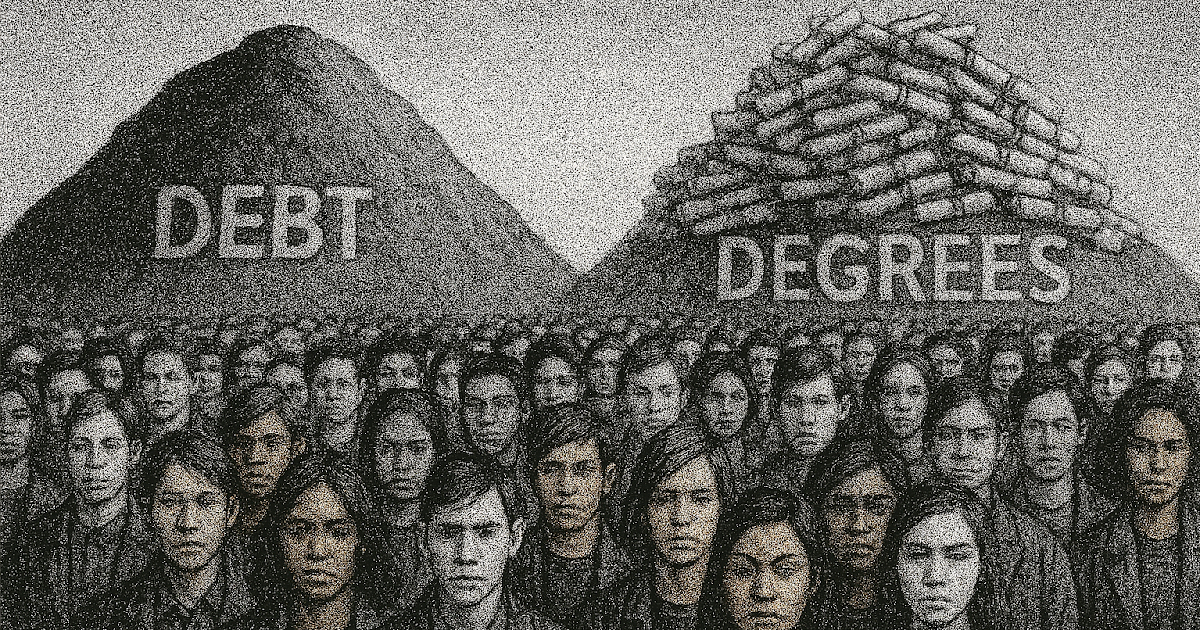
    Debt Dependency – Students and workers finance their “reskilling” through federal loans and employer-linked programs, feeding the student-debt industry and its servicers.

    Market Saturation and Collapse – As more credentials flood the market, each becomes less valuable. Institutions respond by creating even more credentials, accelerating the meltdown.

    The Education-Finance Complex

    The rise of hyper-credentialism is inseparable from the growth of the education-finance complex — a web of universities, private lenders, servicers, and Wall Street investors.
    Firms like 2U, Coursera, and Guild Education sell the illusion of “access” while extracting rents from students and institutions alike. University administrators, pressured by enrollment declines, partner with these firms to chase new markets — often by spinning up online master’s programs with poor outcomes.

    The result is a debt-driven ecosystem that thrives even as public confidence collapses. The fewer good jobs there are, the more desperate people become to buy new credentials. The meltdown feeds itself.

    Winners and Losers

    Winners: Ed-tech executives, university administrators, debt servicers, and the politicians who promote “lifelong learning” as a substitute for wage growth or labor rights.

    Losers: Students, adjunct faculty, working-class families, and the public universities hollowed out by austerity and privatization.

    The rhetoric of “upskilling” and “personal growth” masks a grim reality: a transfer of wealth from individuals to financialized institutions under the guise of opportunity.

    A System That Can’t Redeem Itself

    As enrollment declines and public trust erodes, the industry doubles down on micro-credentials and “stackable” pathways — small fixes to a structural crisis. Each badge, each certificate, is sold as a ticket back into the middle class. Yet every new credential devalues the old, producing diminishing returns for everyone except those selling the product.

    Hyper-credentialism thus becomes both the symptom and the accelerant of the college meltdown. It sustains the illusion of mobility in a collapsing system, ensuring that the blame never reaches the architects of austerity, privatization, and financialization.

    Sources and Further Reading

    Brown, Wendy. Undoing the Demos: Neoliberalism’s Stealth Revolution.

    Giroux, Henry. Neoliberalism’s War on Higher Education.

    Cottom, Tressie McMillan. Lower Ed: The Troubling Rise of For-Profit Colleges in the New Economy.

    The Higher Education Inquirer archives on the college meltdown, OPMs, and the debt economy.

    Source link

  • When Was Higher Education Truly a Public Good? (Glen McGhee)

    When Was Higher Education Truly a Public Good? (Glen McGhee)

    Like staring at the Sun too long, that brief window in time, when higher ed was a public good, has left a permanent hole for nostalgia to leak in, becoming a massive black hole for trillions of dollars, and a blind-spot for misguided national policies and scholars alike. 

    The notion that American higher education was ever a true public good is largely a myth. From the colonial colleges to the neoliberal university of today, higher education has functioned primarily as a mechanism of class reproduction and elite consolidation—with one brief, historically anomalous exception during the Cold War.


    Colonial Roots: Elite Reproduction in the New World (1636–1787)

    The first American colleges—Harvard, William and Mary, Yale, Princeton, and a handful of others—were founded not for the benefit of the public, but to serve narrow elite interests. Their stated missions were to train Protestant clergy and prepare the sons of wealthy white families for leadership. They operated under monopoly charters and drew funding from landowners, merchants, and slave traders.

    Elihu Yale, namesake of Yale University, derived wealth from his commercial ties to the East India Company and the slave trade. Harvard’s early trustees owned enslaved people. These institutions functioned as “old boys’ clubs,” perpetuating privilege rather than promoting equality. Their educational mission was to cultivate “gentlemen fit to govern,” not citizens of a democracy.


    Private Enterprise in the Republic (1790–1860)

    After independence, the number of colleges exploded—from 19 in 1790 to more than 800 by 1880—but not because of any commitment to the public good. Colleges became tools for two private interests: religious denominations seeking influence, and land speculators eager to raise property values.

    Ministers often doubled as land dealers, founding small, parochial colleges to anchor towns and boost prices. State governments played a minimal role, providing funding only in times of crisis. The Supreme Court’s 1819 Dartmouth College decision enshrined institutional autonomy, shielding private colleges from state interference. Even state universities were created mainly out of interstate competition—every state needed its own to “keep up with its neighbors.”


    Gilded Age and Progressive Era: Credential Capitalism (1880–1940)

    By the late 19th century, industrial capitalism had transformed higher education into a private good—something purchased for individual advancement. As family farms and small businesses disappeared, college credentials became the ticket to white-collar respectability.

    Sociologist Burton Bledstein called this the “culture of professionalism.” Families invested in degrees to secure middle-class futures for their children. By the 1920s, most students attended college not to seek enlightenment, but “to get ready for a particular job.”

    Elite universities such as Harvard, Yale, and Princeton solidified their dominance through exclusive networks. C. Wright Mills later observed that America’s “power elite” circulated through these same institutions and their associated clubs. Pierre Bourdieu’s concept of cultural capital helps explain this continuity: elite universities convert inherited privilege into certified merit, preserving hierarchy under the guise of meritocracy.


    The Morrill Acts: Public Promise, Private Gains (1862–1890)

    The Morrill Act of 1862 established land-grant colleges to promote “practical education” in agriculture and engineering. While often cited as a triumph of public-minded policy, the act’s legacy is ambivalent.

    Land-grant universities were built on land expropriated from Indigenous peoples—often without compensation—and the 1890 Morrill Act entrenched segregation by mandating separate institutions for Black Americans in the Jim Crow South. Even as these colleges expanded access for white working-class men, they simultaneously reinforced racial and economic hierarchies.


    Cold War Universities: The Brief Public Good (1940–1970)

    For roughly thirty years, during World War II and the Cold War, American universities functioned as genuine public goods—but only because national survival seemed to depend on them.

    The GI Bill opened college to millions of veterans, stabilizing the economy and expanding the middle class. Massive federal investments in research transformed universities into engines of technological and scientific innovation. The university, for a moment, was understood as a public instrument for national progress.

    Yet this golden age was marred by exclusion. Black veterans were often denied GI Bill benefits, particularly in the South, where discriminatory admissions and housing policies blocked their participation. The “military-industrial-academic complex” that emerged from wartime funding created a new elite network centered on research universities like MIT, Stanford, and Berkeley.


    Neoliberal Regression: Education as a Private Commodity (1980–Present)

    After 1970, the system reverted to its long-standing norm: higher education as a private good. The Cold War’s end, the tax revolt, and the rise of neoliberal ideology dismantled the postwar consensus.

    Ronald Reagan led the charge—first as California governor, cutting higher education funding by 20%, then as president, slashing federal support. He argued that tuition should replace public subsidies, casting education as an individual investment rather than a social right.

    Since 1980, state funding per student has fallen sharply while tuition at public universities has tripled. Students are now treated as “customers,” and universities as corporations—complete with branding departments, executive pay packages, and relentless tuition hikes.


    The Circuit of Elite Network Capital

    Today, the benefits of higher education flow through a closed circuit of power that links elite universities, corporations, government agencies, and wealthy families.

    1. Elite Universities consolidate wealth and prestige through research funding, patents, and endowments.

    2. Corporations recruit talent and license discoveries, feeding the same institutions that produce their executives.

    3. Government and Military Agencies are staffed by alumni of elite universities, reinforcing a revolving door of privilege.

    4. Elite Professions—law, medicine, finance, consulting—use degrees as gatekeeping mechanisms, driving credential inflation.

    5. Wealthy Families invest in elite education as a means of preserving status across generations.

    What the public receives are only residual benefits—technologies and medical innovations that remain inaccessible without money or insurance.


    Elite Network Capital, Not Public Good

    The idea of higher education as a public good has always been more myth than reality. For most of American history, colleges and universities have functioned as institutions of elite reproduction, not engines of democratic uplift.

    Only during the extraordinary conditions of the mid-20th century—when global war and ideological conflict made mass education a national imperative—did higher education briefly align with the public interest.

    Today’s universities continue to speak the language of “public good,” but their actions reveal a different truth. They serve as factories of credentialism and as nodes in an elite network that translates privilege into prestige. What masquerades as a public good is, in practice, elite network capital—a system designed not to democratize opportunity, but to manage and legitimize inequality.


    Sources:

    Labaree (2017), Bledstein (1976), Bourdieu (1984, 1986), Mills (1956), Geiger (2015), Thelin (2019), and McGhee (2025).

    Source link

  • Charlie Kirk’s Assassination Through the Lens of Collins and Hoffer (Glen McGhee and Dahn Shaulis)

    Charlie Kirk’s Assassination Through the Lens of Collins and Hoffer (Glen McGhee and Dahn Shaulis)

    The assassination of Charlie Kirk on September 10, 2025, offers a stark illustration of how violent acts against movement leaders can reconfigure political energy on U.S. campuses. Kirk was the leader of Turning Point USA, Turning Point Action (formerly Students for Trump), and Turning Point Faith. He was also the creator of the Professor Watchlist and the School Board Watchlist

    Far from diminishing conservative student mobilization, Kirk’s death appears to have amplified it—at least in the short term. Randall Collins’ sociology of interaction ritual chains and Eric Hoffer’s classic analysis of mass movements provide a useful lens for understanding both the surge and the likely limits of this moment.

    Collins’ Emotional Energy Framework Applied to Kirk’s Death

    Collins identifies four outcomes of successful ritual gatherings: group solidarity, emotional energy, sacred symbols, and moral righteousness. In the wake of Kirk’s assassination, conservative students and evangelical leaders have experienced all four in compressed, amplified form.

    Pastors quickly declared Kirk a “Christian martyr.” Rob McCoy invoked biblical precedent, while Jackson Lahmeyer described the murder as “spiritual in nature and an attack on the very institution of the church.” This religious framing elevates Kirk from activist to sacred symbol.

    The immediate response has been extraordinary. Turning Point USA claims more than 32,000 requests for new chapters in the 48 hours following his death. Collins would interpret this as emotional energy seeking new ritual outlets. In this sense, Kirk’s martyrdom has become not just a grievance but a generator of collective action.

    The memorial scheduled for September 21 at State Farm Stadium—with capacity for more than 60,000 and featuring Donald Trump—is set to be the largest ritual gathering in the history of conservative student politics. Collins would predict this to be a high-intensity moment of “collective effervescence,” the kind of event that extends emotional energy for months if not years.

    Hoffer’s Mass Movement Dynamics and Conservative Student Mobilization

    Hoffer’s The True Believer provides a complementary angle. He argued that mass movements thrive on frustration, doctrine, and the presence of either a leader or a transcendent cause. Kirk’s assassination intensified frustration while transforming him into a more powerful symbolic figure than he was in life.

    Student conservatives now have all three: grievance (left-wing violence), a sacred cause (free speech framed as religious duty), and a heroic narrative (following a martyred leader). In Hoffer’s words, martyrdom provides both “grievance and transcendent meaning.”

    The shift from Kirk as a living leader to Kirk as martyr reflects Hoffer’s principle of substitutability. Loyalty has already migrated from the man himself to the mythology of his sacrifice. College Republicans chairman William Donahue compared the killing to Martin Luther King Jr.’s assassination, framing it as a watershed for the movement.

    Sustainability and the Ritual Problem

    The paradox is that Kirk’s most important contribution—the high-energy confrontational rituals of his “Prove Me Wrong” campus debates—cannot be replicated without him. These events generated viral spectacle, solidified conservative identity, and created sacred moments of confrontation. They were, in Collins’ terms, engines of emotional energy.

    The September 21 memorial may provide a one-time boost, but Collins emphasizes that emotional energy must be renewed through repeated rituals. Without Kirk’s charisma and willingness to create confrontational spaces, conservative students risk energy dissipation. Already some students report greater enthusiasm for activism, while others express fear of being targeted themselves.

    The dilemma is clear: the rituals that generated the most energy (public confrontations) are the very ones most likely to invite violence. This tension may limit the sustainability of the movement’s current surge.

    The Profit Motive: Martyrdom as Marketplace

    Beyond the sociology of solidarity lies a material reality: martyrdom is also a business model. Conservative organizations are already converting Kirk’s death into a revenue stream. Within hours of the assassination, Turning Point USA launched fundraising appeals invoking Kirk’s “sacrifice,” while conservative merchandisers began selling commemorative t-shirts, hats, and wristbands emblazoned with slogans like “Martyr for Freedom” and “Charlie Lives.”

    Publishing houses are reportedly fast-tracking hagiographic biographies, while streaming platforms are negotiating for documentaries. Memorial events, livestreams, and “Martyrdom Tours” are being packaged as both spiritual rituals and ticketed spectacles. Kirk’s death, in other words, is generating not only emotional energy but also financial capital.

    This profit motive raises questions about the sincerity of the rhetoric surrounding Kirk’s martyrdom. While Collins and Hoffer help explain the emotional pull, the commodification of grief ensures that the “sacred symbol” is also a lucrative brand. Conservative student organizing may thus be sustained less by spontaneous devotion than by a well-financed industry of grievance, merchandise, and media spectacle.

    Indicators to Watch

    Several markers will reveal whether Kirk’s martyrdom produces lasting transformation or burns out in ritual dissipation:

    • Memorial impact: Attendance and intensity at the September 21 gathering will test whether Kirk’s death can generate lasting solidarity.

    • Chapter formation: The real test of Turning Point USA’s 32,000 claims will be functioning chapters in six months.

    • Leadership succession: Hoffer reminds us that movements need charismatic leaders. At present, Trump appears to be monopolizing the emotional energy, raising doubts about the rise of new student leaders.

    • Counter-mobilization: Collins’ conflict theory suggests left-wing backlash could shape whether conservative students double down or retreat.

    The Probable Trajectory

    For the next 6–18 months, conservative student mobilization is likely to grow. The movement now has the grievance, sacred symbolism, and transcendent narrative that both Collins and Hoffer identify as powerful motivators.

    But sustaining this surge will be difficult without Kirk’s unique talent for generating high-energy campus rituals. Unless new leaders emerge who can replicate or reimagine those ritual forms, the emotional energy of martyrdom may eventually dissipate.

    At the same time, the financial infrastructure now growing around Kirk’s death suggests the movement has a fallback strategy: keep the martyrdom alive as long as it remains profitable. In this way, Kirk’s assassination may prove to be not just a sociological event but also a business opportunity—one that reveals the convergence of politics, religion, and profit in contemporary conservative student life.

    Source link

  • How Close Are We to Collapse? (Glen McGhee)

    How Close Are We to Collapse? (Glen McGhee)

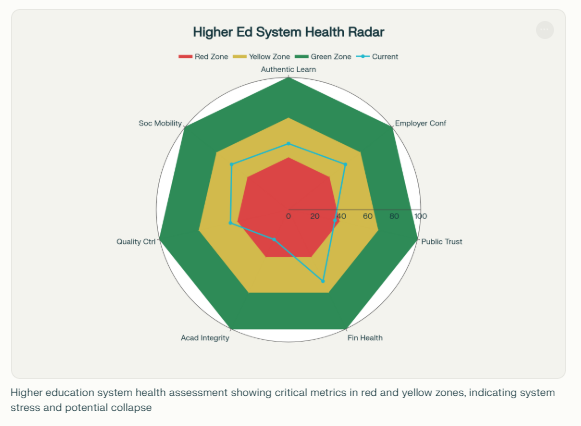
    For years, higher education leaders have avoided one of the most uncomfortable questions in the field: What is the minimum threshold of authentic learning required to keep the system operational? That threshold exists — and recent data suggest we may have already crossed it. The warning signs are visible in eroding public trust, declining employer confidence, and a growing inability to authenticate credentials. What we are watching now is not a temporary disruption, but the managed decline of mass higher education as we have known it.

    A truly viable education system has to deliver four essential functions. It must transmit knowledge — not only basic literacy, numeracy, and critical thinking, but also the domain-specific skills employers recognize, along with the ability to evaluate information in a democratic society. It must authenticate credentials by verifying learner identity, ensuring assessments are legitimate, maintaining tamper-proof records, and clearly differentiating between levels of competence. It must serve as a pathway for social mobility, providing economic opportunities that justify the investment, generating real wage premiums, and fostering professional networks and cultural capital. And it must have reliable quality assurance, with competent faculty, relevant curriculum, trustworthy measurement of learning outcomes, and external accountability strong enough to maintain standards.

    Research into institutional collapse and critical mass theory shows that each of these functions has a minimum operational threshold. The authentic learning rate must exceed 70 percent for degrees to retain their signaling value. Below that point, employers begin to see the credential itself as unreliable. Estimates today range from 30 to 70 percent, depending on the institution and delivery method. Employer confidence must stay above 80 percent for degrees to remain the default hiring credential. When fewer than eight in ten employers trust the degree signal, alternative credentialing accelerates — something already underway as skills-based hiring spreads across industries. Public trust must also remain high, but Gallup’s 2023 data put confidence in higher education at just 36 percent, far below the survival threshold. On the financial side, stability is eroding, with roughly 15 percent of U.S. institutions at risk of closure and more failing each year.

    Despite these trends, parts of the system still function effectively. Elite institutions with rigorous admissions, strong alumni networks, and powerful employer relationships continue to maintain credibility. Professional programs such as medicine, engineering, and law retain integrity through external licensing and oversight. Technical programs tied closely to industry needs still provide authenticated learning with direct employment pathways. Research universities at the graduate level preserve rigor through peer review, publication requirements, and close faculty mentorship. These pockets of quality create the illusion that the overall system remains sound, even as large portions hollow out.

    But the cracks are widening. Public trust is at 36 percent. Fraud rates are climbing beyond detection capacity, with California’s rate estimated at 31 percent. Grade inflation is erasing distinctions between levels of achievement. Authentic learning appears to be hovering somewhere between 30 and 70 percent, putting the system in a yellow warning zone. Financially, the sector remains unstable, with 15 percent of institutions on the brink.

    Higher education is also becoming sharply stratified. At one end are the high-integrity institutions that still maintain meaningful standards, a group that may represent just 20 to 30 percent of the market. In the middle are the credential mills — low-integrity schools operating on volume with minimal quality control, perhaps 40 to 50 percent of the market. On the other end, alternative providers such as bootcamps, apprenticeships, and corporate academies are rapidly filling the skills gap. This stratification allows the system to stagger forward while its core mission erodes.

    Collapse becomes irreversible when several failure points converge. Employer confidence dropping below 50 percent would trigger mass abandonment of degree requirements. Public funding cuts, fueled by political backlash, would intensify. Alternative credentials would reach critical mass, making traditional degrees redundant in many sectors. A faculty exodus would leave too few qualified instructors to maintain quality. Rising student debt defaults could force the federal government to restrict lending.

    The available evidence suggests the tipping point likely occurred sometime between 2020 and 2024. That was when public trust cratered, employer skepticism intensified, financial fragility spread, and the post-pandemic environment made fraud and grade inflation harder to contain. We may already be living in a post-viable higher education system, one where authentic learning and meaningful credentialing are concentrated in a shrinking group of elite institutions, while the majority of the sector operates as a credentialing fiction.

    The question now is whether the surviving components can reorganize into something sustainable before the entire system’s legitimacy evaporates. Without deliberate restructuring, higher education’s role as a public good will vanish, replaced by a marketplace of unreliable credentials and narrowing opportunities. The longer we avoid defining the collapse threshold, the harder it will be to stop the slide.

    Sources: Gallup, Inside Higher Ed, BestColleges, Cato Institute, PMC (National Center for Biotechnology Information), Council on Foreign Relations

    Source link

  • Iron Cage or Golden Handcuffs? (Glen McGhee and Dahn Shaulis)

    Iron Cage or Golden Handcuffs? (Glen McGhee and Dahn Shaulis)

    Max Weber’s “iron cage” described a world where bureaucratic rationality and capitalist structures governed life so thoroughly that individuality and freedom were diminished. Today, Americans still live in that cage, bound by debt, hierarchy, and rules that channel human energy into impersonal systems. Alongside the cage sits another metaphor: the “golden handcuffs.” Unlike the coercion of bureaucracy, golden handcuffs represent the comfort and stability of jobs, mortgages, and benefits that discourage mobility. Taken together, iron and gold shape a society increasingly stuck in place.

    Nowhere is this more visible than in the experience of younger generations. Student loan debt has become one of the most powerful bars of the iron cage. For decades, policymakers sold higher education as the ticket to mobility, yet the financing model has left tens of millions of Americans burdened with obligations that stretch across lifetimes. Parents still paying their own loans now watch their children borrow again, creating a cycle of indebtedness that limits family formation, delays homeownership, and stifles geographic mobility. College graduates often cannot take risks—whether by starting a business, moving to a new city, or pursuing meaningful but lower-paid work—because debt service makes such choices impossible. The American promise of education as liberation has become, for many, education as shackles.

    Layered onto this cage is the massive growth of what anthropologist David Graeber called “bullshit jobs”—roles that exist less to create value than to maintain bureaucratic appearance and control. Whole sectors of the economy are filled with paper-pushers, compliance officers, middle managers, and customer service agents who know that their work adds little or nothing to society. Yet these jobs proliferate because they keep the system running, providing salaries and benefits that workers can’t easily abandon. Here lie the golden handcuffs: people remain in unfulfilling work not because they love it, but because the alternative—losing health insurance, defaulting on loans, or risking homelessness—is too dangerous. In effect, workers trade freedom for security, their ambitions dulled by the constant calculation of what can be risked and what cannot.

    The Wall Street Journal recently documented how job-switching and geographic mobility have fallen to historic lows. For many, the causes are high housing costs, limited relocation packages, and rising mortgage rates. But behind those immediate factors lie deeper structures. Student loan debt reduces the willingness to gamble on uncertain opportunities. Bullshit jobs, however empty, offer just enough stability to keep people locked in place. Older generations, insulated by home equity or pensions, may experience the golden handcuffs as a form of protection, but their children and grandchildren feel more of the iron cage, inheriting debts and diminished opportunities while being funneled into roles that drain meaning from their labor.

    The intergenerational effect is stark. Families once imagined that each generation would surpass the last, but mounting evidence shows downward mobility as the norm. Debt and immobility mean that the youngest workers face worse prospects than their parents, often despite higher levels of formal education. The cage has become hereditary, reinforced by golden handcuffs that reward those already inside while barring others from entry.

    The consequences reach far beyond individual frustration. A society of debt-burdened, risk-averse workers chained to meaningless jobs loses dynamism, creativity, and the possibility of real progress. Economic innovation falters when people cannot afford to move, switch jobs, or challenge existing hierarchies. Civic life suffers when millions are too tired or precarious to participate fully. What Weber described as the cold rationality of bureaucracy now fuses with financialization and corporate incentives to produce both stagnation and quiet despair.

    The question is not only whether Americans are trapped in iron cages or bound by golden handcuffs, but who profits from these arrangements. Student loan servicers, corporate employers, and real estate interests all benefit from a population too indebted, too constrained, and too risk-averse to push back. Unless there is structural change—through debt relief, meaningful labor reform, and a housing policy that restores mobility—the chains will only tighten, passed from one generation to the next.

    The iron cage and the golden handcuffs are not metaphors in tension; they are metaphors in partnership, binding Americans simultaneously by force and by comfort. Together they describe a society that promises freedom while delivering entrapment, and a generation that is learning the hard way that education, work, and home are less ladders to opportunity than carefully designed systems of control.


    Sources

    Max Weber, The Protestant Ethic and the Spirit of Capitalism (1905).

    “Understanding Max Weber’s Iron Cage,” ThoughtCo. https://www.thoughtco.com/understanding-max-webers-iron-cage-3026373

    “Nobody’s Buying Homes, Nobody’s Switching Jobs—and America’s Mobility Is Stalling,” Wall Street Journal, August 14, 2025. https://www.wsj.com/economy/american-job-housing-economic-dynamism-d56ef8fc

    David Graeber, Bullshit Jobs: A Theory (2018).

    Steven J. Davis and John Haltiwanger, “Dynamism Diminished: Housing Markets and Business Formation,” AEA Research (2024). https://www.aeaweb.org/research/charts/dynamism-diminished-housing-markets

    “The Intergenerational Burden of Student Loan Debt,” Brookings Institution, October 2021. https://www.brookings.edu/research/the-intergenerational-burden-of-student-loan-debt/

    Source link

  • Make America Crash Again (Glen McGhee and Dahn Shaulis)

    Make America Crash Again (Glen McGhee and Dahn Shaulis)

    Climate change has begun to have immediate effects, with increasing natural disasters disrupting communities and infrastructure. Reduced environmental regulations have intensified these risks, disproportionately affecting vulnerable populations and increasing economic costs.

    The rollback of regulatory protections in finance, environment, and education has allowed risky practices to grow while reducing oversight. This shift has raised the chances of economic shocks and deepened social inequalities.

    Trade disputes and reduced international cooperation have weakened key economic and diplomatic relationships. At the same time, BRICS countries are expanding their influence, altering the global economic landscape in ways that require careful attention.

    The expansion of surveillance programs and strict immigration enforcement have raised concerns about civil liberties and community trust. These pressures threaten the social cohesion needed to address larger systemic issues.

    Recent reporting by the Higher Education Inquirer shows that the student debt crisis and speculative financial pressures in higher education mirror and magnify these broader challenges. The sector’s increasing reliance on debt financing not only affects students but also contributes to wider economic fragility (HEI 2025).

    Earlier analysis emphasized that these trends were predictable outcomes of longstanding policy decisions and economic structures (HEI 2020).

                 [Analysis of US Economic Downturns for duration and population impact]

    Preventing a serious downturn requires coordinated action on multiple fronts. Strengthening regulations is necessary to reduce financial risks and protect consumers. Effective climate policies are essential, particularly those focused on vulnerable communities. Reforming higher education financing to reduce unsustainable debt burdens can ease economic pressures. Restoring international cooperation and fair trade practices will help rebuild economic and diplomatic relationships. Protecting civil rights and fostering social trust are crucial to maintaining social cohesion.

    These issues are deeply interconnected and require comprehensive approaches.

    Sources

    Higher Education Inquirer, Let’s Pretend We Didn’t See It Coming…Again (June 2025): https://www.highereducationinquirer.org/2025/06/lets-pretend-we-didnt-see-it-comingagain.html

    Higher Education Inquirer, The US Working‑Class Depression: Let’s All Pretend We Couldn’t See It Coming (May 2020): https://www.highereducationinquirer.org/2020/05/lets-all-pretend-we-couldnt-see-it.html

    Federal Reserve, Consumer Credit Report, 2025

    U.S. Department of Education, Student Loan Debt Statistics, 2025

    Intergovernmental Panel on Climate Change (IPCC), Sixth Assessment Report, 2023

    Council on Foreign Relations, The BRICS and Global Power, 2024

    Source link

  • A 20-Year Reflection on Transparency and the Illusion of Access (Glen McGhee)

    A 20-Year Reflection on Transparency and the Illusion of Access (Glen McGhee)

    The cancellation of the latest NACIQI (National Advisory Committee on Institutional Quality and Integrity) meeting brought back bitter memories that refuse to fade. 

    It’s been twenty years since I traveled to Washington, DC—dressed in my best lobbying attire and carrying a meticulous roster of Department of Education staff—to visit the Office of Postsecondary Education (OPE) on K Street. My goal was simple, even noble: to seek answers about the opaque workings of accreditation in American higher education. What I encountered instead was a wall of silence, surveillance, and authoritarianism.

    I stepped off the elevator on the seventh floor of the Department building and signed in. Under “Purpose of Visit,” I wrote: Reform. I was calm, professional, and respectful. I asked to see the NACIQI Chair, Bonnie, hoping that she would be willing to speak with me about a system that, even then, was falling into disrepair. But what happened next still infuriates me.

    Within seconds, two armed, uniformed guards approached me. They didn’t ask questions. They gave an ultimatum: leave or be arrested.

    I eventually complied, descending into the lobby, still stunned. From there I began dialing—one by one—through the directory of names I had so carefully assembled. I called staffers, analysts, assistants, anyone who might answer. Not a single person picked up. I could feel the eyes of the guards watching me, one of them posted on the mezzanine like a sniper keeping watch over a public enemy. I was not dangerous. I was not disruptive. I was, however, unwanted.

    The next day, I turned to my Congressman, Allen Boyd, whose LA generously tried to intervene. His office contacted OPE, attempting to broker a meeting on my behalf. The Department didn’t even return his call. Apparently, a sitting member of Congress—who didn’t sit on a high-ranking committee—carried no weight at the fortress of federal education oversight.

    This most recent overstepping by US ED—unilaterally postponing NACIQI’s Summer 2025 meeting—reminds observers of how limited the oversight provided by NACIQI really is. It is, apparently, nothing more than a performative shell that fulfills ceremonial functions, and not much more.

    I would argue that this latest episode reveals that NACIQI is less an independent watchdog and more a ceremonial body with limited real power, and so my view differs somewhat from David Halperin, because he sees more substantive activity than I do.

    The history of ACICS (Accrediting Council for Independent Colleges and Schools) and SACS (Southern Association of Colleges) appearing before NACIQI illustrates how regulatory capture can manifest not only through industry influence, but also through bureaucratic design and process control. The OPE’s central role, combined with NACIQI’s limited enforcement power, has allowed failing accreditors to retain recognition for years, even in the face of overwhelming evidence of noncompliance and harm to students.

    The illusion of accountability has long been a feature of the accreditation system, not a flaw. NACIQI meetings, when they occur, are tightly scripted, with carefully managed testimony and limited public engagement. The real decisions are made elsewhere, behind closed doors, often under the influence of powerful lobbying groups and entrenched bureaucracies that resist transparency and reform at every turn.

    Despite the increasing scrutiny on higher education and growing public awareness of student debt, poor educational outcomes, and sham institutions, the federal recognition of accreditors remains an elite-controlled process. It is a closed loop. Institutions, accreditors, and government officials all play their roles in a carefully choreographed performance that rarely leads to systemic change. The result is a system that protects institutions at the expense of students, particularly the most vulnerable—low-income, first-generation, and minority students who are often targeted by predatory schools hiding behind federal accreditation.

    This is the reality of the U.S. Department of Education’s accreditation apparatus: inaccessible, unaccountable, and increasingly symbolic. NACIQI, far from being an independent advisory body, has always functioned as a ceremonial front for political appointees and entrenched interests. It is, as I see it, just another arm of Vishnu—multiplicitous, all-seeing, but ultimately indifferent to critique or reform. Whether it’s chaired by a bureaucrat or a former wrestling executive like Linda McMahon, the outcome is the same: the process is rigged to exclude dissent and suppress scrutiny.

    And yet, pundits today still fail to grasp the implications. They speak of accreditation as if it were a technocratic process guided by evidence and integrity. They act as if NACIQI were a neutral arbiter. But I know otherwise, because I was there—thrown out, silenced, and treated like a trespasser in the very institution that claims to protect educational quality and student interest.

    This is more than personal bitterness. It’s about structural rot. When critics are expelled, when staff are muzzled, and when public servants ignore elected representatives, we are not dealing with oversight—we are witnessing capture. Accreditation in this country serves the accreditors and the institutions, not students, not taxpayers, and certainly not reformers.

    Two decades later, the anger remains. So does the silence.


    Sources:
    Department of Education building directory and procedures (2005)
    Congressional Office of Rep. Allen Boyd (archival record, 2005)
    Public notices regarding NACIQI meeting cancellations (2024–2025)
    David Halperin, Republic Report

    Source link

  • How the 2025 U.S. Department of Education Reorganization Fulfills Grover Norquist’s Dream (Glen McGhee)

    How the 2025 U.S. Department of Education Reorganization Fulfills Grover Norquist’s Dream (Glen McGhee)

    In 2001, conservative activist Grover Norquist declared that his goal was to shrink government “to the size where I can drag it into the bathroom and drown it in the bathtub.” More than two decades later, under the leadership of Secretary Linda McMahon, the U.S. Department of Education’s March 2025 reorganization delivers on that radical vision—not with fire and fury, but with vacancies, ambiguity, and quiet institutional collapse.

    Vacant Seats, Hollow Power

    With dozens of senior leadership roles left vacant, enforcement functions gutted, and policymaking handed over to political allies and industry insiders, the Department no longer resembles a federal agency tasked with protecting students and public investment. Instead, it has become a hollowed-out vessel primed for deregulation, privatization, and corporate exploitation.

    The new organizational chart is littered with the word “VACANT.” From Chiefs of Staff and Deputy Assistant Secretaries to senior advisors in enforcement, civil rights, and postsecondary education, entire divisions have been effectively immobilized. The Office of Civil Rights is barely staffed at the top. The Rehabilitation Services Administration is leaderless. The General Counsel’s office lacks oversight in key regulatory areas. This is not streamlining—it is strategic self-sabotage.

    Federal Student Aid (FSA), overseeing over $1.5 trillion in loans, is run by an acting chief. Critical offices such as the Office of Postsecondary Education (OPE) are fragmented, missing key leadership across multiple branches—especially those charged with accreditation, innovation, and borrower protections.

    The Kent Controversy: A Symptom of Systemic Rot

    The collapse of federal oversight is not only evident in the vacancies—it is also embodied in controversial political appointments. As education policy watchdog David Halperin has reported, the Trump administration’s nominee for Under Secretary of Education, Nicholas Kent, epitomizes the revolving door between the Department of Education and the for-profit college industry.

    Kent’s career includes roles at Education Affiliates, which in 2015 paid $13 million to settle a Department of Justice case involving false claims for federal student aid, and later at Career Education Colleges and Universities (CECU), the lobbying group for the for-profit college sector. Under Kent’s policy leadership at CECU, the organization actively fought against borrower defense rules, gainful employment regulations, and other safeguards meant to protect students from exploitative educational institutions.

    Despite this record, the Senate Health, Education, Labor and Pensions (HELP) Committee advanced Kent’s nomination on May 22, 2025, in a party-line 12–11 vote—without a hearing. HELP Ranking Member Bernie Sanders objected, saying, “In my view, we should not be confirming the former lobbyist that represented for-profit colleges.” Advocates, including Halperin and six education justice organizations, sent a letter to Chairman Bill Cassidy calling for public scrutiny of Kent’s background and the Trump administration’s destructive higher education agenda.

    Among their concerns are the elimination of key enforcement staff and research arms at the Department, the cancellation of ongoing research contracts, the rollback of borrower defense and gainful employment protections, the $37 million fine reversal against Grand Canyon University for deceptive practices, and the Department’s silence on accreditation reform and oversight of predatory schools. These developments, the letter argued, mark a decisive return to the era of unchecked corporate education—where taxpayer dollars are funneled to dubious institutions and students are left with mountains of debt and worthless credentials.

    “Mission Accomplished” for the Privatization Movement

    This version of the Department of Education, stripped of its regulatory muscle and stocked with industry sympathizers, is not an accident. It’s the culmination of decades of libertarian, neoliberal, and religious-right agitation to disempower public education. The policy pipeline now flows directly from organizations like the Heritage Foundation and ALEC to appointed officials with deep ties to the industries they were once charged with policing.

    Rather than serving the public, the department’s primary role now appears to be facilitating the private sector’s conquest of higher education—through deregulation, outsourcing, and the erosion of civil rights protections.

    A Shrinking Federal Presence, an Expanding Crisis

    The consequences are far-reaching. Marginalized students—Black, brown, low-income, first-generation, disabled—depend disproportionately on federal guarantees, oversight, and funding. As these protections recede, so too does their access to meaningful educational opportunity. Instead, they are increasingly funneled into high-debt, low-return programs or shut out entirely.

    Meanwhile, the political vacuum left by this strategic dismantling is being filled by corporate actors, right-wing religious institutions, and profit-seeking “ed-tech” startups. The dream of public education as a democratic equalizer is being replaced by a market of extraction and exploitation.

    The Dream Realized

    Grover Norquist’s fantasy of drowning the government has now been partially fulfilled in the U.S. Department of Education. What remains is an agency in name only—a shell that no longer enforces its core mission. In the name of efficiency and deregulation, the department has abandoned millions of students and ceded its authority to those who view education as a commodity rather than a public right.

    The danger now is not only what’s been lost, but what is being built in its place. The Higher Education Inquirer will continue to monitor the ongoing capture of education policy and fight for a system that serves students, not shareholders.

    Sources:

    U.S. Department of Education, Organizational Chart, March 17, 2025

    David Halperin, Republic Report, “The Senate Shouldn’t Vote on Trump Higher Education Pick without a Hearing”

    U.S. Department of Justice press releases on Education Affiliates

    Politico Pro Education updates, May 2025

    Senate HELP Committee voting record, May 22, 2025

    Heritage Foundation and CECU policy recommendations

    Source link