Tag: Global

  • New HEPI Policy Note: Universities’ role in global conflict

    New HEPI Policy Note: Universities’ role in global conflict

    Author:
    HEPI

    Published:

    With the UK Government moving to a posture of ‘war fighting readiness’ amid intensifying global conflict, a new HEPI Policy Note warns higher education remains an untapped asset in national preparedness.

    The Wartime University: The role of Higher Education in Civil Readiness by Gary Fisher argues UK universities must be recognised as central pillars of national security and resilience. The paper highlights how higher education institutions represent a ‘composite capability’ to enhance and sustain civil readiness, spanning defence, health, skills, logistics and democratic continuity, but warns this potential remains under-recognised and poorly integrated into emergency planning frameworks.

    You can read the press release and access the full report here.

    Source link

  • What does the K visa mean for China’s search for global talent?

    What does the K visa mean for China’s search for global talent?

    Earlier this month, China’s State Council amended the Regulations on the Administration of the Entry and Exit of Foreigners, highlighting the growing importance of its global talent strategy.

    Effective from October 1, the visa, which will be subject to approval by the authorities of the People’s Republic of China, will be open to international youths who have earned undergraduate or STEM degrees from leading domestic and global research institutions. 

    The visa will also be open to young international professionals engaged in education and research in STEM fields.

    As per reports, compared with ordinary visa categories in China, the K visa is designed to provide greater convenience for holders through multiple entries, longer validity, and extended stay durations.

    We see it as a powerful signal that China is not only open for business but is actively and competitively seeking to attract the world’s best and brightest minds
    Charles Sun, China Education International

    It will also create opportunities for exchanges and collaboration across education, science, technology, culture, business, and entrepreneurship with applications no longer needing sponsorship from a local enterprise, relying instead on the applicant’s age, educational background, and work experience.

    “We see it as a powerful signal that China is not only open for business but is actively and competitively seeking to attract the world’s best and brightest minds,” Charles Sun, founder and managing director of China Education International, told The PIE News.

    “A key attractive feature is the inclusion of provisions for spouses and children. Making it easier for families to relocate together is perhaps one of the most important factors in convincing top-tier talent to make a long-term commitment to a new country.”

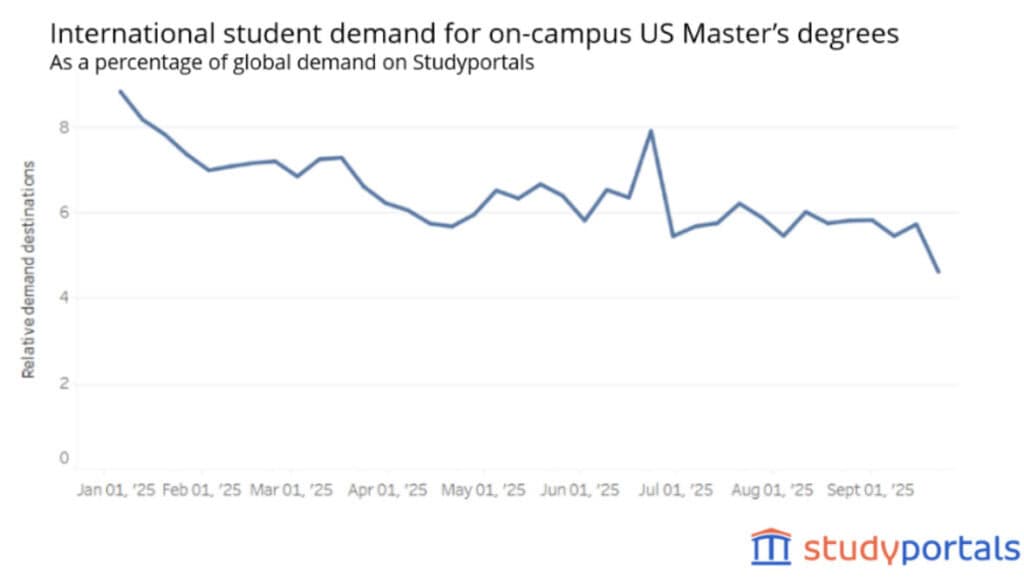
    According to data from Studyportals, this move comes at a time when interest in pursuing Artificial Intelligence degrees in the US is declining, while interest in studying the same in China is on the rise.

    “When comparing January to July 2025 to the same period in 2024, relative demand for artificial intelligence degrees (on-campus Bachelor’s and Master’s and PhDs) in the US on Studyportals dropped 25% year-over-year, while interest in AI degrees in China rose 88%,” read a report shared by Studyportals.

    “Both Beijing and Washington are racing to secure technological leadership in the  ‘Race on AI’. According to Harvey Nash “Digital Leadership Report 2025” artificial intelligence has created the world’s biggest and fastest-developing tech skills shortage in over 15 years. This shortage has created a race for talent, with companies like Meta reportedly handing out $100m sign-on bonuses to win top talent.”

    While interest in pursuing such degrees in China is growing amid its global talent push, the US remains a powerhouse in the field.

    International students account for 70% of all full-time graduate enrolments in AI-related programs and make up more than half of all international students in the country enrolled in STEM disciplines.

    “Nations that succeed in drawing the brightest minds and in creating an environment for innovative business to thrive, will not just advance their economies, they will command the future of technology, security, and influence,” stated Edwin Rest, CEO of Studyportals.

    “International students do not only bring revenue to local economies and soft power, they also fuel innovation, startups, and job creation.”  

    Source link

  • The UK as a Global Partner of Choice for R&D – will it catch on?

    The UK as a Global Partner of Choice for R&D – will it catch on?

    This blog was kindly authored by Alice Routledge, Policy Labs Adviser at Wellcome Trust.

    The UK’s unsustainably funded university sector is not just a domestic challenge to research innovation and growth. It also risks undermining the UK’s global standing. A new Wellcome report highlights the critical role of research and development (R&D) in shaping international partnerships and influencing how the UK is perceived around the world.

    Five years ago, Wellcome published The UK’s role in global research, calling for the UK Government to embrace its strengths in research and development and live up to its place in the world. That report spoke to the optimism for R&D and boosterism of Boris Johnson’s government, leaning into the UK being a science superpower and the idea of a global Britain, following the UK’s exit from the European Union.

    The change in geopolitics over the last five years has been stark, and the world has changed dramatically. A global pandemic, war on mainland Europe, the proliferation of conflict across the Middle East, and a new UK Government are reshaping the context in which UK research operates. With the scaling back of science funding in the US, worries about the future and effectiveness of multilateralism, and internationally diverging trends in the trust of science itself, it was time to think up a new narrative for UK international science collaboration.

    In response, Wellcome has released a report urging the Government to resist the trend towards isolationism, and build on its strengths in R&D and diplomacy to become: The Global Partner of Choice for R&D.

    Why R&D as a tool for diplomacy?

    The UK excels in research. It ranks first globally for the quality of academic publications and leads the G7 in international collaboration. Its universities are world-renowned, with three or four regularly ranked among the global top 10. Its tech sector boasts more tech unicorns than any other European country.  UK research is naturally international, with over 60 per cent of the UK’s academic publications in 2022 being co-authored by international researchers – the highest proportion in the G7.

    It creates growth. Public investment in R&D delivers strong returns: £1 invested in public R&D leverages double that in private investment and generates £7 in net benefits to the UK economy in the long run. In internationally neglected disease research alone, sustained investment could generate more than £4.8 billion of private sector investment in R&D and create nearly 4,000 UK jobs.

    R&D also strengthens the UK’s diplomatic reach, with international research partnerships and alumni networks serving as powerful tools of soft power and global influence.

    There is no national security without health security. Investment in global health research helps to prevent future pandemics by funding the Coalition for Epidemic Preparedness, and finding solutions for infectious diseases such as malaria, TB and meningitis. The report recommends that the Ministry of Defence ensure that it uses its increasing R&D budget to invest in research that supports health security while welcoming the government funding for the collaboration between the Defence Science and Technology Laboratory and the Pandemic Institute for vital research into emerging infectious diseases.

    UK leadership in emerging technologies, from AI to genomics, offers a chance to shape global norms and standards in line with democratic values. The report urges the Government to use the UK’s unique ability in both science and diplomacy to convene an international coalition with a common focus on the regulation of emerging technology.

    A new narrative for a new era

    Wellcome recommends the Government move beyond the language of science superpower or innovation powerhouse. These terms can sound self-congratulatory, and as quoted in the report, “just falls completely flat globally.” Instead, the UK should position itself as the global partner of choice for R&D, a country that others want to work with because of the excellence of its universities as research institutions, its openness, and its commitment to mutual benefit.

    This shift in narrative is not just semantic. It requires a change in how the UK approaches international collaboration.

    • Modernising partnerships: The UK must move from a model of paternalism to one of partnership. This means co-created partnerships based on mutual benefit, nurtured for the long term and where possible led by researchers
    • Choosing partners strategically:  partnering with countries for top-down research relationships should focus on research impact. The UK should deepen ties with the European Union and forge new partnerships with low- and middle-income countries. This will require a rethink of the UK’s approach to Official Development Assistance (ODA), ensuring it supports long-term, equitable research collaborations.
    • The global exchange of people and ideas:  The Government should prioritise reducing the barriers to the global exchange of people and ideas. The Government could encourage an exchange of research talent at all stages with strategic partners around the world by including provisions in Free Trade Agreements and science and innovation agreements, or through joint PhD or exchange schemes and by reducing the costs of moving to the UK.

    Implications for higher education

    To become the global partner of choice for R&D, the UK must ensure that its higher education sector is financially sustainable. Universities play a central role in the UK’s research ecosystem – convening global talent, producing world-class research, and cultivating international alumni networks that serve as diplomatic assets. Yet they will struggle to play this role if they remain under-resourced. Up to 72% of providers are facing an income deficit in 2025-26, and many universities are currently consulting on redundancies.

    While the recent Spending Review did not deliver the funding uplift many hoped for, exploring more stable funding streams must not come at the expense of fundamental research. Funders, institutions, and the Government must work together to ensure the UK remains an attractive place to collaborate on research.

    You can read the full report here.

    Source link

  • Reimagining global student enrolment for the AI era

    Reimagining global student enrolment for the AI era

    These new pressures present a chance to rethink how we support students – not just through better systems, but through smarter, more student-centred strategies that prioritise access, equity, and long-term success for both students and institutions.

    Consider this: most institutions still manage their international enrolment efforts through a patchwork of spreadsheets, legacy systems designed for domestic student needs, and manual workflows. This is not for lack of effort, but because the data is inaccessible or buried in unusable formats, making it difficult for institutions to plan strategically, build diverse student cohorts, and respond to shifting market conditions. Your team should be supporting students face-to-face rather than spending days manually reviewing documents.  

    Meanwhile, students and their families have come to expect responsive, seamless, personalized experiences—which our sector is eager to meet, but not yet equipped to deliver.

    These aren’t just technical challenges, they’re barriers to accessibility. When processes like application review or document verification become bottlenecks, it’s students who face delays, uncertainty, and missed opportunities. 

    The answer isn’t just to digitize what already exists. Many institutions have already adopted CRMs, SIS platforms, and digital document tools, but most of these systems were built decades ago and designed for domestic workflows, often operate in silos, and create new complexities instead of solving old ones. 

    Instead, we need to reimagine how enrolment is managed from the ground up. That means moving from reactive to predictive approaches, from fragmented tools to unified ecosystems, and from gut-feeling decisions to ones guided by real-time insights. Experienced educators will always be central to the admissions process; the goal isn’t to replace their expertise, but to empower it with better data and clearer visibility.

    Imagine being able to forecast application volumes, visa approval rates, and enrolment yields with AI-powered precision. Imagine applicants receiving an offer letter in less time than it takes to walk across campus.

    By analyzing millions of data points from government sources, institutional history, and global market trends, your institution can make smarter investments and streamline decision-making. Routine processes can be automated without compromising quality or control. 

    This isn’t a distant future. It’s possible today with the right technology partner.

    The pressures of shrinking budgets, unpredictable policies, and outdated systems aren’t going away. But with the right tools, institutions can turn these challenges into opportunities for growth. And those who embrace this transformation early will gain a significant advantage in attracting and enrolling high-quality, diverse students.

    That’s why we built Capio. As an enterprise platform company focused on international enrolment management we’re pioneering solutions that transform how institutions approach students around the world. Our platform unifies enrolment intelligence, application management, and agent management, training, and compliance within a single end-to-end, AI-powered platform that empowers institutions throughout the international enrolment management journey. 

    Capio brings together everything institutions need to build smarter, more efficient international enrolment strategies on a global scale. From real-time market insights to precise planning tools, our platform replaces guesswork with clarity. 

    Our Insights Dashboard draws from diverse data sources to surface trends and opportunities in over 150 countries. The Application Management System ensures consistent, transparent processing throughout the complete admissions process, reducing student drop-off, and through our training platform,TrainHub, institutions can better engage and empower educational agents while maintaining alignment and ensuring compliance.

    As leaders in international education, we’re faced with a decision. We can continue to patch together solutions and hope to keep pace with growing complexity. Or, we can embrace the opportunity to build an intelligent infrastructure that transforms international enrolment.

    That choice is ours to make.   

    Find out more at www.capio.app.

    About the author:
    Darin Lee is general manager of Capio, bringing over 20 years of experience in educational technology and digital transformation. Previously serving as CIO at the University of the Fraser Valley and VP Technology at Conestoga College, Darin has led major technological transformations across multiple Canadian institutions, giving him unique insight into the challenges and opportunities facing post-secondary institutions and international enrolment teams

    Source link

  • Is the UK still a destination for global students or just global graduates? How will higher education respond?  

    Is the UK still a destination for global students or just global graduates? How will higher education respond?  

    This HEPI blog was kindly authored by Joanna Hart, Products, Services, and Innovation Director at the Mauve Group. 

    In the last couple of months, the UK Government has unveiled a 10-year, Modern Industrial Strategy and published an Immigration whitepaper, which referenced expanding visa pathways such as the High Potential Individual and Global Talent visas. The industrial strategy aims to attract highly skilled global talent in eight priority sectors, with a strong focus on technology and innovation. Collectively, these efforts to attract global graduates are undercut by new barriers facing international undergraduate students. 

    Ongoing changes to the Skilled Worker visa, including steep increases to salary thresholds, and tighter restrictions on dependents, combined with proposals to shorten the Graduate Visa, and introduce a controversial 6%  international student levy, create mounting financial and reputational pressure on UK universities, while also deterring international undergraduates.

    In response, institutions are turning to establishing overseas campuses to offset domestic shortfalls and attract local talent who may still benefit from expanded UK visa pathways post-graduation. While attracting high-level international talent is valuable for addressing skills gaps in the UK, it must be part of a broader, symbiotic strategy. One that nurtures international students from undergraduate level through to employment to ensure UK higher education remains globally competitive.

    Visa routes 

    An important step in the much-needed long-term strategy is the implementation of expanded visa pathways such as the High Potential Individual (HPI) visa and the visa, traditionally for internationally educated post-graduates and entrepreneurs.

    High Potential Individual (HPI) visa

    The High Potential Individual (HPI) visa is a UK immigration pathway designed for recent graduates from 40 top global universities, providing the opportunity to live and work in the UK for several years. At present, 47% of universities on the list are from the US, with just one institution from the entire southern hemisphere featured.  

    The Immigration whitepaper released in May and the UK government’s industrial strategy referenced extending the HPI visa to a wider selection of global universities. According to the UK government, it intends to roll out a ‘capped and targeted expansion of the HPI route for top graduates, doubling the number of qualifying universities.’ However, we do not yet know whether this expansion will be based on global league tables or geographic location. 

    Innovator Founder visa

    The Innovator Founder visa offers the opportunity for founders of new, innovative, viable and scalable businesses to operate in the UK for three years. Traditionally, it facilitates incoming innovation, but the newly announced UK industrial strategy suggested the Innovator Founder Visa would be reviewed to make it easier for entrepreneurial talent currently studying at UK universities to be eligible. Details are yet to be disclosed but recent figures reveal that the average Innovator Founder Visa application success rate to the UK is almost 88%. While this is significant, it is not as high as other visa types, such as the Skilled Worker Visa, which is 99%. While the overall approval rate for Innovator Founder Visa applications sits at 88%, this figure can be misleading. The critical bottleneck is at the endorsement stage the first hurdle in the process, where the success rate drops sharply to just 36%

    Skilled Worker and Graduate visa 

    Changes to visa pathways for domestically educated international students, including the Skilled Worker and Graduate visas, may result in applicants feeling short-changed. For example, it has been proposed that the standard length of the Graduate visa, which allows international students to remain working in the UK at the beginning of their careers, be reduced from two years to 18 months. If implemented, it may make it hard to secure a career after studying in the UK. 

    Meanwhile, effective from the 22nd July 2025, the minimum salary threshold for the Skilled Worker visa will rise to £41,700. Occupation-specific salary thresholds will also increase by about 10%, with the minimum skills requirements raised to Royal Qualifications Framework (RQF) level 6 for new applicants. Prior to the changes, between 30 and 70 per cent of graduate visa holders in employment may not have been working in RQF level 6 or above occupations. Although there are some discounted thresholds for PhD students, especially in STEM fields, these changes are set to exclude many current Skilled Worker visa holders.

    How will higher education respond to stricter selective visa rules?

    Drawbacks

    One of the major drawbacks comes from the announcement that the government is considering introducing a 6% levy on higher education provider income from international students.  It is likely that universities will be forced to consider passing these costs onto international students. The UK’s higher education sector generates £22 billion annually from international students and education, making it a valuable export to the UK in an increasingly competitive global market. The proposed levy risks discouraging international students and undermining this critical source of economic growth.

    Many institutions will already have factored in price increases to account for rising costs going forward, making an additional 6% unfeasible.

    Numerous universities are already struggling financially, with courses and entire departments being cut. With the possibility of a highly reduced international student body due to the levy and further changes to graduate visa pathways, these institutions face increased strain, meaning even more drastic cuts may be imminent.

    Benefits 

    With an emphasis on higher visa thresholds, rising costs and the controversial 6% levy on international fees, UK universities face growing challenges to remain competitive in the global education landscape.

    In response, many are rethinking their models, with institutions like the Universities of Liverpool and Southampton establishing campuses in Bengaluru and Gurugram, India, respectively. UK Universities operate 38 campuses across 18 countries, educating over 67,750 students abroad. Embracing international collaboration not only broadens the research opportunities available to UK universities but also supports financial sustainability and preserves the UK’s reputation as a global education powerhouse. By establishing overseas campuses and hubs, the UK’s academic influence extends well beyond its borders. This pivot will provide opportunities for international students to receive UK-affiliated accreditations, potentially giving them greater access to selective UK visa pathways post-graduation. 

    To adapt, higher education must develop a more integrated approach; one that links international recruitment, offshore campuses, and expanded visa pathways in a cohesive, long-term strategy. This means not only attracting global graduates but supporting students from undergraduate level through to employment, driving opportunity and innovation in the UK. 

    If UK institutions are to remain global leaders, they must work with the government to ensure that opportunity does not begin at graduation; it begins at enrolment. By nurturing this full pipeline, universities can continue to feed the skilled workforce envisioned in the new industrial strategy.

    Source link

  • How Pakistani students are reshaping global mobility

    How Pakistani students are reshaping global mobility

    A new study from ApplyBoard has shown the number of students leaving Pakistan to join universities in countries such as the UK and US has grown exponentially in the past few years, with student visas issued to Pakistani students bound for the ‘big four’ nearly quadrupling from 2019 to 2025.

    “One of the most striking findings is just how rapid and resilient Pakistan’s growth has been across major study destinations,” ApplyBoard CEO Meti Basiri told The PIE News.

    “The rise of Pakistani students is a clear signal that global student mobility is diversifying beyond traditional markets like India and China,” he said.

    The question is, why?

    A large factor is Pakistan’s young population – 59%, or roughly 142.2 million people, are between the ages of five and 24, making it one of the youngest populations in Asia.

    Additionally, due to economic challenges faced by Pakistan, many young people see international education as a necessity in order to succeed financially, even with Pakistan’s economic growth and gradual stabilisation – which has a possibility of slightly decreasing the overall movement between countries in the future.

    The UK has remained the most popular destination for Pakistani students even through Covid-19, with Pakistan rising to become the UK’s third largest source country in 2024.

    Visas issued to Pakistani students have grown from less than 5,500 to projected 31,000 this year, an increase of over 550% from 2019 to 35,501 in 2024.

    Some 83% of students chose postgraduate programs, with the most popular being business courses, but in recent years statistics show a shift towards computing and IT courses.

    This trend aligns with the growth of the UK’s tech sector, which is now worth more than 1.2 trillion pounds, with graduates set to aid further growth in the coming years.

    “In the US, F-1 visas for Pakistani students are on track to hit an all-time high in FY2025,” said Basiri, with STEM subjects the most popular among the cohort.

    This aligns with the US labour market, where STEM jobs have grown 79% in the last 30 years.

    Basiri highlighted the “surprising” insight that postgraduate programs now make up the majority of Pakistani enrolments, particularly in fields of IT, engineering and life sciences. “This reflects a deliberate and career-driven approach to international education,” he said.

    Such an approach is true of students across the world, who are becoming “more intentional, choosing destinations and programs based on affordability, career outcomes, and visa stability, not just brand recognition,” said Basiri.

    The rise of Pakistani students is a clear signal that global student mobility is diversifying beyond traditional markets like India and China

    Meti Basiri, ApplyBoard

    Canada, unlike the US and UK, has welcomed far fewer Pakistani students, most likely due to the introduction of international student caps. ApplyBoard also suspects Pakistani student populations to drop further in the coming years, it warned.

    Similarly, the amount of visas issued to Pakistani students has also dropped in Australia after high demand following the pandemic.

    Germany, however, has experienced rising popularity, a 70% increase in popularity over five years amongst Pakistani students.

    One of the biggest factors for this is their often tuition-free public post secondary education, according to ApplyBoard, as well as the multitude of engineering and technology programs offered in Germany.

    What’s more, though smaller in scale, the UAE has seen a 7% increase in Pakistani students in recent years, thanks, in part to “geographic proximity, cultural familiarity and expanding institutional capacity,” said Basiri.

    Source link

  • Student Wellbeing in the AI Era: Stress, Confidence, and Connection – A Global Snapshot

    Student Wellbeing in the AI Era: Stress, Confidence, and Connection – A Global Snapshot

    • This HEPI blog was authored by Isabelle Bristow, Managing Director UK and Europe at Studiosity.

    Studiosity’s ninth annual Student Wellbeing Survey, conducted by YouGov in November 2024, gathered insights from university students on their experiences and concerns, and made recommendations to senior leaders. This global research included panels from Australia, Canada, New Zealand, Saudi Arabia, Singapore, the UAE, the UK and the US (see below for the country sample size breakdown).

    The report highlights key learning on AI’s rapid integration into higher education and its impact on student wellbeing. The following are the key takeaways, specifically examining country-specific differences in student experiences with AI, alongside broader issues of stress, connection, belonging, and employability.

    AI Adoption and Its Impact

    AI is now a pervasive tool in higher education, with a significant 79% of all students reporting using AI tools for their studies. While usage is high overall, the proportion of students saying they use AI ‘regularly’ to help with assignments shows interesting variations by country:

    • UK: 17%
    • USA: 27%
    • Singapore: 31%
    • UAE: 38%

    This greater scepticism towards AI among UK students also shows up elsewhere, with students in the UK least likely among the eight countries to expect their university to offer AI tools.

    However, the widespread adoption of AI tools is linked to considerable student stress. The survey found that 68% of students report experiencing personal stress as a result of using AI tools for their coursework. From free text comments, this might be for a number of reasons, including the fear they might be unintentionally breaking the rules; there are also concerns that universities are not moving fast enough to provide AI tools, leaving students to work out for themselves how best to use AI tools. This highlights that navigating the effective and appropriate use of AI is a significant challenge that requires support.

    Furthermore, the way AI is currently being used appears to be affecting students’ confidence in their own learning. Some 61% feel only ‘moderately’ or less confident that they are genuinely learning and improving their own skills when using generative AI.

    Perhaps as a result of this uncertainty, students often seek ‘confidence’ when using university-provided AI support, desiring guided tools that help them check their understanding and validate their genuine learning progress. This motivation was particularly strong in countries like:

    • New Zealand: 31%
    • Australia: 25%
    • UK: 25%

    This suggests a tension between unstructured AI use (linked to lower learning confidence) and the student desire for confidence-building support (which AI, when properly designed for learning, offers).

    Perceptions of how well universities are adapting to AI also vary globally, with 56% of students overall feeling their institutions are adapting quickly enough. However, scepticism is notably higher in certain regions:

    • UK: 53% feel institutions are not adapting fast enough
    • Canada: 52% feel institutions are not adapting fast enough

    Conversely, students in other countries feel their university is adapting fast enough to include AI support tools for study:

    • UAE: 72%
    • Singapore: 66%
    • Saudi Arabia: 65%
    • USA: 58%

    Study Stress: Beyond AI

    While AI contributes to stress, study stress is a broader, multi-faceted challenge for student wellbeing, with frequency and causes differing significantly across countries. Students reported experiencing stress most commonly on a weekly basis (29% overall), with more students than average in Australia and New Zealand (both 33%) experiencing stress on a weekly basis. However, the intensity increases elsewhere:

    • Saudi Arabia: 27% felt stressed daily
    • Canada: 24% felt stressed daily, and a notable 17% felt stressed constantly
    • USA: 16% felt stressed constantly

    The top reasons for general study stress also vary, pointing to the diverse pressures students face:

    • ‘Fear of failing’: significantly higher in the UK (61%) compared with the global average of 52%
    • ‘Not having enough time to balance other life commitments’: significantly higher in the UK (52%) and Australia (48%)
    • ‘Difficult course content’: Singapore (38%)
    • ‘Paying for degree’: Canada (35%) and the USA (31%)
    • ‘Sticking to the rules around integrity and plagiarism’: over-indexed in the UAE (23%) and Saudi Arabia (22%)

    Belonging and Connection

    A sense of belonging is a crucial component of student wellbeing, and the survey revealed variations across countries. Students in Australia (62%) and the UK (65%) reported lower overall belonging levels compared to the global average. What contributes to belonging also differs:

    • ‘Confidence to reach out to teachers’: significantly higher factor in the UK (64%)
    • ‘A flexible schedule to help balance work and study’: dominated as a top reason in Australia (63%) and Singapore (62%)
    • ‘Ease of connecting with a student mentor’: featured prominently in Saudi Arabia (47%), UAE (48%), and USA (43%)
    • ‘Access to mental health support’: over-indexed as a key reason for belonging in Saudi Arabia (47%) and Canada (44%)

    The study also explored direct connections, addressing concerns that AI might reduce human interaction. Students were largely neutral or unsure if generative AI impacted their interactions with peers and teachers (including 63% of students in the UK and 55% in New Zealand). In contrast, students in Saudi Arabia (64%) and the UAE (61%) were most likely to report more interaction due to AI use, followed by Singapore (42%) and the USA (41%).

    Beyond AI’s influence on connection, the survey found that four in ten students (42%) were not provided a mentor in their first year, although over half (55%) would have liked one. Difficulty asking questions of other students was also mentioned by one in ten (13%) students overall. This difficulty was reported more by:

    • Female students: 14% vs 10% for males
    • Older cohorts (50+ year olds): 18% vs 13% for 18-25 year olds
    • Students in the UK (17%), Australia (17%), and New Zealand (16%) compared to other regions.

    Employability Confidence

    Employability is another key area impacting student confidence and overall wellbeing as they look towards the future. The survey found that 59% of students are confident in securing a job within six months of graduation, an increase from 55% in 2024, though concerns remain higher in Canada and the UK. Overall, 74% agree their degree is developing necessary future job skills, although Canadian students were less confident here (68%). Specific concerns about the relevance of a job within six months were more pronounced among:

    • UK students: 20% disagree they will get a related job
    • Canadian students: 14% disagree

    Conclusion

    The YouGov-Studiosity survey provides valuable data highlighting the complex reality of student wellbeing in the current higher education landscape. Rapid AI adoption brings new sources of stress and impacts confidence in learning, adding to existing pressures from general study demands, financial concerns, belonging, connection, and employability anxieties. These challenges, and what supports students most effectively, vary significantly by country. Universities must respond to this complex picture by developing tailored support frameworks that guide students in navigating AI effectively, while also bolstering their sense of belonging, facilitating connections, addressing mental health needs, and supporting their confidence in future careers, in ways responsive to diverse national contexts.

    By country totals: Australia n= 1,234: Canada n= 1,042: New Zealand n= 528: Saudi Arabia n= 511: Singapore n= 1,027: United Arab Emirates n=554: United Kingdom n= 2,328: United States n= 3,000

    You can download further Global Student Wellbeing reports by country here.

    Studiosity is a HEPI Partner. Studiosity is AI-for-Learning, not corrections – to scale student success, empower educators, and improve retention with a proven 4.4x ROI, while ensuring integrity and reducing institutional risk.

    Source link

  • GAZA, GENOCIDE, AND THE GLOBAL MEDICAL RESPONSE (Saint Cecilia Parish, Boston)

    GAZA, GENOCIDE, AND THE GLOBAL MEDICAL RESPONSE (Saint Cecilia Parish, Boston)

    WEDNESDAY, JULY 30 | 6:30PM | PARISH HALL (Boston)

    Join us for a special presentation by Dr. Kuemmerle, a neurologist at Children’s Hospital and the co-founder of Doctors Against Genocide. Founded in 2023, Doctors Against Genocide is a coalition of healthcare professionals who seek to unite their voices in uproar against the genocide in Gaza. This presentation will be livestreamed on our Youtube channel

    Doctors Against Genocide is currently raising $737,000 to fund the construction of a 140-bed field hospital with 4 operating rooms on the grounds of Al-Shifa hosptial. Gaza’s largest hospital has been bombed, burned, and pushed past its limits. After the forced shutdown of the Indonesian, Al-Awda, and Kamal Adwan hospitals, Al-Shifa is the last major hospital left standing in North Gaza. 

    Right now, occupancy is at 200–300%. Patients are being treated on floors, in hallways, and tents. There are no more beds. No more space. But there is a way forward with your help. If you would like donate, please visit: https://doctorsagainstgenocide.org/donate.

    Source link

  • The mercenary spyware industry is a menace to global free expression

    The mercenary spyware industry is a menace to global free expression

    Eli Kronenberg is a rising junior and a FIRE summer intern.


    In the last decade, the rise of the mercenary spyware industry has created a potent new weapon for authoritarian regimes bent on silencing dissent. Represented most prominently by the Israeli-based NSO Group and its flagship spyware Pegasus, surveillance malware is often sold to the world’s most repressive governments with little thought given to the nature of its eventual use.

    Regimes like those in Saudi Arabia and Egypt have long track records of suppressing political opposition and independent journalism. When they acquire state-of-the-art surveillance technology, the result is a crackdown on free expression worldwide, carried out using the devices in our very pockets. And because the surveillance is secret and largely undetectable, it impacts anyone with a reason to suspect that the government might not like what they have to say.

    What is mercenary spyware?

    Mercenary spyware is a type of malicious software developed and sold by private companies to governments. Unlike general malware, which spreads widely and somewhat randomly, mercenary spyware is designed to infiltrate specific devices and extract information. 

    The University of Toronto’s Citizen Lab has published numerous reports explaining how spyware like Pegasus is used to hack the personal devices of political opponents in retaliation for criticizing the government. Victims include an Italian journalist critical of the Meloni government, an Egyptian opposition politician with presidential ambitions, dozens of Catalan separatist leaders in Spain, Mexican journalists investigating presidential corruption, and even a Saudi dissident living in exile in Canada.

    “The consequences that we’ve seen in our research are profound,” said Ronald Deibert, the director of the Citizen Lab. “People are afraid to engage over social media, to use the internet, paranoid about their surroundings, about their social relationships. There’s an obvious chilling effect.”

    Here’s how it works: Mercenary spyware companies like NSO Group search technological operating systems for novel security vulnerabilities known as “zero-days,” which can be used to infiltrate products as ubiquitous as Apple iPhones. Then, they develop spyware designed to exploit these zero-days and sell it to governments, ostensibly for law enforcement and intelligence agencies to use for legitimate data-gathering purposes. 

    In practice, governments with long histories of repression often abuse spyware to hack the devices of anti-government activists, journalists, and other members of civil society. And, even for democratic regimes who preach tolerance of dissent, the temptation of spyware capabilities often proves too powerful. 

    All it takes is one click on a phishing message for spyware to be implanted onto a device. From there, governments can read all of the target’s communications, track the device’s location, and secretly turn on the camera and microphone to listen to live conversations — without the victim receiving any indication that their device has been compromised.

    In recent years, spyware has evolved past the point of needing victims to fall for fake links, instead relying on “zero-click” attacks which automatically implant the spyware without requiring the user to do anything. Not even the most meticulous digital hygiene measures can keep those who have drawn the government’s ire safe in this day and age. 

    “I imagine from the perspective of an operative who’s using this type of product, how addictive it must be,” Deibert said. “It’s almost godlike to be able to just drop into somebody’s life, find out everything about them, watch what they’re doing, turn on the microphone, turn on the camera. That is extremely compelling from an intelligence collection point of view, and opens up all sorts of opportunities that otherwise wouldn’t exist for those types of operatives, which explains why the business is so lucrative.”

    While today’s surveillance agents have shiny new tools, their tactics are tried and true. The Nazis famously used IBM punch cards to categorize citizens by ethnicity and other metrics, as well as wiretaps to track Jews, political dissidents, and other “undesirables.” In East Germany, the Stasi used hidden cameras and bugging devices to maintain files on more than one-third of the population. They even stored body odors to identify dissidents using dogs. The Chinese Communist Party uses facial recognition software so advanced they caught a suspect in a crowd of 60,000 people — and that was seven years ago.

    In 2025, it is easier than ever to invade the private lives of those who dare speak up against public officials. The mercenary spyware industry emerged in the early 2010s, coinciding with the rise of social media-enabled revolutions like the Arab Spring. For regimes seeking to quell political opposition but lacking the technological means to effectively control it, mercenary spyware companies provided a saving grace.

    “What this market offers them is the ability to leapfrog ahead in surveillance capacity, in espionage capacity, effectively drawing from some of the world’s most well-trained, sophisticated veterans of intelligence agencies,” Deibert said.

    Reining in the industry

    Fortunately for supporters of free expression, the U.S. has taken concrete steps to crack down on mercenary spyware companies. In 2023, former President Joe Biden issued an executive order directing agencies to cease procuring commercial spyware that poses a threat to human rights or national security. Twenty-two countries signed on to the Biden administration’s “Joint Statement on Efforts to Counter the Proliferation and Misuse of Commercial Spyware,” pledging to implement similar guardrails. 

    The industry’s biggest fish, NSO Group, was added to the Commerce Department’s trade blacklist in 2021, stifling the company’s business prospects on American soil. NSO has also been dealt blows by the courts, most recently being ordered to pay WhatsApp $170 million in damages after its spyware was used to hack over 1,000 accounts on the messaging app.

    “To me, that was all a roadmap of how you go about effectively reining in this wild west that’s causing all sorts of harm,” Deibert said of these efforts.

    The bad news? While some of the world’s biggest spyware developers have been wounded, they won’t give up easily. NSO Group recently hired a new lobbying firm with the mission of reigniting its relationship with Washington lawmakers and reversing the novel regulations, according to an April report by WIRED

    Those efforts have been rebuffed for now. The Trump administration canceled a meeting with NSO officials in May, citing the company being “not forthcoming in its motives for seeking the meeting,” according to an unnamed official in the Washington Post

    Still, spyware companies and their opportunistic governmental clients thrive when operating from the shadows. The U.S. must remain vigilant and further crack down on companies whose spyware is used to spy on civil society, ensuring that political dissidents worldwide can speak without the threat of dictators — or even democratically elected governments — invading their pockets and upending their lives.

    Source link

  • K12 Earns High Marks for Excellence in Online Public Education

    K12 Earns High Marks for Excellence in Online Public Education

    RESTON, Va.(GLOBE NEWSWIRE) — K12, a portfolio brand of Stride, Inc. has been recognized for its steadfast commitment to quality education. In a recent review by Cognia, a global nonprofit that accredits schools, K12 earned an impressive Index of Education Quality (IEQ) score of 327, well above the global average of 296. Cognia praised K12 for creating supportive environments where students are encouraged to learn and grow in ways that work best for them. 

    For over 25 years, K12 has been a pioneer in online public education, delivering flexible, high-quality learning experiences to families across the country. Having served more than 3 million students, K12 has helped shape the future of personalized learning. This long-standing presence in the field reflects a deep understanding of what families need from a modern education partner. The recent Cognia review further validates K12’s role as a trusted provider, recognizing the strength of its learning environments and its commitment to serving all students. 

    “What stood out in this review is how clearly our learning environments are working for students,” said Niyoka McCoy, Chief Learning Officer at Stride, Inc. “From personalized graduation plans to real-time feedback tools and expanded course options, the Cognia team saw what we see every day, which is students being supported in ways that help them grow, stay engaged, and take ownership of their learning.” 

    K12’s impact extends well beyond the virtual classroom. In 2025, the organization was honored with two Gold Stevie® Awards for Innovation in Education and recognized at the Digital Education Awards for its excellence in digital learning. These awards highlight K12’s continued leadership in delivering meaningful, future-focused education. What sets K12-powered online public schools apart is a curriculum that goes beyond the basics, offering students access to STEM, Advanced Placement, dual-credit, industry certifications, and gamified learning experiences. K12’s program is designed to spark curiosity, build confidence, and help students thrive in college, careers, and life. 

    Through student-centered instruction and personalized support, K12 is leading the way in modern education. As the learning landscape evolves, K12 adapts alongside it, meeting the needs of today’s students while shaping the future of education. 

    To learn more about K12 and its accredited programs, visit k12.com.

    About Stride, Inc.  

    Stride Inc. (LRN) is redefining lifelong learning with innovative, high-quality education solutions. Serving learners in primary, secondary, and postsecondary settings, Stride provides a wide range of services including K-12 education, career learning, professional skills training, and talent development. Stride reaches learners in all 50 states and over 100 countries. Learn more at Stridelearning.com.

    eSchool News Staff
    Latest posts by eSchool News Staff (see all)

    Source link