Tag: GMU

  • Congress Accuses GMU President of Lying About DEI Efforts

    Congress Accuses GMU President of Lying About DEI Efforts

    House Republicans have accused George Mason University President Gregory Washington of lying to Congress about diversity practices at his institution, ratcheting up pressure on the president to step down.

    The Republican-led House Judiciary Committee alleged in a report released Thursday night that Washington made “multiple false statements to Congress” in testimony about diversity, equity, and inclusion efforts at GMU. The public university has been under fire for months over allegedly illegal DEI practices as the Trump administration has sought to crack down on such initiatives, claiming they are discriminatory and violate federal civil rights law. The Judiciary Committee report also alleged that the university “likely violated federal civil rights law by discriminating based on race in its hiring practices to advance Dr. Washington’s diversity, equity, and inclusion initiative.”

    Washington has denied breaking the law through efforts to diversify GMU’s faculty and staff, telling Congress that the university did not practice illegal discrimination under his leadership.

    The report is the latest salvo from Republicans who have launched federal investigations into GMU over its hiring policies, including demands that the embattled president apologize for allegedly discriminatory practices, which he has refused to do as he denies any wrongdoing.

    What’s in the Report

    The House Judiciary Committee’s report zoomed in on an effort by GMU, launched shortly after Washington took office in July 2020, to diversify employee ranks. The Anti-Racism and Inclusive Excellence initiative the president introduced aimed to make faculty and staff “mirror student Demographics” at GMU, which is among the most diverse institutions in the country. As part of that effort, GMU tasked schools and departments with hiring more underrepresented individuals.

    But in Congressional testimony, Washington denied the initiative was a strict mandate.

    “These are overall goals and they’re aspirational in focus,” Washington said, according to a transcript of his Sept. 17 interview released by the House Judiciary Committee Thursday.

    Though the Anti-Racism and Inclusive Excellence initiative stemmed from his office, Washington told Congress that faculty in each department developed plans for their unit. He also cast the creation of such plans as optional, telling Congress “if units did not want to develop a plan, they did not have to.”

    But the House Judiciary Committee claimed Washington lied about that.

    “Documents and testimony obtained by the Committee … show that Dr. Washington and his deputies actively sought to punish schools that did not comply with his racial discrimination mandates,” the committee report states. “A senior GMU official told the Committee that GMU financially punished any school that resisted Dr. Washington’s unconstitutional initiative.” 

    Congress pointed to testimony from Ken Randall, the dean of George Mason University’s Antonin Scalia Law School, as evidence that Washington lied about the plan being optional.

    “You’d get fired if you didn’t have a plan,” Randall said, according to an interview transcript.

    Washington also denied the administration formally reviewed plans to diversify faculty hiring. Republicans accused him of lying about that, too, pointing to internal remarks from then-vice president of Diversity, Equity, and Inclusion Sharnnia Artis (who now has a different title), in which she said the DEI team “consistently reviewed, monitored, and supported” such plans.

    “Again, the evidence contradicts Dr. Washington’s testimony,” the report states.

    However, Douglas Gansler, a lawyer representing the GMU president sharply disrupted claims that his client lied to Congress, which he accused of carrying out a “political lynching” in an emailed statement to Inside Higher Ed.

    “The political theater of the politicians accusing Dr. Washington of misrepresenting anything to them is unadulterated nonsense. Dr. Washington has never discriminated against anybody for any reason and did not utter one syllable of anything not verifiably completely true,” Gansler wrote.

    What Happens Next

    The GMU Board of Visitors has said little in the immediate aftermath of the report.

    “Today, the Board of Visitors received an interim staff report from the U.S. House of Representatives Committee on the Judiciary. We are reviewing the report and consulting with University counsel and counsel for Dr. Washington,” board members wrote in a brief statement. “The Board remains focused on serving our students, faculty and the Commonwealth, ensuring full compliance with federal law and positioning GMU for continued excellence.”

    While the board is reviewing the report, it appears unlikely members would be able to take action against Washington. GMU’s board, which is stocked with GOP donors and political figures appointed by Republican Governor Glenn Youngkin, is currently without a quorum after Virginia Democrats blocked multiple appointments in recent months. Now a legal battle over those blocked appointments is slowly winding its way through the judicial system. While the Virginia Supreme Court heard arguments in the case last month, it has yet to issue a ruling on the matter. In the meantime, with only six of its 16 seats filled, GMU’s board is hobbled.

    Youngkin’s office did not immediately respond to a request for comment from Inside Higher Ed.

    The George Mason chapter of the American Association of University Professors offered a fiery defense of Washington, arguing in a statement the committee was carrying out a politically motivated attack designed to erode institutional autonomy and impose partisan control over the public university.

    “The Committee’s unfounded accusations, dependence on clearly compromised sources, and selective presentation of ‘evidence’ represent an unprecedented abuse of congressional power—designed not to find the truth, but to silence leadership that refuses to yield to political pressure,” the GMU-AAUP chapter wrote in an emailed statement to Inside Higher Ed.

    GMU students, employees and community members rallied in support of president Gregory Washington earlier this year, amid concerns the board would fire him.

    With Washington under pressure from Congress, state and national Democrats have rallied to his defense, accusing the GOP of waging an ideological war on universities and hypocrisy by focusing on the GMU president’s alleged dishonesty while federal officials brazenly lie in court.

    “In Donald Trump’s Gangster State, they pick the target first and figure out the charges later,” House Judiciary Democrats wrote on X. “Today’s target: GMU President Gregory Washington. The Trump Education Department failed to find evidence of employment discrimination at GMU. So [House Judiciary committee] Chairman [Jim] Jordan opened his own investigation. When that one only confirmed Dr. Washington followed Virginia law, Jordan pivoted and conjured up an absurd and convoluted criminal referral based on an alleged lie that takes 8 pages to explain.”

    Representative James Walkinshaw—a Democrat in Virginia’s 11th district, which includes GMU—called Washington “an exemplary leader” in a biting statement posted on Bluesky.

    “Make no mistake, this is an attack on free speech and academic freedom,” Walkinshaw wrote. “It’s cancel culture at its worst and the American people are tired of right-wing snowflakes like Jim Jordan trying to silence anyone who doesn’t bend the knee to their bizarre MAGA ideology.”
    Source link

  • Virginia Democrats Accuse GMU Rector of Conflict of Interest

    Virginia Democrats Accuse GMU Rector of Conflict of Interest

    Photo illustration by Justin Morrison/Inside Higher Ed | Robert Knopes/UCG/Universal Images Group/Getty Images | Maxine Wallace/The Washington Post/Getty Images

    Virginia Democrats want George Mason University board rector Charles Stimson to recuse himself from federal investigations into the university as well as discussions about the university president’s future, saying that his role at the Heritage Foundation, which recently released a report critical of GMU, presents a conflict of interest.

    The letter comes almost two weeks after a state Senate committee blocked 14 gubernatorial appointments to university boards, including six at GMU, which left the Board of Visitors without a quorum. The letter also follows the Heritage report that accused GMU of attempting to hide diversity, equity and inclusion programs. Stimson has had several jobs at Heritage, where he’s currently deputy director of the organization’s legal and judicial studies center.

    The Trump administration has accused GMU of engaging in discriminatory hiring practices and implementing “unlawful DEI policies” and has opened several investigations into the university.

    However, GMU president Gregory Washington has stood his ground, arguing that the federal government rushed the investigation and disputing its findings while rejecting calls to personally apologize. Now, as GMU’s Board of Visitors is stuck without a quorum while a legal challenge over the appointments plays out, state Democrats are seeking to neutralize Stimson in his role as rector.

    A Call for Recusal

    Senate Majority Leader Scott Surovell and other top Democrats in the Senate, L. Louise Lucas and Mamie E. Locke, specifically took issue with the Heritage report’s call to “withhold federal taxpayer funds from universities that violate the Civil Rights Act of 1964,” which the Education Department accused GMU of doing. State Democrats argued that Stimson’s employer is essentially seeking to harm the university.

    “This creates an untenable ethical conflict where your employer’s published position is diametrically opposed to your duties as Rector,” the lawmakers wrote to Stimson.

    (Stimson is one of multiple university board members appointed by Republican governor Glenn Youngkin with distinctly right-wing profiles, including some with ties to conservative think tanks, the Trump administration, GOP megadonors and former Republican politicians, Inside Higher Ed found earlier this year.)

    State Democrats also raised concerns over how he became rector.

    “The appearance of impropriety is compounded by the fact that your selection as Rector reportedly occurred only after direct intervention by Governor Youngkin, raising questions about whether your Heritage Foundation affiliation influenced that appointment,” the Democrats wrote.

    Given what they view as a conflict of interest, the three Democratic leaders called on Stimson to recuse himself “from all Board of Visitors deliberations, discussions, and votes” involving Washington’s employment status or performance evaluations, GMU responses to federal DEI investigations or compliance concerns, GMU funding strategies and university DEI policies.

    “If you cannot commit to this recusal, I believe the appropriate course would be your resignation as Rector to eliminate this conflict entirely,” Surovell and the other Democrats wrote to Stimson while calling on him to respond “outlining the specific steps you will take to address this conflict.”

    Neither GMU officials nor Stimson responded to requests for comment from Inside Higher Ed.

    Youngkin accused Democrats of trying to undermine university boards.

    “Virginia’s progressive left elected officials are trying to paralyze the governing boards of Virginia’s colleges and universities by using despicable bullying and intimidation tactics,” Youngkin wrote in a post on X.

    Faculty Support

    As Washington, GMU’s first Black president, has found himself in the Trump administration’s cross hairs and fighting back, board support has been a constant question. Rumors of Washington’s expected firing swirled in July, but the Board of Visitors kept him on the job.

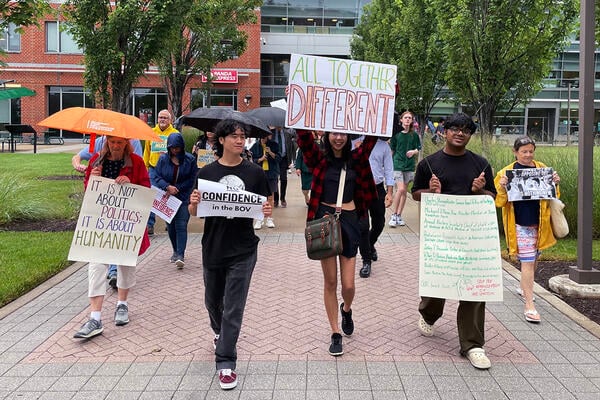
    George Mason faculty have also rallied around the embattled president, with dozens of professors, students and others protesting outside the July meeting. GMU’s chapter of the American Association of University Professors applauded the senators’ letter on Tuesday.

    “We believe that Mr. Stimson has failed to fulfill his fiduciary duties and has repeatedly exceeded his proper authority as Rector of the Board of Visitors. His conflicting leadership role at the Heritage Foundation and his repeated attempts to overreach his authority threaten the foundation of Virginia’s largest public university, endangering its governance, stability, and future,” the GMU-AAUP Executive Committee wrote in an email to members.

    The local AAUP chapter struck a sharper tone than Virginia’s Senate leadership, alleging that Stimson has “usurped GMU President Gregory Washington’s authority to manage the university’s responses to federal investigations, contrary to the president’s delegated authority established in the [Board of Visitors’] Bylaws.”

    GMU-AAUP also echoed the call for Stimson to recuse himself from certain board duties.

    “If Rector Stimson cannot commit to this recusal, we join Senators Surovell, Lucas, and Locke in calling for his resignation as Rector to eliminate this conflict entirely,” the organization wrote. “The independence, integrity, and future of George Mason University depend on nothing less.”

    The group previously voted no confidence in the Board of Visitors in July.

    Source link

  • GMU President Refuses to Apologize, Rejects OCR Findings

    GMU President Refuses to Apologize, Rejects OCR Findings

    Bill O’Leary/The Washington Post via Getty Images

    George Mason University president Gregory Washington has rejected demands by the Department of Education’s Office for Civil Rights that he apologize for alleged discriminatory hiring practices, questioning the findings of an OCR investigation that accused him of implementing “unlawful DEI policies.”

    In a letter to GMU’s board Monday, Washington’s attorney, Douglas F. Gansler, alleged that OCR cut its fact-finding efforts short and only interviewed two university deans before reaching the conclusions the Department of Education published Friday. Gansler wrote that “OCR’s letter contains gross mischaracterizations of statements made by Dr. Washington and outright omissions” related to the university’s DEI practices.

    Gansler also accused OCR of selectively interpreting various remarks by Washington, the first Black president in GMU’s history.

    “To be clear, per OCR’s own findings, no job applicant has been discriminated against by GMU, nor has OCR attempted to name someone who has been discriminated against by GMU in any context. Therefore, it is a legal fiction for OCR to even assert or claim that there has been a Title VI or Title IX violation here,” Gansler wrote in a 10-page letter.

    ED has demanded changes at GMU and a personal apology from Washington.

    “In 2020, University President Gregory Washington called for expunging the so-called ‘racist vestiges’ from GMU’s campus,” Acting Assistant Secretary for Civil Rights Craig Trainor said in a statement released by the Department of Education last week. “Without a hint of self awareness, President Washington then waged a university-wide campaign to implement unlawful DEI policies that intentionally discriminate on the basis of race. You can’t make this up.”

    In his letter to the board, Gansler emphasized that under Washington’s leadership, GMU has complied with executive orders that cracked down on DEI programs and practices, pointing to recent changes such as the dissolution of GMU’s DEI office and restricting the use of diversity statements in hiring.

    “If the Board entertains OCR’s demand that Dr. Washington personally apologize for promoting unlawful discriminatory practices in hiring, promotion, and tenure processes, it will undermine GMU’s record of compliance. An apology will amount to an admission that the university did something unlawful, opening GMU and the Board up to legal liability for conduct that did not occur under the Board’s watch,” Gansler wrote. He added that admitting to such violations could bring about punitive action from other federal agencies, such as the Department of Justice.

    Washington’s rejection of an apology and dispute over the claims made by OCR comes shortly after speculation that GMU’s Board of Visitors—which includes numerous conservative political figures and activists appointed by Republican Virginia governor Glenn Youngkin—would fire him. Instead, the board gave Washington a raise after a lengthy closed-door meeting earlier this month that brought dozens of protesters out to show their support for the besieged president.

    Asked for a statement, GMU officials referred Inside Higher Ed to Gansler.

    ED did not immediately respond to a request for comment from Inside Higher Ed.

    Source link

  • GMU President Keeps Job Amid Tensions

    GMU President Keeps Job Amid Tensions

    Embattled George Mason University president Gregory Washington remains on the job despite concerns that GMU’s Board of Visitors would fire him amid multiple federal investigations into alleged racial discrimination, antisemitism and other matters, which he has publicly pushed back on.

    GMU’s Board of Visitors met Friday to review Washington’s performance and to consult with legal counsel on “actual or probable litigation,” according to the board agenda. While specific legal matters were not detailed in the agenda, GMU is facing investigations from both the U.S. Department of Education and the Department of Justice over alleged discrimination in hiring practices and antisemitism. The DOJ also launched a highly unusual investigation into GMU’s Faculty Senate after it approved a resolution in support of Washington’s leadership.

    The Trump administration seized on remarks made by Washington following the 2020 murder of George Floyd. Washington, as noted in a letter from the DOJ to the university, expressed the need to hire diverse faculty members, promised to advance an antiracist agenda and threw his support behind GMU’s diversity, equity and inclusion initiatives.

    Washington denied engaging in what the Trump administration labeled “illegal DEI” efforts.

    On Friday, he defended both GMU and his own performance, noting he arrived on campus in 2020 when tensions were high and racial strife was still simmering over Floyd’s murder. Adding to the pressure, students, faculty members and others demanded he tear down a statue of university founder George Mason, who was a slave owner. 

    “Despite the commentary that you might hear, this institution is doing extraordinarily well,” Washington told board members on Friday in the open session portion of the meeting, during which he touted GMU’s rise in various university rankings as well as an increase in state funding.

    But many community members feared that Washington, GMU’s first Black president, would lose this job as a result of the investigations. They worried that the inquiries give the Board of Visitors—which is stocked with conservative political activists and former GOP officials—the pretext to remove him. Multiple speakers and attendees at a Friday rally held in support of Washington pointed to other campus leaders recently pushed out. That includes Jim Ryan at the University of Virginia, who resigned under pressure from the DOJ over DEI programs, and Cedric Wins, superintendent of Virginia Military Institute, whose contract was not renewed this spring amid alumni complaints about DEI. One rally organizer had referred to the Friday meeting as “high noon at the OK Corral.”

    Instead, after roughly three hours in closed session, the board emerged with one action item: approval of a 1.5 percent raise for Washington, which members unanimously signed off on. Board members did not discuss their review of his performance conducted behind closed doors.

    That means despite faculty concerns Washington will keep his job—at least for now.

    Support for Washington

    As faculty, students and local lawmakers gathered Friday, they had a clear message for the Board of Visitors: Support Washington and push back on federal investigations they deemed both illegitimate and a broadside against academic freedom at GMU. They also called on the board to protect DEI at GMU, which is Virginia’s most diverse university. However, the board defied that demand by passing a resolution Friday to end race-conscious hiring, scholarships, graduation ceremonies and other initiatives.

    While Washington’s fate was unknown during the rally, speakers urged attendees to push on.

    “We’ve got to keep fighting. No matter what happens today, this is still our university,” said Bethany Letiecq, chair of GMU’s chapter of the American Association of University Professors. Letiecq also referenced personal safety concerns, arguing, “Faculty are being harassed and threatened.” (She previously told Inside Higher Ed she has been subject to two death threats.)

    Bethany Letiecq was one of several speakers to voice support for GMU president Gregory Washington at a Friday rally.

    Former Board of Visitors member Bob Witeck, who served on the search committee that hired Washington in 2020, said he “could not believe our luck” in selecting the president from a pool of nearly 200 candidates and praised his “character, intellect and honesty.” Witeck also warned about threats to both academic freedom and the inclusive nature of GMU, stating, “Discrimination cannot find a home here, nor should political interference or baseless investigations.”

    Another speaker was supportive of Washington while also critical.

    Ellie Fox, a GMU student and president of its Jewish Voices for Peace chapter, was critical of Washington for allegedly repressing “pro-Palestinian speech in the name of Jewish safety.” Fox added that he was “reluctant to resist Trump and conservatives and their attack” on GMU but urged Washington to defy calls to resign from his position and work “toward a better future.”

    Other rally speakers included Fairfax mayor Catherine Read and State Senator Saddam Salim, both GMU graduates and Democrats, who threw their support behind the university and Washington and expressed concerns about the investigations and other attacks on higher education.

    Board-Faculty Tensions

    Although the board did not make any public announcement about the items they discussed in closed session, beyond approving a raise for Washington, an exchange between one member and a GMU professor highlighted the tensions at play.

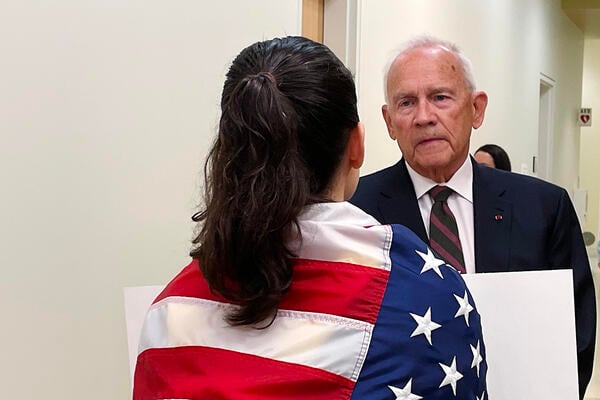
    Robert Pence, a former ambassador to Finland appointed during President Donald Trump’s first term, took issue with a faculty member’s protest sign when he encountered her in a hallway outside the board’s meeting room during a break. Tehama Lopez, a professor in the Jimmy and Rosalynn Carter School for Peace and Conflict Resolution, held a sign calling on the board to support Washington and uphold the First Amendment, academic freedom and due process.

    “You’re suggesting that Bob Pence—Robert Pence—does not support the First Amendment,” he told Lopez before shifting his attention to her call for board members to support Washington.

    Pence then asked Lopez, “If you got a lot of facts and you became convinced that he was engaged in conduct that is deleterious to the university, would you then fire [Washington]? If he meets the standard—whatever the standard is for discharge—would you be willing to fire him?”

    Lopez responded, “Who is being deleterious to the university?” Pence fired back, “You won’t answer the question” and “I’m not playing that game” before walking away from the exchange to return to the meeting.

    A photo of Robert Pence and Tehama Lopez in conversation. She has her back to the camera and an American flag wrapped around her shoulders.

    Board member Robert Pence clashed with a faculty member outside of Friday’s meeting.

    In a brief interview following that conversation, Lopez said that she wanted to see the board uphold its fiduciary duties as GMU faces multiple investigations, which she called “politically motivated.” Given the stakes, she wants to make sure the Board of Visitors protects the university rather than enacting a political agenda pushed by the Trump administration.

    But Lopez appeared uncertain of which path the board will take.

    “Their job on the Board of Visitors is to do the work of protecting the school and the school’s interest, and it’s very unclear whose bidding they’re doing,” Lopez said.

    Source link

  • GMU President Responds to Civil Rights Investigation

    GMU President Responds to Civil Rights Investigation

    In a pointed letter to the George Mason University community Wednesday, President Gregory Washington defended his institution against the Trump administration, which launched an investigation last week into the university’s alleged violations of Title VI.

    According to an announcement from the Education Department, GMU “illegally uses race and other immutable characteristics in university policies, including hiring and promotion.”

    In his letter, Washington vowed to “cooperate fully” with the Office for Civil Rights.

    “I can assure you that George Mason has always operated with a commitment to equality under the law, ever since our inception,” he wrote. ”It is simply the Mason way, and in my experience, it has not discriminated based on race, color, national origin, or otherwise. Our diversity efforts are designed to expand opportunity and build inclusive excellence—not to exclude or advantage any group unlawfully.”

    He offered a brief history of Title VI—which prohibits discrimination on the basis of race, color and national origin in federally funded programs—and the rest of the Civil Rights Act of 1964. Then, without naming any names, he essentially accused the Trump administration of willfully misinterpreting the law.

    “Today, we are seeing a profound shift in how Title VI is being applied,” he wrote. “Longstanding efforts to address inequality—such as mentoring programs, inclusive hiring practices, and support for historically underrepresented groups—are in many cases being reinterpreted as presumptively unlawful. Broad terms like ‘illegal DEI’ are now used without definition, allowing virtually any initiative that touches on identity or inclusion to be painted as discriminatory.

    “This shift represents a stark departure from the spirit in which civil rights law was written: not to erase difference, but to protect individuals from exclusion and to enable equal opportunity for all.”

    He noted that GMU—which enrolls roughly 40,000 students—admits 90 percent of applicants and has more Pell-eligible students than any other institution in Virginia.

    The university’s mission “includes the belief that diversity includes thought, background, and circumstance and any attempt to artificially redefine our diversity, as one of race-based exclusivity, is doomed to fail no matter who ends up being excluded,” he wrote.

    Source link