The MAGA movement is recruiting a new generation… and they’re doing it through the manosphere. From Nick Fuentes to Andrew Tate, a growing army of Trump-aligned influencers is targeting Gen Z boys who feel left behind… promising power, purpose, and belonging while feeding resentment and hate. This isn’t random… it’s a strategy. The “alpha” pipeline is reshaping the Republican Party from the inside out, one lonely teenager at a time. Watch how these extremist influencers are using religion to turn alienation into political weaponry… and building Trump’s future GOP.
Tag: GOP
-

Lake-Sumter Hires GOP Lawmaker as President
Lake-Sumter State College named GOP lawmaker John R. Temple as its president Thursday, making him the latest politician to helm a state institution, the Orlando Business Journal reported.
Temple, an ally of Republican governor Ron DeSantis, breaks with many of his fellow politicians who have become college presidents in that he does have administrative experience in higher education. Temple was hired as the college’s associate vice president for workforce in 2023. Previously he was a teacher and administrator in K–12 schools.
Other recent political hires include former lieutenant governor Jeanette Nuñez at Florida International University, lobbyist and DeSantis ally Marva Johnson at Florida A&M University, and former education commissioner Manny Diaz Jr. in an interim role at the University of West Florida.
Multiple others have been hired across the state college system. A recent analysis by Inside Higher Ed found at least a dozen executive hires with ties to the Republican Party or DeSantis since 2022. Multiple others donated thousands of dollars to GOP candidates and causes.
Another state institution, North Florida College, is also considering a political candidate for its next president. Mike Prendergast, former Citrus County sheriff and chief of staff for Rick Scott, the Republican governor–turned–U.S. senator, is one of several finalists for the North Florida job.
The University of Florida also hired an interim president last week, tapping for the job Donald Landry, a former Columbia University Medical School administrator with ties to conservative academic organizations. Landry was hired after the Florida Board of Governors rejected former University of Michigan president Santa Ono for the UF job for his past support of diversity, equity and inclusion initiatives, which he sought to distance himself from amid his candidacy.
-

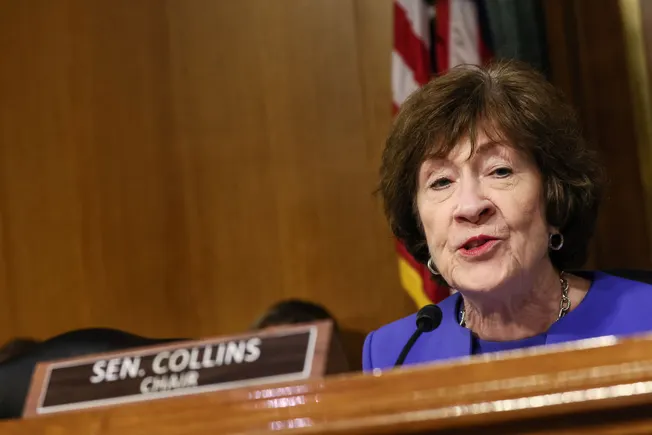
10 GOP senators call on OMB to release frozen K-12 funds
This audio is auto-generated. Please let us know if you have feedback.Dive Brief:
- Ten Republican senators on Wednesday urged the White House budget director to unfreeze over $6 billion in already appropriated federal education funds that the Trump administration has been withholding.
- Withholding the funds, which states were to receive July 1, “is contrary to President Trump’s goal of returning K-12 education to the states,” the GOP letter said.
- Their plea follows a similar request from the other side of the aisle, made in a July 10 letter from 32 Democratic senators to both the Office of Management and Budget the U.S. Department of Education.
Dive Insight:
In the Republican senators’ letter to OMB Director Russell Vought, they said they want to work with him and U.S. Education Secretary Linda McMahon to ensure all of the federal education dollars “help states and school districts provide students an excellent education.”
While they said they share concerns about using federal dollars to fund “radical left-wing programs,” they said they don’t believe that’s happening with these funds meant to support after-school and summer programming as well as adult learners.
The GOP senators emphasized the money had already won approval from Congress and President Donald Trump through the continuing resolution enacted earlier this year.
Other programs at risk — if the funds are not released — include English learner services, academic supports, migrant student assistance and professional development.
“We want to see students in our states and across the country thrive, whether they are adult learners, students who speak English as a second language, or students who need after-school care so that their parents can work,” the senators wrote to Vought. “We believe you share the same goal.”
The signees include Shelley Moore Capito (W.Va.), Susan Collins (Maine), John Boozman (Ark.), Katie Boyd Britt (Ala.), Deb Fischer (Neb.), John Hoeven (N.D.), Jim Justice (W.Va.), Mitch McConnell (Ky.), Lisa Murkowski (Alaska) and Mike Rounds (S.D.).
Last week’s letter from 32 Democratic senators charged that OMB and the Education Department are illegally withholding funds. “It is unacceptable that the administration is picking and choosing what parts of the appropriations law to follow, and you must immediately implement the entire law as Congress intended and as the oaths you swore require you to do,” the Democrats wrote to Vought and McMahon.
Additionally, 24 states and the District of Columbia on Monday sued Trump, the Education Department and OMB over the funding freeze. Students and schools are already beginning to feel the impacts of the freeze, which has disrupted student programs for summer services and supports for English learners, according to the lawsuit.
In a July 17 statement to K-12 Dive, an OMB spokesperson said no funding decisions had been made and that it was still reviewing education funding. The spokesperson added that its preliminary findings show the grant programs “have been grossly abused to promote a radical leftwing DEI agenda” and directly violate Trump’s executive orders.
The OMB spokesperson said it found examples of funds being used by schools to “promote illegal immigrant advocacy organizations” and “conduct a seminar on ‘queer resistance in the arts.’”
The bipartisan calls to unfreeze the funds come as public pushback mounts against the Trump administration over the situation.
On Thursday, 600 local, state and national organizations representing districts, teachers, families and students sent a letter to McMahon and Vought urging them to immediately disburse the funds. The “damage has already been done,” the groups said, as K-12 leaders have had to lay off staff, cancel programs, and terminate contracts “that will impact more than 95,000 schools, nearly 55 million K-12 students, and 1.2 million adult learners.”
-

‘One big mistake’: Higher ed sounds warning over GOP budget law
This audio is auto-generated. Please let us know if you have feedback.The American higher education system is in for a big shake-up with the enactment of Republicans’ massive bill full of tax and spending cuts.
The Senate voted 51-50 on the package, with Vice President JD Vance casting the deciding ballot, after which the bill passed the House by a four-vote margin. President Donald Trump signed it into law on Friday, the deadline he had set for lawmakers.
One of the architects of the bill’s higher ed provisions, Sen. Tim Walberg, a Michigan Republican who chairs his chamber’s education committee, called it “the first set of significant conservative reforms to the higher education landscape in two decades,” adding that it would “maintain America’s world-class higher education system.”
The new law means higher taxes for some university endowments and a new college accountability system tied to financial aid, as well as several changes to the federal student aid program — including ending the GRAD Plus loan program and capping student borrowing overall — that advocates say will limit college access.
The American Council on Education on Thursday described the bill as “a significant improvement” over an earlier House version, but added that it “combines major tax changes with deep spending cuts that will carry significant negative consequences for campuses and students.”
Sameer Gadkaree, president and CEO of The Institute for College Access & Success, said in a July 3 statement, “This bill can only be described as one big mistake — the consequences of which will negatively affect college students, borrowers, and their families for years to come.”
The law cuts $300 billion in federal support to students over 10 years, including by limiting borrowing to graduate students — to $100,000 per borrower, or $200,000 for those in professional programs such as law or medicine. It would also cap Parent PLUS loans to $65,000 per student.
The caps on federal student lending will likely lead more borrowers “to pursue riskier private loans or forego further education,” Gadkaree said.
At the same time, the law culls a handful of federal student loan repayment programs down to just two choices. That reduction — billed as a simplification by supporters — which will leave many borrowers on the hook for larger monthly payments, according to TICAS.
“By increasing the amount, riskiness, and duration of student loan debt, the law directly reduces the likelihood that current borrowers and future students can do better financially than their parents,” Gadkaree said.
He also noted that the law’s funding cuts to Medicaid — the largest in the program’s history — and food assistance could add to the financial difficulties of attending college for many.
Aissa Canchola Bañez, policy director of the Student Borrower Protection Center, decried the law as one that will “push millions off their healthcare, leave children to go hungry, and push dreams of a college education even further out of reach for working people across this country.”
Walberg, meanwhile, said the loan system changes “increase simplicity and affordability so students don’t borrow excessive debt they can never repay.”
Changes to the federal student aid program will also bring financial impact to colleges.
Combined with higher tax rates on the wealthiest private college endowments, the bill’s aid cuts “will force even more difficult decisions on chief business officers and further strain revenue that helps make college affordable for students and families,” Kara Freeman, CEO and president of the National Association of College and University Business Officers, said in a July 3 statement.
Colleges could also be rendered ineligible to receive student loan funds entirely if their former students don’t meet new earnings measures in the bill.
However, changes to the bill narrowed the funds at stake for colleges from a previous version and tweaked the metrics to include only graduates of the programs in question. The accountability system “represents a more targeted and data-informed alternative” to the “punitive” risk-sharing proposal in an earlier House version of the bill, the American Council on Education said on July 3.
As for the endowment tax, the bill creates tiered rates that start at the current levy of 1.4% on investment earnings that rise to 4% and then 8% based on endowment assets per student. While the tax won’t cover many institutions, some colleges will now owe millions to the government each year starting in 2026.
Yale University, for example, estimated it will pay $280 million just in its first year, according to institutional leadership. Such a tax bill represents a significant break in the historic relationship between nonprofit entities and the federal government.
“This is money that would otherwise support our students, faculty, staff, and local partnerships with the city of New Haven,” Yale President Maurie McInnis said in a July 3 community message.
She added, “Taxing universities undermines the education and research that fuel life-saving medical breakthroughs, life-changing innovations, and economic growth in communities across the country and around the globe.”
Along with cuts to the federal aid program, the law expands Pell Grants to short-term programs between eight and 15 weeks in length.
TICAS argued that the law “opens eligibility for potentially high-cost, low-quality short-term programs” that could exacerbate funding pressure on the Pell program.
That assessment came even after the Senate took out a controversial provision that would have permitted Pell eligibility for unaccredited institutions. The chamber’s parliamentarian had concluded it would have violated rules governing the reconciliation process, which the Senate used to sidestep the filibuster and pass the budget bill with a simple majority vote.
-

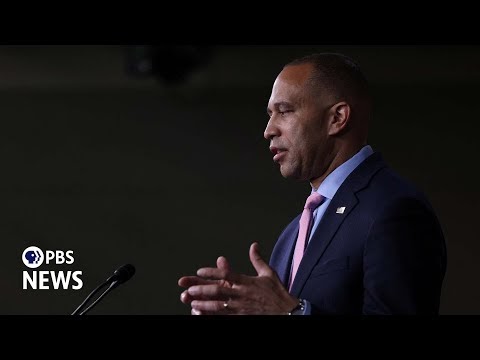
House Minority Leader Jeffries giving marathon speech criticizing GOP tax cut bill (PBS News Hour)
US House Minority Leader Hakeem Jeffries (D-NY) gives a marathon speech, calling out the destructive path that House Republicans are going down. This is a Bill that undermines the United States of America and its national security. It is also a threat to democracy. Folks should listen to every minute of this historical speech.
-

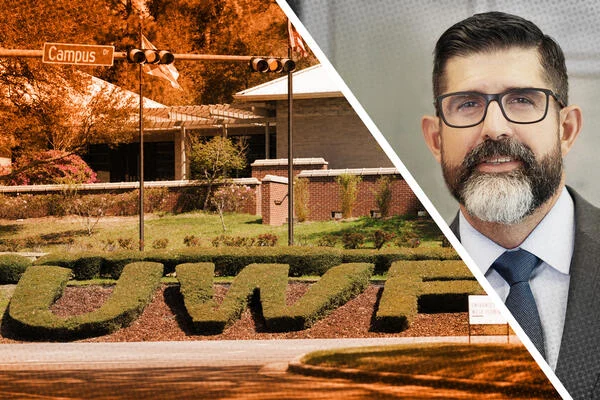
UWF Taps Florida GOP Official as Interim President
Another former Florida lawmaker is stepping into a presidency after the University of West Florida Board of Trustees voted to hire Manny Diaz Jr. in an interim capacity Tuesday.
Diaz, who is currently Florida’s education commissioner, served in Florida’s Senate from 2019 to 2022. The former GOP lawmaker is a close ally of the state’s Republican governor, Ron DeSantis.
The UWF board approved the hire despite the objections of two trustees who raised concerns about transparency and argued that the process of selecting an interim was rushed. UWF’s current president, Martha Saunders, announced her resignation earlier this month after a board member took issue with social media posts from the university dating back several years. Zach Smith, who works for the Heritage Foundation, said he was troubled by actions that included encouraging students to read a book about antiracism and promoting a drag event in 2019.
Both board members and the public questioned Diaz’s qualifications at the meeting.
Trustee Alonzie Scott noted that it was unusual to select an interim without considering internal options and questioned how Diaz was elevated as a sudden candidate without a prior board discussion. He also pressed board chair Rebecca Matthews on whom she spoke with before advancing Diaz as the pick, though she did not offer specifics on those conversations.
“I don’t feel as if I have to run through that list with you today,” Matthews told Scott when he asked whom she had discussed the appointment with before adding it to the board agenda.
Scott also questioned whether the board had violated state sunshine laws.
“I can’t prove that any of us have violated the sunshine guidelines, but I can tell you everything that I read about all the different Florida news outlets, it appears that those decisions were made before this board even had a chance to even discuss. And to me, ma’am, that is a travesty in terms of how we operate,” Scott said, adding the process was “a disservice to the community.”
Matthews defended the hire, noting Diaz’s past work in K-12 education and the State Legislature.
Diaz will formally assume the interim presidency July 14. Despite tapping Diaz as interim, the board will begin a search for its next president, though some trustees argued that naming Diaz instead of an internal candidate to lead UWF would likely suppress the number of applicants.
Of five presidents hired at Florida’s public universities this year (including interim roles), Diaz is one of four who are either former lawmakers or directly connected to the governor’s office. Santa Ono, who was hired as president of the University of Florida on the same day UWF tapped Diaz, is the outlier.
-

TN Schools Could Exclude Immigrant Kids Without Legal Status in GOP-Backed Bill – The 74
Get stories like this delivered straight to your inbox. Sign up for The 74 Newsletter
Tennessee lawmakers on Wednesday voted to advance a bill that would require public K-12 and charter schools to verify student immigration status and allow them to bar children who cannot prove they lawfully reside in the United States unless they pay tuition.
The 5-4 vote by the Senate Education Committee came despite the Legislature’s own fiscal analysis, which said the proposed legislation “may jeopardize federal funding to the state and to local governments” and violate the federal Civil Rights Act, which specifically prohibits discrimination based on national origin in programs receiving federal dollars. Three Republicans joined the committee’s sole Democrat in voting “no.”
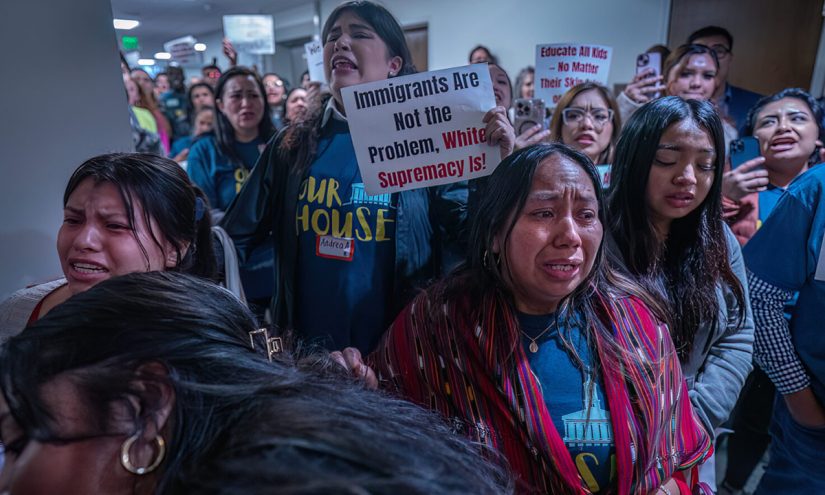
Immediately after the vote was cast, shouts of “so shameful” and “that’s trash” erupted inside the hearing room. Others, including school-age children in attendance, streamed out of the room in tears.
The bill (HB793/SB836) by Sen. Bo Watson, a Hixson Republican, and House Majority Leader William Lamberth, a Portland Republican, says that local school districts and public charter schools “shall require” students to provide one of three forms of documentation: proof of U.S. citizenship, proof the student is in the process of obtaining citizenship or proof they have legal immigration status or a visa.
Students who lack one of the three forms of documentation could then be barred by their local school district from enrolling unless their parents paid tuition.
Watson, the bill’s sponsor, said he brought the measure in response to the increasing cost to the state of providing English-as-a-second-language instruction.
“Remember, we are not talking about people who are here lawfully,” Watson said. “What I’m trying to discuss here is the financial burden that exists with what appears to be an increasing number of people who are not lawfully here.”
In response to a question from Sen. Raumesh Akbari of Memphis, the sole Democrat on the panel, Watson said he had received no formal request from any school official to introduce the measure.
“In an official capacity, this is one of those issues people do not talk about,” Watson said. “This is a very difficult bill to present. It is very difficult to have all these eyes on you.”
“In an unofficial capacity at numerous events, have people mentioned this problem to me? Absolutely,” Watson said.
Akbari responded: “I’m from the largest school district in the state. I have not had those conversations.”
“I am offended by this legislation,” Akbari said. “I find that it is so antithetical to the very foundation of this country….This is saying that babies – you start school at five years old – that you do not deserve to be educated.”
The bill’s sponsors have acknowledged the measure is likely to face a legal challenge if enacted. The proposed legislation, they have said, is intended to serve as a vehicle to potentially overturn the Supreme Court’s Plyler v. Doe decision, which established a constitutional right to a public school education for all children. The 1982 decision was decided by a 5-4 vote, Watson noted.
“Many 5-4 decisions taken to the court today might have a different outcome,” Watson said.
The proposed legislation is part of an unprecedented slate of immigration-related bills introduced in the Tennessee legislature this year as Gov. Bill Lee and the General Assembly’s GOP supermajority seek to align with the Trump Administration’s immigration policies.
Lee last month signed into law legislation to create a state immigration enforcement office to liaise with the Trump administration, create distinct driver’s licenses for noncitizens and levy felony charges at local elected officials who vote in favor of sanctuary policies.
Among nearly three dozen other immigration-related bills still being considered is one to require hospitals that accept Medicaid payments to report on the immigration status of their patients. Another bill would open up charitable organizations, including churches, to lawsuits if they have provided housing services to an individual without permanent legal immigration status and that individual goes on to commit a crime.
Following Wednesday’s hearing in the Senate Education Committee, hundreds congregated in a hallway of the Legislature, chanting “education for all” and pledged to return as the bill winds through the committee process.
The bill “instills fear and hopelessness in these students,” said Ruby Aguilar, a Nashville teacher who testified against the bill during the hearing. “Education is not merely a privilege, it is a shared human right every child should have access to.”
Tennessee Lookout is part of States Newsroom, a nonprofit news network supported by grants and a coalition of donors as a 501c(3) public charity. Tennessee Lookout maintains editorial independence. Contact Editor Holly McCall for questions: [email protected].
Get stories like these delivered straight to your inbox. Sign up for The 74 Newsletter
-

AAUP opposes “anticipatory obedience” to Trump, GOP
The American Association of University Professors released a statement Thursday urging universities not to engage in “anticipatory obedience,” which it defined as “acting to comply in advance of any pressure to do so.”
“As Donald Trump assumes the presidency for a second time, the outlook for higher education is dire,” begins the statement, which the AAUP said its elected national council approved this month.
“The Trump administration and many Republican-led state governments appear poised to accelerate attacks on academic freedom, shared governance and higher education as a public good,” the statement says. “They will attack the curricular authority of the faculty on a number of fronts … It is the higher education community’s responsibility not to surrender to such attacks—and not to surrender in anticipation of them. Instead, we must vigorously and loudly oppose them.”
The White House did not respond to Inside Higher Ed’s request for comment. Before JD Vance was elected vice president, AAUP president Todd Wolfson called him a “fascist.”
In the fall, media reported that the University of North Texas removed words such as “race” from course titles, despite Texas’s anti–diversity, equity and inclusion law specifically exempting “course instruction.” The AAUP statement says that was part of a trend.
“Under no circumstances should an institution go further than the law demands,” the AAUP wrote. “Yet, the examples above depict an eagerness to obey on the part of administrative officers, portending a bleak future.”
The association recommended that faculty act by reviewing “handbooks and contracts to strengthen and reinforce faculty rights” in employment decisions and curricular changes. It also suggested reforming “policies to strengthen faculty oversight in areas currently being used to exercise excessive and undue discipline against faculty, staff and students,” including policies on Title IX, Title VI, acceptable use of institutional resources, outside speakers and campus protests.