
Tag: Government Shutdown

  • The Shutdown Is Over, But Thousands of Kids Are Still Locked Out of Head Start – The 74

    The Shutdown Is Over, But Thousands of Kids Are Still Locked Out of Head Start – The 74


    Get stories like this delivered straight to your inbox. Sign up for The 74 Newsletter

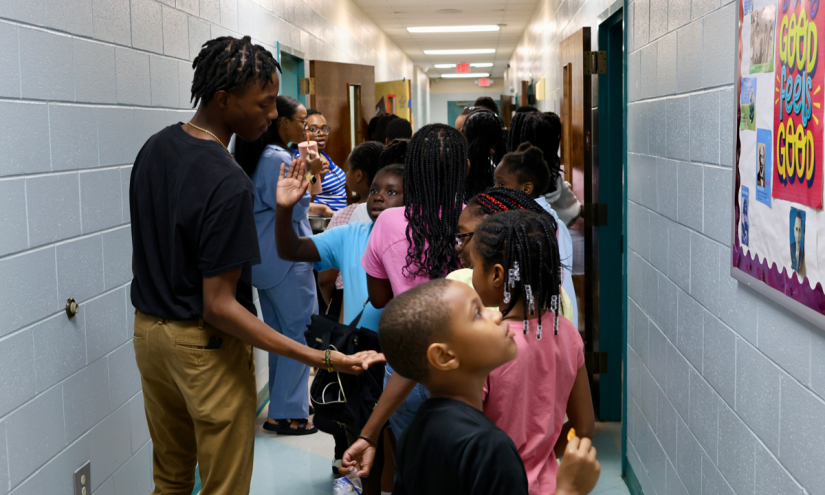
    Nearly 9,000 children across 16 states and Puerto Rico remained locked out of Head Start programming as of Friday evening, according to the National Head Start Association, despite the federal government’s reopening on Wednesday night.

    For some programs, the promise of incoming funding will be enough to restart operations. But many won’t be able to open their doors until they receive their federal dollars, which could take up to two weeks, said Tommy Sheridan, deputy director at the NHSA. 

    Sheridan said the Trump administration understands the urgency and is “moving as fast as they possibly can.”

    That said, this interruption had an opportunity cost, and it’s led to instability for families and providers, he said, adding that the shutdown caused staff to focus on issues they “should not be worried about,” such as fundraising and contingency planning.

    Some providers fear greater delays since the Trump administration shuttered half of the Head Start regional offices earlier this year. 

    “They’re going to be working as hard as they can, but they’re going to be doing it with half the capacity,” said Katie Hamm, former deputy assistant secretary for early childhood development under President Joe Biden.

    And even once the funding comes through, closed centers will need to go through a series of logistical hurdles, including reaching out to families who may have found alternative child care arrangements and calling back furloughed staff, some of whom have found employment elsewhere. 

    “Head Start is not a light switch,” Hamm said. “You can’t just turn it back on.”

    This interruption has also further eroded trust between grantees and the federal government that was already shaky, she added.

    The Administration for Children and Families did not respond to a request for comment on when programs can anticipate communication from the office or their funding.

    Since Nov. 1, approximately 65,000 kids and their families — close to 10% of all of those served by Head Start — have been at risk of losing their seats because their programs had not received their awarded funding during the longest government shutdown in history. The early care and education program delivers a range of resources to low-income families including medical screenings, parenting courses and connections to community resources for job, food and housing assistance. 

    At the peak of the Head Start closures, roughly 10,000 kids across 22 programs lost access to services, according to Sheridan. A number of the remaining programs were able to stay open through private donations, loans, alternative funding streams and staff’s willingness to go without pay.

    Valerie Williams, who runs a Head Start program with two facilities in Appalachian Ohio, was excited to tell parents that classrooms would be reopening soon. Her centers have been closed since Nov. 3, impacting 177 kids and 45 staff, many of whom already live paycheck to paycheck, she said.

    Valerie Williams runs two Head Start centers in Appalachian Ohio, serving 177 kids. (Valerie Williams)

    A number of families were doubly impacted, losing access to Head Start’s resources as well as the Supplemental Nutrition Assistance Program, also known as SNAP, simultaneously. In the days leading up to the closure, Williams and her staff prepared families as best they could, sharing information about resources for food, assistance for utilities and heating and guidance on child care options. 

    On Thursday, Williams wrote to parents via an online portal that she hopes to restart the normal school schedule sometime next week. The post was quickly flooded with comments. 

    “This is super exciting!!” wrote one parent. “Best news in a long time. Carter has been asking every day. Hope to see u guys very soon.”

    “Yayyy,” wrote another. “The kids miss you guys so much!”
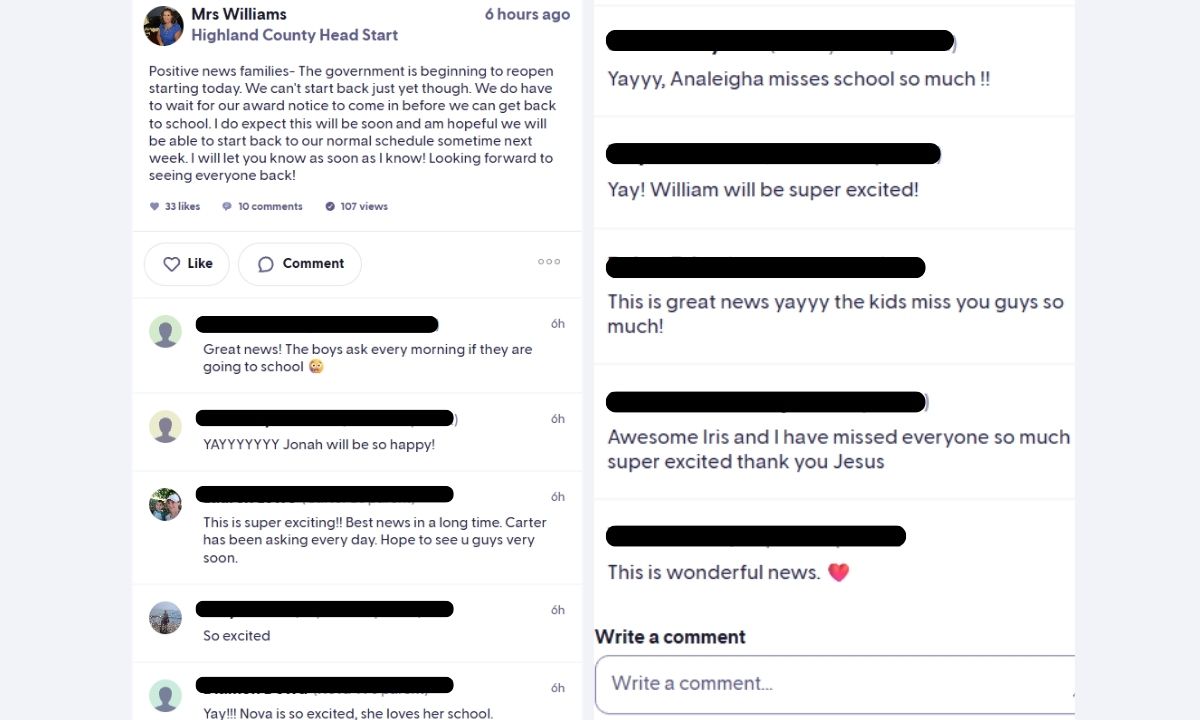
    Valerie Williams, who runs a Head Start program in Appalachian Ohio, was excited to tell parents that classrooms would be reopening soon. (Valerie Williams)

    Still, Williams knows reopening won’t be seamless. Along with program leaders across the country, she’ll need to call back furloughed staff, place food orders and handle a number of other operational challenges.

    And despite the excitement, the transition back may also prove tricky for some kids.

    “I do think that it will feel like starting school again for a lot of our classrooms,” Williams said. “They’ve been out for two weeks … You’re going to work on separation anxiety issues, you’re going to have to get into that routine again and the structure of a classroom environment. So I think that will be a big issue for a lot of our teachers.” 

    As of Friday afternoon, Williams was still awaiting communication from the federal Office of Head Start with information about the anticipated timeline for next steps. 

    “As soon as we get that notice of award, [I want to] start our staff and kids back immediately,” she said. “The very next day.”

    Now that the shutdown has ended, what’s next for Head Start?

    Funding for Head Start is complex. Some 80% comes from federal grants that are released to local providers on a staggered schedule throughout the year. This year, grant recipients with funding deadlines on the first of October and November were left scrambling, as the federal shutdown dragged on.

    The government began to resume operations late Wednesday night after President Donald Trump signed a bill, funding most federal agencies through Jan. 30 and allowing programs that didn’t receive their funding on time, including Head Start, to use forthcoming dollars to backpay expenses incurred over the past month and a half.

    Here’s what Hamm predicts will happen next: The Office of Head Start will recall all staff to resume, including those who were furloughed during the shutdown. The employees will review grant applications, a process which now requires them to flag any language that might be reflective of diversity, equity and inclusion practices. Next, money will be sent along to the remaining regional offices, and eventually dispersed to individual grantees. The NHSA is hopeful that this process will be completed by Thanksgiving for all grantees.

    There are two things the federal government can do to help centers open faster, according to Hamm. First, they could waive a typical protocol that leads to a period of seven days between when a member of Congress is notified that their state will be receiving funding and when the funding actually goes out, Hamm explained. 

    Officials could also notify grantees, in writing, about how much money they’ll get and when it’s expected to come through, so they can begin planning. 

    Unlike SNAP, which received guaranteed funding through the budget year, money for Head Start remains uncertain beyond Jan. 30. While the fear of another shutdown has caused “quite a bit of worry” among the Head Start community, Sheridan said it would likely lead to fewer program disruptions, since it wouldn’t fall at the start of the fiscal year.
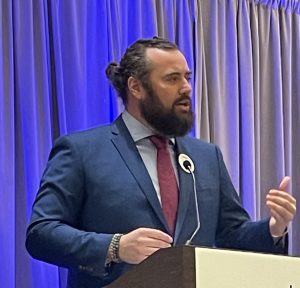
    Tommy Sheridan, deputy director of the National Head Start Association. (Tommy Sheridan)

    To prevent similar chaos moving forward, Democratic Sen. Tammy Baldwin of Wisconsin introduced a bill in the final days of the shutdown that would guarantee uninterrupted service for fiscal year 2026. 

    “The 750,000 children and their families who use Head Start shouldn’t pay the price for Washington dysfunction,” Baldwin, the ranking member of the Senate Appropriations Subcommittee for Labor, Health and Human Services, Education, and Related Agencies, wrote in a statement to The 74.

    Multiple funding threats and deep staffing cuts by the Trump administration over the past year have plunged programs across the country into uncertainty. In the wake of that recent upheaval, a leadership change is also underway. The acting director of the Office of Head Start, Tala Hooban, accepted a new role within the Office of Administration for Children and Families and will be replaced by political appointee Laurie Todd-Smith, according to an email statement from ACF. Todd-Smith currently leads the Office of Early Childhood Development, which oversees the Office of Head Start. 

    Sheridan described this move as anticipated and not particularly concerning, though others were less sure. Joel Ryan, the executive director of the Washington State Association of Head Start, noted that Hooban was a longtime civil servant and strong supporter of the Head Start program. Without her, he fears “there’s nobody internally with any kind of power that will push back,” on future threats to the program.

    Another worry plaguing providers: current funding for Head Start has remained stagnant since the end of 2024, meaning that through at least Jan. 30, programs will be operating under the same budget amid rising costs across the board.

    In previous years, the program’s grant recipients typically got a cost-of-living adjustment, such as the 2.35% bump ($275 million) for fiscal year 2024. In May, a group of almost 200 members of Congress signed a letter to a House Appropriations subcommittee, requesting an adjustment of 3.2% for 2026. A recent statement from NHSA suggested that instead, the proposed Senate bill for next year includes a jump of just 0.6%, or $77 million.

    “If we don’t see a funding increase in line with inflation, that means that Head Start will be facing a cut of that degree,” said Sheridan. “It’s just kind of a quiet cut, or a silent cut.”

    “I think what will end up happening,” said Ryan, “is you’ll end up seeing a massive reduction in the number of kids being served.”


    Did you use this article in your work?

    We’d love to hear how The 74’s reporting is helping educators, researchers, and policymakers. Tell us how
    Source link

  • 1.1 Million College Students – The 74

    1.1 Million College Students – The 74


    Get stories like this delivered straight to your inbox. Sign up for The 74 Newsletter

    Maia Jackson should have been cranking out a research paper for her communications class. Instead, she found herself queuing up at a food pantry to secure groceries for her household amid the nation’s longest government shutdown. 

    “I walked out with a shopping cart full of food,” the 25-year-old college senior said. “I could barely carry it all. I got cereal. I got some frozen meat, hamburger buns. I got a bag of black beans, and then I got a bag of rice.”

    Finding a package of chicken strips, a dish she knew her picky 2-year-old daughter would actually eat, almost made her cry, Jackson said. She expects the combination of perishable, bagged and canned foods to last them a month. By then, she hopes her Supplemental Nutrition Assistance Program (SNAP) payments — widely known as food stamps — will have resumed.

    On November 1, SNAP benefits ground to a halt during the federal budget impasse that began a month earlier, with President Donald Trump’s administration refusing to fully fund these payments, a matter now tied up in court. Even as the Senate has reached a framework deal that leaves lawmakers and the White House a step closer to ending the shutdown, the disruption in benefits has revealed how fragile the social safety net is for vulnerable Americans. That includes single parents and young adults experiencing food insecurity, a problem that occurs when people lack regular access to the nourishment needed to sustain their health. 

    An estimated 1.1 million college students rely on SNAP, including parents like Jackson, who attends North Dakota State University (NDSU) in Fargo. For such students, a delayed SNAP payment isn’t a mere hiccup, but a serious setback that can imperil their education, their health and stability for their children, experts contend.

    “It’s such a distraction for me as a single mom in school,” Jackson said. “I don’t have any bandwidth to give to trying to find food at pantries.”

    She tried to minimize the time she spent at the food pantry last week by making an appointment first, but she was still one of a couple of dozen people in line. The visit prevented her from completing her research paper by its due date, which will likely result in her grade being docked. Jackson, who has so far maintained a 4.0 grade point average, isn’t happy about that prospect, but with her family members an hour away and her child’s father mostly out of the picture, she had to prioritize food over her education.


    No college student should have to choose between a basic need and school, said Deborah Martin, a senior policy associate for The Institute for College Access & Success, a nonprofit that advocates for college access and affordability. 

    “A lot of students have to make these daily tough decisions where they’re wondering, ‘Where am I going to get my next meal from?’ instead of focusing on homework, on classwork,” Martin said. “We know that when students have these unmet basic needs such as food insecurity, they’re more likely to struggle academically, less likely to persist from semester to semester, and in some cases, may even drop out of college altogether.”

    Roughly 60 percent of college students are women. For the most marginalized students, the risk of quitting school due to food insecurity may be even greater. The Government Accountability Office (GAO), a nonpartisan federal agency that provides fact-based information to Congress, reported last year that about 80 percent of food-insecure students are nontraditional — meaning their parents don’t financially support them, they didn’t begin college immediately after high school or they are caring for dependents. Moreover, the 2023-2024 Student Basic Needs Survey Report from the Hope Center, a research center at Temple University focused on the food, housing and health of college students, found that around three-quarters of parenting, Black and Indigenous students experience insecurity related to a basic need

    Most of these students, the GAO discovered, do not sign up for services like SNAP, and those who do may hesitate to discuss their food insecurity. As a mom and a slightly older student who works part-time, Jackson has felt largely alone on campus as SNAP benefits have paused. Her classmates don’t appear to share her anxiety over the shutdown, if they know about it at all. 

    A woman shops at the Feeding South Florida food pantry on October 27, 2025 in Pembroke Park, Florida.
    (Joe Raedle/Getty Images)

    “A lot of the kids that I’m in class with, they’re not in the same circumstance,” Jackson said. “It’s weird to see a lot of people just carrying on as usual.”

    Since most of her classmates — about an even percentage of NDSU students are women and men — are childfree and on the school meal plan, she doesn’t want to be a “downer” by bringing up her difficulties. For the same reason, she didn’t explain to her professor why her paper was late. “I didn’t want to tell him, ‘Oh, I couldn’t write it because I was standing in the food pantry line’ because it just sounds so sad,” she said. “What’s he supposed to say? I don’t want him to feel bad for me. I don’t want to be pitied.”

    But faking normal could come at a high cost for college students who don’t reach out for help. Martin fears these young adults will resort to using high-interest payment plans or acquire credit card debt just to afford groceries.

    “The longer that students and other SNAP participants don’t receive their funds, this is just more days that students are going to have to make these difficult decisions,” she said.


    Some college administrators are taking action. When the shutdown began, Compton College President and CEO Keith Curry contacted Everytable, a food company that offers inexpensive made-from-scratch meals via carryout storefronts and a delivery service. The college, about 18 miles southeast of downtown Los Angeles, has partnered with Everytable for seven years to provide all students — approximately 6,000 of whom attend full time — with one nutritious free meal on weekdays. 

    The federal government crisis prompted Curry and Everytable CEO Sam Polk to scale up that program so SNAP-recipient and economically disadvantaged students didn’t suffer during the shutdown.

    “We need to do something. Can we split the cost?” Curry recalled asking Polk. “I think if we double the meals, at least they get another meal for the day.”

    On November 5, Compton College’s most underprivileged students began getting two free meals per day, or 10 per week. The need for such an intervention there is substantial: A 2025 basic needs survey of students found that 81 percent of them experience at least one form of insecurity related to a basic need. That includes signs of food insecurity such as skipping meals, reducing meal sizes or fearing they will run out of food. Most Compton College students are moderately food insecure, the survey revealed, indicating persistent hardship. Women make up 61 percent of the student body.

    “Right now, students have other stress, and what we’re doing to them is adding more stress,” Curry said of the shutdown. “They still want to do well in classes, but now they don’t have food.” 

    Together, Compton College and Everytable have the resources to supply students with 10 weekly meals for a month, Curry said. The students are deeply grateful for the additional provisions, according to Dee Garrett, who oversees Everytable’s operation at the college.

    “What better way to start your studies than with a stomach that’s full?” Garrett asked. “You don’t have to think about, ‘Oh, my God, my stomach. I can’t concentrate or focus.’”

    Asked what impact he hopes the scaled-up program makes, Curry said he’s more interested in letting students know they’re not alone.  

    “It’s not about the impact. It’s about our students knowing that we were there for them during this time,” he said. “In our community, when students need us most, we have to step up and be there for them, and they’re never going to forget that.”

    Martin applauds the efforts of colleges and K-12 schools, which have connected students and their families to food banks, to curb food insecurity during the shutdown. But she also advocates for long-term policies to ensure students have enough food to eat. That includes the Enhance Access to SNAP Act, proposed legislation to remove the barriers that prevent economically disadvantaged college students from utilizing benefits generally — not just during the current crisis. 

    However, Martin continued, “the most important thing that we can do right now in this moment is for these SNAP benefits to be fully funded and for them to go out to students as soon as possible.”


    Back in Fargo, Jackson has refocused her attention on her coursework now that she has a month’s worth of food. Still, she worries about the people who couldn’t make it to a pantry or that the government will cut other social services she needs. She currently earns $400 monthly working part time as an academic journal editor. The job, which she performs remotely, allows her to attend school and be her daughter’s primary caretaker when the toddler is not in day care. 

    “If they cut child care, if they cut these programs I rely on, I would have to drop out of school,” Jackson said. “But I’m trying to give my daughter a better life than that.”

    Jackson is majoring in university studies with a pre-law emphasis, a dramatic shift from her life before motherhood when she dropped out of school and struggled with addiction. Getting pregnant inspired her to undergo a transformation, which she largely credits to the Jeremiah Program. The national nonprofit provides single mothers with support for college, child care and housing, and it recently started a campaign to raise $190,000 to cover essential needs for families who have lost SNAP and other benefits because of the shutdown. The organization estimates that single-parent families represent nearly a third of families in the United States, with 80 percent of those headed by mothers.  

    Jackson has been deeply disturbed to see the misperceptions that abound about mothers like herself. She’s encountered online commenters who have characterized SNAP recipients as “welfare queens.”

    If she could confront such individuals in person, Jackson would emphasize how much value mothers add to society. “And on top of it… we are all in school and working, too,” she said. “The insinuation is that we’re just scammers, freeloaders, when, in reality, I’m working very hard every day to hopefully not need these supports.”

    This story was originally reported by Nadra Nittle of The 19th. Meet Nadra and read more of their reporting on gender, politics and policy.


    Did you use this article in your work?

    We’d love to hear how The 74’s reporting is helping educators, researchers, and policymakers. Tell us how

    Source link

  • Want to Protect American Children? End the Shutdown – The 74

    Want to Protect American Children? End the Shutdown – The 74


    Get stories like this delivered straight to your inbox. Sign up for The 74 Newsletter

    Politicians love to say, “We must protect our children. They are our future.” But looking at what’s happening in Congress right now, children are not being protected. Families are not being prioritized. Instead, lawmakers are locked in a standoff, waiting to see who blinks first as they fight over who gets the last word and how big of a tax break they can give the wealthiest Americans.

    Meanwhile, families — especially families of color and low-income families — are left to hold their breath and wonder what this shutdown means for them. As members of Congress keep making their rounds on television, babies still need formula, toddlers still need health screenings, children still need breakfast and lunch at school and in their child care programs, and parents still need child care so they can work. Amid extreme stress, families are left, wondering how they will be able to take care of their children.

    The demands of children and their families do not stop just because Congress is at a standstill. 

    According to Kids’ Share 2024, an annual report published by the Urban Institute about federal expenditures, children received only about 9% of all federal spending in 2023, while about 43% of federal spending went toward health and retirement benefits for adults 18 years and older. That’s a very small percentage for a nation in which politicians on both sides of the aisle have expressed interest in increased government investment in children. These numbers contradict the narrative that claims children matter because they are our future.

    That 9% starts to feel even smaller during a government shutdown. Some programs, like Social Security, Medicaid and Medicare, are mandatory, meaning they don’t require annual congressional approval. But others, including a number of crucial children’s programs, such as the Special Supplemental Nutrition Assistance Program for Women, Infants, and Children (WIC), are funded through the annual appropriations process, which Congress must approve. This means when lawmakers can’t agree on a budget, these critical programs are left in limbo.

    The fallout on the horizon from this needless dysfunction is becoming clearer.

    In September, the National WIC Association reminded the public that WIC only had enough funds to temporarily remain open during a government shutdown. Now, according to Reuters, at least two dozen state websites warn there could be an unprecedented benefit gap for more than 41 million people in America who get aid from the Supplemental Nutrition Assistance Program (SNAP) and the nearly 7 million people who rely on WIC

    Georgia Machell, president and chief executive officer of the National WIC Association, delivered this sobering news last week.

    “Without additional support, State WIC Agencies face another looming crisis,” she said. “Several are set to run out of funds to pay for WIC benefits on November 1 and may need to start making contingency plans.”

    Many families in historically marginalized communities, who already face greater barriers to health care, housing and early education, will feel this impact even more sharply. For example, we know that tens of thousands of young children and families rely on vital support received through Head Start, a service that promotes early learning and development, health and well-being. The shutdown is already in its fourth week, and, according to a statement issued on Oct. 16 from the National Head Start Association, if the government shutdown doesn’t end by Nov. 1, more than 65,000 children and families will be at risk of losing critical services

    A missed doctor’s appointment, a delay in SNAP benefits or a gap in child care isn’t just inconvenient. It can destabilize a family and hinder a child’s development, especially in the classroom.

    A research brief published by The Food Research & Action Center highlighted the links between hunger and learning, stating that “behavioral, emotional, mental health, and academic problems are more prevalent among children and adolescents struggling with hunger” and that young people experiencing hunger have lower math scores and poorer grades. The shutdown will have real and lasting consequences on the learning, development and well-being of America’s children because these programs are being impacted.

    It’s frustrating to watch lawmakers stand at podiums and declare how much they care about children while their actions — or inaction — puts children at risk. 

    Words don’t put food on the table. Words don’t pay rent. But actions do. 

    And right now, the actions coming out of Congress are sending an unfortunate message to families: protecting children is not the priority.

    If children truly are our future, then they cannot be treated as bargaining chips. Children deserve more than 9% of America’s federal spending budget. We need federal budgets that reflect children’s needs and protection for essential services. Critical programs that protect child health and well-being should never be disrupted by a government shutdown.

    Finally, Americans deserve government accountability. Policymakers should be held responsible for their words and actions, especially when they fail to deliver on the promises they make about protecting children.

    Children cannot wait. They are growing, learning and developing right now. The choices we make as a country today will shape their tomorrow.


    Did you use this article in your work?

    We’d love to hear how The 74’s reporting is helping educators, researchers, and policymakers. Tell us how

    Source link