
Tag: governor

  • Indiana governor sued by state ACLU over university board control

    Indiana governor sued by state ACLU over university board control

    This audio is auto-generated. Please let us know if you have feedback.

    Dive Brief:

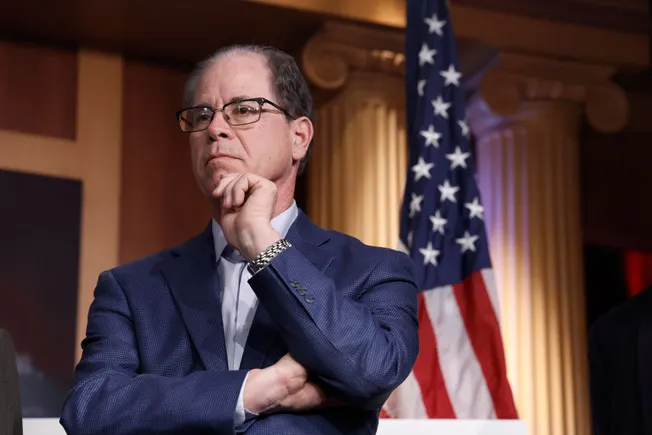
    • The American Civil Liberties Union of Indiana is suing the state’s governor, Mike Braun, over a new law giving him full control over the selection of Indiana University’s trustee board.
    • Last month, Republican lawmakers added several last-minute changes to Indiana’s budget bill that expanded the state’s control over its public colleges. Braun signed the budget into law Tuesday.
    • One provision empowers the governor to appoint all nine members of Indiana University’s board, eliminating the institution’s longstanding tradition of alumni trustee elections. That change illegally targets Indiana University and violates the state’s constitution, ACLU of Indiana’s lawsuit argues.

    Dive Insight:

    Indiana University has held alumni trustee elections since 1891, with the process codified into state law. Board members oversee everything from admissions standards to presidential appointments to faculty promotions and tenure. 

    Prior to the change in law this month, three trustees on the university’s nine-person were elected by alumni. The governor appointed the rest.

    ACLU of Indiana is suing Braun on behalf of a candidate who was vying for a board position this summer, Justin Vasel.

    “This challenge addresses a law that strikes at the heart of democratic governance at Indiana’s flagship university,” Vasel said in a statement Wednesday. “This unconstitutional legislation threatens IU’s 134-year-old tradition of alumni representation while an election for those very positions is already underway.”

    Before the change in law, the university’s over 790,000 graduates were eligible to cast a ballot, according to the university’s alumni association, making the voter pool larger than the populations of Wyoming, Vermont or Alaska.

    Six members of the university’s alumni association had announced their candidacy for trustee, and the month-long election was set to begin in June. Had it gone on as scheduled, the winner would have joined the board July 1.

    Now, Braun has the power to appoint who he wishes, so long as five trustees are university alumni and five are Indiana residents. The governor also received the power to remove any previously elected members at his discretion. 

    Braun defended the change during an April 30 press conference, citing low alumni voter turnout in the trustee elections, according to the Indiana Capital Chronicle.

    “It wasn’t representative. It enabled a clique of a few people to actually determine three board members. And I don’t think that is real representation,” the governor told reporters.

    The university’s next trustee meeting is set to take place June 12.

    The lawsuit castigated lawmakers for not following the normal legislative process when approving the change, instead relying on last-minute amendments.

    “No hearings were held concerning the proposal,” it said. “Instead the change was inserted at the eleventh hour deep within a lengthy budget bill that otherwise would have nothing to do with the election of members of the boards of trustees of Indiana’s higher education institutions.”

    Vasel and the ACLU of Indiana also questioned the constitutionality of the budget’s targeting of Indiana University’s board selection.

    The process for appointing trustees varies among the state’s other public universities. But the alumni of each institution have the ability to vote on or nominate graduates to the board, the lawsuit said. The change Braun signed into law takes that ability away from Indiana University alone.

    “Every other four-year public university in the state has a process for allowing alumni to select at least some members of the board of trustees, and there is no justification for denying that ability to the alumni of IU,” Ken Falk, legal director of ACLU of Indiana, said in a Tuesday statement.

    Indiana Republicans, who control both chambers of the Legislature and the governor’s mansion, have attempted to control other aspects of Indiana University.

    Earlier this year, the state comptroller and two lawmakers joined an event where an advocacy group questioned if the university was illegally routing state funds to the Kinsey Institute, a sexuality and gender research center housed on its Bloomington campus.

    Lt. Gov. Micah Beckwith joined the opposition of the institute and said he and Braun are committed to ensuring Indiana University “is not using taxpayer dollars to fund something that is rooted in this wickedness,” according to WFYI.

    Beckwith also threatened the university and its editorially independent student newspaper, the Indiana Daily Student, over the publication’s coverage of President Donald Trump. 

    The lieutenant governor derided a November cover story that showcased quotes critical of the president made by former Trump officials, though Beckwith misattributed the quotes as from the paper’s staff. He went on to call the story “WOKE propaganda at its finest.”

    “This type of elitist leftist propaganda needs to stop or we will be happy to stop it for them,” Beckwith said in a social media post.

    Source link

  • FIU expected to hire Florida lt. governor as president

    FIU expected to hire Florida lt. governor as president

    Another Florida Republican is reportedly destined for a college presidency. 

    Florida International University is expected to name Lieutenant Governor Jeanette Nuñez as interim president at a meeting Friday, The Miami Herald reported. Nuñez, who earned undergraduate and master’s degrees at FIU, is expected to resign from her position Friday to take the job.

    Nuñez, who has served as lieutenant governor since 2018, was previously an adjunct professor at FIU but does not appear to have prior administrative experience in higher education. As a member of Florida’s House of Representatives, Nuñez pushed for legislation to allow undocumented students to pay in-state tuition but has backed off on her support for that idea in recent years.

    If hired, it seems Nuñez will step into the job right away.

    One anonymous source told the newspaper that the board is seeking to act quickly on the appointment so Nuñez is in place before the Florida legislative session begins on March 4. The thinking behind the move, that source said, was that she can extract more state dollars for FIU.

    FIU is currently led by Kenneth Jessell, who was named interim in January 2022 after then-president Mark Rosenberg resigned amid allegations of sexual harassment. The interim tag was later lifted, and Jessell is on a three-year contract that is set to expire in November.

    If hired, Nuñez will be one of several Republican former lawmakers tapped to lead a Florida university in recent years. Others include Ben Sasse, a U.S. senator from Nebraska—who briefly served as president of the University of Florida but resigned abruptly last fall and has been dogged by questions about his spending—and former state lawmakers Richard Corcoran at New College of Florida, Fred Hawkins at South Florida State College and Mel Ponder at Northwest Florida State College. Ray Rodrigues, another former lawmaker, was hired as chancellor of the State University System of Florida in 2022 following a search that yielded eight applicants.

    Another Republican former lawmaker, Adam Hasner, was recently named as a finalist for the Florida Atlantic University presidency. That search was scuttled by state officials who raised concerns about “anomalies” after FAU did not hire Republican lawmaker Randy Fine last year.

    Florida International University did not respond to a request for comment from Inside Higher Ed.

    Source link

  • Indiana governor issues executive order eliminating DEI

    Indiana governor issues executive order eliminating DEI

    Indiana governor Mike Braun signed an executive order Wednesday eliminating diversity, equity and inclusion in all state agencies and replacing it with what he’s calling “MEI”—merit, excellence and innovation.

    The order requires all executive branch state agencies to uphold the Supreme Court’s 2023 decision in Students for Fair Admissions vs. Harvard, which prohibited the consideration of race in college admissions, noting that “eliminating racial discrimination means eliminating all of it” and that equal protection applies “without regard to any differences of race, of color, or of nationality.”

    Under the order, government offices cannot use state funds, property or resources to support DEI initiatives, require job candidates to issue DEI statements or “mandate any person to disclose their pronouns.” State agencies must review their individual programs and policies for compliance by April 30 and provide a written report to the governor by July 1.

    The order also closes the government’s Office of the Chief Equity, Opportunity and Inclusion Officer, which was created in 2020 under Braun’s predecessor, Governor Eric Holcomb.

    This makes Indiana the second state this year to eliminate DEI by executive order, following West Virginia.

    Among the other executive orders Braun signed during his first week as governor was one requiring the state personnel office to review all job postings and eliminate degree requirements for positions where they’re not necessary.

    Source link

  • New York governor proposes free community college initiative

    New York governor proposes free community college initiative

    During her State of the State address on Tuesday, New York governor Kathy Hochul announced a plan to make community college tuition-free for residents pursuing associate degrees in certain high-demand fields. 

    The program would be open to adults aged 25 to 55 pursuing degrees in nursing, teaching, technology fields and engineering. If enacted, it could take effect as early as this fall and cover tuition, fees and textbook costs for students attending State University of New York and City University of New York community colleges. Hochul also proposed the creation of new apprenticeship programs for similar high-demand jobs. 

    Currently, New York students from families making under $125,000 can attend SUNY and CUNY schools tuition-free, regardless of their degree program. For most of its nearly 200-year existence, all CUNY schools were free for New York residents to attend. That policy was abandoned after the 1976 city financial crisis.

    In recent years, a number of states have enacted free tuition initiatives targeted to midcareer adults and aimed at boosting employment in specific high-demand jobs. Massachusetts’s new MassReconnect program led to a surge in community college enrollment last year, and Michigan enacted a similar plan last summer.

    Source link