
Tag: Gown

  • Town vs. Gown Battles Brew in Pennsylvania, Colorado

    Town vs. Gown Battles Brew in Pennsylvania, Colorado

    Historically, colleges have few friends closer than their local community.

    Localities tend to highlight institutions of higher learning in their areas as a means for workforce development, and colleges routinely brag about their economic impact on the area—often pumping millions of dollars into the community and supporting hundreds or even thousands of jobs at larger universities. Colleges also provide rich cultural opportunities, especially in small towns, where they may house the only local theater, orchestra or other fine arts offerings.

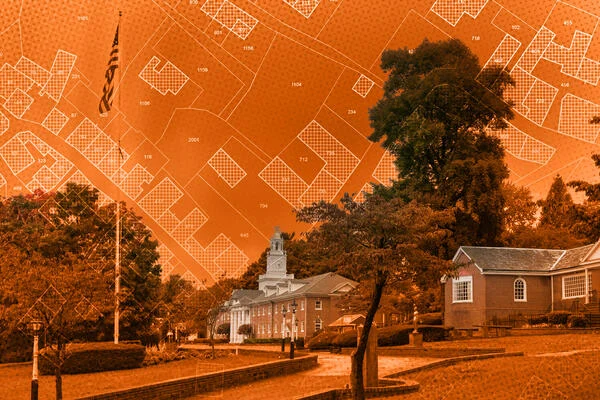
    But what happens when that symbiotic relationship breaks down? Two recent examples offer some insights as colleges square off with localities and lawmakers over campus property and signage, showing how relationships can go from harmonious to heated in some cases.

    Fighting Eminent Domain

    In Pennsylvania, 17 acres are at the heart of a brewing battle between Radnor Township and Valley Forge Military College.

    Local officials have begun the process of taking the college’s land by eminent domain. But college leadership says the land, which houses integral parts of the campus, isn’t for sale. They feel blindsided by the effort to seize the property, which the town wants for a recreational center.

    John English, chairman of the Board of Trustees of the Valley Forge Military Foundation, compared the situation to President Donald Trump’s efforts to acquire Greenland. Like Greenland, Valley Forge’s land isn’t for sale—but the township wants to take it anyway.

    “We’re still in a state of shock,” English said.

    Particularly galling for English is the fact that the property that Radnor Township wants to take by eminent domain includes the college’s health center, gym and dining hall. He argues that those facets of campus are exceedingly important for a military college such as Valley Forge, which has around 100 students. The campus itself spans more than 70 acres.

    “Last time I checked, it’s hard to run a college where you can’t feed them, you can’t house them and—for a military college—you can’t work them out. And if anyone gets injured or they get sick, you have nowhere to send them. All of this for what, open space and a basketball court?” English said.

    Jack Larkin, the member of the Radnor Township Board of Commissioners who is behind the eminent domain push, said he was under the impression that the land was for sale. Larkin notes that Valley Forge has sold off other parcels of land in the past and fielded a recent offer from a developer.

    “It’s impossible for me to tell the difference between posturing in an arm’s-length transaction and the reality of the situation with the school. All I can tell you is that there was another bidder, and the bid was being considered by the school with some degree of seriousness,” Larkin said.

    (Phil Rosenzweig, a lawyer for Valley Forge, noted at the board’s Feb. 9 meeting that while a developer had extended a $20 million deal for a parcel of land, “that offer was not pursued.”)

    Larkin also noted that township officials engaged in prior talks with Valley Forge as it looked for a site for a new recreational center. But Rosenzweig emphasized at the board meeting that those conversations included a “less ambitious” plan and smaller plot.

    Although college officials insist the targeted parcel is not for sale, Larkin argues they are “trying to weaponize the media” to get a better price. He expects a deal to come together in the end.

    English, however, said Valley Forge is resistant to the sale and has appealed to both local and federal officials given the unique nature of the small, private military college, which offers a fast-track program that allows students to commission as a second lieutenant in the U.S. Army. English said that he informed the U.S. Army that “we are under attack.”

    He also suggests that town officials sensed “blood in the water” after the foundation voted to close the affiliated Valley Forge Military Academy, a private prep school that the foundation oversees in addition to the college. English also questioned how supportive local officials are of Valley Forge’s presence.

    “The question I have that I will be asking the township officials is: Do you even want us here?” English said.

    A Sign of the Times

    Meanwhile, 1,700 miles to the west, Colorado State University’s decision to install electronic billboards, which are prohibited by city ordinances, has stirred anger in Fort Collins and prompted legislation to bar additional signage.

    Colorado State officials have used the billboards to plug sporting events and advertisements for local business but also other uses, such as weather advisories. Local media reported that at least eight of 12 planned electronic billboards have been installed, the largest of which are 11 by 22 feet. Seven of the billboards are visible to the community off campus property.

    Located on state property, Colorado State is legally within its rights to install the electronic billboards. While Fort Collins prohibits such billboards, the state does not—even if they are clearly visible to the city. But, some locals are still heated about the decision, including State Sen. Cathy Kipp, who authored a bill to block such billboards.

    Kipp told student media her bill stemmed from complaints about the billboards as well as noise related to campus events, particularly home football games. Her bill would require CSU to comply with local noise and sign ordinances but also allow the city or county to grant waivers.

    Colorado State officials told Inside Higher Ed they hope to reach an agreement on the issue.

    “CSU has been in dialogue with Sen. Kipp regarding her proposed noise and signage legislation and has sought for months to reach a compromise on this issue. We have great respect and appreciation for the senator and her point of view,” spokesperson Nik Olsen wrote by email.

    Olsen added that the bill “would set a concerning precedent for the management of state lands throughout Colorado,” would have a negative economic impact on the region and would erode “public safety infrastructure the campus has put in place to support students and the broader community.”

    A hearing for Kipp’s bill is set for Thursday.

    Fixing Fractured Relationships

    Stephen Gavazzi, an Ohio State University professor who written about town-gown relationships, argues that college and community connections are somewhat akin to a marriage.

    “The difference between a marriage and a town-gown relationship is you can’t get divorced,” Gavazzi said.

    But, like a crumbling marriage, he believes strained town-gown relationships can be repaired. Gavazzi calls disputes like those unfolding in Radnor Township and Fort Collins classic “edge and wedge issues”—flashpoints that arise at the physical edge of campus and drive a wedge between institutions and their neighbors. The two big issues are student misbehavior and land-use. But often, he said, the concerns have more to do with how the university plans to use or acquire land, thus rendering it untaxable. Eminent domain cases are exceedingly rare, he said.

    Like any relationship, healing requires partners to come together in good faith. The work is hard, but he cautions against fatalism, noting leaders should work proactively to keep relationships strong. But when they do break down, it’s up to leaders to essentially kiss and make up lest those relationships further deteriorate and cause additional problems.

    “Campuses and communities can get themselves out of binds if they can cooperate and collaborate with one another, even in the midst of a crisis. But it’s very difficult to do,” he said. “It’s easy to say, harder to do in practice.”

    Source link

  • Trump’s Higher Education Crackdown: Culture War in a Cap and Gown

    Trump’s Higher Education Crackdown: Culture War in a Cap and Gown

    In a recent flurry of executive orders, former President Donald Trump has escalated his administration’s long-running war on American higher education, targeting college accreditation processes, foreign donations to universities, and elite institutions like Harvard and Columbia. Framed as a campaign for accountability and meritocracy, these actions are in reality part of a broader effort to weaponize public distrust, reinforce ideological purity tests, and strong-arm colleges into political obedience.

    But even if Trump’s crusade were rooted in good faith—which it clearly is not—his chosen mechanism for “fixing” higher education, the accreditation system, is already deeply flawed. It’s not just that Trump is using a broken tool for political ends—it’s that the tool itself has long been part of the problem.

    Accreditation: Already a Low Bar

    Accreditation in U.S. higher education is often mistaken by the public as a sign of quality. In reality, it’s often a rubber stamp—granted by private agencies funded by the very schools they evaluate. “Yet in practice,” write economists David Deming and David Figlio, “accreditors—who are paid by the institutions themselves—appear to be ineffectual at best, much like the role of credit rating agencies during the recent financial crisis.”

    As a watchdog of America’s subprime colleges and a monitor of the ongoing College Meltdown, the Higher Education Inquirer has long reported that institutional accreditation is no sign of academic quality. Worse, it is frequently used by subprime colleges as a veneer of legitimacy to mask predatory practices, inflated tuition, and low academic standards.

    The Higher Learning Commission (HLC), the nation’s largest accreditor, monitors nearly a thousand institutions—ranging from prestigious schools like the University of Chicago and University of Michigan to for-profit, scandal-plagued operations such as Colorado Technical University, DeVry University, University of Phoenix, and Walden University. These subprime colleges receive billions annually in federal student aid—money that flows through an accreditation pipeline that’s barely regulated and heavily compromised.

    On the three pillars of accreditation—compliance, quality assurance, and quality improvement—the Higher Learning Commission often fails spectacularly when it comes to subprime institutions. That’s not just a bug in the system; it’s the system working as designed.

    Who Watches the Watchers?

    Accreditors like the HLC receive dues from member institutions, giving them a vested interest in keeping their customers viable, no matter how exploitative their practices may be. Despite objections from the American Association of University Professors, the HLC has accredited for-profit colleges since 1977 and ethically questionable operations for nearly two decades.

    As Mary A. Burgan, then General Secretary of the AAUP, put it bluntly in 2000:

    “I really worry about the intrusion of the profit motive in the accreditation system. Some of them, as I have said, will accredit a ham sandwich…”

    [Image: From CHEA: Higher Learning Commission dues for member colleges. Over the last 30 years, HLC has received millions of dollars from subprime schools like the University of Phoenix.]

    The Council for Higher Education Accreditation (CHEA), which oversees accreditors, acts more like a trade association than a watchdog. Meanwhile, the U.S. Department of Education—the only federal entity with oversight responsibility—has done little to ensure quality or accountability. Under the Trump-DeVos regime, the Department actively dismantled what little regulatory framework existed, rolling back Obama-era protections that aimed to curb predatory schools and improve transparency.

    In 2023, an internal investigation revealed that the Department of Education was failing to properly monitor accreditors—yet Trump’s solution is to hand even more power to this broken apparatus while demanding it serve political ends.

    Harvard: Not a Victim, But a Gatekeeper of the Elite

    While Trump’s attacks on Harvard are rooted in personal and political animus, it’s important not to portray the university as a defenseless bastion of the common good. Harvard is already deeply entrenched in elite power structures—economically, socially, and politically.

    The university’s admissions policies have long favored legacy applicants, children of donors, and the ultra-wealthy. It has one of the largest endowments in the world—over $50 billion—yet its efforts to serve working-class and marginalized students remain modest in proportion to its vast resources.

    Harvard has produced more Wall Street bankers, U.S. presidents, and Supreme Court justices than any other institution. Its graduates populate the upper echelons of the corporate, political, and media elite. In many ways, Harvard is the establishment Trump claims to rail against—even if his own policies often reinforce that very establishment.

    Harvard is not leading a revolution in equity or access. Rather, it polishes the credentials of those already destined to lead, reinforcing a hierarchy that leaves most Americans—including working-class and first-generation students—on the outside looking in.

    The Silence on Legacy Admissions

    While Trump rails against elite universities in the name of “meritocracy,” there is a glaring omission in the conversation: the entrenched unfairness of legacy admissions. These policies—where applicants with familial ties to alumni receive preferential treatment—are among the most blatant violations of meritocratic ideals. Yet neither Trump’s executive orders nor the broader political discourse dare to address them.

    Legacy admissions are a quiet but powerful engine of privilege, disproportionately benefiting white, wealthy students and preserving generational inequality. At institutions like Harvard, Yale, and Princeton, legacy applicants are admitted at significantly higher rates than the general pool, even when controlling for academic credentials. This practice rewards lineage over talent and undermines the very idea of equal opportunity that higher education claims to uphold.

    Despite bipartisan rhetoric about fairness and access, few politicians—Democratic or Republican—have challenged the legitimacy of legacy preferences. It’s a testament to how deeply intertwined elite institutions are with the political and economic establishment. And it’s a reminder that the war on higher education is not about fixing inequalities—it’s about reshaping the system to serve different masters.

    A Hypocritical Power Grab

    Trump’s newfound concern with educational “results” is laced with hypocrisy. The former president’s own venture into higher education—Trump University—was a grift that ended in legal disgrace and financial restitution to defrauded students. Now, Trump is posing as the savior of academic merit, while promoting an ideologically-driven overhaul of the very system that allowed scams like his to thrive.

    By focusing on elite universities, Trump exploits populist resentment while ignoring the real scandal: that billions in public funds are siphoned off by institutions with poor student outcomes and high loan default rates—many of them protected by the very accrediting agencies he now claims to reform.

    Conclusion: Political Theater, Not Policy

    Trump’s latest actions are not reforms—they’re retribution. His executive orders target symbolic elites, not systemic rot. They turn accreditation into a partisan tool while leaving the worst actors untouched—or even empowered.

    Meanwhile, elite institutions like Harvard remain complicit in maintaining a class hierarchy that benefits the powerful, even as they protest their innocence in today’s political battles.

    Real accountability in higher education would mean cracking down on predatory schools, reforming or replacing failed accreditors, and restoring rigorous federal oversight. But this administration isn’t interested in cleaning up the swamp—it’s repurposing the muck for its own ends.

    The Higher Education Inquirer remains committed to pulling back the curtain on these abuses—no matter where they come from or how well they are disguised.

    Source link