Tag: Grade

  • 3,000 Children Repeating Third Grade Under New Indiana Literacy Requirement – The 74

    3,000 Children Repeating Third Grade Under New Indiana Literacy Requirement – The 74


    Get stories like this delivered straight to your inbox. Sign up for The 74 Newsletter

    About 3,000 Indiana students are repeating third grade this school year for not meeting the state’s reading proficiency standards.

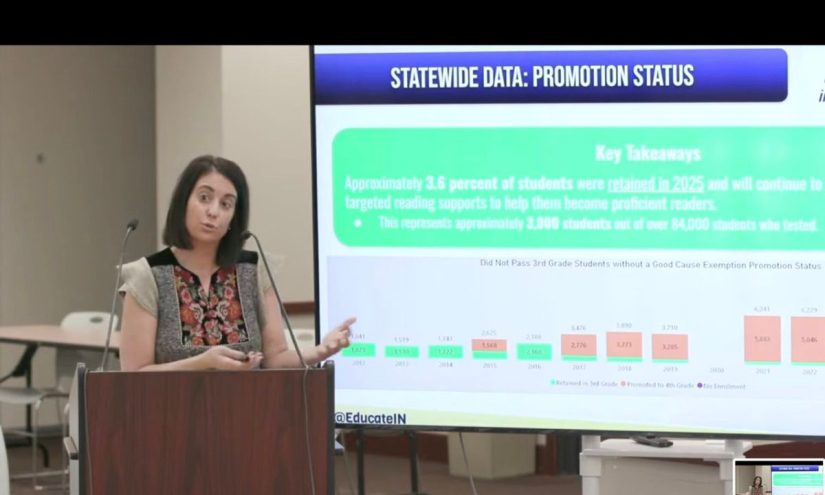
    Data released Wednesday by the Indiana Department of Education showed 3.6% of the 84,000 children who took the statewide IREAD exam were retained in third grade under the first enforcement of a requirement approved by the Legislature in 2024.

    Those 3,040 retained students are more than seven times the 412 children held back in third grade two years ago.

    Education Secretary Katie Jenner credited improved performance by students in the IREAD exam given last school year with the retention figure being lower than anticipated when the literacy requirement was being debated.

    “The numbers that were being thrown out is that it would be 7,000 to 10,000 that this law would trigger retention,” Jenner told State Board of Education members. “But, in fact, a huge shout out to our teachers and our people, we have thousands of kids who are now readers.”

    Education officials announced in August that 87.3% of third graders — about 73,500 out of more than 84,000 students statewide — demonstrated proficient reading skills in 2024-25. They hailed the nearly five percentage point improvement from the previous school year as the largest year-to-year jump since the state began IREAD testing in 2013.

    That left about 10,600 children who didn’t meet the standard, with almost 7,000 being given “good cause exemptions” to avoid retention. Nearly 75% of those given exemptions were special education students and about 24% are English learners with less than two years of specific literacy services.

    Anna Shults, the Department of Education’s chief academic officer, said the new retention requirement was having its intended effect.

    “We are now ensuring that students that are promoted on to grade four are doing so with an ability to read and show mastery of key foundational reading skills,” Shults told the State Board of Education.

    The Department of Education will have an online dashboard providing breakdowns of the Indiana Reading Evaluation and Determination assessment, or IREAD, by school district and individual schools, including charter schools and nonpublic schools.

    Officials noted about 670 children who didn’t meet the literacy standards were not enrolled in Indiana schools this year, saying they likely moved out of state or were being homeschooled.

    Jenner said a determination would need to be made about those students if they returned to Indiana schools.

    “That’s a question that we’ll need to sort through, because some may move back into Indiana, or if they left for homeschool may come back in,” Jenner said. “Because we’re looking at every unique student, I think we’ll try to figure out exactly where they are.”

    According to 2023 data, 13,840 third-graders did not pass I-READ-3. Of those, 5,503 received an exemption and 8,337 did not. Of those without an exemption, 95% moved onto 4th grade while only 412 were retained.

    Indiana Capital Chronicle is part of States Newsroom, a nonprofit news network supported by grants and a coalition of donors as a 501c(3) public charity. Indiana Capital Chronicle maintains editorial independence. Contact Editor Niki Kelly for questions: [email protected].


    Did you use this article in your work?

    We’d love to hear how The 74’s reporting is helping educators, researchers, and policymakers. Tell us how

    Source link

  • 4 Ways to Better Grade Team Projects (opinion)

    4 Ways to Better Grade Team Projects (opinion)

    Some professors resist using teamwork in their classes because they mistakenly believe that team projects are too difficult to grade. One issue is that, as educators, we often only evaluate the team presentation, project or paper with a grade based on how well the team has met our learning objectives.

    However, a single project evaluation at the end allows some members to potentially free ride on harder-working teammates, or enables one aggressive or dominating member to take over the entire project to ensure the team gets an A. If we simply grade team projects at the end, it is too late for our student teams to adapt or adjust and learn how to be better at working in teams, a key skill that employers look for in our graduates.

    The key to effectively grading teamwork is to set up the grading process systematically at the start of the project. In this article, we offer four ways that you can grade team projects effectively to meet your learning objectives and help students become better team members.

    1. Share your grading rubric at the start of the assignment. Students need to know at the outset of the team project how they will be graded. Many good students tell us they hate team projects because they know they will have to deal with “social loafers” who rely on one or two others to do the work. However, by sharing a rubric that highlights the expectations for each team member and how you will be combining individual and team grading, you can help students make more intentional decisions regarding how they distribute the assignment’s requirements. We not only distribute the rubric at the start of the project, but we post it on our course management system and frequently review it with the class so our expectations are clear.
    2. Include peer evaluation as a part of the evaluation process. Students are sometimes asked to rate their fellow team members, but they are seldom taught how to do it well. As a result, they tend to only give positive feedback to avoid conflict or hurting another student’s feelings. Teaching peer feedback takes only a little class time, as few as 15 minutes. It starts with clarifying your expectations about how you will use peer feedback. You can use or create a form that allows students to provide quantitative and qualitative feedback, and then you should use this same form multiple times during the project. The first time you collect peer feedback should be a low-stakes or practice situation early during the project so that students have a psychologically safe opportunity to learn how to use it. Your students should begin with self-evaluation and then evaluate their peers.
      Next, you need to summarize the peer feedback and give results to individual students so they know how they are doing. Finally, have groups reflect on how well the group is doing without naming or shaming others. There are times when students will have to give feedback to a person who is free riding or loafing. When they do, make sure they know to first ask that person for permission before they give feedback, then praise in public, and finally provide any negative feedback in private. Finally, we have a YouTube video that instructors can show during class to help students learn about how to give and receive feedback.
    1. Incorporate ongoing feedback from the instructor. We know of faculty who give out a team assignment and never mention it again until the week before the project is due. This is setting up the student teams for failure. Faculty need to check in frequently with their teams to be sure they are making progress on their work and any questions or concerns are answered. Taking just five minutes at the end of class for teams to meet can pay great dividends in a better project product. This instructor feedback can include a way to hold individual team members accountable for the work they are doing. For example, we have set up a separate Google folder for each team with instructor access. Each team member needed to post their contributions to the team project weekly. In this way, we could keep an eye on any social loafers, and provide feedback to those who were working independently instead of with the team. Instructors can also schedule a brief time to sit in on team meetings so that they get a more comprehensive update about the project and who is working toward each of the outcomes.
    2. Carefully consider the weight you give to each phase of the project. It is essential to incorporate peer assessments and the instructor evaluation about how well the project met the learning objectives into any final grade; both are important. However, the weight of these different evaluations tells students the importance of each. More weight on the individual peer assessments stresses the individual work, while more weight on the instructor grade of the project shows the team efforts are more important. At a minimum, use the 80/20 rule: At least 20 percent of the student’s grade should be based on each.
      Also, be sure to check the peer evaluations to verify that they result from real behaviors rather than personal biases. We accomplish this by looking for consistency across the times of evaluation, across team members and between peer and self-evaluations. In most cases, we find that the evaluations show consistency in all three areas (though self-evaluations are often inflated). In the rare cases when they don’t align, we always refer to supporting documentation, such as agendas, meeting minutes and information that resulted from our ongoing check-ins to help make sense of the reasons underlying any inconsistencies.

    Grading a team project may seem like a daunting challenge, but grading is by no means a reason to avoid giving students the experience of working with a team. By following these four principles for evaluating teamwork, instructors can account for the team’s achievement of the learning objectives as well as provide students with valuable teamwork experiences that they can take to future classes, internships, co-ops and employment.

    Lauren Vicker is a communications professor emeritus, and Tim Franz is a professor of psychology, both at St. John Fisher University. They are the authors of Making Team Projects Work: A College Instructor’s Guide to Successful Student Groupwork (Taylor & Francis, 2024).

    Source link

  • How We Outperformed National Reading Scores – And Kept Students at Grade Level – The 74

    How We Outperformed National Reading Scores – And Kept Students at Grade Level – The 74


    Get stories like this delivered straight to your inbox. Sign up for The 74 Newsletter

    As reading scores remain a top concern for schools nationwide, many districts are experimenting with ability-based grouping in the early grades. The idea is to group students in multiple grade levels by their current reading level — not their grade level. A classroom could have seven kindergartners, 10 first graders, and three second graders grouped together for reading because they all read at the same level.

    While this may work for some schools, in our district, Rockwood School District in Missouri, we’ve chosen a different path. We keep students together in their class during whole-class instruction — regardless of ability level — and provide support or enrichment by creating flexible groups based on instructional needs within their grade level.

    We’re building skilled, confident readers not by separating them, but by growing them together.

    Children, like adults, learn and grow in diverse groups. In a Rockwood classroom, every student contributes to the shared learning environment — and every student benefits from being part of it.

    Our approach starts with whole-class instruction. All students, including English multilingual learners and those working toward grade-level benchmarks, participate in daily, grade-level phonics and comprehension lessons. We believe these shared experiences are foundational — not just for building literacy, but for fostering community and academic confidence.

    After our explicit, whole-group lessons, students move into flexible, needs-based small groups informed by real-time data and observations. Some students receive reteaching, while others take on enrichment activities. During these blocks, differentiation is fluid: A student may need decoding help one day and vocabulary enrichment the next. No one is locked into a static tier. Every day is a new opportunity.

    Students also engage in daily independent and partner reading. In addition, reading specialists provide targeted, research-based interventions for striving readers who need additional instruction.

    We build movement into our instruction, as well — not as a brain break, but as a learning tool. We use gestures for phonemes, tapping for spelling and jumping to count syllables. These are “brain boosts,” helping young learners stay focused and engaged.

    We challenge all students, regardless of skill level. During phonics and word work, advanced readers work with more complex texts and tasks. Emerging readers receive the time and scaffolded support they need — such as visual cues and pre-teaching or exposing students to a concept or skill before it’s formally taught during a whole-class lesson. That can help them fully participate in every class. A student might not yet be able to decode or encode every word, but they are exposed to the grade-level standards and are challenged to meet the high expectations we have for all students.

    During shared and interactive reading lessons, all students are able to practice fluency and build their comprehension skills and vocabulary knowledge. Through these shared experiences, every child experiences success.

    There’s a common misconception that mixed-ability classrooms hold back high achievers or overwhelm striving readers. But in practice, engagement depends more on how we teach rather than who is in the room. With well-paced, multimodal lessons grounded in grade-level content, every learner finds an entry point.

    You’ll see joy, movement, and mutual respect in our classrooms — because when we treat students as capable, they rise. And when we give them the right tools, not labels, they use them.

    While ability grouping may seem like a practical solution, research suggests it can have a lasting downside. A Northwestern University study of nearly 12,000 students found that those placed in the lowest kindergarten reading groups rarely caught up to their peers. For example, when you group a third grader with first graders, when does the older child get caught up? Even if he learns and progresses with his ability group, he’s still two grade levels behind his third-grade peers.

    This study echoes what researchers refer to as the Matthew Effect in reading: The rich get richer, and the poor get poorer. Lower-track students are exposed to less complex vocabulary and fewer comprehension strategies. Once placed on that path, it’s hard to catch up. Once a student is assigned a label, it’s difficult to change it — for both the student and educators.

    In Rockwood, we’re confident in what we’re doing. We have effective, evidence-based curricula for Tier I phonics and comprehension, and every student receives the same whole-class instruction as every other student in their grade. Then, students receive intervention or enrichment as needed.

    At the end of the 2024–25 school year, our data affirmed what we see every day. Our kindergarteners outperformed national proficiency averages in every skill group — in some cases by more than 17 percentage points, according to our Reading Horizons data. Our first and second graders outpaced national averages across nearly every domain. We don’t claim to have solved the literacy crisis — or know that our model will work for every district, school, classroom or student — but we’re building readers before gaps emerge.

    We’ve learned that when every student receives strong Tier I instruction, no one gets left behind. The key isn’t separating kids by ability. It’s designing instruction that’s universally strong and strategically supported.

    We recognize that every community faces distinct challenges. If you’re a district leader weighing the trade-offs of ability grouping, consider this: When you pull students out of the room during critical learning moments, the rich vocabulary, the shared texts and the academic conversation, you are not closing the learning gap, but creating a bigger one. Those critical moments build more than skills; they build readers.

    In Rockwood, our data confirms what we see every day: students growing not only in skills, but also in confidence, stamina and joy. We’re proving that inclusive, grade-level-first instruction can work — and work well — for all learners.


    Get stories like these delivered straight to your inbox. Sign up for The 74 Newsletter

    Source link

  • How About Grade 13? | HESA

    How About Grade 13? | HESA

    Hey everyone, quick bit of exciting Re: University news before we get started. Our speakers are beginning to go live on the site here. We’ll be shouting them out on the blog over the next few weeks, so watch this space. Also, a huge thanks to our many dynamic partners and sponsors for making it all happen, check them out here. And of course, thank you to everyone who has already grabbed a ticket, we are already 75% sold out and we are looking forward to having some very interesting conversations with you in January. Anyway, on with the blog…


    Question:  What policy would increase student preparation for post-secondary education, thus lowering dropouts and average time-to-completion while at the same time lowering per-student delivery costs?

    Answer: Introducing (or re-introducing) Grade 13 and move (or return) to make 3-year degrees the norm.

    It’s a policy that has so many benefits it’s hard to count them all. 

    Let’s start with the basic point that older students on the whole are better-prepared students. In North America, we ask students to grow up and make decisions about academics and careers awfully early. In some parts of the world, they deal with this by having students take “gap years” to sort themselves out. In North America we are very Calvinist (not the good kind) about work and study, and think of tie off just to mature and think as “wasteful”, so we drive them from secondary school to university/college as fast as possible. 

    But there’s no reason that the line between secondary and post-secondary education needs to be where it is today. In antebellum America, the line was in people’s early teens; and age 18 wasn’t an obvious line until after World War II (Martin Luther King Jr. started at Morehead College age 15 because it decided to start taking high school juniors). The Philippines drew the line after 10 years of schooling until about six years ago. Ontario’s elimination of grade 13 was one of the very few examples anywhere in the world of a jurisdiction deciding to roll the age of transition backwards.

    But it’s not clear in Ontario – which has now run this experiment for nearly 25 years – that the system is better off if you make students go to post-secondary education at 18 rather than 19. If you give students an extra year to mature, they probably have a better sense of what specific academic subjects actually consist of and how they lead to various careers. Because they have a better sense of what they want to do with their lives, they study with more purpose. They are more engaged. And almost everything we know about students suggests that more engaged students are easier to teach, switch programs less often, and drop out less frequently. 

    These all seem like good outcomes that we threw away for possibly no good reason.

    Students would spend another year at home. Not all of them would enjoy that, but their parents’ pocket-books sure would. They’d also spend one more year in classes of approximately thirty instead of classes of approximately three hundred. Again, this seems like a good thing.

    And as for cost, well, the per-student cost of secondary education is significantly lower than that of the per-student cost of post-secondary education. I don’t just mean for families, for whom the cost of secondary school is zero. I also mean for governments who are footing the bill for the post-secondary part of the equation, too (at least this is the case everywhere outside Ontario, which has abysmal levels of per-student spending on public post-secondary education). 

    There really is only one problem with moving from a 6+6+4 system of education to a 6+7+3 system.  It’s not that a three-year degree is inherently bad or inadequate. Quebec has a 6+5+2+3 system and as far as I know no one complains. Hell, most of Europe, and to some extent Manitoba, are on a 6+6+3 system and no one blinks. 

    No, the problem is space. Add another year of secondary school and you need bigger secondary schools. And no one is likely to want to get into that, particularly when the system is already bursting – in most of the country, particularly in western Canada – from a wave of domestic enrolments. It is possible that some universities and colleges could convert some of their space to house high schools (the University of Winnipeg has quite a nice one in Wesley Hall), but that wouldn’t be a universal solution. Architecture and infrastructure in this case act as a limiting factor on policy change. However, by the early-to-mid 2030s when secondary student and then post-secondary numbers level off or even start to decline again, that excuse will be gone. Why wouldn’t we consider this?

    (Technically another potential solution here of is to adopt something like a CEGEP, since these which arguably bridge the gap between secondary and university better that grade 13 did. But the real estate/infrastructure demands of creating a new class of institutions probably make that a non-starter).

    Anyways, this is just idle talk. This might be a complete waste of time and money, of course. My suggestions about possible benefits could be totally off. Interestingly, as far as I know, Ontario never did a post-policy implementation review about eliminating grade 13/Ontario Academic Credits. Did we gain or lose as a society? What were the cost implications? Seems like the kind of questions to which you’d want to know the answers (well, I wish I lived in a country that thought these were questions worth answering, anyway). And even if we thought there were benefits to keeping students out of post-secondary for one more year, architectural realities would almost certainly get in the way. 

    But if we’re genuinely interested in thinking about re-making systems of education, these are the sorts of questions we should be asking. Take nothing for granted.

    Source link

  • Ind. B School to Enforce Grade Distribution for Skill Classes

    Ind. B School to Enforce Grade Distribution for Skill Classes

    Photo illustration by Justin Morrison/Inside Higher Ed | Ralf Geithe/iStock/Getty Images

    Some faculty members at the Indiana University Kelley School of Business have been instructed to eliminate grade rounding, remove the A-plus grade option and keep average section GPAs between 3.3 and 3.5 for the fall semester.

    The grading changes aim to “address grade inflation and promote rigor across our curriculum,” according to an email sent to faculty in the Communication, Professional and Computer Skills (CPS) department from business writing course coordinator Polly Graham, which was obtained by Inside Higher Ed. “During the COVID-19 pandemic, [CPS] grades elevated, and in recent years, grades have remained high. In recent semesters, some instructors have awarded 100% A’s in standard (i.e., non-honors) sections, and others have awarded extraordinary numbers of A+’s and incompletes,” the email said. 

    The new grading policy was sent to instructors in early August without faculty discussion or approval, according to a faculty member in the CPS department who asked to remain anonymous for fear of retribution. The department, which does not have its own governance or bylaws beyond what governs the business school writ large, is the only one in Kelley that is staffed entirely by lecturers who do not have tenure protections. So far, the new grading policies apply only to courses in the CPS department, the faculty member said.

    Instructors of standard, nonhonors courses must make the GPA of each section average between 3.3 and 3.5, and honors course GPA averages must fall within 0.2 points of the “section’s cumulative student GPA,” the email stated. Faculty members should not round up final grades “even if the student’s grade is very close to a higher letter grade,” and each instructor will complete two check-ins with CPS leadership—one before and one after midterms—after which “formative support will be provided to faculty as requested or needed.” It’s unclear what form the support will take, but the faculty member suspects it could be additional assistance from the chair on lesson plans or grading strategies.

    It’s not unusual for business schools to enforce a set grade distribution. At the University of Michigan’s Ross Business School, for instance, core class instructors must follow a distribution that allows 40 percent or fewer undergraduates to earn an A-minus or higher, 90 percent or fewer undergraduates to earn a B or higher, and at least 10 percent of undergraduates must earn between a B-minus and an F. Emory University’s Goizueta Business School also enforces a grade distribution, as does Columbia Business School.

    The Kelley School will also enforce an attendance policy for CPS classes this fall. Students will be allowed up to three absences without a grade penalty. After the fourth absence, they lose one-third of their final letter grade, and after five absences, they lose a full letter grade. Six absences will result in an automatic “failure due to non-attendance,” the email explained. The school will allow exceptions on a case-by-case basis.

    All Kelley students are required to take courses within the CPS department, including a business presentations class, a business writing course and three “Kelley Compass” classes that teach soft business skills such as team building, interviewing and conflict management. Like the lab time that accompanies physical science classes, CPS courses offer skills-based training that encourages mastery, the CPS faculty member told Inside Higher Ed. Faculty are concerned that the new GPA targets put an artificial limit on students’ success.

    A spokesperson for the Kelley School did not answer Inside Higher Ed’s questions about the grade recalibration and instead provided the following statement: “At Kelley, faculty design courses to be both rigorous and fair, while supporting student development and career preparation. Our longstanding priority is to ensure that grades reflect the quality of each student’s performance and that grade distribution is fair and consistent, including across multiple sections of the same course.”

    The statement language echoes what faculty have been instructed to tell students and parents who ask about the grading changes, according to the CPS faculty member.

    Indiana’s Kelley School has become more popular of late, and administrators appear to be tightening admissions standards in response. The school has fielded some 27,000 applications for approximately 2,000 spots in recent years, the faculty member said, though the Kelley spokesperson did not confirm or refute these numbers.

    In March, Kelley promoted Patrick E. Hopkins, an accounting professor who has worked at the business school since 1995, to dean. Just over two months later, on June 2, incoming Indiana University prebusiness students were notified that the minimum grade for automatic admission to the Kelley School would be raised from a B to a B-plus, starting with their cohort. Christopher Duff, the father of an incoming Indiana prebusiness student who plans to seek admission to Kelley, said the change was a “bait and switch.”

    “To be crystal clear, I have zero issues with the Kelley School of Business changing their admission criteria. I do, however, have a major issue in the timing of this change. We made our decision based on clearly stated information at the time of commitment. We jettisoned all other schools, offers and financial aid to pursue a degree from Indiana-Kelley,” Duff told Inside Higher Ed. “You want to change the criteria? Fine. Do so with the incoming class who will be aware to make an informed decision. We did not get that choice. It was made for us and when we complained—and we all did—we were essentially told to take it or leave it.”

    Duff said he met with Kelley’s undergraduate admissions director, Alex Bruce, in June to discuss the change, and in that meeting Bruce told him the school had overadmitted for the incoming class and received commitments from far more students than they anticipated.

    “I asked [Bruce] if the admission department was telling the academic departments to grade harder, to weed out even more students than prior years,” Duff said. “He assured me that admissions and academics are separate entities and have no control over each other. I do not believe anything he told me that day.”

    Source link

  • Eliminating grade inflation isn’t as easy as ABC

    Eliminating grade inflation isn’t as easy as ABC

    A perfect grade point average isn’t what it used to be. As grade inflation continues worldwide, more students are earning top marks, but it isn’t always deserved. Critics argue that inflated grades make it harder to distinguish truly exceptional students, while supporters say they reduce stress and improve confidence. 

    From high schools in the United States to universities in Europe, the debate over grade inflation is shaping education systems and college admissions. But is this trend helping students succeed, or is it setting them up for failure?

    Grade inflation is the trend of rising student grades over time without a corresponding increase in academic achievement, often making higher grades less reflective of actual learning or ability. 

    High school is meant to prepare students for higher education, but with grade inflation, many students feel unprepared. 

    Take high school senior Ruby Schwelm. “As a student who has dealt with inflation, I’ve noticed I don’t receive grades and feedback that reflect my actual understanding of the content,” Schwelm said. “I feel like I’m just going through the motions of my courses, completing assignments without really engaging with the material. This makes it hard to track progress, see where I need improvement and feel prepared for college.”

    The rising GPA

    According to a study by ACT, a non-profit organization that runs one of two standardized tests used in the United States used for college admissions, the average adjusted grade point average (GPA) of students in the United States has risen from 3.17 in 2010 to 3.36 in 2021. 

    The report said that grade inflation “calls into question the degree to which we should rely on grades to measure academic achievement or predict future grades.” This shift challenges the typical role of grades as a reliable measure of knowledge, starting a debate over whether they still hold value in measuring students’ abilities.  

    Many educators believe that the shift in grading has led to a lack of rigor and academic accountability. Josh Hsu, a high school English teacher at the Tatnall School in Wilmington, Delaware where I go to high school, said that many students now equate a C with failure, despite it being historically recognized as an average grade.

    “There seems to be a threshold of how low grades will go, and that bar gets pushed higher and higher,” Hsu said.

    This trend has caused concern among educators who feel that the traditional grading system no longer differentiates students based on their academic performance. 

    “What does an A mean if everybody has an A, right?” Hsu said. 

    The psychological effects of grade inflation

    Proponents of grade inflation argue that it helps students maintain self-confidence and reduces academic stress. 

    Sara Gartland, a high school math teacher at the Tatnall School and adjunct professor at the University of Delaware School of Education, said that “there’s a lot of tension in what a grade is.” 

    She worries that students today see grades as a measure of their worth rather than as a tool for learning. Grades should function as a feedback loop between teachers and students rather than a rigid measure of success, Gartland said. 

    She also emphasized the importance of second chances. “I tend to see that really what students are looking for is, ‘Do I have a second chance if today is not my best day?’,” she said. 

    This perspective aligns with educational philosophies that prioritize mastery over memorization. Many teachers now allow students the opportunity to make corrections and retake assessments to make sure that students truly understand the material, which can also lift the burden of test stress off of students. 

    Elevated grades and equity

    While grade inflation is happening across the country, there have been concerns over whether grade inflation is proportionally impacting students of different incomes and communities. 

    Hsu said that parents of students in private schools often expect their children to earn high grades to get into a top college in return for the price of tuition. While this belief may lead people to assume that wealthier students have proportionately higher grades than lower-income students, this actually is not the case. 

    The ACT’s study shows that the average GPA of students in a household with an income of under $36,000 a year has grown much faster than the GPA of students in a household with an income of $100,000 from 2012 to 2021. This could be due to teachers inadvertently trying to give a break to students from low-income families to try and level the playing field. 

    Gartland argues that teachers should provide students with the tools they need for success and take into consideration things that may impact a student’s performance outside of the classroom. 

    “That [grade on a test] doesn’t necessarily take into consideration your drive to school that day, whether or not you forgot your lunch that day, or let’s say you had a particularly exciting life event or a particularly upsetting life event, and you didn’t get to spend the amount of time studying that other students did, all sorts of other things,” she said. 

    With this mindset in education, students are being treated with equity, allowing them the opportunity to experience the same academic success, even if there are barriers in their way. 

    Global patterns in how students are graded

    While the issue of grade inflation is often discussed in the context of schools in the United States, grade inflation is a global issue. A 2024 study, by researchers at the College of New Jersey, found that many countries, including the United Kingdom, Germany and Canada have all experienced rising average grades over time. 

    However, the extent of grade inflation varies from country to country. Australia, for example, maintains relatively strict grading standards through the use of relative grading and limited reliance on student achievement.

    This study also showed that there are many differences in grading practices from region to region. In the United States, professors were significantly more likely to use curved grading, a practice strongly associated with grade inflation. 

    In contrast, educators in Europe and the South Pacific gave lower average grades and curved fewer grades, suggesting a more conservative approach to grading. Asian countries showed grading patterns similar to the United States, with higher usage of grade curves and slightly elevated grade averages.

    These disparities have real implications. Grade inflation complicates international admissions, making it harder to fairly compare students from different educational systems. 

    It can also distort hiring practices. The international study on grade inflation found that in Sweden, students from schools with inflated grades were shown to earn up to 5% more than peers with equivalent abilities. Ultimately, when grades become inflated, they lose their value as an objective measure of performance, creating global challenges in education, employment, and equity. 

    A shift in college admissions 

    As I went through the process of applying to college, I learned from my college counselors how grade inflation has affected the college admissions process. As grade inflation rises, colleges and employers are shifting their focus away from GPAs and toward other indications of student potential. Admissions officers are increasingly looking at extracurricular activities, personal essays and recommendation letters to evaluate applicants.

    According to a report by the group FairTest, which works for equity in educational assessments, standardized tests, which once served as a counterbalance to inflated grades, are also becoming optional at many colleges and universities, further complicating the process of evaluating students.

    Hsu said he worries that without clear academic standards, the education system could lose its credibility. “If you don’t have a set of standards, then it just becomes the Wild West, and then you have everyone getting A’s and B’s and you have students with GPAs that they didn’t earn,” he said.

    Employers, too, are placing greater emphasis on internships and real-world experience rather than assuming high grades equate to a strong work ethic and mastery of material. 

    With the recent trends of grade inflation, we can expect the average GPAs of students across the country to continue to rise. Hsu worries some students have become lazier in recent years. This raises concerns about how this will impact the future of education and if students will be prepared for life post-graduation.

    “Everyone wants instant gratification now,” Hsu said. “They don’t want to work at things as hard because if they have challenges, they’re not willing to stumble through those challenges or fight through them.”


    Questions to consider:

    • What is meant by grade inflation?

    • How can student achievement be measured without letter or number grades?

    • Do you think that getting an A on an assignment should be difficult? Why?


    Source link

  • Grade Appeals to Law Professors

    Grade Appeals to Law Professors


    Grade
    Appeals

    To
    understand my stories is useful to know that law faculties, like most others,
    are assigned to committees. There are committees assigned to  propose
    candidates to be hired, committees to approve new courses, committees to review
    candidates for tenure and promotion. Some committees make long range plans,
    some study how to increase publications. The one I am on this year is called
    Academic standards. We typically handle appeals from students when something
    has been declined by an administrator. For example, a student can take a course
    at another law school and transfer the credit as long as they got a C. Those
    who  get a D or lower, which takes more
    effort than making a B, invariable appeal to Academic Standards to have the
    grade transferred.

    Today
    the committee met  and had two appeals I
    had never encountered before. One was from a student who had just finished the
    first year of school and had received and A in Contract Law. She complained
    that the A grade, the highest you could get, was unfairly granted. Her story
    was that in the class she had become friendly with the teacher Ed Freddy, who
    we all refer to a Mr. Freddy. The friendliness led to lunch which led to dinner
    (all without the knowledge of Mrs. Freddy) and well you can guess where this is
    going.

    They had falling out somewhere near the end of the semester and their fling was
    over.  Then the final exam came. In law
    school in most courses the final exam determines the grade for the entire
    semester. She took the exam and received her grade which, as I mentioned was an
    A. Her petition to us was that she only got and A because of the “services” she
    supplied to Mr. Freddy and that rather be treated like a prostitute she wanted
    a grade no higher than a B. We tabled this case until our next meeting to give
    a chance to evaluate her final exam ourselves.

    Our
    second appeal today was equally bizarre. First you have to understand that law
    schools and other University department hire visitors who teach for a semester
    or a  year are not on the permanent
    faculty. Last year we hired Mary McCan to teach for a
    semester.
     
    She was young, an average teacher, ambitious, frumpy-looking, and  lonely in our small college town.  According to the petition on the last night
    of finals she when out with a few students including the petitioner and she
    brought  one of them home with her. They
    were evidently quite drunk. According to the student, when he got ready to leave she
    blocked the door. In his words he then “obliged her as a courtesy”. The student
    got a B in the course and complained he did not deserve a B. In his words he did
    not know if he had “he’d fucked himself up from a C or down from an A.” He said
    that neither was acceptable and he wanted us to read his paper to determine if
    he deserved either and A or a C, which he was willing to accept.

    Source link