“Will this be on the test?”
If that question immediately makes your heart race, muscles tense, or your face do an unflattering cringe type of expression, you’re not alone. This question used to immediately spike my blood pressure too, until I realized I wasn’t actually frustrated with the question itself or even the student who asked it, but I was frustrated with the culture we have created in education that influences this type of behavior.
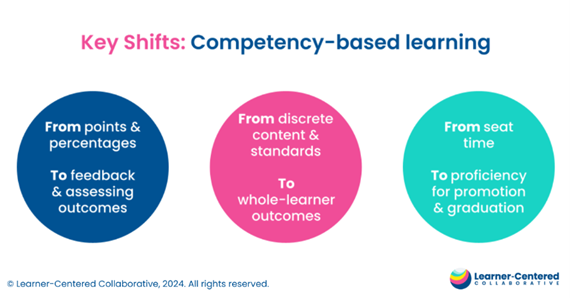
Many students approach their education with a narrow goal: study hard, ace the exam, and get an A in the class. It can feel disappointing when students seem to only care about what will be on the test or how they can bargain to bump up their grades, compared to learning and applying new knowledge to real-world experiences. Traditional grading systems tend to highlight performance above progress and prioritize short-term achievements over long-term growth. This approach not only confines deeper learning but also limits students’ understanding of what success in education truly means. Alternative grading methods that support critical thinking and meaningful reflection, like competency-based grading, can effectively promote student learning and enhance engagement.
Point-Chasing vs. Progress-Making: When Learning Takes the Lead
Traditional grading systems often:
- Emphasize point accumulation rather than true comprehension
- Include punitive consequences for errors without offering a chance to revisit/improve early coursework
- Encourage a focus on “final” grades instead of continuous learning and growth
Traditional grading can also be inconsistent (“Traditional Grading Systems vs. Standards-Based Grading Systems” 2023). A student who only partially understands the content might pass with the application of extra credit or a grading curve, while another student who makes significant progress over time may still fail simply due to early struggles that cannot be counterbalanced. As educators in higher education, we recognize that learning isn’t always linear; so why do our grading practices assume it is?
Meeting Students Where They Are: What is Competency-Based Grading?
Competency-based grading promotes multiple opportunities for students to demonstrate proficiency in specific skills or learning outcomes instead of assigning a single score or high-stakes pass/fail grade to an assignment (Townsley and Schmid 2020). In addition to knowledge, this framework assesses expected student attitudes and skills in a progressive design that holds students accountable. It is important to define clear learning outcomes along with a constructive feedback process to guide future development toward mastery. Naturally, this approach shifts the focus from a final judgment to ongoing growth and improvement. If a student does not meet expectations for a certain skill, they aren’t faced with a permanent loss of points but instead could remediate and try again. (Hanson n.d.)
Putting Mastery into Motion: Strategies to Get Started
Transitioning from a traditional grading system can be a daunting task. Here are six helpful strategies to get started:
- Start small. Unless the program is completing a comprehensive curriculum redesign, reworking your entire course all at once is not recommended and would likely overwhelm you and the students alike. Pilot competency-based grading by applying it to a single assignment or unit taught within the course.
- Define clear learning outcomes. Identify the specific skills and competencies all students should be able to demonstrate. Ensure outcomes are specific, measurable, and student-centered. For example, “will demonstrate proper hand hygiene using aseptic technique” is preferable to “will understand proper hygiene practices”.
- Use outcome-driven rubrics. Competency-based education closely aligns with backward design, so use the determined learning outcomes to build directly correlated rubrics. Focus on mastery, not points. Allow students to access the rubrics in advance. Describe what “competent” looks like by providing specific criteria with behavioral statements for different levels of achievement and provide routine formative feedback on how students can improve if they do not meet expectations. Some of the same assignments can be used, but the method of assessment changes.
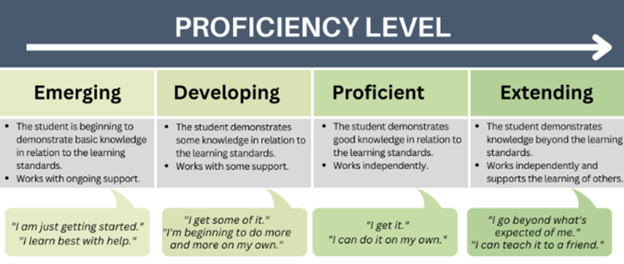
- Use a 4-point scale (or similar) to assess student progress. Competency-based grading focuses on students demonstrating mastery of specific learning objectives rather than accumulating points. (“Extending Our View of Extending” 2022)
- Plan for remediation activities. Incorporate opportunities for revision/resubmission attempts or re-demonstrations into the course schedule. For feasibility, set limits on the total number of resubmissions/re-demonstrations allowed or set a specific timeframe such as within one week of receiving faculty feedback.
- Focus your feedback. Avoid commenting on everything and instead, try to highlight one or two priority areas to guide students toward targeted improvement and maintain a manageable workload. Offer timely individualized support and feedback based on each student’s needs. (Farah 2021; Townsley and Schmid 2020)
Troubleshooting the Transition
Challenges are expected to accompany any change but can usually be mitigated with some thoughtful planning. Although higher education seems to collectively be moving toward competency-based grading, some faculty may experience resistance from their faculty peers and learners. Being transparent by sharing the reason behind the change and how it will benefit students can help increase understanding and engagement from both parties. Providing real-world examples in this area and the powerful impact competency-based education has already had on learning is an influential bonus! Faculty may express valid concerns centered around the increased workload related to time and additional resource demands necessary for success. Since remediation takes time and effort from students and faculty alike, be sure to set clear limits on remediation assignments and the process for completion. Be the example you set for others by utilizing available resources and seeking out professional development opportunities to increase your knowledge. Several online tools, including assessment builders, feedback templates, and progress-tracking programs, can assist faculty in maintaining consistency and efficiency in competency-based grading implementation.
What You Gain When You Grade for Growth
After making the transition and offering a more personalized and reflective learning experience, students focus more attention on what they are learning as opposed to what grade they are getting. Their confidence and willingness to take academic risks increases while anxiety decreases without the fear of irreversible grade penalties taking up real estate in their mind. Instead of asking “How many points did I lose?”, students start asking “How can I improve or make that better?” – which is inspiring! Grading for growth isn’t about lowering academic standards. It’s about redefining meaningful learning and reshaping expectations. Minor changes can lead to major transformation. Take the first step and be prepared to marvel at what happens when students are empowered with the tools and encouragement to grow.
Lisa Pitzer, DNP, MSN, RN, CNE, CNE-cl, serves as an Assistant Professor of Nursing at Saint Francis Medical Center College of Nursing in Peoria, Illinois. In this role, she oversees the Nursing Resource Center Simulation Laboratory and provides instruction in fundamentals and medical-surgical nursing. Dr. Pitzer is a Certified Nurse Educator and Certified Academic Clinical Nurse Educator whose scholarly interests focus on simulation-based pedagogy, curricular innovation, and advancing student success in nursing education. She is an active member of the National League for Nursing, the American Association of Colleges of Nursing, and Sigma Theta Tau International Honor Society of Nursing.
References
“Extending Our View of Extending.” My Growth Mindset, March 6, 2022. https://mygrowthmindset.home.blog/2022/03/06/extending-our-view-of-extending/.
Farah, Kareem. “How to Set Up Mastery-Based Grading in Your Classroom.” Cult of Pedagogy, September 2021. https://www.cultofpedagogy.com/mastery-based-grading/.
Hanson, Ben. “3 Key Shifts from Traditional Grading to Competency-Based Learning and Assessment.” Learner-Centered Collaborative. Accessed May 22, 2025. https://learnercentered.org/blog/traditional-grading-to-competency-based-assessment/.
Townsley, Matt and Deron Schmid. “Alternative Grading Practices: An Entry Point for Faculty in Competency-Based Education.” The Journal of Competency-Based Education 5, no. 3 (2020): 1–5. https://doi.org/10.1002/cbe2.1219.
“Traditional Grading Systems vs. Standards-Based Grading Systems.” KnowledgeWorks, 2023. https://knowledgeworks.org/resources/traditional-grading-vs-standards-based-grading/.