Tag: Graduate

  • Graduate Outcomes, 2022-23 graduating year

    Graduate Outcomes, 2022-23 graduating year

    The headline numbers from this year’s graduate outcomes data – which represents the activities and experiences of the cohort that graduated in 2022-23 around 15 months after graduation look, on the face of it, disappointing.

    There’s a bunch of things to bear in mind before we join the chorus claiming to perceive the end of graduate employment as a benefit of higher education due to some mixture (dilute to preference) of generative AI, the skills revolution, and wokeness.

    We are coming off an exceptional year both for graduate numbers and graduate recruitment – as the pandemic shock dissipates numbers will be returning to normal: viewed in isolation this looks like failure. It isn’t.

    But we’ve something even more fundamental to think about first.

    Before we start

    We’re currently living in a world in which HESA’s Graduate Outcomes data represents the UK’s only comprehensive official statistics dealing with employment.

    If you’ve not been following the travails of the ONS Labour Force Survey (the July overview is just out) large parts of the reported results are currently designated “official statistics in development” and thus not really usable for policy purposes – the response rate is currently around 20 per cent after some very hard work by the transformation team, having been hovering in the mid-teens for a good while.

    Because this is Wonkhe we’re going to do things properly and start with looking at response rates and sample quality for Graduate Outcomes, so strap in. We’ll get to graduate activities in a bit. But this stuff is important.

    Response rates and sample quality

    Declining survey response rates are a huge problem all over the place – and one that should concern anyone who uses survey data to make policy or support the delivery of services. If you are reading or drawing any actionable conclusions from a survey you should have the response rate and sample quality front and centre.

    The overall completion rate for the 2022-23 cohort for Graduate Outcomes was 35 per cent, which you can bump up to 39 per cent if you include partial completions (when someone started on the form but gave up half-way through). This is down substantially from 48 per cent fully completing in 2019-20, 43 per cent in 2020-21, and 40 per cent in 2021-22.

    There’s a lot of variation underneath that: but provider, level of previous study (undergraduate responses are stronger than postgraduate responses), and permanent address all have an impact. If you are wondering about sampling errors (and you’d be right to be at these response rates!) work done by HESA and others assures us that there has been no evidence of a problem outside of very small sub-samples.

    Here’s a plot of the provider level variation. I’ve included a filter to let you remove very small providers from the view based on the number of graduates for the year in question – by default you see nothing with less than 250 graduates.

    [Full screen]

    What do graduates do?

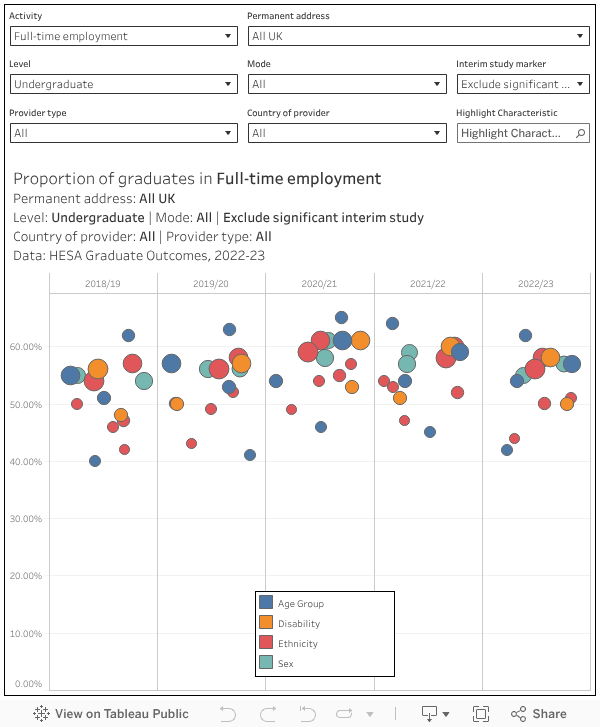
    As above, the headlines are slightly disappointing – 88 per cent of graduates from 2022-23 who responded to the survey reported that they were in work or further study, a single percentage point drop on last year. The 59 per cent in full-time employment is down from 61 per cent last year, while the proportion in unemployment is up a percentage point.

    However, if you believe that (on top of the general economic malaise) that generative AI is rendering entry level graduate jobs obsolete (a theme I will return to) you will be pleasantly surprised by how well employment is holding up. The graduate job market is difficult, but there is no evidence that it is out of the ordinary for this part of the economic cycle. Indeed, as Charlie Ball notes, we don’t see the counter-cyclical growth in further study that would suggest a full-blown downturn.

    There are factors that influence graduate activities – and we see a huge variation by provider. I’ve also included a filter here to let you investigate the impact of age: older graduates (particularly those who studied at a postgraduate level) are more likely to return to previous employment, which flatters the numbers for those who recruit more mature students.

    [Full screen]

    One thing to note in this chart is that the bar graph at the bottom shows proportions of all graduates, not the proportions of graduates with known destinations as we see at the top. I’ve done this to help put these results into context: though the sample may be representative it is not (as is frequently suggested) really a population level finding. The huge grey box at the top of each bar represents graduates that have not completed the survey.

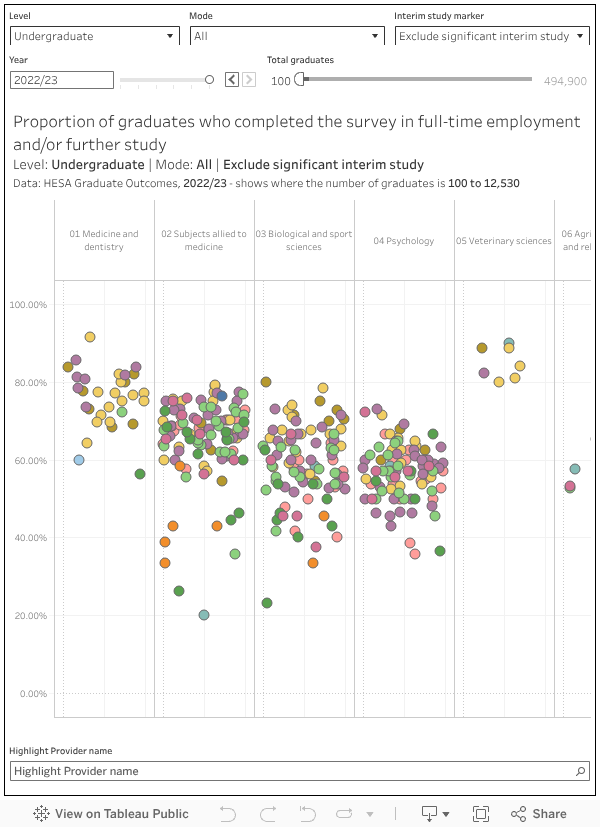
    A lot of the time we focus on graduates in full-time employment and/or further study – this alternative plot looks at this by provider and subject. It’s genuinely fascinating: if you or someone you know is thinking about undergraduate law with a view to progressing a career there are some big surprises!

    [Full screen]

    Again, this chart shows the proportion of graduates with a known destination (ie those who responded to the Graduate Outcomes survey in some way), while the size filter refers to the total number of graduates.

    Industrial patterns

    There’s been a year-on-year decline in the proportion of graduates from UG courses in paid employment in professional services – that is the destination of just 11.92 per cent of them this year, the lowest on record. Industries that have seen growth include public administration, wholesale and retail, and health and social care.

    There’s been a two percentage point drop in the proportion of PG level graduates working in education – a lot of this could realistically put down to higher education providers recruiting fewer early-career staff. This is a huge concern, as it means a lot of very capable potential academics are not getting the first jobs they need to keep them in the sector.

    And if you’ve an eye on the impact of generative AI on early career employment, you’d be advised to keep an eye on the information and communication sector – currently machine generated slop is somehow deemed acceptable for many industrial applications (and indeed employment applications themselves, a whole other can of worms: AI has wrecked the usual application processes of most large graduate employers) in PR, media, and journalism. The proportion of recent undergraduates in paid employment in the sector has fallen from nearly 8 per cent in 2020-21 to just 4.86 per cent over the last two years. Again, this should be of national concern – the UK punches well above its weight in these sectors, and if we are not bringing in talented new professionals to gain experience and enhance profiles then we will lose that edge.

    [Full screen]

    To be clear, there is limited evidence that AI is taking anyone’s jobs, and you would be advised to take the rather breathless media coverage with a very large pinch of salt.

    Under occupation

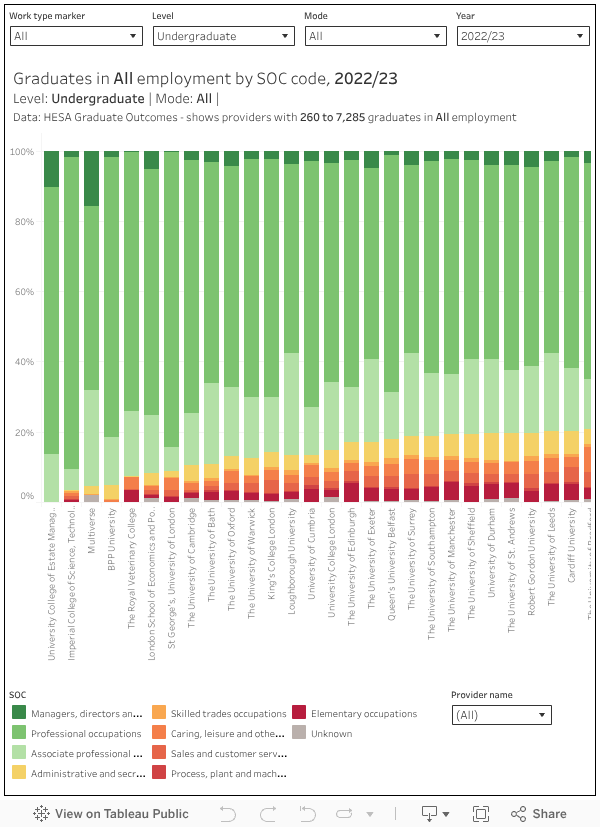
    Providers in England will have an eye on the proportion of those in employment in the top three SOC codes, as this is a key part of the Office for Students progression measure. Here’s a handy chart to get you started with that, showing by default providers with 250 or more graduates in employment, and sorted by the proportion in the top three SOC categories (broadly managers and directors, professionals, and associate professionals).

    [Full screen]

    This is not a direct proxy for a “graduate job”, but it seems to be what the government and sector have defaulted to using instead of getting into the weeds of job descriptions. Again, you can see huge differences across the sector – but do remember subject mix and the likely areas in which graduates are working (along with the pre-existing social capital of said graduates) will have an impact on this. Maybe one day OfS will control for these factors in regulatory measures – we can but hope.

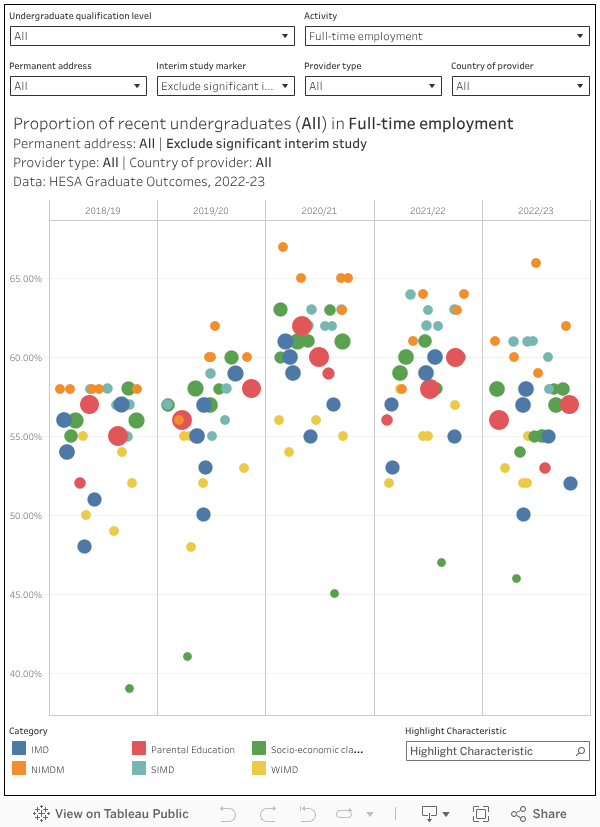
    Here’s a plot of how a bunch of other personal characteristics (age of graduates, ethnicity, disability, sex) can affect graduate activities, alongside information on deprivation, parental education, and socio-economic class for undergraduates. The idea of higher education somehow levelling out structural inequalities in the employment market completely was a fashionable stick to beat the sector with under the last government.

    [Full screen]

    [Full screen]

    Everything else

    That’s a lot of charts and a lot of information to scratch the surface of what’s in the updated graduate outcomes tables. I had hoped to see the HESA “quality of work” measure join the collection – maybe next year – so I will do a proxy version of that at some point over the summer. There’s also data on wellbeing which looks interesting, and a bunch of stuff on salaries which really doesn’t (even though it is better than LEO in that it reflects salaries rather than the more nebulous “earnings”) There’s information on the impact of degree classifications on activity, and more detail around the impact of subjects.

    Look out for more – but do bear in mind the caveats above.

    Source link

  • Raising the Bar: A Graduate Design Engineer’s Path in Engineering

    Raising the Bar: A Graduate Design Engineer’s Path in Engineering

    • By Professor Lisa-Dionne Morris, Professor of Public & Industry Understanding of Capability Driven Design in the School of Mechanical Engineering, and Engagement Champion for the EPSRC EDI Hub+ at the University of Leeds.

    International Women in Engineering Day, Monday 23 June 2025, provides an essential platform to celebrate the contributions of women designers and engineers while also highlighting persistent gender disparities in the profession. In 2021, only 16.5% of engineers in the UK were women, a figure that underscores the continued need for structural reform and targeted support for women pursuing careers in STEM disciplines.

    Preparing the next generation of female international design engineers requires more than the delivery of technical content. It necessitates a systemic, institution-wide approach that equips graduates with the attributes, knowledge, resources, skills, and confidence to navigate a professional landscape that is rapidly changing and, in many cases, still being defined for future careers. The increasing global demand for roles in areas like sustainable product design, AI-integrated manufacturing, inclusive user interface systems, and human-centred engineering is underpinned by the foundational importance of STEM, making the empowerment of women designers and engineers in these fields crucial for driving innovation and achieving sustainable development goals. These emerging sectors demand not only technical competence but also a blend of creativity, emotional intelligence, and social awareness that diverse females in STEM demonstrate.

    Holistic Support: Design Engineering as Ecosystem

    The development of a graduate designer and engineer can be likened to nurturing a tree within a complex ecosystem. While academic performance remains important, the capacity to thrive in uncertain, transdisciplinary, and innovation-driven contexts depends upon institutional ecosystems that foster global awareness, adaptability, collaboration, and resilience.

    Universities play a vital role as critical enablers and a resource. This extends beyond curricula to the people, processes, and environments that scaffold student growth, from technical staff and personal tutors to administrative teams and peer mentors. The university must therefore shift its conceptualisation of employability from curriculum-contained instruction to community-wide responsibility.

    Barriers and Micro-inequities

    For female design and engineering graduates, these ecosystems are even more consequential. While overt discrimination may be declining, micro-barriers, such as imposter syndrome, limited visibility of role models, cultural dissonance and inaccessible resources, continue to affect women disproportionately. The intersectionality of race, disability, and socioeconomic status further compounds these challenges.

    Support mechanisms such as inclusive wellbeing services, financial assistance schemes, mentoring networks, and accessible technical environments serve as critical interventions. These do not merely reduce dropout risk; they transform educational experiences and enhance graduate outcomes.

    Beyond KSA: Towards the ACRES Model

    Traditional employability frameworks such as the KSA model (Knowledge, Skills, Abilities) focus primarily on individual traits. While helpful, such models risk overlooking the social, ethical, and emotional dimensions necessary for future engineering practice. In response, I propose the ACRES framework — a holistic model centred on:

    • A – Adaptability: Developing the capacity to respond flexibly to change
    • C – Collaboration: Cultivating skills in teamwork and interdisciplinary cooperation.
    • R – Resilience: Building psychological robustness through reflective learning
    • E – Empathy: Encouraging emotional intelligence through inclusive design challenges
    • S – Social Responsibility: Engaging students with ethical, civic, and sustainability issues.

    These attributes are more than ideals; they represent the design specifications for the modern engineer.

    Educational Practice in Action

    Design engineering programmes across the UK are embedding these competencies through interdisciplinary projects, challenge-based learning, studio-based learning, sustainability modules, and community-based partnerships. At the University of Leeds, in the Faculty of Engineering and Physical Sciences, for example, students engage in industry-informed design briefs, receive feedback from career mentors, and co-produce portfolios that reflect both technical ability and human-centred thinking.

    Such practices are not incidental, they are fundamental. The preparation of women designers and engineers is a collective act; it is the result of intentional, inclusive, and collaborative university cultures that nurture talent through both “seen and unseen” interventions.

    The university must function not only as a centre of instruction but as a dynamic support system, enabling intersectionality such as first-generation, women, disabled, and underrepresented female students to flourish in STEM to become graduates. When we invest in raising future-ready women designer and engineers, we are not merely producing graduates, we are shaping leaders, changemakers, and innovators for careers that, in many cases, are yet to be invented.

    Source link

  • Subject-level insights on graduate activity

    Subject-level insights on graduate activity

    We know a lot about what graduates earn.

    Earnings data—especially at subject level—has become key to debates about the value of higher education.

    But we know far less about how graduates themselves experience their early careers. Until now, subject-level data on graduate job quality—how meaningful their work is, how well it aligns with their goals, and whether it uses their university-acquired skills—has been missing from the policy debate.

    My new study (co-authored with Fiona Christie and Tracy Scurry and published in Studies in Higher Education) aims to fill this gap. Drawing on responses from the 2018-19 graduation cohort in the national Graduate Outcomes survey, we provide the first nationally representative, subject-level analysis of these subjective graduate outcomes.

    What we find has important implications for how we define successful outcomes from higher education—and how we support students in making informed choices about what subject to study.

    What graduates tell us

    The Graduate Outcomes survey includes a set of questions—introduced by HESA in 2017—designed to capture core dimensions of graduate job quality. Respondents are asked (around 15 months after graduation) whether they:

    • find their work meaningful
    • feel it aligns with their future plans
    • believe they are using the skills acquired at university

    These indicators were developed in part to address the over-reliance on income as a measure of graduate success. They reflect a growing international awareness that economic outcomes alone offer a limited picture of the value of education—in line with the OECD’s Beyond GDP agenda, the ILO’s emphasis on decent work, and the UK’s Taylor Review focus on job quality.

    Subject-level insights

    Our analysis shows that most UK graduates report positive early-career experiences, regardless of subject. Across the sample, 86 per cent said their work felt meaningful, 78 per cent felt on track with their careers, and 66 per cent reported using their degree-level skills.

    These patterns generally hold across disciplines, though clear differences emerge. The chart below shows the raw, unadjusted proportion of graduates who report positive outcomes. Graduates from vocational fields—such as medicine, subjects allied to medicine, veterinary science, and education—tend to report particularly strong outcomes. For instance, medicine and dentistry graduates were 12 percentage points more likely than average to say their work was meaningful, and over 30 points more likely to report using the skills they acquired at university.

    However, the results also challenge the narrative that generalist or academic degrees are inherently low value. As you can see, most subject areas—including history, languages, and the creative arts, often targeted in these debates—show strong subjective outcomes across the three dimensions. Only one field, history and philosophy, fell slightly below the 50 per cent threshold on the skills utilisation measure. But even here, graduates still reported relatively high levels of meaningful work and career alignment.

    Once we adjusted for background characteristics—such as social class, gender, prior attainment, and institutional differences—many of the remaining gaps between vocational and generalist subjects narrowed and were no longer statistically significant.

    This chart shows the raw proportion of 2018-19 graduates who agree or strongly agree that their current work is meaningful, on track and using skills, by field of study (N = 67,722)

    Employment in a highly skilled occupation—used by the Office for Students (OfS) as a key regulatory benchmark—was not a reliable predictor of positive outcomes. This finding aligns with previous HESA research and raises important questions about the appropriateness of using occupational classification as a proxy for graduate success at the subject level.

    Rethinking what we measure and value

    These insights arrive at a time when the OfS is placing greater emphasis on regulating equality of opportunity and ensuring the provision of “full, frank, and fair information” to students. If students are to make informed choices, they need access to subject-level data that reflects more than salary, occupational status, or postgraduate progression. Our findings suggest that subjective outcomes—how graduates feel about their work—should be part of that conversation.

    For policymakers, our findings highlight the risks of relying on blunt outcome metrics—particularly earnings and occupational classifications—as indicators of course value. Our data show that graduates from a wide range of subjects—including those often labelled as “low value”—frequently go on to report meaningful work shortly after graduation that aligns with their future plans and makes use of the skills they developed at university.

    And while job quality matters, universities should not be held solely accountable for outcomes shaped by employers and labour market structures. Metrics and league tables that tie institutional performance too closely to job quality risk misrepresenting what higher education can influence. A more productive step would be to expand the Graduate Outcomes survey to include a wider range of job quality indicators—such as autonomy, flexibility, and progression—offering a fuller picture of early career graduate success.

    A richer understanding

    Our work offers the first nationally representative, subject-level insight into how UK graduates evaluate job quality in the early stages of their careers. In doing so, it adds a missing piece to the value debate—one grounded not just in earnings or employment status, but in graduates’ own sense of meaning, purpose, and skill use.

    If we are serious about understanding what graduates take from their university experience, it’s time to move beyond salary alone—and to listen more carefully to what graduates themselves are telling us.

    DK notes: Though the analysis that Brophy et al have done (employing listwise deletion, examining UK domiciled first degree graduates only) enhances our understanding of undergraduate progression and goes beyond what is publicly available, I couldn’t resist plotting the HESA public data in a similar way, as it may be of interest to readers:

    [Full screen]

    Source link

  • Trends in Hiring, 2025 Graduate Readiness for the Workforce

    Trends in Hiring, 2025 Graduate Readiness for the Workforce

    SDI Productions/E+/Getty Images 

    Commencement season brings excitement to college campuses as community members look to celebrate the accomplishments of the graduating class and usher them into their next chapter of life.

    The Class of 2025, however, is gearing up to enter a challenging environment, whether that’s a competitive application cycle for gaining admission to graduate school or a tighter job market compared to previous years.

    Inside Higher Ed compiled 25 data points regarding the Class of 2025 and the workforce they will enter, including levels of career preparedness, challenges in the workplace and the value of higher education in reaching career goals.

    1. Over half of seniors feel pessimistic about starting their careers because they worry about a competitive job market and a lack of job security.
    2. Seventy-eight percent of students rank job stability as a “very important” attribute in potential employers, followed by a healthy workplace culture.
    3. Eighty-eight percent of college juniors and seniors believe their coursework is adequately preparing them for entry-level roles in their chosen fields.
    4. Eight out of 10 soon-to-be graduates plan to start work within three months of graduating.
    5. Hiring for college graduates is down 16 percent compared to last year, and 44 percent below 2022 levels.
    1. Starting salaries are up 3.8 percent year over year, outpacing inflation’s growth of 2.4 percent, as of March.
    2. Seventy-nine percent of young adults say health benefits are a “high” or “very high” priority for them when considering a job opportunity.
    3. Desired location is a top priority for 73 percent of 2025 graduates in deciding which jobs to apply for, followed by job stability (70 percent). Over two-thirds said they’re looking for a job near their family.
    4. If they choose to relocate for work, cost of living is the most pressing issue for new graduates (90 percent), followed by a diverse and tolerant community (64 percent). Ninety-eight percent of young adults say cost of living is their No. 1 money stressor, as well.
    5. Flexibility remains key for graduates, with 43 percent looking for hybrid work, defined as being on-site for two or three days a week. Forty-four percent cited the ability to work from home as an important benefit, and over half want more than two weeks of vacation or paid time off in their first year of work.
    1. Roughly half of entry-level job postings employers plan to create will be hybrid, and about 45 percent will be for fully in-person roles.
    2. Engineering students are expected to be the highest paid of all the majors pursued by the class of 2025, earning an average of $78,731 this year.
    3. Recent college graduates who participated in experiential learning while in college earn on average $59,059, compared to their peers without internships, who earn an average of $44,048.
    4. As of last fall, only half of first-generation students in the Class of 2025 had completed an internship, compared to 66 percent of their peers.
    5. About 12 percent of students have not participated in an internship and do not expect to do so before finishing their degree—lower than the average of 35 percent of workers who enter the workforce without an internship or other relevant work experience.
    1. Ninety-eight percent of employers say their organization is struggling to find talent, but nearly 90 percent say they avoid hiring recent grads—in part, as 60 percent noted, because they lack real-world experience.
    2. One-third of hiring managers say recent graduates lack a strong work ethic, and one in four say graduates are underprepared for interviews.
    3. Over half (57 percent) of HR departments expect to increase spending on training and development in the year ahead.
    4. As of March, nearly 6 percent of recent graduates (ages 22 to 27 who hold a bachelor’s degree or higher) were unemployed, compared with 2.7 percent of all college graduates. The unemployment rate for all young workers (ages 22 to 27) is approximately 7 percent.
    5. Twenty-five percent of young adults are struggling to find jobs in their intended career fields; 62 percent aren’t employed in the career they intended to pursue after graduation.
    6. Nearly 90 percent of students chose their major with a specific job or career path in mind.
    7. Finding purposeful work is critical to Gen Z’s job satisfaction, and more than half say meaningful work is important when evaluating a potential employer.
    8. One-quarter of young adults already have a side hustle, and 37 percent of Gen Z want to start a side hustle.
    9. Ninety-seven percent of human resources leaders say it’s important that new hires have a foundational understanding of business and technology, including in such areas as artificial intelligence, data analytics and IT.
    10. Gen Y and Gen Z workers are more likely than their older peers to worry they will lose their job or their job will be eliminated by generative AI.

    We bet your colleague would like this article, too. Send them this link to subscribe to our newsletter on Student Success.

    Source link

  • Why Timing Matters: Enhancing Graduate Recruitment Strategies with Prompt Communication

    Why Timing Matters: Enhancing Graduate Recruitment Strategies with Prompt Communication

    Graduate enrollment is more competitive than ever. As an admissions leader, you’re not just striving to hit enrollment targets––you’re also navigating the complex needs of prospects who are balancing careers, families, and other responsibilities. It’s no small task. 

    Our recent collaboration with UPCEA confirmed something many of us already suspected: Timely, meaningful communication is the key to standing out in a crowded market. 

    To dig deeper, we enlisted Kate Monteiro, associate director of communication strategy at Collegis Education, to share her perspective on why prompt, responsive interactions matter. Her insights reveal how intentional communication builds trust and drives results. 

    3 key benefits of effective, early communication 

    “Plans and interests can change as quickly as they develop,” Monteiro explains. “Capitalizing on a prospective student’s excitement early can help you keep their momentum going — and dramatically improve their likelihood of enrolling.” 

    From that very first touchpoint, graduate students are evaluating your institution. Are you responsive? Are you supportive? These early interactions set the tone for how they perceive your school will engage with them once they are enrolled – and this can make or break their decision. Here’s why they matter so much: 

    1. Making a strong first impression 

    Your first interaction says a lot. A quick, thoughtful response shows students that their time and interest matter. “Quick responses instill confidence,” Monteiro shares. “They signal that your institution is organized, efficient, and genuinely cares—all of which are qualities students associate with the experience they’ll have if they enroll.” 

    2. Alleviating anxiety and uncertainty 

    Navigating graduate admissions can be overwhelming, especially for students juggling applications to multiple institutions. A delayed response could be viewed as a red flag by students who feel overlooked or unworthy of attention. 

    On the flip side, timely and helpful communication reassures students that they’re a priority. That sense of trust could be the difference between a completed application and a missed opportunity. 

    3. Setting the tone for future interactions 

    “Students notice when there’s a lack of responsiveness,” Monteiro cautions. “If their early experiences are stressful or unclear, they’ll assume that’s what they can expect moving forward.” 

    Consistency is key. A reliable, nurturing communication strategy not only establishes trust but encourages forward momentum toward enrollment. 

    The data on communication preferences 

    If you’re wondering just how much communication matters, numbers tell the story. A 2023 Ruffalo Noel Levitz study found that 65% of enrolled students identified personalized attention as a critical factor in choosing their school. 

    And when it comes to how students want to connect, the data from our survey with UPCEA confirms that email is the clear favorite for all stages. Email was reported as preferred by 47% of students for initial inquiries, 67% for follow-ups, 74% when approaching application, and 69% for application decision notifications.  

    “Email provides a professional yet low-pressure way to engage,” Monteiro adds. “It’s also something students can reference later, which helps minimize miscommunication or misunderstanding.” 

    This data emphasizes a key takeaway: Schools that respond quickly and deliberately, particularly through the channels students prefer, are the most likely to earn trust and secure enrollments. 

    5 strategies to master timely communication 

    A thoughtful approach to communication doesn’t just make a good impression—it sets your team up for long-term success. Here are five strategies to help you get there: 

    1. Develop a structured outreach plan 

    Without a clear communication plan, students can easily fall through the cracks. Monteiro often sees institutions struggle here: “A lot of schools don’t have an outlined communication plan or fail to hold their staff accountable to it. By having a clear and structured plan, you ensure students receive the outreach they need at the right time.” 

    Your outreach plan should have a strategic mix of emails, calls, and texts, with pre-written templates, clear timelines, and designated responsibilities outlined for your team. This ensures consistent, proactive communication with prospective students throughout the funnel. 

    2. Leverage technology 

    Technology is your ally in timely communication, but its effectiveness depends on the strength of your data foundation. CRM systems, AI chatbots, and automated workflows streamline outreach while keeping things personal—provided your data is accurate and well-organized. 

    Automated emails can deliver the communication students prefer, and chatbots can address frequently asked questions 24/7, ensuring students get quick answers—even outside standard business hours. However, without a solid data infrastructure, these tools may fall short. While not a replacement for human connection, they can provide efficient support when and where students need it most—if your data house is in order. 

    3. Foster collaboration across teams 

    Admissions, marketing, and academic teams all play a role in student outreach. Monteiro highlights the disconnect she often sees: “Each team assumes the other is responsible. But ultimately, prospective students are everyone’s responsibility.” 

    Breaking down silos between teams ensures consistent messaging and a seamless student experience. 

    4. Use data to inform strategies 

    Data can reveal what’s working in your current graduate recruitment strategies—and what isn’t. For example, if students are engaging more with email than phone calls, it might be time to shift your focus toward crafting compelling email campaigns. Data can also provide insights into how long students typically take to move through the admissions funnel, allowing teams to optimize communication frequency, timing, and format. 

    5. Balance speed with personalization 

    Quick responses powered by automation are essential, but it’s the personal touch that leaves a lasting impression. Pairing automated emails with personalized follow-ups—whether by phone, text, or email—ensures your outreach feels both efficient and authentic. 

    Level up your graduate recruitment strategies 

    Improving communication isn’t just a nice-to-have—it’s a need-to-have for institutions looking to thrive in today’s competitive graduate market. With a structured plan, the right tools, and data-driven insights, you can build trust and guide more students to enrollment. 

    “Our Collegis Enrollment Specialists hear it all the time from the students at our partner institutions: The level of support and responsiveness is what ultimately compels them to move forward.” 

    – Kate Monteiro, Associate Director of Communication Strategy

    To learn more about how Collegis Education can help enhance your graduate recruitment strategies, explore our Enrollment and Recruitment Services page. For more actionable insights on engaging and enrolling graduate students, request your copy of the report below.

    Optimize Your Enrollment Funnel

    Get the latest on graduate student enrollment trends. Download the full report now.

    Source link

  • Graduate Student Insights and Perspectives

    Graduate Student Insights and Perspectives

    Facing challenges in enrollment, retention, or tech integration? Seeking growth in new markets? Our strategic insights pave a clear path for overcoming obstacles and driving success in higher education.

    Unlock the transformative potential within your institution – partner with us to turn today’s roadblocks into tomorrow’s achievements. Let’s chat.

    Source link

  • The Graduate Route — the most undervalued tool at the Treasury’s disposal to drive growth in the UK.

    The Graduate Route — the most undervalued tool at the Treasury’s disposal to drive growth in the UK.

    The HEPI blog was kindly authored by James Pitman, Chair of IHE and Managing Director U.K. and Ireland, Study Group

    The Graduate Route has been extraordinarily powerful in driving international education value in the UK. Although all the surveys show students choose universities and courses for their reputation or fit, the opportunity to translate this into a first job in another country to strengthen English language skills as they earn is evidenced by what happens as soon as that is taken away.

    The correlation between removing the Post Study Work Visa scheme on the back of statistically invalid analysis and the drop in international students choosing the UK in 2012 is irrefutable. This is strengthened by the significant international student growth linked to the re-introduction of the Graduate Route in 2021.

    Why is the graduate route visa such a powerful incentive for some international students to come and study in the UK? The simplest explanation came from an agent in India, who explained:

    ‘An Indian student can recoup much of their investment in a UK degree over a few years of employment in the UK when it would take several decades to do the same back in India.’

    International students contribute a net £100,000 to the UK economy during their degree study. A degree is required to enter the Graduate Route. Therefore, one could consider the ‘entry ticket’ for a Graduate Route visa to be a £100,000 investment in the UK – which may be worth up to £30,000 to the exchequer. From a Treasury growth perspective, international students drive employment and economic benefit in every constituency of the UK, especially in university towns and cities. I doubt the mandarins at the Treasury could think of a more cost-effective measure that seeds prosperity right across the country while building connections and loyalty that last a lifetime amongst the very group who will, in years to come, shape societies and build companies.

    Oxford Economics concluded that every 10 international students supports 6 jobs, with half in Higher Education and half in the local economy. If this remains accurate, the reported loss of approximately 10,000 jobs in Higher Education last year, mainly attributed to the decline in international students, should correspond to a similar loss in local economies across the country.

    And yet this is economic harm proactively driven by policy choices which raised uncertainty regarding the future of the Graduate Route.  If you were thinking of making a £100,000 investment, uncertainty would not exactly be conducive to choosing to invest in the UK. As one local businessman in Sheffield put it, “If you walk past a shop window swinging a baseball bat for a couple of weeks, it doesn’t matter if you never hit it, the people inside will still get worried.” Even just the threat of future policy changes creates “a massive amount of uncertainty, and uncertainty for students is a big problem.” 

    Subsidising the domestic tax payer

    Students on the Graduate Route, like all international students, pay the Immigration Health Surcharge (currently £776 p.a. for students and £1035 p.a. for graduates on the Graduate Route).  The actual costs according to the Department of Health and Social Care in 2018 were £480 p.a. including dependants.  Given the restrictions on dependants, a shift in the mix (until recent restrictions) to shorter PG courses, the prevalence of private insurance that many students have and the reality of waiting times for treatment, this is a subsidy to the NHS.

    Another subsidy is less well known, but any student on the Graduate Route employed at any salary level, high or low, is actually subsiding the UK tax payer. In comparison with a domestic employee at the exact same level of remuneration, international students pay the same income tax and National Insurance, but critically, they can only access less than half of the services that those taxes pay for. International students on the Graduate Route are barred from benefiting from services provided in the areas of Education, Social Protection, and Housing, and they already subsidise the NHS, as shown above. Those four areas account for c.65% of public sector expenditure on services (PESA 2023/4).  Another way of putting this is that international students employed on the Graduate Route are effectively paying income tax at double the rate of a domestic equivalent worker.  

    The dependants dilemma — a third way

    However, the Migration Advisory Committee has argued that there is a subsidy element for international students. This seems to be based on the fact that international students could, until last year, bring unlimited numbers of dependants and that any child dependants had access to free education at the UK taxpayer’s cost. This option was then removed with a devastating knock-on impact for university finances.

    However, it is instructive to note that the options considered around this issue were binary — either close the dependants route (the approach taken for any students other than for those on research-intensive PG courses) or leave the system as was. What was not considered was adapting the dependants’ visa by removing access to free childhood education but leaving the route, which would have caused far less damage to international student recruitment in 2024. Instead, removing the dependant’s route caused significant damage that disadvantaged female students and students from cultures where chaperones are required. I know the options considered, because the Home Office responded to an FOI on this matter. Let us also remember that dependants have always been (as the name implies) dependant on the international student that they accompany, not the UK tax payer.

    Cost-benefit analysis

    In reality, in economic terms, international graduates are more akin to tourists, having no recourse to public funds (apart from the historical significant exception of child dependants) and bringing resources into the UK to sustain themselves. However, unlike tourists, they do have to pay the Immigration Health Surcharge.

    To give an indicator of the cost to the UK of restricting international students coming to study in the UK over that period, I compared the government-published data on value and growth rates of international education from 2010 to 2024 to the equivalent global international student mobility value growth rates published by Holon IQ (part of the QS Quacquarelli Symonds, group).  It is only an indicator, but against the UK having been permitted by government to grow at the same growth rate as the global market (which I doubt many in the sector would have bet against), cumulative loss to GDP over that period was £66 billion, implying a cumulative loss of income to the exchequer of £23 Billion. How many hospitals, schools and roads would be in better shape today if that scale of investment had been funded by international education?  What a wasted opportunity, and for what purpose?

    Now, the Prime Minister tells us his priorities are security and growth. On both, international students can be a key part of a progressive policy shift. And yet it is sad to say that our new government, whilst saying the right things, has not yet done anything to undo the damage of the past. If reports are to be believed, they are even being tempted to impose even more restrictions on international students in the Immigration White Paper to be published this month, preceding the new iteration of the International Education Strategy in April.  

    Once again, it appears that those who are tasked with reducing immigration are acting in direct opposition to the avowed growth agenda of the Treasury, the Department of Business and Trade, the Department for Education and others and, quite frankly, considering the above, against the demonstrable interests of the UK.

    Rethinking terms

    I have a clear understanding of the root cause of this ambivalence towards international students, and I direct any interested readers to the HEPI blog ‘When is an Immigrant not an Immigrant’. Allpolling of the general public (most recently by Public Future) shows that they recognise international students are not immigrants, and a strong majority cannot comprehend why they are categorised in the same way. If our government is serious about growth, I urge them to separate international students from immigration immediately.

    Finally, again, to demonstrate the value of international students, we should consider the increasingly dangerous situation we find ourselves in and the government’s commitment to ramp up defence spending. That incremental 0.2% GDP or £6 billion spend, announced recently, could have avoided the contentious cut in the overseas budget.  

    Why didn’t the Treasury consider international education instead? With no investment needed beyond the political will to enhance the UK’s international education offering, we could provide high-quality education to an additional 175,000 international students (that’s merely, on average, 1,250 per university). At current rates, this would generate around £6 billion for the exchequer from each cohort while also supporting the creation of approximately 50,000 jobs in higher education and another 50,000 jobs for hard-pressed families in local communities across the UK. Furthermore, it would significantly enhance the UK’s soft power in the long term.

    Many in the international education sector believe that our ability to welcome students is, in financial terms, as near as our country can get to a golden goose, although not one that will live forever. The Graduate Route is a key golden lever in its nest.  International students bring huge investments in order to access the benefits of the Graduate Route, subsidise the UK taxpayer while they are on it and can only remain in the UK after that with another category of visa.

    Source link

  • AI tools deepening divides in graduate outcomes (opinion)

    AI tools deepening divides in graduate outcomes (opinion)

    Since OpenAI first released ChatGPT in November 2022, early adopters have been informing the public that artificial intelligence will shake up the world of work, with everything from recruitment to retirement left unrecognizable. Ever more cautious than the private sector, higher ed has been slow to respond to AI technologies. Such caution has opened a divide within the academy, with the debate often positioned as AI optimism versus pessimism—a narrow aperture that leaves little room for realistic discussion about how AI is shaping student experience.

    In relation to graduate outcomes (simply put, where students end up after completing their degrees, with a general focus on careers and employability), universities are about to grapple with the initial wave of graduates seriously impacted by AI. The Class of 2025 will be the first to have widespread access to large language models (LLMs) for the majority of their student lives. If, as we have been repeatedly told, we believe that AI will be the “great leveler” for students by transforming their access to learning, then it follows that graduate outcomes will be significantly impacted. Most importantly, we should expect to see more students entering careers that meaningfully engage with their studies.

    The reality on the ground presents a stark difference. Many professionals working in career advice and guidance are struggling with the opposite effect: Rather than acting as the great leveler, AI tools are only deepening existing divides.

    1. Trust Issues: Student Overreliance on AI Tools

    Much has been said about educators’ ability to trust student work in a post-LLM landscape. Yet, when it comes to student outcomes, a more pressing concern is students’ trust in AI tools. As international studies show, a broad range of sectors is already placing too much faith in AI, failing to put proper checks and balances in place. If businesses beholden to regulatory bodies and investors are left vulnerable, then time-poor students seeking out quick-fix solutions are faring worse.

    This is reflected in what we are seeing on the ground. We were both schoolteachers when ChatGPT launched and both now work in student employability. As is common, the issues we first witnessed in the school system are now being borne out in higher ed: Students often implicitly trust that AI will perform tasks better than they are able to. This means graduates are using AI to write CVs, cover letters and other digital documentation without first understanding why such documentation is needed. Although we are seeing a generally higher (albeit more generic) caliber of writing, when students are pressed to expand upon their answers, they struggle to do so. Overreliance on AI tools is deskilling students by preventing them from understanding the purpose of their writing, thereby creating a split between what a candidate looks like on paper and how they present in real life. Students can only mask a lack of skills for so long.

    1. The Post-Pandemic Social Skills Deficit

    The generation of students now arriving at university were in their early teens when the pandemic hit. This long-term disruption to schooling had a profound impact on social and emotional skills, and, crucially, learning loss also impacted students from disadvantaged backgrounds at a much higher rate. With these students now moving into college, many are turning to AI to try and ameliorate feelings of being underprepared.

    Such a skills gap is tangible when working with students. Those who already present high levels of critical thinking and independence can use AI tools in an agile manner, writing more effective prompts before tailoring and enhancing answers. Conversely, those who struggle with literacy are often unable to properly evaluate how appropriate the answers provided by AI are.

    What we are seeing is high-performing students using AI to generate more effective results, outpacing their peers and further entrenching the divide. Without intervention, the schoolchildren who couldn’t answer comprehensions questions such as “What does this word mean?” about their own AI-generated homework are set to become the graduates left marooned at interview where they can no longer hide behind writing. The pandemic has already drawn economic battle lines for students in terms of learning loss, attainment and the very awarding of student grades—if we are not vigilant, inequitable AI use is set to become a further barrier to entry for those from disadvantaged backgrounds.

    1. Business Pivots, Higher Ed Deliberates

    Current graduates are entering a tough job market. Reports have shown both that graduate-level job postings are down and that employers are fatigued by high volumes of AI-written job applications. At the same time, employers are increasingly turning to AI to transform hiring processes. Students are keenly attuned to this, with many reporting low morale that their “dream role” is now one that AI will fulfill or one that they can see becoming replaced by AI in the near future.

    Across many institutions, higher education career advice and guidance is poorly equipped to deal with such changes, still often rooted in an outdated model that is focused on traditional job markets and the presumption that students will follow a “one degree, one career” trajectory, when the reality is most students do not follow linear career progression. Without swift and effective changes that respond to how AI is disrupting students’ career journeys, we are unable to make targeted interventions that reflect the job market and therefore make a meaningful impact.

    Nonetheless, such changes are where higher education career advice and guidance services can make the greatest impact. If we hope to continue leveling the playing field for students who face barriers to entry, we must tackle AI head-on by teaching students to use tools responsibly and critically, not in a general sense, but specifically to improve their career readiness.

    Equally, career plans could be forward-thinking and linked to the careers created by AI, using market data to focus on which industries will grow. By evaluating student need on our campuses and responding to the movements of the current job market, we can create tailored training that allows students to successfully transition from higher education into a graduate-level career.

    If we fail to achieve this and blindly accept platitudes around AI improving equity, we risk deepening structural imbalances among students that uphold long-standing issues in graduate outcomes.

    Sean Richardson is a former educator and now the employability resources manager at London South Bank University.

    Paul Redford is a former teacher, now working to equip young people with employability skills in television and media.

    Source link

  • How to Unlock Graduate Enrollment Growth [Webinar]

    How to Unlock Graduate Enrollment Growth [Webinar]

    Your graduate programs should be thriving, but if you’re relying on outdated outreach tactics, you’re leaving enrollments on the table. Today’s grad students expect more personalization, relevance, and connection. And if you’re not aligning with their needs, another institution will. The only way to meet them where they are is by asking the right questions and getting real answers. That’s exactly what Collegis Education and UPCEA did, and now we’re pulling back the curtain to share what we found.

    Unlock Graduate Enrollment Growth
    Proven Strategies for Engaging Graduate Students
    Date
    : April 8, 2025
    Time: 2:00 pm (Eastern) / 1:00 pm (Central)

    Tracy Chapman

    Chief Academic Officer

    Collegis Education

    Headshot of Bruce Etter

    Bruce Etter

    Senior Director Research & Consulting
    UPCEA

    Join Tracy Chapman, Chief Academic Officer at Collegis Education, and Bruce Etter, Senior Director of Research & Consulting at UPCEA, for their upcoming webinar “Unlock Graduate Enrollment Growth: Proven Strategies for Engaging Graduate Students.” In this session, they’ll reveal some surprising discoveries about graduate enrollment and the factors that drive impact and growth.

    • Graduate student needs and expectations
    • Why grad students disengage during their enrollment journey
    • What information grad students are willing to give you and when
    • How to best communicate and reach graduate students actively evaluating programs
    • Presidents
    • Provosts
    • Enrollment leaders 
    • Marketing leaders

    At the end, we’ll leave room for questions and conversion, and all attendees will receive a copy of the entire research report. 

    See you on April 8! 

    Source link

  • Graduate Student Preferences Webinar | Collegis Education

    Graduate Student Preferences Webinar | Collegis Education

    Your graduate programs should be thriving, but if you’re relying on outdated outreach tactics, you’re leaving enrollments on the table. Today’s grad students expect more personalization, relevance, and connection. And if you’re not aligning with their needs, another institution will. The only way to meet them where they are is by asking the right questions and getting real answers. That’s exactly what Collegis Education and UPCEA did, and now we’re pulling back the curtain to share what we found.

    Unlock Graduate Enrollment Growt
    Proven Strategies for Engaging Graduate Students
    Date
    : April 8, 2025
    Time: 2:00 pm (Eastern) / 1:00 pm (Central)

    Join Tracy Chapman, Chief Academic Officer at Collegis Education, and Bruce Etter, Senior Director of Research & Consulting at UPCEA, for their upcoming webinar “Unlock Graduate Enrollment Growth: Proven Strategies for Engaging Graduate Students.” In this session, they’ll reveal some surprising discoveries about graduate enrollment and the factors that drive impact and growth.

    Walk away with a clear understanding of:

    • graduate student needs and expectations,
    • why grad students disengage during their enrollment journey,
    • what information grad students are willing to give you and when, and
    • how to best communicate and reach graduate students actively evaluating programs. 

    Who should attend:

    • Presidents
    • Provosts
    • Enrollment leaders 
    • Marketing leaders

    At the end, we’ll leave room for questions and conversion, and all attendees will receive a copy of the entire research report. See you on April 8! 

    Source link