Tag: Graduates

  • Federal cuts to AmeriCorps could make it harder for recent graduates to find jobs

    Federal cuts to AmeriCorps could make it harder for recent graduates to find jobs

    This story about AmeriCorps jobs was produced by The Hechinger Report, a nonprofit, independent news organization focused on inequality and innovation in education. Sign up for the Hechinger newsletter.

    Lily Tegner didn’t know what she wanted to do when she graduated from Oregon State University with a chemical engineering degree five years ago. She entered the workforce at a point when unemployment briefly skyrocketed and companies were freezing hiring because of the Covid pandemic. “I didn’t have a very clear direction as far as where I was going in life,” she said. 

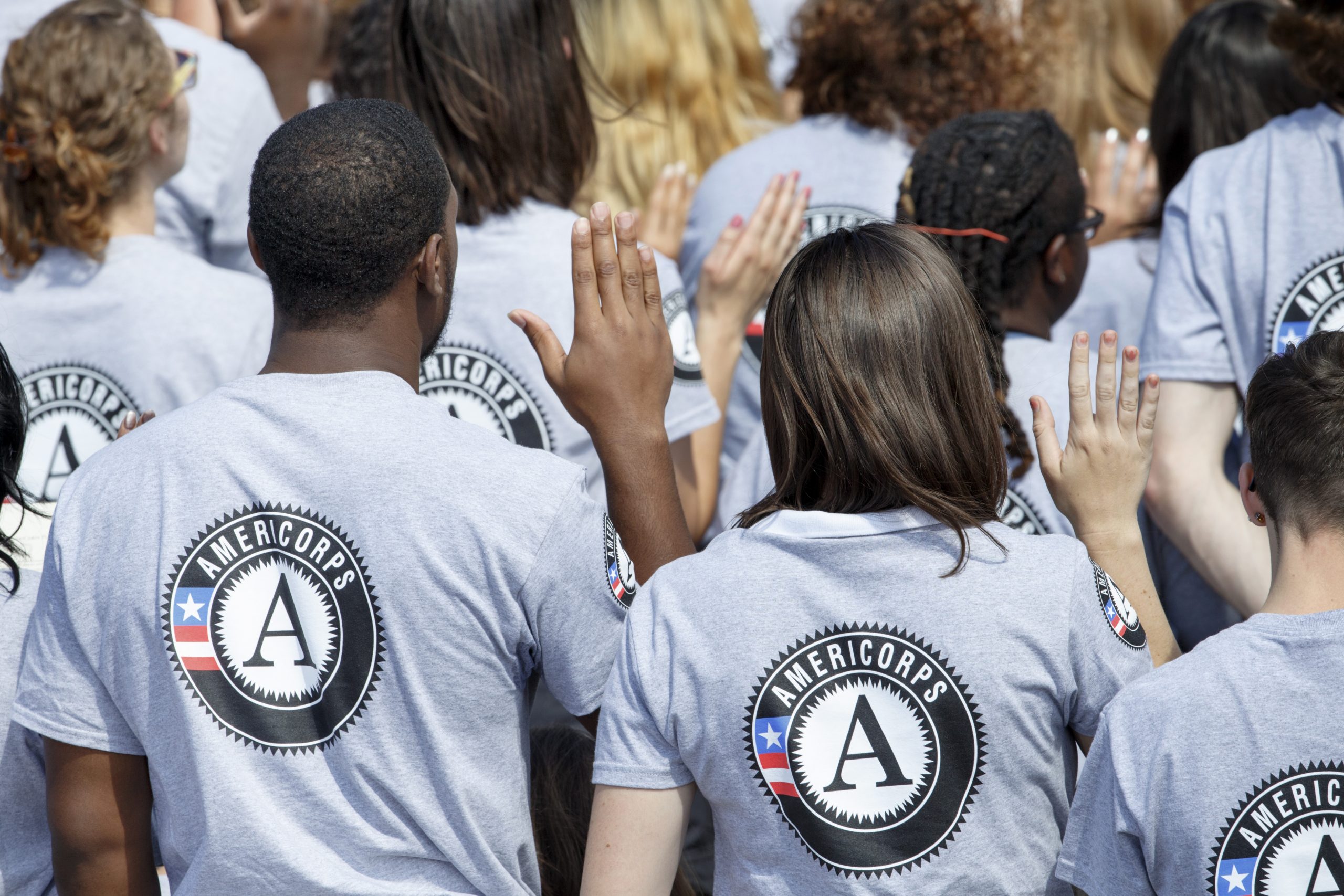
    Like hundreds of thousands of other young adults, Tegner kick-started her career through AmeriCorps, a federal agency that sends its members to communities across the country to tutor students, help after disasters strike and restore wildlife habitats, among other activities. She took a position at the Alaska Afterschool Network, where her job was to help find ways to expand science, technology, engineering and math access in its programs. Four years later, she’s still there — now, as a full-time employee managing the nonprofit’s AmeriCorps program. 

    “This state became my home,” Tegner said, adding that her year in AmeriCorps “completely changed the trajectory of my career.” 

    An AmeriCorps member poses with a student in one of the Alaska Afterschool Network’s funded programs. The organization lost its AmeriCorps funding last spring. Credit: Courtesy of Alaska Afterschool Network

    This spring, Alaska Afterschool Network was one of hundreds of organizations abruptly notified that its AmeriCorps funding had been terminated. Federal funding cuts forced the nonprofit to eliminate three full-time positions and cancel 19 internships scheduled for this summer. Tegner’s job is also at risk, though the organization is trying to find a way to keep her on. 

    In late April, the Trump administration slashed 41 percent of AmeriCorps’ funding, cutting about $400 million in grants and letting go of more than 32,000 members serving in hundreds of programs across the United States. In June and also this month, judges ordered the government to restore some funding, but the ruling does not reinstate all the money that was taken away. Shrinking AmeriCorps is among the many steps the Trump administration has taken to curb what he has called “waste, fraud and abuse” of federal funds. More action is expected in the months ahead. 

    Related: Become a lifelong learner. Subscribe to our free weekly newsletter featuring the most important stories in education. 

    Over the years, the program former President Bill Clinton created has deployed more than a million people. On top of gutting AmeriCorps, the cuts have diminished the reach of an agency that has been a critical path to a career for recent high school and college graduates at a time when entry-level jobs can be difficult to find.

    AmeriCorps was created more than three decades ago to oversee expanded federal volunteer programs, incorporating existing projects including Volunteers in Service to America and the National Civilian Community Corps. Its members take on community service positions across the country that can last for up to two years. They receive a small living stipend, and full-time members are eligible for health insurance. At the end of their terms, members are awarded a grant that can be used to pay college tuition or student loans.

    “AmeriCorps dollars have a powerful ripple effect, for both the AmeriCorps members and the students that they serve,” said Leslie Cornfeld, founder and CEO of the National Education Equity Lab, a nonprofit that brings college courses to high-poverty schools. “In many instances, it helps them define their careers.” 

    About half of the AmeriCorps funding for the Philadelphia Higher Education Network for Neighborhood Development was cut this spring. Credit: Courtesy of PHENND

    Federal surveys of AmeriCorps members from 2019, 2021 and 2023 show that 90 percent of members joined the national program in part to gain skills that would help them in school and work, and well over 80 percent said their experience in AmeriCorps helped further their “professional goals and endeavors.”

    The Trump administration cited fraud as part of its reason for nearly halving the AmeriCorps budget. Audits of the agency have raised questions about its financial management. 

    Related: Hundreds of thousands of students are entitled to training and help finding jobs. They don’t get it

    Peter Fleckenstein, 23, joined Aspire Afterschool in Arlington, Virginia, through AmeriCorps last year after graduating from the University of Delaware with a degree in psychology. He saw AmeriCorps as a way to build out his resume; even the entry-level positions he encountered during his job search required experience in the field. 

    In his position at the after-school program, Fleckenstein leads daily activities for a group of about two dozen fourth grade students. The experience has helped him crystallize his career aspirations: Before AmeriCorps, he was considering clinical social work or teaching. Now, he wants to become a counselor.

    “Working with the kids here is a lot of behavior management: problem solving, helping them regulate themselves,” Fleckenstein said. “Doing one-on-one work with them, building habits and routines with them — that is something that I could focus on more if I was in a counseling job.”

    Fleckenstein’s position was cut in April before he could complete his one-year term set to end in August, but Aspire Afterschool was able to raise money through donations to hire him and some of the nonprofit’s other AmeriCorps members part-time to finish out their grant year. 

    The Philadelphia Higher Education Network for Neighborhood Development lost half of its AmeriCorps funding this past spring when the federal agency was slashed. Credit: Courtesy of PHENND

    While some members have joined Americorps after graduating, student Deja Johnson, 24, joined as a way to help pay for college. Her term at The Scholarship Academy — a nonprofit in Atlanta helping low-income high school students navigate financial aid applications — was supposed to end with a $7,400 education grant. Because the terms were cut short, members have been told they’ll get only a prorated portion of the money.

    “It’s a little bit of a shame,” said Johnson, who is using the education grant to pursue a bachelor’s degree in nonprofit leadership. 

    “That’s what a lot of us look forward to with this work that we’re doing, because we know how much of a sacrifice it can be at times. It’s that ‘pouring into our community’ — and that’s how our community pours into us,” Johnson said.

    The AmeriCorps termination letters told grantees that their programs no longer met agency priorities, but the nonprofits were not told what those priorities are. Programs with different missions, in both Democratic- and Republican-led communities, were cut.

    Sira Coulibaly, a member with the Philadelphia Higher Education Network for Neighborhood Development’s Next Steps AmeriCorps program, packs bags of food for the Metropolitan Area Neighborhood Nutrition Alliance. Credit: Courtesy of PHENND

    The Hindman Settlement School, a nonprofit in rural Kentucky, was one victim of the cuts. The organization receives about $1 million a year from AmeriCorps for its program tutoring students with math and reading learning disabilities in more than two dozen schools. Losing that funding means drastically scaling back services, said Josh Mullins, senior director of operations at the Hindman Settlement School. He said he does not know why Hindman’s grants were terminated: The nonprofit regularly passes its audits, and its last annual report showed an average gain of seven months in reading levels among students in its dyslexia intervention program.

    A statement published in January on an AmeriCorps webpage says the agency is in the process of “conducting a full review” to comply with President Donald Trump’s executive order banning diversity, equity and inclusion in federal programs. But Mullins and other AmeriCorps grantees said diversity, equity and inclusion efforts were not listed anywhere as part of their operations.

    “That’s what’s devastating,” Mullins said. “It was completely out of our control. There was nothing you could do.”

    Related: Tracking Trump: His actions to dismantle the Education Department, and more

    The administration also gutted 85 percent of the agency’s federal staff, which has caused problems even for programs that are still receiving AmeriCorps funding. 

    The federal government terminated about half of the AmeriCorps grants for the Philadelphia Higher Education Network for Neighborhood Development. The group uses the funding to place members in local nonprofits and to help develop community partnerships in high-poverty schools. Director Hillary Kane said she’s been experiencing delays from the national AmeriCorps office in getting members approved for the programs that are still operating.

    “We need the humans in D.C. to do the stuff that they do, so we can do the stuff that we do,” Kane said. “The person we communicate with isn’t there.”

    About half of the AmeriCorps funding for the Philadelphia Higher Education Network for Neighborhood Development was cut this spring. Credit: Courtesy of PHENND

    On June 5, a federal judge granted a temporary injunction ordering the Trump administration to restore AmeriCorps funding in states that had sued over the budget cuts. The lawsuit, which was filed by two dozen Democratic-led states in May, challenges the administration’s authority to cancel the funding without Congressional approval. But the judge’s injunction does not require the Trump administration to reinstate AmeriCorps’ federal employees, and funding is not being restored to programs in states that did not sign on to the lawsuit, including Alaska, home of the Alaska Afterschool Network, or Virginia, where Aspire Afterschool is based.

    The Hindman Settlement School in Kentucky was one organization whose funding was restored this summer because of the lawsuit. Mullins said he’s hopeful the nonprofit will continue to receive AmeriCorps funding for the upcoming grant cycle in the fall.

    For Kane, the injunction does not undo the chaos caused by the abrupt cancellation of half of her Philadelphia organization’s funding. Many terminated members that were with Kane’s organization have already moved on. 

    “It’s too late for us,” she said.

    Related: Schools push career ed classes ‘for all,’ even kids heading to college

    Programs whose grants were cut can apply again in the next grant cycle, but the president’s 2026 budget calls for shutting down AmeriCorps entirely. 

    While the debate in Washington rages, current and former volunteers mourn the potential loss of a program they said gave their lives meaning and led to employment. The avenue AmeriCorps provided for Tegner to start a career at the Alaska Afterschool Network gave her purpose in life, she said. She’s worried if the program ends, there won’t be another pathway on the same scale for young idealists who aren’t sure what they want to do with their lives.

    “It helps young people of all ages grow and try new things,” Tegner said. “That’s very much what it was for me.”

    Contact staff writer Ariel Gilreath on Signal at arielgilreath.46 or at [email protected].   

    This story about AmeriCorps jobs was produced by The Hechinger Report, a nonprofit, independent news organization focused on inequality and innovation in education. Sign up for the Hechinger newsletter.


    The Hechinger Report provides in-depth, fact-based, unbiased reporting on education that is free to all readers. But that doesn’t mean it’s free to produce. Our work keeps educators and the public informed about pressing issues at schools and on campuses throughout the country. We tell the whole story, even when the details are inconvenient. Help us keep doing that.

    Join us today.

    Source link

  • 1 in 2 graduates say their college major didn’t prepare them for today’s market

    1 in 2 graduates say their college major didn’t prepare them for today’s market

    This audio is auto-generated. Please let us know if you have feedback.

    As today’s college graduates struggle to start a steady career, 1 in 2 Americans say their college major didn’t prepare them for the job market, according to a June 18 report from Preply.

    Beyond that, 1 in 6 Americans who went to college said they regret it. When thinking about their college experience, college graduates said their top regrets included taking out student loans, not networking more and not doing internships.

    “One of the main concepts of seeking higher education after high school is that college will prepare you for the rest of your life. While some graduates leave their alma mater feeling prepared to enter the workforce and begin their career, others feel underprepared,” according to the report.

    In a survey of more than 1,700 Americans with an undergraduate degree, 29% said they wished they picked a different major, and 18% said they regretted the institution they attended.

    College graduates said they felt unprepared in numerous ways, especially finding a job after graduation and navigating student debt and personal finances. 

    Americans also said they don’t feel college gave them real-world work experience, practical or technical skills or a professional network. In fact, only 5% reported feeling “adequately prepared” for life and the workplace.

    On the other side of the hiring table, more than half of hiring managers say recent graduates appear to be unprepared for the workforce, and 1 in 6 say they’re reluctant to hire them, according to a report from Resume.org. Their top complaints included excessive phone use, a lack of professionalism and poor time management skills.

    Within the workplace, executives and workers alike say entry-level workers seem unprepared for their jobs, particularly compared to five years ago, according to a General Assembly report. Although leaders said workers don’t have enough training to be hired, employers also don’t offer adequate training, the report found.

    Source link

  • International Graduates and the New Employability Challenge

    International Graduates and the New Employability Challenge

    • By Louise Nicol, Founder of Asia Careers Group.

    As global economies come under increasing strain from technological disruption, demographic change and tightening labour markets, one long-held assumption is starting to fray: that an overseas degree guarantees stronger employment outcomes for international graduates returning home. For many years, particularly across Asia, this belief underpinned the value proposition of international education. But new data suggests that this premium is beginning to erode – not because domestic education is closing the gap, but because international graduates are being left to navigate the final step of their journey alone.

    Recent analysis from the Asia Careers Group (ACG), drawing on the outcomes of over 20,000 international graduates from UK and Australian universities who returned to China, India, Malaysia, and Singapore since 2015, offers critical insights. The headline message is that while international graduates continue to outperform their domestically educated peers in many cases, the margin is narrowing. The problem is not the quality of education delivered overseas, but the lack of structured support that enables these students to transition into meaningful employment in their home markets. For families across Asia making significant financial sacrifices to send their children abroad, the return on investment increasingly hinges not just on the degree earned, but on the job secured afterwards. For universities in the UK and other major host countries, international graduate outcomes are no longer just a reputational concern – they are becoming central to the long-term sustainability of international recruitment strategies.

    China’s story illustrates the shifting terrain. For decades, foreign-educated Chinese graduates enjoyed a clear employment advantage in China’s urban job markets. Overseas qualifications, English fluency and global experience were seen as major assets. But just before the pandemic, as outbound numbers surged and China’s youth unemployment crisis deepened, that edge started to dull. The term ‘Sea Turtles’ (or haigui) came to represent the growing number of returnees entering an already saturated labour market, combined with employer preference for local experience, meant that the haigui label no longer guaranteed success.

    By 2020, full-time employment among returnees had dropped below 30% – lower than the domestic graduate average for the first time. And yet, recovery has followed. In 2023-24, nearly 50% of internationally educated Chinese graduates secured full-time employment within six months of graduation, while only 30% of their domestically educated peers did the same. Despite mounting geopolitical pressure and a sluggish economy, UK and Australian degrees remain a lever of upward mobility, so long as students are able to connect their education to employment.

    India reveals the outsized influence of immigration policy on international graduate outcomes. Following the withdrawal of post-study work rights by the UK government in 2012, Indian students returning home with UK degrees struggled to compete in the domestic job market. The lack of international work experience meant they were often indistinguishable from their peers who had remained in India. When post-study work rights were reinstated in 2019, a marked improvement followed. By 2022, nearly 65% of Indian returnees were in full-time employment within six months, well ahead of the national average. However, this improvement has not held.

    Since 2023, the data shows another downward trend. While the Graduate Route remains technically available, it has not been accompanied by sufficient careers guidance, reintegration support, or India-facing employer engagement. As a result, many students—even those who stay on to work in the UK for a period—struggle to reconnect with Indian employers when they return. Without a deliberate, structured transition, the employability premium fades.

    Malaysia presents a more complex picture. ACG data from 2010 to 2021 show that full-time employment for returnees dropped from nearly 80% to just over 30%. By contrast, Ministry of Education and Khazanah Research Institute data suggest that domestic graduate outcomes have remained relatively flat, hovering around 45–50%. On the surface, this looks like a convergence, but not for the right reasons. Employment outcomes for returnees have worsened, rather than improved, for domestic graduates. And yet when salary data is introduced, the story changes. International graduates continue to command significantly higher incomes, particularly those with UK and Australian degrees. ACG’s analysis and national labour statistics both show a clear premium: returnees are more likely to earn over RM6,000, while 65% of domestic graduates earn under RM2,000. This suggests that international education still opens doors to higher-level and better-paid roles—but only once graduates overcome the initial hurdle of securing employment. Without local support networks and targeted CIAG, many returnees remain stranded at the starting line.

    Singapore’s system is notable for its transparency, with robust graduate employment data published annually. Even so, ACG’s data shows that internationally educated Singaporean returnees are now significantly less likely to secure full-time roles than their locally educated peers. Between 2013 and 2023, employment for returnees fell from over 80% to just above 40%, while domestic graduate outcomes stayed consistently above 75%. But this is less a judgement on the quality of international education than a reflection of systems misalignment. Many Singaporeans now study abroad at the postgraduate level in destinations or fields that don’t map neatly onto Singapore’s structured graduate pathways, especially in the public sector. Some never return. Others miss out on local graduate schemes or lack the mentoring and guidance necessary to re-enter the domestic market. These are not less capable graduates – they are structurally unsupported.

    The implications for UK higher education institutions and policymakers are profound. Graduate outcomes for international students returning home have long been neglected in favour of compliance metrics, application numbers, and league table performance. But if we are to retain our position as a leading destination for international students, we must confront a simple truth: it is no longer enough to bring students in, deliver a quality education, and send them on their way. We must know what happens next. That means tracking international graduate outcomes systematically, forging deep partnerships with employers in key source countries, and embedding culturally tailored careers support into the student journey – not as an add-on, but as core infrastructure. This also means preparing students for re-entry from the moment they arrive, rather than reacting after they leave.

    Governments in destination countries must play their part too. That includes aligning visa and migration policy with long-term employability outcomes, ensuring post-study work routes remain stable and transparent, and avoiding knee-jerk compliance changes that disrupt student confidence. The UK, in particular, must make good on the promise of the Graduate Route by working with universities to ensure that work experience gained in the UK translates into lasting employability abroad. We should also consider incentivising institutions to track and support international graduate success, just as we are increasingly focused on domestic outcomes.

    And finally, for students and families, the message is clear: an international degree can still unlock opportunity, but it is not a guarantee. The most successful graduates are those who receive support tailored to their return journey—those with access to informed advice, strong alumni networks, and employer connections in their home country. Without these, the international education premium – once considered automatic – is slipping.


    References

    1. Asia Careers Group (ACG). Proprietary international graduate outcomes tracking data, 2015–2024.
    2. India Skills Report (ISR). Confederation of Indian Industry, Wheebox, and Taggd, various years.
    3. Ministry of Education, Malaysia & Khazanah Research Institute (KRI). Graduate Tracer Study and labour market reports, 2010–2021.
    4. Department of Statistics Malaysia (DOSM). Monthly and graduate salary distribution reports.
    5. Ministry of Education, Singapore. Graduate Employment Survey (GES), 2013–2023.
    6. UK Home Office & Migration Advisory Committee. Graduate Route Policy Review, 2024.
    7. Chinese Ministry of Education (MoE) and independent think tank analysis of returnee graduate outcomes (Haigui commentary), various sources.

    Source link

  • 1 in 3 Americans recommend trade school for high school graduates

    1 in 3 Americans recommend trade school for high school graduates

    This audio is auto-generated. Please let us know if you have feedback.

    More adults recommend trade school for new high school graduates than those who recommend college, according to a June 5 report from the American Staffing Association.

    When considering the “ideal post high school path” for today’s graduates, 33% of U.S. adults advocated for a vocational or trade school, followed by 28% who encouraged a four-year college or university, 13% who advised entering the workforce and 11% who supported apprenticeships.

    “The time has come to radically rethink how we’re preparing America’s future workforce,” said Richard Wahlquist, CEO of ASA. “Americans are clearly concerned that colleges and universities are failing to equip students with the workplace-relevant skills that employers need.”

    In the survey of more than 2,000 U.S. adults, opinions varied by generation. Vocational and trade school careers were most supported by baby boomers (41%), Generation X (37%) and millennials (31%), as compared to 22% of Generation Z.

    On the other hand, Gen Z was the only generation to recommend a four-year degree (36%) over a vocational or trade school (22%). Members of Gen Z were most likely to say graduates should pursue a traditional degree, followed by entering the workforce or attending a trade school.

    “These results underscore the importance of educators, policymakers and parents coming together now to develop, fund and support programs designed to prepare young people for the jobs of today and the future world of work,” Wahlquist said.

    More than 40% of Gen Z adults are working in or pursuing a blue-collar or skilled trade job, according to a Resume Builder report. Workers said they’re choosing these jobs for better long-term options, higher pay and a lower risk of being replaced by artificial intelligence tools.

    The labor market could face a “white-collar recession” as job postings decline for desk-based workers, according to an Employ report. 

    Although many Gen Z workers want to pursue skilled trades careers, they face challenges when trying to access critical training, according to a Dewalt report. Half of the students surveyed said they were placed on training waitlists, but once enrolled, they participated in internships, mentorship programs and real-world work experiences.

    Source link

  • 1 in 3 Americans recommend trade school for high school graduates

    1 in 3 Americans recommend trade school for high school graduates

    This audio is auto-generated. Please let us know if you have feedback.

    More adults recommend trade school for new high school graduates than those who recommend college, according to a June 5 report from the American Staffing Association.

    When considering the “ideal post high school path” for today’s graduates, 33% of U.S. adults advocated for a vocational or trade school, followed by 28% who encouraged a four-year college or university, 13% who advised entering the workforce and 11% who supported apprenticeships.

    “The time has come to radically rethink how we’re preparing America’s future workforce,” said Richard Wahlquist, CEO of ASA. “Americans are clearly concerned that colleges and universities are failing to equip students with the workplace-relevant skills that employers need.”

    In the survey of more than 2,000 U.S. adults, opinions varied by generation. Vocational and trade school careers were most supported by baby boomers (41%), Generation X (37%) and millennials (31%), as compared to 22% of Generation Z.

    On the other hand, Gen Z was the only generation to recommend a four-year degree (36%) over a vocational or trade school (22%). Members of Gen Z were most likely to say graduates should pursue a traditional degree, followed by entering the workforce or attending a trade school.

    “These results underscore the importance of educators, policymakers and parents coming together now to develop, fund and support programs designed to prepare young people for the jobs of today and the future world of work,” Wahlquist said.

    More than 40% of Gen Z adults are working in or pursuing a blue-collar or skilled trade job, according to a Resume Builder report. Workers said they’re choosing these jobs for better long-term options, higher pay and a lower risk of being replaced by artificial intelligence tools.

    The labor market could face a “white-collar recession” as job postings decline for desk-based workers, according to an Employ report. 

    Although many Gen Z workers want to pursue skilled trades careers, they face challenges when trying to access critical training, according to a Dewalt report. Half of the students surveyed said they were placed on training waitlists, but once enrolled, they participated in internships, mentorship programs and real-world work experiences.

    Source link

  • What SHAPE graduates do | Wonkhe

    What SHAPE graduates do | Wonkhe

    As debates continue about the value of degrees, and the role of universities in society and the future economy, understanding graduate outcomes is more important than ever.

    Yet much of the current discussion – and policymaking – is shaped by narrow metrics, which over-focus on graduate earnings.

    This approach overlooks many of the ways graduates contribute to society and distorts our understanding of the value of different subjects.

    The right SHAPE

    The British Academy represents SHAPE disciplines; social sciences, humanities and arts for people and the economy. SHAPE graduates develop crucial skills like critical thinking, creativity and problem solving. These skills help them contribute to tackling many of today’s most pressing challenges, from climate change to the ethical deployment of AI.

    However, we wanted to know more. How do they use these skills? What do SHAPE graduates do after university? How can we best measure the full breadth of their contribution to the UK economy and society? And do we have the data to address these questions comprehensively?

    To help provide answers, the British Academy has launched a new data-rich policy resource, Understanding SHAPE Graduates, which illustrates exactly how SHAPE graduates contribute to the UK economy and society. The toolkit consists of an interactive data dashboard, a series of key findings drawn from the data, and a policy briefing contextualising the measurement of graduate outcomes.

    SHAPE graduates and the economy

    The toolkit offers several myth-busting insights into SHAPE graduate activity, some of which we will outline here. Importantly, it challenges the narrative that SHAPE graduates have weak labour market prospects, showing that their employment rates are strong: 87 per cent of SHAPE graduates were in work in 2023, compared to 79 per cent of non-graduates with level 3 qualifications and 88 per cent of STEM graduates.

    SHAPE graduates also earn significantly more than non-graduates, with an average real hourly wage of £21 in 2023 – £5 higher than the average for those with at least two A levels or equivalent. And you can increasingly find them working in the UK’s fastest growing sectors; between 2010 and 2022, the top three sectors by GVA growth – manufacturing; transport and communication; and professional, scientific and technical services – saw growing numbers of SHAPE graduates. These sectors are outlined in the Government’s Industrial Strategy green paper, and SHAPE graduates comprised 52.8 per cent of the graduate workforce in all of them combined in 2023, up from 45.8 per cent in 1997.

    They are also well represented in the UK’s most productive regions. In 2023, SHAPE first-degree graduates accounted for 71 per cent per cent of the graduate workforce in London, 64 per cent in the North West and 58 per cent in the South East of England – the three regions with the highest GDP levels that year.

    What the data doesn’t show

    While the Academy’s policy toolkit marks a step forward, it also highlights the limitations of current graduate data. For example, while broad categories like SHAPE and STEM are useful, they can mask significant variations between disciplines.

    The toolkit uses the Labour Force Survey (LFS) and the Longitudinal Education Outcomes (LEO) dataset. Most significantly, both LEO and LFS focus primarily on earnings and employment. This narrow lens misses non-financial aspects of graduate impact – such as contributions to public life, wellbeing, culture, and civic engagement – which are especially important in understanding the SHAPE disciplines.

    Limitations in longitudinal graduate data also present specific challenges. Response rates to the LFS have declined in recent years, affecting its robustness, particularly for smaller cohorts like doctoral graduates. And the LEO dataset, which offers rich England-only data by tracking individuals from education into the labour market, has its own knowledge gaps. For example, LEO does not distinguish between full-time and part-time work, making it harder to interpret earnings data, especially for female graduates who are more likely to work part-time due to caregiving responsibilities. LEO also struggles to fully capture self-employed graduates, including freelancers in the creative industries and other sectors, due to its reliance on PAYE data.

    Looking ahead, the HESA Graduate Outcomes Survey (which replaced the Destination of Leavers from Higher Education (DLHE) survey in 2018) offers promise. Over time, it will offer increasingly longitudinal insights to help us deepen our understanding, and it is encouraging to see that HESA is already exploring non-financial measures of graduate activity. We plan to incorporate these into future work.

    Starting the conversation

    The Understanding SHAPE Graduates toolkit shows that SHAPE graduates are vital to the UK economy. As we approach the government’s Comprehensive Spending Review and await the publication of its refreshed Industrial Strategy, we must remember that the UK’s future success depends on drawing talent from across all disciplines.

    We want to continue exploring how we capture non-financial outcomes, to reflect the full value of a university education.

    At the British Academy, we will continue to champion the diverse and vital contributions that SHAPE graduates make across society and the economy. We look forward to working with the sector to develop better data, better metrics, and better understanding.

    You can see and use the data here.

    Source link

  • Legacy and Purpose: Congresswoman Jasmine Crockett Calls Tougaloo Graduates to Action

    Legacy and Purpose: Congresswoman Jasmine Crockett Calls Tougaloo Graduates to Action

    –JACKSON, Mississippi

    Texas Congresswoman Jasmine CrockettIn a powerful address that wove together civil rights history with present-day challenges, U.S. Representative Jasmine Crockett (D-Texas) delivered an impassioned commencement speech at Tougaloo College’s graduation ceremony on Sunday, urging graduates to embrace their purpose in continuing the fight for progress.

    Standing on the historic grounds of the private Mississippi HBCU—once a sanctuary and launch pad for the Civil Rights Movement—the Congresswoman reflected on the paradoxical nature of the moment: that in 2025, her very presence as a speaker remained controversial.

    “As I stand here in this safe space, still only one of the few places that an institution can invite me to speak… to think about the fact that people have to be fearful of having a sitting member of Congress come and address their graduates tells us that we still got a lot of work to do,” she told the graduates.

    Drawing parallels between past and present struggles, she reminded the audience that Tougaloo was one of a few places in Mississippi where Dr. Martin Luther King Jr. could speak during the Civil Rights Movement. Now, decades later, she noted the irony of similar limitations placed on Black voices in positions of power.

    “The president of the United States having a temper tantrum that strips funding because I’m Black and I’m proud should not be something that we are dealing with in 2025,” she stated, her voice rising with conviction.

    The Congresswoman, who acknowledged working multiple jobs during her own college years, spoke candidly about personal struggles and the fatigue that comes with fighting systemic barriers. Invoking the refrain from the gospel song “I Don’t Feel No Ways Tired,” she encouraged graduates to persevere despite exhaustion.

    “I just can’t give up now. I’ve come too far from where I started from,” she recited, asking graduates to reflect on their own journeys through college—the multiple jobs, the stepping away and stepping back in—all while excelling despite the challenges.

    Her message anchored in both acknowledgment of weariness and the necessity of continued struggle, themes particularly relevant at an institution with Tougaloo’s civil rights legacy. The college was home to the “Tougaloo Nine,” students who organized sit-ins at segregated libraries, and alumni like Anne Moody and Memphis Norman, who participated in the historic Woolworth’s lunch counter sit-in in 1963.

    “Sitting in these very classrooms is just as much of a protest as Anne and Memphis pulling up to Woolworths in 1963,” she said, emphasizing how education remains an act of resistance.

    The Congresswoman warned graduates about attempts to erase this history, not just from textbooks but through policies targeting diversity initiatives and institutions serving Black communities. “Jim Crow never died,” she declared. “He just lied in wait.”

    She shared personal experiences of being labeled “ghetto” and “unqualified” despite her impressive credentials—modern versions of racial epithets—connecting these attacks to historical patterns of undermining Black achievement and institutions.

    Looking to the future, she issued a direct challenge to the graduates.

    “If you are waiting on somebody to come and save you, they are not coming,” she warned. “You are the person that you’ve been waiting on.”

    Reminding them that every significant social justice movement has been led by young people, she noted that she is now older than Medgar Evers, Dr. Martin Luther King Jr., and Malcolm X were when they were assassinated.

    “Your moment is not in the future. Your moment is now,” she urged. “This country is relying on each and every one of you to walk into your purpose and to walk in greatness with your head held high.”

    The Congresswoman’s speech resonated deeply with the graduates and assembled families at Tougaloo, an institution that has persisted in its educational mission despite historical and ongoing challenges.

    “She was dynamic and passionate,” said Rose Lucas, whose niece was among the more than 120 undergraduates to receive their diploma. “At a time when so many of our politicians are afraid to speak out against the injustices in Washington, I am encouraged by the Congresswoman’s passion and commitment.” 

    As Crockett concluded with a call to action, she left the new alumni with a poignant message about belonging. 

    “There are people that are going to tell you that there is not a table in which there is a seat for you, but I am here to remind you of Montgomery and those folding chairs.”

    Source link

  • Employers will increasingly focus on graduates’ skills over technical knowledge

    Employers will increasingly focus on graduates’ skills over technical knowledge

    There are few safe bets about the future, so the impact of technology on labour markets, how transitions through education and into work will change, and the need to reskills and upskill, can only be predicted.

    But we do know that technology – AI in particular – is a disruptive force. We know that declining birth rates and higher employer skills needs have the potential to create a difficult labour market that hinders growth. We also know it’s likely that people who don’t adapt to changes in work could see their careers suffer.

    In response to these shifts, graduate and apprentice employers are considering fresh approaches to their talent strategies. Strategies that will focus less on a person’s age, education and technical experience, and more on their skills, capabilities and aptitudes.

    The Institute of Student Employers (ISE) recent report, From early career to emerging talent, shows that 68 per cent of early career employers have already adopted or partially adopted a skills-based strategy to hiring – and another 29 per cent are considering it.

    A constricted labour market

    Quite rightly, we are all concerned about the tough jobs market facing students, the high volumes of applications they make, and the time it takes many to get a graduate job. Because of the UK’s anaemic growth, the current labour market is tight (ISE predicts graduate vacancies will only grow by one per cent this year). But once growth returns to the economy, it’s likely employers will see significant talent shortages.

    We can see latent labour market problems in the current Labour Market Information (LMI) data. The UK’s unemployment rate at 4.4 per cent is historically low. Only 16.4m people in England and Wales are educated to level 4 or over – yet there are 18.6m jobs currently at that level, rising to 22.7m over the next 10 years. Over the next decade the working age population will increase only by 1.14m people (the over-70s, on the other hand, will increase by 2.1m).

    Mention 2022 and while most remember the heatwave, recruiters remember the post-pandemic growth spurt which left many vacancies unfilled. A CIPD labour market survey from summer of that year reported that 47 per cent of employers had hard-to-fill vacancies and the top response to difficulties reported by employers was to upskill existing staff.

    A problematic word

    What is a skill, an attribute or a capability? What can be taught, learned and developed, and what individual traits are innate? Some skills are technical, some more behavioural. And we’ll all have our own views on the abilities of ourselves and others. So, the word skills is problematic, which makes agreement on what approach we take to skills problematic.

    In their recent Wonkhe articles, Chris Millward and Konstantinos Kollydas and James Coe are right to highlight the challenge of differentiating between knowledge, technical behavioural and cognitive skills. To varying degrees, employers need both. I’d add another challenge, particularly in the UK: the link between what you study and what you do is less pronounced. Over 80 per cent of graduate recruiters do not stipulate a degree discipline. This makes connecting skills development to the labour market problematic.

    Another problem with the use of the word skills is the danger that we take a reductive, overly simplistic view of skills. A student who does a group activity successfully may think they’ve nailed teamworking skills. In reality, working with people involves a multitude of skills that many of us spend our working lives trying to master.

    Employers are already increasing their focus on skills

    In their report The skill-based organisation: a new operating model for work and the workforce, Deloitte describe how organisations are developing “a whole new operating model for work and the workforce that places skills, more than jobs, at the centre.”

    As recruitment for specific expertise becomes more challenging, people are matched to roles based on skills and potential, less on experience in a role. Skills-based hiring strategies encompass career changers, older workers, people who have near-to work experience. Technology maps an organisation’s skills base to create an internal marketplace for roles and employees are encouraged to re-skill and upskill in order to move about the organisation as jobs change.

    Graduates will need the skills and associated mindset to navigate this future world of work. World Economic Forum 2025 Future of Jobs analysis shows that 69 per cent of UK organisations placed resilience, flexibility and agility in the top five skills that will increase in importance by 2030.

    Graduate recruitment strategies could evolve to make less use of education exit points to define the talent pool hired from: career-changers, older-workers, and internal switchers are incorporated into development programmes. More learning content becomes focused on developing behavioural and cognitive skills to promote a more agile cohort.

    Students do develop skills

    Within HE, practitioners have already established a considerable body of knowledge, research and practice on employability skills. Where change is occurring, is in the campus-wide approach to skills that many institutions have developed (or are in the process of developing). Approaches that aim to ensure all students have the opportunity to develop a core set of skills that will enable them to transition through education and into work. Bristol and Kingston, among others, have shown how skills can be embedded right across the curriculum.

    I’m a big fan of Bobby Duffy’s work on delayed adulthood which suggests to me that the average student or graduate in their late teens and early twenties is at quite a different stage of development to previous generations. Which means that it’s wrong-headed to think of deficits in students’ work readiness as the fault of students (or their coddling parents).

    Employers and educators together have a role to play in helping students understand their own skills and how to develop them. Skills require scaffolding. Surfacing skills in the curriculum ensures students understand how their academic work develops core skills.

    And the provision and promotion of extra-curricular activities, including work experience, can be built into the student journey. Programmes where students develop their ability to deal with change and challenging situations, to analyse and solve complex problems, to adopt a positive approach to life-long learning.

    The skills agenda opportunity

    At the ISE we leave the language of skills gaps and employers’ apparent low opinion of graduates to the tabloids. Only 17 per cent of employers in our annual survey say they disagree that graduates are not work-ready. We do ask a more subtle question on the attitudes and behaviours that employers expect early career hires to possess when they start work. The top skills employers thought students weren’t as proficient in as they expected were self-awareness, resilience and personal career management.

    I am not, never have been, and never will be, a policy wonk. Maybe someone who is can design the architecture of incentives and systems that better connect education pathways to labour market needs. This architecture will also have to be able to predict labour market needs four to five years in advance, because that’s the lag between a typical students’ course choice and their job application. But if that can’t be done, surely a good investment is ensuring that students have plenty of opportunities to develop their skills and attributes to deal with an ever more changing workplace.

    Fully embracing a skills approach is a great opportunity to demonstrate how HE adds value to the UK economy through the triangulation of student interests, employer needs and a great education experience.

    Read the ISE’s report, From early talent to emerging talent, for a detailed analysis of the forces impacting how employers will hire and develop students in the future.

    Source link

  • Free speech, graduates, student finance

    Free speech, graduates, student finance


    By submitting you agree to our terms and conditions

    Source link

  • Policy Proposals Lack Clarity About How to Evaluate Graduates’ Additional Degrees

    Policy Proposals Lack Clarity About How to Evaluate Graduates’ Additional Degrees

    Title: Accounting for Additional Credentials in Postsecondary Earnings Data

    Authors: Jason Delisle, Jason Cohn, and Bryan Cook

    Source: The Urban Institute

    As policymakers across both parties consider how to evaluate postsecondary outcomes and earnings data, the authors of a new brief from the Urban Institute pose a major question: How should students who earn multiple credentials be included in data collection for the college that awarded their first degree?

    For example, should the earnings of a master’s degree recipient be included in the data for the institution where they earned their bachelor’s degree? Additionally, students who finish an associate degree at a community college are likely to earn higher wages when they complete a bachelor’s degree at another institution. Thus, multiple perspectives need to be considered to help both policymakers and institutions understand, interpret, and treat additional degrees earned.

    Additional key findings include:

    Earnings Data and Accountability Policies

    Many legislative proposals would expand the use of earnings data to provide further accountability and federal aid restrictions. For example, the House Republicans’ College Cost Reduction Act, proposed in 2024, would put institutions at risk of losing funding if they have low student loan repayment rates. The brief’s authors state that the bill does not indicate if students who earn additional credentials should be included in the cohort of students where they completed their first credential.

    The recently implemented gainful employment rule from the Biden administration is explicit in its inclusion of those who earn additional credentials. Under the rule, students who earn an additional degree are included in both calculations for their recent degree and the program that awarded their first credential.

    How Much Do Additional Credential Affect Earnings Data?

    Determining how much additional credentials affect wages and earnings for different programs is difficult. The first earnings measurement—the first year after students leave school—is usually too early to include additional income information from a second credential.

    Although the entire data picture is lacking, a contrast between first- and fifth-year earnings suggests that the number of students earning additional degrees may be very high for some programs. As an example, students who earn associate degrees in liberal arts and general studies often have some of their quickest increases in earnings during these first five years. A potential explanation is because students are then completing a bachelor’s degree program at a four-year institution.

    Policy Implications: How Should Earnings Data Approach Subsequent Credentials?

    In general, it seems that many policymakers have not focused on this complicated question of students who earn additional degrees. However, policy and data professionals may benefit from excluding students who earn additional credentials to more closely measure programs’ return on investment. This can be especially helpful when examining the costs of bachelor’s programs and their subsequent earnings benchmarks, by excluding additional earnings premiums generated from master’s programs.

    Additionally, excluding students who earn additional credentials may be particularly valuable to students in making consumer and financial aid decisions if the payoff from a degree is extremely different depending on whether students pursue an additional credential.

    However, some programs are intended to prepare students for an additional degree, and excluding data for students who earn another degree would mean excluding most graduates and paint a misleading picture.

    To read the full report from the Urban Institute, click here.

    —Austin Freeman


    If you have any questions or comments about this blog post, please contact us.

    Source link