Tag: graduating

  • More South Carolina Students Are Graduating, But Many Aren’t Ready for Life After High School – The 74

    More South Carolina Students Are Graduating, But Many Aren’t Ready for Life After High School – The 74


    Get stories like this delivered straight to your inbox. Sign up for The 74 Newsletter

    COLUMBIA — South Carolina high schools posted their highest graduation rate in a decade, but a quarter of students still aren’t ready for college or the workforce, according to state report card data released Monday.

    Generally, South Carolina’s schools improved compared to last year, according to the statewide data that gauges how well schools perform based on test scores, classroom surveys and student growth, among other metrics. Education officials applauded a 10-year high in the number of students graduating on time — meaning they graduated four years after entering ninth grade — while saying they would continue pushing for programs to improve how well those students were prepared for life after high school.

    “We have to make sure that our diplomas are worth more than the piece of paper that they are written on,” said state Superintendent Ellen Weaver.

    Overall, 270 schools rated “excellent” this year, an increase from 232 last year. The bottom tier of “unsatisfactory” decreased from 49 to 31, and “below average” schools dropped from 186 to 145.

    Any time the number of schools in the lowest tier shrinks, that’s good news, since it means children across the state are getting a better education, said Patrick Kelly, a lobbyist with the Palmetto State Teachers Association.

    “There’s encouraging information here,” Kelly said of the report cards.

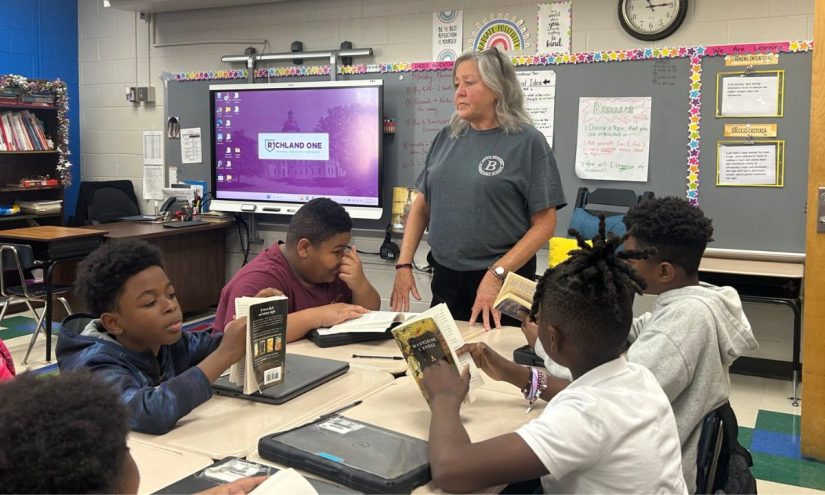
    Officials from the state Department of Education and the independent Education Oversight Committee, which is tasked by state law with grading schools, announced the results at Annie Burnside Elementary School in Columbia, which jumped two tiers this year, from “average” to “excellent.”

    At the Richland District One school, 83% of the 306 students live in poverty. The school’s big rating boost was due to significant student improvement, as shown by their test scores, and results on a survey about the school’s general environment, according to its report card.

    “Our academic gains are no coincidence,” said Principal Janet Campbell. “They are the result of setting measurable goals, challenging our students to reach them and supporting them along the way.”

    Graduation rates and readiness

    This year, 87% of high schoolers graduated on time, up from 85% last year. That’s worth celebrating, Kelly said.

    “Our goal should be for every student in South Carolina who has the ability to earn a high school diploma,” he said.

    Three-quarters of students were ready for either college or a career after graduation, a gain of 3 percentage points, according to the state data. Less than a third were ready for both.

    Although the gap between students who are graduating and those who are prepared for what comes next continues to shrink slightly, state officials remain concerned about it, Weaver said.

    “At the end of the day, we want our students, when they leave a South Carolina high school, to know that that diploma that they carry is a diploma of value,” Weaver said. “This is a diploma that is going to ensure that they are ready to go onto whatever post-secondary success looks like for them.”

    All 11th graders in the state take a test assessing skills commonly needed for jobs, divided into four areas: math, reading, understanding data and “soft skills,” which include aspects of a job such as dressing professionally and working well with others. Results are graded from 1 to 5, with higher scores suggesting students are ready to pursue more careers.

    Students are considered career-ready if they receive a score of 3 or higher on that test, earn a technical education certificate, complete a state-approved internship or receive a high enough score on the Armed Services Vocational Aptitude Battery to enlist in the military. This year, 73% of students met that benchmark, compared to 70% last year, according to report card data.

    College readiness is based on a student’s score on the ACT or SAT college entrance exam, college credit earned through a dual-enrollment course and/or scores on end-of-course Advanced Placement tests.

    One-third of graduating students were college-ready, which is on par with at least the past five years, according to state data. The rate of high school students applying for college also continued to decrease, with 59% reporting filling out applications this year, compared with 61% last year.

    A gap between graduation rate and readiness for the next step suggests schools are sometimes passing students without actually imparting the skills they need to succeed in life, Kelly said.

    For instance, district policies setting minimum grades teachers can give makes it easier for students to pass their classes, even if they haven’t actually done the work, Kelly said. Alternatives for students who fail tests or classes are sometimes easier, meaning a student can catch up without actually learning the same skills as their peers, he said.

    “We’ve put some policies in place that make it harder to evaluate what a student knows and can do,” Kelly said.

    Beginning this school year, students can follow a so-called pathway to earn credentials that build on each other every year, allowing students to learn more advanced skills meant to make it easier to find a job in the field they want to pursue, said April Allen, chair of the Education Oversight Committee’s governing board.

    “At the same time, we recognize that strengthening the system must go hand-in-hand with addressing the barriers that keep students from wholly engaging in school,” said Allen, who’s also a government relations director for Continental Tire.

    Chronic absenteeism and test scores

    For example, the number of students who missed at least 10 days of school this year remained a concern, Allen said.

    Around 23% of students were chronically absent, essentially the same number as last year. The more days of school a student misses, the less likely they are to perform as expected for their grade level on end-of-year tests, according to a report the committee put out last year.

    Those tests, in turn, play a role in determining how well a school or a district is performing. Officials and teachers’ advocates credited the Palmetto Literacy Project and a change in how early educators teach reading for improving English scores, but math scores remain low, with less than half of third- through eighth-graders able to perform on grade level, according to state testing data.

    Just over half the state’s high school students scored at least a C, which is a 70%, on their end-of-course Algebra I exams, often taken freshman year, according to report card data. Nearly 69% passed their English 2 exams, typically taken sophomore year.

    While rooting for improvement, teachers’ advocates also warned against depending too heavily on a single exam score in deciding how well teachers and students are performing. A single, high-pressure exam at the end of the year is not necessarily the best indicator of school performance, said Dena Crews, president of the South Carolina Education Association.

    “If people are making judgments based on that, they’re missing a whole lot about schools and districts,” Crews said.

    Teacher support

    The Department of Education plans to focus on teachers in 2026, Weaver said.

    “The No. 1 thing that we have to do to support student learning is take care of our teachers,” Weaver said.

    She is asking legislators to raise the minimum pay for a first-year teacher to $50,000, up from $48,500. Legislators have increased the pay floor in increments for years, with the stated goal of reaching $50,000.

    Weaver is also asking for $5 million to continue a pilot program that awards teachers bonuses based on how well their students perform on tests. She also wants to start a program that offers extra pay to exceptional teachers who mentor others. The additional responsibility would be another way to earn more money without leaving the classroom to go into school administration, she said.

    Supporting teachers is key in improving how well schools are performing, Kelly said. The promising results in this year’s report cards came after the first dip in teacher vacancies since 2019, he added.

    “It should not be a surprise to see school performance improve as teacher vacancies go down,” Kelly said.

    SC Daily Gazette is part of States Newsroom, a nonprofit news network supported by grants and a coalition of donors as a 501c(3) public charity. SC Daily Gazette maintains editorial independence. Contact Editor Seanna Adcox for questions: [email protected].


    Did you use this article in your work?

    We’d love to hear how The 74’s reporting is helping educators, researchers, and policymakers. Tell us how

    Source link

  • Graduate Outcomes, 2022-23 graduating year

    Graduate Outcomes, 2022-23 graduating year

    The headline numbers from this year’s graduate outcomes data – which represents the activities and experiences of the cohort that graduated in 2022-23 around 15 months after graduation look, on the face of it, disappointing.

    There’s a bunch of things to bear in mind before we join the chorus claiming to perceive the end of graduate employment as a benefit of higher education due to some mixture (dilute to preference) of generative AI, the skills revolution, and wokeness.

    We are coming off an exceptional year both for graduate numbers and graduate recruitment – as the pandemic shock dissipates numbers will be returning to normal: viewed in isolation this looks like failure. It isn’t.

    But we’ve something even more fundamental to think about first.

    Before we start

    We’re currently living in a world in which HESA’s Graduate Outcomes data represents the UK’s only comprehensive official statistics dealing with employment.

    If you’ve not been following the travails of the ONS Labour Force Survey (the July overview is just out) large parts of the reported results are currently designated “official statistics in development” and thus not really usable for policy purposes – the response rate is currently around 20 per cent after some very hard work by the transformation team, having been hovering in the mid-teens for a good while.

    Because this is Wonkhe we’re going to do things properly and start with looking at response rates and sample quality for Graduate Outcomes, so strap in. We’ll get to graduate activities in a bit. But this stuff is important.

    Response rates and sample quality

    Declining survey response rates are a huge problem all over the place – and one that should concern anyone who uses survey data to make policy or support the delivery of services. If you are reading or drawing any actionable conclusions from a survey you should have the response rate and sample quality front and centre.

    The overall completion rate for the 2022-23 cohort for Graduate Outcomes was 35 per cent, which you can bump up to 39 per cent if you include partial completions (when someone started on the form but gave up half-way through). This is down substantially from 48 per cent fully completing in 2019-20, 43 per cent in 2020-21, and 40 per cent in 2021-22.

    There’s a lot of variation underneath that: but provider, level of previous study (undergraduate responses are stronger than postgraduate responses), and permanent address all have an impact. If you are wondering about sampling errors (and you’d be right to be at these response rates!) work done by HESA and others assures us that there has been no evidence of a problem outside of very small sub-samples.

    Here’s a plot of the provider level variation. I’ve included a filter to let you remove very small providers from the view based on the number of graduates for the year in question – by default you see nothing with less than 250 graduates.

    [Full screen]

    What do graduates do?

    As above, the headlines are slightly disappointing – 88 per cent of graduates from 2022-23 who responded to the survey reported that they were in work or further study, a single percentage point drop on last year. The 59 per cent in full-time employment is down from 61 per cent last year, while the proportion in unemployment is up a percentage point.

    However, if you believe that (on top of the general economic malaise) that generative AI is rendering entry level graduate jobs obsolete (a theme I will return to) you will be pleasantly surprised by how well employment is holding up. The graduate job market is difficult, but there is no evidence that it is out of the ordinary for this part of the economic cycle. Indeed, as Charlie Ball notes, we don’t see the counter-cyclical growth in further study that would suggest a full-blown downturn.

    There are factors that influence graduate activities – and we see a huge variation by provider. I’ve also included a filter here to let you investigate the impact of age: older graduates (particularly those who studied at a postgraduate level) are more likely to return to previous employment, which flatters the numbers for those who recruit more mature students.

    [Full screen]

    One thing to note in this chart is that the bar graph at the bottom shows proportions of all graduates, not the proportions of graduates with known destinations as we see at the top. I’ve done this to help put these results into context: though the sample may be representative it is not (as is frequently suggested) really a population level finding. The huge grey box at the top of each bar represents graduates that have not completed the survey.

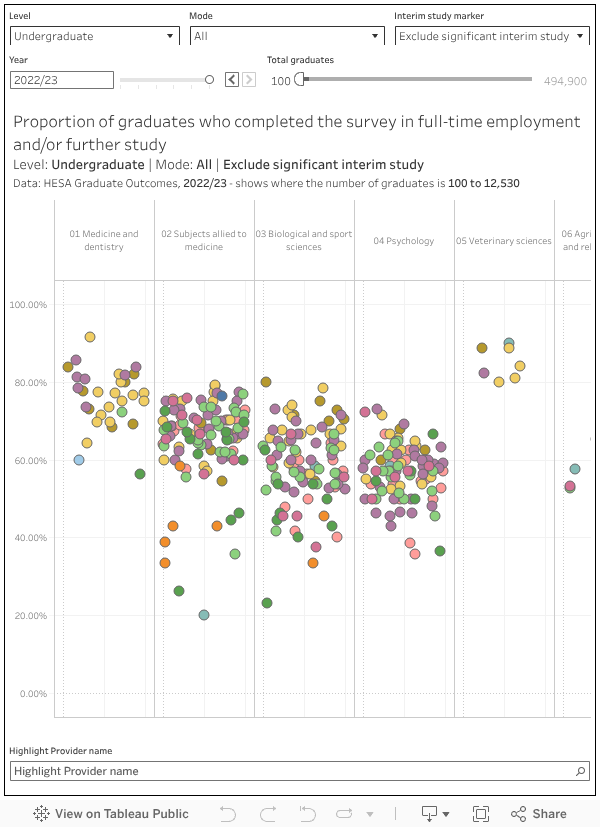
    A lot of the time we focus on graduates in full-time employment and/or further study – this alternative plot looks at this by provider and subject. It’s genuinely fascinating: if you or someone you know is thinking about undergraduate law with a view to progressing a career there are some big surprises!

    [Full screen]

    Again, this chart shows the proportion of graduates with a known destination (ie those who responded to the Graduate Outcomes survey in some way), while the size filter refers to the total number of graduates.

    Industrial patterns

    There’s been a year-on-year decline in the proportion of graduates from UG courses in paid employment in professional services – that is the destination of just 11.92 per cent of them this year, the lowest on record. Industries that have seen growth include public administration, wholesale and retail, and health and social care.

    There’s been a two percentage point drop in the proportion of PG level graduates working in education – a lot of this could realistically put down to higher education providers recruiting fewer early-career staff. This is a huge concern, as it means a lot of very capable potential academics are not getting the first jobs they need to keep them in the sector.

    And if you’ve an eye on the impact of generative AI on early career employment, you’d be advised to keep an eye on the information and communication sector – currently machine generated slop is somehow deemed acceptable for many industrial applications (and indeed employment applications themselves, a whole other can of worms: AI has wrecked the usual application processes of most large graduate employers) in PR, media, and journalism. The proportion of recent undergraduates in paid employment in the sector has fallen from nearly 8 per cent in 2020-21 to just 4.86 per cent over the last two years. Again, this should be of national concern – the UK punches well above its weight in these sectors, and if we are not bringing in talented new professionals to gain experience and enhance profiles then we will lose that edge.

    [Full screen]

    To be clear, there is limited evidence that AI is taking anyone’s jobs, and you would be advised to take the rather breathless media coverage with a very large pinch of salt.

    Under occupation

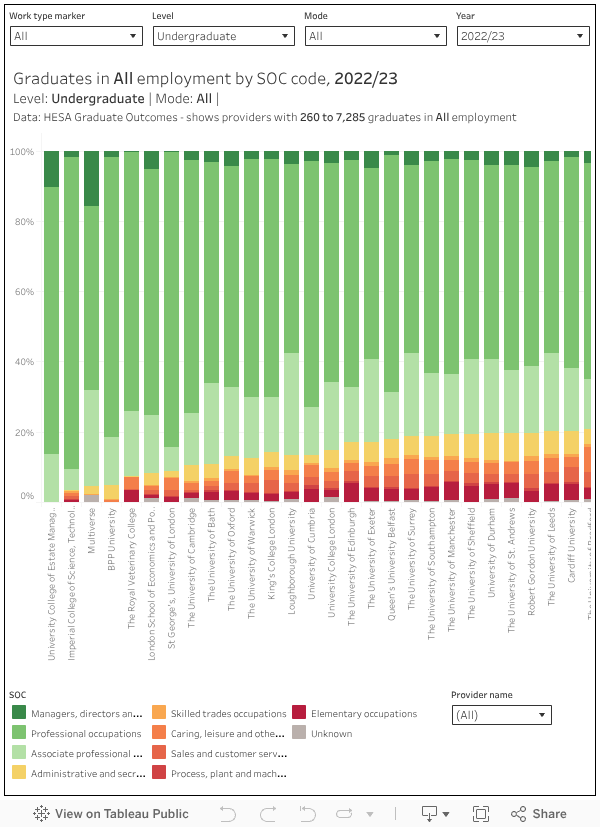
    Providers in England will have an eye on the proportion of those in employment in the top three SOC codes, as this is a key part of the Office for Students progression measure. Here’s a handy chart to get you started with that, showing by default providers with 250 or more graduates in employment, and sorted by the proportion in the top three SOC categories (broadly managers and directors, professionals, and associate professionals).

    [Full screen]

    This is not a direct proxy for a “graduate job”, but it seems to be what the government and sector have defaulted to using instead of getting into the weeds of job descriptions. Again, you can see huge differences across the sector – but do remember subject mix and the likely areas in which graduates are working (along with the pre-existing social capital of said graduates) will have an impact on this. Maybe one day OfS will control for these factors in regulatory measures – we can but hope.

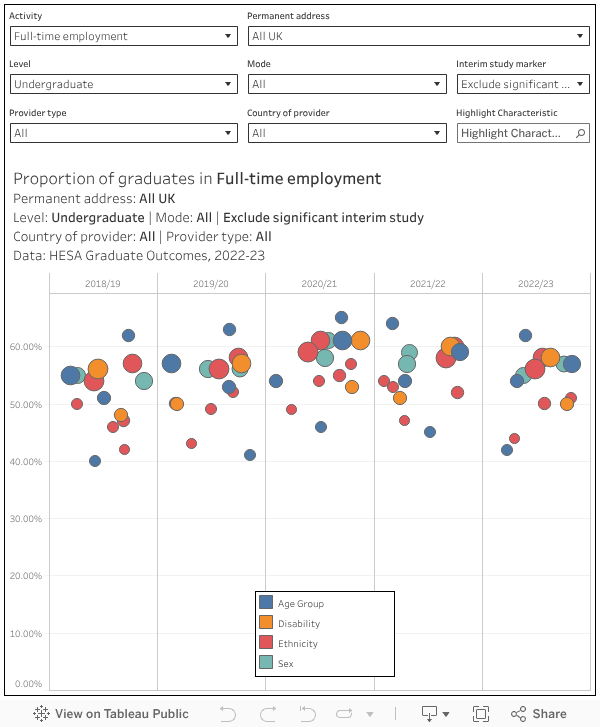
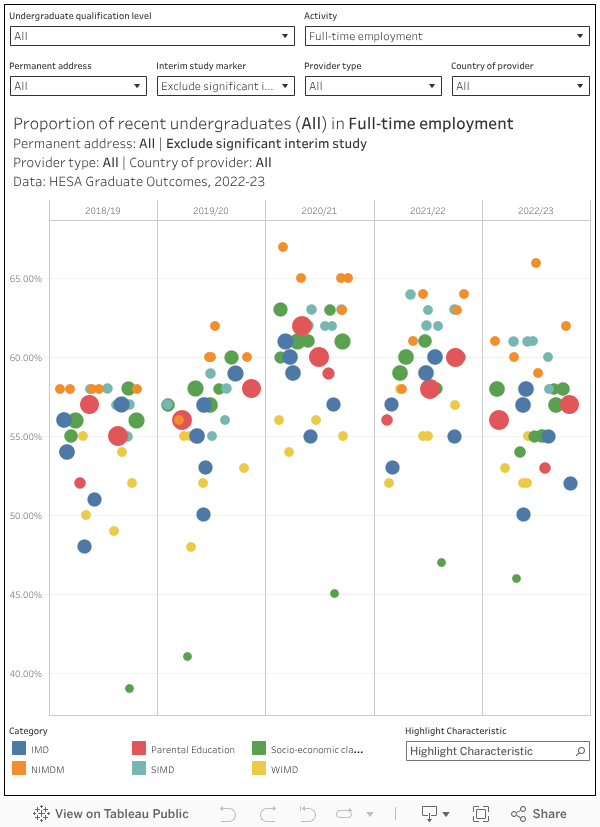
    Here’s a plot of how a bunch of other personal characteristics (age of graduates, ethnicity, disability, sex) can affect graduate activities, alongside information on deprivation, parental education, and socio-economic class for undergraduates. The idea of higher education somehow levelling out structural inequalities in the employment market completely was a fashionable stick to beat the sector with under the last government.

    [Full screen]

    [Full screen]

    Everything else

    That’s a lot of charts and a lot of information to scratch the surface of what’s in the updated graduate outcomes tables. I had hoped to see the HESA “quality of work” measure join the collection – maybe next year – so I will do a proxy version of that at some point over the summer. There’s also data on wellbeing which looks interesting, and a bunch of stuff on salaries which really doesn’t (even though it is better than LEO in that it reflects salaries rather than the more nebulous “earnings”) There’s information on the impact of degree classifications on activity, and more detail around the impact of subjects.

    Look out for more – but do bear in mind the caveats above.

    Source link