Tag: Grants

  • Trump administration illegally axed NIH grants, government watchdog says

    Trump administration illegally axed NIH grants, government watchdog says

    This audio is auto-generated. Please let us know if you have feedback.

    Dive Brief:

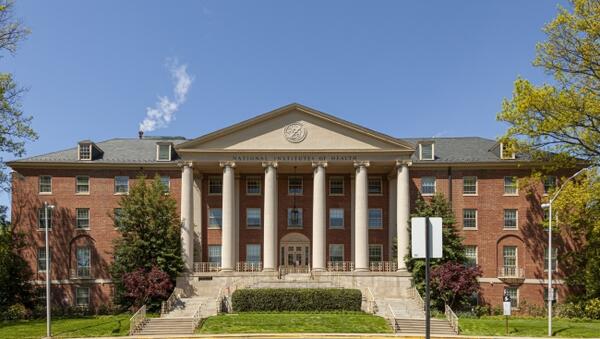
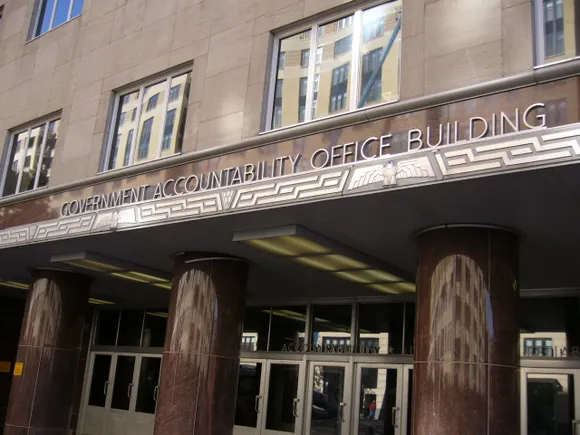
    • The Trump administration acted illegally when it delayed and canceled billions of dollars of biomedical research grants, despite Congress appropriating funds to the National Institutes of Health, the Government Accountability Office said on Tuesday. 
    • Between February and June, the watchdog agency estimates the NIH awarded about $8 billion less in funds for research grants and awards compared to the prior year and cut more than 1,800 active grants as it attempted to follow President Donald Trump’s directive to weed out “equity-related” projects.
    • The GAO’s report concludes the administration violated the Impoundment Control Act, which requires the president to provide notice before delaying or blocking congressionally directed spending. GAO can file a lawsuit in an attempt to restore the grants. However, the watchdog agency has not yet opted to do so in its dealings with Trump.

    Dive Insight:

    NIH grants came under scrutiny this winter following a series of executive orders directing federal agencies to terminate “equity-related” grants or contracts, federal funding of projects supporting “gender ideology” and DEI programs. 

    The NIH began carrying out these directives in February. In addition to the grant cuts, the agency also dragged its feet on approving new projects, GAO found. From late January to early March, the NIH paused grant reviews entirely, delaying funds from being allocated to hospitals and universities.

    When contacted for comment, a spokesperson for the HHS referred Healthcare Dive to the agency’s testimony to GAO. The testimony states that NIH has since “moved rapidly to reschedule and hold meetings impacted by the short pause, and to process grant applications.”

    The HHS said between March 24 and June 30, NIH scheduled or held 837 peer review meetings — 186 more than for the same period the year prior.

    Still, GAO said that the department hadn’t adequately explained its decision to pause the review process in the first place, despite its resumption of grant review.

    “If the executive branch wishes to make changes to the appropriation provided to NIH, it must propose funds for rescission or otherwise propose legislation to make changes to the law for consideration by Congress,” the watchdog group wrote in its report. The HHS had done neither, the GAO said, adding: “In short, HHS has offered no evidence that it did not withhold amounts from obligation or expenditure, and it has not shown that the delay was a permissible programmatic one.”

    The report also suggests the Trump administration may be continuing efforts to block NIH funds from flowing to medical research.

    The office said the Office of Management and Budget asked NIH to “pause the issuing of grants, research contracts and training” in late July. There are reports that decision was later reversed, but GAO said it could not confirm whether the pause was lifted.

    Following the release of the report, Democratic lawmakers called for the Trump administration to resume funding NIH grants as Congress specified, warning that medical research progress is at stake.

    “Cutting off investments Congress has made into research that saves millions of lives is as backward and as inexcusable as it gets,” said Sen. Patty Murray, D-Wash., in a statement. “It is critical President Trump reverse course, stop decimating the NIH, and get every last bit of this funding out.”

    This report is not the first time Trump’s funding cuts have been challenged.

    Researchers, unions and a coalition of 16 states sued over the NIH cuts, with academics saying they needed the funds to perform critical medical research, including learning about alcohol’s impact on Alzheimer’s risk and suicide prevention among LGBTQ+ youth experiencing homelessness. In June, a U.S. district judge ordered the NIH to reinstate the plaintiffs’ canceled funds. However, litigation remains ongoing after the Trump administration appealed that ruling.

    GAO has the potential to bring its own suit against the NIH, but it will likely be a last resort, according to reporting by the New York Times. The watchdog group has previously found the administration violated the ICA on a range of topics and opted not to sue.

    Source link

  • Higher ed groups ask Supreme Court to preserve lower court order to restore NIH grants

    Higher ed groups ask Supreme Court to preserve lower court order to restore NIH grants

    This audio is auto-generated. Please let us know if you have feedback.

    Dive Brief: 

    • The American Council on Education and other major higher education associations are urging the U.S. Supreme Court to preserve a lower court’s ruling that ordered the National Institutes of Health to reinstate funding for hundreds of canceled grants. 
    • In June, a federal judge vacated NIH directives to nix grant funding for research related to diversity, equity and inclusion. The Trump administration quickly appealed the decision and asked the Supreme Court in July to pause the lower court’s order while an appeals court considers the case. 
    • Eight higher ed groups — including ACE, the Association of American Universities and the Association of American Medical Colleges — argued in legal filings Friday that allowing NIH to cancel the grants again would destabilize the nation’s biomedical research and waste government funding on projects forced to stop midstream. 

    Dive Insight: 

    President Donald Trump signed several executive orders shortly after beginning his second term that prompted the NIH cancellations. One ordered federal agencies to terminate all “equity-related” grants “to the maximum extent allowed by law,” and another directed them to end federal funding for “gender ideology,” which the administration defined as the idea that gender exists on a spectrum. 

    Civil rights groups have noted that anti-LGBT groups use the term “gender ideology” to cast being transgender as a political movement rather than a fundamental identity. And the American Medical Association has said that “trans and non-binary gender identities are normal variations of human identity and expression.”

    The Trump administration canceled vast sums of scientific research funding following those orders. In NIH’s case, the agency often informed researchers of the terminations by saying their work “no longer effectuates agency priorities.”

    The moves quickly drew legal challenges. 

    Researchers and unions argued in an April lawsuit that the move was “a reckless and illegal purge to stamp out NIH-funded research that addresses topics and populations that they disfavor.” A coalition of states also filed a lawsuit that month challenging the terminations. 

    U.S. District Judge William Young agreed with their arguments, ordering NIH in June to restore the plaintiff’s canceled grants. According to a Monday press release from ACE, the order impacted roughly 1,200 grants — though that is only a fraction of the awards that the agency has terminated.

    Since the order only covered the plaintiffs’ grants, ACE and other higher ed groups have also asked NIH Director Jay Bhattacharya, in a July 29 letter, to reinstate the other awards canceled under the anti-DEI directives —  “in the spirit of fairness and consistency.” 

    The Trump administration has appealed Young’s decision. So far, federal officials have asked both Young and the appellate court to block the order to reinstate the grants while the appeals process plays out. Both rejected that request. 

    Then last month, the Trump administration took it to the Supreme Court. 

    The higher education groups noted in their legal filings that grant applications undergo rigorous scientific review before NIH accepts them. 

    In recent months, however, the Executive Branch has jettisoned NIH’s scientific decisionmaking via agencywide directives that mandated the termination en masse of NIH grants deemed related to disfavored political topics,” their Friday filing argued. 

    If those terminations are allowed to stand during the appeals process, critical medical research into diseases like Alzheimer’s and diabetes will be ground to a halt, they said. The groups noted some researchers have had to abandon projects halfway through and lay off staff and students with knowledge of the work. 

    The Trump administration, meanwhile, has argued to the Supreme Court that Young didn’t have jurisdiction to order NIH to reinstate the grants, arguing instead that the matter should proceed in the Court of Federal Claims. In its emergency request, it pointed to the Supreme Court’s April ruling that allowed the U.S. Department of Education to maintain a freeze on $65 million in canceled grant funding for teacher training. 

    In that ruling, the court’s unsigned majority opinion said the government likely wouldn’t be able to recover the funding once disbursed and added that the grant recipients would not “suffer irreparable harm” if a lower court’s order to reinstate the grants was put on hold during the appeals process. 

    The Trump administration urged the Supreme Court to make a similar ruling in the NIH case.

    Source link

  • National Science Foundation Suspends Grants at UCLA

    National Science Foundation Suspends Grants at UCLA

    Frederic J. Brown/AFP via Getty Images

    (This article has been updated with comment from UCLA.)

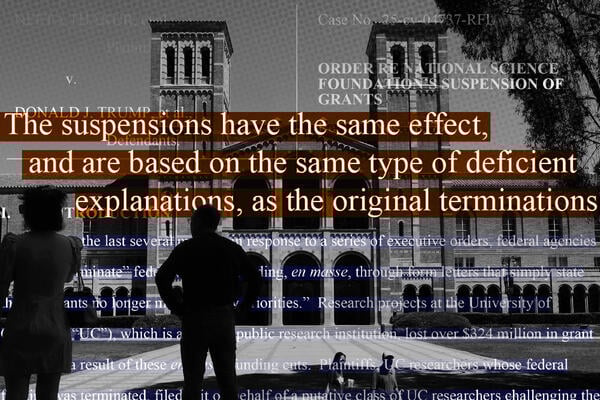
    The National Science Foundation said Thursday that it’s suspending grant awards at the University of California, Los Angeles. 

    An NSF spokesperson said that the university’s awards “are not in alignment with current NSF priorities and/or programmatic goals,” though they didn’t offer more specifics. NSF changed its priorities in April and, as a result, cut off funding to programs related to diversity, equity and inclusion and those aimed at combating misinformation

    Freelance journalist Dan Garisto wrote on BlueSky that nearly 300 grants at UCLA are now suspended. That includes a $25 million grant that supports the university’s Institute for Pure and Applied Mathematics. (In 2022, UCLA had about 450 grants from the NSF, totaling more than $350 million.)

    UCLA chancellor Julio Frenk wrote in a letter to the campus community that the freeze extended beyond NSF to include grants from the National Institutes of Health and other federal agencies.

    “This is not only a loss to the researchers who rely on critical grants,” Frenk wrote. “It is a loss for Americans across the nation whose work, health, and future depend on the groundbreaking work we do.”

    Frenk noted that UCLA was prepared for a grant freeze and has developed contingency plans. “We will do everything we can to protect the interests of faculty, students and staff—and to defend our values and principles,” he pledged.

    The Associated Press reported that the freeze affected $339 million in federal grants.

    The grant suspension comes as UCLA finds itself the Trump administration’s latest target in its growing war with higher education. Earlier this week, the university settled a lawsuit in which a group of Jewish students alleged that UCLA enabled pro-Palestinian activists to cut off Jewish students’ access to parts of campus. On the same day the settlement was announced, the Justice Department accused UCLA of violating the federal civil rights law that bars antisemitism and race-based discrimination.

    Frenk said the government claimed “antisemitism and bias as the reasons” for the freeze. But he argued that Trump’s “far-reaching penalty of defunding life-saving research does nothing to address any alleged discrimination.” 

    He added that UCLA shares the goal of eradicating antisemitism, detailing the steps the university has taken in the last year to address the issue, including establishing new policies for campus protests.

    UCLA has until Aug. 5 to respond to the DOJ’s notice of violation; DOJ officials threatened that the university would “pay a heavy price for putting Jewish Americans at risk.” The Justice Department is also investigating the admissions practices at UCLA, but that inquiry hasn’t wrapped up yet.

    Source link

  • Abrupt Pause, Unpause of Grants Doesn’t End NIH Funding Woe

    Abrupt Pause, Unpause of Grants Doesn’t End NIH Funding Woe

    The Tuesday night news quickly sowed alarm among researchers: Media outlets reported that the Trump administration had stopped the National Institutes of Health from funding any new grants. The Wall Street Journal wrote that “certain grants that are up for renewal” were also cut off, and STAT, along with other outlets, later confirmed that reporting.

    The newspaper reported that the Office of Management and Budget was blocking these billions of dollars in research funding for the rest of the fiscal year, which ends Sept. 30. After that, the dollars would return, unspent, to the Treasury. This nationwide halt to grants stemmed from an OMB footnote in a budget document, the Journal reported, adding that “the fourth quarter of the fiscal year is typically the busiest for grant-giving institutes at the NIH.”

    Inside Higher Ed reviewed screenshots of an email from an NIH employee saying, “Research grant, R&D contract, or training awards cannot be issued during this pause.” The funding halt would’ve meant an end to new research to help find and improve cures and treatments for diseases as well as stanched the flow of federal dollars to already financially beleaguered universities and labs nationwide.

    “This is undeniably an unforced error, since this will not only harm current and future American patients, but the disruptive and chilling effect of this sudden holding back of promised funds will further jeopardize the future of the American medical research enterprise,” Association of American Universities president Barbara R. Snyder said a statement Tuesday.

    But before the night was over, the Trump administration appeared to reverse course. In an updated article citing unnamed sources, the Journal reported that unnamed “senior White House officials intervened.” (OMB is part of the executive branch.) The Journal said officials at the Health and Human Services Department, which includes NIH, fought the pause for days, but OMB only relented after the newspaper published its initial story Tuesday.

    In response to Inside Higher Ed’s written questions and interview requests about the situation Wednesday, the White House and HHS both sent the same statement from an HHS spokesperson: “The programmatic review is over. The funds are out.”

    One OMB spokesperson posted on X that OMB had been “waiting for more information from NIH” before releasing the funds.

    The NIH is one of the largest sources of funding for research at colleges and universities, and it touts itself as the “largest single public funder of biomedical and behavioral research in the world.” Tuesday night’s controversy wasn’t the first—and likely won’t be the last—upheaval that this crucial agency has faced under the Trump administration.

    From grant cancellations to the White House proposal to slash the agency’s budget by 40 percent for the next fiscal year, institutions and researchers have seen the flow of NIH grant money stymied. Atop all this, the reportedly now-abandoned move by OMB to stop grant awards highlights continuing concerns about the fate of the grant dollars that the NIH still hasn’t given out this current fiscal year.

    Since Trump took office, the NIH has awarded fewer grants compared to previous years, multiple analyses have found. A former NIH official estimated to Science that at least $6 billion of the agency’s $48 billion budget could be sent back. In a higher estimate, Sen. Patty Murray, the top Democrat on the Senate Appropriations Committee, said in a statement that what OMB reportedly tried to do before reversing course Tuesday “would choke off approximately $15 billion in funding that would otherwise go to institutions across the country.”

    A nongovernment official familiar with the NIH appropriations process told Inside Higher Ed that, within a sample of major universities surveyed, institutions are down 20 to 48 percent in NIH award and renewal funds compared to the same time last year.

    The official, who requested anonymity to maintain relationships with people within the administration, said Wednesday that there’s been “a very, very slow spend at NIH, even prior to last night’s fire drill.” The official said they don’t think NIH has ever had to push out so much remaining money in such a short time, and there’s “a very small amount of NIH staff left to allocate those funds.”

    Heather Pierce, senior director for science policy at the Association of American Medical Colleges, told Inside Higher Ed that Tuesday’s news “caused a real concern across the research enterprise very quickly. This is a community that has seen not just threats but actual damaging changes to the typically stable federally funded research grants take place overnight, or even faster.

    “By any measure, the pace of grant funding is a fraction of what it has been in any other year, and that includes grant renewals, that includes new funding opportunities,“ Pierce added. “And the pace with which grant applications are reviewed and awarded is far below what we’ve seen in the past, and that includes applications that were submitted a long time ago that have already been scored and gotten very competitive scores that would be expected to be funded.”

    Joanne Padrón Carney, chief government relations officer for the American Association for the Advancement of Science, said the reported freeze “just reinforced the current mood among researchers that the future of scientific research at NIH is still in question and could change at a moment’s notice, but also that this isn’t just about NIH. This cloud of uncertainty hovers over other agencies as well, such as the National Science Foundation.”

    Carney added that “the head of the Office of Management and Budget has made public his interest in reducing spending and reducing the size of government and using what tools that he is able to use to do that.”

    Russell Vought, head of OMB, hasn’t sworn off using rescission legislation, which can be passed with a simple majority in both chambers of Congress, to take back already appropriated funds during a fiscal year. NPR also reported that he’s called Congress’s spending bills “a ceiling … not a floor.”

    Murray, who represents Washington State, previously warned that the Trump administration’s use of such legislation to claw back funds already appropriated for this fiscal year—like it recently did for public broadcasting money—could scuttle consensus on the budget for next fiscal year.

    Carney attributed the slowdown in NIH grants to multiple factors, including the regular change in presidential administrations, Congress adopting a continuing resolution instead of a budget for this fiscal year and the Trump administration’s executive orders and other actions.

    “It’s like throwing sand into the machine,” Carney said. She said her association is pleased “that the funding will continue to flow, but it’s still unknown whether that flow of funds will be in drips or will be full stream, and we only have two months left until the end of the fiscal year.”

    Some Senate Republicans recently called on NIH and OMB to send more money out the door, as directed in the continuing resolution Congress passed in March.

    “We are concerned by the slow disbursement rate of [fiscal year 2025] NIH funds, as it risks undermining critical research and the thousands of American jobs it supports,” the senators wrote in a letter to OMB. “Suspension of these appropriated funds—whether formally withheld or functionally delayed—could threaten Americans’ ability to access better treatments and limit our nation’s leadership in biomedical science. It also risks inadvertently severing ongoing NIH-funded research prior to actionable results.”

    Tuesday night’s controversy came as some Republican members of Congress have joined Democrats in opposing the president’s proposal to gut the NIH’s funding for fiscal 2026. The Senate Appropriations Committee is meeting today, and it’s set to unveil how much it plans to send NIH next fiscal year.

    Carney said, “The U.S. is considered a global leader in biomedical research and medical discoveries, and we can’t afford to lose opportunities for advancing new discoveries and therapies and treatments for diseases that affect millions all over the world.

    “So when it comes to Alzheimer’s or cancer or infectious diseases, this is about hope,” she said. “It shouldn’t be about politics.”

    Source link

  • Researchers “Cautiously Optimistic” NIH Will Restore Grants

    Researchers “Cautiously Optimistic” NIH Will Restore Grants

    Months after individual researchers, advocacy groups and a coalition of Democratic state attorneys general filed two lawsuits against the National Institutes of Health for terminating hundreds of active research grants misaligned with the Trump administration’s ideologies, some scientists are hopeful that the agency will soon restore the grants and allow them to resume their research.

    Last week, a federal judge in Massachusetts ordered the NIH to restore the roughly 900 grants named in the lawsuits, including many focused on studying vaccine hesitancy, LGBTQ+ health and diversity, equity and inclusion in the medical field. U.S. District Judge William Young, who was appointed by President Ronald Reagan, ruled the terminations void and unlawful, stating during a hearing that in all his years on the bench he’d “never seen” discrimination by the government to this extent.

    Although Science reported Thursday morning that the NIH has internally communicated plans to restore those grants “as soon as practicable”—and also cease further grant terminations—researchers say they still don’t know when they can expect to get the money they were promised.

    “Since the ruling, we are really encouraged,” said Heidi Moseson, a plaintiff in one of the cases and a senior researcher at Ibis Reproductive Health. “But we haven’t heard anything from the NIH about our grants being reinstated, and we don’t have a window into what that process looks like.”

    Back in March, Moseson received a letter from the agency terminating her grant, which was aimed at improving the accuracy of data collected in sexual and reproductive health research for all people, including those who identify as transgender and gender diverse. The award “no longer effectuates agency priorities,” the letter said. “Research programs based on gender identity are often unscientific, have little identifiable return on investment, and do nothing to enhance the health of many Americans.”

    The NIH did not respond to Inside Higher Ed’s request for comment on its specific plans for restoring the terminated grants.

    Appeal Anxiety

    Moseson said each week that goes by with the grant on pause “is another week where people are not being appropriately screened into clinical care and research that would be relevant for their bodies, leading to missed preventative care or, conversely, unnecessary preventive care.”

    While her team is ready to resume their research as soon as the NIH restores the funding in accordance with the judge’s ruling, she’s bracing for further disruptions ahead, depending on what happens with the appeals process.

    On Monday, the NIH filed a notice of appeal with the U.S. Court of Appeals for the First Circuit. It also filed a motion to stay the judge’s order to restore the grants while pending the appeal, but Young denied that motion on Tuesday, noting that a stay “would cause irreparable harm to the plaintiffs.”

    “This is a case in equity concerning health research already bought and paid for by the Congress of the United States through funds appropriated for expenditure and properly allocated during this fiscal year,” the judge wrote. “Even a day’s delay further destroys the unmistakable legislative purpose from its accomplishment.”

    The following day, Michelle Bulls, a senior NIH official who oversees extramural funding, told staffers in an email that the agency must restore funding for the hundreds of projects identified by the plaintiffs, Science reported. “Please proceed with taking action on this request as part of the first phase of our compliance with the court’s judgment,” Bulls wrote, noting that “additional information is forthcoming.”

    Noam Ross, executive director at rOpenSci, a nonprofit that supports reproducible open research, and co-founder of the website Grant Watch, which is tracking grant terminations, put out a call for information on LinkedIn Wednesday about any grants the NIH has restored. But he told Inside Higher Ed Thursday afternoon that he has yet to receive any verified reports of restored NIH grants.

    Shalini Goel Agarwal, counsel for Protect Democracy, a nonprofit focused on combating perceived authoritarian threats, and one of the lawyers representing the plaintiffs, said Thursday morning that she also had not yet heard of any researchers getting grant money the NIH previously terminated.

    Though it’s not clear what could come of the government’s effort to appeal Young’s ruling, “at this moment the judge’s order is in effect and the NIH should be returning money to the researchers whose grants were terminated,” she said. “NIH should right now be undoing the effects of its directives.”

    ‘Cautiously Optimistic’

    Katie Edwards, a social work professor at the University of Michigan and a plaintiff in one of the cases, said that as of Thursday afternoon, she had yet to receive any communication from the NIH about its plans to restore her numerous multiyear grants.

    Edwards, whose research focuses on Indigenous and LGBTQ+ youth, said that delaying the grants much longer will undermine the research she’s already started, to the detriment of public health research.

    “For some of our studies, it’s just a matter of weeks before they’ll be really hard if not impossible to restart. I’m feeling a lot of anxiety,” she said. “We’re in a waiting phase, but I’m trying to be cautiously optimistic.”

    Despite the uncertainty of what’s ahead, she did get some reassuring news from the NIH on Thursday. The agency notified her that it approved her bid for a new three-year, $710,000 grant to develop and evaluate a self-defense program for adult women survivors of sexual violence. Like many other applications for new grants, the application had been in limbo for months. “So something (good??) is going on there!” she said in an email.

    Other cases moving through the courts also look promising for federally funded researchers eager to get their grants restored.

    On Monday, U.S. District Court Judge Rita Lin ruled that the Environmental Protection Agency, the National Science Foundation and the National Endowment for the Humanities had also unlawfully terminated grants that had already been awarded to researchers in the University of California’s 10-campus system. The judge, a Biden appointee, ordered the government to restore them, adding that she is weighing extending the order to 13 other federal agencies, including the NIH.

    “Many of the cases that are making their way through the courts share claims that are being made about the illegality of the federal government’s actions,” said Olga Akselrod, counsel for the American Civil Liberties Union and a lawyer representing the plaintiffs in one of the suits against the NIH. “Any time we have a win in one of these cases it’s an important statement of the applicable law, and that’s relevant for all of the cases that are proceeding.”

    Source link

  • Alliant Credit Union Foundation Grants $108K to Boost AI and Digital Programs at Ridgewood High School

    Alliant Credit Union Foundation Grants $108K to Boost AI and Digital Programs at Ridgewood High School

    The Alliant Credit Union Foundation has awarded a $108,000 grant to Digital Leaders Now, the nonprofit that powers the Digital Leaders Academy at Ridgewood Community High School District 234, to support the implementation of innovative digital opportunity programs.

    The initiative will begin rolling out in Spring 2025, with full program implementation for the 2025-2026 school year. The grant will help students gain critical digital skills, enhance career preparation opportunities at Ridgewood and beyond, and ensure teachers have the necessary resources to integrate technology into the classroom effectively.

    “The Alliant Credit Union Foundation is committed to fostering educational opportunities that prepare students for the future,” said Meredith Ritchie, President of The Alliant Credit Union Foundation. “By partnering with the Digital Leaders Academy, we are helping to bridge the digital divide and ensure that students in Ridgewood Community High School District 234 are equipped with the skills and knowledge they need to succeed in the evolving workforce.”

    The grant will support key initiatives, including:

    • Integration of AI Tools: Students will gain hands-on experience using AI and emerging technologies to enhance their learning and problem-solving skills.
    • Teacher Training & Development: Supporting professional development programs that empower educators with the tools and knowledge to incorporate digital learning strategies into their curriculum.
    • Digital Fluency Expansion: Enhancing student digital literacy and technology-based learning experiences to build a foundation for future careers.
    • Career Readiness Programs: Preparing students for high-demand technology roles by connecting them with industry experts, mentorship opportunities, and real-world applications of digital skills.

    Through this initiative, the Alliant Credit Union Foundation continues its mission of driving positive change in education by expanding access to technology and professional development resources.

    “The Digital Leaders Academy is a testament to the power of partnership and community. With the support of Alliant, we’re equipping students, teachers, and parents with the tools to thrive in the digital age, because when we invest in digital fluency, we unlock limitless potential,” said Caroline Sanchez Crozier, Founder of Digital Leaders Now, an Illinois-based nonprofit, and creator of Digital Leaders Academy.

    Ridgewood Community High School District 234 students will benefit from enhanced learning experiences, giving them a competitive edge in today’s digital economy.

    Kevin Hogan
    Latest posts by Kevin Hogan (see all)

    Source link

  • Canceling AmeriCorps grants threatens the future of education and workforce pipelines that power our nation’s progress

    Canceling AmeriCorps grants threatens the future of education and workforce pipelines that power our nation’s progress

    The recent decision to cancel $400 million in AmeriCorps grants is nothing short of a crisis. With over 1,000 programs affected and 32,000 AmeriCorps and Senior Corps members pulled from their posts, this move will leave communities across the country without critical services.

    The cuts will dismantle disaster recovery efforts, disrupt educational support for vulnerable students and undermine a powerful workforce development strategy that provides AmeriCorps members with in-demand skills across sectors including education.

    AmeriCorps provides a service-to-workforce pipeline that gives young Americans and returning veterans hands-on training in high-demand industries, such as education, public safety, disaster response and health care. Its nominal front-end investment in human capital fosters economic mobility, enabling those who engage in a national service experience to successfully transition to gainful employment.

    As leaders of Teach For America and City Year, two organizations that are part of the AmeriCorps national service network and whose members receive education stipends that go toward certification costs, student loans or future education pursuits, we are alarmed by how this crisis threatens the future of the education and workforce pipelines that power our nation’s progress, and it is deeply personal. We both started our careers as corps members in the programs we now lead.

    Related: A lot goes on in classrooms from kindergarten to high school. Keep up with our free weekly newsletter on K-12 education.

    Aneesh began his journey as a Teach For America corps member teaching high school English in Minnesota. Jim’s path began with City Year, serving at a Head Start program in Boston. We know firsthand that AmeriCorps programs are transformative and empower young people to drive meaningful change — for themselves and their communities.

    At Teach For America, AmeriCorps grants are essential to recruiting thousands of new teachers every year to effectively lead high-need classrooms across the country. These teachers, who have a consistent and significant positive impact on students’ learning, rely on the AmeriCorps education awards they earn through their two years of service to pay for their own education and professional development, including new teacher certification fees, costs that in some communities exceed $20,000.

    Termination of these grants threatens the pipeline of an estimated 2,500 new teachers preparing to enter classrooms over the summer. At a time when rural and urban communities alike are facing critical teacher shortages, cutting AmeriCorps support risks leaving students without the educators they need and deserve.

    City Year, similarly, relies on AmeriCorps to recruit more than 2,200 young adults annually to serve as student success coaches in K-12 schools across 21 states, 29 cities and 60 school districts.

    These AmeriCorps members serving as City Year student success coaches provide tutoring and mentoring that support students’ academic progress and interpersonal skill development and growth; they partner closely with teachers to boost student achievement, improve attendance and help keep kids on track to graduate. Research shows that schools partnering with City Year are two times more likely to improve their scores on English assessments, and two to three times more likely to improve their scores on math assessments.

    Corps members gain critical workforce skills such as leadership, problem-solving and creative thinking, which align directly with the top skills employers seek; the value of their experience has been reaffirmed through third-party research conducted with our alumni. The City Year experience prepares corps members for success in varied careers, with many going into education.

    AmeriCorps-funded programs like Breakthrough Collaborative and Jumpstart further strengthen this national service-to-workforce pathway, expanding the number of trained tutors and teacher trainees while also preparing corps members for careers that make a difference in all of our lives.

    Those programs’ trained educators ensure all students gain access to excellent educational opportunities that put them on the path to learn, lead and thrive in communities across the country. And the leaders of both organizations, like us, are AmeriCorps alumni, proof of the lasting effect of national service.

    Collectively, our four organizations have hundreds of thousands of alumni whose work as AmeriCorps members has impacted millions of children while shaping their own lives’ work, just as it did ours. Our alumni continue to lead classrooms, schools, districts, communities and organizations in neighborhoods across the country.

    Related: Tracking Trump: His actions to dismantle the Education Department, and more

    The termination of AmeriCorps grants is a direct blow to educators, schools and students. And, at a time when Gen Z is seeking work that aligns with their values and desire for impact, AmeriCorps is an essential on-ramp to public service and civic leadership that benefits not just individuals but entire communities and our country at large.

    For every dollar invested in AmeriCorps, $17 in economic value is generated, proving that national service is not only efficient but also a powerhouse for economic growth. Rather than draining resources, AmeriCorps drives real, measurable results that benefit individual communities and the national economy.

    Moreover, two-thirds of AmeriCorps funding is distributed by governor-appointed state service commissions to community- and faith-based organizations that leverage that funding to meet local needs. By working directly with state and local partners, AmeriCorps provides a more effective solution than top-down government intervention.

    On behalf of the more than 6,500 current AmeriCorps members serving with Teach For America and City Year, and the tens of thousands of alumni who have gone on to become educators, civic leaders and changemakers, we call on Congress to protect AmeriCorps and vital national service opportunities.

    Investing in AmeriCorps is an investment in America’s future, empowering communities, strengthening families and revitalizing economies. Let’s preserve the fabric of our national service infrastructure and ensure that the next generation of leaders, educators and community advocates who want to serve our nation have the ability to do so.

    Aneesh Sohoni is Teach For America’s new CEO. Previously, he was CEO of One Million Degrees and executive director of Teach For America Greater Chicago-Northwest Indiana. He is a proud alum of Teach For America.

    Jim Balfanz, a recognized leader and innovator in the field of education and national service, is CEO and a proud alum of City Year.

    Contact the opinion editor at [email protected].

    This story about AmeriCorps, Teach For America and City Year was produced by The Hechinger Report, a nonprofit, independent news organization focused on inequality and innovation in education. Sign up for Hechinger’s weekly newsletter.

    The Hechinger Report provides in-depth, fact-based, unbiased reporting on education that is free to all readers. But that doesn’t mean it’s free to produce. Our work keeps educators and the public informed about pressing issues at schools and on campuses throughout the country. We tell the whole story, even when the details are inconvenient. Help us keep doing that.

    Join us today.

    Source link

  • Education Department retracts CTE grants for Native American and Hawaiian students

    Education Department retracts CTE grants for Native American and Hawaiian students

    This audio is auto-generated. Please let us know if you have feedback.

    The U.S. Department of Education canceled two grant competitions for fiscal year 2025 meant to improve career opportunities for Native American and Native Hawaiian students, according to notices published in the Federal Register earlier this month. 

    The competitions were canceled because they do not “align with the objectives established by the Trump Administration while fostering consistency across all grant programs.” The department also said in its notices that canceling the competition for the fiscal year is part of “enhancing the economic effectiveness of Federal education funding.” 

    Instead of continuing the competitions, the department will dedicate available funds to support current recipients of the grants. 

    In total, the grants provided nearly $21.6 million for the Native American Career and Technical Education Program and the Native Hawaiian Career and Technical Education Program, according to the Education Department’s Office of Career, Technical and Adult Education. It provided nearly $18 million in Native American opportunities and $3.6 million for Native Hawaiians on an annual basis, according to the department. 

    The competitions were originally announced in the Federal Register on Jan. 7, prior to the inauguration of President Donald Trump, who has proposed a much slimmer Education Department budget that would cut its total funding by 15%. The administration has also already slashed a handful of other education grant programs. 

    In previous years, the Native American and Native Hawaiian grants have supported colleges, schools and tribes in establishing postsecondary career pathways.  

    For example, in fiscal year 2021, the department awarded 39 grants under the NACTEP program and nine grants under the NHCTEP program. 

    A NACTEP grant awarded to Chief Leschi Schools, a Native American tribal school located in Washington, allowed for work-based learning related to fisheries, medical facilities, schools and other careers.

    “The tribal connections of pathways embrace and honor the culture and identity of students and families and provide students a connection to their heritage along with a path to a successful future,” the program description states.

    In Castle High School in Hawaii, the NHCTEP program prepared students for a medical career pathway.

    The project will provide culture-based education to Native Hawaiian students and foster a community where relationships are formed, and learning is connected to the context of students’ lives applied to the real world,” the description states. 

    In 2021-22, there were more than 8.1 million high school CTE participants out of 11.5 million participants nationwide, according to the Association for Career and Technical Education. Nationally, about 109,000 were American Indian or Alaska Native and 43,000 were Native Hawaiian or Other Pacific Islander.

    Source link

  • Fulbright-Hays Grants Canceled for the Year

    Fulbright-Hays Grants Canceled for the Year

    The Department of Education canceled this year’s competition for three Fulbright-Hays fellowship programs, adding to the growing list of higher education grants that have been eliminated since President Donald Trump took office in January.

    The decision, announced Thursday on the Federal Register, will affect doctoral students and faculty who applied for the Group Projects Abroad, Doctoral Dissertation Research Abroad and Faculty Research Abroad programs—all of which focus on expanding American expertise in critical languages and are congressionally mandated.

    About 110 individuals and 22 groups from over 55 institutions benefited from these three programs, according to department data, in fiscal year 2022, the most recent year for which data is available. This year, prior to the cancellation, more than 400 applications had been submitted.

    Department officials wrote in Thursday’s announcement that the cancellation is just for fiscal year 2025 and was part of a “comprehensive review” to ensure that all competition criteria and priorities “align with the objectives established by the Trump Administration.”

    But outside critics say these cuts signify larger problems that stem from cutting nearly half of the department’s staff in March.

    The massive reduction in force was sweeping and impacted nearly every sector of the agency, including the International and Foreign Language Education Office, which oversees Fulbright-Hayes. After the cuts, not one IFLE employee remained.

    “When [the department] conducted the reductions in force, it claimed it would continue to deliver on all of its statutory requirements,” said Antoinette Flores, director of higher education accountability and quality at New America, a left-leaning think tank. “But this is evidence that it’s not, and it can’t.”

    The Department of Education did not respond to Inside Higher Ed’s request for further comment on why the cuts were made and whether the program will resume in fiscal year 2026.

    ‘A Loss to Education’

    All three of the canceled programs were signed into law by President John F. Kennedy during the Cold War in response to national security concerns. The goal was to ensure Americans had the international exposure and comprehensive language training necessary to maintain the nation’s diplomatic, economic, military and technological prowess.

    In total, the 12 Fulbright-Hays programs have allocated more than $2 trillion to nearly 58,000 participants since 2000. But now higher education advocates worry that impact will be squandered.

    “This is just a cancellation for these grants for this year, but the entire office that ran these programs was let go. It’s a team that had very specific expertise and knowledge that is not easily transferable or replaceable,” said Flores, who worked as a political appointee in the department during the Biden administration. “This is just one year, but long term, it’s a loss to education over all.”

    IFLE’s former director of institutional services confirmed Flores’s concerns in a court declaration filed in an ongoing lawsuit from Democratic state attorneys general challenging Trump’s efforts to dismantle the department.

    In addition to selecting grant recipients, the anonymous declarant said, IFLE assisted the awardees with securing visas and housing, ensured their work aligned with the goals articulated in their applications, helped establish research affiliations, and responded to safety and security concerns if they arose. Furthermore, each of the 18 staff members had expertise in curriculum development, and most were multilingual—skills the declarant said were “critical.”

    Without the staff’s expertise, maintaining the program and meeting the department’s statutory obligations would likely be impossible, the former director explained.

    “The complete removal of our team, leaving underqualified and overwhelmed staff left to manage these programs, seems to suggest to me that the decision was not made for budgetary efficiency but rather as part of a broader effort to dismantle international education initiatives within the Department and the America[n] education system,” the declarant explained.

    And the consequences will not only fall on this year’s applicants whose proposals will be dismissed, but also on last year’s awardees, who are currently abroad and left with no experienced contact point in the States.

    “We put in lifesaving mechanisms to ensure that scholars overseas are safe,” the declarant said. “The absence of this expertise puts scholars at extreme risk.”

    Source link

  • Florida’s Own DOGE Is Reviewing Faculty Research, Grants

    Florida’s Own DOGE Is Reviewing Faculty Research, Grants

    Elon Musk’s days with DOGE appear numbered—the unelected billionaire bureaucrat said Tuesday that his time spent leading the agency-gutting U.S. Department of Government Efficiency will “drop significantly” next month. As Tesla’s profits plummet, the world’s richest man faces opposition from both Trump administration officials and voters.

    DOGE’s legacy remains unclear. Lawsuits are challenging its attempted cuts, including at the U.S. Education Department. Musk seems to have scaled back his planned overall budget savings from $1 or $2 trillion to $150 billion, and it’s unclear whether DOGE will achieve even that.

    But something may outlive Musk’s DOGE: all the state iterations it has inspired, with legislators and governors borrowing or riffing off the name. Iowa’s Republican governor created the Iowa DOGE Task Force. Missouri’s GOP-controlled Legislature launched Government Efficiency Committees, calling them MODOGE on Musk’s X social media platform. Kansas lost the reference to the original doge meme when it went with COGE, for its Senate Committee on Government Efficiency.

    But, as with the federal version, the jokey names for these state offshoots may belie the serious impact they could have on governments and public employees—including state higher education institutions and faculty.

    To take perhaps the most glaring example, the sweeping requests from the Florida DOGE team, which is led by a former federal Department of Transportation inspector general, have alarmed scholars.

    Earlier this month, the Florida DOGE asked public college and university presidents to provide an account—by the end of last week—of “all research published by staff” over the last six years, including “Papers and drafts made available to the public or in online academic repositories for drafts, preprints, or similar materials.”

    “If not contained therein, author’s name, title, and position at the institution” must be provided, according to the letters the presidents received. The letters didn’t say what this and other requests were for.

    The Florida DOGE also requested information on all grants awarded to institutions over the last six years, asking for each institution’s policy on allocating grants “for purposes of indirect cost recovery, including procedures for calculation.” Further, it requested an account of “all filled and vacant positions held by any employee with a non-instructional role.”

    By the end of April, Florida’s public institutions must also provide the “Length of research associated” with each research publication, funding sources associated with the research and any “publications about the research” from the researcher or institution. In addition, the state DOGE is requesting funding sources for each institution’s noninstructional positions and the names of the nonstudent employees administering the grants.

    And that may not be the end of the DOGE demands. In a March 26 letter, the state DOGE team told college presidents that it will conduct site visits “to ensure full compliance” with the governor’s executive order that created it, “as well as existing Florida law.” It said it may in the future request various other information, including course descriptions, syllabi, “full detail” on campus centers and the required end of diversity, equity and inclusion activities.

    The requests so far from the Florida DOGE are the latest in a string of state actions that faculty say threaten to infringe on, or have already reduced, academic freedom. Dan Saunders, lead negotiator for the United Faculty of Florida union at Florida International University and a tenured associate professor of higher education, expressed concerns about what he called a “continuation of a chilling effect on faculty in terms of what we research and publish.”

    “The lack of any meaningful articulation as to why they’re looking for this data and what they’re going to do with it just adds to the suspicions that I think the state has earned from the faculty,” Saunders said. “It’s clear that this is part of a broader and multidimensional attack” on areas of scholarship such as women’s and gender studies—part of a “comprehensive assault” on the “independence of the university,” he said.

    “If Florida DOGE is following the patterns of the federal DOGE, then I think we can expect some radical oversimplifications of nuanced data and some cherry picking” of texts that an “unsophisticated AI will highlight,” he said. Noting how much research is published over six years, he questioned “how anyone is supposed to engage meaningfully” with that much information.

    David Simmons, president of the University of South Florida’s Faculty Senate and a tenured engineering professor, said many faculty are “reasonably” concerned that this request is part of an effort to target “certain ideas that are disfavored by certain politicians.” Simmons—who stressed that he’s not speaking on behalf of the Senate or his institution—said such targeting would be “fundamentally un-American and inconsistent with the mission of a public university.”

    “We hope that’s not happening. We hope this is just an inefficient effort to collect data,” Simmons said. He noted that much of the research information that the Florida DOGE is requesting is already publicly available on Google Scholar, an online database with profiles on faculty across the country.

    “Universities are being required to reproduce information that’s already freely available in some cases, and to do that they’re using considerable resources and manpower,” Simmons said. The initial two-week data request was “so large as to be nearly impossible” to fulfill, he added.

    A State University System of Florida spokesperson deferred comment to the DOGE team, which didn’t respond to Inside Higher Ed’s requests for an interview or provide answers to written questions Thursday. A spokesperson for the Florida Department of Education, which includes the Florida College System, deferred comment to Republican governor Ron DeSantis’s office, which responded via email but didn’t answer multiple written questions.

    “In alignment with previous announcements and correspondence with all 67 counties, 411 municipalities, and 40 academic institutions the Florida DOGE Task Force aims to eliminate wasteful spending and cut government bloat,” a DeSantis spokesperson wrote. “If waste or abuse is identified during our collaborative efforts with partnering agencies and institutions, each case will be handled accordingly.”

    ‘DOGE Before DOGE Was Cool’

    When Donald Trump returned to the White House in January and announced DOGE’s creation, he suggested it was an effort to cut the alleged waste his Democratic predecessor had allowed to fester. But DeSantis—who lost to Trump in the GOP presidential primary—launched his own DOGE in a state that he’s been leading for six years.

    “Florida was DOGE before DOGE was cool,” DeSantis posted on X Feb. 24. (His actions in higher education have, in many ways, presaged what Trump is now doing nationally.)

    So, perhaps not surprisingly, DeSantis’s executive order creating the Florida DOGE that day began by saying the state already has a “strong record of responsible fiscal management.” A list of rosy financial stats followed before DeSantis finally wrote, “Notwithstanding Florida’s history of prudent fiscal management relative to many states in the country, the State should nevertheless endeavor to explore opportunities for even better stewardship.”

    “The State of Florida should leverage cutting edge technology to identify further spending reductions and reforms in state agencies, university bureaucracies, and local governments,” DeSantis wrote, echoing, at least in language, the tech-focused approach of the federal DOGE.

    He established the DOGE team within the Executive Office of the Governor, tasking it in part to work with the statewide higher education agencies to “identify and eliminate unnecessary spending, programs, courses, staff, and any other inefficiencies,” including “identifying and returning unnecessary federal grant funding.” The executive order says state agencies must set up their own DOGE teams, which will identify grants “that are inconsistent with the policies of this State and should be returned to the American taxpayer in furtherance of the President’s DOGE efforts.”

    This executive order expires about a year from now. In an emailed statement, Teresa M. Hodge, the statewide United Faculty of Florida union president, said the request for faculty publication records “is not about transparency or accountability; it is about control.”

    “Our members should not be forced to defend their scholarship, or their silence, in a political witch hunt,” Hodge said. “We stand united in ensuring that Florida’s faculty are free to teach, conduct research, and to speak without fear of retaliation.”

    Source link